

United Kingdom Argan Oil Market Size & Forecast
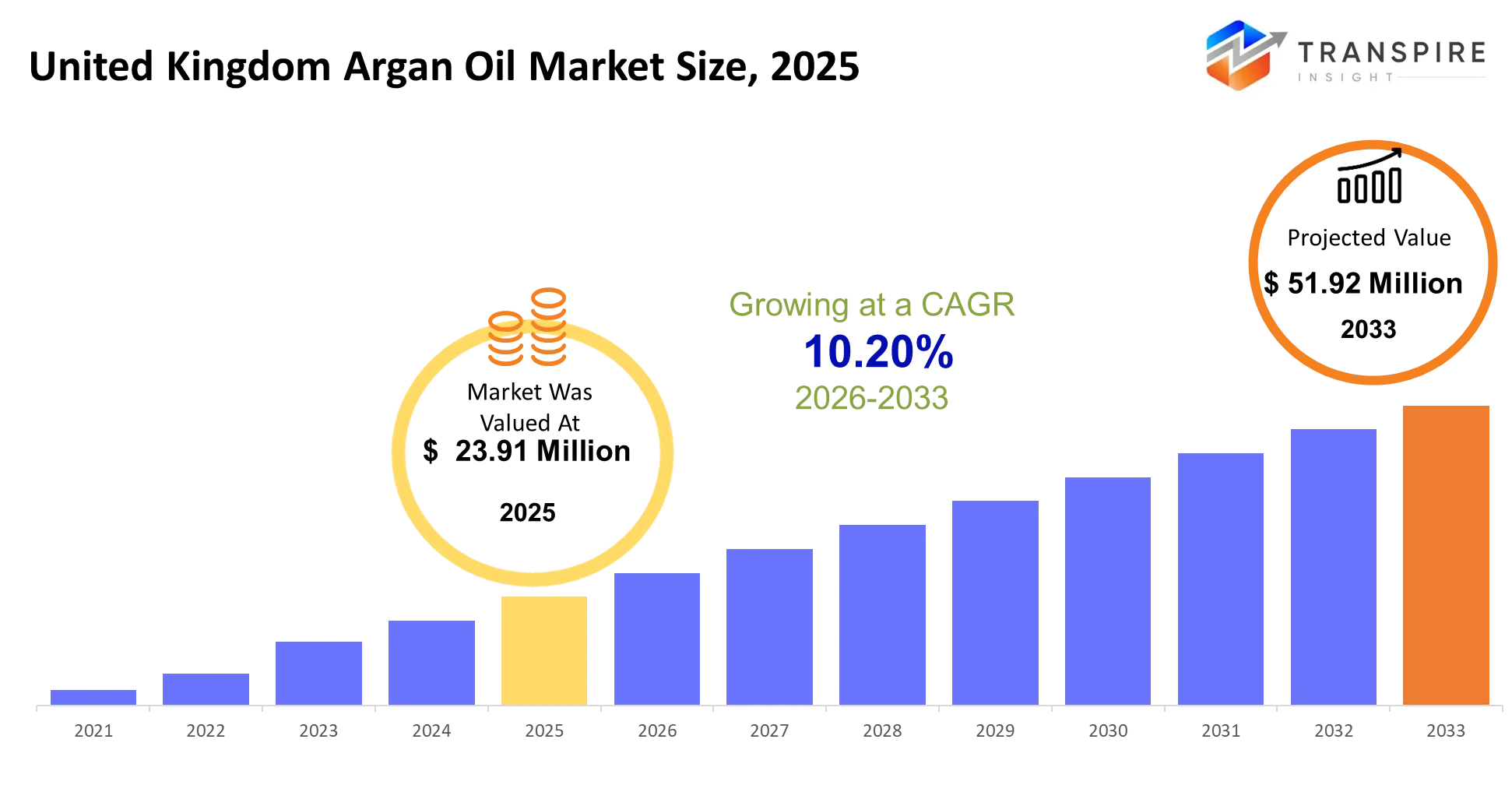
- United Kingdom Argan Oil Market Size 2025: USD 23.91 Million
- United Kingdom Argan Oil Market Size 2033: USD 51.92 Million
- United Kingdom Argan Oil Market CAGR: 10.20%
- United Kingdom Argan Oil Market Segments: By Type (Organic Argan Oil, Conventional Argan Oil), By Application (Cosmetics, Food & Beverages, Pharmaceuticals), By Distribution Channel (Online Retail, Specialty Stores, Supermarkets & Hypermarkets)
To learn more about this report,  Download Free Sample Report
United Kingdom Argan Oil Market Summary
Argan oil is a precious oil extracted from the kernels of argan trees native to Morocco. The oil contains high concentrations of vitamin E, phenolic compounds, and linoleic acid, which give it moisturizing, antioxidant, and anti-inflammatory properties. In the United Kingdom market, argan oil serves primarily as a cosmetic ingredient in skincare and haircare products, with emerging applications in food supplements and pharmaceutical preparations. The UK argan oil market was valued at USD 23.91 Million in 2025 and is projected to reach USD 51.92 Million by 2033, growing at a compound annual growth rate of 10.20 percent.
The United Kingdom has experienced sustained growth in premium natural and organic beauty products over the past five years. Consumer demand for plant-based skincare, clean beauty formulations without synthetic chemicals, and products with transparent sourcing has created a receptive market environment for argan oil brands. Major retailers including Boots, Superdrug, and John Lewis have expanded their natural beauty sections significantly. E-commerce channels including Amazon UK, Cult Beauty, and brand-direct websites have become primary distribution points for specialist argan oil products.
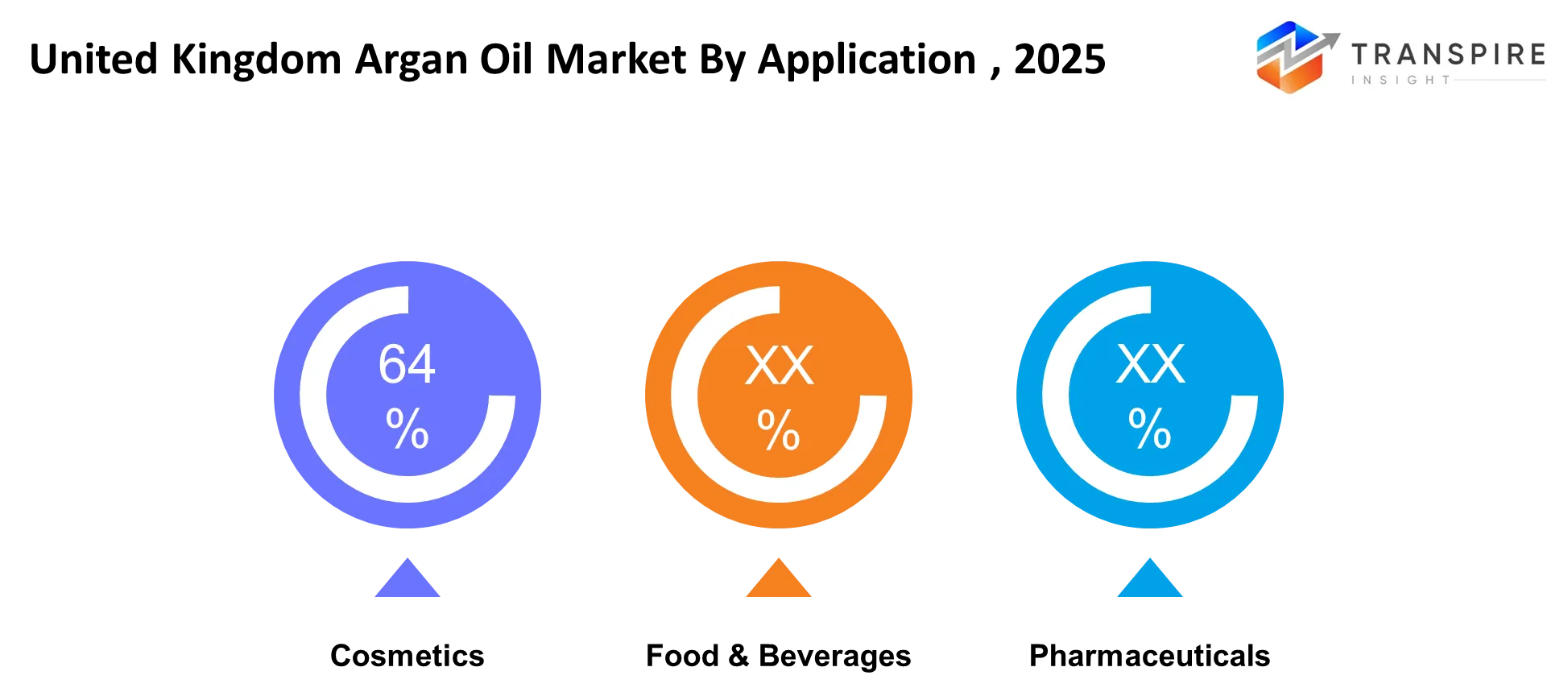
The cosmetics segment dominates UK argan oil consumption at 64 percent of total market volume, driven by the category's maturity and the established presence of argan oil in premium skincare lines from brands including The Body Shop International, Neal's Yard Remedies, and specialized beauty retailers. Food and beverages remain a smaller but fast-growing segment as nutritional supplements containing argan oil target health-conscious consumers. Pharmaceuticals represent the smallest segment by volume but command the highest average selling price per unit.
Key United Kingdom Argan Oil Market Insights
- The cosmetics segment accounts for 64 percent of UK argan oil market revenue in 2025, anchored by mainstream beauty retailers and specialty natural product stores catering to conscious consumers.
- Organic argan oil commands a price premium of 40 to 60 percent over conventional argan oil in the UK market, driven by consumer willingness to pay for certified organic status and traceability.
- Online retail channels account for approximately 45 percent of UK argan oil sales in 2025, with beauty-focused e-commerce platforms like Cult Beauty, Selfridges Beauty, and brand-direct sites generating the highest growth.
- The Body Shop International Ltd. is the single largest argan oil brand by retail presence in the UK, operating over 140 stores and maintaining a significant online presence through its corporate website.
- L'Oréal S.A. and its subsidiary brands including Lancôme and Kérastase have introduced argan oil formulations into premium product lines, driving mainstream adoption and legitimizing argan oil in prestige beauty channels.
- Supermarkets and hypermarkets including Tesco, Sainsbury's, and Waitrose have expanded their natural beauty product ranges to include argan oil-based skincare and haircare items to capture the growing wellness consumer segment.
- Specialty health food retailers including Whole Foods Market and Planet Organic have positioned themselves as trusted sources for premium argan oil brands, leveraging their existing customer loyalty in the organic food category.
- UK consumers purchasing argan oil products demonstrate high engagement with origin storytelling and sustainability narratives, with Moroccan sourcing and fair trade certification serving as key purchase decision drivers.
- Dermatological efficacy claims and clinical trial data supporting argan oil's anti-aging and skin barrier function benefits have become essential marketing tools for premium product lines targeting affluent UK consumers.
- Brexit-related supply chain disruptions between 2020 and 2023 initially increased import costs for argan oil products, but logistics networks have stabilized, allowing retail margins to normalize since late 2023.
What are the Key Drivers, Restraints, and Opportunities in the United Kingdom Argan Oil Market?
Driver: The primary driver is sustained UK consumer demand for premium, natural, and sustainable beauty products. The clean beauty movement has transformed from a niche segment catering to a small number of organic-focused consumers into a mainstream category that major retailers now feature prominently. Younger demographics including Gen Z and millennial consumers demonstrate willingness to pay 30 to 50 percent price premiums for products with transparent sourcing, environmental certifications, and claims substantiated by clinical research. The COVID-19 pandemic accelerated this trend by shifting retail channel mix dramatically toward online commerce, where specialty argan oil brands benefit from lower shelf space constraints and direct access to highly engaged sustainability-conscious consumers through targeted digital marketing.
Restraint: The primary constraint is the UK argan oil market's limited supply elasticity and geographic concentration of production in Morocco. Approximately 99 percent of global argan oil originates from Morocco, creating supply chain vulnerability to climate disruption, crop disease, geopolitical instability, or trade restrictions affecting the region. UK market growth is therefore constrained by the global argan oil crop output rather than by demand dynamics within the United Kingdom itself. Additionally, the high price point of genuine premium argan oil products creates a ceiling on market penetration in price-sensitive consumer segments, limiting the addressable market to affluent and upper-middle-income households who represent approximately 35 to 40 percent of the UK population.
Opportunity: The clearest forward opportunity is the integration of argan oil into the growing functional food and supplement category targeting wellness and preventative health. The UK dietary supplement market is growing at approximately 7 to 8 percent annually, and argan oil's documented cardiovascular health benefits, skin health support, and antioxidant properties create a natural alignment with this trend. Brands that successfully position argan oil supplements within the mainstream nutrition retail channel, including supermarket health sections and online supplement retailers, stand to capture a significant portion of the estimated 18 million UK consumers who regularly consume dietary supplements. The pharmaceutical opportunity is smaller but higher-margin, with potential applications in dermatological preparations and medical-grade skincare products for skin conditions including atopic dermatitis and psoriasis.
What Has the Impact of Artificial Intelligence Been on the United Kingdom Argan Oil Market?
Artificial intelligence enters the UK argan oil market primarily through e-commerce personalization and supply chain optimization rather than through product innovation or manufacturing processes. Major online retailers including Cult Beauty and Sephora UK employ machine learning algorithms to recommend argan oil products based on skin type, purchase history, and browsing behavior, creating a more targeted shopping experience that increases conversion rates and average order value. This algorithmic personalization has become a competitive necessity in the highly fragmented UK online beauty retail space, where brands that fail to integrate AI-powered recommendation engines experience materially lower customer retention compared to competitors who do.
Supply chain optimization represents a secondary AI application gaining traction among larger argan oil distributors and multinational brands with UK operations. Predictive demand forecasting using machine learning models has improved inventory management efficiency by approximately 15 to 25 percent, reducing stockouts and overstock situations that were previously common in the volatile specialty beauty retail environment. Traceability systems that employ blockchain and AI to verify argan oil provenance and organic certification are beginning to emerge, addressing UK consumer concerns about product authenticity and fair trade compliance. The certification verification use case is particularly valuable given the documented instances of argan oil product adulteration in European markets between 2015 and 2020.
Key Market Trends
The United Kingdom argan oil market grows at 10.20 percent CAGR from USD 23.91 Million in 2025 to USD 51.92 Million by 2033, driven by sustained consumer demand for natural beauty products, channel diversification from specialty retail to mainstream supermarkets, and emerging applications in functional foods and supplements. Multi-brand platforms and private label product offerings are fragmenting traditional retail shelf space and increasing price competition among mid-tier product lines.
- Cosmetics account for 64 percent of UK argan oil revenue in 2025, with skincare products representing the largest sub-category within cosmetics at approximately 58 percent of cosmetics volume.
- Organic argan oil commands 55 to 60 percent market share by volume in the UK premium segment, with certified organic products trading at 40 to 60 percent price premiums over conventional equivalents.
- Online retail channels expanded from approximately 38 percent of total UK argan oil sales in 2021 to 45 percent in 2025, reflecting the structural shift toward e-commerce acceleration that persisted beyond the pandemic period.
- Beauty-focused e-commerce platforms including Cult Beauty, Space NK, and Selfridges Beauty now account for approximately 22 percent of total UK online argan oil sales, competing directly with pure-play marketplaces including Amazon.
- Supermarket and hypermarket channel penetration has accelerated from 2023 onward, with Tesco, Sainsbury's, and Waitrose expanding natural beauty sections and now collectively accounting for 18 to 20 percent of UK argan oil retail volume.
- Brand consolidation in the argan oil space is creating larger, vertically integrated operators, with L'Oréal S.A. and Unilever (through The Body Shop) now controlling approximately 30 to 35 percent of UK market share.
- Food and beverage applications are growing faster than cosmetics overall, projected to expand at 12 to 13 percent CAGR through 2033 as nutritional supplement consumption patterns normalize in post-pandemic wellness trends.
- Sustainability and fair trade certification claims are now baseline expectations among UK consumers purchasing premium argan oil products, with brands unable to articulate transparent sourcing facing measurable sales headwinds.
- Pharmacy channel penetration is increasing as dermatologists and GPs recommend argan oil-based products for skin conditions, with pharmacy brands including Eucerin and CeraVe beginning to stock argan oil formulations in UK pharmacies.
- Gen Z consumers demonstrate higher argan oil product adoption rates than older demographics, with TikTok and Instagram-driven awareness campaigns creating disproportionate demand among 18 to 25 year-old UK consumers.
United Kingdom Argan Oil Market Segmentation
By Type
Organic argan oil commands 55 to 60 percent market share by volume in the UK premium segment. UK consumers purchasing cosmetic and food products explicitly seek organic certification as a marker of product purity, environmental sustainability, and fair trade sourcing. Organic products trade at 40 to 60 percent price premiums, which UK affluent consumers accept based on perceived health and environmental benefits. Growth in the organic segment runs 12 to 14 percent annually, outpacing conventional argan oil growth of approximately 8 to 9 percent, reflecting the migration of mainstream consumers toward organic consumption patterns.
Conventional argan oil serves the mass-market and value-conscious segments, where price sensitivity overrides organic certification preference. This segment includes private-label argan oil products from major retailers including Tesco, Boots, and Superdrug, which compete aggressively on price and capture budget-focused consumers. Conventional argan oil typically costs 40 to 50 percent less per unit than organic equivalents. Although this segment is growing in absolute terms, its market share is declining as organic products gain penetration across income segments.
By Application
Cosmetics dominate UK argan oil consumption at 64 percent of market revenue. Within cosmetics, skincare products account for approximately 58 percent, haircare for 35 percent, and color cosmetics and fragrance for the remaining 7 percent. Skincare remains the anchor application because argan oil's documented benefits for skin hydration, anti-aging, and barrier function align with the largest consumer spending category in UK beauty. The haircare application is growing faster than skincare, driven by consumer awareness of argan oil's benefits for damaged and color-treated hair.
Food and beverages represent 22 percent of UK argan oil market volume, driven by nutritional supplement consumption and the emerging trend of culinary argan oil for high-end cooking and salad applications. This segment grows faster than cosmetics overall at 12 to 13 percent CAGR, reflecting the mainstream adoption of functional foods and wellness supplements by health-conscious UK consumers. Supplement formulations combining argan oil with vitamin E, antioxidants, and skin-health ingredients are gaining shelf space in supermarkets and online supplement retailers.
Pharmaceuticals account for the smallest segment by volume at approximately 14 percent of UK market revenue but command the highest average selling price and gross margin. Dermatological applications targeting skin conditions including atopic dermatitis, psoriasis, and eczema-prone skin create a specialized niche where clinical efficacy data and medical professional recommendations drive purchasing decisions. This segment is expected to grow 11 to 12 percent CAGR through 2033 as dermatologists increasingly recommend argan oil formulations as adjunctive treatments.
To learn more about this report, Download Free Sample Report
By Distribution Channel
Online retail accounts for 45 percent of UK argan oil sales in 2025, including both marketplace platforms like Amazon UK and specialty e-commerce sites like Cult Beauty, Space NK, and brand-direct websites. This channel offers consumers product variety, price transparency, and access to niche brands unavailable in physical retail. Beauty-focused platforms particularly cater to consumers seeking premium and specialty argan oil brands with strong educational content and customer reviews.
Specialty stores including Neal's Yard Remedies, Whole Foods Market UK, and Planet Organic account for approximately 25 percent of retail volume. These retailers position themselves as trusted sources for authentic, sustainably sourced argan oil products. Consumers visit these channels specifically for organic certification, fair trade verification, and expert sales guidance. Channel growth is steady at approximately 8 to 9 percent annually.
Supermarkets and hypermarkets including Tesco, Sainsbury's, Waitrose, and Asda account for 20 percent of UK argan oil sales. This channel expanded significantly from 2022 onward as mainstream retailers added natural beauty sections. Growth in this channel accelerates rapidly at 14 to 16 percent annually as consumers increasingly expect argan oil availability in their regular grocery shopping environment.
What are the Key Use Cases Driving the United Kingdom Argan Oil Market?
The dominant use case is anti-aging and moisturizing skincare for affluent female consumers aged 25 to 55. The UK premium skincare market explicitly targets consumers seeking non-invasive alternatives to cosmetic procedures, and argan oil's documented efficacy for skin elasticity, wrinkle reduction, and skin hydration aligns perfectly with this need. Brands including Neal's Yard Remedies, REN Clean Skincare, and specialist argan oil suppliers like Kahina Giving Beauty have built entire product lines around argan oil as the primary active ingredient. This use case generates the largest revenue volume and demonstrates the lowest price sensitivity, as consumers purchasing premium skincare accept price points that would be unacceptable in mass-market channels.
Damaged and color-treated hair restoration is the second-largest use case, particularly relevant in the UK where blonde highlights and color treatments are mainstream beauty practices. Consumers use argan oil-based haircare products to restore moisture, reduce frizz, and repair chemical-damage from coloring and heat styling. Mainstream haircare brands including Schwarzkopf, Wella, and Redken have integrated argan oil into their damage-repair product lines, making this use case accessible across income segments. This use case grows faster than skincare overall, expanding at 11 to 12 percent annually.
Functional and nutritional supplementation represents an emerging use case targeting health-conscious consumers seeking preventative health benefits rather than therapeutic claims. Consumers take argan oil supplements with claimed benefits for cardiovascular health, skin health from within, and general antioxidant support. This use case remains smaller than cosmetic applications but is growing faster at 12 to 14 percent annually as the UK dietary supplement market expands and wellness trends reach mainstream consumer consciousness.
Report Overview Table
|
Report Metrics |
Details |
|
Market size value in 2025 |
USD 23.91 Million |
|
Market size value in 2026 |
USD 26.3 Million |
|
Revenue forecast in 2033 |
USD 51.92 Million |
|
Growth rate |
CAGR of 10.20% from 2026 to 2033 |
|
Base year |
2025 |
|
Historical data |
2021 - 2024 |
|
Forecast period |
2026 - 2033 |
|
Report coverage |
Revenue forecast, competitive landscape, growth factors, and trends |
|
Regional scope |
United Kingdom (England, Scotland, Wales, Northern Ireland) |
|
Key companies profiled |
OLVEA Group, Arganfarm Sarl, ZineGlob Ltd., Malak Bio, Argan Oil Company, The Body Shop International Ltd., L'Oréal S.A., Josie Maran Cosmetics LLC, Kahina Giving Beauty, Neal's Yard Remedies, Pura D'Or, Aura Cacia, Now Foods, Cliganic LLC, Acure Organics |
|
Customization scope |
Free report customization (channel, application & type scope). Avail customized purchase options to meet your exact research needs. |
|
Report Segmentation |
By Type (Organic Argan Oil, Conventional Argan Oil), By Application (Cosmetics, Food & Beverages, Pharmaceuticals), By Distribution Channel (Online Retail, Specialty Stores, Supermarkets & Hypermarkets) |
What Market Dynamics are Shaping the United Kingdom Argan Oil Market?
The United Kingdom argan oil market operates within a demand environment shaped primarily by consumer values and channel evolution rather than by supply-side constraints. Unlike commodity markets subject to production variability, the UK argan oil market is demand-constrained by a consumer base with limited price elasticity at premium price points and strong brand loyalty to established natural beauty retailers. Channel fragmentation has intensified competition and driven consolidation among mid-tier brands, with private-label offerings from major retailers now capturing market share that previously went to specialized brands. The structural shift toward online retail has also enabled new-entrant argan oil brands to access UK consumers without physical store infrastructure, lowering barriers to market entry but increasing competitive intensity across price segments.
Brexit-related supply chain disruptions between 2020 and 2023 raised import duties and logistics costs, creating temporary margin compression for UK distributors. However, logistics networks have stabilized since late 2023, and competitive pricing has normalized. The key ongoing dynamic is the regulatory environment surrounding organic certification, cosmetic ingredient claims, and food supplement regulations. The UK diverged from EU cosmetic regulations post-Brexit, creating both opportunities and challenges for brands marketing argan oil products.
Consumer awareness of argan oil's benefits has reached a saturation point among affluent UK consumers, meaning future growth depends increasingly on price-point expansion to reach middle-income segments and on application expansion beyond cosmetics into functional foods and pharmaceuticals. TikTok and Instagram-driven awareness campaigns have created disproportionate interest among younger demographics, opening a growth opportunity in Gen Z beauty consumers who represent a largely untapped segment relative to millennial and older demographic adoption rates.
Who are the Key Players in the United Kingdom Argan Oil Market and How Do They Compete?
The United Kingdom argan oil market is moderately fragmented, with approximately 40 to 45 distinct brands competing across different channels and price segments. No single brand holds dominant market share, but major international companies including L'Oréal S.A., Unilever (through The Body Shop), and specialty brands including Neal's Yard Remedies collectively account for 35 to 40 percent of market revenue. Small and mid-sized argan oil brands including Kahina Giving Beauty, Josie Maran Cosmetics, and Pura D'Or compete on brand story, product formulation expertise, and direct-to-consumer digital marketing rather than on retail shelf presence.
The Body Shop International Ltd. competes through ubiquitous retail presence with over 140 UK stores and a strong online channel, leveraging brand heritage and corporate sustainability positioning. L'Oréal competes through prestige brand portfolios including Lancôme and Kérastase, gaining consumer legitimacy through professional aesthetician and dermatologist endorsements. Specialty retailers including Neal's Yard Remedies and Whole Foods Market compete through curated brand selection and expert in-store guidance. Online-native brands including Cult Beauty compete by aggregating multiple argan oil product options and providing educational content that helps consumers navigate an increasingly fragmented product landscape.
Private-label argan oil products from major retailers including Tesco, Sainsbury's, and Boots compete aggressively on price, capturing budget-conscious consumers who accept generic branding in exchange for 30 to 40 percent lower prices. This channel is creating material margin pressure on independent mid-tier brands without significant retail infrastructure.
United Kingdom Argan Oil Market Companies
- OLVEA Group
- Arganfarm Sarl
- ZineGlob Ltd.
- Malak Bio
- Argan Oil Company
- The Body Shop International Ltd.
- L'Oréal S.A.
- Josie Maran Cosmetics LLC
- Kahina Giving Beauty
- Neal's Yard Remedies
- Pura D'Or
- Aura Cacia
- Now Foods
- Cliganic LLC
- Acure Organics
Recent Developments
In March 2026, The Body Shop International Ltd. announced the launch of a new Argan Oil body care line featuring sustainably sourced Moroccan argan oil with explicit fair trade certification and supply chain transparency claims. The product range includes body lotion, body oil, and exfoliating scrub formulations targeting the growing wellness-conscious consumer segment in the UK. https://www.thebodyshop.com (The Body Shop Official Website).
In January 2026, Neal's Yard Remedies expanded its argan oil product range with the introduction of an organic argan oil serum formulation positioned for the anti-aging skincare segment. The product features botanical actives including rosehip and carrot seed oil in combination with cold-pressed Moroccan argan oil. https://www.nealsyardremedies.com (Neal's Yard Remedies Official Website).
In February 2026, Sainsbury's launched a private-label organic argan oil moisturizer and hair serum product line at a retail price point 35 to 40 percent below premium branded equivalents, capturing growing demand from price-sensitive organic beauty consumers. The launch reflects supermarket channel expansion into natural beauty as a core category. https://www.sainsburys.co.uk (Sainsbury's Official Website).
What Strategic Insights Define the Future of the United Kingdom Argan Oil Market?
Over the next five to seven years, the United Kingdom argan oil market will undergo three simultaneous transitions: channel consolidation reducing the number of viable retailers, application expansion into food and pharmaceutical segments capturing price-insensitive consumers outside cosmetics, and demographic expansion as younger consumers discover argan oil through social media and mainstream retail distribution. Premium skincare will remain the revenue anchor, but functional food and pharmaceutical applications are expected to grow 12 to 14 percent annually, faster than cosmetics at 9 to 10 percent. Brands that successfully build supply chain transparency narratives and secure fair trade certification will command sustained price premiums, while brands competing primarily on price will experience margin compression.
The hidden risk in the market is the potential for synthetic or bio-engineered argan oil substitutes to disrupt the market if research delivers products with equivalent efficacy at substantially lower cost. Several laboratory and biotechnology companies are investing in fermentation-based argan oil synthesis, though commercial viability remains uncertain as of 2026. If these products reach market and gain consumer acceptance, the UK argan oil market could face a structural shift toward lower-cost alternatives that compress pricing across all product categories.
The opportunity not yet reflected in most market analyses is the emerging pharmaceutical and dermatological application space. As UK dermatologists increasingly recommend argan oil formulations for atopic dermatitis, psoriasis, and general skin health, regulated dermatological product channels represent a high-margin growth opportunity that brands entering early can capture through clinical trial sponsorship and professional medical relationships.
United Kingdom Argan Oil Market Report Segmentation
By Type
- Organic Argan Oil
- Conventional Argan Oil
By Application
- Cosmetics
- Food & Beverages
- Pharmaceuticals
By Distribution Channel
- Online Retail
- Specialty Stores
- Supermarkets & Hypermarkets
Frequently Asked Questions
Find quick answers to common questions.
The United Kingdom Argan Oil Market size is expected to reach USD 51.92 Million by 2033.
The key segments are By Type (Organic Argan Oil, Conventional Argan Oil), By Application (Cosmetics, Food & Beverages, Pharmaceuticals), and By Distribution Channel (Online Retail, Specialty Stores, Supermarkets & Hypermarkets).
Major players include OLVEA Group, Arganfarm Sarl, ZineGlob Ltd., Malak Bio, Argan Oil Company, The Body Shop International Ltd., L'Oréal S.A., Josie Maran Cosmetics LLC, Kahina Giving Beauty, Neal's Yard Remedies, Pura D'Or, Aura Cacia, Now Foods, Cliganic LLC, and Acure Organics.
The United Kingdom Argan Oil Market size is USD 23.91 Million in 2025.
The United Kingdom Argan Oil Market CAGR is 10.20% from 2026 to 2033.
- OLVEA Group
- Arganfarm Sarl
- ZineGlob Ltd.
- Malak Bio
- Argan Oil Company
- The Body Shop International Ltd.
- L'Oréal S.A.
- Josie Maran Cosmetics LLC
- Kahina Giving Beauty
- Neal's Yard Remedies
- Pura D'Or
- Aura Cacia
- Now Foods
- Cliganic LLC
- Acure Organics
Recently Published Reports
-
Apr 2026
Baby Infant Formula Market
Baby Infant Formula Market Size, Share & Analysis Report By ype (Infant Milk, Follow On Milk, Specialty Baby Milk, Growing-Up Milk), By Ingredient (Carbohydrate, Fat, Protein, Minerals, Vitamins, and Others), By Product Form (Powder, Liquid, and Ready-to-feed), By Distribution Channels (Supermarket/Hypermarket, Specialty Store, Pharmacies, Online Retail, and Others), and Geography (North America, Europe, Asia-Pacific, Middle East and Africa, South and Central America), 2021 - 2031
-
Apr 2026
Edible Insects for Animal Feed Market
Edible Insects for Animal Feed Market Size, Share & Analysis Report By Type (Insect Powder, Insect Meal, Insect Bar, Insect Paste, Insect Oil, and Others), By Insect Type (Beetles, Cricket, Caterpillar, Hymenoptera, Orthoptera, Tree Bugs, and Others), By Application (Livestock, Pet Food, and Aquaculture), By Livestock Type (Poultry, Swine, and Others), and Geography (North America, Europe, Asia-Pacific, Middle East and Africa, South and Central America), 2021 - 2031
-
Apr 2026
Food Industry Disinfection and Bacterial Control Market
Food Industry Disinfection and Bacterial Control Market Size, Share & Analysis Report By Type (Chemical Disinfectants, Physical Disinfectants, and Biocides and Antimicrobials), By Application (Food Processing Equipment Surface Disinfection, Food Preparation Areas Surface Disinfection, Storage Areas Surface Disinfection, Anti-microbial Coatings Food Preservation, and Preservative Solutions Food Preservation), By End User (Meat and Poultry Processing, Dairy Processing, Seafood Processing, Bakery and Confectionery, Restaurants and Commercial Kitchens, and Food Service Providers), By Sales Channel (Online, Offline), and Geography (North America, Europe, Asia-Pacific, Middle East and Africa, South and Central America), 2021 - 2031
-
Apr 2026
Freeze Dried Food Market
Freeze Dried Food Market Size, Share & Analysis Report By Product Type (Fruits, Vegetables, Freeze-Dried Dairy Products, Freeze-Dried Meat and Seafood, Freeze-Dried Pet Food, and Prepared Meal), By Nature (Organic, and Conventional), By Form (Powdered, Granules, and Diced), By End Use (Breakfast Cereals, Dairy Products, Bakery & Confectionery, Nutritional Bars & Supplements, Powdered Beverages, Snacks, and Retail (Household)), and Geography (North America, Europe, Asia-Pacific, Middle East and Africa, South and Central America), 2021 - 2031