Asia Pacific Liquefied Petroleum Gas (LPG) Tanker Market Size & Forecast:
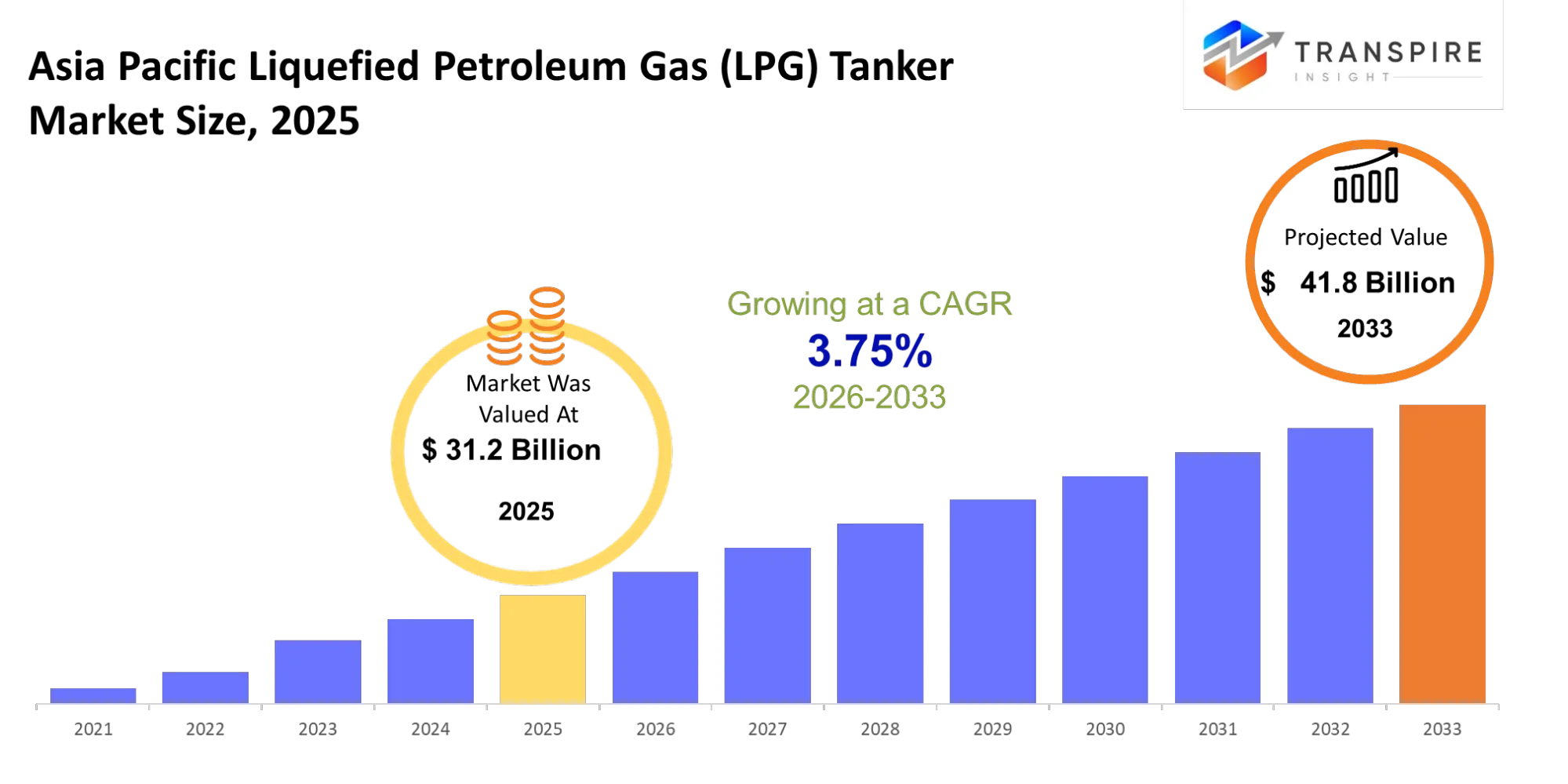
- Asia Pacific Liquefied Petroleum Gas (LPG) Tanker Market Size 2025: USD 31.2 Billion
- Asia Pacific Liquefied Petroleum Gas (LPG) Tanker Market Size 2033: USD 41.8 Billion
- Asia Pacific Liquefied Petroleum Gas (LPG) Tanker Market CAGR: 3.75%
- Asia Pacific Liquefied Petroleum Gas (LPG) Tanker Market Segments: By Type (Fully Pressurized, Semi-refrigerated, Fully Refrigerated, Others); By Application (Transportation, Storage, Distribution, Others); By End-User (Oil & Gas Companies, Logistics Providers, Energy Companies, Government, Industrial Users, Others); By Capacity (Small, Medium, Large, Others)
To learn more about this report,  Download Free Sample Report
Asia Pacific Liquefied Petroleum Gas (LPG) Tanker Market Summary
The Asia Pacific Liquefied Petroleum Gas (LPG) Tanker Market was valued at USD 31.2 Billion in 2025. It is forecast to reach USD 41.8 Billion by 2033. That is a CAGR of 3.75% over the period.
Asian Pacific countries use LPG tankers to transport pressurized energy cargo from export terminals to refineries and import hubs which helps these growing coastal economies maintain their cooking fuel supplies and petrochemical production needs. The market has shifted in the last few years as operators replace older vessels with larger, more fuel-efficient very large gas carriers and adopt dual-fuel propulsion systems that reduce emissions and improve voyage economics.
The international shipping emission regulations which require cleaner ship designs and retrofits have created a structural change that affects the industry. Geopolitical tensions in major shipping routes have resulted in extended detours which create additional ton-mile requirements and decrease the number of available ships. The shipping operators and traders have increased their contract activities because of higher utilization rates which also enable fleet expansion and generate ongoing revenue growth throughout the regional LPG logistics network.
Key Market Insights
- China controls almost 32-35 percent of the Asia Pacific Liquefied Petroleum Gas (LPG) Tanker Market because the country relies heavily on LPG imports.
- The Indian market from 2025 to 2032 will experience its fastest growth because urban areas switch to different fuels and refineries expand their production capabilities.
- Japan and South Korea maintain their position as stable centers for LPG shipping demand while using advanced tanker technology.
- The Asia Pacific Liquefied Petroleum Gas (LPG) Tanker Market operates through Very Large Gas Carriers (VLGC) which achieve maximum cargo efficiency and extended distance transportation capabilities.
- The second-largest market share in Gas Carriers (MGC) enables them to develop intra-Asia LPG distribution systems.
- The dual-fuel LPG carriers will become the most rapidly expanding sector until 2030 because of their new emissions control technologies.
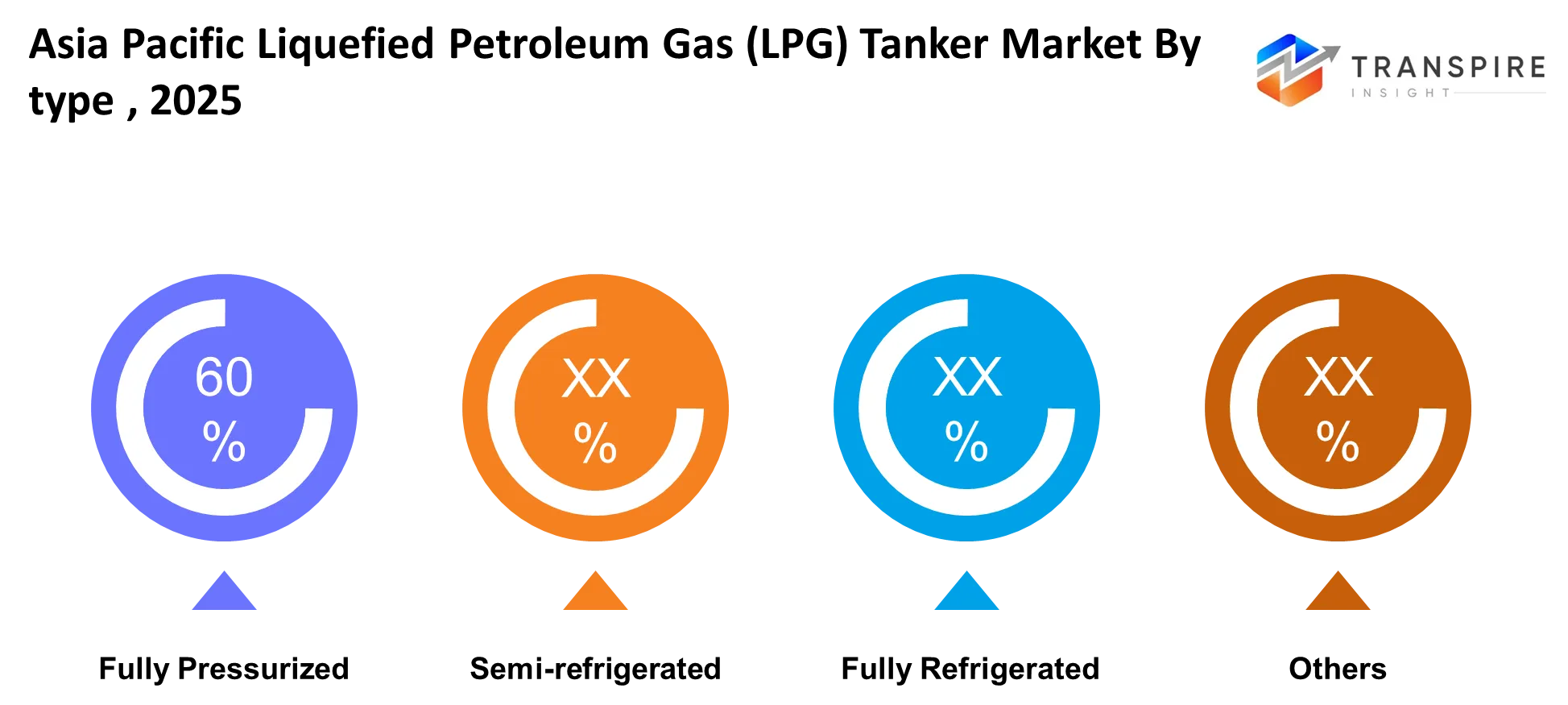
- The International LPG transportation system holds a market share of almost 60 percent within the Asia Pacific Liquefied Petroleum Gas (LPG) Tanker Market.
- The shipping of petrochemical feedstock is developing into a major industry because of the increasing production capacity of chemical plants in Southeast Asia.
- The oil and gas trading companies control more than 40 percent of the LPG tanker chartering market, which makes them the primary drivers of demand.
- The industrial chemical manufacturing industry will become the most rapidly expanding end-user market because of rising demand for propane and butane products.
What are the Key Drivers, Restraints, and Opportunities in the Asia Pacific Liquefied Petroleum Gas (LPG) Tanker Market?
The LPG Tanker Market in Asia Pacific region will experience growth because international LPG trade expands and developing nations adopt cleaner energy sources. The countries of China, India and Indonesia have increased their LPG imports because their refineries cannot meet rising household and industrial demands. The result has created greater demand for long-haul shipping because shipping needs have increased while shipping capacity which enables companies to move goods has improved through better utilization of their vessels and higher charter rates which especially benefit large gas carriers that operate between continents.
The tanker fleets face a significant limitation because they require substantial financial resources and their vessels need long periods before they can be replaced. The process of creating new LPG carriers or upgrading existing ones demands huge financial resources which typically exceed the expected commercial returns for smaller business operators. The process of renewing fleets operates at a slow pace because companies need to hold onto outdated ships which have lower performance standards than newer models. The fleet base operates with varying efficiency levels which creates a negative impact on total company earnings while it creates delays in technology implementation throughout the Asia Pacific region LPG Tanker Market.
The shipyards of South Korea and Japan now present a developing chance to adopt dual-fuel propulsion systems for newly built LNG-ready LPG carriers. The shipbuilding company Mitsubishi Shipbuilding has started to receive more contracts for environmentally friendly gas carriers which meet the new International Maritime Organization environmental rules. The transition will create a new investment cycle because fleet owners need to update their ships for compliance with regulations which especially occurs on high-traffic Asia to Middle East trade routes where long-distance operations provide the most significant operational efficiency improvements.
What Has the Impact of Artificial Intelligence Been on the Asia Pacific Liquefied Petroleum Gas (LPG) Tanker Market?
The Asia Pacific Liquefied Petroleum Gas (LPG) Tanker Market now employs artificial intelligence together with advanced digital systems which change all aspects of maritime operations including vessel management and maintenance work and regulatory compliance throughout international shipping routes. Shipping companies now use AI-enabled fleet management platforms to automate scrubber performance tracking and continuously monitor exhaust gas cleaning systems which maintain compliance with IMO emission standards through automatic system checks that eliminate manual inspection requirements. The systems use actual voyage information to determine optimal speed and routing and fuel consumption.
Machine learning models are also used for predictive maintenance which uses sensor information from compressors and pumps and propulsion systems to create equipment failure forecasts. The system prevents unscheduled downtime while it increases operational time for vessels which particularly benefits very large gas carriers that operate between Asia and the Middle East on high-demand routes. The emissions forecasting tools enable operators to calculate their carbon emissions for each voyage which enhances their compliance reporting and helps with charter negotiations.
The technologies provide operational benefits which include better fuel efficiency through optimized routing and decreased maintenance expenses because they enable organizations to use proactive equipment monitoring instead of traditional maintenance methods. Operators experience better fleet availability because their systems identify faults at an earlier stage while their advanced scheduling methods improve efficiency.
The existing adoption process faces obstacles because mid-ocean analytics requires real-time data which the current maritime connectivity systems do not support. The Asia Pacific Liquefied Petroleum Gas Tanker Market experiences deployment delays because high integration costs and inconsistent sensor calibration problems affect small fleet operators who operate older vessels.
Key Market Trends
- Shipowners started replacing their old ships with dual-fuel VLGCs after 2022 because they needed to comply with new IMO emission standards.
- China's increasing need for LPG imports has forced ships to operate more than 20 percent since 2021 which has reduced available tankers in the region.
- The shipping routes which use the Red Sea and Strait experienced disruptions that increased ton-mile requirements while shifting the way Asia Pacific LPG tankers used their routes.
- South Korean shipbuilders started building more LNG-ready LPG carriers during 2024 which helps shipping companies to switch to cleaner propulsion systems.
- The implementation of digital fleet optimization systems brought automatic monitoring capabilities which enhanced voyage efficiency and decreased fuel usage through AI-based routing changes that began in 2023.
- The unplanned tanker downtime decreased because predictive maintenance tools enabled early detection of faults in compressors and cargo handling systems.
- Trading companies established permanent charter agreements with BW LPG and other operators to obtain shipping capacity during times of market instability.
- The demand for emissions control solutions led to an increase in scrubber installation projects among shipping companies that operate their vessels for more than five years in Japan and Southeast Asia.
- Southeast Asia became a distribution center that changed regional LPG transportation routes while the number of tanker trips within Asia increased.
Asia Pacific Liquefied Petroleum Gas (LPG) Tanker Market Segmentation
By Type :
LPG tankers which operate at full pressure transport gas under high pressure while maintaining ambient temperature for their short-distance operations. Semi-refrigerated tankers use moderate cooling and pressure balance for flexible operations. The fully refrigerated tankers maintain LPG at extremely low temperatures to facilitate their long-distance shipping operations. The hybrid designs function as another type because they serve specific route and cargo requirements.
The different tanker types operate to meet specific transport needs which depend on the distance required to travel and the safety needed and the cost efficiency of the operation. The pressurized systems operate effectively for tiny shipments, but the refrigerated systems work better for international trade which involves large volumes. The semi-refrigerated units provide a suitable operational solution for facilities that need to run two different types of work. The various types of equipment enable continuous LPG transportation which serves both industrial and commercial supply systems.
To learn more about this report, Download Free Sample Report
By Application :
The Transportation application handles the transportation of LPG between production facilities and terminals or ports through the use of marine tankers. The Storage application enables controlled storage of LPG for temporary periods until subsequent transportation occurs. The Distribution application handles the process of delivering goods to customers in various regional markets. The system provides two functions which include handling emergency supply situations and delivering specialized support for industrial logistical operations.
The applications establish a connected supply chain system which enables LPG transportation throughout the Asia Pacific region. The transportation system provides connections for long-distance travel between locations while storage facilities guarantee uninterrupted delivery of products. The distribution system enables customers to access products in their respective local markets. The system provides multiple applications which enhance operational flexibility by enabling continuous distribution of LPG to various consumption locations.
By End-User :
Oil and gas companies use LPG tankers for large-scale export and domestic movement. The logistics providers handle all aspects of shipping and transport coordination. The energy companies need continuous LPG deliveries to supply their power generation and fuel requirements. Government entities support strategic reserves, while industrial users depend on LPG for heating, processing, and production activities.
LPG demand across the region receives continuous support from all end-user categories. Oil and gas companies drive bulk trade flows, while logistics providers ensure smooth distribution. Energy companies support infrastructure stability. Government participation strengthens supply security, and industrial users maintain steady consumption across manufacturing and processing sectors.
By Capacity :
Small capacity LPG tankers support short-distance routes and limited cargo movement between nearby ports. Medium capacity tankers handle regional trade with balanced efficiency and operational flexibility. Large capacity tankers operate international shipping routes by transporting high volumes of LPG through major maritime corridors at lower costs per unit shipped.
Trade volume changes and route distance variations receive support through capacity segmentation. Small tankers suit local demand and frequent trips, while medium vessels balance cost and coverage. Large tankers dominate global shipping lanes with economies of scale. The existing capacities enable orderly LPG supply distribution to meet various market demands throughout the Asia Pacific region.
What are the Key Use Cases Driving the Asia Pacific Liquefied Petroleum Gas (LPG) Tanker Market?
The primary purpose of the Asia Pacific Liquefied Petroleum Gas (LPG) Tanker Market operates through its continuous transportation of LPG between Middle Eastern export terminals and Asian import hubs which experience high demand. The shipping industry uses Very Large Gas Carriers to handle this shipping operation because these carriers enable lower shipping costs and provide a constant delivery service for residential fuel and refinery operations.
The industry now needs to develop new applications which include both petrochemical feedstock logistics and the transportation of LPG cargoes between different locations in Asia. Medium gas carriers serve as the primary transportation method for industrial gas suppliers and trading firms to deliver propane and butane to manufacturing centers in China India and Southeast Asia which experience increasing demand from the chemicals and plastics industries.
The industry now develops new applications which include offshore LPG bunkering to support dual-fuel vessels and floating storage operations for use in congested ports. Shipping operators are currently evaluating adaptable LPG-to-power systems which they use in remote industrial areas and which operate on advancements in cryogenic technologies and current maritime fuel switch regulations in the Asia Pacific region.
|
Report Metrics |
Details |
|
Market size value in 2025 |
USD 31.2 Billion |
|
Market size value in 2026 |
USD 32.3 Billion |
|
Revenue forecast in 2033 |
USD 41.8 Billion |
|
Growth rate |
CAGR of 3.75% from 2026 to 2033 |
|
Base year |
2025 |
|
Historical data |
2021 - 2024 |
|
Forecast period |
2026 - 2033 |
|
Report coverage |
Revenue forecast, competitive landscape, growth factors, and trends |
|
Regional scope |
Asia Pacific ( China, India, Japan, South Korea, Australia, Rest of Asia Pacific) |
|
Key company profiled |
Hyundai Heavy Industries, Samsung Heavy Industries, Mitsubishi Heavy Industries, Daewoo Shipbuilding, Kawasaki Heavy Industries, CSSC, Wärtsilä, MAN Energy Solutions, MOL, NYK Line, Teekay, BW LPG, Exmar, Navigator Holdings, DSME |
|
Customization scope |
Free report customization (country, regional & segment scope). Avail customized purchase options to meet your exact research needs. |
|
Report Segmentation |
By Type (Fully Pressurized, Semi-refrigerated, Fully Refrigerated, Others); By Application (Transportation, Storage, Distribution, Others); By End-User (Oil & Gas Companies, Logistics Providers, Energy Companies, Government, Industrial Users, Others); By Capacity (Small, Medium, Large, Others) |
Which Regions are Driving the Asia Pacific Liquefied Petroleum Gas (LPG) Tanker Market Growth?
The main application of the Asia Pacific Liquefied Petroleum Gas (LPG) Tanker Market operates through international LPG transportation which connects Middle Eastern export terminals with major Asian import centers. Very Large Gas Carriers dominate this flow because they reduce per-ton shipping costs and support steady supply for residential fuel distribution and refinery balancing.
The development of applications now includes petrochemical feedstock logistics and intra-Asia redistribution of LPG cargoes. Industrial gas suppliers and trading firms rely on medium gas carriers to move propane and butane into manufacturing clusters in China, India, and Southeast Asia, where demand from chemicals and plastics production continues to rise.
The new use cases include offshore LPG bunkering for dual-fuel vessels and floating storage integration in congested ports. Shipping operators are now testing flexible LPG-to-power solutions which operate in remote industrial areas while new cryogenic handling systems and maritime fuel transition policies evolve throughout the Asia Pacific region.
Who are the Key Players in the Asia Pacific Liquefied Petroleum Gas (LPG) Tanker Market and How Do They Compete?
The Asia Pacific LPG tanker market shows moderate consolidation at the vessel ownership level because its chartering and spot freight operations remain divided into multiple segments. The deep-sea capacity of the market sector gets controlled by a few major VLGC operators while regional shipowners and trading companies vie for brief contract opportunities. The industry now evaluates competition through three factors which include fuel efficiency and dual-fuel capabilities and companies' success in obtaining extended charter contracts for their operations between Asia and the Middle East. Companies achieve profitability through two factors which include their geographic location near export routes and their ability to meet emission reduction requirements.
BW LPG achieves cost leadership through its operation of one of the largest VLGC fleets in the world while using LPG trading operations to enhance its voyage efficiency. Dorian LPG uses energy-efficient eco-design carriers to create a competitive advantage because its vessels reduce fuel consumption on Asia US shipping routes. The diversified gas carrier investments of Mitsui O.S.K. Lines together with its long-term contracts with Japanese utilities help the company build its market position. The decarbonization targets of Kawasaki Kisen Kaisha drive the company to invest in new LPG vessels which match its sustainability objectives. NYK Line uses strategic partnerships and clean fuel transition initiatives to create stable charter revenue streams for its operations on Asia-Pacific routes.
Company List
- Hyundai Heavy Industries
- Samsung Heavy Industries
- Mitsubishi Heavy Industries
- Daewoo Shipbuilding
- Kawasaki Heavy Industries
- CSSC
- Wärtsilä
- MAN Energy Solutions
- MOL
- NYK Line
- Teekay
- BW LPG
- Exmar
- Navigator Holdings
- DSME
Recent Development News
In April 2026, Carib LPG Trading Ltd. acquired the LPG/chemical tanker Intrepid (IMO 9798167) to expand its owned fleet into the semi-refrigerated handy gas carrier segment. The acquisition strengthens the company’s operational flexibility in LPG and ammonia transport across global routes serving Asia-linked trading flows. Source https://shippingtelegraph.com/
In April 2026, Navigator Gas entered into a non-binding agreement with Bernhard Schulte (Singapore) Holdings Pte. Ltd. and Sloman Neptun Schiffahrts AG to sell eight gas carriers along with its Unigas International B.V. stake. The transaction, valued at approximately USD 183 million, is expected to reshape LPG carrier fleet allocation and charter operations impacting Asia-linked LPG shipping capacity.Source https://www.globenewswire.com/
What Strategic Insights Define the Future of the Asia Pacific Liquefied Petroleum Gas (LPG) Tanker Market?
The Asia Pacific Liquefied Petroleum Gas (LPG) Tanker Market will develop into a shipping system which operates at high efficiency while producing minimal emissions through its use of large dual-fuel ships and advanced digital ship management systems. The maritime industry will face increased pressure to update its fleet through permanent ship leasing agreements during the next 5 to 7 years because Middle Eastern and Asian trade volumes will rise and maritime carbon emission regulations will become stricter. The requirement to control freight expenses together with the need to fulfill compliance standards has caused this transition.
The danger which exists but remains unnoticed stems from how major VLGC operators operate their fleets which creates a risk that pricing will become fixed and operators will lose their capacity to respond during periods of high demand or when crucial shipping routes experience political unrest. The process will develop over time as small charterers lose their ability to negotiate with carriers because of this concentration.
The shipbuilding industry offers an emerging market opportunity which enables the transformation of conventional vessels into ammonia-ready ships through the application of multi-gas carrier technology. These vessels could future-proof assets as energy carriers diversify beyond LPG. The market players should focus their resources to make early investments in advanced dual-purpose gas carriers which will help them build future contracts and protect themselves from regulatory changes.
Asia Pacific Liquefied Petroleum Gas (LPG) Tanker Market Report Segmentation
By Type
- Fully Pressurized
- Semi-refrigerated
- Fully Refrigerated
By Application
- Transportation
- Storage
- Distribution
By End-User
- Oil & Gas Companies
- Logistics Providers
- Energy Companies
- Government
- Industrial Users
By Capacity
- Small
- Medium
- Large
Frequently Asked Questions
Find quick answers to common questions.
The Asia Pacific Liquefied Petroleum Gas (LPG) Tanker Market size is USD 41.8 Billion in 2033.
Key segments for the Asia Pacific Liquefied Petroleum Gas (LPG) Tanker Market are By Type (Fully Pressurized, Semi-refrigerated, Fully Refrigerated, Others); By Application (Transportation, Storage, Distribution, Others); By End-User (Oil & Gas Companies, Logistics Providers, Energy Companies, Government, Industrial Users, Others); By Capacity (Small, Medium, Large, Others).
Major Asia Pacific Liquefied Petroleum Gas (LPG) Tanker Market players are Hyundai Heavy Industries, Samsung Heavy Industries, Mitsubishi Heavy Industries, Daewoo Shipbuilding, Kawasaki Heavy Industries, CSSC, Wärtsilä, MAN Energy Solutions, MOL, NYK Line, Teekay, BW LPG, Exmar, Navigator Holdings, DSME.
The Asia Pacific Liquefied Petroleum Gas (LPG) Tanker Market size is USD 31.2 Billion in 2025.
The Asia Pacific Liquefied Petroleum Gas (LPG) Tanker Market CAGR is 3.75% from 2026 to 2033.
- Hyundai Heavy Industries
- Samsung Heavy Industries
- Mitsubishi Heavy Industries
- Daewoo Shipbuilding
- Kawasaki Heavy Industries
- CSSC
- Wärtsilä
- MAN Energy Solutions
- MOL
- NYK Line
- Teekay
- BW LPG
- Exmar
- Navigator Holdings
- DSME
Recently Published Reports
-
Apr 2026
ATV & UTV Market
ATV & UTV Market Size, Share & Analysis Report By Type (ATV, and UTV), By Variants (Less Than 400 CC, 400 CC To 800 CC, and More Than 800 CC), and Geography (North America, Europe, Asia-Pacific, Middle East and Africa, South and Central America), 2021 - 2031
-
Apr 2026
Automotive Central Gateway Module Market
Automotive Central Gateway Module Market Size, Share & Analysis Report By Type (Ethernet Central Gateway Module, CAN Central Gateway Module, LIN Central Gateway Module, and FlexRay), By Application (Powertrain Control, Body Control, Infotainment System, Advanced Driver Assistance Systems (ADAS), and Others), By End User (Passenger Vehicles, and Commercial Vehicles), and Geography (North America, Europe, Asia-Pacific, Middle East and Africa, South and Central America), 2021 - 2031
-
Apr 2026
Automotive Engine Oil Filter Market
Automotive Engine Oil Filter Market Size, Share & Analysis Report By Filter Type (Fuel Filter, Engine Oil Filter, Hydraulic Oil Filter, and Others), By Filter Media (Cellulose, Synthetic, and Micro), By Sales Channel (OEMs, and Aftermarket), By Vehicle Type (Passenger Cars, Light Commercial Vehicles, Heavy Duty Trucks, Buses and Coaches, and Off-road Vehicles), and Geography (North America, Europe, Asia-Pacific, Middle East and Africa, South and Central America), 2021 - 2031
-
Apr 2026
Automotive Parts Aluminium Die Casting Market
Automotive Parts Aluminium Die Casting Market Size, Share & Analysis Report By Production Process (Pressure Die Casting, Vacuum Die Casting, Squeeze Die Casting, Gravity Die Casting), By Application (Body Parts, Engine Parts, Transmission Parts, Battery And Related Components, Other Application Types), and Geography (North America, Europe, Asia-Pacific, Middle East and Africa, South and Central America), 2021 - 2031
Our Clients