

Europe Greenhouse Multi-Layer Benching Systems Market Size & Forecast:
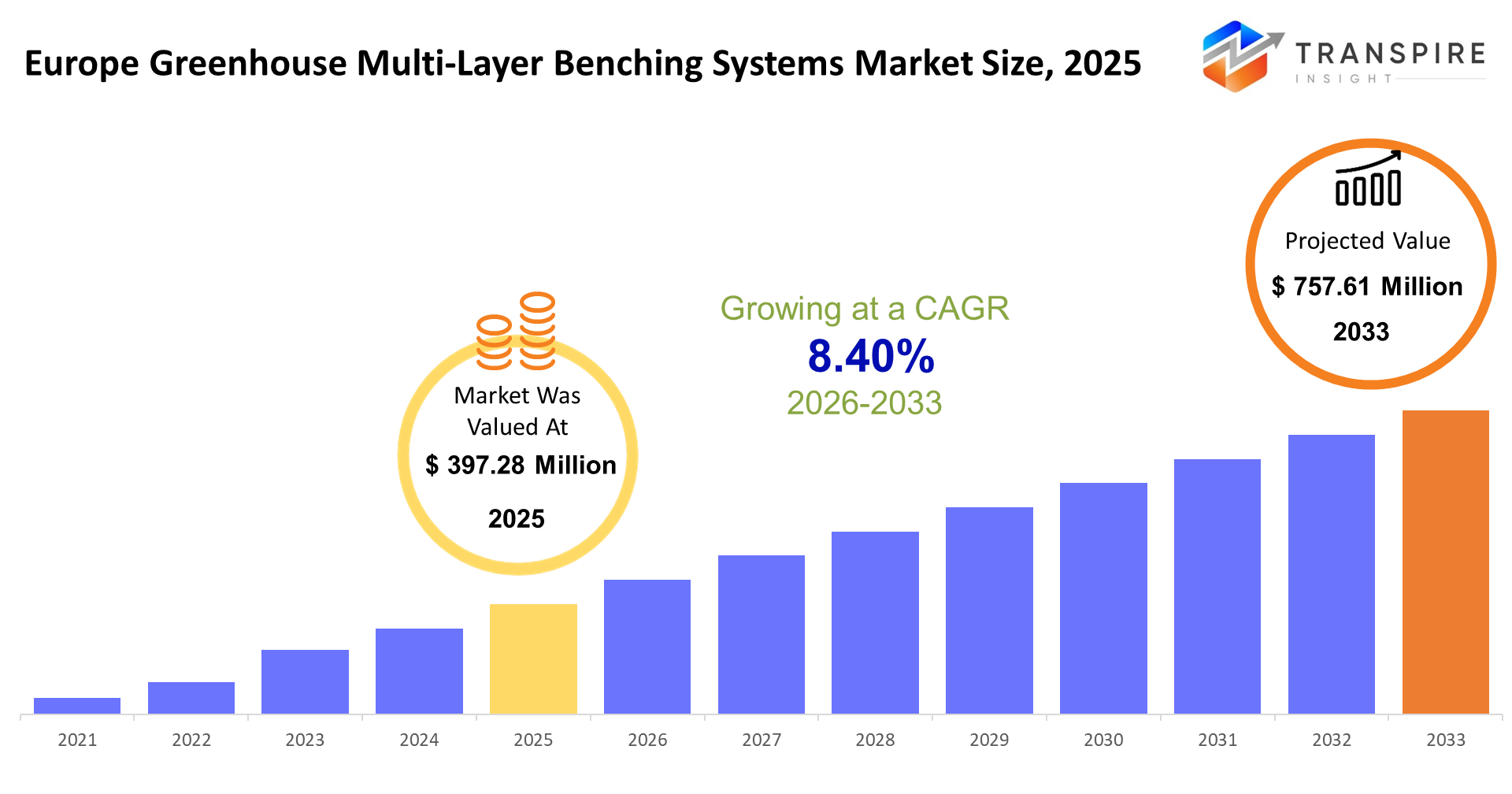
- Europe Greenhouse Multi-Layer Benching Systems Market Size 2025: USD 397.28 Million
- Europe Greenhouse Multi-Layer Benching Systems Market Size 2033: USD 757.61 Million
- Europe Greenhouse Multi-Layer Benching Systems Market CAGR: 8.40%
- Europe Greenhouse Multi-Layer Benching Systems Market Segments: By Type (Fixed Benching, Rolling Benching, Others), By Application (Vegetables, Flowers, Nurseries, Others), By End-User (Commercial Growers, Greenhouses, Research Institutes, Others), By Material (Metal, Plastic, Others).
To learn more about this report,  Download Free Sample Report
Europe Greenhouse Multi-Layer Benching Systems Market Summary:
The Europe Greenhouse Multi-Layer Benching Systems Market size is estimated at USD 397.28 Million in 2025 and is anticipated to reach USD 757.61 Million by 2033, growing at a CAGR of 8.40% from 2026 to 2033. For commercial growers who need to increase their plant output without acquiring extra land and workforce Greenhouse multi-layer benching systems offer a solution to their operational challenge. The systems create productive output through their vertical design which allows to cultivate multiple layers while they provide necessary irrigation and lighting facilities needed for European greenhouse operations which require high operational costs to grow vegetables and ornamental plants and young plants.
The market has moved towards automation-ready benching solutions which include climate-controlled systems that work with sensor networks and centralized control systems during the last three to five years. Growers need to implement systems which provide optimal resource usage because EU energy efficiency regulations and water conservation policies have become more demanding. The European energy price shock which occurred after 2021 forced operators to review their expense management procedures and spend money on building environmentally friendly resource-efficient systems in their facilities.
Large-scale growers must now adopt this technology because it has become essential for their operations. The implementation of this practice directly impacts margin stability which makes advanced benching system investment essential for operating success in the business.
Key Market Insights
- The Netherlands Greenhouse Multi-Layer Benching Systems Market will achieve more than 30% market share by 2025. The country's advanced greenhouse infrastructure and horticultural export activities drive this success.
- The southern European region will experience the fastest growth until 2030 because greenhouse facilities and climate-controlled farming systems gain popularity throughout Spain.
- The market for mobile multi-layer benching systems will exceed 45% market share in 2025 because these systems enable flexible operations and they optimize space while working with automated systems.
- Fixed benching systems serve as the second biggest market segment because they provide traditional greenhouses with cost-effective solutions that need less initial investment.
- The automated benching systems market functions as the most rapidly developing segment because smart greenhouse technology spreads throughout Europe until 2030.
- The vegetable cultivation sector holds 40% of market share in 2025 because the agricultural industry requires high-volume production and continuous product availability.
- Ornamental plants represent the fastest-growing application segment, supported by increasing exports and premium plant demand across European retail markets.
- European commercial greenhouse operators control more than 50% of the market because they use multi-layer benching systems to achieve production efficiency at their sites.
- The vertical farming sector is expanding its operations because urban agriculture funding and controlled-environment technology bring new opportunities for growth.
What are the Key Drivers, Restraints, and Opportunities in the Europe Greenhouse Multi-Layer Benching Systems Market?
The Europe Greenhouse Multi-Layer Benching Systems Market experiences its main growth driver through the increased energy and land expenses which occurred after the 2021–2023 energy price shock. High-cost growers from regions including the Netherlands and Germany had to increase their production capacity because their profit margins shrank. Multi-layer benching systems enable vertical farming which helps farmers to reduce their operational space requirements. EU regulations on resource efficiency and water management have pushed operators to implement integrated systems that combine benching with automated irrigation and climate control systems. Suppliers who provide scalable automation-ready solutions have experienced quick capital investment cycles which lead to increased revenue generation.
The most significant barrier remains the high upfront capital expenditure and retrofit complexity associated with installing multi-layer benching systems in existing greenhouses. Many European facilities were built decades ago with fixed layouts that cannot easily support vertical expansion or automation integration. Retrofitting requires structural modifications together with project downtime and climate and lighting system coordination which results in increased project risk. The absence of financing options for smaller growers creates a barrier which prevents them from adopting new technologies despite evidence showing efficiency improvements.
The growing need for eco-friendly urban farming solutions creates a major chance for businesses which operate between multi-layer benching systems and vertical farming and hybrid greenhouse systems in cities and their surrounding areas. The controlled-environment agriculture facilities in France and the UK now receive more funding because these facilities will provide year-round agricultural production for areas near their consumption centers. Farmers can achieve maximum yield production by using multi-layer benching systems together with LED lighting and AI-based systems which control their crop production. The market prepares for its upcoming growth stage through its relationship with urban food distribution systems and the requirements of retailers who seek locally sourced products.
What Has the Impact of Artificial Intelligence Been on the Europe Greenhouse Multi-Layer Benching Systems Market?
Artificial intelligence together with advanced digital technologies now transform greenhouse multi-layer benching operations by creating responsive data-driven production systems from their static infrastructure. European facilities require modern AI systems to operate both climate control platforms and benching movement systems which will automatically manage irrigation timing and nutrient dosing and airflow adjustments through crop-zone control. The multi-layer setups contain sensors which gather continuous data about humidity and temperature and plant growth, enabling control systems to automatically move benches and modify microclimates without needing human control.
Machine learning models create predictive abilities through their capacity to detect equipment wear patterns which start to develop in motors and tracks and irrigation lines, which leads to decreased unexpected operational interruptions. Predictive yield modeling enables growers to determine optimal planting density for their layered crops, which results in increased output consistency and decreased input waste. The systems have the potential to enhance both operational uptime and resource efficiency by achieving more than 10 percent improvements, especially in environments where high-density vegetable and ornamental plants are produced.
Adoption remains limited because organizations find it challenging to combine different systems. Many legacy greenhouses lack standardized data infrastructure, making it difficult to align AI tools with existing control systems. The implementation costs increase because of system fragmentation, which also hinders predictive model accuracy through incomplete historical data and inconsistent data points.
Key Market Trends
- Dutch and German growers redirected their financial resources toward multi-layer systems since 2021 to reduce energy expenses and increase their crop production per square meter.
- The period from 2020 to 2025 saw over 35% growth in greenhouse operations that integrated benching with climate control systems which now operate in complete synchronization.
- Growers have changed their farming methods from permanent field designs to portable bench systems which experienced rapid growth after the 2020 to 2022 period when workforce deficits became critical.
- The use of automated irrigation systems that connect with benching systems became more popular after 2022 because EU member states implemented stricter water usage regulations which required better control over water consumption.
- Priva Holding and Visser Horti Systems developed new AI solutions after 2023 which allow companies to predict equipment failures and optimize their crop production processes.
- Export-focused growers in Southern Europe started using higher-density farming methods after 2022 to maintain their cost advantages according to their business needs.
- LED lighting technology for multi-layer benching systems showed significant growth between 2021 and 2024 which enabled farmers to grow crops throughout the year without needing seasonal sunlight.
- Vertical farming businesses increased their acquisition of multi-layer systems by more than 40% since 2022 which supports urban agriculture development in France and the UK.
- The greenhouse industry experienced a decline in retrofitting older facilities after 2023 because operators preferred to create new facilities which already had automation capabilities.
Europe Greenhouse Multi-Layer Benching Systems Market Segmentation
By Type
The greenhouse environment which needs to accommodate many plants employs rolling benching systems because this system provides better space usage and operational capabilities than any other system. Commercial growers select rolling systems because these systems enable better access to their facilities while they simultaneously automate their irrigation and climate control systems. Fixed benching systems maintain their importance in smaller facilities which follow traditional setups because these systems require less money for installation and provide simpler setup procedures.
The market for suspended or hybrid systems exists to fulfill the needs of specific research environments and special crop requirements but these systems control only a small portion of the market. The adoption of rolling systems has increased because organizations need to reduce their labor expenses while achieving greater output per square meter of space. The future market will prefer rolling designs that work with automated systems which will drive manufacturers to develop modular systems and advanced control networks that can adapt to new business needs.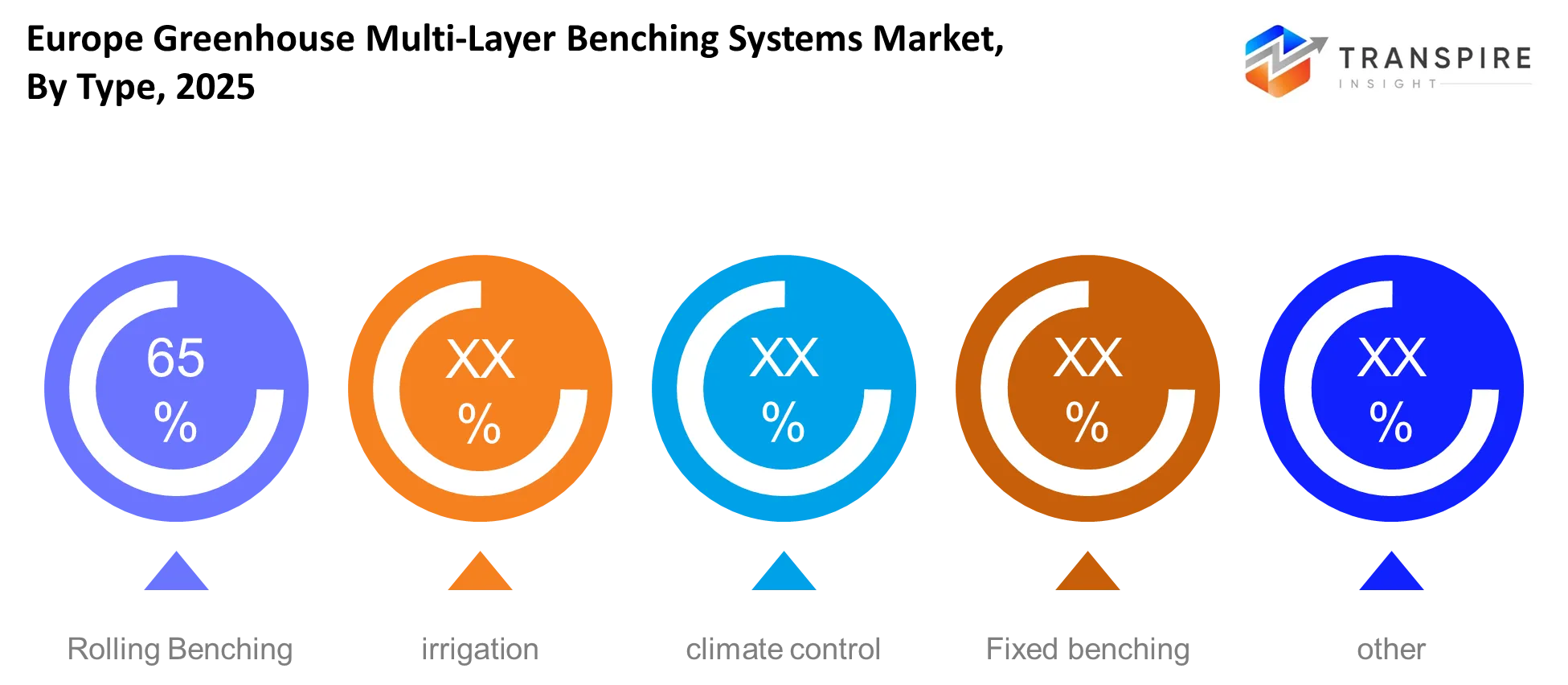
To learn more about this report, Download Free Sample Report
By Application
The market for vegetable cultivation exists in Europe because retailers and exporters need vegetables to be available throughout the entire year. The commercial food supply chains depend on multi-layer benching because it enables them to grow leafy greens and tomatoes and herbs through intensive agricultural cycles. The flower and ornamental plant production sector holds the second position in the market because it benefits from high export demand and premium pricing which Dutch customers maintain.
The nursery business experiences consistent expansion because young plant producers pursue better propagation efficiency. The research applications and specialty crop markets exist as smaller but crucial operational sectors. The industry will focus on developing high-value crops which require vertical systems for their production because this will lead suppliers to create specifications that meet both crop needs and controlled environment demands.
By End-User
The commercial greenhouse sector experiences its highest end-user distribution through greenhouse operators because their business needs require them to operate at substantial size while their financial resources permit them to operate extensive facilities and their requirements for efficient production demand they attain maximum output levels through their operations. The system enables large operators to maintain their profit levels while fulfilling their contractual obligations which need them to provide uninterrupted product delivery.
The independent greenhouses and mid-sized growers need to face financing challenges and retrofit difficulties which prevent them from using the new technology. The research institutes and academic institutions test new cultivation methods and system designs while they maintain a minor testing capacity to assess technological innovations. The urban agriculture movement in Western Europe drives vertical farming companies to become the fastest expanding customer segment in the market. The shift leads to a new cultivation approach that relies on technological solutions which prompts system developers to create complete systems that connect benching with lighting and automation and data analytics.
By Material
The greenhouse environment requires metal-based benching systems because their materials provide excellent durability together with high load capacity and extended performance for intensive greenhouse operations. The multi-layer systems depend on galvanized steel and aluminum structures which maintain their strength through high humidity conditions and multiple cleaning procedures. Plastic components serve as secondary materials, which manufacturers use to produce trays and supports and lightweight structures because their cost and corrosion resistance provide operational benefits.
The use of composites together with other materials remains restricted although they receive increasing attention for applications that require lightweight materials and better hygienic performance. As farmers choose metal systems for their ability to work with automatic machines metal systems will continue to grow in popularity. Future developments may include hybrid material designs that balance strength with cost efficiency, which will drive manufacturers to create new coating materials and develop modular systems and find eco-friendly sources of raw materials.
What are the Key Use Cases Driving the Europe Greenhouse Multi-Layer Benching Systems Market?
The primary application of horticultural operations centers on vegetable production specifically with high-density commercial greenhouses dedicated to cultivating leafy greens and herbs and vine crops. Operators need to achieve maximum yield production for each square meter because retail contracts and year-round supply requirements demand continuous product availability. The implementation of multi-layer benching system enables vertical space development while the system produces shorter crop growth periods and enables accurate irrigation management which results in uniform product production and reliable profit margins.
The combination of flower cultivation with young plant propagation has become popular among export-focused growers and nursery operators. To achieve consistent product quality through multi-layer systems ornamental producers can create larger plant batches which fulfill seasonal demand requirements. Propagation facilities adopt these systems to improve germination rates and space efficiency especially where climate control and uniformity are critical.
New applications are emerging for vertical farming systems which operate in urban environments and research-based agricultural systems. European metropolitan areas implement urban agriculture programs which use multi-layer benching systems to establish local fresh produce production methods. Research institutions are also deploying these systems to test crop genetics and controlled-environment techniques which will create new avenues for innovative advancements.
|
Report Metrics |
Details |
|
Market size value in 2025 |
USD 397.28 Million |
|
Market size value in 2026 |
USD 430.65 Million |
|
Revenue forecast in 2033 |
USD 757.61 Million |
|
Growth rate |
CAGR of 8.40% from 2026 to 2033 |
|
Base year |
2025 |
|
Historical data |
2021 - 2024 |
|
Forecast period |
2026 - 2033 |
|
Report coverage |
Revenue forecast, competitive landscape, growth factors, and trends |
|
Regional scope |
Europe (Germany, United Kingdom, France, Italy, Spain and Rest of Europe) |
|
Key company profiled |
Richel Group, Priva, Argus Controls, Hort Americas, Rough Brothers, Atlas Manufacturing, Bosman Van Zaal, Certhon, Netafim, Signify, Svensson, Harnois, Agra Tech, GrowSpan, GGS Structures |
|
Customization scope |
Free report customization (country, regional & segment scope). Avail customized purchase options to meet your exact research needs. |
|
Report Segmentation |
By Type (Fixed Benching, Rolling Benching, Others), By Application (Vegetables, Flowers, Nurseries, Others), By End-User (Commercial Growers, Greenhouses, Research Institutes, Others), By Material (Metal, Plastic, Others) |
Which Regions are Driving the Europe Greenhouse Multi-Layer Benching Systems Market Growth?
The Netherlands functions as the central market hub for Western Europe, which maintains its market leadership through its advanced greenhouse system and export-focused horticultural sector. The combination of strong energy efficiency policies and water optimization policies has led growers to adopt high-density farming methods. The existing ecosystem of technology providers together with system integrators and finance organizations enables businesses to implement multi-level benching products at high speed. The ongoing cooperation between growers and research institutes and suppliers results in new product development which strengthens the region's market leadership.
The countries of Northern Europe provide dependable backing for their economies through operational efficiency and long-term cost management which Germany and Denmark particularly demonstrate. In contrast to the Netherlands international trade does not drive adoption here because businesses prioritize energy control and legal obligations. Growers continue to invest in modernization projects which involve improving their current facilities instead of constructing fresh facilities. The controlled method generates steady demand patterns which enable system manufacturers to establish dependable income streams.
The greenhouse industry in Southern Europe experiences rapid growth, with Spain and Italy leading the expansion to fulfill both international market demands and local market requirements. The recent financial backing for climate control systems and irrigation efficiency projects has created momentum for businesses to transition to multi-layered organizational structures. Growers in warmer regions must implement resource-efficient technologies because they face both climate challenges and water resource limitations. The current growth momentum establishes significant market entry prospects for new businesses which develop affordable expandable products designed for mid-sized companies until 2033.
Who are the Key Players in the Europe Greenhouse Multi-Layer Benching Systems Market and How Do They Compete?
The European greenhouse multi-layer benching systems market displays moderate market fragmentation because established horticultural engineering companies and specialized greenhouse equipment manufacturers compete for business. The industry evaluates competitors through multiple factors which include system integration ability and automation preparedness and climate control system compatibility. Established players defend their positions through package deals that combine benching systems with irrigation and lighting and greenhouse structural components while newer companies develop installation solutions which enable their products to work with existing systems. The current business environment requires companies to achieve technological advancement and personalized service delivery which has replaced the previous focus on maintaining cost dominance.
Richel Group strengthens its position through integrated greenhouse engineering solutions rather than standalone benching systems. The company sets itself apart by providing complete greenhouse systems which include climate control and irrigation systems to facilitate seamless operation for large agricultural producers. The company expands its operations throughout Europe by establishing permanent business arrangements with commercial horticulture partners and executing collaborative ventures with greenhouse construction companies which enable it to obtain continuous customer demand through modernization initiatives.
Priva Holding uses its automation and digital control technologies for environmental management systems, which it integrates into its benching operations. The system enables growers to manage their irrigation and energy consumption and crop development by using unified software tools. Visser Horti Systems develops mechanical benching systems which operate with high precision to support propagation and young plant production, while their engineering design provides both reliability and scalability advantages. Metazet FormFlex expands its business through modular benching systems, which enable fast retrofitting, to assist mid-sized growers who need to modernize their existing equipment throughout Western and Southern Europe.
Company List
- Richel Group
- Priva
- Argus Controls
- Hort Americas
- Rough Brothers
- Atlas Manufacturing
- Bosman Van Zaal
- Certhon
- Netafim
- Signify
- Svensson
- Harnois
- Agra Tech
- GrowSpan
- GGS Structures
Recent Development News
In April 2026, Eternal.ag launches robot-ready modular greenhouse trolley system: Eternal.ag introduced a modular “robot-ready” trolley system that can later be upgraded into fully autonomous harvesting systems. This innovation is directly linked to greenhouse structural layouts, including benching and mobility infrastructure optimization.
Source: https://www.fruitnet.com
In March 2026, Eternal.ag raises €8M to scale autonomous greenhouse harvesting robots: German agritech company Eternal.ag secured €8M in funding to expand deployment of autonomous greenhouse robots. The technology is designed to integrate directly with greenhouse infrastructure, improving operational efficiency in controlled farming systems.
Source: https://tech.eu
What Strategic Insights Define the Future of the Europe Greenhouse Multi-Layer Benching Systems Market?
The Europe Greenhouse Multi-Layer Benching Systems Market is developing into an automated cultivation system which uses integrated benching systems as operational production equipment. The agricultural industry requires this transformation because it needs to achieve maximum crop yield through controlled-environment agriculture while decreasing all essential resources. The next five to seven years will see demand focus on systems which digitally link benching systems with climate control and crop analytics to create complete operational systems especially in expensive Western European horticultural centers.
The market faces a hidden danger because businesses depend on a few advanced greenhouse technology providers which creates supply concentration risk together with fixed pricing structures for customers. Supply chain disruptions or component shortages which impact specialized providers will lead to increased project costs and schedule delays. The partial automation hybrid retrofitting process which updates existing greenhouses with new technology results in operational system problems that investment planners typically do not recognize.
The French, UK, and Southern European urban vertical farming clusters present a new business opportunity through AI-based modular benching systems. The next infrastructure growth phase will require market participants to develop scalable systems which can be retrofitted with predictive maintenance and resource optimization capabilities to decrease system installation times.
Europe Greenhouse Multi-Layer Benching Systems Market Report Segmentation
By Type
- Fixed Benching
- Rolling Benching
- Others
By Application
- Vegetables
- Flowers
- Nurseries
- Others
By End-User
- Commercial Growers
- Greenhouses
- Research Institutes
- Others
By Material
- Metal
- Plastic
- Others
Frequently Asked Questions
Find quick answers to common questions.
The Approximate Europe Greenhouse Multi-Layer Benching Systems Market size for the Market will be USD 757.61 Million in 2033.
The key Segments of the Europe Greenhouse Multi-Layer Benching Systems Market are By Type (Fixed Benching, Rolling Benching, Others), By Application (Vegetables, Flowers, Nurseries, Others), By End-User (Commercial Growers, Greenhouses, Research Institutes, Others), By Material (Metal, Plastic, Others).
Major Players in the Europe Greenhouse Multi-Layer Benching Systems Market are Richel Group, Priva, Argus Controls, Hort Americas, Rough Brothers, Atlas Manufacturing, Bosman Van Zaal, Certhon, Netafim, Signify, Svensson, Harnois, Agra Tech, GrowSpan, GGS Structures.
The Current Market size of the Europe Greenhouse Multi-Layer Benching Systems Market is USD 397.28 Million in 2025.
The Europe Greenhouse Multi-Layer Benching Systems Market CAGR is 8.40%.
- Richel Group
- Priva
- Argus Controls
- Hort Americas
- Rough Brothers
- Atlas Manufacturing
- Bosman Van Zaal
- Certhon
- Netafim
- Signify
- Svensson
- Harnois
- Agra Tech
- GrowSpan
- GGS Structures
Recently Published Reports
-
Apr 2026
Handling and Lifting Equipment Market
Handling and Lifting Equipment Market Size, Share & Analysis Report By Product (Cranes and Hoists, Forklifts, Conveyor Systems, Aerial Work Platforms, Others), By Application (E-Commerce, Automotive and Railway, Food and Beverages, Aviation, Others), and Geography (North America, Europe, Asia-Pacific, Middle East and Africa, South and Central America), 2021 - 2031
-
Apr 2026
HVAC Equipment Market
HVAC Equipment Market Size, Share & Analysis Report By Heating Equipment Type (Boilers and Furnaces, Heat Pumps, and Unitary Heaters), By Ventilation Equipment (Air Handling Units, Humidifiers and Dehumidifiers, Air Filters, and Fan Coiling Units), By Air Conditioning Equipment (Unitary Air Conditioners, Room Air Conditioners, Packaged Terminal Air Conditioners, and Chillers), By End User (Commercial, Residential, Industrial, and others), and Geography (North America, Europe, Asia-Pacific, Middle East and Africa, South and Central America), 2021 – 2031
-
Apr 2026
Refrigeration Valves Market
Refrigeration Valves Market Size, Share & Analysis Report By Type (Solenoid Valves, Expansion Valves, Check Valves, Service Valves, Others), By Application (Commercial Refrigeration, Industrial Refrigeration, Transport Refrigeration, Residential Refrigeration, Air Conditioning Systems), By End User (Food and Beverage Industry, Pharmaceutical Industry, HVAC Industry, Chemical Industry, Others), and Geography (North America, Europe, Asia-Pacific, Middle East and Africa, South and Central America), 2021 – 2031
-
Apr 2026
E-Commerce Packaging Materials Market
E-Commerce Packaging Materials Market By Material Type (Corrugated Boxes, Paper & Paperboard, Foam & Cushioning Materials, Plastic Packaging, Flexible Packaging, Protective Packaging, Others), By Product(Primary Packaging, Secondary Packaging, Tertiary Packaging), By Packaging Function (Protective Packaging, Branding & Presentation Packaging, Transit & Logistic Packaging, Sustainable Packaging, Tamper Evidence Packaging), By End-User (Retail & Consumer Goods, Electronic Appliances, Food & Beverages, Healthcare & Pharmaceutical, Fashion & Apparel, Home & Furnishing, Others); By Industry Analysis, Size, Share, Growth, Trends, and Forecasts 2021-2033