Asia Pacific Maritime Transport Market Size & Forecast:
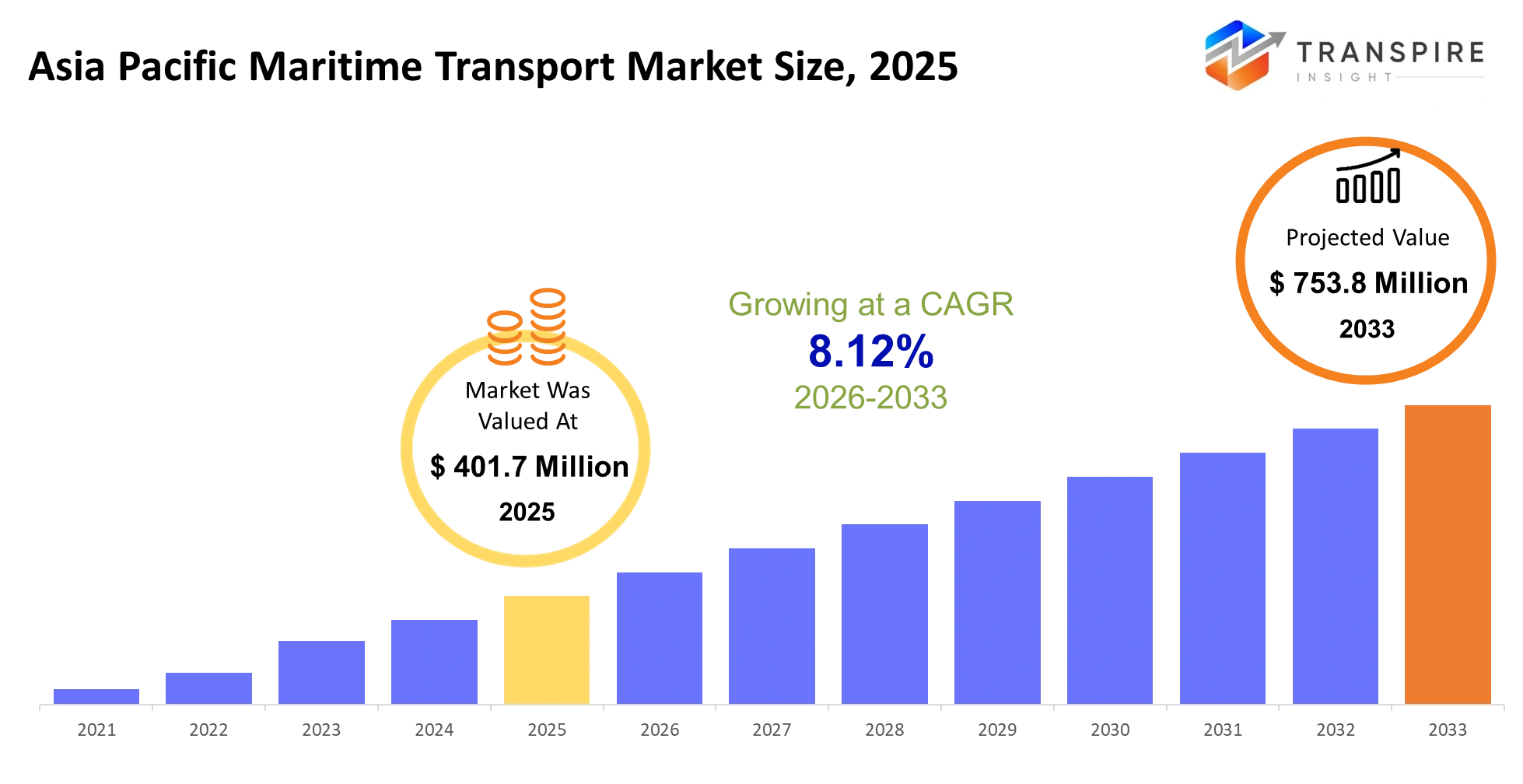
- Asia Pacific Maritime Transport Market Size 2025: USD 401.7 Million
- Asia Pacific Maritime Transport Market Size 2033: USD 753.8 Million
- Asia Pacific Maritime Transport Market CAGR: 8.12%
- Asia Pacific Maritime Transport Market Segments: By Type (Container Shipping, Bulk Shipping, Tanker Shipping, Others); By Application (International Trade, Coastal Transport, Offshore Logistics, Passenger Transport, Others); By End-User (Shipping Companies, Logistics Providers, Governments, Oil & Gas Companies, Industrial Firms, Others); By Vessel Type (Cargo Ships, Tankers, Bulk Carriers, Others).
To learn more about this report,  Download Free Sample Report
Asia Pacific Maritime Transport Market Summary
The Asia Pacific Maritime Transport Market was valued at USD 401.7 Million in 2025. It is forecast to reach USD 753.8 Million by 2033. That is a CAGR of 8.12% over the period.
The Asia Pacific maritime transport market maintains regional trade links between manufacturing centers and export-based economies and major consumer markets through sea routes that transport bulk goods and containers and energy products. The system enables industrial supply chains to operate at large distances because it simplifies and decreases expenses for transporting products between remote coastal areas and island territories. The market has experienced fundamental changes during the past three to five years as shipping companies adopted digital technologies and environmentally friendly shipping methods while investing in smart navigation systems and automated port operations and alternative fuels to comply with new emission requirements.
The International Maritime Organization has implemented stricter decarbonization regulations which have combined with pandemic-related port congestion problems to create an unexpected trigger that revealed flaws in established logistics systems. The new requirements forced carriers to develop new methods for improving their routing processes and their capacity estimation methods. The implementation of fleet upgrades and complete port operational systems has increased which leads to faster ship turnaround times while changing the methods used to generate income from cargo and terminal activities.
Key Market Insights
- China controls approximately 40 to 45 percent of the Asia Pacific Maritime Transport Market because of its extensive export manufacturing and development of port facilities.
- Through the years 2024 to 2030 Southeast Asia experiences its fastest growth rate because of expanding trade networks and increasing demand for shipping routes between Asian countries.
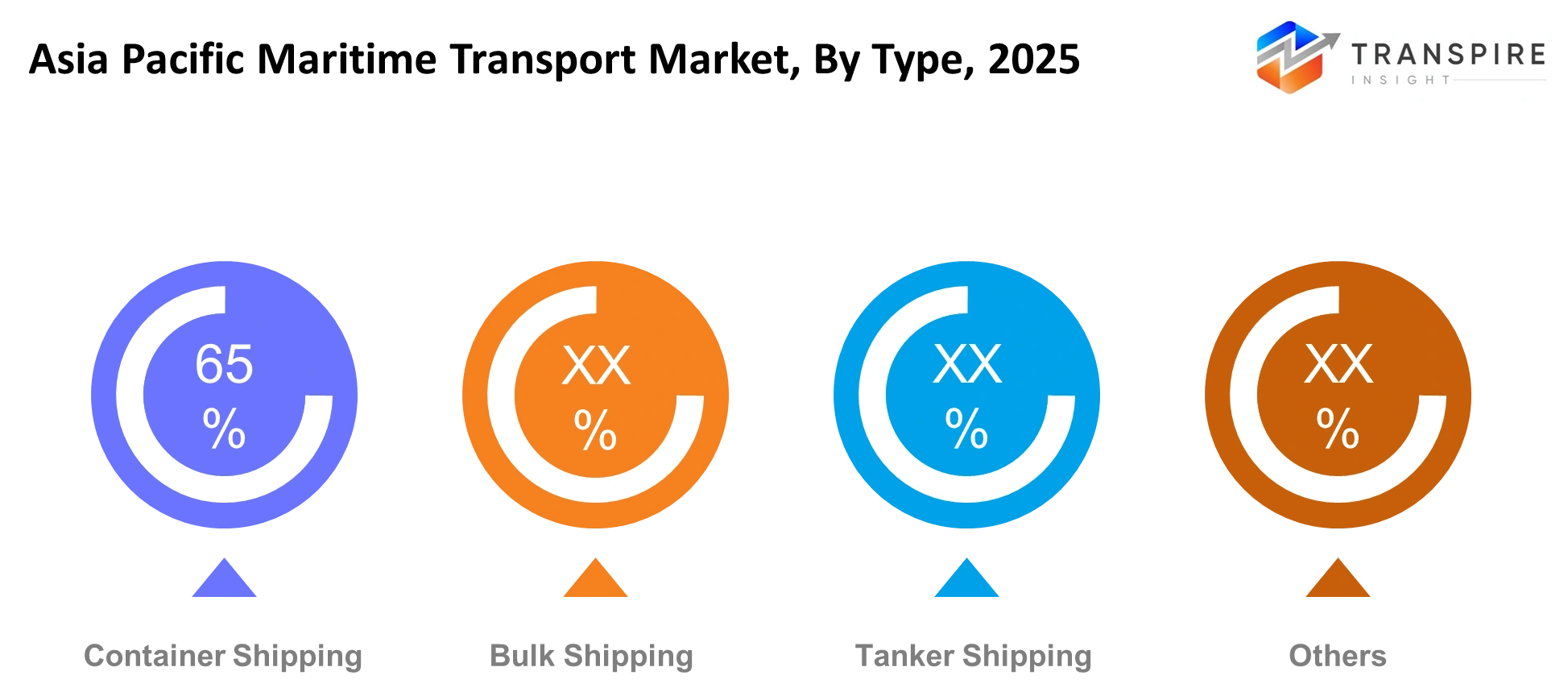
- The Asia Pacific Maritime Transport Market operates through container shipping which controls more than 50% of the market because global trade and efficient standardized cargo movement systems drive its operations.
- The second-biggest market segment of the bulk shipping industry exists because Asian countries need to transport energy resources and coal and raw materials.
- The digital freight and smart shipping services market section experiences its fastest growth between 2024 and upcoming years because automation and tracking technologies start to take effect.
- International trade logistics dominates applications with more than 55% share, which shows how Asia's export-oriented industrial supply chain system operates.
- The fastest-growing application of international trade logistics operates through e-commerce-based maritime container movements, which support cross-border fulfillment networks to operate between online retail and regional markets.
- The manufacturing export sector leads all end-user segments because it uses maritime transport for approximately 48% of its international freight operations.
- E-commerce logistics providers show rapid growth as their main customer group because they need complete shipping solutions which include both integrated transportation and last-mile delivery services.
- COSCO Shipping achieves greater market power through its expansion of fleet operations and its investments in port facilities throughout Asia-Pacific trade routes.
What are the Key Drivers, Restraints, and Opportunities in the Asia Pacific Maritime Transport Market?
The rapid modernization of regional trade logistics which decarbonization mandates and digital port infrastructure upgrades drive has become the main factor that drives the Asia Pacific Maritime Transport Market forward. The International Maritime Organization has established stricter emissions compliance rules which compel shipping operators to spend money on low-sulfur fuels and LNG-powered vessels and route optimization systems. The shift requires implementation because it constitutes an essential requirement which affects both operating cost structures and fleet renewal cycles and capital expenditure expenses of major carriers. Companies now depend on technology-based productivity improvements to generate revenue although they still need to transport goods.
Port congestion constitutes the main obstacle which emerges when developing Southeast Asian economies face challenges related to their infrastructure development. The lack of deep-water capacity and automated cargo handling systems at secondary ports prevents quick resolution of systemic delays because these requirements need expensive resources and extended construction periods. The current framework restricts operational capacity that results in extended turnaround periods which interferes with shipping operations and decreases potential freight revenue during intra-regional trade activities.
Vietnam and Indonesia present a major opportunity for growth through their development of smart port ecosystems which will benefit from government partnerships with global logistics companies. Tanjung Priok Port uses 5G-enabled port automation technology to create real-time cargo tracking systems which provide predictive scheduling capabilities. The process establishes conditions which increase vessel processing capacity and open the upcoming development stage which leads to operational digitization in the Asia Pacific Maritime Transport Market.
What Has the Impact of Artificial Intelligence Been on the Asia Pacific Maritime Transport Market?
The Asia Pacific Maritime Transport Market is undergoing permanent transformation through artificial intelligence because it enhances vessel tracking and maintenance and operational processes throughout international and regional shipping routes. Shipping operators have started to implement AI-based scrubber performance systems together with exhaust gas cleaning technology to create automated systems that track sulfur emissions and guarantee compliance with IMO 2020 standards. The systems automatically manage operational settings while the operational tasks of the fleets in busy Asia-Pacific corridors need less human input which leads to better accuracy in regulatory documentation.
Machine learning models are now used in predictive applications to perform predictive maintenance of engines and hull performance analysis and fuel consumption forecasting. Operators can prevent maintenance problems by analyzing sensor data from propulsion systems and weather routing inputs which leads to a 10 to 15 percent increase in vessel uptime and decreased fuel consumption through optimized voyage planning.
Carriers use digital optimization platforms to reduce their bunker fuel expenses while improving their schedule reliability on busier routes that connect China with Singapore and India. The adoption process faces challenges because satellite connectivity in remote ocean areas prevents real-time data transmission which leads to decreased accuracy in AI-powered decision systems. Regional operators face difficulties in deploying new technologies because legacy fleet systems require high integration expenses which particularly affect mid-sized companies.
Key Market Trends
- The container shipping networks implemented automated terminal operations after 2022 which enhanced their efficiency at terminals throughout Shanghai Singapore and Busan ports.
- COSCO Shipping and Maersk expanded their LNG-powered fleets between 2023 and 2025 because they needed to meet stricter maritime emission compliance standards.
- The intra-Asia trade lanes grew by more than 30% since 2021 because supply chains now use multiple countries for export instead of relying on one country.
- Smart port systems using AI-based cargo tracking expanded in Vietnam and Indonesia after 2023 which resulted in substantial reductions of container dwell time.
- The introduction of predictive maintenance platforms by NYK Line in 2024 led to decreased unplanned vessel downtime while enhancing the precision of operational scheduling.
- The shipping industry saw a shift in its demand patterns during 2022 to 2025, which resulted in decreased coal transport operations and increased LNG shipments but increased demand for energy transition materials.
- The real-time pricing system of CMA CGM which uses digital freight platforms has changed its competitive pricing methods since 2023.
- The supply chain disruptions of 2021 to 2022 caused port congestion problems to reach their highest level, which led to Asian countries making permanent investment decisions for automated handling system development.
- The shipping industry expanded its blockchain-based documentation trials after 2024, which enabled faster customs processing and reduced paperwork delays.
Asia Pacific Maritime Transport Market Segmentation
By Type :
Container shipping operates standardized cargo movement between ports which creates better operational efficiency and smoother trade operations. The Asia Pacific maritime transport market uses bulk shipping to transport unpackaged goods which include grains and minerals through massive quantities because it maintains industrial and agricultural supply chains.
Tanker shipping operates as a dedicated maritime service which delivers liquid materials that include crude oil and chemicals to sustain energy supply systems between different geographical locations. The maritime industry employs specialized vessels which operate unique transport systems to move cargo that requires specific handling through various ocean shipping routes and port facilities.
To learn more about this report, Download Free Sample Report
By Application :
International trade drives maritime transport demand through cross-border movement of goods between Asia Pacific economies and global markets which strengthens export and import activity while supporting industrial growth across manufacturing and commerce sectors. Coastal transport supports short-distance movement between domestic ports which improves regional supply flow.
Offshore logistics supports energy and resource operations through its applications in marine-based projects. Passenger transport combined with other functions serves both mobility requirements and tourist traffic in coastal areas.
By End-User :
Shipping companies maintain their operations through management of extensive ship fleets which they use to coordinate their worldwide cargo shipping activities across ocean routes from their bases. The logistics sector uses its transportation networks to provide fast delivery services and effective cargo handling across different markets which work together.
Government authorities control port facilities and maritime shipping routes to preserve efficient trade operations while ensuring security requirements are met. Marine transport functions as the primary distribution method for oil and gas companies to deliver their energy products. The industrial sector relies on these services to obtain raw materials which enables them to maintain production operations throughout different industries.
By Vessel Type :
Cargo ships operate as international and regional freight vessels which transport standard merchandise to maintain continuous commercial shipping and supply chain operations. Tankers operate as transport vessels which move liquid products including fuels and chemicals throughout the Asia Pacific region for energy and industrial purposes.
Bulk carriers transport massive raw material shipments which contain coal and grain and iron ore to provide industrial facilities with essential production resources. The maritime industry uses specialized vessels which have been designed for particular shipping operations that support their logistics networks.
What are the Key Use Cases Driving the Asia Pacific Maritime Transport Market?
The primary use case in the Asia Pacific Maritime Transport Market functions to handle international trade through large-scale containerized cargo operations which link manufacturing centers to worldwide consumer markets. The highest demand for this application exists because export-oriented economies in China, South Korea, and Japan depend on standardized container shipping to transport their electronics, machinery, and automotive components.
The industry develops new applications which encompass bulk commodity transport and energy logistics operations that handle LNG and coal shipments to power generation facilities and industrial manufacturing centers. These use cases are increasingly important for energy importers like India and Southeast Asian economies, where industrial expansion is tightly linked to maritime fuel and raw material supply chains.
Businesses develop new applications which use smart shipping services through digital technology and test autonomous vessels with support from port authorities and logistics companies. The shipping industry uses real-time route optimization and remote vessel monitoring to meet strict emissions reporting requirements, while the autonomous navigation pilots that Singapore and South Korea operate will transform deep-sea freight operations throughout the world.
|
Report Metrics |
Details |
|
Market size value in 2025 |
USD 401.7 Million |
|
Market size value in 2026 |
USD 436.3 Million |
|
Revenue forecast in 2033 |
USD 753.8 Million |
|
Growth rate |
CAGR of 8.12% from 2026 to 2033 |
|
Base year |
2025 |
|
Historical data |
2021 - 2024 |
|
Forecast period |
2026 - 2033 |
|
Report coverage |
Revenue forecast, competitive landscape, growth factors, and trends |
|
Regional scope |
Asia Pacific (China, India, Japan, South Korea, Australia, Rest of Asia Pacific) |
|
Key company profiled |
Maersk, MSC, COSCO Shipping, CMA CGM, Hapag-Lloyd, Evergreen Marine, NYK Line, MOL, Yang Ming, ZIM Integrated Shipping, Hyundai Merchant Marine, Pacific International Lines, Wan Hai Lines, OOCL, K Line. |
|
Customization scope |
Free report customization (country, regional & segment scope). Avail customized purchase options to meet your exact research needs. |
|
Report Segmentation |
By Type (Container Shipping, Bulk Shipping, Tanker Shipping, Others); By Application (International Trade, Coastal Transport, Offshore Logistics, Passenger Transport, Others); By End-User (Shipping Companies, Logistics Providers, Governments, Oil & Gas Companies, Industrial Firms, Others); By Vessel Type (Cargo Ships, Tankers, Bulk Carriers, Others). |
Which Regions are Driving the Asia Pacific Maritime Transport Market Growth?
China dominates the Asia Pacific Maritime Transport Market because it possesses superior port infrastructure and its export manufacturing facilities operate in complete synchronization with its port network. The main ports at Shanghai and Shenzhen operate extensive container handling systems which use cutting-edge technology and efficient customs processing capabilities. The government maintains strong financial support for both port expansion activities and dredging operations which enables ongoing capacity development despite ongoing congestion problems. The company maintains its market leadership through its complete logistics system that connects inland production facilities with coastal shipping ports.
Japan represents a more stability-driven contributor, where maritime transport growth is anchored in technological reliability and disciplined fleet modernization. Japan establishes its international trade system through its system of high-value cargo transportation which uses the NYK Line and Mitsui O.S.K. Lines. The shipping industry maintains uninterrupted operations through its strict adherence to established regulations and its commitment to replacing vessels at scheduled intervals. The shipping industry establishes a strong operational framework which supports both safety measures and efficient operations while avoiding quick business growth through additional capacity.
Southeast Asia ranks as the fastest expanding region because port infrastructure development progresses rapidly while international supply chains redirect operations toward Vietnam and Indonesia and Malaysia. Since 2022, governments have expedited the development of maritime corridors and free trade port zones to attract manufacturing companies who want to move their operations. The development of intra-Asian shipping routes has accelerated while shipping companies show greater interest in operating mid-sized container ships. The period from 2026 to 2033 will produce multiple strong entry points for logistics companies and investors who focus on developing new coastal trade routes.
Who are the Key Players in the Asia Pacific Maritime Transport Market and How Do They Compete?
The Asia Pacific Maritime Transport Market exhibits moderate market consolidation through which global shipping companies control major trade routes while local shipping companies operate specialized services between regional ports. The competitive environment now depends more on operational costs and fleet upgrades and digital service development work than on shipping capacity. Existing companies protect their market positions through vessel technology advancements and commitment to extended contracts with exporters and energy transportation companies. Digital logistics platforms which utilize digital technology to enhance route planning and pricing visibility, lead to operational disruption in the market.
COSCO Shipping enhances its market position through its extensive fleet growth and its complete operational partnership with Chinese port facilities, which enable the company to control substantial export trade operations. The company achieves its strategic advantage through its ability to synchronize logistics operations with government requirements while operating ultra-large container ships across Asia and Europe. Maersk uses digital freight services and complete supply chain management solutions to create its unique market position which it enhances through funding green methanol-powered ship development and new booking system development. Evergreen Marine expands its business operations through capacity growth on intra-Asia routes which it accomplishes by establishing strategic partnerships that enable ongoing container shipment operations.
NYK Line and Mitsui O.S.K. Lines create dedicated LNG carrier fleets together with their energy freight operations systems as they enter lucrative fuel transport markets. The companies strengthen their business operations through two main activities which involve obtaining long-term charter contracts and building their fleet with ships that comply with decarbonization standards; this enables them to handle shifts in container shipping market patterns.
Company List
- Maersk
- MSC
- COSCO Shipping
- CMA CGM
- Hapag-Lloyd
- Evergreen Marine
- NYK Line
- MOL
- Yang Ming
- ZIM Integrated Shipping
- Hyundai Merchant Marine
- Pacific International Lines
- Wan Hai Lines
- OOCL
- K Line
Recent Development News
In April 2026, Pacific International Lines (PIL) and PSA International established Singapore's first combined land-sea environmentally friendly shipping service through their collaboration which received support from DNV. The initiative enables verifiable carbon emissions reduction for cargo transshipped through Singapore, marking a major step in integrating low-carbon logistics solutions across maritime and port operations in Asia Pacific.
Source: https://www.pilship.com/
In April 2026, Pacific Basin Shipping Limited announced an adjustment and expansion of its newbuilding programme. The company revised its vessel orders by shifting to fuel-efficient conventional ultramax ships while retaining optional dual-fuel vessel acquisition rights, which present them with operational choices during their international maritime decarbonisation efforts and their transitional period between fuels.
Source: https://www.marketscreener.com/
What Strategic Insights Define the Future of the Asia Pacific Maritime Transport Market?
The Asia Pacific Maritime Transport Market will undergo permanent changes during the upcoming 5 to 7 years because shipping networks will develop into digital systems that emit fewer carbon emissions and operate under stricter environmental regulations while supply chains will transform to support Asian-based manufacturing centers. The company needs to improve its operational intelligence capabilities because its success will depend on its ability to achieve routing efficiency and fuel efficiency and its success in implementing digital port operations.
Maritime operators face hidden dangers when their fleets rely too heavily on separate decarbonization technologies. The implementation of LNG and methanol and hybrid propulsion systems by operators will create interoperability problems which will increase both compliance requirements and retrofit expenses for mid-sized carriers in the future.
Southeast Asia's smart inland-coastal integration corridors present a new business opportunity because Vietnam and Indonesia are developing digital customs and inland logistics systems to connect their ports. This system develops in its initial phases but will become essential when trade patterns shift toward regional value networks. Market participants need to invest in digital logistics systems that work with different systems because they need to develop fleet systems that work with multiple fuel standards which will help them stay resilient through changing Asia-Pacific trade regulations.
Asia Pacific Maritime Transport Market Report Segmentation
By Type
- Container Shipping
- Bulk Shipping
- Tanker Shipping
By Application
- International Trade
- Coastal Transport
- Offshore Logistics
- Passenger Transport
By End-User
- Shipping Companies
- Logistics Providers
- Governments
- Oil & Gas Companies
- Industrial Firms
By Vessel Type
- Cargo Ships
- Tankers
- Bulk Carriers
Frequently Asked Questions
Find quick answers to common questions.
The Asia Pacific Maritime Transport Market size is USD 753.8 Million in 2033.
Key segments for the Asia Pacific Maritime Transport Market are By Type (Container Shipping, Bulk Shipping, Tanker Shipping, Others); By Application (International Trade, Coastal Transport, Offshore Logistics, Passenger Transport, Others); By End-User (Shipping Companies, Logistics Providers, Governments, Oil & Gas Companies, Industrial Firms, Others); By Vessel Type (Cargo Ships, Tankers, Bulk Carriers, Others).
Major Asia Pacific Maritime Transport Market players are Maersk, MSC, COSCO Shipping, CMA CGM, Hapag-Lloyd, Evergreen Marine, NYK Line, MOL, Yang Ming, ZIM Integrated Shipping, Hyundai Merchant Marine, Pacific International Lines, Wan Hai Lines, OOCL, K Line.
The Asia Pacific Maritime Transport Market size is USD 401.7 Million in 2025.
The Asia Pacific Maritime Transport Market CAGR is 8.12% from 2026 to 2033.
- Maersk
- MSC
- COSCO Shipping
- CMA CGM
- Hapag-Lloyd
- Evergreen Marine
- NYK Line
- MOL
- Yang Ming
- ZIM Integrated Shipping
- Hyundai Merchant Marine
- Pacific International Lines
- Wan Hai Lines
- OOCL
- K Line
Recently Published Reports
-
Apr 2026
ATV & UTV Market
ATV & UTV Market Size, Share & Analysis Report By Type (ATV, and UTV), By Variants (Less Than 400 CC, 400 CC To 800 CC, and More Than 800 CC), and Geography (North America, Europe, Asia-Pacific, Middle East and Africa, South and Central America), 2021 - 2031
-
Apr 2026
Automotive Central Gateway Module Market
Automotive Central Gateway Module Market Size, Share & Analysis Report By Type (Ethernet Central Gateway Module, CAN Central Gateway Module, LIN Central Gateway Module, and FlexRay), By Application (Powertrain Control, Body Control, Infotainment System, Advanced Driver Assistance Systems (ADAS), and Others), By End User (Passenger Vehicles, and Commercial Vehicles), and Geography (North America, Europe, Asia-Pacific, Middle East and Africa, South and Central America), 2021 - 2031
-
Apr 2026
Automotive Engine Oil Filter Market
Automotive Engine Oil Filter Market Size, Share & Analysis Report By Filter Type (Fuel Filter, Engine Oil Filter, Hydraulic Oil Filter, and Others), By Filter Media (Cellulose, Synthetic, and Micro), By Sales Channel (OEMs, and Aftermarket), By Vehicle Type (Passenger Cars, Light Commercial Vehicles, Heavy Duty Trucks, Buses and Coaches, and Off-road Vehicles), and Geography (North America, Europe, Asia-Pacific, Middle East and Africa, South and Central America), 2021 - 2031
-
Apr 2026
Automotive Parts Aluminium Die Casting Market
Automotive Parts Aluminium Die Casting Market Size, Share & Analysis Report By Production Process (Pressure Die Casting, Vacuum Die Casting, Squeeze Die Casting, Gravity Die Casting), By Application (Body Parts, Engine Parts, Transmission Parts, Battery And Related Components, Other Application Types), and Geography (North America, Europe, Asia-Pacific, Middle East and Africa, South and Central America), 2021 - 2031
Our Clients