

South Korea Silica Sand Market Size & Forecast:
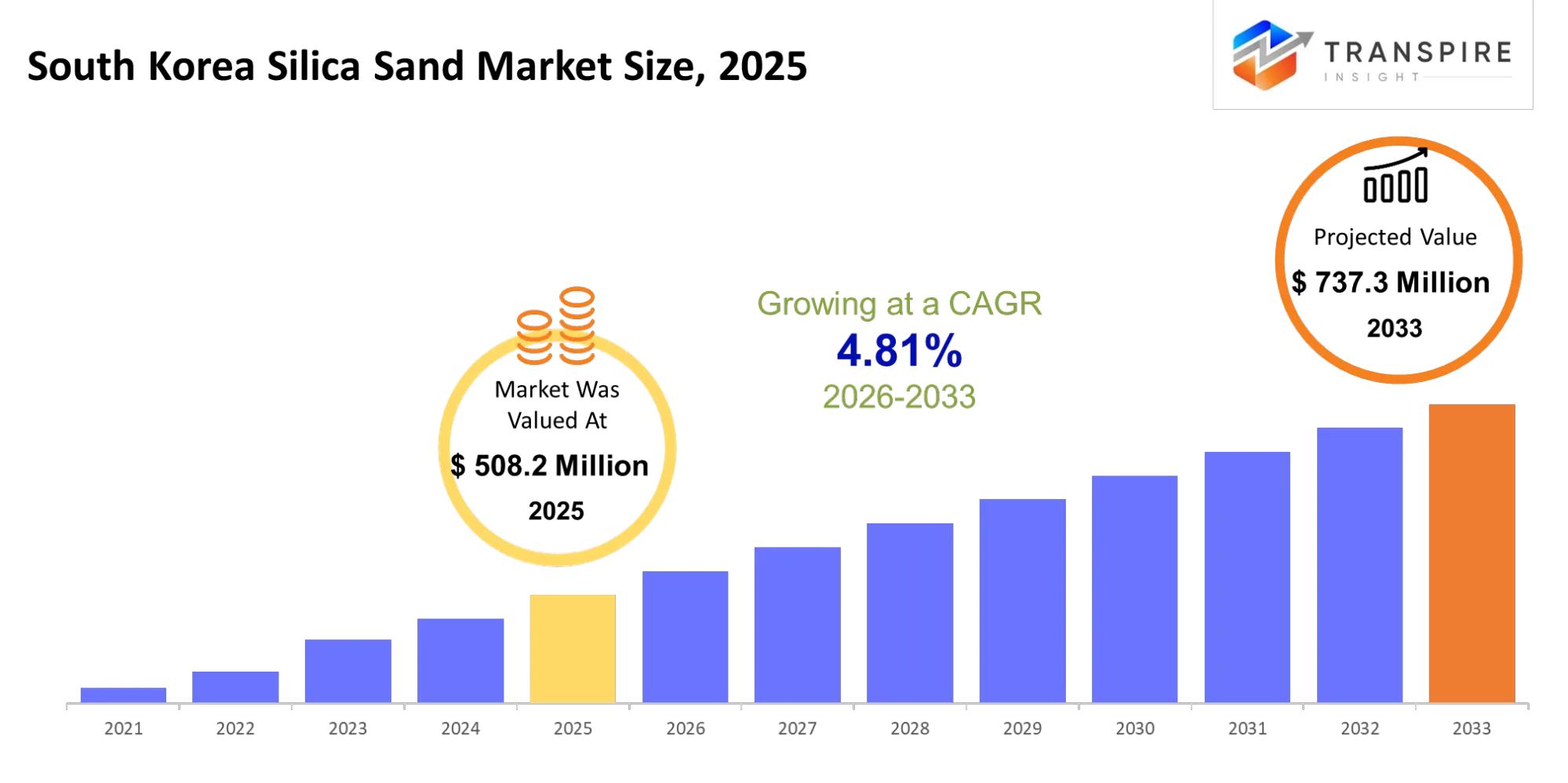
- South Korea Silica Sand Market Size 2025: USD 508.2 Million
- South Korea Silica Sand Market Size 2033: USD 737.3 Million
- South Korea Silica Sand Market CAGR: 4.81%
- South Korea Silica Sand Market Segments: By Type (Industrial Sand, Foundry Sand, Glass Sand, Others); By Application (Glass Manufacturing, Foundry, Construction, Oil & Gas, Others); By End User (Glass Industry, Construction, Industrial, Others)
To learn more about this report,  Download Free Sample Report
South Korea Silica Sand Market Summary
The South Korea Silica Sand Market was valued at USD 508.2 Million in 2025. It is forecast to reach USD 737.3 Million by 2033. That is a CAGR of 4.81% over the period.
In South Korea, silica sand isnt just some abstract mineral commodity anymore, it’s more like a grounding input that keeps a bunch of stuff moving such as glass manufacturing, precision casting, construction materials, and those coastal reclamation projects that never really stop. It kind of enables everything, from the flat glass used in buildings and displays, to the molds used in shipbuilding and industrial metal components.
Over the past 3–5 years, the market has changed in a more structural way, toward higher-purity grades too, because the display sector and semiconductor-adjacent industries started demanding tighter material specifications. At the same time, stricter domestic environmental controls on quarrying and coastal extraction have made it harder to get “easy” local supply. One main trigger was the global logistics disruption during the pandemic period , it showed how dependent many operations were on imported sand streams, and then buyers started pushing for diversified sourcing plus stockpiling. So now procurement tends to lean on long-term import agreements and value-added processing, and the revenue stream logic shifts away from pure bulk commodity traders , toward specialized suppliers.
Key Market Insights
- The South Korea Silica Sand Market is sort of dominated by high-purity industrial sand demand , taking nearly 38–42% of the share in 2025, across glass and foundry uses.
- In terms of geography , the Seoul Capital Region leads consumption at roughly 35% , mainly because of the dense building activity and those advanced manufacturing clusters.
- When you look closer at the types, the high-purity silica sand segment is still in the lead, holding the biggest market share. This is fueled by display glass needs and precision casting requirements, not just one thing.
- After that, washed and graded silica sand comes in second, and it is widely used as construction aggregate and also in infrastructure development programs.
- Also, ultra-high purity silica sand is the fastest-growing part , backed by electronics-grade material specifications and stricter quality checks.
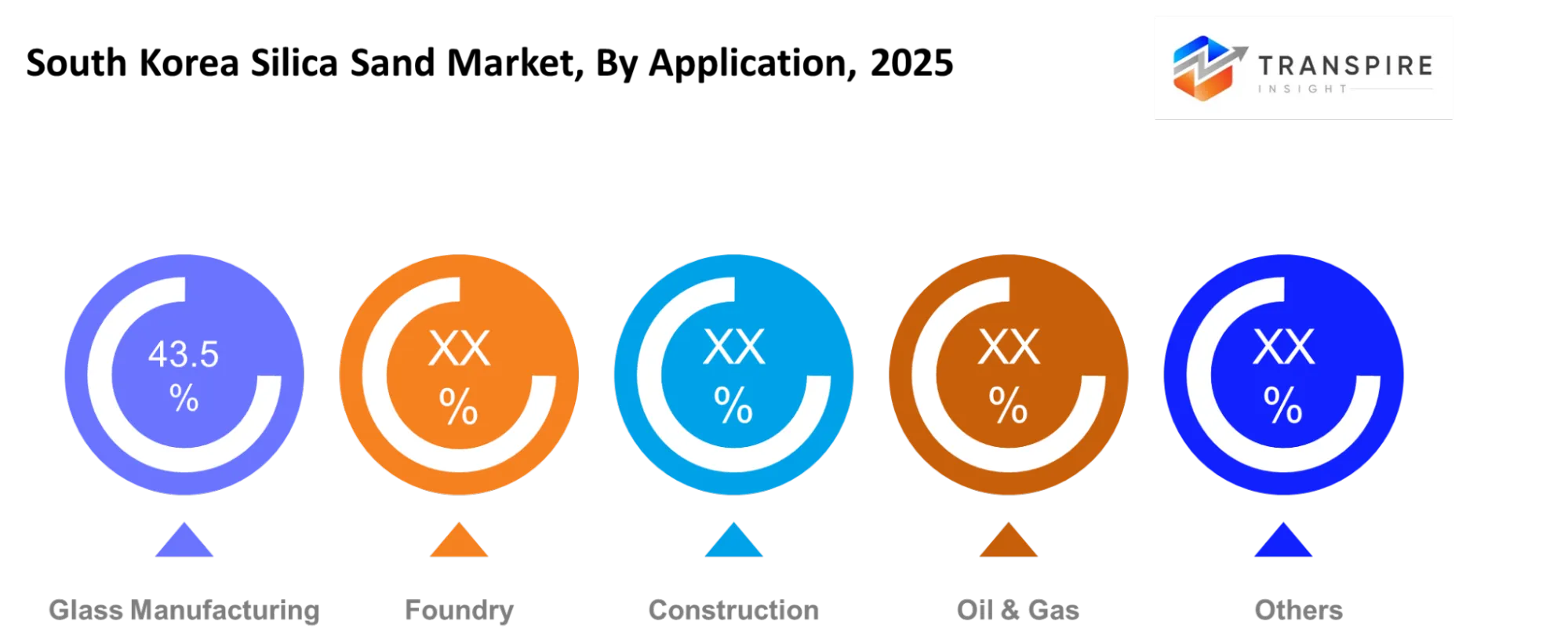
- For applications, glass manufacturing takes the biggest slice, around 40% , kept steady by construction glass needs plus specialty industrial glass demand , too.
- The construction sector still feels like the leading end-user , with something like over 45% share, kind of backed by infrastructure redevelopment and urban renewal efforts.
- Electronics and advanced manufacturing, on the other hand, is the fastest growing end-user group, mainly pushed by precision material needs within the fabrication ecosystem.
- Some key names in the South Korea silica sand market are Sibelco, Saint-Gobain, U.S. Silica Holdings, Mitsubishi Materials, and a bunch of local aggregate suppliers too those help with import distribution networks.
- Many companies are expanding via longer-term import contracts, silica purification upgrades, and by leaning on strategic collaborations with glass makers and construction manufacturers as well.
What Has the Impact of Artificial Intelligence Been on the South Korea Silica Sand Market?
The main driver in the South Korea Silica Sand Market is increasing demand from high spec glass and precision casting sectors, pushed by more strict material purity rules across construction and electronics supply chains. Producers now want a steady silica makeup to cut down defect rates in flat glass and engineered components, so procurement volumes for refined grades keep going up. In practice this has shifted revenue focus toward processed imports and longer term supplier arrangements, not so much the quick spot style commodity buying, and that helps premium producers keep more stable pricing.
The biggest restraint is sort of obvious when you look at it, limited local silica sand availability because of environmental boundaries on quarrying and coastal extraction areas. You can't fix this fast because permitting limits and ecological protection plans slow down any new mining additions. Because of that the market keeps leaning on imports, costs more in logistics, and has extra exposure to global freight swings. All of these pressures end up squeezing margin growth for downstream manufacturers, who still rely heavily on raw material that is both stable and on the cheaper side.
A main opportunity is advanced silica purification, plus recycling approaches, that can upgrade lower grade sand into industrial grade inputs. Money and attention are moving toward beneficiation plants near port hubs like Incheon, since they can process imports in a more cost effective way. This could reduce the need for expensive imports and open up new value streams for suppliers that tie together refining, shipping coordination, and long duration industrial contracts inside the South Korea Silica Sand Market.
Key Market Trends
- Between 2021 and 2026 the South Korea silica sand market sort of moved toward ultra high purity grades, as display and semiconductor adjacent manufacturing got stricter about what they’ll accept across the supply chain.
- Since 2020, environmental rules around coastal zones and quarry extraction in South Korea have cut domestic output a bit, so import reliance climbed to above 55 percent.
- During 2020 to 2022, with the pandemic logistics disruptions, buyers for silica sand shifted away from pure spot buying and toward long term contracts , plus some strategic stockpiling across a range of industrial users.
- In 2022, upgrades at Incheon port infrastructure improved how efficiently silica sand imports are handled. That helped South Korea silica sand market distributors, by trimming lead times more than before.
- From 2023 onward, glass manufacturers kept raising their purity thresholds, which in turn made them less willing to accept low grade silica sand in flat glass production lines, and that is pretty important.
- In 2024 the shipbuilding and automotive recovery cycles increased foundry-grade silica demand, reshaping industrial consumption patterns across South Korea in the Silica Sand Market, kind of like it was a nudge from industry.
- Companies such as Sibelco and Saint-Gobain, moved to expand beneficiation technologies and also formed blending collaborations to lock in high-consistency silica supply for Korean buyers.
- Meanwhile, recycling efforts and industrial sand substitution moves are starting to gain real momentum, backed by pilot projects aimed at circular construction material systems, starting in 2023.
South Korea Silica Sand Market Segmentation
By Type :
Industrial sand use in South Korea Silica Sand Market is basically tied to construction materials, plus general manufacturing needs, and there’s been a noticeable kind of shift toward cleaner processed grades since 2021 because the quality control rules got tighter. Also, import reliance has gone up, since the limits on domestic extraction made supply less stable, so buyers end up leaning on longer term sourcing agreements, not just spot buying.
The foundry sand and glass sand parts have had stronger specification upgrades since 2022, because manufacturers are asking for more consistent grain size , and lower levels of impurities. For glass sand, demand should keep climbing as the flat glass production standards get stricter, while the other sand types stay smaller but still help with niche industrial uses across several factory operations.
By Application :
Glass manufacturing ends up leading overall in the South Korea Silica Sand Market since building and display glass producers moved to higher purity inputs after 2020. Production upgrades have reduced tolerance for low-grade silica , which then increases dependence on imported processed sand and also leads to more structured procurement setups across supplier networks.
Foundry uses have been growing steadily along with industrial production recovery since 2023, especially for metal casting and precision parts. Construction still acts like a stable demand base, while oil and gas is more limited, but it does support filtration and processing roles within specialized infrastructure projects around the country.
To learn more about this report, Download Free Sample Report
By End User :
In the glass industry, end users pretty much dominate silica sand usage, as manufacturing plants moved toward higher efficiency production lines after stricter quality norms came in over the last few years. With that change, contract based sourcing has gone up, so it helps lock in supply stability and also cuts down the exposure to short run price swings, especially in imported materials.
Meanwhile construction as well as other wider industrial users have adjusted their buying patterns since 2021 by keeping more storage on hand and securing a more diversified supplier base. Industrial end users tend to emphasize uniform material behavior for their equipment, and processing workloads, while the other smaller end users—often supporting chemical and filtration type applications—need a controlled purity level, plus steady availability throughout the cycle.
What are the Key Use Cases Driving the South Korea Silica Sand Market?
Glass production still seems like the main, dominant reason the South Korea silica sand market moves the way it does. Flat glass makers plus specialty glass producers both lean on high-purity input materials so they can keep clarity up, strength steadier, and thermal resistance more reliable. That demand doesn’t just happen, it’s pushed further by very strict quality expectations in construction glazing, and also in display-grade products where stable chemical composition matters a lot ,and the impurity levels need to stay low. Otherwise you get production defects, and then yield losses show up.
At the same time, foundry work and construction related use are getting broader as metal casting activity slowly comes back , and infrastructure redevelopment keeps rolling through lots of city areas. In parallel, automotive and industrial equipment manufacturers rely on silica sand for precision molds. Meanwhile, construction teams use it to nudge concrete and mortar performance, especially for bigger building projects that can’t really afford variability.
Newer use cases are starting to appear too, like advanced filtration systems and engineered material applications inside industrial processing plants. There are even pilot initiatives trying to mix recycled silica in more controlled construction materials. This is often tied to sustainability goals, and tighter rules on waste handling, so it looks like the market may slowly diversify beyond the older, traditional manufacturing routes.
|
Report Metrics |
Details |
|
Market size value in 2025 |
USD 508.2 Million |
|
Market size value in 2026 |
USD 530.5 Million |
|
Revenue forecast in 2033 |
USD 737.3 Million |
|
Growth rate |
CAGR of 4.81% from 2026 to 2033 |
|
Base year |
2025 |
|
Historical data |
2021 - 2024 |
|
Forecast period |
2026 - 2033 |
|
Report coverage |
Revenue forecast, competitive landscape, growth factors, and trends |
|
Country scope |
South Korea |
|
Key company profiled |
Sibelco, U.S. Silica, Covia, VRX Silica, Mitsubishi Corporation, Tochu Corporation, Quarzwerke, Saint-Gobain, Minerali Industriali, Adwan Chemical, Badger Mining, Chongqing Changjiang, Euroquarz, PUM Group, JFE Mineral |
|
Customization scope |
Free report customization (country, regional & segment scope). Avail customized purchase options to meet your exact research needs. |
|
Report Segmentation |
By Type (Industrial Sand, Foundry Sand, Glass Sand, Others); By Application (Glass Manufacturing, Foundry, Construction, Oil & Gas, Others); By End User (Glass Industry, Construction, Industrial, Others) |
Which Regions are Driving the South Korea Silica Sand Market Growth?
The Seoul Capital Region kinda leads the South Korea Silica Sand Market, mainly because it has a bunch of glass makers, building firms, and some more advanced industrial hubs all together. The infrastructure is strong too, so the movement of imported silica sand from the ports to inland production sites stays pretty fast. On top of that, regulatory pressure around material quality has nudged manufacturers here to lock in high-purity inputs more consistently, not just once in a while. And there’s also this thick network of suppliers, processors and end users, which keeps it as the biggest consumption center, even when demand shifts around.
Then you’ve got the Busan and Ulsan corridor, which works like a steady second region. It’s supported by its industrial muscle and also by being close to major maritime trade paths. Compared with the capital area, demand there is more tied to shipbuilding, heavy engineering, and industries that link into petrochemicals. Suppliers and manufacturers often use longer agreements, so silica sand supply keeps flowing at a stable pace even when global prices jump. In this case, reliability comes more from consistent output, rather than from rapid expansion or sudden policy changes.\
Meanwhile, the Incheon and western coastal zone looks like the fastest-growing area. That’s because of recent port expansion, plus better bulk handling capacity for imported raw materials. Since around 2023, logistics infrastructure investments have reduced unloading time and also the general transport delays for industrial minerals. Because of that, more new distribution hubs and processing units have started locating near the coast. For 2026 to 2033, this growth should create even stronger entry points for suppliers that are focused on import optimization, and also value-added processing, instead of only simple supply.
Who are the Key Players in the South Korea Silica Sand Market and How Do They Compete?
In the South Korea silica sand market, competition stays sort of moderately consolidated , like not super fragmented, but not fully locked either. The big global industrial mineral suppliers tend to manage the high-purity supply chains, while local distributors kinda do the logistics , blending and day to day coordination. What really drives the fight here is not so much raw volume but more the consistency of purity, how dependable the deliveries are, and whether the material passes the strict standards that glass and construction customers expect. Most of the established players keep their positions by using long-term supply contracts with manufacturers, and those contracts usually need stable grain size distribution, plus low impurity levels. New entrants get slowed down by import dependence, certification rules , and also the close loop between processing operators and the end users, which makes it harder to “just” sell a product and move on.
Sibelco is leaning into technology-led beneficiation, and it pushes high consistency silica grades that are customized for glass manufacturers. In practice, it strengthens its position via processing upgrades and regional supply partnerships, kind of tightening the chain. Saint-Gobain benefits from its downstream glass manufacturing ecosystem, so it can secure internal demand channels while also broadening supply agreements across Asia through integrated sourcing networks for materials. U.S. Silica Holdings goes at it with cost efficiency and large scale production, aiming at long-term industrial buyers who want stable pricing contracts rather than frequent spot adjustments. Mitsubishi Materials differentiates through precision grade mineral processing, and it also has good proximity to Northeast Asian trade routes, which helps shorten the fulfillment cycles. Overall, these firms keep expanding through joint ventures with regional distributors, investing in purification facilities close to port hubs, and signing strategic contracts with glass and construction manufacturers that want supply security, not just a quick purchase.
Company List
- Sibelco
- U.S. Silica
- Covia
- VRX Silica
- Mitsubishi Corporation
- Tochu Corporation
- Quarzwerke
- Saint-Gobain
- Minerali Industriali
- Adwan Chemical
- Badger Mining
- Chongqing Changjiang
- Euroquarz
- PUM Group
- JFE Mineral
Recent Development News
In May 2026, Doosan Corporation finalized the acquisition of SK Siltron. The transaction gives Doosan control of South Korea’s only semiconductor wafer producer, strengthening domestic semiconductor-material supply chains that depend on ultra-high-purity quartz and silica-derived inputs used in wafer manufacturing. Source https://www.mk.co.kr/en/
In May 2026, Doosan Corporation completed final-stage negotiations and moved toward a KRW 4.7 trillion acquisition of SK Siltron. The deal represented a major investment commitment in South Korea’s semiconductor materials ecosystem, a key downstream consumer of high-purity quartz sand and silica materials. Sourcehttps://www.businesskorea.co.kr/
What Strategic Insights Define the Future of the South Korea Silica Sand Market?
The South Korea Silica Sand Market is kind of slowly but surely moving toward a tighter, high purity and import led supply chain during the next five to seven years. The main cause is that glass making now has stricter industrial material specs, and construction quality rules as well as precision manufacturing needs are getting stricter too. Because of that, the room for low grade inputs is shrinking, and the appetite for processed silica streams is getting stronger, in a more noticeable way.
There is also a risk that is less in your face, it comes from leaning too much on a small number of import corridors. That makes things sensitive to shipping disruptions, plus the power of a few suppliers stays concentrated. If freight gets volatile for a while, or if export limits show up from key supplying regions, availability can tighten quickly and input costs may jump. So even when demand looks steady, the market can still be structurally exposed.
At the same time, a more interesting opening is showing up: localized beneficiation, and reprocessing hubs near coastal ports. In simple terms, imported silica sand can be refined into more application specific grades. Early movement near Incheon, and in parts of western port zones suggests this trend. Market players should keep an eye on locking in long term port linked processing capacity, and signed supply agreements that connect upstream and midstream. Once the midstream processing control is in place, it will matter a lot more for margin steadiness and customer stickiness, even when competition is high.
South Korea Silica Sand Market Report Segmentation
By Type
- Industrial Sand
- Foundry Sand
- Glass Sand
By Application
- Glass Manufacturing
- Foundry
- Construction
- Oil & Gas
By End User
- Glass Industry
- Construction
- Industrial
Frequently Asked Questions
Find quick answers to common questions.
The expected South Korea Silica Sand Market size is USD 737.3 Million in 2033.
Key segments for the South Korea Silica Sand Market are By Type (Industrial Sand, Foundry Sand, Glass Sand, Others); By Application (Glass Manufacturing, Foundry, Construction, Oil & Gas, Others); By End User (Glass Industry, Construction, Industrial, Others).
Major South Korea Silica Sand Market players are Sibelco, U.S. Silica, Covia, VRX Silica, Mitsubishi Corporation, Tochu Corporation, Quarzwerke, Saint-Gobain, Minerali Industriali, Adwan Chemical, Badger Mining, Chongqing Changjiang, Euroquarz, PUM Group, JFE Mineral.
The South Korea Silica Sand Market size is USD 508.2 Million in 2025.
The South Korea Silica Sand Market CAGR is 4.81% from 2026 to 2033.
- Sibelco
- U.S. Silica
- Covia
- VRX Silica
- Mitsubishi Corporation
- Tochu Corporation
- Quarzwerke
- Saint-Gobain
- Minerali Industriali
- Adwan Chemical
- Badger Mining
- Chongqing Changjiang
- Euroquarz
- PUM Group
- JFE Mineral
About the Authors

Pankaj Ghogare Patil
I am Pankaj Ghogare Patil, a Senior Research Analyst at Transpire Insight, specializing in the Pharmaceutical, Chemicals & Materials, Healthcare IT, and Biotechnology industry. My expertise lies in conducting comprehensive market research, analyzing industry trends, evaluating competitive landscapes, and translating complex data into actionable insights. At Transpire Insight, I closely follow emerging technologies, regulatory developments, and market innovations to create accurate, well-researched, and informative content that helps businesses and professionals make informed decisions. I am committed to producing credible, evidence-based articles that reflect industry best practices while making technical topics accessible and valuable for a broad audience.

Chakradhar Khansole
Chakradhar serves as the Research Director at Transpire Insight, bringing over 8 years of experience in technology, innovation, and strategic market intelligence. He specializes in transforming complex market data into actionable business insights that enable organizations to make informed, growth-oriented decisions. Recognized for his strategic vision and analytical expertise, Chakradhar leads high-impact research initiatives, delivering comprehensive market assessments, competitive intelligence, and forward-looking industry analysis.
Recently Published Reports
-
May 2026
Healthcare Polymer Packaging Market
Healthcare Polymer Packaging Market Size, Share & Analysis Report By Packaging Type (Syringes, IV Bottles and Pouches, Clamshells, Blisters, Bottles & Jars, Containers, Tubes, IV Parental Packaging, Others), By Type (Regulated, Non-regulated), By Polymer Type (LDPE (Low-Density Polyethylene), HDPE (High-Density Polyethylene), Homo-polymer (Homo), Random Copolymer (Random), Block Copolymer (Block), PET, Polystyrene, Polyvinyl Chloride, Polyamide/EVOH, Others), and Geography (North America, Europe, Asia-Pacific, Middle East and Africa, South and Central America), 2021 - 2031
-
Apr 2026
Hydrophilic Tape (Waterstop) Market
Hydrophilic Tape (Waterstop) Market Size, Share & Analysis Report By Type (Bentonite-Based Hydrophilic Tape, Rubber-Based Hydrophilic Tape), By Application (Residential Buildings, Commercial Buildings, Infrastructure Projects), and Geography (North America, Europe, Asia-Pacific, Middle East and Africa, South and Central America), 2021 - 2031
-
Apr 2026
Metalens Market
Metalens Market Size, Share & Analysis Report By Type (Visible Light Metalens, and Infrared Metalens), By Application (Consumer Electronics, Automotive Electronics, Industrial, Medical, and Others), and Geography (North America, Europe, Asia-Pacific, Middle East and Africa, South and Central America), 2021 - 2031
-
Apr 2026
PBT Resin Market
PBT Resin Market Size, Share & Analysis Report By Type (Reinforced PBT Resin, Unreinforced PBT Resin), By Processing Method (Injection Molding, Extrusion, Blow Molding, Others), By End-User (Automotive, Electrical & Electronics, Consumer Appliances, Industrial Machinery, Medical Devices, Packaging, Others), and Geography (North America, Europe, Asia-Pacific, Middle East and Africa, South and Central America), 2021 - 2031