

Japan Glass Substrate Market Size & Forecast:
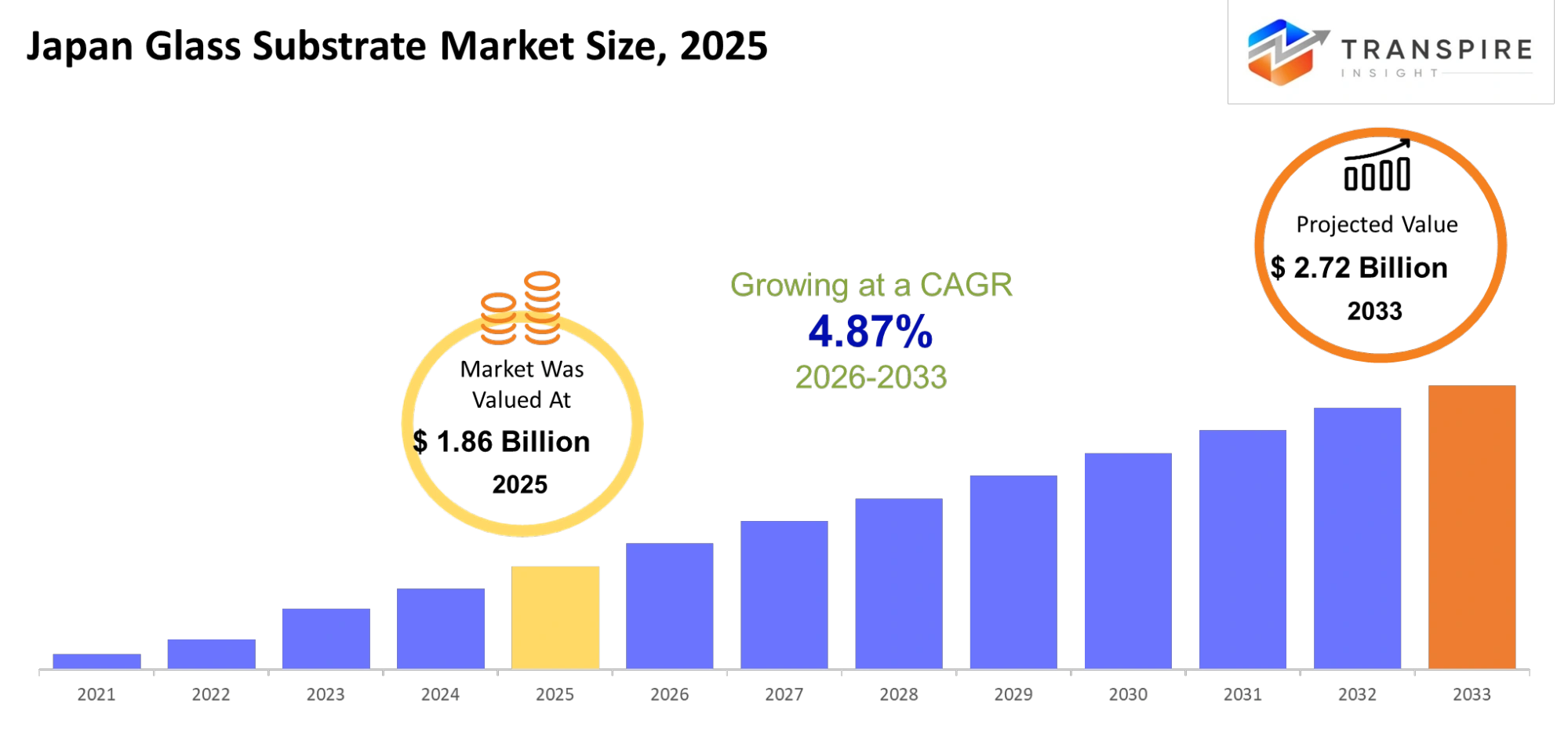
- Japan Glass Substrate Market Size 2025: USD 1.86 Billion
- Japan Glass Substrate Market Size 2033: USD 2.72 Billion
- Japan Glass Substrate Market CAGR: 4.87%
- Japan Glass Substrate Market Segments: By Type (Display Glass, Semiconductor Glass, Solar Glass, Optical Glass, Specialty Glass, Others); By Application (Consumer Electronics, Automotive, Solar Panels, Industrial Use, Optoelectronics, Semiconductor Packaging, Others); By End-User (Electronics Industry, Automotive Industry, Solar Industry, Semiconductor Industry, Industrial Firms, Display Manufacturers, Others); By Form (Sheets, Panels, Wafers, Coated Glass, Others)
To learn more about this report,  Download Free Sample Report
Japan Glass Substrate Market Summary
The Japan Erdheim Chester Disease Market was valued at USD 1.86 Billion in 2025. It is forecast to reachUSD 2.72 Billion by 2033. That is a CAGR of 4.87% over the period.
Japan’s glass substrate ecosystem supports electronic packaging and display technologies which serve as foundational components for semiconductor circuits and advanced AI hardware systems and automotive sensors and future display technologies. The industry has moved away from traditional organic laminates to adopt ultra-thin glass substrates because chip designs require improved thermal stability and reduced signal loss and better component integration.
The development of advanced packaging architectures which use chiplet-based designs has become a major structural change for the industry because glass interposers increase performance density. Japanese manufacturers developed domestic capacity when they faced semiconductor shortages during the pandemic and later restrictions on advanced chip supply chains which forced them to secure essential materials. The funding has shifted to scalable glass processing technologies which speed up their implementation in semiconductor packaging and high-resolution display production.
Key Market Insights
- The Japan Glass Substrate Market will see Eastern Japan as its dominant region because it will hold more than 40% of market share which exists becauseEastern Japan has semiconductor fabrication facilities and research and development centers.
- Western Japan emerges as the fastest-growing region through 2033, supported by electronics manufacturing expansion and supply chain decentralization strategies.
- The industrial clustering around Tokyo and Osaka innovation corridors supports the growth of the Japan Glass Substrate Market.
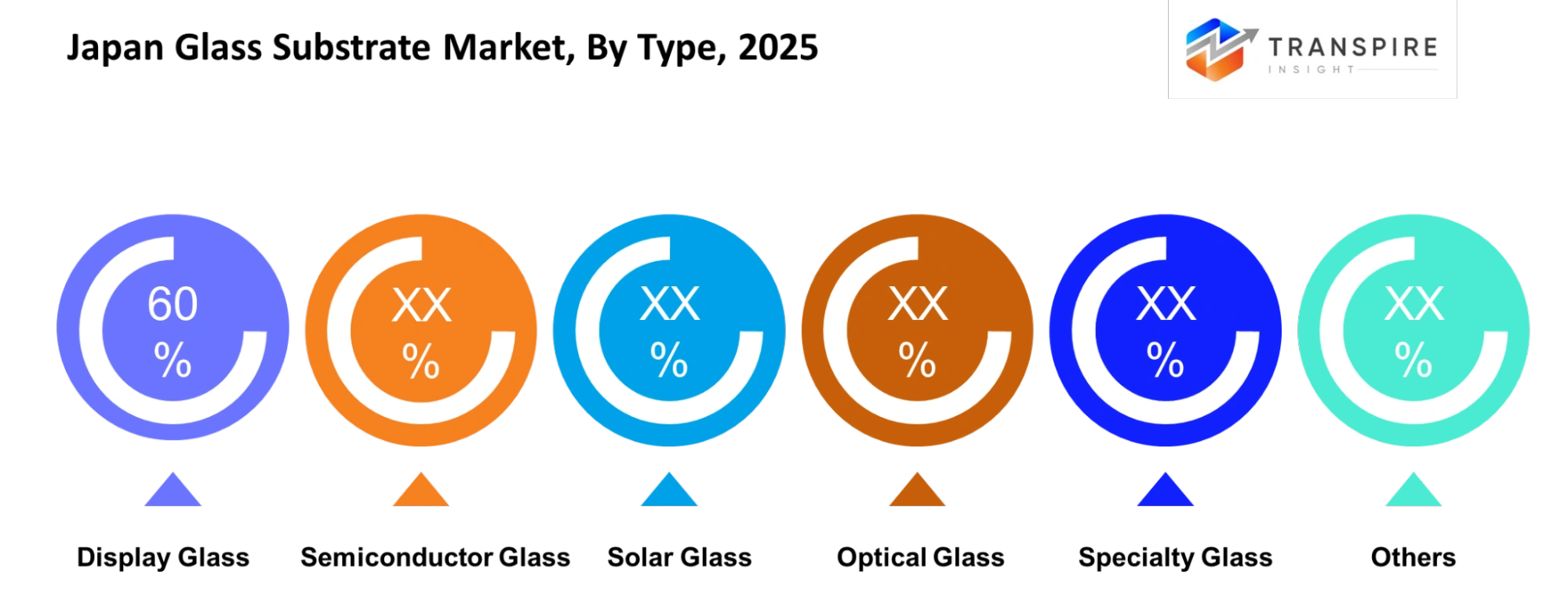
- The display glass substrate market segment controls approximately 45% of the market because it supplies high-resolution panels and consumer electronics manufacturers.
- The semiconductor glass interposers market segment will experience its fastest growth until 2033 because of the increased use of chiplet-based advanced packaging systems.
- The Japan Glass Substrate Market shows an increasing demand for ultra-thin glass solutions because these products provide better thermal stability and improved signal performance.
- The Japan Glass Substrate Market shows display applications as its main segment which controls 50% of the market because OLED and LCD manufacturing processes require glass substrates at that size.
- The semiconductor packaging industry develops as its main application because AI systems and HPC systems and miniaturized chip integration technologies continue to grow.
- The semiconductor foundries sector experiences the highest growth rate among end-user groups because it drives demand for innovative substrate technologies.
- Automotive OEMs increase their adoption of Japanese Glass Substrate Market solutions to develop electric vehicles and autonomous vehicles of the future.
What are the Key Drivers, Restraints, and Opportunities in the Japan Glass Substrate Market?
The Japan Glass Substrate Market develops through semiconductor packaging technologies which use chiplet integration and heterogeneous system design to create advanced packaging methods. Traditional silicon scaling reaches its performance limits because heat dissipation issues and signal interference problems function as critical system chokepoints. Glass substrates deliver exceptional dimensional stability together with minimal dielectric loss, which makes them vital components for high-density interposers used in AI accelerators and high-performance computing systems. The global supply chain disruptions which Japanese semiconductor manufacturers face have led to increased domestic operations, which result in higher revenue potential for precision glass processing and wafer-level packaging companies.
Ultra-thin glass products require complex manufacturing processes, which create difficulties for manufacturers to achieve defect-free production throughout their manufacturing operations. Manufacturing substrates with micron-level thickness requires manufacturers to achieve accurate thermal control and surface finishing together with yield management processes, which leads to increased production expenses. The structural barrier requires long-term capital funding together with step-by-step process improvements, which make it hard to find fast technological solutions. The restricted adoption of mid-tier electronics products, which require low-cost solutions, hinders revenue growth despite strong demand from premium product segments.
The Opportunity exists because glass substrates can be combined with upcoming AI server systems and 6G communication hardware. The ongoing pilot investments in advanced packaging facilities across Japan's industrial corridors demonstrate a shift towards producing high-end substrates in local facilities. Data center operators who demand increased bandwidth density will find glass interposers to be essential for developing expandable computing systems.
What Has the Impact of Artificial Intelligence Been on the Japan Glass Substrate Market?
Japan's glass substrate manufacturing system now uses artificial intelligence together with advanced digital technologies because these technologies create new methods for producing precision materials that semiconductor and display applications require. AI computer vision systems now function in production environments to detect defects on ultra-thin glass sheets because these systems identify micro-cracks and surface irregularities which traditional inspection methods cannot find. The automated quality control systems enable factories to decrease their need for manual inspections while they achieve consistent product yield throughout their high-volume production operations.
The thermal processing equipment and deposition chambers and etching systems now use predictive analytics models to estimate equipment degradation which enables maintenance scheduling before equipment failures happen. Continuous production cycles benefit from these improvements because they lead to higher operational uptime and decreased unplanned downtime. The manufacturing process results in enhanced throughput stability and decreased scrap rates for manufacturers who produce advanced packaging-grade substrates with extremely narrow tolerances.
Real-time AI process optimization adjusts furnace temperatures and coating parameters to improve energy efficiency while maintaining production quality and decreasing operational expenses. The high integration costs together with the restricted supply of high-quality ultra-thin glass defect datasets make it difficult for companies to adopt new technology. The presence of fragmented legacy systems in most facilities creates difficulties for organizations that want to implement artificial intelligence solutions across their entire operations. The industry experiences digital transformation at an accelerating pace but companies face challenges when they try to expand their operations throughout their entire organization.
Key Market Trends
- Japanese glass substrate manufacturing companies moved from laboratory-testing TGV prototypes during the period from 2023 to 2024 to start using their pilot production facilities in 2025 which helped them achieve faster commercial production that would deliver product samples in 2026.
- The semiconductor packaging market started to favor chiplet designs which AI and high-performance computing required so glass substrates became essential because they provided better interconnect performance and thermal stability than traditional organic materials.
- AGC and Nippon Electric Glass decided to concentrate on producing ultra-thin glass products which measure below 100 µm thickness because they observed an increasing demand from customers who wanted foldable displays and 5G/6G devices which would become popular after 2025.
- Japanese companies conducted panel-level packaging testing through their partnerships with Rapidus which used 600 mm glass panels to develop next-generation AI processors that needed more than wafer-scale technology.
- The industry required advanced dimensions stability standards because businesses needed to control all deformations which exceeded 20 microns through the implementation of alkali-free and fused silica glass material.
- The glass substrate market became more concentrated because the top five global companies which included Japanese manufacturers controlled more than 60 percent of industry revenues by 2025 which created higher obstacles for new competitors.
- Japanese glass manufacturing companies experienced severe price and energy challenges from glass fusion processes which led them to change their pricing strategies while halting their plans for complete production capacity because of rising product demand.
- The partnership between foundries and Japanese suppliers developed further because Intel AMD and Samsung accelerated their testing process which required Japanese suppliers to work with chip designers on substrate specification development instead of conducting their work alone.
- Japan introduced laser drilling and TGV formation breakthroughs which eliminated the need for chemical etching methods while increasing yield reliability and providing better via scaling capabilities for high-end packaging solutions.
Japan Glass Substrate Market Segmentation
By Type :
Display glass maintains its highest market standing because of its full integration with flat panel manufacturing and the strong need for high-resolution displays in all consumer electronics. Semiconductor glass retains its valuable market position because advanced chip manufacturing facilities need ultra-flat defect-free substrates which serve as essential components for next-generation chip production. The renewable deployment programs currently support solar glass which maintains a smaller market share yet experiences consistent growth.
Optical glass maintains steady demand because it serves essential roles in precision instruments and imaging systems and medical devices. Specialty glass develops gradually through its use in high-performance electronics and thermal-resistant applications while other product segments show limited development through their narrow market presence. Semiconductor glass growth expands through lithography precision and wafer-level requirements while display glass development occurs through continual panel upgrades which improve both visual quality and power efficiency.
Solar glass grows under renewable installation momentum but faces pricing constraints. Optical glass maintains its current market position through high-accuracy imaging systems while specialty glass develops through miniaturization requirements and durability demands. Future direction indicates stronger capital concentration in semiconductor and display glass which pushes suppliers towards developing defect control technologies and creating advanced fabrication capabilities. The need for high-performance material innovation will drive strategic shifts because commodity-heavy categories experience margin pressure.
To learn more about this report, Download Free Sample Report
By Application :
The primary demand for consumer electronics comes from ongoing manufacturing of smartphones and displays and connected devices which need specialized glass materials. The two sectors of semiconductor packaging and optoelectronics present high-growth opportunities because of their need for chip integration and sensing technology development. The automotive sector experiences continuous growth because of increasing electric vehicle use and rising demand for in-vehicle display systems. Solar panels provide a moderate energy output which increases due to clean energy development and industrial operations maintain constant power consumption through equipment and measurement tool requirements. The other applications remain divided into multiple parts which produce minimal output.
Application growth develops through the different technology intensities which benefit semiconductor packaging with 3D integration and AI chip requirements and optoelectronics through LiDAR and sensing technologies. The growth of consumer electronics depends on two factors which include how often customers replace their devices and the market penetration of OLED technology. The transition to digital cockpit systems and electric vehicle development provides benefits to automotive applications while solar panels monitor the growth of renewable energy infrastructure.
The future shows semiconductor packaging and optoelectronic systems will develop stronger growth which will direct value to high-functionality substrate materials. The consumer electronics market now shows stabilization which leads to increased demand for high-end product components. The automotive and solar sectors receive fundamental backing which leads suppliers to create products that combine multiple glass features and develop complete material solutions.
By End-User :
The electronics industry leads consumption because it has strong manufacturing ecosystems for device production and display technology development. The semiconductor industry requires high-value semiconductor products because of its complex fabrication processes and advanced packaging requirements. The automotive industry maintains its growth path because vehicles contain more electronic components than before. Display manufacturers provide essential panel production services, while the solar industry maintains continuous demand through its link to energy transition requirements. Industrial firms and other end-users remain comparatively smaller but stable.
The dominant role of semiconductors and the integration of electronics into supply chains determine how end-users operate. The automotive sector and solar industry benefit from electrification and energy diversification, while display manufacturers profit from high-resolution demand cycles. Industrial firms maintain their connection to capital investment patterns. The future prediction shows that semiconductor and electronics ecosystems will develop more concentrated structures that will enhance their capacity to drive material development. Automotive end-use shifts toward software-defined systems, raising substrate complexity requirements. Solar adoption expands but remains price sensitive. Investors and suppliers increasingly prioritize semiconductor and display ecosystems while aligning with vertically integrated end-user supply chains.
By Form:
The essential component of sheets derives from their extensive application throughout display panels and industrial settings. Consumer electronics and automotive display systems maintain their strong need for panel technology. Wafers represent a high-value segment essential for semiconductor processing and advanced chip architectures. Coated glass grows steadily through optical performance enhancement and energy-efficient applications. The other forms of glass development remain restricted because they lack unifying market demand and they exist as separate product lines.
The development process of form-based systems exists through two distinct paths for functional differentiation because wafers expand with semiconductor manufacturing and precise engineering requirements. Coated glass grows through energy efficiency requirements and advanced optical performance standards. The increasing use of panels in automotive and electronic displays brings advantages to manufacturers. Standard applications have created high usage of sheets in the market but manufacturers now face commoditization challenges.
The future outlook shows that technological advancements and performance requirements will increase wafer and coated glass segments value capture throughout the upcoming period. The automotive industry shows constant need for panels because of their ongoing integration into vehicles. Manufacturers develop sheets through two main pathways: cost reduction and enhanced functionality which drives them to improve their wafer technologies and coating methods to achieve competitive advantages in manufacturing.
What are the Key Use Cases Driving the Japan Glass Substrate Market?
Display electronics remains the core use case, driven by smartphones, televisions, and high-resolution panels that require ultra-flat designs and thermally stable materials. The market remains active because manufacturers keep developing display technology which enables them to produce slimmer devices that have better display quality and reduced power consumption for their products.
The automotive industry now adopts new use cases for both automotive electronic systems and semiconductor packaging technology. Automotive dashboards and infotainment systems and head-up displays now depend on precise glass components while semiconductor packaging technology uses advanced substrates to enable higher chip density and better thermal management in AI and high-performance computing systems.
Optoelectronics and advanced sensing systems used in industrial automation and mobility solutions represent emerging applications. The usage of LiDAR units and photonic devices and EV sensor modules is increasing because of more stringent accuracy standards and the new system designs which require high-stability glass platforms for their compact designs.
|
Report Metrics |
Details |
|
Market size value in 2025 |
USD 1.86 Billion |
|
Market size value in 2026 |
USD 1.95 Billion |
|
Revenue forecast in 2033 |
USD 2.72 Billion |
|
Growth rate |
CAGR of 4.87% from 2026 to 2033 |
|
Base year |
2025 |
|
Historical data |
2021 - 2024 |
|
Forecast period |
2026 - 2033 |
|
Report coverage |
Revenue forecast, competitive landscape, growth factors, and trends |
|
Country scope |
Japan |
|
Key company profiled |
Corning, AGC Inc, Nippon Electric Glass, SCHOTT, Saint-Gobain, Guardian Glass, NSG Group, Central Glass, Xinyi Glass, Asahi India Glass, Fuyao Glass, Flat Glass Group, Taiwan Glass, Sisecam, Pilkington |
|
Customization scope |
Free report customization (country, regional & segment scope). Avail customized purchase options to meet your exact research needs. |
|
Report Segmentation |
By Type (Display Glass, Semiconductor Glass, Solar Glass, Optical Glass, Specialty Glass, Others); By Application (Consumer Electronics, Automotive, Solar Panels, Industrial Use, Optoelectronics, Semiconductor Packaging, Others); By End-User (Electronics Industry, Automotive Industry, Solar Industry, Semiconductor Industry, Industrial Firms, Display Manufacturers, Others); By Form (Sheets, Panels, Wafers, Coated Glass, Others) |
Which Regions are Driving the Japan Glass Substrate Market Growth?
The Asia-Pacific region dominates the global market because it contains numerous semiconductor fabrication facilities and sophisticated display manufacturing systems. The four countries of Japan, South Korea, Taiwan, and China together create complete supply chain networks which enable glass substrate manufacturing and device production to operate effectively. The government establishes policies which support semiconductor industry independence and electronics manufacturing that depends on export markets to build up production capabilities for the future. The region benefits from supplier networks which maintain strong connections to each other, resulting in shorter delivery times and better material accuracy needed for advanced applications.
North America maintains its status as an ongoing contributor because robust semiconductor investment cycles operate together with continuous demand from both consumer electronics and defense-related products. The region achieves growth through capital-intensive reshoring programs together with corporate investment commitments which last for extended periods, in contrast to Asia-Pacific which develops its manufacturing capacity. The combination of federal funding programs and technology security regulations provides companies with essential backing to strengthen their domestic manufacturing operations. The system establishes a consistent need for advanced materials which find application in high-performance computing systems and specialized electronic equipment.
The fastest economic growth in Southeast Asia occurs because of increasing electronics assembly operations and semiconductor packaging plant construction activities. The countries of Vietnam, Malaysia and Thailand attract foreign investments because they offer lower operational costs and their companies pursue strategic supply chain diversification initiatives. The combination of new infrastructure developments together with industrial policies that promote export production creates an environment which drives companies to use cutting-edge manufacturing materials such as precision glass products. The time period from 2026 to 2033 will establish this region as the primary growth center which new businesses and investors will use to expand their operations beyond existing production facilities.
Who are the Key Players in the Japan Glass Substrate Market and How Do They Compete?
The Japan Glass Substrate Market shows moderate market consolidation because few established manufacturers control most of the valuable market resources. The market is dominated by AGC Inc., Nippon Electric Glass, HOYA Corporation, and Corning Incorporated because these companies maintain entrance barriers through their specialized skills in ultra-flat surface engineering and defect control and their extended semiconductor and display customer qualification processes. The assessment of competition depends on three factors which include material precision and yield stability and supply reliability over extended periods. The existing market players build their market position through two strategies which involve increasing production capacity for advanced semiconductor and display-grade substrates and establishing partnerships with device manufacturers who demand high-quality standards.
AGC Inc. focuses on large-scale material integration across display and semiconductor glass through its diversified production base, which enables the company to create both high-volume products and high-performance products. Nippon Electric Glass strengthens its position through its specialty glass expertise, particularly in high-precision display and optical applications, while shifting capacity toward higher-margin semiconductor substrates. The company competes with precision-driven optical components and semiconductor components through its cleanroom manufacturing capabilities, which it uses to produce photomask and high-end electronics products. Corning Incorporated establishes its unique position through its advanced specialty glass technologies, which it develops through its close cooperation with worldwide display manufacturers, while using long-term partnerships and licensing agreements to keep its position in premium substrate markets.
Company List
- Corning
- AGC Inc
- Nippon Electric Glass
- SCHOTT
- Saint-Gobain
- Guardian Glass
- NSG Group
- Central Glass
- Xinyi Glass
- Asahi India Glass
- Fuyao Glass
- Flat Glass Group
- Taiwan Glass
- Sisecam
- Pilkington
Recent Development News
Prompt: In April 2025, Nippon Electric Glass announced plans to develop and ship sample 510-mm glass substrates for high-performance semiconductor devices by as early as 2026. The move targets AI chip packaging applications, leveraging glass’s superior heat resistance and flatness compared to organic materials, positioning the company as a key supplier in next-generation semiconductor packaging.Source https://www.investing.com/
In December 2025, Dai Nippon Printing (DNP) launched a pilot production line for Through-Glass Via (TGV) glass core substrates at its Kuki Plant in Japan. The facility enables mass-production validation and is scheduled to begin sample shipments in early 2026, strengthening Japan’s role in advanced chiplet packaging substrates.Source https://www.trendforce.com/
What Strategic Insights Define the Future of the Japan Glass Substrate Market?
The Japan Glass Substrate Market will experience structural changes because semiconductor scaling and advanced display technologies create new material requirements which high-performance and ultra-precision materials will meet throughout the upcoming 5 to 7 years. The market now demands defect-free substrates which provide thermal stability through ultra-thin glass materials that manufacturers create for AI chips and heterogeneous integration and next-generation OLED and AR displays. The transition occurs because rising chip complexity creates shorter device integration cycles which require more advanced technologies than previous levels of production volume.
A less visible risk emerges from increasing concentration in a narrow group of qualified end-users which exposes suppliers to demand shocks if design architectures shift toward glass alternatives such as advanced polymers or hybrid substrates. The market for wafer-level glass in 3D semiconductor packaging presents a significant opportunity which has entered industrial adoption but is currently gaining traction because of AI and high-performance computing requirements.
Market participants should invest early in wafer-compatible processing technologies while establishing stronger co-development partnerships with semiconductor foundries to achieve design integration benefits that will last throughout time.
Japan Glass Substrate Market Report Segmentation
By Type
- Display Glass
- Semiconductor Glass
- Solar Glass
- Optical Glass
- Specialty Glass
By Application
- Consumer Electronics
- Automotive
- Solar Panels
- Industrial Use
- Optoelectronics
- Semiconductor Packaging
By End-User
- Electronics Industry
- Automotive Industry
- Solar Industry
- Semiconductor Industry
- Industrial Firms
- Display Manufacturers
By Form
- Sheets
- Panels
- Wafers
- Coated Glass
Frequently Asked Questions
Find quick answers to common questions.
The Japan Glass Substrate Market size is USD 2.72 Billion in 2033.
Key segments for the Japan Glass Substrate Market are By Type (Display Glass, Semiconductor Glass, Solar Glass, Optical Glass, Specialty Glass, Others); By Application (Consumer Electronics, Automotive, Solar Panels, Industrial Use, Optoelectronics, Semiconductor Packaging, Others); By End-User (Electronics Industry, Automotive Industry, Solar Industry, Semiconductor Industry, Industrial Firms, Display Manufacturers, Others); By Form (Sheets, Panels, Wafers, Coated Glass, Others).
Major Japan Glass Substrate Market players are Corning, AGC Inc, Nippon Electric Glass, SCHOTT, Saint-Gobain, Guardian Glass, NSG Group, Central Glass, Xinyi Glass, Asahi India Glass, Fuyao Glass, Flat Glass Group, Taiwan Glass, Sisecam, Pilkington.
The Japan Glass Substrate Market size is USD 1.86 Billion in 2025.
The Japan Glass Substrate Market CAGR is 4.87% from 2026 to 2033.
- Corning
- AGC Inc
- Nippon Electric Glass
- SCHOTT
- Saint-Gobain
- Guardian Glass
- NSG Group
- Central Glass
- Xinyi Glass
- Asahi India Glass
- Fuyao Glass
- Flat Glass Group
- Taiwan Glass
- Sisecam
- Pilkington
Recently Published Reports
-
Apr 2026
Healthcare Polymer Packaging Market
Healthcare Polymer Packaging Market Size, Share & Analysis Report By Packaging Type (Syringes, IV Bottles and Pouches, Clamshells, Blisters, Bottles & Jars, Containers, Tubes, IV Parental Packaging, Others), By Type (Regulated, Non-regulated), By Polymer Type (LDPE (Low-Density Polyethylene), HDPE (High-Density Polyethylene), Homo-polymer (Homo), Random Copolymer (Random), Block Copolymer (Block), PET, Polystyrene, Polyvinyl Chloride, Polyamide/EVOH, Others), and Geography (North America, Europe, Asia-Pacific, Middle East and Africa, South and Central America), 2021 - 2031
-
Apr 2026
Hydrophilic Tape (Waterstop) Market
Hydrophilic Tape (Waterstop) Market Size, Share & Analysis Report By Type (Bentonite-Based Hydrophilic Tape, Rubber-Based Hydrophilic Tape), By Application (Residential Buildings, Commercial Buildings, Infrastructure Projects), and Geography (North America, Europe, Asia-Pacific, Middle East and Africa, South and Central America), 2021 - 2031
-
Apr 2026
Metalens Market
Metalens Market Size, Share & Analysis Report By Type (Visible Light Metalens, and Infrared Metalens), By Application (Consumer Electronics, Automotive Electronics, Industrial, Medical, and Others), and Geography (North America, Europe, Asia-Pacific, Middle East and Africa, South and Central America), 2021 - 2031
-
Apr 2026
PBT Resin Market
PBT Resin Market Size, Share & Analysis Report By Type (Reinforced PBT Resin, Unreinforced PBT Resin), By Processing Method (Injection Molding, Extrusion, Blow Molding, Others), By End-User (Automotive, Electrical & Electronics, Consumer Appliances, Industrial Machinery, Medical Devices, Packaging, Others), and Geography (North America, Europe, Asia-Pacific, Middle East and Africa, South and Central America), 2021 - 2031