
South Korea Potato Protein Market Summary
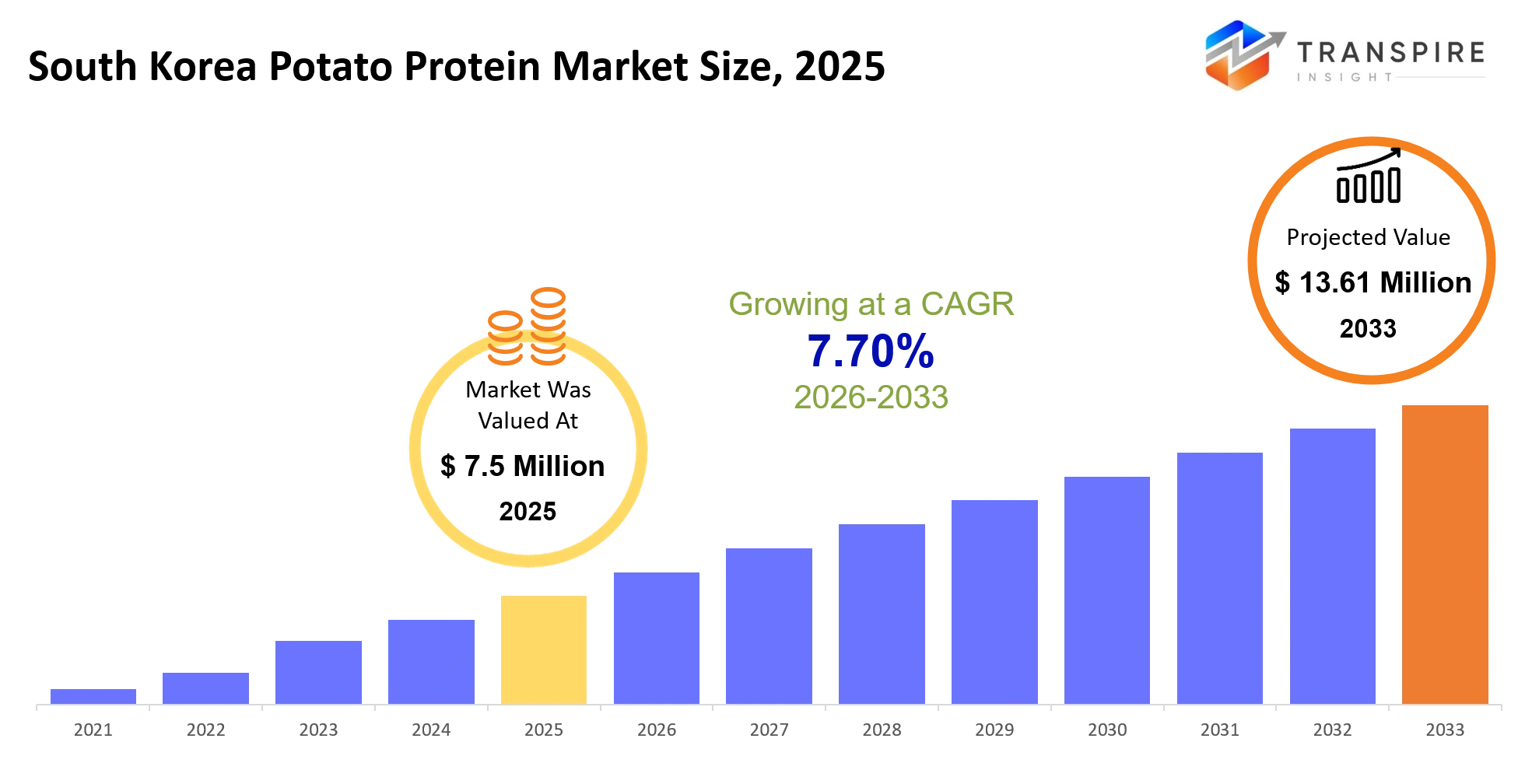
As per Transpire Insight Analysis the South Korea Potato Protein Market size is estimated at USD 20.8 Million in 2025 and is anticipated to reach USD 13.61 Million by 2033, growing at a CAGR of 7.70% from 2026 to 2033.
The South Korea potato protein market provides concentrated plant derived protein ingredients for food, nutrition, feed, and those specialty formulations that need a bit more control, helping manufacturers boost protein levels texture and binding while also strengthening product positioning—so they are not stuck using animal based sources or soy proteins all the time. In day to day use, potato protein works across meat alternatives, sports nutrition, bakery items, functional foods, and a few targeted feed uses too, depending on what the buyer is aiming for. Over the last 3–5 years there’s been a kind of structural drift, from simple plant protein replacement toward higher functionality inputs, and Korean makers are actively looking for proteins that bring both nutritional value and processing advantages. A big push behind this was the wider growth of high protein food production, which climbed 24% in 2024 to KRW 568.8 billion, per MFDS records. At the same time Korea’s food manufacturing footprint grew, and Korean food and beverage product sales rose 17.1% in 2024. Put together, these trends make wider ingredient adoption easier and open revenue chances for suppliers that can deliver functional, high purity and application specific potato protein.
South Korea Potato Protein Market Size & Forecast:
- South Korea Potato Protein Market Size 2025: USD 7.5 Million
- Expected Market Value 2033: USD 13.61 Million
- Forecast CAGR: 7.70%
- Leading region in 2025:
- Fastest Growing region:
- Key Profile: Avebe, KMC Ingredients, Royal Agrifirm Group, Roquette Frères, Tereos Group, Emsland Group, AGRANA Beteiligungs AG, Sudstärke GmbH, AKV Langholt, PPZ Niechlow, Lyckeby Starch AB, Meelunie B.V., Brenntag SE, Cargill Inc., Ingredion Incorporated.
Key Market Insights
- The South Korea potato protein market is kind of shifting away from just basic protein supplementation toward functional formulations that deliver texture, binding, emulsification, and also nutritional upsides, you know.
- In 2024, high-protein food production grew 24% , and that’s helping commercial opportunities for concentrated plant-protein ingredients look a lot stronger than before.
- At the same time, food and beverage manufacturing sales rose 17.1% in 2024 , so industrial channels for specialized protein ingredients are getting more space.
- Avebe, through PerfectaMAR®, expanded potato-protein applications for better surimi texture , and it launched commercially across Asia in 2024.
- Also, alternative-meat consumption has moved past soy - centric formulations, which creates room for potato protein inside blended systems and other application specific protein setups.
- Food manufacturers are increasingly preferring functional ingredients that improve texture and processing performance, alongside the protein enrichment part, so the value per kilogram tends to go up.
- Meanwhile, Gyeonggi’s manufacturing base is becoming more strategically important as Korean policy channels push smart-factory investment toward regional food-processing operations.
- MFDS food-labeling rules keep stressing ingredient, nutrition, origin, and product details, which means ingredient suppliers face more documentation work.
- Potato protein suppliers are going beyond conventional concentrates and are also pushing into isolates, hydrolyzed ingredients, instantized powders, and customized formulations that match specific processing needs.
- Overall, competitive advantage is sliding toward suppliers who can combine extraction technology, application laboratories, formulation support, reliable import channels, and long-term partnerships with Korean food manufacturers.
What are the Key Drivers, Restraints, and Opportunities in the South Korea Potato Protein Market?
Driver: The most powerful growth driver is Korea’s drift toward high-protein food formulation, and sort of functional plant ingredients too. MFDS said there was a 24% jump in high-protein product production in 2024, hitting KRW 568.8 billion. Potato protein gains from this shift because concentrated inputs let manufacturers lift protein levels while still keeping texture stable, plus overall formulation performance. In practice the commercial effect doesn’t just stop at meat alternatives it can spill into sports nutrition, functional foods, bakery items, and more specialized formulation needs.
Restraint: One of the core structural restraints is the limited domestic production capacity for specialized potato protein ingredients. Because of this Korean manufacturers lean heavily on imported ingredients, so procurement teams get dragged into freight charges, exchange-rate swings lead times that vary, and also supplier qualification expectations. This import dependence can, in turn, make it harder for smaller food manufacturers to adopt premium protein grades since landed ingredient pricing is less predictable than locally sourced conventional proteins.
Opportunity: Application-specific protein systems look like the clearest expansion path. Avebe’s PerfectaMAR® is a good illustration, using potato protein to enhance surimi texture while needing a lower dosage than certain animal-protein alternatives. Also, Korean food-tech investment sets up better conditions for formulation work, and MAFRA is allocating KRW 28.5 billion across five years starting 2024 for agri-food and food-tech research programs that include AI, biotechnology, smart manufacturing, and food upcycling.
What Has the Impact of Artificial Intelligence Been on the South Korea Potato Protein Market?
Artificial intelligence is starting to affect potato-protein production, largely because Korean food processing keeps moving toward smart manufacturing, kinda in a wider adoption way. With AI-enabled manufacturing platforms, they can pull together sensor outputs from extraction, filtration, drying, milling, and also the packaging units, and then figure out abnormal operating conditions before you get a quality failure. In practice predictive models can watch temperature, pressure, moisture, flow rate, and even energy-use patterns so that preventive maintenance happens earlier. This is also tied to more consistent powder specifications, at least when the line is tuned well.
Korea’s industrial policy is basically aiming for manufacturing-site AI deployment to jump from 5% up to 40% by 2030, which signals a major expansion of industrial AI infrastructure. On top of that, government-backed smart-factory programs offer direct support to food manufacturers too, for example KRW 4 billion for 50 food factories in Gyeongbuk during 2025. So it’s not just talk , there is funding attached.
In the day to day, AI can help with batch consistency, cut down on unplanned downtime, and also optimize drying conditions. It can strengthen traceability across ingredient production as well, since the system can log the right parameters over time. Korean autonomous-manufacturing initiatives often point to productivity increases of more than 30%, plus fewer costs, fewer defects, and lower energy consumption across participating industrial projects. For potato-protein processors, similar digital controls could help keep protein purity tighter and moisture specifications steadier, while reducing production losses. The big catch, though, is integration cost because smaller ingredient processors might not have enough historical process datasets, connected equipment that actually sends usable signals, or specialist AI staff needed for dependable model deployment.
Key Market Trends
- Since 2021, Korean manufacturers have sort of leaned more toward functional plant proteins that deliver texture and processing benefits, while also doing protein enrichment, kinda together.
- In 2024, high-protein product production jumped 24% , which really boosted commercial interest in concentrated protein ingredients across nutrition categories.
- Meanwhile Korean food and beverage manufacturing sales grew 17.1% in 2024, that expanded the industrial runway for specialty ingredient suppliers, without much delay.
- Since 2024, potato protein innovation has widened into seafood analogues too, with Avebe bringing PerfectaMAR® into surimi uses.
- Plant-protein formulation has also moved away from single-source proteins toward blended systems, aimed at better texture, nutrition , stability, and processing performance all at once.
- Since 2024, Korean food-tech programs have placed more weight on AI, IoT, biotechnology, smart manufacturing, and food-processing automation.
- Smart-factory support expanded in 2025, including regional funding for 50 food factories in Gyeongbuk and 40 companies in Jeonnam, and yes it matters.
- Food manufacturers are requiring more detailed ingredient documentation, because Korean labeling standards now emphasize composition , nutrition, origin, plus product information.
- At the 2025 Seoul Food exhibition , there were 1,639 companies from 45 countries, and that keeps reinforcing Korea’s position as a strategic B2B food-ingredient market.
- Supplier competition is also shifting, moving toward technical formulation support, customized grades, Asian partnerships, and application-specific product development rather than price alone.
South Korea Potato Protein Market Segmentation
By Product Type
Potato Protein Isolates give you a higher protein concentration for sports nutrition, functional foods, and those specialized formulations that need tightly controlled nutritional specs. Potato Protein Concentrates feel like the more economical path for food or feed recipes, where a moderate protein lift is enough to hit the target performance. Hydrolyzed Potato Protein, on the other hand, is aimed at use cases where better solubility matters and it becomes easier to blend into the final matrix. Organic Potato Protein is basically for certified organic product lines, so the sourcing and the claims stay aligned. Conventional Potato Protein still stays in the picture too, especially in cost focused industrial settings, and for well established food formulations that just work.
Now, Functional Potato Protein has a lot of promise because texture, binding capability, emulsification, and overall stability can contribute more value than protein content alone. Feed Grade Protein fits animal nutrition, while Food Grade Protein goes into human food manufacturing, under controlled quality expectations. Pharmaceutical Grade Protein needs even stricter purity, plus stronger documentation records, for those specialized formulations. And then there’s Others , which includes customized grades and protein blends made for a specific application depending on what each manufacturer needs.
By Application
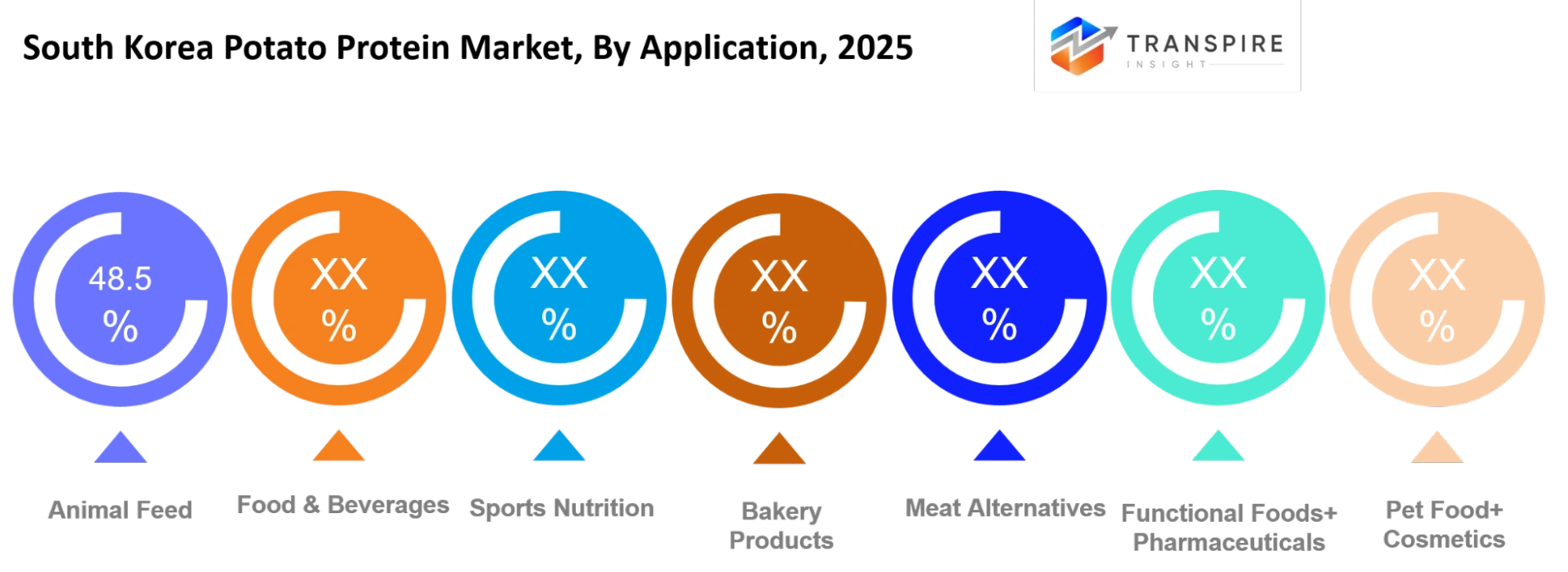
Animal Feed is kind of an established outlet where potato protein can add nutritional value inside made-to-measure diets, mostly when formulators are trying to hit specific targets. Food & Beverages is a big commercial route too, because manufacturers can slot potato protein into protein enriched foods , drinks, bakery products, and plant based formulations, it feels pretty broad. Sports Nutrition works well with concentrated protein formats, like powders and other nutrition products, including high protein blends meant for performance goals. Bakery Products lean on protein ingredients for nutritional lift and also for formulation stability, and then Meat Alternatives use potato protein in combinations built to support structure and texture.
Functional Foods basically open doors for everyday protein boosted choices, while Pharmaceuticals usually demand very controlled ingredient specifications , no surprises. Pet Food shows up again as a specialized use case where protein quality and formulation flexibility still matter a lot. Cosmetics may take selected potato-derived protein ingredients for specialty formulations, and Others just covers new and upcoming options where you want customized functional behavior or nutritional traits.
By Form
Powder remains the most practical form for ingredient handling , storage, blending and industrial formulation. Liquid formats fit selected processing systems where direct dispersion or wet-stage incorporation helps manufacturing efficiency, and really it can be quite convenient. Granules give controlled handling traits, while Concentrates bring higher protein density for use cases that need efficient ingredient loading. Spray-Dried products tend to offer better stability and are easier to fold into dry formulations, especially when you want consistent results.
Instantized Powder supports faster dispersion in nutrition and beverage applications, meanwhile Blended Formulations mix potato protein with other proteins or functional ingredients, in order to reach targeted performance. Pellets can support selected feed applications that need controlled physical handling. Customized Formulations let suppliers fine-tune particle size, solubility, protein concentration, or functional attributes based on manufacturer specifications.
Other formats cover specialized physical options designed for niche processing requirements, and sometimes the naming is a bit flexible depending on the supplier.
By End User
Food Manufacturers count as a big customer segment because potato protein really helps with protein enrichment and that texture improvement thing, plus it supports formulation development across a lot of processed food categories. Animal Feed Producers typically rely on feed grade ingredients inside formulated nutritional products. Nutraceutical Companies usually look for concentrated proteins, for nutrition and wellness related formulations. Pharmaceutical Companies run under tougher standards around purity, consistency, paperwork documentation, and general quality requirements for specialized ingredient use. Cosmetic Manufacturers are smaller in number but still matter a bit technically for protein containing personal care formulations.
Pet Food Companies may select certain protein grades for specialized nutrition products. Research Institutes also play a role through product development, ingredient testing, and application research. Contract Manufacturers can provide the formulation and production capacity for brands that do not have big internal manufacturing assets. Agricultural Companies can join in via feed, crop linked processing and ingredient development activities. Others, includes specialized processors, laboratories, and application development organizations.
By Distribution Channel
Direct Sales still stays relevant for big food manufacturers, especially when they need technical specifications , long-term supply agreements, quality documentation, and that kind of formulation help. Ingredient Distributors give smaller buyers a way into the market, and they also take away some of the logistical burden that can come with imported specialty proteins. Online B2B channels are now showing more weight because ingredient buyers end up comparing specifications, suppliers, certifications, and commercial terms in a digital way. Wholesalers help with wider inventory access, meanwhile Specialty Suppliers tend to concentrate on technical grades and ingredients that match specific applications.
Retail Stores are kinda limited for industrial potato protein but they can still matter for small-scale nutrition and certain specialty-product demand. Importers keep counting because specialized protein supply is strongly tied to what international producers can deliver. Exporters back cross-border ingredient movement and regional supply networks, and Industrial Suppliers usually serve larger manufacturing accounts that need reliable bulk delivery. “Others” covers brokers, sourcing platforms, and specialized procurement channels, those that support more niche commercial needs.
What are the Key Use Cases Driving the South Korea Potato Protein Market?
Food and beverage manufacturing, honestly it’s kinda the main use case, and it’s being backed by protein enhanced foods, plant based formulations, bakery items, and nutrition products too. Potato protein is able to deliver concentrated protein, but it also brings along some useful functional properties. That means manufacturers can strengthen their nutritional positioning without having to rely only on animal sources or soy proteins, which is kinda the big point.
For high protein product production, the numbers got to KRW 568.8 billion in 2024 after a 24% annual increase. This, sort of, underlines how commercially important protein focused formulation has become, not just as a trend.
Sports nutrition and functional foods are another place where food manufacturers and nutraceutical companies keep finding room to grow. With powdered and instantized formats, you can build protein drinks, nutrition mixes and other handy high protein products. And functional grades can help in texture and overall processing performance. On top of that, Korean food tech investment is also pushing more sophisticated formulation and manufacturing capabilities.
Then there are the emerging uses, like seafood analogues, pet nutrition, specialized pharmaceutical formulations, and even customized protein blends. Avebe’s PerfectaMAR® shows commercial promise for Asian surimi production, mainly by improving texture with a relatively low dosage. With this kind of application specific development, potato protein can move beyond the usual food uses and open up higher value ingredient opportunities, all the way through 2033.
|
Report Metrics |
Details |
|
Market size value in 2025 |
USD 7.5 Million |
|
Market size value in 2026 |
USD 8.1 Million |
|
Revenue forecast in 2033 |
USD 13.61 Million |
|
Growth rate |
CAGR of 7.70% from 2026 to 2033 |
|
Base year |
2025 |
|
Historical data |
2021 - 2024 |
|
Forecast period |
2026 - 2033 |
|
Report coverage |
Revenue forecast, competitive landscape, growth factors, and trends |
|
Regional scope |
United States; Canada; Mexico; United Kingdom; Germany; France; Italy; Spain; Denmark; Sweden; Norway; China; Japan; India; Australia; South Korea; Thailand; Brazil; Argentina; South Africa; Saudi Arabia; United Arab Emirates |
|
Key company profiled |
Avebe, KMC Ingredients, Royal Agrifirm Group, Roquette Frères, Tereos Group, Emsland Group, AGRANA Beteiligungs AG, Sudstärke GmbH, AKV Langholt, PPZ Niechlow, Lyckeby Starch AB, Meelunie B.V., Brenntag SE, Cargill Inc., Ingredion Incorporated. |
|
Customization scope |
Free report customization (country, regional & segment scope). Avail customized purchase options to meet your exact research needs. |
|
Report Segmentation |
By Product Type (Potato Protein Isolates, Potato Protein Concentrates, Hydrolyzed Potato Protein, Organic Potato Protein, Conventional Potato Protein, Functional Potato Protein, Feed Grade Protein, Food Grade Protein, Pharmaceutical Grade Protein, Others); By Application (Animal Feed, Food & Beverages, Sports Nutrition, Bakery Products, Meat Alternatives, Functional Foods, Pharmaceuticals, Pet Food, Cosmetics, Others); By Form (Powder, Liquid, Granules, Concentrates, Spray-Dried, Instantized Powder, Blended Formulations, Pellets, Customized Formulations, Others); By End User (Food Manufacturers, Animal Feed Producers, Nutraceutical Companies, Pharmaceutical Companies, Cosmetic Manufacturers, Pet Food Companies, Research Institutes, Contract Manufacturers, Agricultural Companies, Others); By Distribution Channel (Direct Sales, Ingredient Distributors, Online B2B, Wholesalers, Specialty Suppliers, Retail Stores, Importers, Exporters, Industrial Suppliers, Others). |
Which Regions are Driving the South Korea Potato Protein Market Growth?
The Seoul Capital Area, sort of covering Seoul, Gyeonggi and Incheon, still comes out as the top commercial zone because it stacks food manufacturers with ingredient buyers, R&D organizations, and distribution networks together. Korea’s food and beverage manufacturing space saw a 17.1% product sales increase in 2024, which ends up building a solid customer base for specialty protein ingredients. Also the region has the advantage of being close to major logistics infrastructure, so imported potato-protein suppliers can serve formulation and manufacturing customers more efficiently. On top of that, smart-factory programs add to the loop by backing automation, production systems and quality improvements among food-processing companies, kind of tightening everything.
Chungcheong, meanwhile, gives a different kind of growth base, since it’s more about food-processing and agricultural production activity than metropolitan consumer access. Manufacturing companies there can tap into national food-tech programs, smart-factory funding, and shorter links with agricultural supply chains. Korea is also growing the cumulative count of participating food-manufacturing smart facilities from 30 in 2024 up to 187 by 2026, helping processors keep production more consistent and use ingredients more effectively. Between available industrial land, solid food-processing capacity, and ongoing tech investment, Chungcheong ends up acting as a stable contributor as manufacturers scale specialized protein formulations.
Busan and the southeastern industrial belt look like they hold the strongest near-term growth momentum, since food-processing infrastructure is becoming more connected with smart-production and stricter food-safety controls.
Who are the Key Players in the South Korea Potato Protein Market and How Do They Compete?
Competition in South Korean potato-protein market is kind of mostly specialized and push for innovation rather than just about cheap prices. European suppliers still seem to hold an edge thanks to long-standing potato-processing knowledge, tighter control over agricultural sourcing, steady product quality, and also that practical application know-how. Meanwhile distributors give the local route to market that Korean manufacturers need, even if their role is more commercial than technical. In the end, the most noticeable differentiation is shifting toward functional performance and formulation support, plus traceability and the ability to develop ingredients for specific uses— not so much protein volume alone.
Avebe stands out through functional potato-protein development and what you could call customer-led application research. PerfectaMAR®, created for surimi, shows how Avebe turns potato protein into a specialized ingredient with texture and gel-strength advantages, and there was also South Korean research involved in the development path, even if it wasn’t fully public. KMC Ingredients leans into formulation performance too, using its Innovation Center to collaborate closely with food developers, and it provides potato protein sourced from non-GMO Danish potatoes, with documented provenance. KMC and Avebe also teamed up with researchers at DTU and Aarhus University within the REFINES project, aiming to handle potato-protein off-flavors, which could make these ingredients more suitable for higher-value food applications later.
Emsland Group competes with specialized animal-nutrition offerings, like Empet® coagulated potato proteins, while Roquette Frères works from broader plant-protein capabilities to expand its textured-protein lineup.
Company List
- Avebe
- KMC Ingredients
- Royal Agrifirm Group
- Roquette Frères
- Tereos Group
- Emsland Group
- AGRANA Beteiligungs AG
- Sudstärke GmbH
- AKV Langholt
- PPZ Niechlow
- Lyckeby Starch AB
- Meelunie B.V.
- Brenntag SE
- Cargill Inc.
- Ingredion Incorporated
Recent Development News
"In January 2025, Emsland Group entered a strategic distribution partnership with UniBourne Food Ingredients. The agreement, effective January 1, 2025, expanded Emsland's potato-based ingredient portfolio reach among Indian food manufacturers and strengthened its wider Asian distribution capabilities."
Source: http://www.potatopro.com/topics/potato-protein ([PotatoPro]).
"In March 2025, Brenntag Specialties expanded its strategic partnership with Royal Avebe to Poland. The agreement added Avebe's potato starch and derivatives to Brenntag's Polish Food & Nutrition portfolio, strengthening distribution coverage for potato-based ingredients."
Source: https://corporate.brenntag.com/en/media/news/brenntag-specialties-and-royal-avebe-further-expand-their-strategic-partnership-for-food-and-nutrition-to-poland.html ([Brenntag]).
"In September 2025, KMC Ingredients and Royal Avebe entered a research partnership with DTU and Aarhus University. The REFINES project targets enzymatic removal of potato-protein off-flavors, with the potential to improve food applications and increase the commercial value of potato-protein side streams."
Source: https://projects.au.dk/plant2food/activities/item/artikel/two-competitors-one-shared-challenge ([Plant2Food, Aarhus University]).
What Strategic Insights Define the Future of the South Korea Potato Protein Market?
South Korea potato protein market feels like it is structurally shifting toward higher value functional ingredients, not just commodity protein supply, mostly because food manufacturers want that better texture and nutrition, plus clearer allergen positioning, and even faster formulation workflow efficiency. There’s also a less obvious risk sitting in the background, supplier and raw material concentration. In practice, Korean buyers lean quite a lot on overseas potato protein producers, so any crop volatility or freight disruption, and currency swings, or European production constraints could push landed costs up pretty fast, even without warning.
At the same time, there is a more meaningful emerging opportunity, application specific proteins for seafood alternatives and functional foods. This matters a lot, especially because Korean food manufacturers are tying protein innovation together with their existing seafood processing know how. Avebe’s PerfectaMAR® already kind of shows the commercial logic here, using potato protein to improve surimi texture at a low dosage, which is not small. So market participants should treat this as a technical game as much as a commercial one, prioritize partnerships with Korean processors, build multi supplier sourcing plans, and run localized formulation trials instead of trying to win mostly on ingredient price.
South Korea Potato Protein Market Report Segmentation
By Product Type
• Potato Protein Isolates
• Potato Protein Concentrates
• Hydrolyzed Potato Protein
• Organic Potato Protein
• Conventional Potato Protein
• Functional Potato Protein
• Feed Grade Protein
• Food Grade Protein
• Pharmaceutical Grade Protein
• Others
By Application
• Animal Feed
• Food & Beverages
• Sports Nutrition
• Bakery Products
• Meat Alternatives
• Functional Foods
• Pharmaceuticals
• Pet Food
• Cosmetics
• Others
By Form
• Powder
• Liquid
• Granules
• Concentrates
• Spray-Dried
• Instantized Powder
• Blended Formulations
• Pellets
• Customized Formulations
• Others
By End User
• Food Manufacturers
• Animal Feed Producers
• Nutraceutical Companies
• Pharmaceutical Companies
• Cosmetic Manufacturers
• Pet Food Companies
• Research Institutes
• Contract Manufacturers
• Agricultural Companies
• Others
By Distribution Channel
• Direct Sales
• Ingredient Distributors
• Online B2B
• Wholesalers
• Specialty Suppliers
• Retail Stores
• Importers
• Exporters
• Industrial Suppliers
• Others
Frequently Asked Questions
Find quick answers to common questions.
The expected South Korea Potato Protein Market size for the market will be USD 13.61 Million in 2033.
Key segments for the South Korea Potato Protein Market are By Product Type (Potato Protein Isolates, Potato Protein Concentrates, Hydrolyzed Potato Protein, Organic Potato Protein, Conventional Potato Protein, Functional Potato Protein, Feed Grade Protein, Food Grade Protein, Pharmaceutical Grade Protein, Others); By Application (Animal Feed, Food & Beverages, Sports Nutrition, Bakery Products, Meat Alternatives, Functional Foods, Pharmaceuticals, Pet Food, Cosmetics, Others); By Form (Powder, Liquid, Granules, Concentrates, Spray-Dried, Instantized Powder, Blended Formulations, Pellets, Customized Formulations, Others); By End User (Food Manufacturers, Animal Feed Producers, Nutraceutical Companies, Pharmaceutical Companies, Cosmetic Manufacturers, Pet Food Companies, Research Institutes, Contract Manufacturers, Agricultural Companies, Others); By Distribution Channel (Direct Sales, Ingredient Distributors, Online B2B, Wholesalers, Specialty Suppliers, Retail Stores, Importers, Exporters, Industrial Suppliers, Others).
Major South Korea Potato Protein Market players are Avebe, KMC Ingredients, Royal Agrifirm Group, Roquette Frères, Tereos Group, Emsland Group, AGRANA Beteiligungs AG, Sudstärke GmbH, AKV Langholt, PPZ Niechlow, Lyckeby Starch AB, Meelunie B.V., Brenntag SE, Cargill Inc., Ingredion Incorporated.
The South Korea Potato Protein Market size is USD 7.5 Million in 2025.
The South Korea Potato Protein Market CAGR is 7.70% from 2026 to 2033.
- Avebe
- KMC Ingredients
- Royal Agrifirm Group
- Roquette Frères
- Tereos Group
- Emsland Group
- AGRANA Beteiligungs AG
- Sudstärke GmbH
- AKV Langholt
- PPZ Niechlow
- Lyckeby Starch AB
- Meelunie B.V.
- Brenntag SE
- Cargill Inc.
- Ingredion Incorporated
About the Authors

Chetan Dhatrak
I’m Chetan Dhatrak, a Senior Research Analyst at Transpire Insight, specializing in the Consumer Goods, Foods and Beverages industry. I focus on analyzing market trends, consumer behavior, competitive landscapes, and industry developments to deliver accurate, data-driven insights. My research at Transpire Insight is built on credible sources and in-depth analysis, helping businesses and readers better understand market dynamics, emerging opportunities, and evolving consumer preferences. I’m committed to creating reliable, well-researched content that supports informed decision-making and reflects the latest developments in the consumer goods and food & beverage sectors.

Chakradhar Khansole
Chakradhar serves as the Research Director at Transpire Insight, bringing over 8 years of experience in technology, innovation, and strategic market intelligence. He specializes in transforming complex market data into actionable business insights that enable organizations to make informed, growth-oriented decisions. Recognized for his strategic vision and analytical expertise, Chakradhar leads high-impact research initiatives, delivering comprehensive market assessments, competitive intelligence, and forward-looking industry analysis.
Recently Published Reports
-
Apr 2026
Baby Infant Formula Market
Baby Infant Formula Market Size, Share & Analysis Report By ype (Infant Milk, Follow On Milk, Specialty Baby Milk, Growing-Up Milk), By Ingredient (Carbohydrate, Fat, Protein, Minerals, Vitamins, and Others), By Product Form (Powder, Liquid, and Ready-to-feed), By Distribution Channels (Supermarket/Hypermarket, Specialty Store, Pharmacies, Online Retail, and Others), and Geography (North America, Europe, Asia-Pacific, Middle East and Africa, South and Central America), 2021 - 2031
-
Apr 2026
Edible Insects for Animal Feed Market
Edible Insects for Animal Feed Market Size, Share & Analysis Report By Type (Insect Powder, Insect Meal, Insect Bar, Insect Paste, Insect Oil, and Others), By Insect Type (Beetles, Cricket, Caterpillar, Hymenoptera, Orthoptera, Tree Bugs, and Others), By Application (Livestock, Pet Food, and Aquaculture), By Livestock Type (Poultry, Swine, and Others), and Geography (North America, Europe, Asia-Pacific, Middle East and Africa, South and Central America), 2021 - 2031
-
Apr 2026
Food Industry Disinfection and Bacterial Control Market
Food Industry Disinfection and Bacterial Control Market Size, Share & Analysis Report By Type (Chemical Disinfectants, Physical Disinfectants, and Biocides and Antimicrobials), By Application (Food Processing Equipment Surface Disinfection, Food Preparation Areas Surface Disinfection, Storage Areas Surface Disinfection, Anti-microbial Coatings Food Preservation, and Preservative Solutions Food Preservation), By End User (Meat and Poultry Processing, Dairy Processing, Seafood Processing, Bakery and Confectionery, Restaurants and Commercial Kitchens, and Food Service Providers), By Sales Channel (Online, Offline), and Geography (North America, Europe, Asia-Pacific, Middle East and Africa, South and Central America), 2021 - 2031
-
May 2026
Freeze Dried Food Market
Freeze Dried Food Market Size, Share & Analysis Report By Product Type (Fruits, Vegetables, Freeze-Dried Dairy Products, Freeze-Dried Meat and Seafood, Freeze-Dried Pet Food, and Prepared Meal), By Nature (Organic, and Conventional), By Form (Powdered, Granules, and Diced), By End Use (Breakfast Cereals, Dairy Products, Bakery & Confectionery, Nutritional Bars & Supplements, Powdered Beverages, Snacks, and Retail (Household)), and Geography (North America, Europe, Asia-Pacific, Middle East and Africa, South and Central America), 2021 - 2031