

Global Animal Feed Market Size & Forecast:
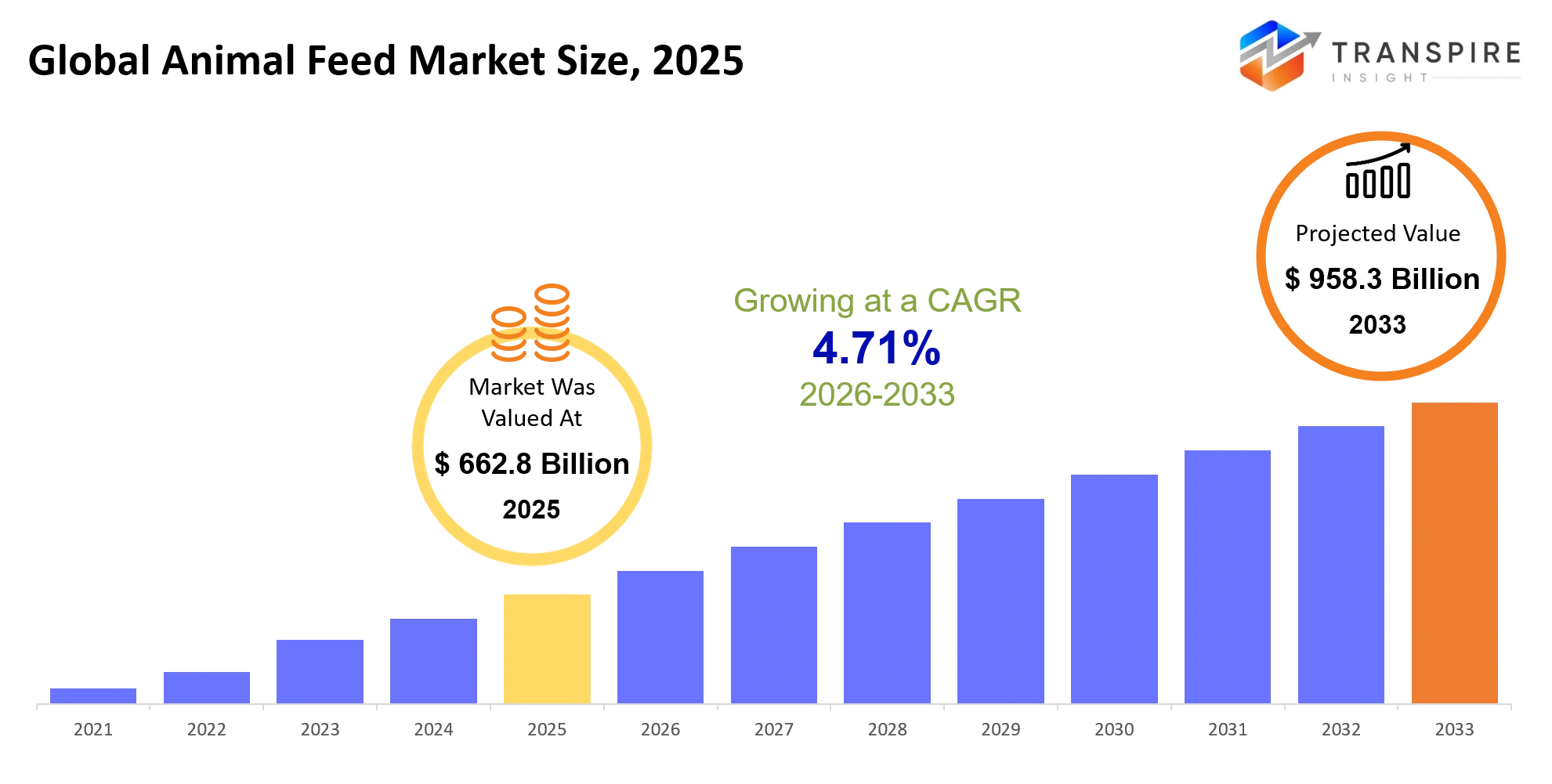
- Global Animal Feed Market Size 2025: USD 662.8 Billion
- Global Animal Feed Market Size 2033: USD 958.3 Billion
- Global Animal Feed Market CAGR: 4.71%
- Global Animal Feed Market Segments: By Type (Compound Feed, Feed Premixes, Feed Additives, Silage, Fodder, Specialty Feed, Organic Feed, Others); By Livestock (Poultry, Swine, Ruminants, Aquaculture, Equine, Pets, Others); By Ingredient (Cereals, Oilseeds, Molasses, Fishmeal, Vitamins, Minerals, Others); By Form (Pellets, Crumbles, Mash, Others); By Distribution (Direct Sales, Dealers, Online, Others).
Global Animal Feed Market Summary:
As Per Transpire Insight Analysis, the Global Animal Feed Market size is estimated at USD 662.8 Billion in 2025 and is anticipated to reach USD 958.3 Billion by 2033, growing at a CAGR of 4.71% from 2026 to 2033.
The market provides the inputs into livestock producers’ operations in the form of complete, balanced formulations, helping animals develop into stronger, healthier livestock with better reproductive rates and efficiency of conversion into feed, used across species of poultry, swine, ruminants, aquaculture, and pets. In the recent 5 years, the sector has been undergoing a transitional pattern from volume growth-driven production to growth at value with precision nutrition and digital feed calculation support technologies, functionality, and new sustainability-driving sourcing directions, and there is a substantial and widespread shift of structure towards using speciality and performance feed products to achieve lower waste and enhance output. The impact from global supply shocks, following the war in the Russia-Ukraine conflict, resulted in diversification for ingredient usage and investment toward alternative protein sources. Drivers like improved biological efficiency, stringent regulatory compliance with food safety standards, and better animal returns from livestock producers continue driving growth as they push innovation for new ingredients, calculations, and processes in the industry.
Key Global Animal Feed Market Insights:
The animal feed industry is changing from supplying bulk nutrition towards more performance-oriented, technologically advanced feeding systems to boost the productivity and sustainability of livestock production beyond commercial settings. Precision formulation, digital manufacturing, sustainable ingredients, and integrated livestock solutions are becoming key factors for competitive differentiation, more than just production scale.
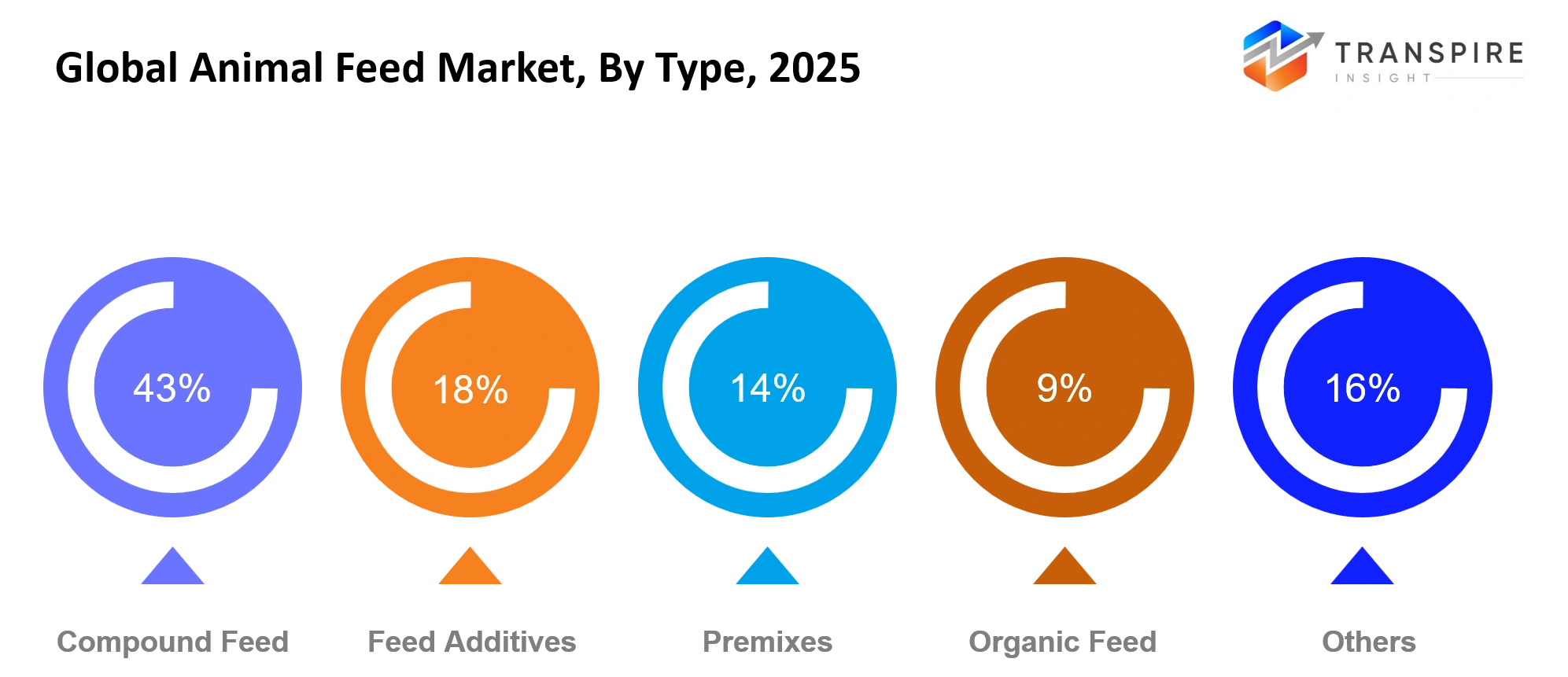
- The biggest segment is Compound Feed 43% as firms are building automated feed mills and precision formulation platforms for commercial livestock feeding.
- Asia Pacific 41% is the world's leading market for manufacturers to boost local production, backed by digital supply-chain management and integrated farming models.
- The growing commercial relevance of Feed Additives 18% is being driven by investment in enzyme, probiotic, and phytogenic innovations in place of traditional growth promoters.
- Feed Premixes 14% are benefiting from AI-assisted nutritional balancing, which allows customising them for intensive poultry and dairy production.
- Europe 24% is at the forefront of sustainable feed innovation with low-carbon ingredients, circular raw materials, and traceability technologies.
- Organic Feed 9% grows steadily as consumers demand residue-free animal products, which are clearly traceable and certified organic.
- Strong investment is being made in export-oriented poultry and beef production in Latin America, which is 8%, supporting advanced feed processing technologies and smart manufacturing.
- In speciality feed, high-value livestock functional nutrition, alternative proteins and precision feeding systems are driving strong R&D spending, 10.7% CAGR.
What are the Key Drivers, Restraints, and Opportunities in the Global Animal Feed Market?
Driver:
Precision feeding technologies have the potential to improve feed conversion efficiencies and decrease costs across commercial operations. The need for greater efficiency from meat, milk, egg, and aquaculture operations is driving demand and investment in scientifically developed, added-value feeds that use enzymes, probiotics, amino acids, and functional additives. Modern poultry and swine operations that have seen rapid development, especially in the Asia-Pacific and Latin America, now require high-quality nutritionally adjusted feeds enabling value-added rather than generic feed development and higher margins.
In February 2026, Alltech and ADM launched Akralos, a new commercial joint venture in North America. This corporate consolidation unifies Hubbard Feeds, Masterfeeds, and ADM's domestic milling networks to deliver scientifically engineered products.
Restraint:
Raw material availability and prices remain a constant headache for feed manufacturers since cereals, soybean meal, fishmeal, and oilseeds’ value chains are too sensitive to climate volatility, trade barriers, and geopolitics. This dependency structure results in volatile production costs and narrow operational margins, more evident in smaller operators with no procurement latitude. The operational challenge of a uniform feed quality under the pressure of cost formulation restricts the scale of investment and product innovation.
Opportunity:
Alternative protein, precision nutrition, and the development of sustainable ingredients will be drivers of future expansion. Opportunities exist as companies invest in insect protein, algae nutrients, fermentation protein, and circular feed ingredients, shifting away from reliance on commodities. Digital feed solutions driven by nutrition AI provide further avenues for profit enhancement. There are also compelling long-term investment opportunities for niche feed players due to accelerated commercial aquaculture expansion and dairy modernisation within Southeast Asia, Africa, and in targeted markets in the Middle East.
In May 2026, Nutreco completed a widespread geographic expansion of its Smart Shrimp Ecosystem platform across primary Latin American aquaculture facilities. This commercial deployment integrates real-time pond diagnostics and automation.
What Has the Impact of Artificial Intelligence Been on the Global Animal Feed Market?
Artificial intelligence is driving a transformation in the global animal feed sector, enabling a new era of precise, automated and data-centric feed formulation, manufacturing and livestock nutrition. AI solutions can take the complexity of ingredient profiles, nutritional demands, feed costs, weather data, and livestock performance and develop cost-effective feed formulations without compromising health and productivity. Through advanced machine learning algorithms, ingredients are precisely blended, formulation errors are minimised, and wasted raw materials are reduced to boost production efficiency and profit margins. Predictive analytics improves inventory planning, anticipating feed ingredient needs and warning of potential supply chain risks before they arise, so producers can make strategic purchases well ahead of actual demand. On farm, integrated AI sensors monitor livestock feed intake, growth, weight gain, health, and yield, triggering timely nutritional adjustments to optimise feed utilisation, reduce mortality rates, and veterinary expense. In the feed mill, it facilitates preventive equipment maintenance, production schedules, quality control, and product tracking. Challenges such as upfront investment, systems integration, and variability of farm-level data make implementation a hurdle, especially for smaller producers. In March 2026, CattleEye (a subsidiary of GEA Farm Technologies) launched a significant research and development initiative to enhance its artificial intelligence systems. This rollout integrates advanced machine learning and camera-based tracking directly into commercial herd management platforms.
Key Global Animal Feed Market Trends:
The market is shifting from commodity feed production to precision nutrition, sustainable sourcing, and digitally optimized production, with a better commercial focus on productivity than just feed. Incorporating nutrition science, automation, and environmental compliance is transforming the development of products, procurement strategies, and livestock management throughout feed value chains globally.
- Feed formulations are moving away from universal recipes and towards precision nutrition for species, to support animal productivity and health.
- Commercial operations are replacing routine use of AGPs with functional ingredients like probiotics, enzymes, phytogenics, and organic acids.
- Insect meal, algae, fermentation protein, and agricultural by-products are also being used as alternatives to fish meal for sustainability by manufacturers.
- Digital formulation software is taking the place of manual ration balancing, allowing for optimization to be completed faster with the aid of ingredient prices and nutritional goals.
- As food companies build sustainable livestock supply chains, carbon footprint measurement is increasingly being a factor in procurement decisions of feed.
- Feed mills are increasingly improving production consistency by using automation that provides intelligent batching, quality monitoring, and predictive equipment maintenance.
- Innovation in aquaculture feeds is increasing rapidly, with highly digestible formulations that lower nutrient losses and enhance water quality.
- Traceable feed ingredients, backed by certified products, digital documentation, and clear sourcing practices, are becoming a necessity for premium livestock producers.
Global Animal Feed Market Segmentation
By Type:
Compound Feed leads the global animal feed market with 43% market share, driven by its balanced nutrition, cost efficiency, and extensive use in commercial livestock farming. Feed Additives account for 18%, while Feed Premixes hold 14%, supported by increasing use of enzymes, probiotics, amino acids, vitamins, and minerals to improve feed efficiency and animal productivity. Organic Feed represents 9% of the market as certified livestock farming expands. Meanwhile, Specialty Feed is the fastest-growing category, registering a 10.7% CAGR due to rising investment in precision nutrition and species-specific feeding solutions.
By Livestock:
Poultry continues to generate the highest feed consumption owing to intensive broiler and layer production, while swine maintains strong demand across industrial farming systems. Ruminants benefit from nutritional optimization supporting dairy productivity, aquaculture records rapid expansion through specialized aquatic feed formulations, and equine, pet, and other livestock categories contribute stable premium demand supported by health-focused nutrition.
By Ingredient:
Cereals remain the primary energy source across feed formulations, followed by oilseeds supplying protein-rich nutrition. Fishmeal retains strategic importance in aquaculture despite sustainability concerns, while molasses supports palatability and energy balance. Vitamins and minerals strengthen animal immunity, productivity, and reproductive performance, encouraging higher-value formulation strategies.
By Form:
Pellets dominate commercial production because of handling efficiency, reduced wastage, and consistent nutrient delivery. Crumbles remain preferred for young livestock, mash serves traditional feeding systems, while other specialized forms support application-specific requirements.
By Distribution:
Direct sales maintain leadership through long-term supply agreements with commercial farms, dealers expand regional accessibility, online platforms gain momentum among smaller buyers through digital procurement, and other channels support localized market penetration.
What are the Key Use Cases Driving the Global Animal Feed Market?
Commercial poultry farming represents the biggest application of feed compound, contributing significantly to accelerated growth, optimized feed conversion, better immunity, and ultimately, maximizing efficiency for poultry farmers to provide efficient production in line with the tremendous domestic need for poultry meat and eggs.
Other applications include dairy farming, swine operations, and aquaculture, in which feed compounding is gaining prevalence for dairy milk yields, reproductive efficacy, immune strength, and consistent production.
Consequently, modern feeding systems and the utilization of various functional supplements for this farming industry sector are emerging. Other future trends include organic farming, premium food for pets, and the sustainable feed compound utilizing innovative proteins, while using other, digitally integrated feed.
|
Report Metrics |
Details |
|
Market size value in 2025 |
USD 662.8 Billion |
|
Market size value in 2026 |
USD 694.5 Billion |
|
Revenue forecast in 2033 |
USD 958.3 Billion |
|
Growth rate |
CAGR of 4.71% from 2026 to 2033 |
|
Base year |
2025 |
|
Historical data |
2021 - 2024 |
|
Forecast period |
2026 - 2033 |
|
Report coverage |
Revenue forecast, competitive landscape, growth factors, and trends |
|
Regional scope |
United States; Canada; Mexico; United Kingdom; Germany; France; Italy; Spain; Denmark; Sweden; Norway; China; Japan; India; Australia; South Korea; Thailand; Brazil; Argentina; South Africa; Saudi Arabia; United Arab Emirates |
|
Key company profiled |
Cargill, ADM, Nutreco, Land O'Lakes, Charoen Pokphand Foods, Alltech, De Heus, ForFarmers, Kent Nutrition, New Hope Group, Purina Animal Nutrition, Japfa, BRF, Tyson Foods, Godrej Agrovet. |
|
Customization scope |
Free report customization (country, regional & segment scope). Avail customized purchase options to meet your exact research needs. |
|
Report Segmentation |
By Type (Compound Feed, Feed Premixes, Feed Additives, Silage, Fodder, Specialty Feed, Organic Feed, Others); By Livestock (Poultry, Swine, Ruminants, Aquaculture, Equine, Pets, Others); By Ingredient (Cereals, Oilseeds, Molasses, Fishmeal, Vitamins, Minerals, Others); By Form (Pellets, Crumbles, Mash, Others); By Distribution (Direct Sales, Dealers, Online, Others). |
Which Regions are Driving the Global Animal Feed Market Growth?
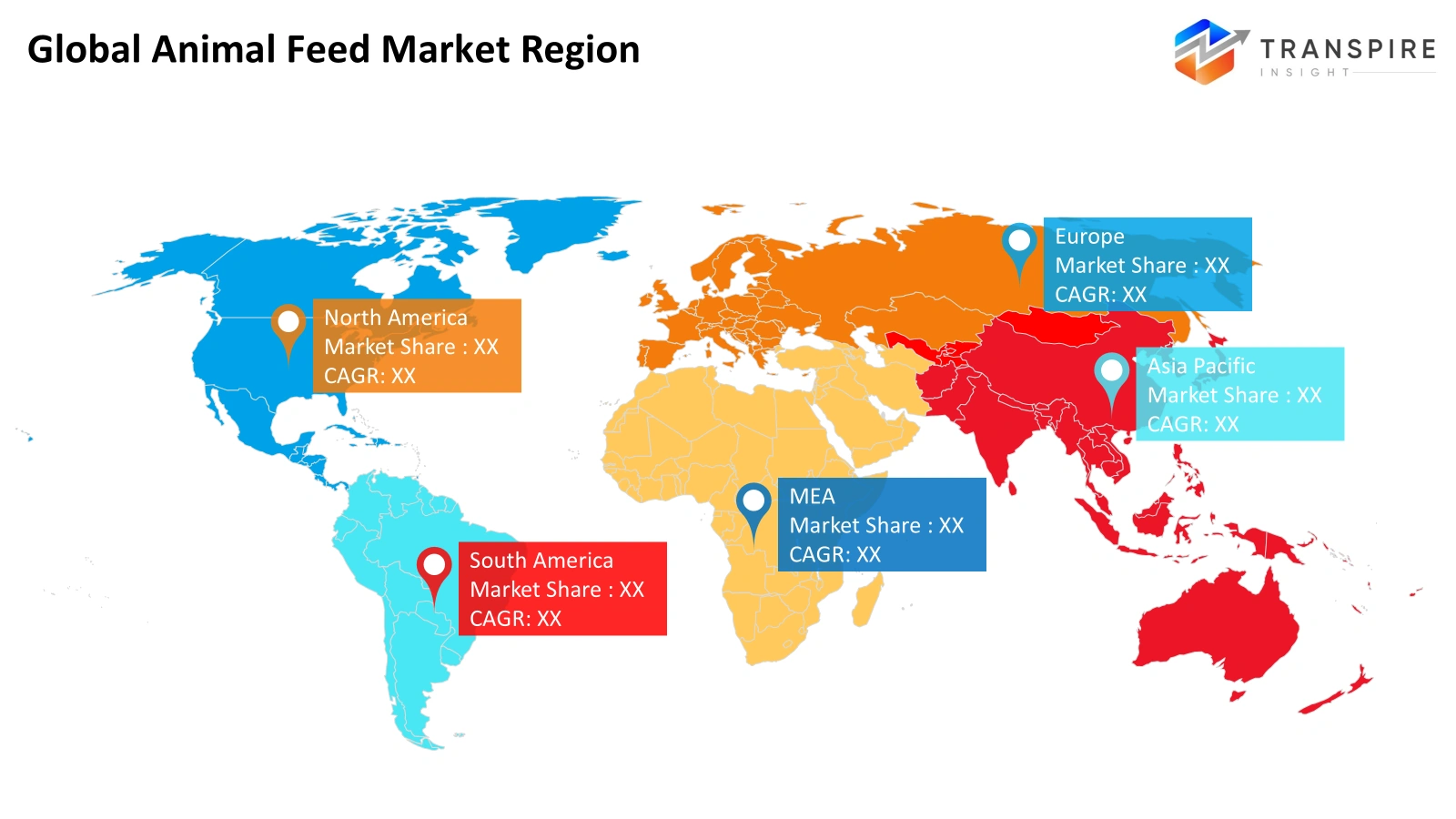
Asia Pacific is the largest regional contributor of the global market, holding 41% share of the market, due to the presence of a well-established base of poultry, swine, and aquaculture production in the region. Investment in commercial farming, feed manufacturing and increased livestock numbers remain strong, supporting the regional demand. The efforts of the Government to improve food security and agricultural modernisation further bolster production capacity. The region still has a competitive edge with advanced feed processing facilities and the growing use of precision nutrition.
Europe accounts for 24% of the market and is more focused on quality, sustainability, regulations, and less on production volumes. Technological innovation, rigorous feed safety regulations, and the use of speciality ingredients give the Asia Pacific a boost of growth. Manufacturers are very involved in traceable sourcing, alternative proteins, and low-emission feed formulations. Slowly increasing herds and stable dairy and livestock industries offer long-term market stability. In April 2026, Novonesis officially launched Europe's first specialised Bacillus probiotic product range explicitly engineered for lactating dairy cows. This product rollout targets tight EU environmental margins by naturally maximising feed-to-milk conversion efficiency.
Latin America accounts for 8% of the market, but has the highest growth rate of 11.8% CAGR. In recent years, there has been increased investment in modern feed mills and integration of livestock production due to rising exports of poultry and beef. To support competitiveness in the area, increasing the availability of soybeans and enhancing agricultural infrastructure is important. Foreign investment, coupled with technological modernization, is an important driver for Latin America as a future production and export region.
In April 2026, Avanti Feeds executed a $3 million strategic investment to acquire a 10% equity stake in Thai Union Feedmill Ecuador S.A.S. (TFME). This joint venture partnership drives technical alignment across South America's expanding aquaculture infrastructure to meet scaling regional feed demands.
Who are the Key Players in the Global Animal Feed Market and how do they Compete?
In the global animal feed market, competing on price is becoming less important, and more important is the ability to offer innovative nutrition, integrated services for livestock, resiliency in the supply chain, and sustainable development of ingredients. Companies distinguish themselves by having a mix of scientific feed formulation, digital production technologies, regional production networks, and long-term customer relationships. By leveraging cutting-edge nutritional science, precision feed formulation, and acquisitions designed to bolster global manufacturing capabilities, Cargill, ADM, and Nutreco vie for market share. Land O'Lakes, Charoen Pokphand Foods, Alltech, and De Heus specialize in Integrated Farming Ecosystems, Functional Feed Ingredients, and Technical Advisory Services that localize to enhance the productivity of farms and increase customer loyalty. For Farmers, Kent Nutrition, New Hope Group, Purina Animal Nutrition, Japfa, BRF, Tyson Foods, and Godrej Agrovet highlight their regional expansion, application-specific formulations, and digital livestock management platforms. The competitive approach consists of gaining additional production capacity, creating a special nutrition portfolio, sourcing raw material more efficiently, and working with commercial livestock producers to provide a customized feeding program that will improve operational performance and increase long-term market presence.
Key Players are:
- Cargill
- ADM
- Nutreco
- Land O'Lakes
- Charoen Pokphand Foods
- Alltech
- De Heus
- ForFarmers
- Kent Nutrition Group
- New Hope Group
- Purina Animal Nutrition
- Japfa
- BRF
- Tyson Foods
- Godrej Agrovet
Recent Development News
In February 2026, Akralos Animal Nutrition officially launched its commercial operations across North America. Formed through a major joint venture between global agriculture leaders ADM and Alltech, this business consolidation combines Alltech's Hubbard Feeds and Masterfeeds infrastructure with ADM's existing US feed mills.
Source: https://www.akralos.com
In February 2026, dsm-firmenich executed a definitive agreement to divest its complete Animal Nutrition & Health (ANH) business unit to CVC Capital Partners for an enterprise value, including an earnout of up to €0.5 billion. This transaction splits off dsm-firmenich’s livestock feed and specialized additives operations into a standalone entity.
Source: https://www.globenewswire.com
In February 2026, Cargill Animal Nutrition & Health officially opened a state-of-the-art dairy feed manufacturing plant in Wazirabad, Punjab (India). Built via a direct corporate investment of ₹300 crore, the new facility introduces an annual production capacity of 4 lakh tonnes to supply high-yield dairy livestock farms.
Source: https://www.cargill.com
What Strategic Insights Define the Future of the Global Animal Feed Market?
The market is steadily progressing towards precision nutrition, the sustainable sourcing of ingredients, and digitally connected feed production, in which value creation more and more depends on biological efficiency rather than the volume of production. Firms with the ability to combine nutritional sciences with AI, automation, and traceability will have a better competitive position in commercial livestock industries. Less obvious in a strategic risk is the reliance on internationally traded ag commodities, which leaves manufacturers vulnerable to extended price fluctuations, climate change, and geopolitical supply risk, which cannot be mitigated by procurement. Commercialization of alternative proteins, fermentation-derived nutrients, and formulations of carbon-efficient feed that meet changing sustainability goals are important emerging opportunities. Market players should focus on regional supply diversification, investment in new precision formulation technologies, and collaboration with livestock producers to create resilient, higher margin businesses that can meet evolving regulatory and environmental demands.
Key Segmentations are:
By Type
- Compound Feed
- Feed Premixes
- Feed Additives
- Silage
- Fodder
- Specialty Feed
- Organic Feed
- Others
By Livestock
- Poultry
- Swine
- Ruminants
- Aquaculture
- Equine
- Pets
- Others
By Ingredient
- Cereals
- Oilseeds
- Molasses
- Fishmeal
- Vitamins
- Minerals
- Others
By Form
- Pellets
- Crumbles
- Mash
- Others
By Distribution
- Direct Sales
- Dealers
- Online
- Others
Regional Outlook
North America
- United States
- Canada
- Mexico
Europe
- Germany
- United Kingdom
- France
- Spain
- Italy
- Rest of Europe
Asia Pacific
- Japan
- China
- Australia & New Zealand
- South Korea
- India
- Rest of Asia Pacific
South America
- Brazil
- Argentina
- Rest of South America
Middle East & Africa
- Saudi Arabia
- United Arab Emirates
- South Africa
- Rest of the Middle East & Africa
Frequently Asked Questions
Find quick answers to common questions.
The global animal feed market size was valued at USD 662.8 Billion in 2025 and is poised to reach USD 958.3 Billion by 2033, expanding at a 4.71% CAGR.
Key segments for the global animal feed market are By Type (Compound Feed, Feed Premixes, Feed Additives, Silage, Fodder, Specialty Feed, Organic Feed, Others); By Livestock (Poultry, Swine, Ruminants, Aquaculture, Equine, Pets, Others); By Ingredient (Cereals, Oilseeds, Molasses, Fishmeal, Vitamins, Minerals, Others); By Form (Pellets, Crumbles, Mash, Others); By Distribution (Direct Sales, Dealers, Online, Others).
Growth is primarily driven by precision nutrition, modernization of commercial livestock farming, functional feed additives, AI-based feed formulation, expanding poultry and aquaculture production, and investment in sustainable alternative feed ingredients.
The global animal feed market is led by major manufacturers, including Cargill, ADM, Nutreco, Land O'Lakes, Charoen Pokphand Foods, Alltech, De Heus, ForFarmers, Kent Nutrition, New Hope Group, Purina Animal Nutrition, Japfa, BRF, Tyson Foods, and Godrej Agrovet.
Asia Pacific, holding 41% of the global market, drives industry growth through large-scale livestock production, integrated feed manufacturing, strong agricultural infrastructure, government support, and rapid adoption of advanced feed technologies.
Commercial opportunities lie in specialty feed, alternative proteins, precision nutrition, AI-powered feed optimization, sustainable feed additives, digital livestock management, and expanding aquaculture and dairy industries across emerging markets.
- Cargill
- ADM
- Nutreco
- Land O'Lakes
- Charoen Pokphand Foods
- Alltech
- De Heus
- ForFarmers
- Kent Nutrition Group
- New Hope Group
- Purina Animal Nutrition
- Japfa
- BRF
- Tyson Foods
- Godrej Agrovet
About the Authors

Chetan Dhatrak
I’m Chetan Dhatrak, a Senior Research Analyst at Transpire Insight, specializing in the Consumer Goods, Foods and Beverages industry. I focus on analyzing market trends, consumer behavior, competitive landscapes, and industry developments to deliver accurate, data-driven insights. My research at Transpire Insight is built on credible sources and in-depth analysis, helping businesses and readers better understand market dynamics, emerging opportunities, and evolving consumer preferences. I’m committed to creating reliable, well-researched content that supports informed decision-making and reflects the latest developments in the consumer goods and food & beverage sectors.

Chakradhar Khansole
Chakradhar serves as the Research Director at Transpire Insight, bringing over 8 years of experience in technology, innovation, and strategic market intelligence. He specializes in transforming complex market data into actionable business insights that enable organizations to make informed, growth-oriented decisions. Recognized for his strategic vision and analytical expertise, Chakradhar leads high-impact research initiatives, delivering comprehensive market assessments, competitive intelligence, and forward-looking industry analysis.
Recently Published Reports
-
Apr 2026
Baby Infant Formula Market
Baby Infant Formula Market Size, Share & Analysis Report By ype (Infant Milk, Follow On Milk, Specialty Baby Milk, Growing-Up Milk), By Ingredient (Carbohydrate, Fat, Protein, Minerals, Vitamins, and Others), By Product Form (Powder, Liquid, and Ready-to-feed), By Distribution Channels (Supermarket/Hypermarket, Specialty Store, Pharmacies, Online Retail, and Others), and Geography (North America, Europe, Asia-Pacific, Middle East and Africa, South and Central America), 2021 - 2031
-
Apr 2026
Edible Insects for Animal Feed Market
Edible Insects for Animal Feed Market Size, Share & Analysis Report By Type (Insect Powder, Insect Meal, Insect Bar, Insect Paste, Insect Oil, and Others), By Insect Type (Beetles, Cricket, Caterpillar, Hymenoptera, Orthoptera, Tree Bugs, and Others), By Application (Livestock, Pet Food, and Aquaculture), By Livestock Type (Poultry, Swine, and Others), and Geography (North America, Europe, Asia-Pacific, Middle East and Africa, South and Central America), 2021 - 2031
-
Apr 2026
Food Industry Disinfection and Bacterial Control Market
Food Industry Disinfection and Bacterial Control Market Size, Share & Analysis Report By Type (Chemical Disinfectants, Physical Disinfectants, and Biocides and Antimicrobials), By Application (Food Processing Equipment Surface Disinfection, Food Preparation Areas Surface Disinfection, Storage Areas Surface Disinfection, Anti-microbial Coatings Food Preservation, and Preservative Solutions Food Preservation), By End User (Meat and Poultry Processing, Dairy Processing, Seafood Processing, Bakery and Confectionery, Restaurants and Commercial Kitchens, and Food Service Providers), By Sales Channel (Online, Offline), and Geography (North America, Europe, Asia-Pacific, Middle East and Africa, South and Central America), 2021 - 2031
-
May 2026
Freeze Dried Food Market
Freeze Dried Food Market Size, Share & Analysis Report By Product Type (Fruits, Vegetables, Freeze-Dried Dairy Products, Freeze-Dried Meat and Seafood, Freeze-Dried Pet Food, and Prepared Meal), By Nature (Organic, and Conventional), By Form (Powdered, Granules, and Diced), By End Use (Breakfast Cereals, Dairy Products, Bakery & Confectionery, Nutritional Bars & Supplements, Powdered Beverages, Snacks, and Retail (Household)), and Geography (North America, Europe, Asia-Pacific, Middle East and Africa, South and Central America), 2021 - 2031