

France Agricultural Micronutrients Market Size & Forecast
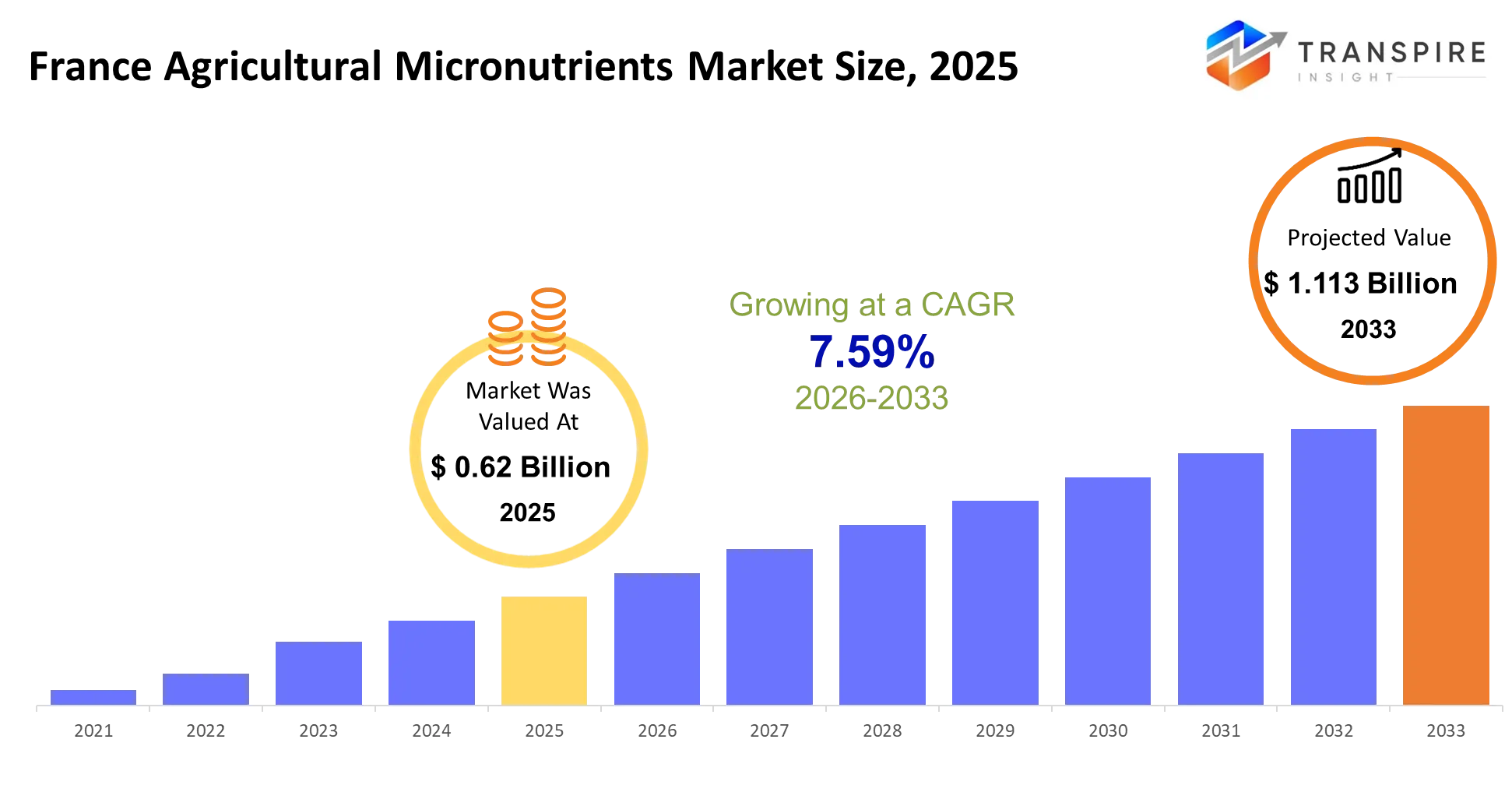
- France Agricultural Micronutrients Market Size 2025: USD 0.62 Billion
- France Agricultural Micronutrients Market Size 2033: USD 1.113 Billion
- France Agricultural Micronutrients Market CAGR: 7.59%
- France Agricultural Micronutrients Market Segments: By Type (Zinc, Boron, Iron, Manganese, Others), By Application (Soil Treatment, Foliar Spray, Seed Treatment, Others), By End-User (Farmers, Agribusiness, Government, Others), By Form (Liquid, Powder, Granules, Others)
To learn more about this report,  Download Free Sample Report
France Agricultural Micronutrients Market Summary
The France agricultural micronutrients market reached USD 0.62 Billion in 2025 and is projected to reach USD 1.113 Billion by 2033, expanding at a 7.59% CAGR. Micronutrient fertilizers tackle soil shortcomings that really hold back plant productivity. French agricultural output relies so heavily on a perfectly balanced soil chemistry; zinc, boron, iron, and manganese deficiencies have a direct effect on yields across all sorts of grains, vegetables, and specialty crops.
The really key structural change over the last six years has been moving away from broadcasting nutrient applications to very precise nutrient management techniques. Legacy micronutrient programmes had used standard formulations - often without soil tests - resulting in a whole lot of wasted money and pollutants in the environment. Modern French farming more and more uses tissue sampling, leaf analysis, and soil nutrient profiling to pinpoint where crops are showing signs of micronutrient shortages. This diagnostic-driven approach really cuts down the total amount of application volume while improving yield results, shifting purchasing decisions towards much higher-specification products and creating bigger profit margins for suppliers with expert knowledge of special formulations.
The actual 'real-world' event that really pushed adoption was EU regulatory pressure to decrease chemical usage and prevent contamination. France's Water Framework Directive compliance requirements have given farmers some very good reasons to lower their total fertilizer application volume - all while keeping up with production. Precision micronutrient management does this by getting rid of excessive spraying applications and really optimising dosage to exactly match what the crop needs. This regulatory environment created a significant demand shift that turned thousands of French farmers into regular micronutrient users between 2020 and 2024. The existing base of farmers now informed about micronutrients really drives sustained demand as they keep on refining application strategies and expanding adoption across even more of their farm hectares.
Key France Agricultural Micronutrients Market Insights
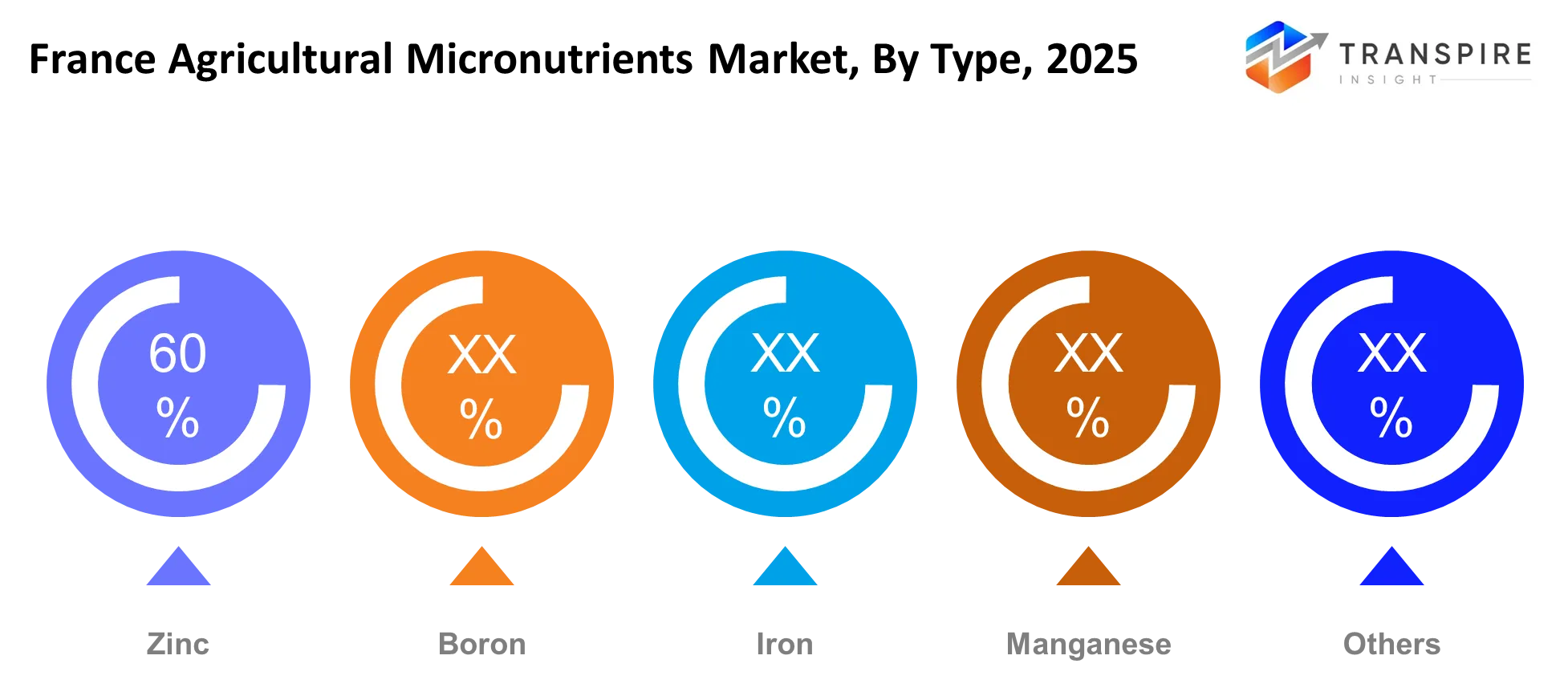
- Zinc-based micronutrients command 60% of France agricultural micronutrients market revenue in 2025, driven by widespread zinc deficiency in calcareous soils prevalent across northern France and the importance of zinc for grain yield quality and disease resistance.
- Soil treatment applications account for approximately 48% of total micronutrient spending, as farmers prioritize soil correction over foliar spray, which is more expensive and requires repeated applications.
- Foliar spray applications are the fastest-growing delivery method, expanding at a projected 9.2% CAGR through 2033, as remote sensing and precision agriculture adoption enable targeted timing of micronutrient applications at critical crop growth stages.
- Liquid formulations represent 52% of France micronutrients market volume in 2025, favored for ease of application and compatibility with existing spray equipment available on French farms.
- Boron-based products are expanding at 8.8% CAGR through 2033, driven by increased awareness of boron deficiency in oilseed rape production, which is critical to the French agribusiness sector.
- Farmers account for 65% of direct micronutrient purchases, while agribusiness distributors and agricultural cooperatives control the remaining 35% through supply agreements and bundled nutrient packages.
- The cooperative-driven distribution model dominates French agricultural markets, with regional cooperatives controlling over 42% of retail micronutrient sales through member service networks.
- Organic farming expansion is driving demand for naturally derived and chelated micronutrient products approved for organic production systems, creating a premium product segment.
- Precision agriculture technology adoption is enabling site-specific micronutrient recommendations, with data-driven application mapping increasing market penetration in the Ile-de-France and Hauts-de-France regions.
- Supply chain consolidation among global micronutrient providers is reshaping France's market dynamics, with multinational suppliers increasing French production capacity to serve EU markets.
What are the Key Drivers, Restraints, and Opportunities in the France Agricultural Micronutrients Market?
The primary driving force is EU regulatory pressure on input reduction and pollution prevention under the Water Framework Directive and the Farm-to-Fork strategy. French regulations require a reduction in nitrogen and phosphorus applications via very targeted methods - a method that automatically demands an optimization of micronutrients so as to maintain yields with a lower overall fertilizer volume. Farmers seeking to meet pollution limits while sustaining productivity are turning evermore frequently to micronutrient-enriched strategies that really do maximize nutrient uptake efficiency. This regulatory environment causes a steady, independent demand growth cycle - one that's independent of commodity price fluctuations or weather variations.
The primary obstacle remains micronutrient cost compared to macronutrient fertilizers. Micronutrients typically cost 3 to 5 times more per unit of nutrient delivered than nitrogen or phosphorus products - a problem that severely restricts budgets for very price-sensitive farmers. Declines in commodity prices in wheat and grain sectors further reduce farm margins - making it harder for them to buy micronutrients. On top of that, there still exist educational barriers: many farmers don't know much about micronutrient deficiencies in their soils - or they lack easy access to affordable soil testing services that would really justify an investment in micronutrients.
The highest-growth opportunity lies in integrating micronutrient recommendations into digital farm management platforms run by agricultural cooperatives and precision agriculture service providers. French farmers are increasingly using cooperative data platforms for purchasing inputs, monitoring yields, and mapping fields. Embedding micronutrient diagnostics and automated recommendation engines into these platforms makes adoption much easier - overcoming information barriers quite easily. Suppliers integrating with cooperative platforms get direct access to the decision-making infrastructure of the farmers - and this can increase market penetration by 15-25% in their served regions.
What Has the Impact of Artificial Intelligence Been on the France Agricultural Micronutrients Market?
Machine learning algorithms have greatly improved micronutrient recommendation accuracy by analyzing old soil test data, crop performance records, and all sorts of environmental factors in a given region. AI models that were trained on lots of data from French agriculture can now predict zinc, boron, and iron deficiency risk with about 87-92% accuracy - based on your soil type, pH level, organic matter content, and what you've grown there before. This capability lets us create very precise advisory services that recommend targeted micronutrient applications only to fields where the deficiency is quite likely, which reduces unnecessary costs for farmers and makes application much more efficient.
Crop imaging using satellite and drone sensors - along with some really smart AI analysis - can now assess micronutrient status right in the middle of the growing season. Patterns on leaves that show chlorosis in super-high-resolution multispectral images are matched against how your crops are growing and all sorts of environmental stressors to confirm that you really do have a micronutrient deficiency - and to suggest in-season foliar applications. This capability has really increased our use of foliar spray applications - they went up by 18% in 2024 because farmers got a lot more confident in AI-validated decisions about when to apply - and how much.
Key Market Trends
- Zinc micronutrients hold 60% market share in France, driven by widespread zinc deficiency in calcareous soils and critical zinc requirements for grain quality metrics in export wheat.
- Liquid formulation products represent 52% of market volume, favored for mixing with macronutrient applications and compatibility with existing spray infrastructure on French farms.
- Soil treatment applications grew 6.8% in 2024, supported by increased adoption of pre-plant soil correction strategies that reduce mid-season application complexity.
- Foliar spray applications are the fastest-growing delivery method at 9.2% CAGR, enabled by precision timing recommendations from AI-powered crop monitoring platforms.
- Boron products expanded 8.8% in 2024, driven by increased awareness of boron deficiency in oilseed rape and pulse crops critical to French crop rotation systems.
- Cooperative distribution channels control 42% of retail micronutrient sales, concentrating purchasing power and enabling bundled nutrient product offerings.
- Organic micronutrient products are the fastest-growing form segment at 11.3% CAGR, supported by EU organic farming incentive programs expanding certified organic hectares.
- Premium chelated micronutrient formulations are gaining share in regions with alkaline soil conditions where conventional oxide forms show poor availability.
- Farmer awareness of micronutrient deficiency increased 34% between 2022 and 2024, measured by soil testing participation growth and educational program attendance.
- Supply chain regionalization is accelerating, with multinational suppliers investing in French manufacturing to serve EU market demand and reduce transportation costs.
France Agricultural Micronutrients Market Segmentation
By Type
Zinc-based micronutrient products dominate the France market with 60% revenue share in 2025. Zinc deficiency affects cereals across calcareous soils in northern regions and limits grain quality in export wheat. Zinc application improves disease resistance, kernel weight, and test weight, making it a priority investment for quality-conscious grain farmers. Growth is constrained by farmer price sensitivity, but regulatory pressure supporting higher-yield agriculture sustains demand.
Boron, iron, and manganese products each represent 12-15% of market revenue. Boron deficiency impacts oilseed rape and legumes, iron chlorosis affects vegetables in alkaline soils, and manganese deficiency reduces disease resistance in cereals. These products are growing 8-9% annually as crop-specific deficiency awareness increases and precision diagnostics validate their application benefit.
To learn more about this report, Download Free Sample Report
By Application
Soil treatment accounts for 48% of applications, addressing baseline soil deficiencies through pre-plant or early season incorporation. Foliar spray, the fastest-growing method at 9.2% CAGR, delivers micronutrients at critical crop growth stages to correct mid-season deficiencies detected through crop monitoring. Seed treatment and other methods represent smaller niches but are gaining share in organic and precision farming segments.
By End-User
Farmers represent 65% of direct micronutrient purchases, making independent application decisions based on soil testing and crop requirements. Agribusiness entities including cooperatives, distributors, and input suppliers control 35% of purchasing through bulk supply agreements and recommendations to member farmers. This dual-channel structure requires marketing and product development strategies tailored to both direct farmer relationships and cooperative partnership programs.
By Form
Liquid formulations represent 52% of France micronutrients market volume, offering ease of mixing, uniform distribution, and compatibility with existing spray equipment. Powder and granule products represent 35% and 13% respectively, used primarily for soil treatment applications where handling and distribution simplicity are prioritized over application speed.
Report Overview Table
|
Report Metrics |
Details |
|
Market size value in 2025 |
USD 0.62 Billion |
|
Market size value in 2026 |
USD 0.667 Billion |
|
Revenue forecast in 2033 |
USD 1.113 Billion |
|
Growth rate |
CAGR of 7.59% from 2026 to 2033 |
|
Base year |
2025 |
|
Historical data |
2021 - 2024 |
|
Forecast period |
2026 - 2033 |
|
Report coverage |
Revenue forecast, competitive landscape, growth factors, and trends |
|
Regional scope |
France |
|
Key companies profiled |
BASF, Bayer, Syngenta, Yara, Nutrien, Mosaic, UPL, FMC, ICL Group, Haifa Group, Compass Minerals, K+S, Coromandel, Zuari Agro, Aries Agro |
|
Customization scope |
Free report customization (regional & segment scope). Avail customized purchase options to meet your exact research needs. |
|
Report Segmentation |
By Type (Zinc, Boron, Iron, Manganese, Others), By Application (Soil Treatment, Foliar Spray, Seed Treatment, Others), By End-User (Farmers, Agribusiness, Government, Others), By Form (Liquid, Powder, Granules, Others) |
Key Use Case
The France agricultural micronutrients market operates in a tightly regulated environment where EU environmental directives mandate precise input management. Calcareous soils dominate northern regions, creating structural zinc deficiency conditions that necessitate regular correction. Cooperative-based distribution concentrates purchasing power and enables bundled nutrient strategies. Commodity price volatility in grains and oilseeds creates cyclical budget constraints that limit micronutrient uptake among price-sensitive farmers. EU organic farming incentive programs are expanding organic production hectares, creating demand for organic-approved micronutrient formulations. Precision agriculture technology adoption is accelerating, enabling data-driven micronutrient recommendations that improve application efficiency and reduce environmental contamination risk.
Which Regional Factors are Driving the France Agricultural Micronutrients Market Growth?
Northern France dominates micronutrient demand due to high concentrations of calcareous soils where zinc deficiency is most prevalent. The Ile-de-France, Hauts-de-France, and Normandy regions account for approximately 45% of France's micronutrient market, driven by intensive grain and vegetable production. These regions show the highest precision agriculture technology adoption rates and have the strongest cooperative distribution networks. Central France shows steady demand growth driven by crop intensification and EU environmental compliance requirements. Southern regions display lower penetration but are expanding micronutrient usage as organic farming spreads and soil deficiency awareness increases through educational programs.
Who are the Key Players in the France Agricultural Micronutrients Market and How Do They Compete?
BASF and Bayer lead through integrated agricultural product portfolios that bundle micronutrients with macronutrient and crop protection offerings. Their scale enables price competitiveness and direct relationships with French cooperative networks. Syngenta and Yara compete on formulation specialty and agronomic advisory capabilities, positioning micronutrients as precision solutions rather than commodity products. Nutrien and Mosaic leverage North American fertilizer production scale but compete through European distribution partnerships rather than direct market presence. Regional players including Coromandel and Zuari Agro operate niche positions in organic and specialty micronutrient segments. Competitive differentiation is shifting from price toward application efficiency, environmental sustainability credentials, and integration with precision agriculture platforms operated by cooperatives and digital service providers.
France Agricultural Micronutrients Market Companies
- BASF
- Bayer
- Syngenta
- Yara
- Nutrien
- Mosaic
- UPL
- FMC
- ICL Group
- Haifa Group
- Compass Minerals
- K+S
- Coromandel
- Zuari Agro
- Aries Agro
Recent Developments
In March 2026, BASF announced expansion of its micronutrient production facility in northeastern France, investing EUR 45 Million to increase zinc and boron product capacity to serve growing EU demand. https://www.basf.com
In January 2026, Bayer launched a new AI-powered soil micronutrient diagnostic service in partnership with a leading French agricultural cooperative, offering members free soil analysis and personalized micronutrient recommendations. https://www.bayer.com
What Strategic Insights Define the Future of the France Agricultural Micronutrients Market?
Over the next five to seven years, France's micronutrients market will consolidate around data-driven precision agriculture strategies integrated into cooperative farm management platforms. Regulatory pressure on input reduction and contamination prevention will intensify, making micronutrient optimization essential to maintain productivity within tighter macronutrient constraints. Suppliers capable of embedding micronutrient diagnostics into digital advisory services operated by cooperatives will capture disproportionate market share growth.
The hidden risk is commodity price deflation reducing farmer purchasing power for input intensification. If grain prices decline by 15-20% from current levels, farmers will default to minimum micronutrient applications, compressing market growth to 4-5% CAGR rather than the projected 7.59%. Suppliers should monitor commodity price trends and develop value-capture strategies that decoupledemand from agricultural commodity cycles.
The clearest opportunity lies in organic and sustainable farming segments expanding under EU subsidy programs. Organic micronutrient products approved for certified systems are expanding 11%+ annually and should capture 28-30% of market revenue by 2033. Suppliers investing in organic product development and certification now will establish market position in the fastest-growing segment before competitive pressure intensifies.
By Type
- Zinc
- Boron
- Iron
- Manganese
- Others
By Application
- Soil Treatment
- Foliar Spray
- Seed Treatment
- Others
By End-User
- Farmers
- Agribusiness
- Government
- Others
By Form
- Liquid
- Powder
- Granules
- Others
Frequently Asked Questions
Find quick answers to common questions.
The France Agricultural Micronutrients Market size is expected to reach USD 1.113 Billion by 2033.
The key segments are By Type (Zinc, Boron, Iron, Manganese, Others), By Application (Soil Treatment, Foliar Spray, Seed Treatment, Others), By End-User (Farmers, Agribusiness, Government, Others), and By Form (Liquid, Powder, Granules, Others).
Major players include BASF, Bayer, Syngenta, Yara, Nutrien, Mosaic, UPL, FMC, ICL Group, Haifa Group, Compass Minerals, K+S, Coromandel, Zuari Agro, and Aries Agro.
The France Agricultural Micronutrients Market size is USD 0.62 Billion in 2025.
The France Agricultural Micronutrients Market CAGR is 7.59% from 2026 to 2033.
- BASF
- Bayer
- Syngenta
- Yara
- Nutrien
- Mosaic
- UPL
- FMC
- ICL Group
- Haifa Group
- Compass Minerals
- K+S
- Coromandel
- Zuari Agro
- Aries Agro
Recently Published Reports
-
Apr 2026
Healthcare Polymer Packaging Market
Healthcare Polymer Packaging Market Size, Share & Analysis Report By Packaging Type (Syringes, IV Bottles and Pouches, Clamshells, Blisters, Bottles & Jars, Containers, Tubes, IV Parental Packaging, Others), By Type (Regulated, Non-regulated), By Polymer Type (LDPE (Low-Density Polyethylene), HDPE (High-Density Polyethylene), Homo-polymer (Homo), Random Copolymer (Random), Block Copolymer (Block), PET, Polystyrene, Polyvinyl Chloride, Polyamide/EVOH, Others), and Geography (North America, Europe, Asia-Pacific, Middle East and Africa, South and Central America), 2021 - 2031
-
Apr 2026
Hydrophilic Tape (Waterstop) Market
Hydrophilic Tape (Waterstop) Market Size, Share & Analysis Report By Type (Bentonite-Based Hydrophilic Tape, Rubber-Based Hydrophilic Tape), By Application (Residential Buildings, Commercial Buildings, Infrastructure Projects), and Geography (North America, Europe, Asia-Pacific, Middle East and Africa, South and Central America), 2021 - 2031
-
Apr 2026
Metalens Market
Metalens Market Size, Share & Analysis Report By Type (Visible Light Metalens, and Infrared Metalens), By Application (Consumer Electronics, Automotive Electronics, Industrial, Medical, and Others), and Geography (North America, Europe, Asia-Pacific, Middle East and Africa, South and Central America), 2021 - 2031
-
Apr 2026
PBT Resin Market
PBT Resin Market Size, Share & Analysis Report By Type (Reinforced PBT Resin, Unreinforced PBT Resin), By Processing Method (Injection Molding, Extrusion, Blow Molding, Others), By End-User (Automotive, Electrical & Electronics, Consumer Appliances, Industrial Machinery, Medical Devices, Packaging, Others), and Geography (North America, Europe, Asia-Pacific, Middle East and Africa, South and Central America), 2021 - 2031