

France Animal Feed Market Size & Forecast:
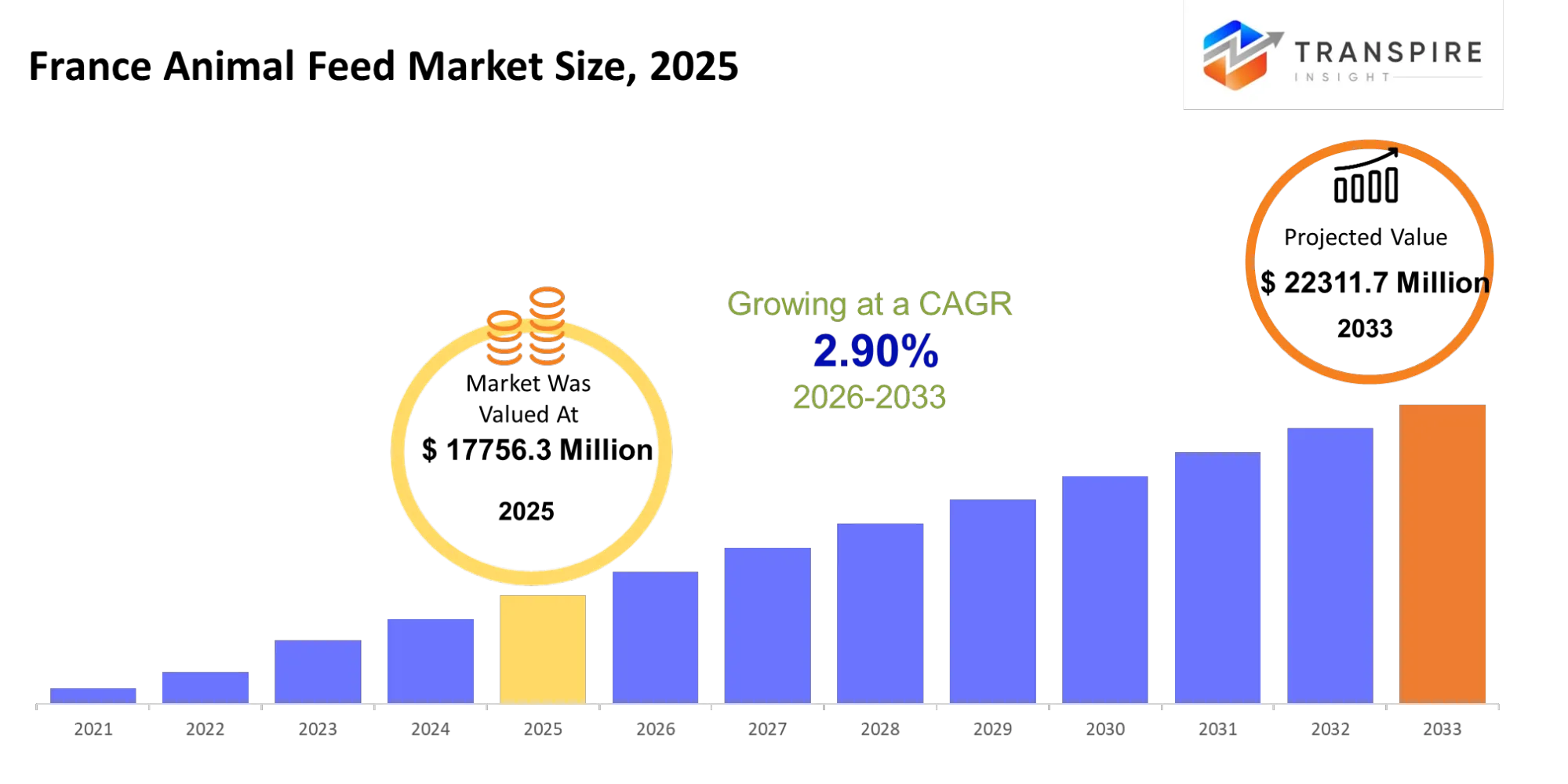
- France Animal Feed Market Size 2025: USD 17756.3 Million
- France Animal Feed Market Size 2033: USD 22311.7 Million
- France Animal Feed Market CAGR: 2.90%
- France Animal Feed Market Segments: By Type (Compound Feed, Fodder, Additives, Others); By Application (Poultry, Swine, Ruminants, Aquaculture, Pet Food, Others); By End-User (Livestock Farms, Dairy Farms, Poultry Farms, Aquaculture Farms, Others); By Form (Pellets, Mash, Crumbles, Others)
To learn more about this report,  Download Free Sample Report
France Animal Feed Market Summary
The France Animal Feed Market was valued at USD 17756.3 Million in 2025. It is forecast to reach USD 22311.7 Million by 2033. That is a CAGR of 2.90% over the period.
The France animal feed market functions as the backbone of livestock productivity because it provides scientifically balanced nutrition which determines the quality of meat and dairy and poultry production in all industrial farming systems. The solution enables producers to achieve animal health and productivity targets while keeping feeding expenses low under EU safety and quality regulations. The market has shifted toward precision nutrition because companies now use digital nutrient profiling to develop customized feed formulas instead of relying on standard ingredient combinations. Producers needed to change their diet formulas because EU regulations on antibiotic growth promoters became more strict which led to increased use of probiotics and enzymes instead of traditional additives.
French manufacturers had to search for new raw material sources because the Russia-Ukraine supply chain disruption changed the import patterns for corn and soybean meal. The new systems have created faster ways to develop new protein sources and optimize feeding practices through data analysis which helps businesses in the livestock industry create more value through their products.
Key Market Insights
- France Animal Feed Market continues expanding as livestock producers adopt precision nutrition systems to improve feed conversion efficiency.
- Industrial livestock farming holds nearly 58% share of demand in 2025 because poultry production and dairy production require more resources.
- Poultry feed remains the leading product segment because France experiences high consumption rates and fast production cycles.
- Ruminant feed maintains its position as the second most popular feed type because dairy production remains constant in Brittany and Normandy regions.
- Aquaculture feed emerges as the fastest-growing segment through 2025-2033 with rising sustainable protein demand.
- Commercial farms dominate end-use with over 60% share because they implement scale-driven feed procurement strategies.
- Smallholder livestock operations represent a growing niche segment that uses fortified feed blends to improve their productivity.
- Cargill and ADM together with other major companies expand their enzyme-enhanced feed product lines.
- Nutreco and dsm-firmenich invest in sustainable protein and additive innovation.
- Strategic partnerships and digital feed formulation platforms are strengthening competitive positioning across the France Animal Feed Market ecosystem.
What are the Key Drivers, Restraints, and Opportunities in the France Animal Feed Market?
The France animal feed market expansion operates because farmers need more feed to support their growing livestock operations while authorities demand better feed efficiency and reduced reliance on antibiotics. The EU prohibited antibiotic growth promoters through its policy changes which forced manufacturers to create new products that included probiotics and enzymes and amino-acid components. The transition resulted in three benefits which included higher sales of premium compound feed products which became profitable for both chemical and construction businesses.
The main limitation exists because supply chains for essential raw materials experience instability which affects soybean meal and corn imports because these commodities face geopolitical threats and climate changes. The Russia-Ukraine conflict created major disruptions to grain markets which made it difficult for French feed producers to obtain their needed materials. The requirement to import protein crops for feed production creates ongoing operational challenges which lead to decreased profitability and extend the period until price stabilization occurs.
The market opportunity exists because companies can create new products through the use of alternative protein sources which include insect-based and algae-derived feed ingredients. European pilot projects which include French agritech initiatives plan to develop black soldier fly protein production for use in poultry and aquaculture feed. The shift will decrease import needs while establishing local systems for circular feed production which will enhance environmental sustainability and control operational costs.
What Has the Impact of Artificial Intelligence Been on the France Animal Feed Market?
Artificial intelligence has transformed the French animal feed industry by enhancing feed formulation accuracy and increasing production efficiency while improving supply chain management throughout feed manufacturing operations. The AI-driven formulation platforms use livestock weight gain information together with nutrient absorption data and ingredient price changes to create optimized feed recipes that feed mills can use throughout the day. This process decreases feed mill waste while delivering consistent nutritional quality to poultry and dairy businesses.
Feed production facilities now use machine learning systems to forecast when their equipment needs maintenance which helps decrease unexpected production interruptions that affect grinding and mixing and pelleting equipment operations. The predictive systems assist in finding the most efficient ways to use energy which leads to better operational performance and decreased cost per production batch. The manufacturers who use automated quality control systems report that their output consistency has improved while their formulation errors have decreased.
The absence of standardized high-quality livestock data across different farms creates a major obstacle because it prevents models from achieving accurate results. The implementation expenses for AI-capable feed mill systems remain excessively high, especially for mid-sized manufacturers who do not have digital systems that can grow with their needs. The feeding industry experiences slow adoption rates because farm management software and feed production systems do not work together effectively.
Key Market Trends
- The period from 2022 to 2025 saw a major increase in the use of precision livestock nutrition which resulted in better feed conversion rates for industrial farms.
- The introduction of EU feed restrictions prompted a quick expansion of antibiotic-free feed formulations which changed the patterns of additive demand throughout the French animal feed market.
- After 2022 supply disruptions, import diversification strategies for soybean products became more important because they helped decrease dependence on Eastern European grain corridors.
- The use of enzyme and probiotic additives in poultry feed formulations increased during the period from 2023 until 2025.
- The large feed mills implemented digital feed formulation systems, which helped them achieve better cost management and accurate nutrient balance results.
- French pilot projects for alternative protein trials used insect meal as feed, which increased during 2024 for both aquaculture and poultry production.
- The market control of feed manufacturers grew stronger through industry consolidation, which allowed multinational companies to extend their operations by building new production sites.
- The implementation of sustainability-based procurement rules led to an increased need for feed ingredients that could be traced back to their origin and had low carbon emissions throughout livestock supply chains.
- The implementation of AI-powered predictive maintenance systems for feed production facilities began in 2023, which helped decrease operational downtime.
France Animal Feed Market Segmentation
By Type
The French animal feed market considers compound feed to be the most important product because it provides standardized nutritional content which meets the needs of intensive livestock production systems. Compound feed delivers necessary components which large poultry and swine operations use to achieve stable feed conversion ratios and forecasted growth patterns. Industrial farming models prefer compound feed because it reduces formulation variability and aligns with EU quality and traceability requirements, strengthening its structural demand base.
Fodder maintains a stable secondary position, primarily serving ruminant livestock systems where roughage remains essential for digestive efficiency and milk productivity. The demand for this product comes from dairy farming clusters which exist in western France because these regions still use pasture integration to determine their animal feeding methods. The additive market develops at a faster rate than traditional market segments because feed formulations now include enzymes and amino acids and probiotics to decrease the need for antibiotics. The forecast period will see compound feed maintain its market leadership while additives will enable value growth through innovation and create premium feed products with unique characteristics.
By Application
The main application segment that stays most important for poultry operations because of their high production requirements and rapid growth rates and their seamless connection to French agricultural supply chains. Feed conversion efficiency directly impacts profitability in poultry farming. This makes nutritionally optimized feed a core operational requirement for their business. Swine production generates substantial economic value because structured farm operations exist together with steady demand for high-protein feed formulations.
Ruminants form a stable application base driven by France’s strong dairy sector, particularly in regions with cooperative farming structures. Controlled fish farming operations expand to meet rising protein-efficient feed system demands, making aquaculture the fastest-growing application. Pet food represents a niche but steadily expanding segment, supported by urbanization and premium pet ownership trends. The aquaculture and specialty nutrition segments will experience increased application demand as protein production methods develop multiple new ways to produce protein.

To learn more about this report, Download Free Sample Report
By End-User
The primary customer group for livestock farms consists of farms that require large amounts of compound feed to support their mixed animal husbandry operations. The farms maintain their supply chain relationships through regular bulk purchases because they need to keep their costs down while delivering equal nutritional value. The poultry industry maintains its substantial market share because its farms require extensive feed resources to support their continuous production operations.
Dairy farms maintain stable demand driven by consistent milk production requirements and structured feeding programs aligned with cooperative systems. Aquaculture farms are expanding rapidly as controlled aquatic farming gains industrial scale in coastal and inland regions. Special demand channels emerge from integrated agribusiness units which function as additional end-user categories. The strongest growth trajectory for aquaculture farms during the forecast period will result from two developments: modernization together with protein diversification trends.
By Form
Pellets have become the most popular feed option for large-scale livestock operations because they provide better digestion rates and lower feed waste and work well with automatic feeding systems. The feed's uniform structure enables accurate nutrient distribution, which makes it the preferred choice for both poultry and swine production systems. The industrial feed mills select pellet production as their main manufacturing method because it improves their storage capacity and minimizes material losses.
Mash feed maintains a steady position, especially in dairy and small-scale farming systems where flexible feeding practices are still common. Crumbles are gaining traction in starter feed applications for poultry due to improved digestibility for young livestock. Some specialized forms exist to meet specific nutritional requirements or processing needs. The forecast period will witness pelletized feed maintaining its market dominance while crumbles experience faster expansion because of increasing needs in early-stage animal nutrition and precision feeding systems.
What are the Key Use Cases Driving the France Animal Feed Market?
The primary application of animal feed in France focuses on providing essential nutrition to poultry and livestock animals which include dairy cows and swine because their feed determines their growth rate and milk production and meat quality. The main factor driving demand for commercial farms operates through their use of standardized compound feed which enables them to achieve expected feed conversion ratios while following EU food safety and traceability requirements. The industrial farming sector depends on this use case because feed efficiency and nutrient precision determine its profitability.
Producers of integrated livestock and aquaculture operations now use functional feed formulations which help them achieve better productivity results and better control of animal diseases. Western French dairy cooperatives and poultry integrators now use enzyme-enriched feed with probiotics because it helps them reduce veterinary needs while maintaining product quality. Aquaculture farms are increasing their need for specialized high-protein feed because it enables them to maintain controlled conditions during fish farming operations.
New applications of climate-optimized feed formulations focus on developing feed that decreases methane emissions from ruminant animals while digital feed personalization uses data from farm IoT systems. The EU-compliant dairy clusters have begun to adopt pilot sustainability programs which demonstrate early sustainability implementation in their operations. The upcoming period will see these applications change the demand for premium feed products.
|
Report Metrics |
Details |
|
Market size value in 2025 |
USD 17756.3 Million |
|
Market size value in 2026 |
USD 18261.1 Million |
|
Revenue forecast in 2033 |
USD 22311.7 Million |
|
Growth rate |
CAGR of 2.90% from 2026 to 2033 |
|
Base year |
2025 |
|
Historical data |
2021 - 2024 |
|
Forecast period |
2026 - 2033 |
|
Report coverage |
Revenue forecast, competitive landscape, growth factors, and trends |
|
Regional scope |
France |
|
Key company profiled |
Cargill, ADM, Nutreco, Alltech, De Heus, Land O Lakes, ForFarmers, CP Group, Tyson Foods, Kent Nutrition, Purina, BASF, DSM, Evonik, Kemin |
|
Customization scope |
Free report customization (country, regional & segment scope). Avail customized purchase options to meet your exact research needs. |
|
Report Segmentation |
By Type (Compound Feed, Fodder, Additives, Others); By Application (Poultry, Swine, Ruminants, Aquaculture, Pet Food, Others); By End-User (Livestock Farms, Dairy Farms, Poultry Farms, Aquaculture Farms, Others); By Form (Pellets, Mash, Crumbles, Others) |
Which Regions are Driving the France Animal Feed Market Growth?
Northern France dominates the animal feed industry because of its high poultry and pig farming activity which connects with its industrial feed mill network. The region improves its logistics infrastructure through its ports which include Le Havre to facilitate the efficient delivery of soybean meal and corn. The European Union requires strict feed safety standards which increases the demand for certified compound feed products used in large farms. The ecosystem enables stable demand throughout the year which helps the business maintain its leading position in the market.
Western France provides continuous economic support because its cooperative farming system and strong dairy production base exists in Brittany and Pays de la Loire. The region operates through family-owned farms and cooperative procurement systems which create stable supply contracts instead of using industrial consolidation methods which dominate the northern industrial belt. Dairy pricing maintains economic stability while regulatory changes remain consistent which enables the industry to produce stable national feed consumption levels.
The Mediterranean coastline in southern France experiences rapid development through aquaculture growth and the modernization of livestock facilities in Occitanie. Recent investments in controlled-environment farming and feed storage infrastructure have accelerated adoption of high-performance feed products. The feed manufacturers will find new business opportunities because of the current trend toward specialized aquatic and heat-resilient livestock nutrition which will continue until 2026 to 2033.
Who are the Key Players in the France Animal Feed Market and How Do They Compete?
The France animal feed market exists as a moderately consolidated market which has global agribusiness companies competing against specialized nutrition firms. The competition arises from three main factors which include formulation technology and ingredient sourcing efficiency and compliance with EU feed safety and sustainability standards. Existing large companies use their integrated supply chains to maintain market share while innovative companies create functional additives and precision nutrition solutions which enhance livestock performance.
Cargill uses its cost-effective methods for producing bulk feed and its complete grain procurement systems to create stability during periods of market input fluctuations. ADM establishes stronger market control through its protein optimization solutions and international commodity trading capabilities which help decrease its dependence on raw materials. Nutreco offers itself as a unique company through its development of advanced feed products which enhance both aquaculture and dairy production performance in European distribution areas.
dsm-firmenich develops new enzyme products and vitamin solutions and feed additives which establish its identity as a technology-based supplier instead of a basic product manufacturer. Alltech expands its business through the development of probiotic-based feed products which help livestock farmers decrease their need for antibiotics. The De Heus company expands its operations through opening new locations and establishing local feed manufacturing facilities which provide advantages based on geographic proximity to European farming areas.
Company List
- Cargill
- ADM
- Nutreco
- Alltech
- De Heus
- Land O’Lakes
- ForFarmers
- CP Group
- Tyson Foods
- Kent Nutrition Group
- Purina
- BASF
- DSM-Firmenich
- Evonik Industries
- Kemin Industries
Recent Development News
In September 2025, Archer Daniels Midland (ADM) entered a joint venture with Alltech to consolidate North American feed mill operations. The partnership restructures feed manufacturing capacity to improve cost efficiency and strengthen specialty animal nutrition supply chains, indirectly impacting European and French feed ingredient stability.
http://www.reuters.com
What Strategic Insights Define the Future of the France Animal Feed Market?
The French animal feed industry is transitioning toward precision nutrition and low-emission livestock systems because of two factors which include new regulations and unpredictable market conditions. Over the next 5 to 7 years, value creation will shift from bulk feed production to performance-optimized formulations which combine farm-level data analytics. The EU sustainability mandates require livestock productivity to meet environmental compliance standards which support this transformation.
A less obvious risk is increasing dependency on a narrow set of high-performance feed additives which concentrates supply chains among a few biotechnology suppliers. The production of enzymes and amino acids faces potential bottlenecks which become apparent only when analyzing grain supply indicators. The need for alternative protein sources will lead to a gradual decrease in traditional feed consumption across specific market segments.
The developing market for carbon-accounted feed products provides a major business opportunity which dairy exporters can use to enter low-emission certification markets. The companies that combine digital traceability with their feed formulation processes will obtain better control over their pricing strategies. The market participants need to allocate their resources toward vertically integrated sourcing and AI-driven nutrition platforms which will help them achieve sustained market advantage.
France Animal Feed Market Report Segmentation
By Type
- Compound Feed
- Fodder
- Additives
- Others
By Application
- Poultry
- Swine
- Ruminants
- Aquaculture
- Pet Food
- Others
By End-User
- Livestock Farms
- Dairy Farms
- Poultry Farms
- Aquaculture Farms
- Others
By Form
- Pellets
- Mash
- Crumbles
- Others
Frequently Asked Questions
Find quick answers to common questions.
the estimated value for 2033 is USD 22311.7 Million.
Key segments for the France Animal Feed Market are By Type (Compound Feed, Fodder, Additives, Others); By Application (Poultry, Swine, Ruminants, Aquaculture, Pet Food, Others); By End-User (Livestock Farms, Dairy Farms, Poultry Farms, Aquaculture Farms, Others); By Form (Pellets, Mash, Crumbles, Others).
Major France Animal Feed Market players are Cargill, ADM, Nutreco, Alltech, De Heus, Land O Lakes, ForFarmers, CP Group, Tyson Foods, Kent Nutrition, Purina, BASF, DSM, Evonik, Kemin.
The France Animal Feed Market size is USD [confirmed 2025 figure] in 2025.
The France Animal Feed Market CAGR is 2.90% from 2026 to 2033.
- Cargill
- ADM
- Nutreco
- Alltech
- De Heus
- Land O’Lakes
- ForFarmers
- CP Group
- Tyson Foods
- Kent Nutrition Group
- Purina
- BASF
- DSM-Firmenich
- Evonik Industries
- Kemin Industries
Recently Published Reports
-
Apr 2026
Baby Infant Formula Market
Baby Infant Formula Market Size, Share & Analysis Report By ype (Infant Milk, Follow On Milk, Specialty Baby Milk, Growing-Up Milk), By Ingredient (Carbohydrate, Fat, Protein, Minerals, Vitamins, and Others), By Product Form (Powder, Liquid, and Ready-to-feed), By Distribution Channels (Supermarket/Hypermarket, Specialty Store, Pharmacies, Online Retail, and Others), and Geography (North America, Europe, Asia-Pacific, Middle East and Africa, South and Central America), 2021 - 2031
-
Apr 2026
Edible Insects for Animal Feed Market
Edible Insects for Animal Feed Market Size, Share & Analysis Report By Type (Insect Powder, Insect Meal, Insect Bar, Insect Paste, Insect Oil, and Others), By Insect Type (Beetles, Cricket, Caterpillar, Hymenoptera, Orthoptera, Tree Bugs, and Others), By Application (Livestock, Pet Food, and Aquaculture), By Livestock Type (Poultry, Swine, and Others), and Geography (North America, Europe, Asia-Pacific, Middle East and Africa, South and Central America), 2021 - 2031
-
Apr 2026
Food Industry Disinfection and Bacterial Control Market
Food Industry Disinfection and Bacterial Control Market Size, Share & Analysis Report By Type (Chemical Disinfectants, Physical Disinfectants, and Biocides and Antimicrobials), By Application (Food Processing Equipment Surface Disinfection, Food Preparation Areas Surface Disinfection, Storage Areas Surface Disinfection, Anti-microbial Coatings Food Preservation, and Preservative Solutions Food Preservation), By End User (Meat and Poultry Processing, Dairy Processing, Seafood Processing, Bakery and Confectionery, Restaurants and Commercial Kitchens, and Food Service Providers), By Sales Channel (Online, Offline), and Geography (North America, Europe, Asia-Pacific, Middle East and Africa, South and Central America), 2021 - 2031
-
Apr 2026
Freeze Dried Food Market
Freeze Dried Food Market Size, Share & Analysis Report By Product Type (Fruits, Vegetables, Freeze-Dried Dairy Products, Freeze-Dried Meat and Seafood, Freeze-Dried Pet Food, and Prepared Meal), By Nature (Organic, and Conventional), By Form (Powdered, Granules, and Diced), By End Use (Breakfast Cereals, Dairy Products, Bakery & Confectionery, Nutritional Bars & Supplements, Powdered Beverages, Snacks, and Retail (Household)), and Geography (North America, Europe, Asia-Pacific, Middle East and Africa, South and Central America), 2021 - 2031