

Europe Dairy Processing Equipment Market Size & Forecast:
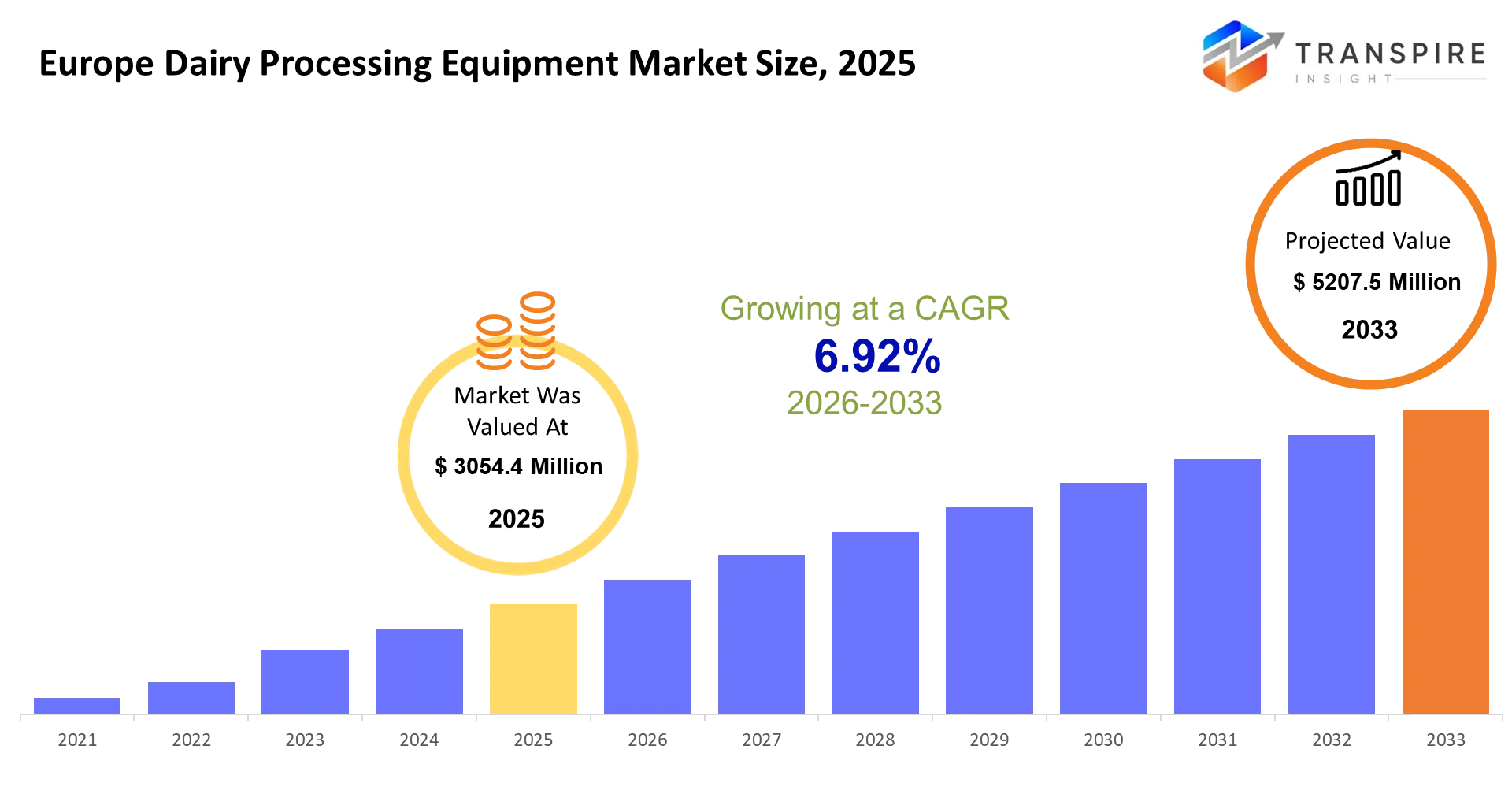
- Europe Dairy Processing Equipment Market Size 2025: USD 3054.4 Million
- Europe Dairy Processing Equipment Market Size 2033: USD 5207.5 Million
- Europe Dairy Processing Equipment Market CAGR: 6.92%
- Europe Dairy Processing Equipment Market Segments: By Type (Pasteurizers, Homogenizers, Separators, Evaporators, Others), By Application (Milk Processing, Cheese, Yogurt, Butter, Ice Cream, Others), By End-User (Dairy Companies, Food Processors, Cooperatives, Others), By Operation (Automatic, Semi-automatic, Manual, Others).
To learn more about this report,  Download Free Sample Report
Europe Dairy Processing Equipment Market Summary:
The Europe Dairy Processing Equipment Market size is estimated at USD 3054.4 Million in 2025 and is anticipated to reach USD 5207.5 Million by 2033, growing at a CAGR of 6.92% from 2026 to 2033. The Europe Dairy Processing Equipment Market stands between two main elements in the contemporary food production framework of Europe because it allows dairy facilities to produce industrial quantities of safe and shelf-stable products from their raw milk supplies. Producers utilize various technologies which include pasteurizers and homogenizers and membrane filtration and automated filling systems to achieve their goals of reducing product contamination risks and product loss and extending product shelf life and maintaining consistent product quality which meets retailer specifications for cheese and yogurt and butter and high-protein dairy products.
The market has undergone a transformation during the previous five years which has shifted its focus away from capacity expansion toward modernization efforts which depend on improved operational efficiency. European dairy processors now spend money on energy-efficient equipment which includes digitally connected systems because rising energy prices and worker shortages and mandatory sustainability reporting requirements have changed their operational expenses. The Russia-Ukraine conflict together with the ensuing energy and agricultural supply chain disruptions accelerated this change because it forced processors to develop new methods for managing their operational stability and resource management. Equipment suppliers nowadays experience increased demand for automation solutions and heat recovery systems and modular processing equipment which enables them to decrease operational costs while achieving adaptable manufacturing capabilities. The changes in the industry create new opportunities for businesses to make money from their maintenance services while establishing extensive equipment replacement cycles which require compliance and traceability and carbon footprint reduction tracking.
Key Market Insights
- Western Europe maintained its position as the leading market for Dairy Processing Equipment in Europe during 2025 by achieving 48% market share through its superior dairy infrastructure and extensive processing capabilities.
- Northern Europe emerges as the quickest expanding regional market which will continue until 2030 because of its dedication to sustainable dairy production and its investments in energy-saving plant updates.
- In 2025 pasteurization equipment secured the largest market share with approximately 28% because food processors prioritized both safety standards and product shelf life extension.
- The second most important equipment category after homogenizers became known as homogenizers because European retailers expanded their distribution of premium yogurt flavored milk and protein beverages.
- The market for membrane filtration systems will experience rapid expansion until 2030 because of increased consumer demand for lactose-free and high-protein dairy products.
- European dairy equipment industry revenue reached 34% through cheese processing applications which benefited from export demand and special cheese production activities.
- The market for functional dairy beverages shows rapid growth because consumers prefer products that contain high levels of protein and additional nutritional value.
- Automated processing systems enable large-scale dairy manufacturers to achieve better operational results which resulted in their share of end-user market demand exceeding 55%.
- Mid-sized dairy cooperatives are rapidly increasing their equipment purchases to achieve operational efficiency while reducing their need for labor because energy prices continue to rise.
- The Europe Dairy Processing Equipment Market experiences strong growth through the implementation of IoT-enabled monitoring systems which enhance predictive maintenance capabilities and decrease unexpected system failures.
What are the Key Drivers, Restraints, and Opportunities in the Europe Dairy Processing Equipment Market?
The Europe Dairy Processing Equipment Market reaches its peak growth period because dairy facilities implement modernized operations to reduce expenses while complying with European Union food safety standards and environmental protection regulations. The 2022 energy crisis brought about electricity rate hikes which revealed that outdated pasteurization and cooling and drying systems needed upgrading to automatic energy-efficient technologies. Dairy producers focus on purchasing equipment that decreases water consumption and enhances product yield and minimizes operational downtime, which results in increased sales of new equipment and extended service agreements.
The market faces its greatest structural challenge because of the need for significant capital investment. The dairy processing industry needs extensive initial capital because its advanced processing technologies need funding for automation systems and clean-in-place systems and energy-efficient solutions. The small and medium-sized dairies throughout Southern and Eastern Europe operate with limited financial resources, which makes it challenging to conduct complete facility upgrades. The presence of outdated dairy infrastructure in fragmented markets creates a situation where replacement cycles are delayed and new technologies need extended time to receive acceptance.
The main opportunity for future growth exists within the production of dairy products which contain high protein content and do not contain lactose. European processors are increasing their spending on ultrafiltration and precision separation technologies to create dairy products that meet premium nutritional standards. The dairy industry in Denmark, the Netherlands, and Ireland has become an important investment center because export-focused dairy companies are expanding their production of value-added products for international sports nutrition and clinical nutrition markets.
What Has the Impact of Artificial Intelligence Been on the Europe Dairy Processing Equipment Market?
The Europe Dairy Processing Equipment Market experiences transformation through both artificial intelligence and advanced digital technologies which enhance production efficiency and decrease energy needs while reducing unplanned operational interruptions throughout dairy facilities. Equipment manufacturers implement AI-based automation systems within their pasteurization systems and membrane filtration units and filling lines to track temperature stability and flow rates and microbial contamination levels and cleaning processes. The smart control systems maintain automatic processing parameter adjustments which assist dairy processors with their product loss reduction and product batch consistency improvement.
Processors use machine learning models to predict maintenance needs for their separators and homogenizers and refrigeration systems. Processors use vibration pattern analysis and pressure fluctuation analysis and equipment runtime data analysis to identify equipment components that will fail before actual breakdowns take place. The deployment of predictive analytics platforms resulted in directional improvements for several large dairy facilities across Western Europe which achieved 15% to 25% lower maintenance costs along with measurable production interruption decreases. Digital twins and cloud-connected monitoring systems enable organizations to achieve energy efficiency through their operational processes which include spray drying and cooling operations because even small efficiency improvements lead to significant cost reductions.
AI adoption for most mid-sized dairy plants encounters a critical barrier because their existing fragmented legacy systems do not support standardized data management through central data frameworks. The process of incorporating advanced analytics into existing processing systems demands expensive retrofitting work along with specific software knowledge and extended implementation periods which creates barriers to adoption for organizations that lack large-scale dairy processing capacity.
Key Market Trends
- Automated production systems in European dairy plants have increased their spending since 2022 because they need to address increasing labor shortages and decrease their need for staff who supervise production processes.
- The retail availability of lactose-free products and high-protein dairy items has led to increased usage of membrane filtration technology throughout Germany and Denmark and the Netherlands.
- The industry adopted energy-efficient pasteurization systems to replace outdated thermal pasteurization equipment after European electricity prices underwent dramatic increases during the post-Ukraine conflict period.
- From 2021 to 2025 large processing facilities began using AI-based systems for predictive maintenance which helped them decrease unexpected system failures that affected their separators and homogenizers.
- Dairy cooperatives implemented modular processing systems which enable them to produce smaller product volumes while creating new products without needing complete factory renovations.
- European regulators have imposed stricter regulations on water discharge and energy reporting since 2020 which requires manufacturers to enhance their clean-in-place systems and heat recovery systems.
- GEA Group and Alfa Laval extended their smart dairy plant technology offerings through IoT-based monitoring systems and automatic process improvement capabilities.
- European dairy companies raised their spray drying technology investments to support their market expansion into Asia and the Middle East for their infant formula and sports nutrition product lines.
- Dairy processors from the mid-size market postponed their equipment replacement schedule because they faced financial difficulties which restricted their ability to plan for capital spending after the year 2023.
- Manufacturers changed their competitive approach by adopting extended digital service contracts which enabled their remote diagnostic and predictive analytics systems to become their main sources of revenue by 2025.
Europe Dairy Processing Equipment Market Segmentation
By Type
The Type segment analysis demonstrates that pasteurizers and separators maintain leading market positions because these technologies serve critical functions in food safety compliance and milk standardization processes used in large dairy operations. The demand for consistent texture in premium yogurt and flavored milk products fuels the need for homogenizers, which base their operations on this market requirement. Thermal systems which include evaporators maintain their fundamental importance for cheese and milk powder production.
The sub-segments demonstrate different growth paths because pasteurizers succeed through strict hygiene standards while separators expand their market presence to meet the needs of high-protein dairy processing and yield improvement requirements. The aging equipment of older facilities drives an increased demand for evaporator systems that businesses will use to enhance their energy efficiency through replacement. The future trajectory shows that industrial dairy processors will implement energy-optimized systems with digital controls because manufacturers will combine sensor technology with automated systems to decrease thermal waste and enhance operational quality.
By Application
Cheese processing stands as the primary market leader through its combination of export requirements and local consumption habits and its extensive manufacturing facilities found throughout Western Europe. The yogurt market experiences its fastest growth because of new probiotic products and high-protein product development, while milk processing sustains constant market demand across all European regions. The butter and ice cream markets generate constant income streams, but their growth rate decreases because most retail outlets already stock these products.
The cheese market depends on industrial manufacturing growth, while yogurt products increase their market presence through nutritional trends and their expanded product range. The future will bring more investments in dairy processing facilities that can handle different products through minor facility upgrades which will help manufacturers produce high-value goods especially in areas that focus on exporting products.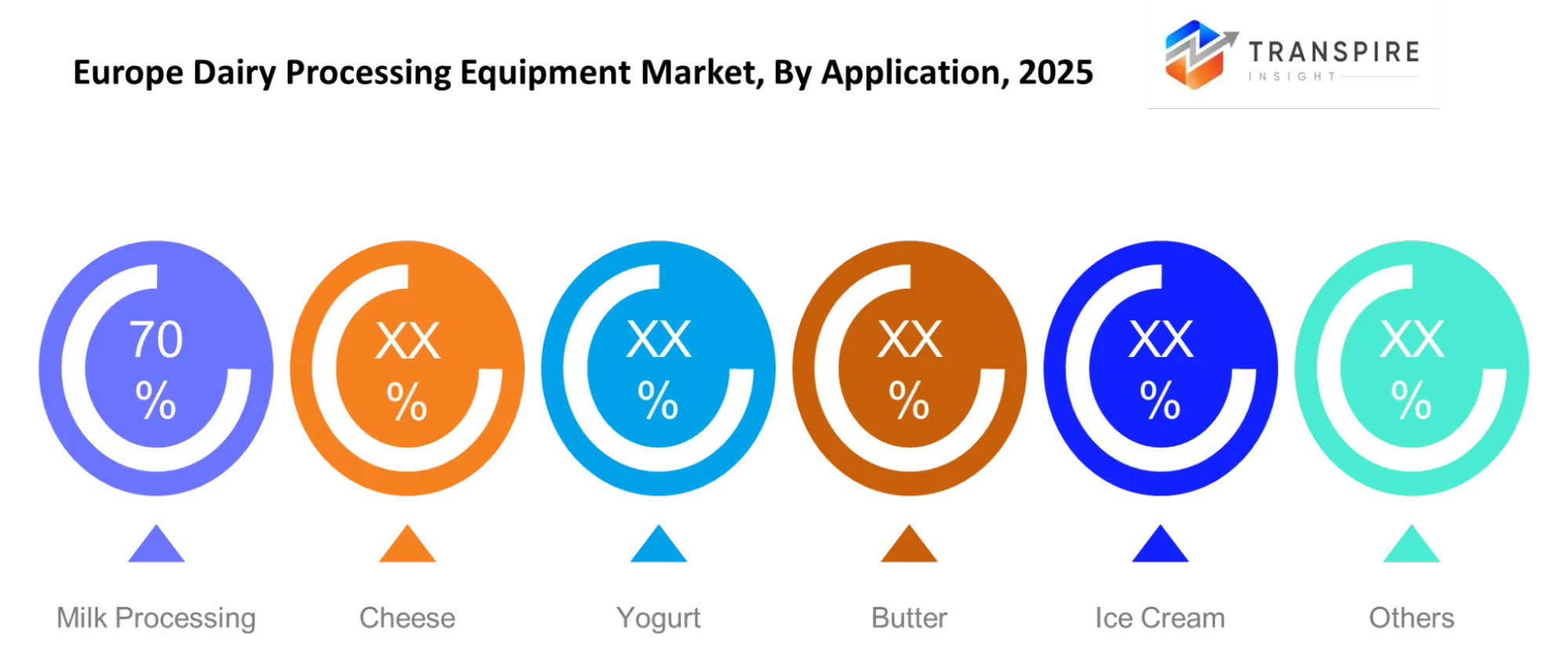
To learn more about this report, Download Free Sample Report
By End-User
The equipment requirements of large dairy companies which produce high volumes of milk and operate international markets and modernize their processing facilities continuously throughout the year. The dairy cooperative network operates as a major secondary industry segment in countries such as Germany and France and the Netherlands because farmers create shared processing facilities through their collective investments. The demand from food processors continues to increase because dairy components have become necessary ingredients for bakery products and confectionery items and nutritional products.
The entire market ecosystem has entered a new phase because dairy companies are merging which leads to larger equipment buying operations and stronger connections with their vendors. The member organizations of cooperatives are now replacing their outdated systems because they need to comply with new traceability and sustainability standards. Future trends forecast that equipment suppliers will establish stronger partnerships with large-scale processors through extended service agreements and digital solutions and tailored processing systems which will enhance operational productivity and lower product development expenses.
By Operation
Automatic systems have become the dominant solution in dairy processing because companies now consider both efficiency and process reliability and regulatory needs for their production operations which handle large volumes of work. The use of semi-automatic systems has decreased at mid-sized plants because their automation costs have dropped and their digital systems have become easier to implement.
The production process of manual systems exists only for small-scale operations that produce artisanal products. Automation receives support from three factors which include labor shortages and increasing energy prices and the demand for immediate production tracking in complex dairy operations. Semi-automatic setups persist where capital constraints delay full modernization. The upcoming period will show almost total automation in large facilities which will use AI control systems and predictive maintenance and cloud monitoring systems to boost productivity while minimizing operational downtime and enhancing energy efficiency in dairy processing systems.
What are the Key Use Cases Driving the Europe Dairy Processing Equipment Market?
The Europe Dairy Processing Equipment Market operates mainly through cheese production and standardized milk processing because Western Europe industrial dairy operations create its primary demand. The need for export-grade cheese production with uniform quality and the enforcement of EU hygiene standards forces processors to acquire pasteurization and separation and homogenization equipment. The highest equipment demand exists for this use case because continuous production processes depend on constant thermal control together with efficient high-volume processing capabilities.
Food processors and large dairy companies targeting functional nutrition markets expand their operations through yogurt and high-protein dairy beverage production. These applications achieve protein concentration and lactose reduction and texture consistency through their dependence on membrane filtration and precision blending systems. Butter and cream processing deliver ongoing demand which particularly benefits cooperative-operated facilities that use their diverse product range to create revenue stability during milk supply fluctuations throughout the year.
The development of lactose-free dairy products and whey valorization for sports nutrition and infant formula ingredients has emerged as a new use case. Dairy cooperatives and ingredient-focused processors have started to allocate more resources towards advanced filtration and enzymatic treatment systems because they want to attain better results from their by-product waste. The applications exist as niche markets which are starting to gain popularity because EU sustainability regulations drive manufacturers to adopt zero-waste dairy processing systems.
|
Report Metrics |
Details |
|
Market size value in 2025 |
USD 3054.4 Million |
|
Market size value in 2026 |
USD 3259.1 Million |
|
Revenue forecast in 2033 |
USD 5207.5 Million |
|
Growth rate |
CAGR of 6.92% from 2026 to 2033 |
|
Base year |
2025 |
|
Historical data |
2021 - 2024 |
|
Forecast period |
2026 - 2033 |
|
Report coverage |
Revenue forecast, competitive landscape, growth factors, and trends |
|
Regional scope |
Europe (Germany, United Kingdom, France, Italy, Spain and Rest of Europe) |
|
Key company profiled |
Tetra Pak, GEA Group, Alfa Laval, SPX Flow, Krones, IDMC, Feldmeier, Scherjon Dairy Equipment, Paul Mueller, JBT Corporation, Pentair, Buhler, KHS, Kiremko, Coperion |
|
Customization scope |
Free report customization (country, regional & segment scope). Avail customized purchase options to meet your exact research needs. |
|
Report Segmentation |
By Type (Pasteurizers, Homogenizers, Separators, Evaporators, Others), By Application (Milk Processing, Cheese, Yogurt, Butter, Ice Cream, Others), By End-User (Dairy Companies, Food Processors, Cooperatives, Others), By Operation (Automatic, Semi-automatic, Manual, Others) |
Which Regions are Driving the Europe Dairy Processing Equipment Market Growth?
The Europe Dairy Processing Equipment Market offers its most considerable market share to Western Europe because this region operates its dairy industry with advanced industrial capacity and it follows EU food safety standards. The dairy production systems of Germany, France, and the Netherlands support their economic needs through export markets, which require them to invest continuously in new processing technologies. The established original equipment manufacturers and technology providers create an environment which enables companies to adopt automation systems together with energy-efficient pasteurization and high-capacity separation technologies. The integrated system that connects cooperatives with processors and equipment manufacturers enables dairy facilities to maintain their market position through continuous investment.
The Europe Dairy Processing Equipment Market receives its contribution from Northern Europe as a stable yet distinct market segment which operates differently than Western Europe. The dairy production systems in Denmark, Sweden, and Finland utilize cooperative models which focus on operational efficiency, product traceability, and meeting environmental regulations instead of maximizing production output. Dairy processors maintain their investment levels because they prefer to upgrade equipment that has a long operational life instead of building new facilities. The high demand from consumers who prefer premium and organic dairy products drives ongoing improvements in processing facilities which create demand for advanced small-scale equipment solutions.
Eastern Europe has become the fastest-growing region because it modernizes its outdated dairy infrastructure while receiving more foreign direct investment for processing plants. The EU agricultural funding and industrial development programs have enabled Poland, Romania, and Hungary to speed up their equipment modernization efforts.
Who are the Key Players in the Europe Dairy Processing Equipment Market and How Do They Compete?
The Europe Dairy Processing Equipment Market operates with moderate market consolidation which results in global OEMs controlling essential contracts while regional suppliers handle needs. The existing market players maintain their market position by offering complete processing systems and permanent maintenance contracts and they meet EU food safety and energy efficiency standards. New market entrants must overcome three major obstacles which include certification processes and expensive equipment requirements and the creation of customer support systems. Companies in the dairy industry use their technological advancements and service operations to compete against one another according to their production capacity.
The GEA Group improves its market position through complete automation solutions which combine separation and pasteurization processes with digital monitoring capabilities into one unified system. The technology-based method enables dairy processors to achieve better energy efficiency and reduced production interruptions which gives GEA a competitive advantage in major industrial facilities. Alfa Laval develops advanced thermal systems which enhance heat transfer and separation performance to decrease energy requirements in continuous dairy processing operations. Tetra Pak provides a unique market solution through its integrated processing and packaging systems which connect dairy processing operations from milk intake through to packaging for retail distribution while demonstrating strong sustainability credentials.
SPX FLOW provides market competition through its customized mixing and homogenizing and fluid handling solutions which meet the operational needs of modern dairy facilities. Krones AG extends its market presence by combining dairy filling technology with high-speed automation and intelligent packaging systems which enable large-scale bottling operations.
Company List
- Tetra Pak
- GEA Group
- Alfa Laval
- SPX Flow
- Krones
- IDMC
- Feldmeier
- Scherjon Dairy Equipment
- Paul Mueller
- JBT Corporation
- Pentair
- Buhler
- KHS
- Kiremko
- Coperion
Recent Development News
In April 2026, DuPont launches new reverse osmosis system for dairy processing: DuPont introduced its FilmTec MXP RO-8038-FF reverse osmosis element, designed for milk, whey, and lactose concentration used widely in European dairy plants.The upgrade improves productivity and membrane efficiency, supporting modernization of dairy processing lines across Europe.
Source: https://www.investing.com
In April 2026, Alfa Laval unveils new high-efficiency centrifuge for advanced food & dairy processing: Alfa Laval launched the PureFerm 750 N centrifuge, targeting high-solids dairy and fermentation-based food production.The system enhances separation efficiency and supports next-gen dairy protein and ingredient processing in European facilities.
Source: https://www.alfalaval.us
What Strategic Insights Define the Future of the Europe Dairy Processing Equipment Market?
The Europe Dairy Processing Equipment Market is moving toward fully automated production systems which use energy-efficient technology and digital systems for dairy processing operations. Dairy processors need to maintain their costs because energy prices remain unstable and EU environmental reporting requirements become more stringent. Investment patterns will change during the next 5-7 years because organizations will focus on intelligent retrofit solutions which extend equipment lifespan and boost dairy supply chain traceability and yield efficiency. Technology concentration creates a hidden danger because various original equipment manufacturers (OEMs) gain control over digital control systems which forces processors to depend on specific systems while making it difficult to obtain new equipment during times of supply chain interruptions.
The developing market opportunity in Eastern Europe centers on modular micro-processing dairy plants which EU rural development grants and local food production regulations support. These systems enable smaller cooperatives to enter premium dairy categories without large-scale infrastructure investment. The most effective approach for market participants involves developing equipment which uses open-architecture designs that connect with third-party digital systems to decrease lock-in risk and enable faster adoption by mid-tier processors who use multiple systems.
Europe Dairy Processing Equipment Market Report Segmentation
By Type
- Pasteurizers
- Homogenizers
- Separators
- Evaporators
- Others
By Application
- Milk Processing
- Cheese
- Yogurt
- Butter
- Ice Cream
- Others
By End-User
- Dairy Companies
- Food Processors
- Cooperatives
- Others
By Operation
- Automatic
- Semi-automatic
- Manual
- Others
Frequently Asked Questions
Find quick answers to common questions.
The Approximate Europe Dairy Processing Equipment Market size for the Market will be USD 5207.5 Million in 2033.
The key Segments of the Europe Dairy Processing Equipment Market are By Type (Pasteurizers, Homogenizers, Separators, Evaporators, Others), By Application (Milk Processing, Cheese, Yogurt, Butter, Ice Cream, Others), By End-User (Dairy Companies, Food Processors, Cooperatives, Others), By Operation (Automatic, Semi-automatic, Manual, Others).
Major players in the Europe Dairy Processing Equipment Market are Tetra Pak, GEA Group, Alfa Laval, SPX Flow, Krones, IDMC, Feldmeier, Scherjon Dairy Equipment, Paul Mueller, JBT Corporation, Pentair, Buhler, KHS, Kiremko, Coperion.
The Current Market size of the Europe Dairy Processing Equipment Market is USD 3054.4 Million in 2025.
The Europe Dairy Processing Equipment Market CAGR is 6.92%.
- Tetra Pak
- GEA Group
- Alfa Laval
- SPX Flow
- Krones
- IDMC
- Feldmeier
- Scherjon Dairy Equipment
- Paul Mueller
- JBT Corporation
- Pentair
- Buhler
- KHS
- Kiremko
- Coperion
Recently Published Reports
-
Apr 2026
Handling and Lifting Equipment Market
Handling and Lifting Equipment Market Size, Share & Analysis Report By Product (Cranes and Hoists, Forklifts, Conveyor Systems, Aerial Work Platforms, Others), By Application (E-Commerce, Automotive and Railway, Food and Beverages, Aviation, Others), and Geography (North America, Europe, Asia-Pacific, Middle East and Africa, South and Central America), 2021 - 2031
-
Apr 2026
HVAC Equipment Market
HVAC Equipment Market Size, Share & Analysis Report By Heating Equipment Type (Boilers and Furnaces, Heat Pumps, and Unitary Heaters), By Ventilation Equipment (Air Handling Units, Humidifiers and Dehumidifiers, Air Filters, and Fan Coiling Units), By Air Conditioning Equipment (Unitary Air Conditioners, Room Air Conditioners, Packaged Terminal Air Conditioners, and Chillers), By End User (Commercial, Residential, Industrial, and others), and Geography (North America, Europe, Asia-Pacific, Middle East and Africa, South and Central America), 2021 – 2031
-
Apr 2026
Refrigeration Valves Market
Refrigeration Valves Market Size, Share & Analysis Report By Type (Solenoid Valves, Expansion Valves, Check Valves, Service Valves, Others), By Application (Commercial Refrigeration, Industrial Refrigeration, Transport Refrigeration, Residential Refrigeration, Air Conditioning Systems), By End User (Food and Beverage Industry, Pharmaceutical Industry, HVAC Industry, Chemical Industry, Others), and Geography (North America, Europe, Asia-Pacific, Middle East and Africa, South and Central America), 2021 – 2031
-
Apr 2026
E-Commerce Packaging Materials Market
E-Commerce Packaging Materials Market By Material Type (Corrugated Boxes, Paper & Paperboard, Foam & Cushioning Materials, Plastic Packaging, Flexible Packaging, Protective Packaging, Others), By Product(Primary Packaging, Secondary Packaging, Tertiary Packaging), By Packaging Function (Protective Packaging, Branding & Presentation Packaging, Transit & Logistic Packaging, Sustainable Packaging, Tamper Evidence Packaging), By End-User (Retail & Consumer Goods, Electronic Appliances, Food & Beverages, Healthcare & Pharmaceutical, Fashion & Apparel, Home & Furnishing, Others); By Industry Analysis, Size, Share, Growth, Trends, and Forecasts 2021-2033