

Asia Pacific Automatic Bending Machine Market Size & Forecast:
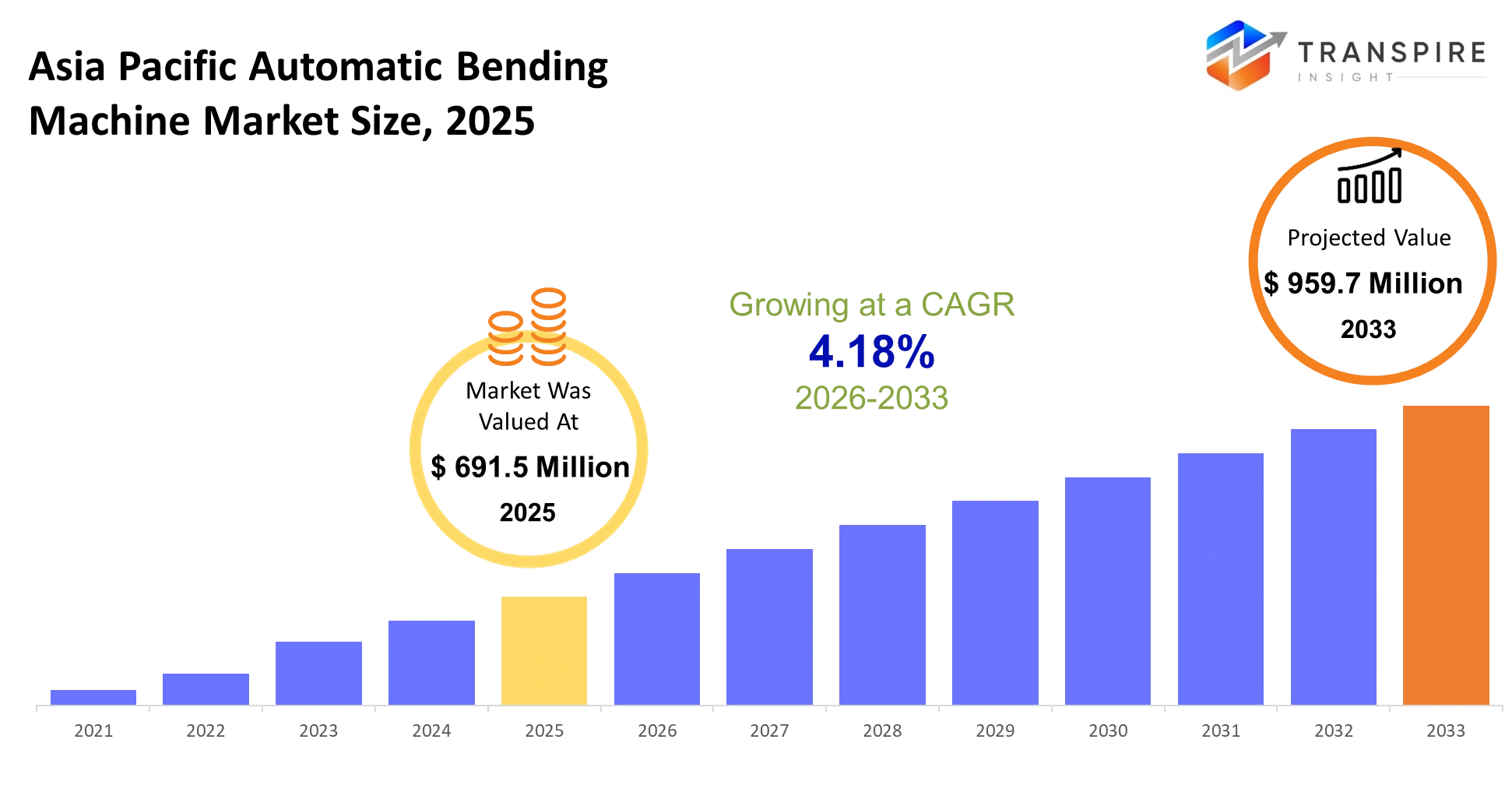
- Asia Pacific Automatic Bending Machine Market Size 2025: USD 691.5 Million
- Asia Pacific Automatic Bending Machine Market Size 2033: USD 959.7 Million
- Asia Pacific Automatic Bending Machine Market CAGR: 4.18%
- Asia Pacific Automatic Bending Machine Market Segments: By Type (CNC Bending Machines, Hydraulic Bending Machines, Electric Bending Machines, Others); By Application (Metal Fabrication, Automotive, Construction, Aerospace, Industrial Manufacturing, Others); By End-User (Manufacturers, Automotive Companies, Construction Firms, Aerospace Industry, Industrial Firms, Others); By Technology (CNC Systems, Robotics Integration, Automation Systems, Others)Â
To learn more about this report,  Download Free Sample Report
Asia Pacific Automatic Bending Machine Market Summary
The Asia Pacific Automatic Bending Machine Market was valued at USD 691.5 Million in 2025. It is forecast to reach USD 959.7 Million by 2033. That is a CAGR of 4.18% over the period.
The Asia Pacific region employs automatic bending machines which enable metal fabrication facilities and shipbuilding yards as well as industrial manufacturing operations to bend pipes and tubes and metal sheets with uniform precision to construct ships and vehicles and building structures. The systems enable operations to decrease their need for manual bending since operators find it hard to produce accurate results which they can repeat throughout their entire production process.
The market has experienced a transition during the past three to five years from traditional hydraulic systems to CNC-controlled systems and servo-electric bending machines which operate together with CAD/CAM software. The structural changes which occurred in this system improved measurement accuracy while enabling the creation of intricate shapes and decreasing material waste. The COVID-19 disruption served as a major trigger which exposed weaknesses in supply chains and compelled manufacturers from the region to establish local production operations while implementing automation technologies.Â
The simultaneous infrastructure development projects and increasing shipbuilding requirements in China and India and Southeast Asia resulted in an urgent need for equipment modernization. The adoption rate has increased because manufacturers now choose to strengthen their production operations through faster results and steadier work performance and less need for skilled workers.
Key Market Insights
- China will control between 38 percent and 42 percent of the Asia Pacific Automatic Bending Machine Market in 2025 because of its extensive shipbuilding industry and heavy manufacturing operations.Â
- India shows the highest growth rate among all regions from 2024 to 2030 because of Make-in-India industrial policies and increasing automation in metal fabrication plants.Â
- The advanced robotics systems of Japan and South Korea together with their capacity to produce high-precision engineering work enable both countries to keep their competitive edge.Â
- The market for CNC automatic bending machines reaches 45 percent because their users value their accurate output and consistent performance and their capacity to connect with digital systems.Â
- Hydraulic bending systems today serve as the second biggest market segment which industrial companies still use to operate their mid-scale workshops.
- The servo-electric bending machines segment will experience its most rapid expansion until 2030 because of energy-efficient systems and smart factory technologies.Â
- The Asia Pacific Automatic Bending Machine Market shows its highest demand from shipbuilding and marine fabrication which together account for 32% of the total market share.Â
- The production of electric vehicle structural components drives the automotive component manufacturing industry to become its most rapidly expanding application area.Â
- The construction and infrastructure metal frameworks create consistent demand from developing economies throughout Southeast Asia. Aerospace component manufacturers are increasing their adoption of high-precision bending applications.
What are the Key Drivers, Restraints, and Opportunities in the Asia Pacific Automatic Bending Machine Market?
The Asia Pacific Automatic Bending Machine Market grows because metal fabrication and heavy engineering industries shift toward CNC-based and servo-electric automation. The transition occurred because rising labor costs and tighter precision requirements in shipbuilding and automotive component manufacturing and production process delays needed to be solved. The shift from manual and semi-automated bending methods to digital control systems enables equipment suppliers and software-integrated machine providers to generate new business opportunities which mostly benefit China and Japan and South Korea.
Advanced bending systems require high initial capital costs and complex integration procedures which create a major obstacle for their implementation. Manufacturing companies across Southeast Asia continue using hydraulic machines because they lack resources to acquire new equipment and hire qualified personnel. The fundamental obstacle prevents companies from replacing their equipment, which results in delayed industrial automation and upcoming revenue growth for high-end equipment producers according to market demand estimates.
The market opportunity arises from IoT-based predictive maintenance solutions combined with AI technology for bending process optimization in India's industrial corridors and Vietnam's manufacturing export zones. Companies such as TRUMPF are already advancing smart factory solutions that reduce downtime and improve precision output. The development of digital manufacturing ecosystems will enable connected bending machines to drive the next expansion phase of the Asia Pacific Automatic Bending Machine Market through improved productivity and data-driven operational efficiency.
What Has the Impact of Artificial Intelligence Been on the Asia Pacific Automatic Bending Machine Market?
The Asia Pacific Automatic Bending Machine Market experiences operational changes because advanced digital technologies and artificial intelligence systems transform manual bending operations into data-based workflows. AI systems in modern CNC bending systems use their cutting-edge control software to dynamically modify bending angles and material feed rates and tool positioning through active monitoring of real-time sensor data to decrease operator needs while maintaining accurate results during high-volume production operations in shipbuilding and automotive parts manufacturing.
The implementation of machine learning models for predictive maintenance involves the examination of vibration and pressure and temperature data which hydraulic and servo-electric systems produce to predict when components will wear out before they break down. This method decreases unexpected equipment downtime while it extends equipment lifespan and boosts production scheduling performance. Advanced manufacturing facilities use AI-driven optimization tools to decrease material waste and maintain steady production cycles which result in operational efficiency improvements and energy savings.
The implementation of artificial intelligence-ready bending systems faces a major obstacle because their high integration expenses create financial difficulties for small and mid-sized workshops throughout Southeast Asia. Many legacy machines lack standardized sensor infrastructure which creates a data deficit that hinders effective model development in the current environment. These gaps slow large-scale adoption despite strong long-term efficiency benefits.
Key Market Trends
- China increased adoption of CNC bending systems post-2023, replacing legacy hydraulic units across large shipbuilding and steel fabrication facilities.
- The Indian government implemented automation incentives through its 2022 policy which resulted in SMEs upgrading their bending operations to use semi-automated systems.
- Japan integrated AI-assisted control systems in precision bending workflows, improving defect reduction rates in high-value automotive component production.
- South Korea expanded its usage of servo-electric bending machines throughout industrial metal forming processes in 2024, which led to decreased energy usage throughout their operations.
- Vietnam and Indonesia increased imports of mid-range bending machines after supply chain diversification trends emerged post-2021 disruptions.
- Amada and other manufacturers adopted IoT-equipped machines after 2023 to enhance their predictive maintenance and machine availability performance.
- Since 2022, rising labor costs and skilled operator shortages have led to increased demand for CNC systems, which use automated systems instead of manual fabrication methods.Â
- European exporters intensified Asia Pacific expansion strategies in 2024, increasing localized assembly partnerships to reduce delivery lead times.Â
- Automotive electric vehicle component production has expanded since 2023, which creates demand for precise bending processes that drive regional suppliers to adopt servo-electric machines.
Asia Pacific Automatic Bending Machine Market Segmentation
By Type:
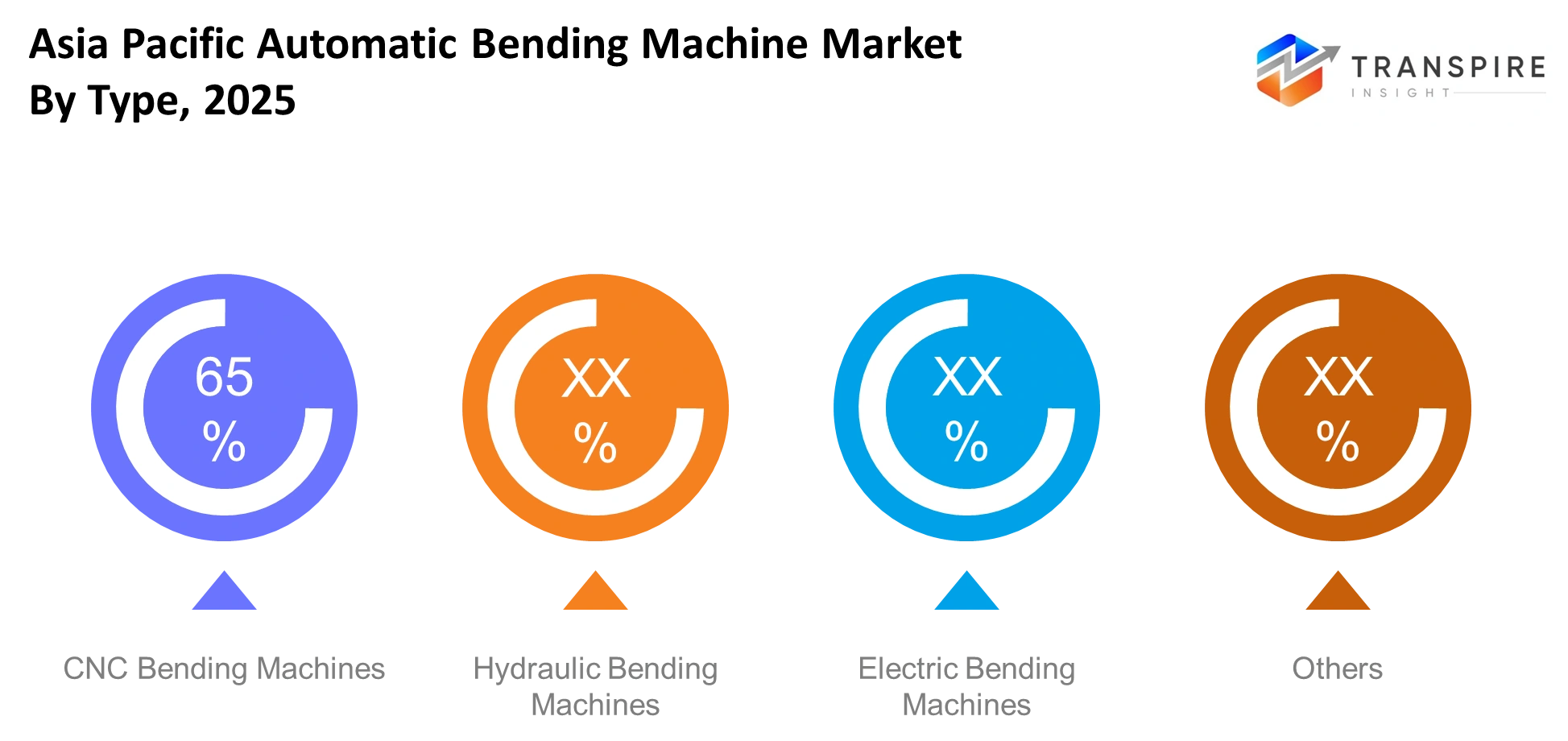
The CNC bending machines segment maintains a strong market position within the Asia Pacific Automatic Bending Machine Market because it delivers precise results and maintains consistent performance and can execute intricate bending tasks. The demand for these systems keeps rising because multiple industries require both precise shaping capabilities and reduced material waste. The programming flexibility of these systems enables production facilities to achieve faster setup times while processing multiple batches of work.Â
The enduring popularity of hydraulic bending machines stems from their ability to produce powerful force output which makes them suitable for demanding metalworking operations. Electric bending machines are becoming more popular because they provide an energy efficient option which requires less upkeep and operates in a more environmentally friendly manner. The other category includes hybrid systems and specialized machines designed for custom industrial applications which support market growth because manufacturing needs are becoming more diverse.
To learn more about this report, Download Free Sample Report
By Application:
Metal fabrication represents a major application area in the Asia Pacific Automatic Bending Machine Market because industrial sectors require sheet metal processing at high volumes. Automated systems improve production speed while decreasing errors that occur during manual handling. Fabrication companies need to achieve consistent bending quality because it drives their operational efficiency and capacity development.Â
The market expands through substantial contributions from automotive, construction, aerospace and industrial manufacturing sectors. The automotive industry requires precise component shaping for production purposes while construction projects need durable structural elements. Aerospace manufacturing requires detailed specifications to ensure safety and performance requirements are met. Other applications include electrical equipment and consumer product manufacturing, where automation helps maintain steady production quality and reduces processing time.
By End-User:
The Asia Pacific Automatic Bending Machine Market sees its largest customer base from manufacturers who need automated systems to improve their production processes. Manufacturing facilities use automatic bending solutions because these systems help them produce consistent output while decreasing their need for human workers. The ongoing industrial modernization initiatives that various regional economies pursue create a demand for investment in advanced bending technologies.
The market experiences continuous demand from automotive companies, construction firms, aerospace industry participants, and industrial firms. Automotive businesses focus on mass production accuracy, while construction firms require dependable metal forming capabilities for infrastructure development. Aerospace companies need to achieve both precision and high dependable operation. The end-user group includes medium-scale workshops and custom production units which use automation to create better competitive advantages and enhanced workflow management.
By Technology:
The Asia Pacific Automatic Bending Machine Market technology segment depends on CNC systems because their digital control system produces precise results which can be repeated through various programming methods. Production facilities increasingly adopt CNC-enabled equipment to support complex bending tasks while minimizing operational errors. Digital monitoring features improve resource management by enhancing process control capabilities within organizations.
Industries are expanding their robotics systems and automation technologies to achieve smart manufacturing capabilities. Robotic handling improves speed and reduces manual intervention, helping facilities maintain continuous operation. Automation systems enhance machine function coordination with production line operations. The technological advancements enable industrial organizations to implement scalable operations which produce high-quality metal bending results through efficient processes.
What are the Key Use Cases Driving the Asia Pacific Automatic Bending Machine Market?
The Asia Pacific Automatic Bending Machine Market uses CNC bending systems for accurate hull structure and pipeline and load-bearing framework creation which remains vital for shipbuilding and heavy metal fabrication. The shipyard operations in China and South Korea and Japan face high demand because they need to maintain consistent production while minimizing operator mistakes.
The automotive component manufacturing sector and industrial construction industry both show increasing demand for chassis part and exhaust system and structural steel component production. Heavy manufacturing industries and mid-sized fabrication workshops are implementing these applications because they want to modernize from semi-automated systems which will help them achieve faster production and improved accuracy in their products.
Aerospace component forming and EV battery enclosure fabrication represent new applications that need ultra-precise bending for creating lightweight safety-critical components. The offshore energy infrastructure projects now implement advanced bending systems for their pipeline and platform structures which shows that industrial fabrication requirements are expanding to new areas.
|
Report Metrics |
Details |
|
Market size value in 2025 |
USD 691.5 Million |
|
Market size value in 2026 |
USD 720.3 Million |
|
Revenue forecast in 2033 |
USD 959.7 Million |
|
Growth rate |
CAGR of 4.18% from 2026 to 2033 |
|
Base year |
2025 |
|
Historical data |
2021 - 2024 |
|
Forecast period |
2026 - 2033 |
|
Report coverage |
Revenue forecast, competitive landscape, growth factors, and trends |
|
Regional scope |
Asia Pacific ( China, India, Japan, South Korea, Australia, Rest of Asia Pacific) |
|
Key company profiled |
Amada, Trumpf, Bystronic, Salvagnini, Prima Power, LVD Group, Durma, Accurpress, Haco, Eagle Bending Machines, Boschert, Muratec, Tailift, Ermaksan, Yawei |
|
Customization scope |
Free report customization (country, regional & segment scope). Avail customized purchase options to meet your exact research needs. |
|
Report Segmentation |
By Type (CNC Bending Machines, Hydraulic Bending Machines, Electric Bending Machines, Others); By Application (Metal Fabrication, Automotive, Construction, Aerospace, Industrial Manufacturing, Others); By End-User (Manufacturers, Automotive Companies, Construction Firms, Aerospace Industry, Industrial Firms, Others); By Technology (CNC Systems, Robotics Integration, Automation Systems, Others)Â |
Which Regions are Driving the Asia Pacific Automatic Bending Machine Market Growth?
China leads the Asia Pacific Automatic Bending Machine Market because its shipbuilding centers and heavy fabrication operations and its government support of industrial automation create an optimal environment for business development. The company maintains its market leadership position because of its complete port system and its manufacturing facilities which require high-precision metal forming tools for their export activities. The industrial areas located along the coast enable shipyards and steel fabrication units to continuously improve their machinery through modern advancements. The established system maintains regular acquisition of CNC and servo-driven bending machines by both state-owned and private manufacturing companies.
Japan represents a stable and technology-intensive contributor because precision engineering standards and advanced manufacturing require extended capital investment periods. Japan demands high-spec automotive and marine components which require precise and reliable production processes instead of China which focuses on producing products in large quantities. The company maintains its replacement requirements through its quality control systems and its gradual automation process while establishing consistent demand patterns. This relationship establishes Japan as a dependable revenue source for machine manufacturers who specialize in high-quality engineering products.
The fastest growing area of India receives support from its developing industrial corridors and its ongoing port modernization efforts and its increasing use of automated fabrication systems in mid-sized workshops. The recent policy initiatives which support domestic manufacturing have resulted in increased investments for CNC equipment in the steel and automotive and infrastructure industries. Companies increasingly adopt automated bending methods because they need to solve their workforce problems. The present growth trend offers investors and newcomers a chance to establish themselves in the market by providing automated solutions which will be needed throughout the upcoming decade until 2033.
Who are the Key Players in the Asia Pacific Automatic Bending Machine Market and How Do They Compete?
In the Asia Pacific Automatic Bending Machine Market, three main companies control the high-end CNC and servo-electric segments while regional manufacturers compete in the mid-range and cost-sensitive product segments.Competition exists today because technology integration has become more important than price competition according to buyers who seek automation and precise control and predictive maintenance functions. The shipbuilding and automotive supply chain industries use service networks and software-enabled machine ecosystems as their primary methods for establishing competitive advantages.
Amada strengthens its position through advanced sheet metal automation systems and IoT-enabled platforms that connect bending operations with factory-wide production monitoring. The company maintains a strong service network throughout Japan and Southeast Asia, which enables it to perform rapid maintenance services that help decrease downtime for manufacturing operations at high-volume production facilities. Yamazaki Mazak develops multi-tasking machining systems which use smart factory software to merge bending and precise cutting operations, enabling manufacturers to create unified production processes that drive automotive production efficiency.Â
TRUMPF differentiates itself through its high-precision laser-assisted bending technology and Its Industry 4.0 software ecosystems, which enable customers to optimize their real-time production scheduling processes. LVD Company competes by offering modular CNC press brakes tailored for small and mid-sized fabrication units, enabling flexible scaling without full system replacement. Durma expands through cost-competitive hydraulic and CNC systems supported by distributor-led networks across emerging Asian markets, capturing demand from price-sensitive industrial buyers.
Company List
- Amada
- Trumpf
- Bystronic
- Salvagnini
- Prima Power
- LVD Group
- Durma
- Accurpress
- Haco
- Eagle Bending Machines
- Boschert
- Muratec
- Tailift
- Ermaksan
- Yawei
Recent Development News
In March 2026, TRUMPF launched the redesigned TruBend 3000 bending machine series. The new generation automatic bending system delivers around 40úster throughput and improved energy efficiency, strengthening advanced sheet-metal automation adoption across Asia Pacific manufacturing facilities seeking higher precision and productivity.Sourcehttps://www.trumpf.com/
"In September 2025, TRUMPF launched its next-generation TruBend 3000 series at Blechexpo 2025. The product introduced automated angle measurement and enhanced programming capabilities, improving production accuracy and reinforcing competitive pressure on automatic bending machine suppliers serving Asia Pacific fabrication and automotive manufacturing sectors. Source https://www.trumpf.com/
What Strategic Insights Define the Future of the Asia Pacific Automatic Bending Machine Market?
The Asia Pacific Automatic Bending Machine Market is moving toward complete software-based industrial production systems which use CNC bending machines as interconnected components of intelligent manufacturing systems. The need for precision engineering in shipbuilding and automotive electrification and large-scale infrastructure projects drives this change because production efficiency and digital traceability have become more important than mechanical capacity.
Mid-sized manufacturers face a hidden danger because technology distribution remains restricted to a small number of worldwide equipment manufacturers. When software ecosystems establish proprietary control through tight restrictions, fabrication enterprises experience increased operational expenses and diminished ability to share resources, which slows down automation progress although demand remains strong.
The market presents an emerging opportunity through the fast development of AI-based modular bending systems which manufacturers create for decentralized production facilities in India and Southeast Asia. The systems support governmental industrial corridor development and local production operations. The market requires machine designs that deliver flexibility and compatibility, which enable industrial facilities to implement automation at their own pace, instead of relying primarily on expensive complete system installations.
Asia Pacific Automatic Bending Machine Market Report Segmentation
By Type
- CNC Bending Machines
- Hydraulic Bending Machines
- Electric Bending Machines
By Application
- Metal Fabrication
- Automotive
- Construction
- Aerospace
- Industrial Manufacturing
By End-User
- Manufacturers
- Automotive Companies
- Construction Firms
- Aerospace Industry
- Industrial Firms
By Technology
- CNC Systems
- Robotics Integration
- Automation Systems
Frequently Asked Questions
Find quick answers to common questions.
The Asia Pacific Automatic Bending Machine Market size is USD 959.7 Million in 2033.
Key segments for the Asia Pacific Automatic Bending Machine Market are By Type (CNC Bending Machines, Hydraulic Bending Machines, Electric Bending Machines, Others); By Application (Metal Fabrication, Automotive, Construction, Aerospace, Industrial Manufacturing, Others); By End-User (Manufacturers, Automotive Companies, Construction Firms, Aerospace Industry, Industrial Firms, Others); By Technology (CNC Systems, Robotics Integration, Automation Systems, Others).
Major Asia Pacific Automatic Bending Machine Market players are Amada, Trumpf, Bystronic, Salvagnini, Prima Power, LVD Group, Durma, Accurpress, Haco, Eagle Bending Machines, Boschert, Muratec, Tailift, Ermaksan, Yawei.
The Asia Pacific Automatic Bending Machine Market size is USD 691.5 Million in 2025.
The Asia Pacific Automatic Bending Machine Market CAGR is 4.18% from 2026 to 2033.
- Amada
- Trumpf
- Bystronic
- Salvagnini
- Prima Power
- LVD Group
- Durma
- Accurpress
- Haco
- Eagle Bending Machines
- Boschert
- Muratec
- Tailift
- Ermaksan
- Yawei
Recently Published Reports
-
Apr 2026
Handling and Lifting Equipment Market
Handling and Lifting Equipment Market Size, Share & Analysis Report By Product (Cranes and Hoists, Forklifts, Conveyor Systems, Aerial Work Platforms, Others), By Application (E-Commerce, Automotive and Railway, Food and Beverages, Aviation, Others), and Geography (North America, Europe, Asia-Pacific, Middle East and Africa, South and Central America), 2021 - 2031
-
Apr 2026
HVAC Equipment Market
HVAC Equipment Market Size, Share & Analysis Report By Heating Equipment Type (Boilers and Furnaces, Heat Pumps, and Unitary Heaters), By Ventilation Equipment (Air Handling Units, Humidifiers and Dehumidifiers, Air Filters, and Fan Coiling Units), By Air Conditioning Equipment (Unitary Air Conditioners, Room Air Conditioners, Packaged Terminal Air Conditioners, and Chillers), By End User (Commercial, Residential, Industrial, and others), and Geography (North America, Europe, Asia-Pacific, Middle East and Africa, South and Central America), 2021 – 2031
-
Apr 2026
Refrigeration Valves Market
Refrigeration Valves Market Size, Share & Analysis Report By Type (Solenoid Valves, Expansion Valves, Check Valves, Service Valves, Others), By Application (Commercial Refrigeration, Industrial Refrigeration, Transport Refrigeration, Residential Refrigeration, Air Conditioning Systems), By End User (Food and Beverage Industry, Pharmaceutical Industry, HVAC Industry, Chemical Industry, Others), and Geography (North America, Europe, Asia-Pacific, Middle East and Africa, South and Central America), 2021 – 2031
-
Apr 2026
E-Commerce Packaging Materials Market
E-Commerce Packaging Materials Market By Material Type (Corrugated Boxes, Paper & Paperboard, Foam & Cushioning Materials, Plastic Packaging, Flexible Packaging, Protective Packaging, Others), By Product(Primary Packaging, Secondary Packaging, Tertiary Packaging), By Packaging Function (Protective Packaging, Branding & Presentation Packaging, Transit & Logistic Packaging, Sustainable Packaging, Tamper Evidence Packaging), By End-User (Retail & Consumer Goods, Electronic Appliances, Food & Beverages, Healthcare & Pharmaceutical, Fashion & Apparel, Home & Furnishing, Others); By Industry Analysis, Size, Share, Growth, Trends, and Forecasts 2021-2033