
Europe Aquaculture Market Size & Forecast:
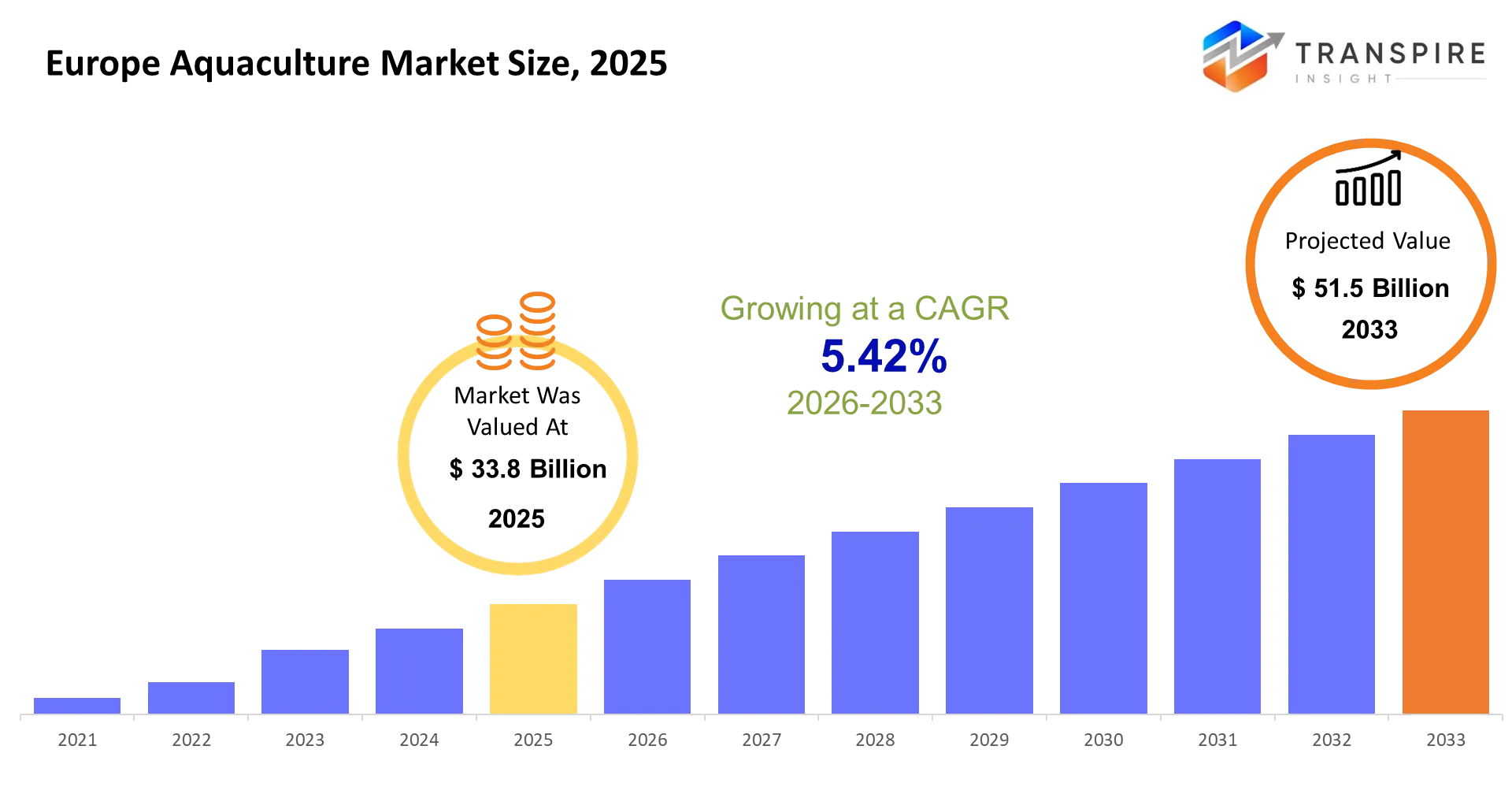
- Europe Aquaculture Market Size 2025: USD 33.8 Billion
- Europe Aquaculture Market Size 2033: USD 51.5 Billion
- Europe Aquaculture Market CAGR: 5.42%
- Europe Aquaculture Market Segments: By Type (Fish Farming, Shellfish Farming, Seaweed Farming, Freshwater Aquaculture, Marine Aquaculture, Others); By Application (Food Production, Feed Production, Nutraceuticals, Others); By End-User (Commercial Farms, SMEs, Government, Others); By System (Open Systems, Closed Systems, Recirculating Systems, Others)
To learn more about this report,  Download Free Sample Report
Europe Aquaculture Market Summary
The Europe Aquaculture Market was valued at USD 33.8 Billion in 2025. It is forecast to reach USD 51.5 Billion by 2033. That is a CAGR of 5.42% over the period.
The Europe aquaculture market operates as an organized system which produces protein by transforming controlled aquatic and terrestrial habitats into stable seafood supplies for retail chains and exporters and food service networks. The system ensures stable fish supply to European food systems while decreasing dependence on wild fish stocks and imported protein materials. The system establishes a controlled industrial supply chain which connects authorized marine farming areas with hatcheries and feed manufacturers and processing facilities.
The sector has transitioned during the past five years from its previous practice of expanding open net pens to building offshore facilities and developing high-technology recirculating aquaculture systems. EU environmental regulations now impose stricter requirements which govern sea lice control and waste disposal and coastal space utilization to limit industry operations. The energy price shock which followed the 2022 supply crisis created new operational expenses for traditional coastal farms which required operators to implement systems that improved their efficiency. The process of adopting new technologies now occurs more frequently among large producers who operate integrated systems which enable them to fund automation and biosecurity enhancements and vertical feed operations. The organization now generates revenue through biological efficiency and regulatory compliance and dependent production environment expansion which controls production processes.
Key Market Insights
- Norway leads the European Aquaculture Market with its 55% market share which comes from its salmon production through its fjord-based license system and its superior cold-water salmon farming facilities in 2025.
- Southern Europe experiences rapid growth until 2026 because Spain implements offshore licensing changes and Mediterranean countries adopt modern aquaculture methods.
- The Europe Aquaculture Market shows fish farming as its major segment because it controls more than 60% of market share through high export needs and its complete supply network.
- The second largest segment of the market exists through shellfish farming which benefits from low-input coastal farming methods and consistent EU market demand for domestic seafood products.
- The fastest-growing segment of aquaculture systems in Europe exists through recirculating aquaculture systems which will increase after 2025 when the region adopts biosecure land-based production systems.
- Europe Aquaculture Market distribution shows food production applications as the most common sector because retail export agreements and increased demand for certified seafood products drive industry growth.
- The marine bioactive extraction field currently shows its fastest growth through nutraceutical applications which marine bioactive extraction field implements in the wellness and pharmaceutical sectors.
- Commercial farms lead end-user adoption with large-scale integrated operations controlling most licensed production capacity across Northern Europe.
- Niche species farming and modular aquaculture technology now display their highest growth rate among small and medium-sized enterprises.
- Mowi ASA enhances its market position through vertical integration which extends from feed production to seafood distribution networks across the world.
What are the Key Drivers, Restraints, and Opportunities in the Europe Aquaculture Market?
The regulatory framework which controls environmental performance and traceability requirements for specific areas in Norway Scotland and EU coastal zones operates as the main factor which determines the development of the European aquaculture industry. Operators have been compelled to adopt controlled production systems and offshore installations after regulations established more strict limits which restricted sea lice and discharge and escape incidents. The industry responds to regulatory demands by investing in recirculating aquaculture systems and automated feeding systems and integrated monitoring systems which create increased demand for equipment and rapid technology adoption. Businesses that operate at a larger scale benefit from decreased certification expenses because they can distribute those costs through their entire production process.
The most significant restraint is biological risk volatility in open sea farming, especially disease outbreaks and harmful algal blooms that cannot be fully controlled with current technology. The structural limitation exists because marine ecosystems face climate variability which scientists cannot fully replicate through land-based system engineering. The unpredictable risks lead to mortality events which insurance costs create and these costs decrease revenue stability making it difficult for smaller companies to enter the market and expand production in coastal areas which experience high risk.
A key opportunity exists through hybrid production models which combine offshore farming with land-based recirculating aquaculture systems. The first deployments which took place in Norway and Spain demonstrated that controlled inland systems to sea cages transfer led to better survival rates for juvenile fish. Coastal industrial hubs are experiencing rising investment in modular RAS systems which operate on renewable energy.This transition could unlock scalable, lower-risk production capacity for new entrants between 2026 and 2033.
What Has the Impact of Artificial Intelligence Been on the Europe Aquaculture Market?
Artificial intelligence now operates in aquaculture through automatic systems that monitor fish feeding patterns and oxygen concentration and water quality in open sea cages and recirculating aquaculture systems. Computer vision systems now track fish behavior in real time, allowing automated feeding adjustments that reduce feed waste and improve growth consistency. The vessel uses AI-enabled dashboards to track digital scrubber performance and marine emission control systems, which monitor exhaust gas cleaning efficiency and ensure compliance with EU sulfur and carbon regulations that increase in fishing fleets and support vessels.
Operators use machine learning models to create predictive maintenance systems for pumps and oxygenation units and offshore feeding systems, which help operators decrease unexpected equipment failures while maintaining consistent production output. These systems used in multiple Nordic operations have decreased maintenance-related interruptions while increasing equipment availability and helping service vessels achieve better fuel efficiency. AI-based forecasting tools now estimate biomass growth rates and emissions output, enabling better planning for harvest timing and regulatory reporting accuracy.
Adoption faces limitations because environmental monitoring equipment needs high-quality training data for maritime operations to function accurately, since marine sensors experience degradation from environmental conditions. The lack of internet access in offshore agricultural areas prevents farmers from accessing real-time analytics, which forces them to depend on uploaded data that arrives later instead of using continuous artificial intelligence systems for making decisions.
Key Market Trends
- The Nordic producers maintained their production assets during the period from 2024 to 2026 which enabled them to gain better control over their licenses while they decreased the number of separate coastal ownership areas which existed throughout Norway.
- The European Union implemented stricter regulations which affected coastal areas in the European Union since 2025 because this made investors choose offshore aquaculture systems and deeper-water systems instead of traditional net pens.
- Mowi ASA increased its acquisition operations during 2026 to establish vertical integration which creates stable production and supports better export planning throughout Europe.
- The companies Andfjord Salmon and its similar competitors established more post-smolt partnerships during 2026 which helped them decrease grow-out risk while they achieved major reductions in their biological production time.
- The recirculating aquaculture systems market experienced rapid growth after 2025 because companies needed to meet new waste discharge standards and sea lice control requirements.
- SalMar ASA expanded its offshore installation activities from 2024 to 2026 by establishing new production facilities outside of restricted coastal farming areas.
- The fishmeal market experienced feed supply uncertainties which compelled producers to establish their own feed production operations while securing alternative protein sources after 2025.
- The 2026 Mediterranean aquaculture licensing reforms enabled modular farming systems to enter Spain and its neighboring areas through their ability to produce different species.
- From 2024 onward retail customers preferred to purchase certified low-carbon seafood which created new requirements for producers to implement complete traceability systems.
Europe Aquaculture Market Segmentation
By Type:
The European aquaculture industry depends on fish farming because it has developed industrial operations for fish exports and operates effective biological systems which work in cold-water settings. The European market demand for salmon and trout species as well as their suitability for controlled marine farming operations make these fish types the main commercial output of the industry. Shellfish farming maintains a stable but smaller position because it has reduced operational expenses and benefits from productive coastal growing areas but seaweed farming remains limited yet essential for ecological functions and development of new feed solutions.
The expansion of fish farming continues because large Nordic producers consolidate their operations while people increasingly demand certified low-carbon protein products. Seaweed farming receives more attention as it combines with carbon reduction targets and feed substitution initiatives while freshwater aquaculture faces limitations due to land restrictions and water regulations which affect inland areas. The offshore licensing reforms enable marine aquaculture to operate in deeper waters while they decrease the need for coastal space.
The development of the future will support fish farming systems that require technology because these systems need advanced technology for their recirculating and offshore hybrid systems which deliver better production results. Seaweed farming will attract investment from feed producers and bio-based material developers seeking alternative inputs. Shellfish farming will maintain niche relevance in coastal economies, while freshwater systems will shift toward high-efficiency enclosed units. The funding distribution process will prioritize fish production systems which can create scalable operations that expose less biological risk to their activities.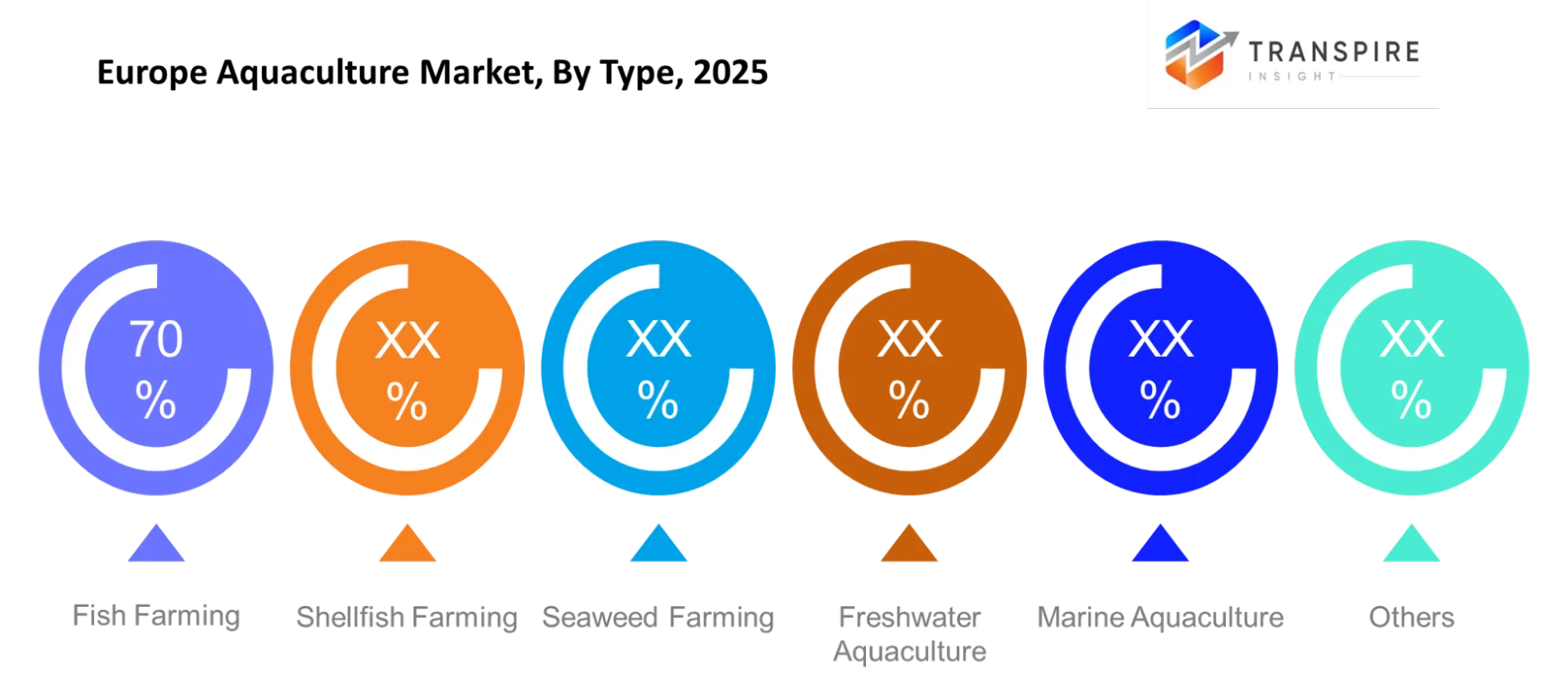
To learn more about this report, Download Free Sample Report
By Application:
The European aquaculture industry requires its highest volume of production because customers show strong demand for its products which food service establishments and institutional buyers use to meet their operational needs. The primary driving force of feed production exists because major producers implement vertical integration methods to achieve better control over costs and maintain consistent supply of their products. Nutraceutical applications remain smaller but increasingly relevant as marine-derived omega-3 and bioactive compounds gain traction in health-focused consumer markets.
Food production growth is supported by tightening traceability regulations and rising preference for sustainably certified seafood in supermarkets and export markets. Feed production expands as producers attempt to reduce dependency on external suppliers and stabilize input costs amid volatile raw material markets. Nutraceutical growth is linked to pharmaceutical and wellness industries that extract high-value compounds from marine biomass rather than bulk protein supply chains.
The future demand will remain focused on food production systems which achieve operational efficiency while meeting certification standards. Feed production will become more integrated into upstream operations, particularly among large-scale fish farming operators. The nutraceutical industry will attract biotech companies and investors who focus on developing high-profit marine bioactive extraction methods. The strategic value of production models will transition to vertically integrated systems which link feed production with farming and end-market processing.
By End-User:
The primary user group for European aquaculture operations consists of commercial farms which possess both licensed production zones and expensive infrastructure and international trade business operations. The small and medium-sized enterprises maintain essential functions within niche species breeding and regional distribution networks while they concentrate on localized sales and unique seafood items. The research institutions and government operations support broodstock development and environmental monitoring activities but they do not create substantial production capacity.
The regulations create advantages for commercial farms because they require expensive compliance and environmental reporting which only large operators can afford. The small and medium-sized enterprises develop their business through specialization which enables them to cultivate high-value and locally adapted species that do not compete with industrial salmon products. Government engagement creates better sustainability oversight which enables innovation development for programs that control diseases and manage ecosystems.
The large commercial farms will control production capacity through their investment in automated systems and offshore operations and recirculating technologies in future development. The small and medium-sized enterprises will stay important in product markets that require unique products but they will encounter challenges because of increasing compliance expenses. The government will focus on sustainability enforcement and regulatory coordination instead of controlling actual production processes. The investment patterns will benefit operators who can scale their businesses through supply chain integration and compliance with regulatory requirements.
By System:
The current European aquaculture sector uses open systems because they require less capital investment and their existing infrastructure supports production activities according to current European aquatic farming practices which includes both coastal and offshore marine farming operations. The application of closed systems in hatcheries and controlled biological environments remains restricted because they can only be developed to small operating sizes. The regulatory and environmental support for land-based production systems in Northern and Western Europe has led to rapid growth of recirculating systems.
The ongoing use of open systems results from historical licensing systems and the cost-effective nature of sea-based farming which operates in specific regions. The application of recirculating systems in aquaculture continues to expand because regulatory authorities impose stricter regulations on sea lice control waste discharge management and the usage of coastal areas. Closed systems operate as transitional infrastructure which enables juvenile fish development while providing controlled environments needed by high-value fish species.
The industry will develop hybrid production systems which combine offshore open systems with land-based recirculating units to create an optimal balance between production capacity and operational risk. Recirculating systems will receive the most investment because technology advancements will enhance water recycling systems and energy recovery processes. The operational framework of open systems will continue to function as a vital component despite the introduction of more stringent environmental regulations. Investors and technology providers will focus on developing systems which decrease biological fluctuations while enabling industrial-scale production capabilities.
What are the Key Use Cases Driving the Europe Aquaculture Market?
The primary application of the European aquaculture industry focuses on intensive finfish production which executes salmon farming in controlled marine and fjord environments. The application establishes the highest demand because it enables customers to export protein products which maintain constant output through existing licensing areas and the benefits of cold-water fish. Large producers prioritize this use case to maintain year-round supply stability and meet strict EU traceability and sustainability requirements.
The adjacent systems operate post-smolt production and land-based recirculating aquaculture systems which provide services to seafood processors and vertically integrated exporters. Companies in Norway and Scotland are adopting these use cases because they want to decrease biological danger and fast-track their growing process. Food service distributors and retail supply chains also increasingly rely on these controlled production systems to ensure predictable volume commitments.
The new applications which have emerged include offshore multi-trophic aquaculture systems which operate in connection with wind farm infrastructure and seaweed farming systems which provide carbon capture and feed supplementation. These models are still early-stage but are gaining attention from energy operators and sustainability-driven investors. The systems will transform the distribution of marine space because they will divide it among energy production, food harvesting, and environmental protection services.
|
Report Metrics |
Details |
|
Market size value in 2025 |
USD 33.8 Billion |
|
Market size value in 2026 |
USD 35.6 Billion |
|
Revenue forecast in 2033 |
USD 51.5 Billion |
|
Growth rate |
CAGR of 5.42% from 2026 to 2033 |
|
Base year |
2025 |
|
Historical data |
2021 - 2024 |
|
Forecast period |
2026 - 2033 |
|
Report coverage |
Revenue forecast, competitive landscape, growth factors, and trends |
|
Regional scope |
Europe (Germany, United Kingdom, France, Italy, Spain, Rest of Europe) |
|
Key company profiled |
Mowi, Cermaq, Leroy Seafood, Grieg Seafood, BioMar, Skretting, Aller Aqua, Cargill Aqua Nutrition, Thai Union, Tassal Group, Cooke Aquaculture, Avanti Feeds, Nireus Aquaculture, SalMar, Stolt Sea Farm |
|
Customization scope |
Free report customization (country, regional & segment scope). Avail customized purchase options to meet your exact research needs. |
|
Report Segmentation |
By Type (Fish Farming, Shellfish Farming, Seaweed Farming, Freshwater Aquaculture, Marine Aquaculture, Others); By Application (Food Production, Feed Production, Nutraceuticals, Others); By End-User (Commercial Farms, SMEs, Government, Others); By System (Open Systems, Closed Systems, Recirculating Systems, Others) |
Which Regions are Driving the Europe Aquaculture Market Growth?
The European aquaculture industry considers Norway and its adjacent Nordic maritime regions as its primary operating center because those areas possess established regulatory systems and developed marine aquaculture facilities. Large companies use the area access rights that they obtained through the strict yet constant licensing rules to maintain their production operations, which generates high biological output from their fjord facilities. The region possesses advanced cold-water aquaculture knowledge together with extensive port transportation systems and processing plants that operate near fishing areas. Strong public oversight also reinforces disease control standards, which reduces mortality risk and improves export consistency.
Western Europe, led by the United Kingdom and Ireland, maintains its presence through steady operations instead of pursuing market dominance. The region utilizes diversified coastal areas together with its existing farming methods because it needs to protect its environmental resources and engage with local communities. Scotland's salmon farming clusters provide economic stability through continuous local seafood consumption and permanent funding for marine development projects. Operators receive extended planning periods from the gradual development of regulatory processes because they will face slower growth rates compared to Nordic production facilities. The area functions as a consistent source of income that does not drive major production growth.
The fastest developing section of Southern Europe exists in Spain together with the newly developed Mediterranean aquaculture areas because these regions now possess operational offshore and land-based aquaculture permits. The government agencies started to simplify the marine farm licensing process while they allocated funds to upgrade coastal industrial facilities that would help decrease seafood import dependence. The establishment of new recirculating aquaculture systems together with the introduction of warmer-water species for farming purposes now enables organizations to expand their production capabilities within restricted areas. The region creates investment opportunities for new businesses through its development of diverse species farming systems and modular farming technologies. The period between 2026 and 2033 will create an investment opportunity that attracts capital from investors who seek high-growth potential investments beyond the established Nordic supply chain.
Who are the Key Players in the Europe Aquaculture Market and How Do They Compete?
The European aquaculture industry shows a strong market concentration because Nordic companies control most salmon production capacity throughout Norway and the Faroe Islands. Companies compete through structural advantages which include access to farming licenses and their abilities to produce biological products and their ability to produce efficient feed and their ability to meet improving environmental regulations which create more stringent requirements. New companies enter the market through land-based recirculating systems and offshore farming technologies which help them evade restrictions that coastal areas impose on their operations while existing businesses protect their existing operational sites and licensed production facilities.
Mowi ASA controls its entire value chain which includes its operations from feed production through processing and worldwide distribution to achieve lower costs and maintain consistent product availability. SalMar ASA establishes its market position through its substantial investments in offshore and exposed farming systems which encompass its development of extensive ocean facilities. Lerøy Seafood Group builds its competitive edge through its distribution network and seafood sales system which creates competitive advantage through its downstream capabilities and its acquisition of processing and logistics companies which improve market access through its operations.
Grieg Seafood uses a multi region production approach which exists in Norway and Canada and the UK as a way to minimize biological and regulatory risks through its production environment diversification. Bakkafrost achieves market differentiation through its complete vertical integration system which manages feed production and Hydropower-supported operations to enhance its control over input expenses and sustainability practices when compared to competitors who maintain fewer integrated systems.
Company List
- Mowi
- Cermaq
- Leroy Seafood
- Grieg Seafood
- BioMar
- Skretting
- Aller Aqua
- Cargill Aqua Nutrition
- Thai Union
- Tassal Group
- Cooke Aquaculture
- Avanti Feeds
- Nireus Aquaculture
- SalMar
- Stolt Sea Farm
Recent Development News
In July 2025, Grieg Seafood announced the sale of its Canadian salmon farming operations to Cermaq. The divestment reflects ongoing consolidation and portfolio optimization among major European aquaculture players, with firms increasingly concentrating on core Nordic production regions amid cost and regulatory pressures.https://en.wikipedia.org
“In March 2026, Mowi ASA announced a transaction agreement to purchase Torghatten Aqua’s salmon farming seawater business. The acquisition expands Mowi’s licensed biomass capacity in Northern Norway and strengthens its control over regional production assets, reinforcing ongoing consolidation in European salmon farming.https://live.euronext.com
What Strategic Insights Define the Future of the Europe Aquaculture Market?
The European aquaculture market will transition from traditional coastal operations to advanced sustainable production systems which use cutting-edge technology throughout the coming 5–7 years because European Union regulations will become stricter and sea temperatures will fluctuate and consumers will demand traceable low-carbon protein products. Controlled environments will experience most of the market growth through RAS systems and offshore facilities which use renewable energy systems. The market operates under hidden danger because companies depend on unstable supply chains for their essential fishmeal and soybean resources, which face potential disruption from climate events and trade embargoes that will force price increases during periods of high demand. The upcoming opportunity for aquaculture development through partnership with offshore wind farms will create shared resources and generate leasing agreements which will enhance economic performance for both parties. Companies in the market should invest early in systems that integrate all functions and depend on minimal feed resources while they should obtain permits from multiple jurisdictions to maintain their business operations after new regulations take effect.
Europe Aquaculture Market Report Segmentation
By Type
- Fish Farming
- Shellfish Farming
- Seaweed Farming
- Freshwater Aquaculture
- Marine Aquaculture
- Others
By Application
- Food Production
- Feed Production
- Nutraceuticals
- Others
By End-User
- Commercial Farms
- SMEs, Government
- Others
By System
- Open Systems
- Closed Systems
- Recirculating Systems
- Others
Frequently Asked Questions
Find quick answers to common questions.
The Europe Aquaculture Market size is USD 51.5 Billion in 2033.
Key Segments for the Europe Aquaculture Market are By Type (Fish Farming, Shellfish Farming, Seaweed Farming, Freshwater Aquaculture, Marine Aquaculture, Others); By Application (Food Production, Feed Production, Nutraceuticals, Others); By End-User (Commercial Farms, SMEs, Government, Others); By System (Open Systems, Closed Systems, Recirculating Systems, Others).
Major Europe Aquaculture Market players are Mowi, Cermaq, Leroy Seafood, Grieg Seafood, BioMar, Skretting, Aller Aqua, Cargill Aqua Nutrition, Thai Union, Tassal Group, Cooke Aquaculture, Avanti Feeds, Nireus Aquaculture, SalMar, Stolt Sea Farm.
The Current Europe Aquaculture Market size is USD 33.8 Billion in 2025.
The Europe Aquaculture Market CAGR is 5.42% from 2026 to 2033.
- Mowi
- Cermaq
- Leroy Seafood
- Grieg Seafood
- BioMar
- Skretting
- Aller Aqua
- Cargill Aqua Nutrition
- Thai Union
- Tassal Group
- Cooke Aquaculture
- Avanti Feeds
- Nireus Aquaculture
- SalMar
- Stolt Sea Farm
Recently Published Reports
-
Apr 2026
Baby Infant Formula Market
Baby Infant Formula Market Size, Share & Analysis Report By ype (Infant Milk, Follow On Milk, Specialty Baby Milk, Growing-Up Milk), By Ingredient (Carbohydrate, Fat, Protein, Minerals, Vitamins, and Others), By Product Form (Powder, Liquid, and Ready-to-feed), By Distribution Channels (Supermarket/Hypermarket, Specialty Store, Pharmacies, Online Retail, and Others), and Geography (North America, Europe, Asia-Pacific, Middle East and Africa, South and Central America), 2021 - 2031
-
Apr 2026
Edible Insects for Animal Feed Market
Edible Insects for Animal Feed Market Size, Share & Analysis Report By Type (Insect Powder, Insect Meal, Insect Bar, Insect Paste, Insect Oil, and Others), By Insect Type (Beetles, Cricket, Caterpillar, Hymenoptera, Orthoptera, Tree Bugs, and Others), By Application (Livestock, Pet Food, and Aquaculture), By Livestock Type (Poultry, Swine, and Others), and Geography (North America, Europe, Asia-Pacific, Middle East and Africa, South and Central America), 2021 - 2031
-
Apr 2026
Food Industry Disinfection and Bacterial Control Market
Food Industry Disinfection and Bacterial Control Market Size, Share & Analysis Report By Type (Chemical Disinfectants, Physical Disinfectants, and Biocides and Antimicrobials), By Application (Food Processing Equipment Surface Disinfection, Food Preparation Areas Surface Disinfection, Storage Areas Surface Disinfection, Anti-microbial Coatings Food Preservation, and Preservative Solutions Food Preservation), By End User (Meat and Poultry Processing, Dairy Processing, Seafood Processing, Bakery and Confectionery, Restaurants and Commercial Kitchens, and Food Service Providers), By Sales Channel (Online, Offline), and Geography (North America, Europe, Asia-Pacific, Middle East and Africa, South and Central America), 2021 - 2031
-
Apr 2026
Freeze Dried Food Market
Freeze Dried Food Market Size, Share & Analysis Report By Product Type (Fruits, Vegetables, Freeze-Dried Dairy Products, Freeze-Dried Meat and Seafood, Freeze-Dried Pet Food, and Prepared Meal), By Nature (Organic, and Conventional), By Form (Powdered, Granules, and Diced), By End Use (Breakfast Cereals, Dairy Products, Bakery & Confectionery, Nutritional Bars & Supplements, Powdered Beverages, Snacks, and Retail (Household)), and Geography (North America, Europe, Asia-Pacific, Middle East and Africa, South and Central America), 2021 - 2031