

Asia Pacific Functional Foods Market Size & Forecast:
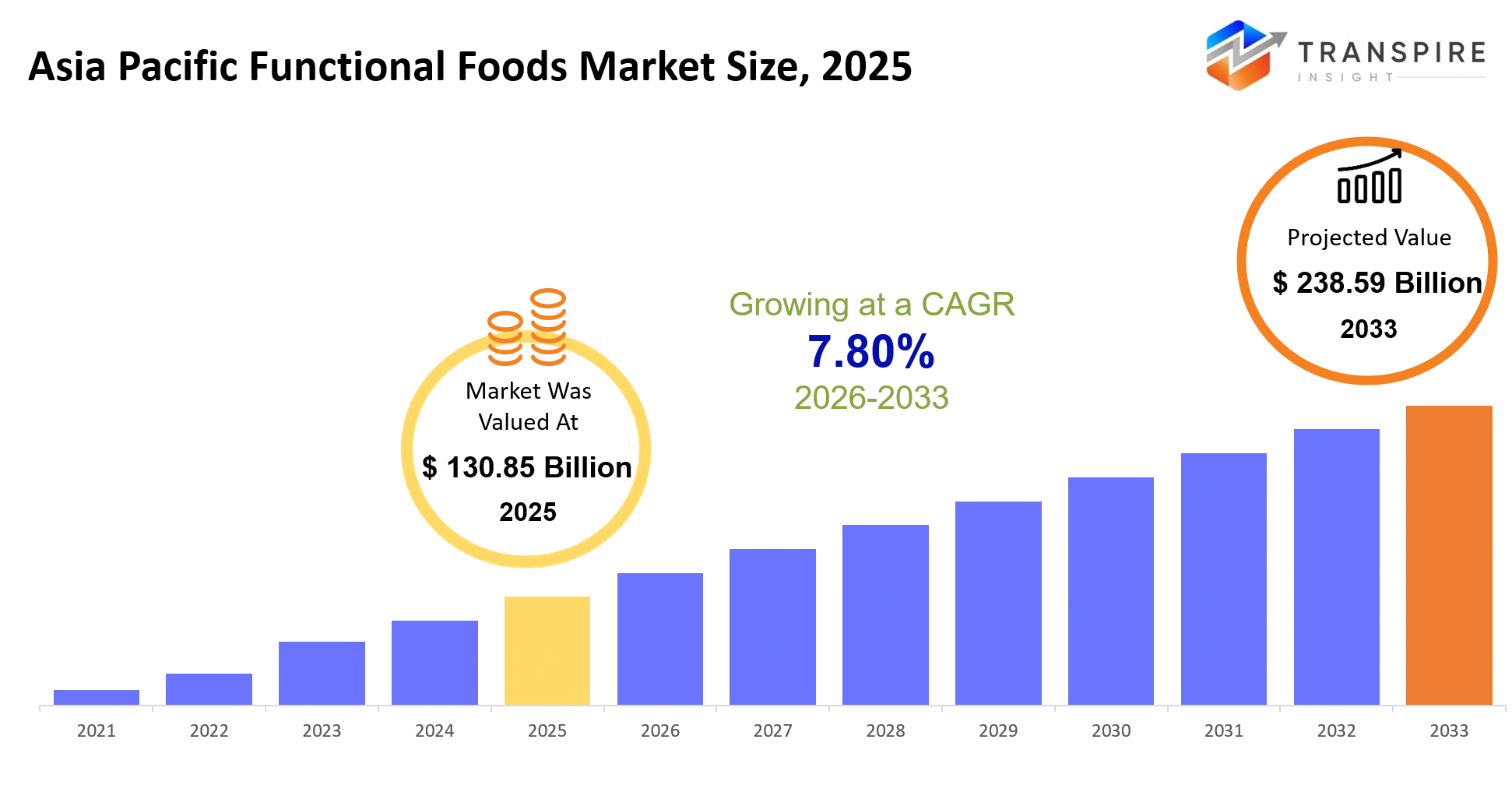
- Asia Pacific Functional Foods Market Size 2025: USD 130.85 Billion
- Asia Pacific Functional Foods Market Size 2033:USD 238.59 Billion
- Asia Pacific Functional Foods Market CAGR: 7.80%
- Asia Pacific Functional Foods Market Segments: By Product Type (Fortified Foods, Probiotic Foods, Functional Beverages, Protein-Enriched Foods, Energy Foods, Heart Health Foods, Digestive Health Foods, Others); By Distribution Channel (Supermarkets, Convenience Stores, Online Retail, Health Stores, Pharmacies, Hypermarkets, Specialty Stores, Others); By Ingredient (Probiotics, Vitamins, Minerals, Fibers, Omega-3, Plant Extracts, Proteins, Others); By End User (Adults, Elderly Consumers, Athletes, Children, Health-Conscious Consumers, Women, Working Professionals, Others).
Asia Pacific Functional Foods Market Summary
The Asia Pacific Functional Foods Market was valued at USD 130.85 Billion in 2025. It is forecast to reach USD 238.59 Billion by 2033. That is a CAGR of 7.80% over the period.
The Asia Pacific Functional Foods Market is really helpful for people who want to get the nutrients they need from the food and drinks they have every day. By just taking supplements or going to the doctor, functional foods help people have healthy digestion, a strong immune system, a healthy heart, lots of energy and feel good overall. They do this by adding stuff to things like milk, cereal, drinks, snacks and other foods that are good for you. This is a practical way to stay healthy which is why functional foods are a big part of how people in the Asia Pacific region try to prevent health problems.
Over the five years the Asia Pacific Functional Foods Market has changed a lot. Now people are looking for foods that are specifically designed to help with health issues rather than just general healthy foods. The COVID-19 pandemic was a reason for this change because it made people think more about how to stay healthy and have a strong immune system. Food companies started making products with things like probiotics, protein, fiber, vitamins and other good stuff that can help people stay healthy. This change has been good, for food companies and the people who supply them with ingredients because people are willing to pay more for foods that're really good for them. As companies keep doing research and making products that are tailored to what people need, the Asia Pacific Functional Foods Market is going to keep growing and becoming more profitable. The Asia Pacific Functional Foods Market is going to have more different kinds of functional foods which will help companies stand out and make more money.
Key Market Insights
- The Asia Pacific Functional Foods Market is moving towards products that are proven to be good for gut health, immunity and metabolic wellness.
- East Asia made up 44% of the market in 2025 because they are good at making new food products and have modern factories.
- Southeast Asia is growing fast and will keep growing until 2033 because people are eating more food that is good for their health.
- Drinks that're good for you like probiotic drinks and protein shakes make up almost 32% of the market because people want to be healthy.
- Foods like yogurt and milk that are good for you are still really popular because people trust them and they have lots of stuff in them.
- Foods that help your gut and have bacteria in them have become really popular since 2021 because companies are trying to make people healthier.
- Products that help keep you from getting sick are still becoming more popular because people want to stay healthy and eat food that's good for them.
- Companies like Nestlé, Danone, Yakult, PepsiCo and Abbott are making products and using science to make sure their food is good for you.
- Food companies are working with suppliers to make different kinds of functional foods.
- Companies are now competing by trying to prove their products really work, making recipes and helping people eat food that is good for them, not just making regular products.
What are the Key Drivers, Restraints, and Opportunities in the Asia Pacific Functional Foods Market?
Driver
The main thing that is changing the Asia Pacific Functional Foods Market is that people are moving away from wellness products and towards nutrition solutions that are supported by science. This happened a lot after the pandemic when people started looking at products to see if they really worked or just believing what the ads said. So food companies started putting money into things like probiotics, protein and ingredients that help with digestion and immunity. They made sure these things were backed up by science. This change made premium functional products more valuable so companies could charge money for them, make them stand out from other products and make more money from specialized nutrition categories.
Restraint
The biggest problem is that the rules around health claims and ingredients are really complicated. Companies that make food often have to spend a lot of money on research and testing before they can say their products do certain things for your health. This is hard because the rules are different in markets and they are always changing. So it takes longer to develop products, it costs more money to get them on the market and it takes longer for new and innovative products to become available. This is a challenge for companies that want to make money from these products.
Opportunity
Companies can make money from nutrition. This is because of health technologies and nutritional analytics. Food companies are making products that're good for people of different ages. They are also making products that're good for people, with different lifestyles and health issues. Some people have bacteria in their bodies so companies are making products for them too.New technologies are helping companies make foods. These technologies can look at people's health data. Figure out what they need. Companies that make food will get a big share of the market where people pay more for good food. These companies will. Make more money over time.The Asia Pacific Functional Foods Market is a place for companies to sell these products. Companies that focus on nutrition and targeted health solutions will do well in this market. Personalized nutrition is important. Companies that do this will be successful. The Asia Pacific Functional Foods Market is where companies can sell nutrition products and people will buy them.
What Has the Impact of Artificial Intelligence Been on the Asia Pacific Functional Foods Market?
The food industry is changing because of intelligence and new digital technologies. These things are making it easier for companies to make products work better and understand what people want. Food companies are using intelligence to look at what people like to eat, what is good for them and how ingredients work together. This helps them make products faster.
They also use computers to check the quality of their products and make sure they are made the way every time. This helps them find problems before they happen.Artificial intelligence is also used to predict how ingredients will work together, make fermentation better and plan how to get ingredients to the factory. Companies use intelligence to guess how many ingredients they will need so they do not run out or have too many. This helps them make products without stopping.Artificial intelligence can also help companies fix their machines before they break so they can keep working all the time. This saves them money and time.
Artificial intelligence is also helping companies make food that's just right for each person. It does this by looking at their health, diet and how they live. However there is a problem. It is hard to get information about food and people. If the information is not good then the artificial intelligence does not work well. This is a problem even though artificial intelligence and digital technologies are getting better and better in the food industry.
Key Market Trends
- Since 2021 the people who make products have been working on making things that're good for our digestive health and immunity and they are making sure these things really work.
- A lot of drinks with special ingredients came out between 2022 and 2025 and big companies like Nestlé and Danone made more products with probiotics and protein.
- Companies like Nestlé, Danone and Yakult are spending money to learn about the microbiome, which is like the tiny world of living things inside our bodies so they can make better products for digestive health.
- Food companies are trying to make their products cleaner by taking out ingredients and using natural things instead and this is happening really fast.
- After 2023 more people started using platforms to help them eat the right foods for their bodies and this is making food companies think about how they can make products that are just right for each person.
- Now we can find snacks and drinks with protein, in regular stores not just in special sports stores and more people are buying them.
- Food companies are working with the people who supply them with ingredients so they can make new products faster.
- Computers are being used to help design products, which makes it easier and faster to make them and it helps companies choose the right ingredients.
- Because it can be hard to get some ingredients companies are trying to find new places to get them from so they are not stuck if one place has a problem.
- Now companies are competing with each other to see who can make products that really work and are backed up by science rather than just trying to make their brand look cool.
Asia Pacific Functional Foods Market Segmentation
By Product Type:
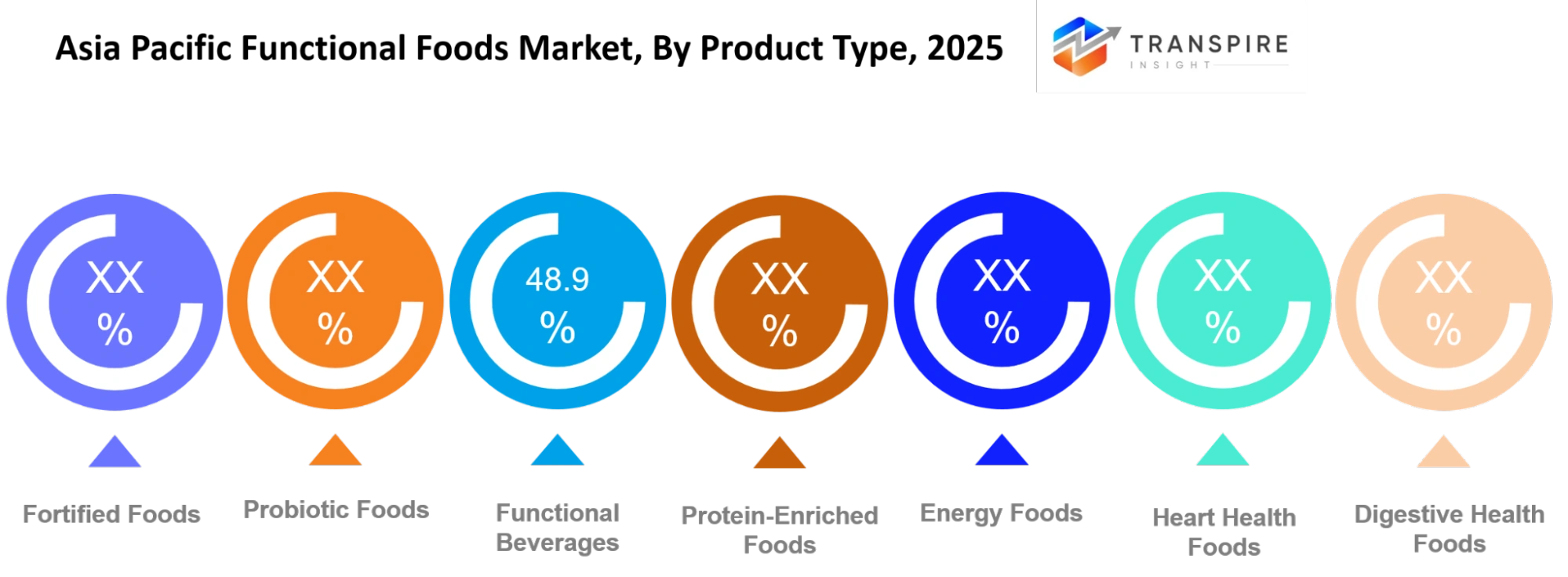
Fortified Foods are really good for you because they add nutrition to the food you eat every day. They help fill in the gaps in your diet when you are not getting all the nutrients you need. Probiotic Foods are also very good for you because they help your system and keep your gut healthy. More and more people want Probiotic Foods because they are learning about how important it's to take care of their microbiome. Functional Beverages are drinks that not quench your thirst but also give you extra health benefits. You can find Functional Beverages in stores and people like to buy them. Protein-Enriched Foods are great for people who want to build muscles and stay full for a long time. Energy Foods help you have the energy you need to get through your day. Heart Health Foods are special because they help keep your heart healthy. Digestive Health Foods help your body digest food properly. There are types of foods that are coming out that focus on specific health needs.
By Distribution Channel:
You can buy food at supermarkets. They have a lot of kinds of food and you can find them in many cities. Convenience Stores are great for when you need something. They have foods that are easy to eat on the go. Online Retail is getting more popular because people like to shop from home and have their food delivered. Health Stores have people who know a lot about health and can help you choose the food. Pharmacies sell foods that can help prevent you from getting sick. Hypermarkets are stores where you can buy a lot of food at once. Specialty Stores have foods that are made for specific health needs. There are stores that are a mix of different types of stores and they sell a wide variety of functional foods.
By Ingredient:
Probiotics are really good for your gut. Help keep you healthy. Vitamins are important for your health. Minerals help keep your bones strong and your body working properly. Fibers are good for your system and can also help you lose weight. Omega-3 ingredients are good for your heart and brain. Plant extracts are used to make foods that're natural and healthy. Proteins are important for building muscles. There are ingredients that are used to make foods that are good for specific health needs.
By End User:
Adults are the ones who buy food the most. They need nutrition to stay healthy.Elderly people buy food that helps with bone health. This keeps them from getting sick.Athletes like food with a lot of protein. It helps them perform better.Children need food with nutrition. It helps them grow strong and healthy.People who care about their health like to buy food. It's good for them.Women buy food that helps with bone health. This keeps them healthy.Working professionals, like food that's easy to eat. It gives them energy .There are people who have dietary needs. They buy food that's good for them.
What are the Key Use Cases Driving the Asia Pacific Functional Foods Market?
The Asia Pacific Functional Foods Market is really about functional beverages and fortified foods. These are the things that people are using. They put probiotics and vitamins and proteins into the food and drinks that people have every day. This makes it easy for people to get the nutrition they need. Food companies like this because they can add things to the food and drinks that people already like such as juice and milk and ready-to-eat meals.
People want to take care of their supplements and sports nutrition products so they can buy them. This is because people want to have immune systems and lots of energy and people want to be able to recover from working out. Old people are also using supplements and sports nutrition products to stay healthy in hospitals and pharmacies where old people can get special food that helps their bones and prevents old people from getting sick.Now people are starting to make food that's just for one person, based on what that person's body needs. People are also making food that helps peoples supplements and sports nutrition products, which is like the tiny ecosystem inside people's bodies. Hospitals are using food to help people get better and prevent people from getting sick.
The Asia Pacific Functional Foods Market is going to keep growing as technology gets better. We can make precise formulas for dietary supplements and sports nutrition products. Functional beverages and fortified foods are going to be a part of supplements and sports nutrition products.
|
Report Metrics |
Details |
|
Market size value in 2025 |
USD 130.85 Billion |
|
Market size value in 2026 |
USD 141.05 Billion |
|
Revenue forecast in 2033 |
USD 238.59 Billion |
|
Growth rate |
CAGR of 7.80% from 2026 to 2033 |
|
Base year |
2025 |
|
Historical data |
2021 - 2024 |
|
Forecast period |
2026 - 2033 |
|
Report coverage |
Revenue forecast, competitive landscape, growth factors, and trends |
|
Regional scope |
Asia Pacific (India, China, Japan, Australia, South Korea, Rest of Asia Pacific) |
|
Key company profiled |
Nestle, Danone, Yakult, PepsiCo, Coca-Cola, General Mills, Kellogg's, Abbott, Herbalife, Amway, Arla Foods, Fonterra, Meiji, FrieslandCampina, Unilever. |
|
Customization scope |
Free report customization (country, regional & segment scope). Avail customized purchase options to meet your exact research needs. |
|
Report Segmentation |
By Product Type (Fortified Foods, Probiotic Foods, Functional Beverages, Protein-Enriched Foods, Energy Foods, Heart Health Foods, Digestive Health Foods, Others); By Distribution Channel (Supermarkets, Convenience Stores, Online Retail, Health Stores, Pharmacies, Hypermarkets, Specialty Stores, Others); By Ingredient (Probiotics, Vitamins, Minerals, Fibers, Omega-3, Plant Extracts, Proteins, Others); By End User (Adults, Elderly Consumers, Athletes, Children, Health-Conscious Consumers, Women, Working Professionals, Others). |
Which Regions are Driving the Asia Pacific Functional Foods Market Growth?
The Asia Pacific Functional Foods Market is led by East Asia. This is because East Asia has a good food manufacturing base, it knows a lot about nutrition and it has a great system for getting food to stores. East Asia is also putting a lot of money into biotechnology and new food ideas, which helps to create products quickly, especially foods that are fortified and have probiotics. East Asia also has strict rules about food safety, which means that people can trust the food they buy. The region has a lot of companies that make ingredients, do research and produce food, which makes it even stronger. The Asia Pacific Functional Foods Market and East Asia are closely related in this context.
South Asia is the biggest region for the Asia Pacific Functional Foods Market. It is growing because it can process food now and more people are living in cities. Unlike East Asia, South Asia is growing because food is affordable and a lot of people want to buy it, not because of advanced research. The stores in South Asia are getting better and more people are buying packaged food, which helps the Asia Pacific Functional Foods Market to grow. Big food companies from countries are also investing in South Asia, which means that people can get the food they need and the companies can make money.
Southeast Asia is growing the fastest. This is because people are becoming more aware of their health and they are shopping at stores and online more often. Recently Southeast Asia has seen a lot of investment in food manufacturing and countries are working together more which helps the Asia Pacific Functional Foods Market. The governments are also encouraging companies to make food by supporting good policies. This will create a lot of opportunities for companies and investors who want to be part of the Asia Pacific Functional Foods Market from 2026, to 2033. The Asia Pacific Functional Foods Market and Southeast Asia will likely see a lot of growth in this time period.
Who are the Key Players in the Asia Pacific Functional Foods Market and How Do They Compete?
Competition in the Asia Pacific Functional Foods Market remains moderately consolidated at the top but fragmented across mid-tier and regional brands. Global food and nutrition companies dominate premium and science-backed product categories, while local firms compete aggressively in price-sensitive segments. The primary basis of competition has shifted from branding alone to formulation capability, clinical validation, and ingredient innovation. New entrants continue to disrupt specific niches such as probiotic beverages and plant-based functional foods, forcing incumbents to accelerate product development cycles and strengthen supply chain integration.
Nestlé focuses on technology-driven nutrition innovation, particularly in fortified dairy and medical nutrition, using strong R&D capabilities to differentiate through clinically supported formulations. Danone strengthens its position through probiotic and gut-health-focused products, leveraging its microbiome science expertise and expanding through partnerships with ingredient suppliers. Yakult maintains a niche specialization strategy centered on probiotic beverages, supported by long-standing consumer trust and strong distribution penetration in Asian markets.
PepsiCo expands through functional snacks and beverage innovation, integrating protein and energy-focused formulations into mainstream product lines. Abbott strengthens its clinical nutrition portfolio through hospital and pharmacy channels, focusing on scientifically validated health outcomes and medical-grade formulations. These companies are increasingly investing in regional expansion, digital nutrition platforms, and ingredient partnerships to shorten innovation cycles and maintain competitive differentiation.
Company List
- Yakult
- Kellogg's
- Abbott
- Herbalife
- Amway
- Arla Foods
- Fonterra
- Meiji
- FrieslandCampina
- Unilever
Recent Development News
In February 2026, Marico announced acquisition of Cosmix Wellness to expand its functional nutrition and plant-based wellness portfolio. This move strengthens its position in protein-based and clean-label functional foods.
Source: https://www.proteinproductiontechnology.com
In February 2026, Brenntag opened a Nutrition Innovation and Application Centre in Mumbai to support functional food and beverage formulation in Asia Pacific. The facility improves product development speed and ingredient application testing for manufacturers.
Source: https://www.foodbusinessmea.com
In March 2026, DKSH signed an exclusive distribution partnership with Limagrain Ingredients to expand functional ingredient access across Southeast Asia. This enhances supply chain reach for bakery and nutrition manufacturers.
Source: https://in.marketscreener.com
What Strategic Insights Define the Future of the Asia Pacific Functional Foods Market?
The Asia Pacific Functional Foods Market is moving toward a precision nutrition model where product value will increasingly depend on measurable health outcomes rather than general wellness positioning. Growth over the next five to seven years will be shaped by biotechnology adoption, microbiome research, and data-driven food formulation systems that enable more targeted health solutions. This shift will strengthen demand for probiotic, protein-enriched, and condition-specific foods embedded into daily diets rather than isolated supplement use.
A less visible risk is overdependence on a narrow set of scientifically validated ingredients and supply chains. As product differentiation concentrates around a limited pool of high-performance bioactive compounds, any disruption in fermentation inputs or specialty raw materials could constrain production scalability and increase pricing pressure across categories.
A key emerging opportunity lies in AI-enabled personalized nutrition ecosystems that integrate consumer health data with customized functional food recommendations. This is still in early adoption stages but is gaining traction through digital health platforms and food-tech partnerships. Market participants should invest in proprietary formulation capabilities and regional manufacturing flexibility to shorten innovation cycles and secure long-term competitive positioning.
Asia Pacific Functional Foods Market Report Segmentation
By Product Type
- Fortified Foods
- Probiotic Foods
- Functional Beverages
- Protein-Enriched Foods
- Energy Foods
- Heart Health Foods
- Digestive Health Foods
- Others
By Distribution Channel
- Supermarkets
- Convenience Stores
- Online Retail
- Health Stores
- Pharmacies
- Hypermarkets
- Specialty Stores
- Others
By Ingredient
- Probiotics
- Vitamins
- Minerals
- Fibers
- Omega-3
- Plant Extracts
- Proteins
- Others
By End User
- Adults
- Elderly Consumers
- Athletes
- Children
- Health-Conscious Consumers
- Women
- Working Professionals
- Others
Frequently Asked Questions
Find quick answers to common questions.
The expected Asia Pacific Functional Foods Market size for the market will be USD 238.59 Billion in 2033.
Key segments for the Asia Pacific Functional Foods Market are By Product Type (Fortified Foods, Probiotic Foods, Functional Beverages, Protein-Enriched Foods, Energy Foods, Heart Health Foods, Digestive Health Foods, Others); By Distribution Channel (Supermarkets, Convenience Stores, Online Retail, Health Stores, Pharmacies, Hypermarkets, Specialty Stores, Others); By Ingredient (Probiotics, Vitamins, Minerals, Fibers, Omega-3, Plant Extracts, Proteins, Others); By End User (Adults, Elderly Consumers, Athletes, Children, Health-Conscious Consumers, Women, Working Professionals, Others).
Major Asia Pacific Functional Foods Market players are Nestle, Danone, Yakult, PepsiCo, Coca-Cola, General Mills, Kellogg's, Abbott, Herbalife, Amway, Arla Foods, Fonterra, Meiji, FrieslandCampina, Unilever.
The Asia Pacific Functional Foods Market size is USD 130.85 Billion in 2025.
The Asia Pacific Functional Foods Market CAGR is 7.80% from 2026 to 2033.
- Nestlé
- Danone
- Yakult
- PepsiCo
- Coca-Cola
- General Mills
- Kellogg's
- Abbott
- Herbalife
- Amway
- Arla Foods
- Fonterra
- Meiji
- FrieslandCampina
- Unilever
About the Authors

Chetan Dhatrak
I’m Chetan Dhatrak, a Senior Research Analyst at Transpire Insight, specializing in the Consumer Goods, Foods and Beverages industry. I focus on analyzing market trends, consumer behavior, competitive landscapes, and industry developments to deliver accurate, data-driven insights. My research at Transpire Insight is built on credible sources and in-depth analysis, helping businesses and readers better understand market dynamics, emerging opportunities, and evolving consumer preferences. I’m committed to creating reliable, well-researched content that supports informed decision-making and reflects the latest developments in the consumer goods and food & beverage sectors.

Chakradhar Khansole
Chakradhar serves as the Research Director at Transpire Insight, bringing over 8 years of experience in technology, innovation, and strategic market intelligence. He specializes in transforming complex market data into actionable business insights that enable organizations to make informed, growth-oriented decisions. Recognized for his strategic vision and analytical expertise, Chakradhar leads high-impact research initiatives, delivering comprehensive market assessments, competitive intelligence, and forward-looking industry analysis.
Recently Published Reports
-
Apr 2026
Baby Infant Formula Market
Baby Infant Formula Market Size, Share & Analysis Report By ype (Infant Milk, Follow On Milk, Specialty Baby Milk, Growing-Up Milk), By Ingredient (Carbohydrate, Fat, Protein, Minerals, Vitamins, and Others), By Product Form (Powder, Liquid, and Ready-to-feed), By Distribution Channels (Supermarket/Hypermarket, Specialty Store, Pharmacies, Online Retail, and Others), and Geography (North America, Europe, Asia-Pacific, Middle East and Africa, South and Central America), 2021 - 2031
-
Apr 2026
Edible Insects for Animal Feed Market
Edible Insects for Animal Feed Market Size, Share & Analysis Report By Type (Insect Powder, Insect Meal, Insect Bar, Insect Paste, Insect Oil, and Others), By Insect Type (Beetles, Cricket, Caterpillar, Hymenoptera, Orthoptera, Tree Bugs, and Others), By Application (Livestock, Pet Food, and Aquaculture), By Livestock Type (Poultry, Swine, and Others), and Geography (North America, Europe, Asia-Pacific, Middle East and Africa, South and Central America), 2021 - 2031
-
Apr 2026
Food Industry Disinfection and Bacterial Control Market
Food Industry Disinfection and Bacterial Control Market Size, Share & Analysis Report By Type (Chemical Disinfectants, Physical Disinfectants, and Biocides and Antimicrobials), By Application (Food Processing Equipment Surface Disinfection, Food Preparation Areas Surface Disinfection, Storage Areas Surface Disinfection, Anti-microbial Coatings Food Preservation, and Preservative Solutions Food Preservation), By End User (Meat and Poultry Processing, Dairy Processing, Seafood Processing, Bakery and Confectionery, Restaurants and Commercial Kitchens, and Food Service Providers), By Sales Channel (Online, Offline), and Geography (North America, Europe, Asia-Pacific, Middle East and Africa, South and Central America), 2021 - 2031
-
May 2026
Freeze Dried Food Market
Freeze Dried Food Market Size, Share & Analysis Report By Product Type (Fruits, Vegetables, Freeze-Dried Dairy Products, Freeze-Dried Meat and Seafood, Freeze-Dried Pet Food, and Prepared Meal), By Nature (Organic, and Conventional), By Form (Powdered, Granules, and Diced), By End Use (Breakfast Cereals, Dairy Products, Bakery & Confectionery, Nutritional Bars & Supplements, Powdered Beverages, Snacks, and Retail (Household)), and Geography (North America, Europe, Asia-Pacific, Middle East and Africa, South and Central America), 2021 - 2031