

South Korea Potassium Nitrate Market Size & Forecast:
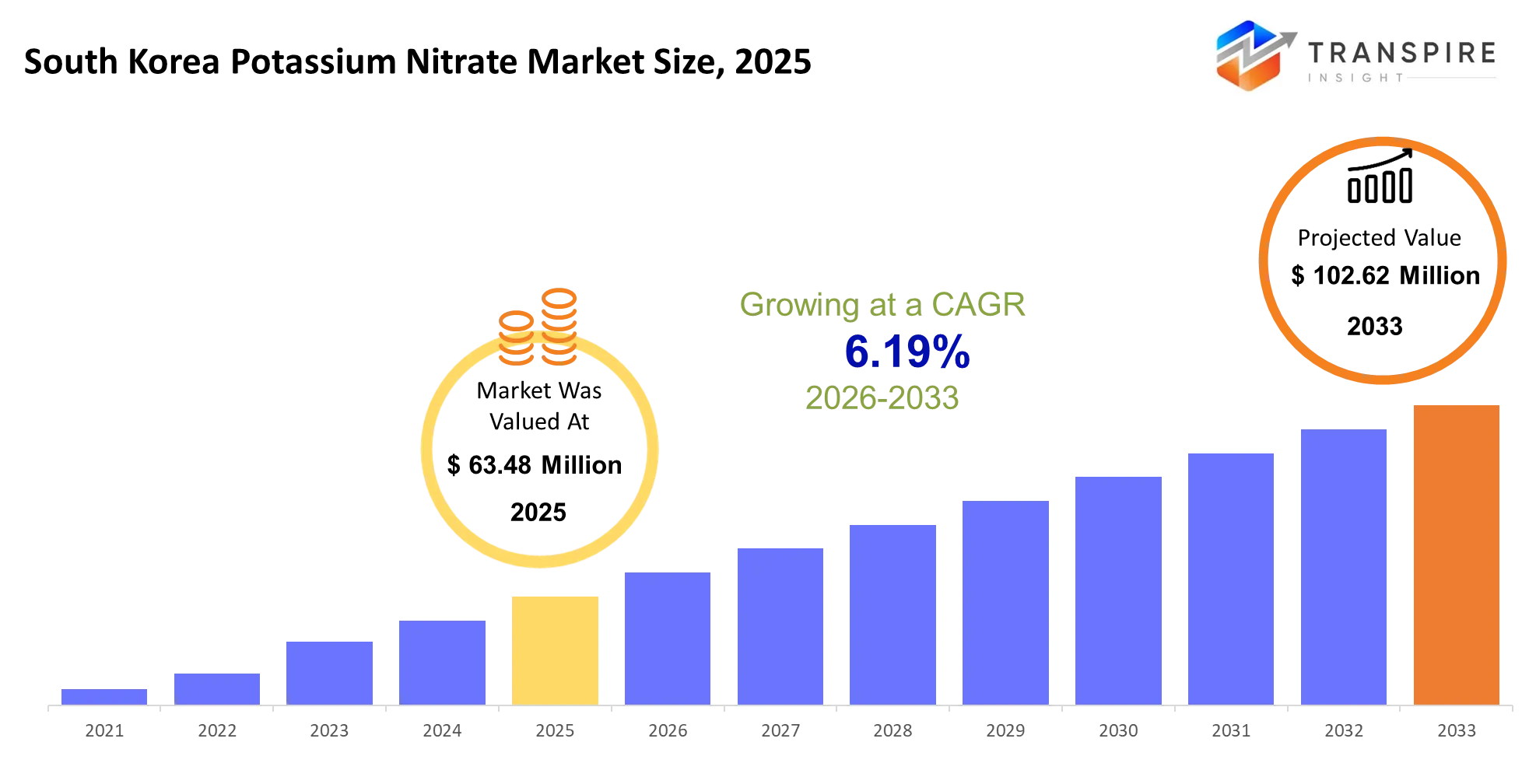
- South Korea Potassium Nitrate Market Size 2025: USD 63.48 Million
- South Korea Potassium Nitrate Market Size 2033: USD 102.62 Million
- South Korea Potassium Nitrate Market CAGR: 6.19%
- South Korea Potassium Nitrate Market Segments: By Grade (Agriculture Grade, Industrial Grade, Pharmaceutical Grade, Food Grade, Others); By Form (Powder Potassium Nitrate, Granular Potassium Nitrate, Liquid Potassium Nitrate, Others); By Application (Fertilizers, Food Preservation, Explosives Manufacturing, Pharmaceuticals, Others); By End User (Agriculture Industry, Chemical Industry, Food Industry, Pharmaceutical Industry, Others); By Distribution Channel (Direct Sales, Chemical Distributors, Retail Sales, Others)
To learn more about this report,  Download Free Sample Report
South Korea Potassium Nitrate Market Summary
The South Korea Potassium Nitrate Market was valued at USD 63.48 Million in 2025. It is forecast to reach USD 102.62 Million by 2033. That is a CAGR of 6.19% over the period.
South Korea Potassium Nitrate Market , in a way, backs intensive agriculture with precision fertigation, plus specialty glass manufacturing, pyrotechnics and broader industrial chemical processing, where a stable nitrate- based nutrient delivery , and steady controlled oxidation behavior, really matter. In South Korea’s high-value greenhouse farming slice, potassium nitrate is used so growers can push better crop yield, improved quality, stronger water efficiency, and tighter nutrient precision, especially for fruits, vegetables and those hydroponic cultivation setups that rely on careful solution management. Over the last five years the market kinda moved away from plain bulk fertilizer purchasing and toward specialty-grade , water soluble formulations that line up with smart farming habits and controlled-environment agriculture. Meanwhile, supply chain disruptions after the Russia-Ukraine conflict, messed with global fertilizer trade routes, and made South Korea’s reliance on imported nitrate inputs more visible, so distributors started adjusting by broadening sourcing agreements, and changing inventory tactics too. At the same time , greenhouse expansion and automated irrigation systems boosted the need for premium nitrate blends, and that let suppliers strengthen margins through more tailored agricultural solutions rather than just chasing commodity volume.
Key Market Insights
- South Korea Potassium Nitrate Market demand kind of drifted toward water soluble grades after 2022, mostly because automated fertigation rollouts in greenhouse vegetable farming got more common and routine.
- Specialty agriculture uses held the dominant industry portion in 2025 , since growers leaned into chloride free nutrient mixes for export quality crops and better shelf alignment.
- Meanwhile technical grade potassium nitrate showed up as the fastest moving segment from 2026 to 2033, supported by electronics, glass, plus industrial oxidizer applications, that mix seems to be getting attention from multiple buyers.
- On the regional side, Gyeonggi Province kept the top regional share during 2025 thanks to dense greenhouse setups and smarter agriculture spending , including those smart farming upgrades that scale faster.
- The Jeolla region logged the quickest projected growth as protected cultivation programs expanded for strawberries, tomatoes and premium horticulture exports too.
- For applications, fertigation dominated revenue generation with over 45% share in 2025, largely because precision irrigation integration became more standard in operational systems.
- Hydroponic farming turned into the fastest growing application after 2023, as vertical farming operators expanded urban food production capability, even when spaces are tight.
- In terms of end users, large commercial greenhouse operators stayed in front, because centralized purchasing helped raise input efficiency and nutrient consistency , for most production schedules.
- Companies like SQM, Haifa Group, Yara International, ICL Group, and Nutrien also tightened Asian distribution partnerships following the global fertilizer trade volatility seen in 2022–2024.
- Producers then started pushing harder into low carbon specialty fertilizers along with digital agronomy platforms, basically to lock in a competitive position in premium agricultural markets and stay differentiated.
What are the Key Drivers, Restraints, and Opportunities in the South Korea Potassium Nitrate Market?
The main thing driving the South Korea potassium nitrate industry is kinda this fast uptake of precision farming ,and also controlled-environment growing setups. In South Korea, growers are leaning more and more on automated fertigation and hydroponic cultivation to push for higher output per square meter even though farmland is tight. This momentum got stronger after the government backed smart farming initiatives rolled out more digital greenhouse infrastructure, alongside water-efficiency targets. Potassium nitrate helps right away because it dissolves quickly, it feeds nitrogen plus potassium at the same time, and it backs high-value crops that really need nutrient accuracy. So, as greenhouse operators ramp up commercial output, suppliers can earn more leverage on pricing by selling premium tailored formulations instead of just moving commodity grade fertilizer .
The biggest drag is still South Korea’s reliance on imported raw materials and supply chains located overseas. Potassium nitrate production depends a lot on internationally traded potassium chloride and nitrate feedstocks, which means buyers get hit by shipping cost swings, geopolitical shocks , and also currency changes. And this kind of dependency isn’t something you can fix fast, since domestic mineral resources and big nitrate production scale are still limited. What follows is uneven procurement costs for ag distributors, plus slower ordering cycles for smaller farming operators when global fertilizer prices jump around.
One real opportunity is showing up through advanced hydroponics and city vertical farming. South Korea’s spending on smart food-security systems is creating demand for nutrient solutions that are super soluble, and also chloride-free, for closed-loop cultivation.
What Has the Impact of Artificial Intelligence Been on the South Korea Potassium Nitrate Market?
Artificial intelligence , and advanced digital farming systems is kind of changing the way potassium nitrate gets applied, watched , and optimized throughout South Korea’s precision agriculture ecosystem. In many commercial greenhouse setups, operators are now relying on AI guided nutrient management platforms that automate fertigation timing based on crop stage, humidity, temperature, plus soil conductivity readings. The platforms keep fine tuning nitrate dosing levels all the time, so fertilizer waste drops , while crop performance stays more stable in tomato, strawberry, and leafy vegetable production.
Also, machine learning is helping predict cultivation outcomes in a smoother way. Smart greenhouse software is basically parsing past nutrient uptake records, weather rhythms, and irrigation efficiency trends to anticipate crop stress, and then adjust nutrient delivery before productivity starts slipping. Several indoor farming operators said they saw real reductions in both water use and fertilizer consumption after they linked AI assisted nutrient management tools with hydroponic infrastructure. On top of that, digital monitoring supports better operational uptime, because it can flag pump failures , irrigation imbalance, or nutrient concentration deviations before any real crop damage can take hold.
Even with all that , AI adoption runs into a practical snag. In South Korea, a lot of mid sized farms still use older fragmented infrastructure, with sensor integration that is inconsistent at best. That means the installation costs feel heavy, and standardized agricultural datasets are limited, which in turn can reduce model accuracy—especially when you compare different crop varieties and regional greenhouse conditions. Still, despite those constraints, AI enabled precision nutrient systems are gradually becoming a differentiator, particularly for larger commercial cultivation operators.
Key Market Trends
- In 2022, fertilizer distributors started to diversify sourcing contracts, after geopolitical disruptions kind of dragged to the surface vulnerabilities in nitrate and potash supply chains.
- In 2023–2025 greenhouse operators also increased use of water-soluble potassium nitrate formulations, mainly to better fit automated fertigation setups.
- At the same time hydroponic farming projects expanded pretty sharply inside urban agricultural areas, because South Korea pushed domestic food resilience, and cultivation in controlled-environment spaces became a bigger focus.
- Premium horticulture producers moved away from fertilizers that were chloride-heavy, since export-focused farming started to emphasize crop quality more directly and nutrient precision in a more strict way.
- Yara International together with Haifa Group expanded their digital agronomy assistance, across Asia, after precision farming adoption really accelerated.
- By 2024, producers leaned into lower-carbon specialty fertilizers, after buyers began screening agricultural inputs using sustainability procurement standards, so yeah that shifted decisions.
- Meanwhile technical-grade potassium nitrate demand tightened, in electronics and specialty glass manufacturing, supported by steady industrial production recovery following pandemic disruptions.
- Commercial growers increasingly chose long-term procurement agreements over spot purchasing, because fertilizer price volatility stayed elevated after 2022.
- South Korean smart farm operators then combined AI-driven nutrient analytics with fertigation systems, to reduce nutrient loss, and keep crop outputs stable.
- Finally, regional distributors expanded warehouse capacity near greenhouse clusters. That happened after supply disruptions made localized inventory management feel more important.
South Korea Potassium Nitrate Market Segmentation
By Grade
Agriculture Grade kind of holds the dominant market spot, mainly because greenhouse cultivation and hydroponic farming, plus precision fertigation, they all lean on nitrate fertilizers that are highly soluble, with potassium content that stays balanced , so uptake is smoother. In practical terms, commercial fruit and vegetable growers keep using these agriculture-grade formulations to boost crop quality, nutrient absorption, and also irrigation efficiency across protected farming locations. You can see stable pull from strawberries, tomatoes, peppers and leafy vegetable production which keeps procurement volumes high across South Korea’s smart agriculture ecosystem. Also , chloride-sensitive crop routines push demand further since potassium nitrate is preferred over more usual fertilizer blends.
Industrial Grade is expanding in a steady way too, mostly tied to specialty glass manufacturing, pyrotechnics, and chemical oxidation workflows where purity along with combustion control is basically non-negotiable. Meanwhile Pharmaceutical Grade and Food Grade stay smaller, but they keep a certain niche, because tight regulatory requirements reduce supplier involvement and can limit production scaling. Then there are the Others category, including custom grades that are built for laboratory work, defense, and certain odd industrial uses where nitrate concentrations need tuning. Over the forecast window, agriculture-related products should keep leading, while industrial and pharmaceutical variants can pull in better margin chances through more specialized manufacturing demand.
By Form
Powder Potassium Nitrate is still, like, taking the biggest market share right now because fertigation setups and industrial processing plants need it to dissolve fast and mix pretty easily in practice. A lot of greenhouse operators and hydroponic farms lean toward powder formulations, not just because they like exact nutrient dosing but also because it fits cleanly with automated irrigation systems. On top of that, industrial buyers tend to stay with powder variants since storage, shipment, and batch integration stay relatively efficient across chemical processing lines. That operational flexibility, kind of keeps the demand steadier across both agricultural and industrial uses.
Granular Potassium Nitrate also hangs onto solid adoption, especially in more conventional farming situations where controlled field application matters, and manual handling is still a big deal. Liquid Potassium Nitrate is getting more interest, mainly because newer hydroponic systems and automated nutrient delivery platforms prefer pre dissolved materials, which helps dosing consistency and cuts down the time spent on preparation. There are also other options, like blended or customized delivery formats, made for niche industrial setups or even laboratory work. Over the forecast timeline, liquid formulations are expected to grow quicker as digital agriculture spreads and closed loop cultivation systems expand through commercial greenhouse infrastructure.
By Application
Fertilizers sort of stay as the leading application segment , mainly because high-value horticulture and greenhouse farming operations need water-soluble nutrient solutions that can boost crop yield, quality, and nutrient efficiency. Commercial growers are leaning more and more toward potassium nitrate in fertigation programs— for fruits, vegetables, and hydroponic cultivation specifically. And precision irrigation systems also end up strengthening this segment , since balanced nitrogen plus potassium delivery does improve crop uniformity and export-grade agricultural output. Stable deployment across smart farming projects keeps backing long-term procurement growth , even when conditions shift a bit.
Explosives Manufacturing and Food Preservation keep smaller positions but they’re still strategically important , because industrial oxidizers and preservative functions are involved. Pharmaceuticals are seeing slow, steady traction too , since controlled nitrate compounds can fit selected medicinal and laboratory formulations that really need regulated chemical purity. Other uses include specialty chemical processing and a few niche industrial applications with customized nitrate requirements. Over the forecast period, fertilizer applications are expected to keep dominance while pharmaceutical and industrial uses end up creating more higher-value opportunities for producers who can supply premium-grade materials , consistently.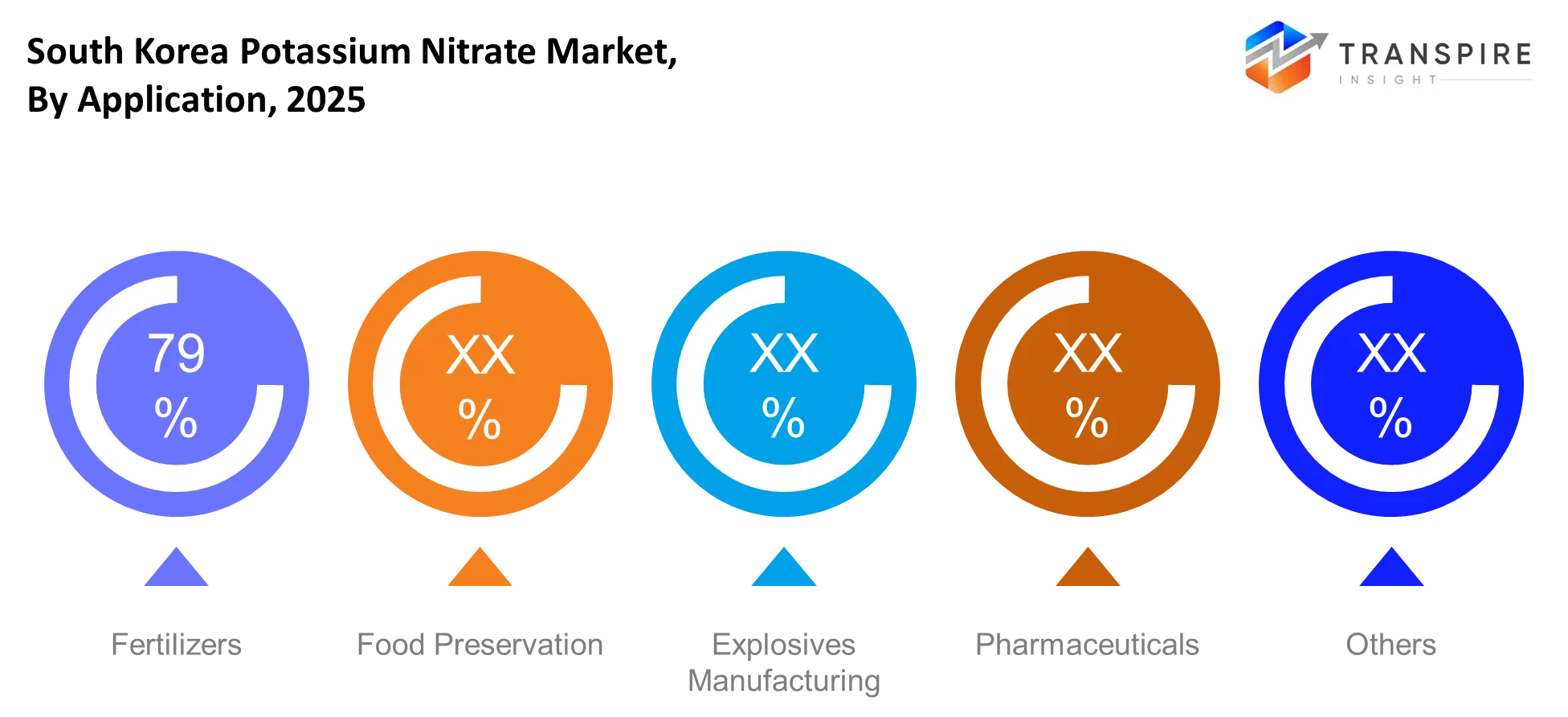
To learn more about this report, Download Free Sample Report
By End User
Agriculture Industry keeps the leading end-user spot, because South Korea’s greenhouse farming scene really relies on tight precision nutrient control and automated fertigation systems, more than most people think. Commercial growers keep raising their use of potassium nitrate (and it is not just for yield), they want better water use, stronger crop performance, and more consistent nutrient accuracy even when the growing area is basically land-constrained. On top of that, government-backed smart agriculture programs, plus hydroponic growth, kinda lock in long-term buying confidence for this segment. Also export-driven horticulture production keeps a fairly steady need going, especially for chloride-free nutrient solutions which is pretty standard for many operations.
Chemical Industry stays comparatively steady, mainly tied to oxidizer production, specialty chemicals, and broader industrial processing uses where nitrate behavior must be controlled. The Food Industry and Pharmaceutical Industry sit smaller in volume, but they still matter because demand is high-purity and procurement behavior gets shaped by strict quality rules and regulatory compliance. Then there are Others, like laboratory, defense, and pyrotechnic users, they operate in more specialized industrial settings where requirements can be a bit more specific. During the forecast period, agricultural end users are expected to keep revenue leadership. At the same time, pharmaceutical buyers and specialty chemical customers are likely to deliver stronger margin expansion chances for premium suppliers, so suppliers that can meet those demands tend to benefit more.
By Distribution Channel
Direct Sales basically dominate the market, because big greenhouse operators , industrial processors, and commercial agricultural cooperatives tend to lean toward long-term procurement arrangements with manufacturers and large distributors. Those bulk purchasing agreements help with supply steadiness and make pricing feel more predictable, particularly once fertilizer market swings picked up after global trade disruptions in the last few years. Also direct supplier contact gives buyers the chance to get customized nutrient formulations, plus hands on agronomy support, matched to their specific cultivation systems. In the end, the strong volume efficiency keeps reinforcing this channel’s leading spot.
Meanwhile Chemical Distributors still stay pretty important, especially for regional stock control and for mid-sized industrial buyers who need flexible buying conditions. Retail Sales show up mostly through smaller agricultural operations and independent growers who pick standardized fertilizer products, usually in smaller volumes. Then there are others too, like digital procurement platforms, and hybrid distribution partnerships that support specialized industrial uses. During the forecast period, direct procurement models are expected to keep gaining ground, since commercial farming operators care more about supply security, better integration of technical services, and longer term sourcing collaborations.
What are the Key Use Cases Driving the South Korea Potassium Nitrate Market?
South Korea’s main way of using potassium nitrate seems to be precision agriculture, and more specifically greenhouse fertigation for fruits, vegetables, and hydroponic crops. Most commercial growers keep leaning on water soluble nitrate formulations, because they let nutrients get taken up quickly , but still keep a tight handle on irrigation and overall crop quality. So yeah this use tends to create the highest demand, driven by the country's intensive cultivation style and the fact that arable land is kinda limited.
Then there are secondary uses that are picking up in industrial manufacturing. You see it in specialty glass work, pyrotechnics , and chemical oxidizer production. Electronics and specialty materials makers also use technical grade potassium nitrate for controlled industrial processing and combustion related steps. In those circles, what matters most is purity that stays consistent, plus a supply that doesn’t suddenly wobble.
More emerging use cases show up in vertical farming and closed loop urban agriculture systems. Some indoor cultivation teams are testing customized nutrient blends that are matched with AI controlled irrigation platforms. That whole setup might support longer term growth, meaning specialized potassium nitrate formulations designed for automated crop management spaces, rather than one-size-fits-all products.
|
Report Metrics |
Details |
|
Market size value in 2025 |
USD 63.48 Million |
|
Market size value in 2026 |
USD 67.41 Million |
|
Revenue forecast in 2033 |
USD 102.62 Million |
|
Growth rate |
CAGR of 6.19% from 2026 to 2033 |
|
Base year |
2025 |
|
Historical data |
2021 - 2024 |
|
Forecast period |
2026 - 2033 |
|
Report coverage |
Revenue forecast, competitive landscape, growth factors, and trends |
|
Regional scope |
South Korea |
|
Key company profiled |
SQM, Haifa Group, Yara International, Nutrien, Uralchem, Arab Potash Company, Deepak Fertilisers, Gujarat State Fertilizers & Chemicals, ICL Group, EuroChem, Kemapco, Migao Corporation, Helm AG, K+S Group, Coromandel International |
|
Customization scope |
Free report customization (country, regional & segment scope). Avail customized purchase options to meet your exact research needs. |
|
Report Segmentation |
By Grade (Agriculture Grade, Industrial Grade, Pharmaceutical Grade, Food Grade, Others); By Form (Powder Potassium Nitrate, Granular Potassium Nitrate, Liquid Potassium Nitrate, Others); By Application (Fertilizers, Food Preservation, Explosives Manufacturing, Pharmaceuticals, Others); By End User (Agriculture Industry, Chemical Industry, Food Industry, Pharmaceutical Industry, Others); By Distribution Channel (Direct Sales, Chemical Distributors, Retail Sales, Others) |
Which Regions are Driving the South Korea Potassium Nitrate Market Growth?
Asia-Pacific still feels like the main regional market for potassium nitrate usage, kind of tied to South Korea, mostly because there is so much greenhouse agriculture, electronics production, and specialized chemical processing going on. South Korea, China, and Japan, for example, keep large protected cultivation facilities that lean on water-soluble nutrient blends, this is a big reason. People also keep adopting agricultural technology fast, plus export-focused horticulture keeps nitrate consumption looking steady across the area. You also have established ports and pretty advanced fertilizer distribution networks that, honestly, lock in Asia-Pacific as the main demand hub.
Europe comes in as the second-biggest contributor, but the way it grows is different, it doesn’t ride on greenhouse expansion alone. In Europe, buyers seem to care more about regulatory precision, and sustainability compliance, more than just increasing covered cultivation. Agricultural producers there keep procuring chloride-free fertilizers in a consistent way, to satisfy tough soil and environmental management requirements. And fertigation together with controlled irrigation tools keeps showing up in Mediterranean horticulture markets, so demand doesn’t really disappear. Also, long-term supplier ties and predictable subsidy frameworks help Europe stay a dependable revenue area, even if total volumes grow slower.
Latin America looks like the fastest-growing regional chance from 2026 to 2033. Brazil, Chile, and Peru have pushed higher-value fruit exports and greenhouse investment further, especially after global food supply diversification started accelerating post-pandemic. Upgrades to irrigation systems, plus export agriculture logistics, added lift to the need for specialty nitrate fertilizers, which is why the region feels like it’s moving quickly.
Who are the Key Players in the South Korea Potassium Nitrate Market and How Do They Compete?
Competition in the potassium nitrate sector stays, kind of moderately consolidated since big scale nitrate manufacturing needs access to mineral resources, specialized processing infrastructure, and worldwide distribution abilities. The big players often go at each other using product purity, steady supply, special agronomic knowhow, and regional logistics routes more than just commodity price tags. Even so incumbents keep defending their market share by tying in digital agronomy services and premium fertigation offerings into wider specialty nutrition catalogs, which kinda keeps customers in their ecosystem.
SQM stands out with vertically integrated nitrate production and tight control over mineral feedstocks sourced from Chile. They push low-carbon specialty plant nutrition offerings and they also keep expanding distribution infrastructure across Asia and Europe, not only selling but building reach. Haifa Group leans into niche specialization, especially water soluble fertilizers and precision fertigation systems, which gives it strong footing with greenhouse and hydroponic operators. Yara International tends to compete by rolling out digital farming platforms and crop specific nutrient optimization services, so growers stay longer because the approach feels targeted, and retention improves.
ICL Group relies on specialty mineral technology and customized plant nutrition recipes, while Nutrien leans on its large global agricultural retail network to enhance procurement scale and improve regional supply responsiveness. A few other producers are also increasing presence through strategic warehousing, regional collaborations, and smart agriculture initiatives to lock in longer term contracts in Asia’s greenhouse farming corridor, even when conditions are competitive.
Company List
- SQM
- Haifa Group
- Yara International
- Nutrien
- Uralchem
- Arab Potash Company
- Deepak Fertilisers
- Gujarat State Fertilizers & Chemicals
- ICL Group
- EuroChem
- Kemapco
- Migao Corporation
- Helm AG
- K+S Group
- Coromandel International
Recent Development News
In January 2026, SQM announced a collaboration and exploration agreement with Ivanhoe Electric for joint copper exploration activities in northern Chile. The agreement strengthens SQM’s broader mineral resource strategy and supports long-term operational diversification linked to nitrate and specialty chemical production.https://www.sec.gov
In March 2026, SQM Specialty Plant Nutrition confirmed expansion initiatives at its Netherlands production facility and additional commercial office investments in India and Morocco. The expansion improves global potassium nitrate distribution capacity and strengthens supply responsiveness for specialty agriculture customers.https://www.sqmnutrition.com
In April 2026, SQM filed its 2025 annual report highlighting increased specialty plant nutrition revenues and strategic prioritization of potassium nitrate production capacity. The move reflects stronger focus on higher-value nitrate products amid shifting global potash allocation strategies.https://ir.sqm.com
What Strategic Insights Define the Future of the South Korea Potassium Nitrate Market?
The South Korea Potassium Nitrate Market is kinda structurally tilting toward premium, technology- driven specialty nutrition solutions, rather than just moving huge volumes like commodity fertilizer trade. Precision agriculture, hydroponic cultivation, and greenhouse automation are slowly changing how people buy, and it pushes suppliers to really compete on formulation efficiency, practical agronomic support , and dependable supply. A less obvious risk also shows up here, raw material concentration exposure. Even though people talk about it less, global nitrate and potash supply is still kinda dependent on a few producing regions only. So South Korean buyers can get stuck if geopolitical disruptions happen, or if freight gets volatile, or if export policies suddenly shift, and that can distort pricing stability pretty fast.
At the same time there is an emerging opportunity that seems overlooked: AI- integrated nutrient management systems, made for closed-loop urban farming and vertical agriculture. These solutions are still somewhat niche today, but they fit South Korea’s longer term food security goals and smart agriculture direction. So market players should lean into partnerships with greenhouse technology providers and digital farming platform developers. Instead of trying to win mostly by fertilizer pricing, suppliers could focus on specialty nutrient formulations together with real-time crop optimization services. That mix should help them lock in stronger long-term margins, and keep customers longer too.
South Korea Potassium Nitrate Market Report Segmentation
By Grade
- Agriculture Grade
- Industrial Grade
- Pharmaceutical Grade
- Food Grade
- Others
By Form
- Powder Potassium Nitrate
- Granular Potassium Nitrate
- Liquid Potassium Nitrate
- Others
By Application
- Fertilizers
- Food Preservation
- Explosives Manufacturing
- Pharmaceuticals
- Others
By End User
- Agriculture Industry
- Chemical Industry
- Food Industry
- Pharmaceutical Industry
- Others
By Distribution Channel
- Direct Sales
- Chemical Distributors
- Retail Sales
- Others
Frequently Asked Questions
Find quick answers to common questions.
The Expected South Korea Potassium Nitrate Market size for the Market will be USD 102.62 Million in 2033.
Key Segments for the South Korea Potassium Nitrate Market are By Grade (Agriculture Grade, Industrial Grade, Pharmaceutical Grade, Food Grade, Others); By Form (Powder Potassium Nitrate, Granular Potassium Nitrate, Liquid Potassium Nitrate, Others); By Application (Fertilizers, Food Preservation, Explosives Manufacturing, Pharmaceuticals, Others); By End User (Agriculture Industry, Chemical Industry, Food Industry, Pharmaceutical Industry, Others); By Distribution Channel (Direct Sales, Chemical Distributors, Retail Sales, Others).
Major South Korea Potassium Nitrate Market Players are SQM, Haifa Group, Yara International, Nutrien, Uralchem, Arab Potash Company, Deepak Fertilisers, Gujarat State Fertilizers & Chemicals, ICL Group, EuroChem, Kemapco, Migao Corporation, Helm AG, K+S Group, Coromandel International.
The Current South Korea Potassium Nitrate Market size is USD 63.48 Million in 2025.
The South Korea Potassium Nitrate Market CAGR is 6.19% from 2026 to 2033.
- SQM
- Haifa Group
- Yara International
- Nutrien
- Uralchem
- Arab Potash Company
- Deepak Fertilisers
- Gujarat State Fertilizers & Chemicals
- ICL Group
- EuroChem
- Kemapco
- Migao Corporation
- Helm AG
- K+S Group
- Coromandel International
Recently Published Reports
-
May 2026
Healthcare Polymer Packaging Market
Healthcare Polymer Packaging Market Size, Share & Analysis Report By Packaging Type (Syringes, IV Bottles and Pouches, Clamshells, Blisters, Bottles & Jars, Containers, Tubes, IV Parental Packaging, Others), By Type (Regulated, Non-regulated), By Polymer Type (LDPE (Low-Density Polyethylene), HDPE (High-Density Polyethylene), Homo-polymer (Homo), Random Copolymer (Random), Block Copolymer (Block), PET, Polystyrene, Polyvinyl Chloride, Polyamide/EVOH, Others), and Geography (North America, Europe, Asia-Pacific, Middle East and Africa, South and Central America), 2021 - 2031
-
Apr 2026
Hydrophilic Tape (Waterstop) Market
Hydrophilic Tape (Waterstop) Market Size, Share & Analysis Report By Type (Bentonite-Based Hydrophilic Tape, Rubber-Based Hydrophilic Tape), By Application (Residential Buildings, Commercial Buildings, Infrastructure Projects), and Geography (North America, Europe, Asia-Pacific, Middle East and Africa, South and Central America), 2021 - 2031
-
Apr 2026
Metalens Market
Metalens Market Size, Share & Analysis Report By Type (Visible Light Metalens, and Infrared Metalens), By Application (Consumer Electronics, Automotive Electronics, Industrial, Medical, and Others), and Geography (North America, Europe, Asia-Pacific, Middle East and Africa, South and Central America), 2021 - 2031
-
Apr 2026
PBT Resin Market
PBT Resin Market Size, Share & Analysis Report By Type (Reinforced PBT Resin, Unreinforced PBT Resin), By Processing Method (Injection Molding, Extrusion, Blow Molding, Others), By End-User (Automotive, Electrical & Electronics, Consumer Appliances, Industrial Machinery, Medical Devices, Packaging, Others), and Geography (North America, Europe, Asia-Pacific, Middle East and Africa, South and Central America), 2021 - 2031