

Global Food Technology Market Size & Forecast:
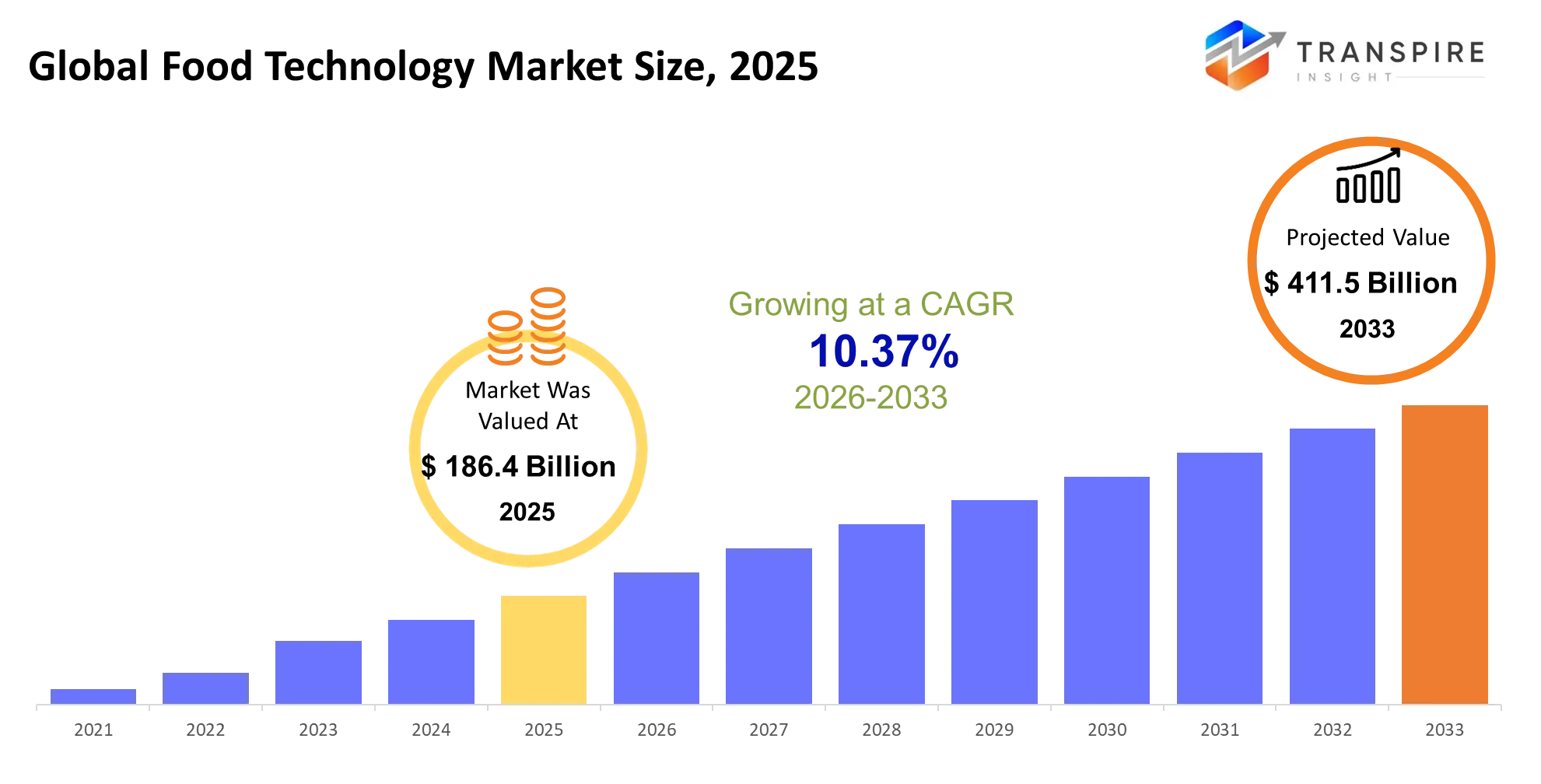
- Global Food Technology Market Size 2025: USD 186.4 Billion
- Global Food Technology Market Size 2033: USD 411.5 Billion
- Global Food Technology Market CAGR: 10.37 %
- Global Food Technology Market Segments: By Technology (Processing, Packaging, Preservation, Safety), By Application (Food Processing, Quality Control, Supply Chain, Storage), By End-User (Food Manufacturers, Retailers, Restaurants, Consumers)
To learn more about this report,  Download Free Sample Report
Global Food Technology Market Summary:
The global food technology market size is estimated at USD 186.4 billion in 2025 and is anticipated to reach USD 411.5 billion by 2033, growing at a CAGR of 10.37 % from 2026 to 2033.
The global food technology market is changing the way food is processed, packaged, stored and delivered – enhancing operational efficiencies, food safety and product quality throughout the supply chain. In the last 3–5 years, the industry has undergone a dramatic transition from manual work to automation, AI-based quality inspection, smart packaging, and digital supply chain systems. One of the most significant market structural changes is the growing adoption of sustainable, plant-based food production technologies, as consumers become more conscious of and interested in healthy, environmentally friendly options. Companies in the food sector are putting money into robotics, cold-chain monitoring and traceability software to limit food waste, boost compliance and efficiency. Further, the fast-growing urban populations and busy lifestyles, along with the global population growth, are driving demand for convenient and ready-to-eat food products and customised food solutions
Key Market Insights:
The Food Technology sector is undergoing a rapid transformation as companies strive to enhance efficiency and usability within the manufacturing process to better serve today's demanding consumer. The global food technology market is progressing rapidly as food manufacturers become increasingly aware of the need to adopt automation, sustainability, and digitalisation to boost efficiency and meet the high expectations of today's consumers. The industry is transforming production & distribution strategies as investment in AI & smart processing systems, as well as plant-based innovation, increases.
- In 2024, the hardware market accounted for more than 42% of the total market share, with the increased adoption of robotics, automatic filling systems, smart sensors, and IoT sensors for processing equipment to boost production efficiency and decrease human resource dependence.
- Food processing technology accounted for approximately 40% of market share, indicating high demand in the food processing industry for new technologies available to address food safety and shelf life, including high-pressure processing and extrusion, and digital monitoring technologies.
- Nearly 22% of the market was in the beverages business, which is driven by a trend towards plant-based beverages, functional and low-sugar options, which demand advanced formulation, aseptic processing and packaging technologies.
- The food science application segment market is growing with growing R&D investments in the development of healthier food formulations, nutritional profiling, allergen-free products, and the use of AI to assist in product development.
- In 2024, the fish, meat, and seafood category accounted for nearly 19% of the market, with sustainable sourcing, innovative preservation methods, and alternative proteins like lab-grown and plant-based seafood and meat gaining traction among businesses.
- Now Smart packaging and Food traceability technologies are getting immense traction in the market, aiding companies to achieve better transparency, minimise food waste and meet stringent food safety regulations.
- As the demand for clean-label, ready-to-eat and customised food products continues to rise, businesses are increasingly seeking to increase their competitiveness in the market by investing in automation, digital supply chain systems, and sustainable production technologies.
What are the Key Drivers, Restraints, and Opportunities in the Global Food Technology Market?
Drivers: The growing trend toward automation, artificial intelligence-driven monitoring and sophisticated preservation methods in food manufacturing and distribution is fueling the growth of the global food technology market. This trend has gained momentum since the outbreak of the COVID-19 pandemic, which highlighted the vulnerabilities in conventional food supply chains and made contactless processing, a longer shelf life and efficient cold-chain logistics more essential. Food companies are investing in robotics, smart packaging technology and functional ingredient technologies to enhance efficiency and adapt to evolving consumer demands for healthier, ready-to-eat, traceable food products. AI-powered food processing systems have helped manufacturers lower manufacturing costs and increase consistency, thus helping them make a profit and accelerate product commercialisation. In May 2026, food manufacturers will turn to AI monitoring and smart packaging to enhance traceability, ensure shelf life, and lower processing expenses.
The high development, integration and compliance costs are a significant challenge for the global food technology market, especially for small and medium manufacturers. The advanced technologies like blockchain traceability, precision fermentation and IoT-based automation will need high investment in infrastructure, software development and ongoing regulatory proof of concept. The challenge persists because some food manufacturers still have legacy processing systems that are not easy to integrate with modern digital platforms. Also, consumer doubt of lab-grown products and super-processed options restricts product adoption across a number of areas.
The global food technology market presents significant opportunities for the use of AI in sustainable food production and in digital supply chains. The global food technology market offers great potential for AI, enabling sustainable food production and enabling transparency in digital supply chains. The increase in investments in precision fermentation, smart factories, and blockchain-enabled traceability tracks is helping companies enhance food safety, cut waste, and increase consumer confidence. A few global food companies are investing in cold chain networks with IoT and recycling technologies to enhance sustainability, operational efficiency, and help food companies distribute food at scale. In May 2026, AI-driven precision fermentation and blockchain traceability will drive a more sustainable and reduced-waste food production sector, while enhancing the transparency of digital supply chains.
What Has the Impact of Artificial Intelligence Been on the Global Food Technology Market?
Artificial Intelligence has played a pivotal role in reshaping the global food technology market, enhancing automation, operational efficiency, and ensuring supply chain management within food processing and distribution networks. The use of AI-powered technologies for quality inspection, temperature monitoring, smart packaging, and automated food sorting has significantly decreased the need for manual labour and enhanced production uniformity. By using machine learning algorithms to analyse consumer buying habits, inventory management and demand fluctuations, more accurate predictions can be made, and food waste can be minimised.
AI is also being leveraged to boost predictive components, such as optimising raw material consumption, tracking cold-chain logistics, and optimising delivery plans in real-time. These technologies facilitate shorter production cycles, reduce reliance on labour and enhance resource efficiency, directly contributing to the operational performance in the food market. Moreover, AI analytics are aiding the industry in adapting to evolving consumer preferences for health and plant-based and ready-to-eat food products more efficiently. The large implementation and system integration cost, however, is a big challenge, especially for small-scale processors using the traditional infrastructure and the old processing systems. In May 2026, food processors will utilise AI tools for quality assurance and predictive inventory to reduce waste, manage temperature, and streamline supply chain decisions.
Global Food Technology Market Trends:
The global food technology market is progressing beyond traditional food processing to intelligent, data-driven, and sustainable systems. The growing demand for healthier, transparent and convenient food products is driving innovation in food processing, packaging, distribution and supply chain.
- The market has moved beyond mass food production, and consumers are now looking for nutrition and health plans and food products tailored according to their health goals, wearable health information, and lifestyle preferences.
- In the food processing industry, automation has climbed the ranks from simple to advanced, with robots taking over some of the most labour-intensive tasks, AI-sorting systems sorting and categorising food, and smart quality control and inspection technologies ensuring consistency and hygiene.
- The industry is moving from simple packaging towards smart and sustainable packaging solutions to extend shelf life, reduce waste, and real-time freshness monitoring through sensor-based technologies.
- In the food service industry, the digital revolution has been gaining momentum, and online food delivery services, cloud kitchens, and food apps have gained considerable traction in today's consumption habits.
- Blockchain-based traceability systems are enhancing food supply chains, enabling improved monitoring of food safety compliance, storage conditions, and sourcing, making them more transparent.
- The use of AI and predictive analytics in food manufacturing and inventory management is becoming more prevalent, driving better utilisation of raw materials, demand prediction, and reduced losses.
- The importance of IoT in cold chain and storage systems arises because companies strive to preserve product quality during transportation and minimise product spoilage and distribution inefficiencies.
- Scalable food technology solutions are becoming a reality in emerging markets for food security, food processing efficiency and modernising food production facilities.
Global Food Technology Market Segmentation
By Technology:
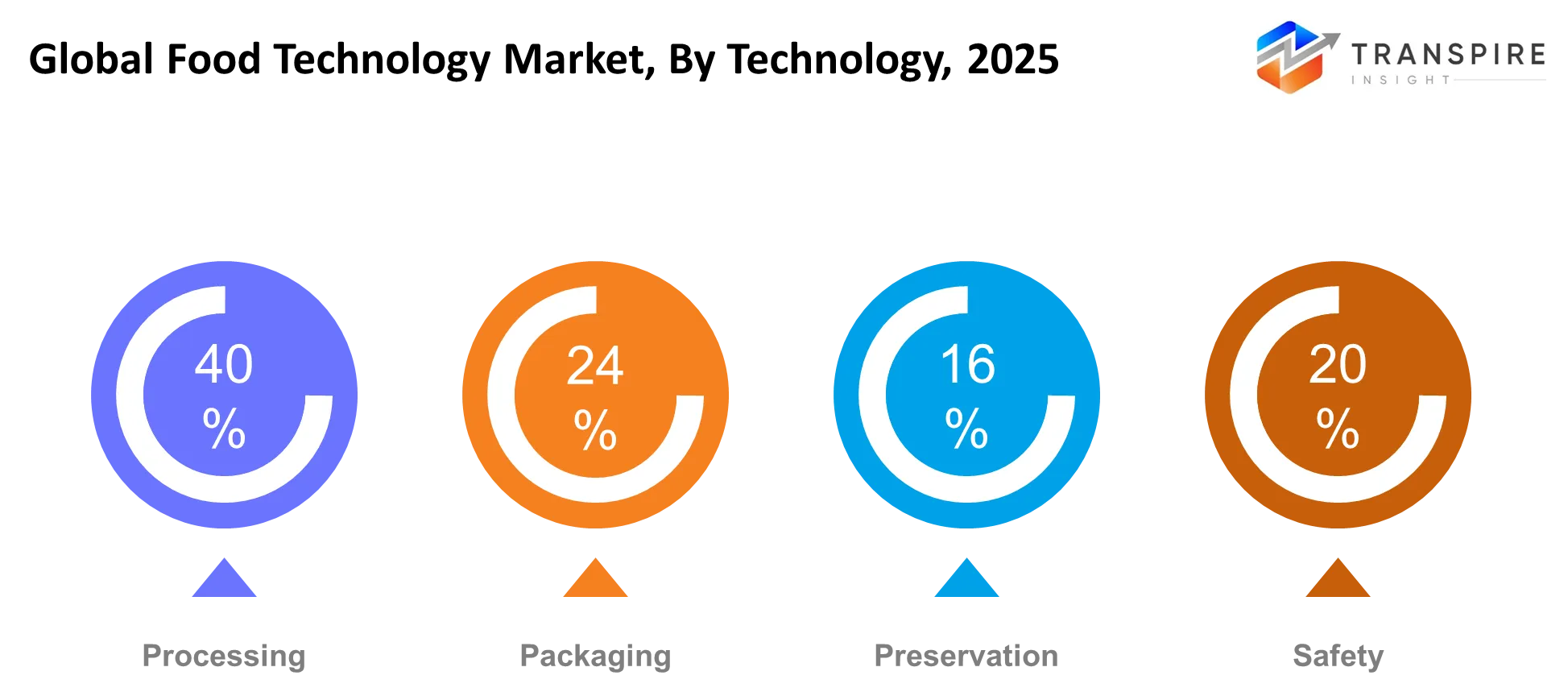
The food-technology industry is dominated by processing, representing 40% of the technology mix, and the processing sub-segments (such as precision fermentation, robotics cooking, automated lines, etc.) make up 64% of processing spending. Packaging represents 24% of the technology mix and focuses on active packaging and modified‑atmosphere systems to extend shelf life. Preservation takes up 16% and focuses on advanced cold-chain monitoring and prediction of storage. Safety is 20% of the mix, featuring smart sensors, AI vision and blockchain traceability to detect contamination, ensure compliance and speed up recalls. In all categories, software -- AI analytics, warehouse management systems and traceability platforms connect these hardware technologies and turn sensor information into business decisions.
To learn more about this report, Download Free Sample Report
By Application:
Food processing is the biggest application, with companies adopting alternative proteins, healthier formulations, and sustainable manufacturing processes to align with evolving consumer preferences. AI-powered inspection and real-time analytics help lower defects and recalls through quality control. Supply-chain apps focus on route optimisation, dark kitchen fulfilment and real-time tracking to reduce spoilage and convenience. Smart cold chain solutions and predictive maintenance are used in storage applications to maintain product quality and minimise losses. Software solutions are making it more efficient to sync processes across these applications and are powering data action product innovation.
By End-user:
Food manufacturers are the biggest adopters, using end-to-end automation and software to scale production and cut costs. Retailers and restaurants use inventory management to improve customer experience and delivery time, as well as smart shelving and connected delivery solutions. The use of temperature-controlled vehicles, delivery companies and logistics firms to take steps to ensure the safety of live tracking. Consumers get fresher, safer products, more sustainable products, app-based personalisation, and quicker delivery. The combination of AI integration, automation, and intelligent monitoring will further enhance efficiency, transparency, and a customer-first approach.
What are the Key Use Cases Driving the Global Food Technology Market?
Food processing and quality management are the main use cases for the global food technology market, particularly in the dairy, meat, seafood, and packaged foods sectors. Food companies are leveraging automation, smart sensors and AI-driven monitoring to enhance food safety, lengthen food shelf life, and minimise food waste while ensuring product quality.
The growth of applications is evident in delivery platforms, supply chain tracking and technologies for restaurants. To meet the growing demand of convenience and quick service from consumers, businesses are turning to cloud-based management systems, digital ordering platforms and IoT-based cold chain monitoring.
New applications are expected to be personalised nutrition, plant-based product development and AI-assisted food science research. With the assistance of advanced analytics and biotechnology, manufacturers are developing personalised nutrition, sustainable protein sources, and data-driven innovations to meet evolving consumer preferences for health and sustainability.
|
Report Metrics |
Details |
|
Market size value in 2025 |
USD 186.4 Billion |
|
Market size value in 2026 |
USD 206.2 Billion |
|
Revenue forecast in 2033 |
USD 411.5 Billion |
|
Growth rate |
CAGR of 10.37% from 2026 to 2033 |
|
Base year |
2025 |
|
Historical data |
2021 - 2024 |
|
Forecast period |
2026 - 2033 |
|
Report coverage |
Revenue forecast, competitive landscape, growth factors, and trends |
|
Regional scope |
North America (U.S., Canada, Mexico); Europe (Germany, U.K., France, Italy, Spain, Rest of Europe); APAC Japan, China, India, Australia, South Korea, Rest of APAC); South America (Brazil, Argentina, Chile, Rest of South America); MEA (South Africa, GCC, Rest of MEA) |
|
Key company profiled |
Nestle, PepsiCo, Coca-Cola, Unilever, Danone, Tyson Foods, Cargill, ADM, Kraft Heinz, General Mills, Mondelez, JBS, Smithfield, Kerry Group, Ingredion |
|
Customization scope |
Free report customization (country, regional & segment scope). Avail customized purchase options to meet your exact research needs. |
|
Report Segmentation |
By Technology (Processing, Packaging, Preservation, Safety), By Application (Food Processing, Quality Control, Supply Chain, Storage), By End-User (Food Manufacturers, Retailers, Restaurants, Consumers) |
Which Regions are Driving the Global Food Technology Market Growth?
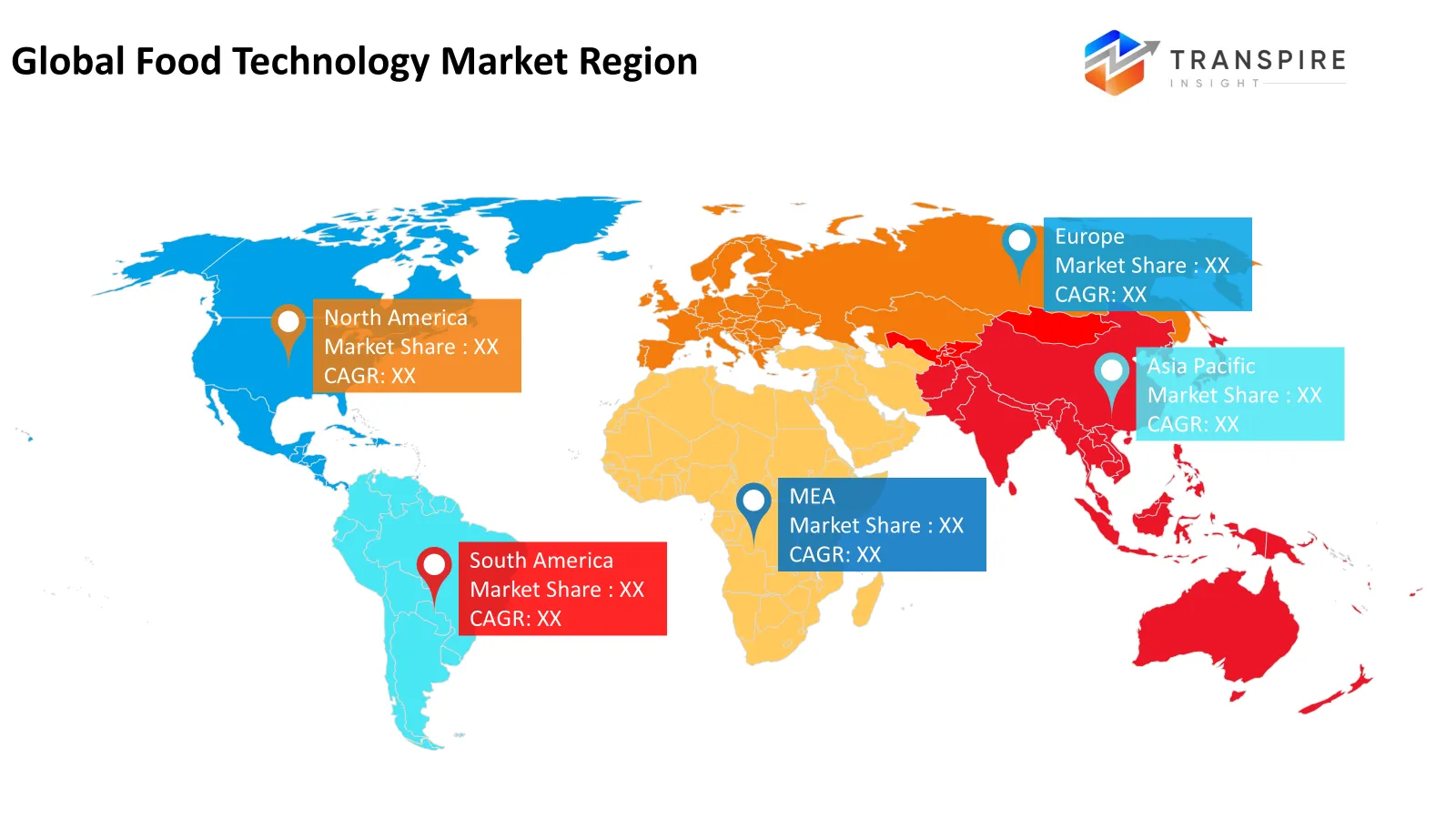
North America leads in the global food technology market with 36% of the global value, bolstered by its robust food processing infrastructure, significant investments in automation and AI technology, and advanced manufacturing practices. The region has experienced high research investment, high demand for sustainable and convenient food, and quick adoption of robotics by restaurants and supply chains. The growth is further boosted by supportive government policies and a concentration of large food technology companies in the United States and Canada.GEA has a Food Technology Centre in Wisconsin that helps companies make fermented and cultivated meat with better facilities. In May 2026, North American food-tech companies furthered their efforts in sustainable food production and cultivated-meat innovations with new investments in AI automation and fermentation plants.
Europe has the most mature markets 26% and is noted for its high level of regulation, which focuses on protecting the environment and food safety. The European market focuses on environmental responsibility, clean‑label products and wise use of resources, whereas the North American market is driven by automation. Long-term stability is ensured by stable regulations, modern food-processing systems, and consumer preference for low-waste products. In April 2026, European processors expanded the use of clean-label and low-waste technologies to boost food safety and resource efficiency.
The Asia Pacific region, at 24%, is growing rapidly due to urbanisation, expanding e‑commerce, and changing dietary habits that speed up technology adoption. Asia-Pacific is the fastest‑growing region with a projected CAGR of 11.9%. Food delivery chains, digital payments and scalable food processing technologies have gained in India, China, Japan and Southeast Asia during the pandemic. There is significant potential for food technology companies, given the Government initiatives in food security and sustainable production. The rest of the world (ROW) is 14% of the market, with gently rising but still emerging demand. In March 2026, Asia-Pacific businesses expanded their digital food delivery, payments and processing platforms to speed up technology adoption.
To learn more about this report, Download Free Sample Report
Who are the Key Players in the Global Food Technology Market and how do they Compete?
The global food technology market is really competitive. Companies are trying to be better by using technology to be more efficient and be kind to the earth. They want to be the best in the market. Now companies are doing more than food. They are using intelligence to deliver food, making smart kitchens, and making food just for you. Big companies are spending a lot of money on automation, cloud-based platforms and data analytics to make customers happy and see what is happening in the supply chain. Kraft Heinz is changing the way they work by using technology and making new products. They want to make food that's good for you. It is working hard to make things run smoothly. The company also wants to make sure it is good for the environment.
These companies are expanding through acquisitions, services and international market penetration. They are using data analysis and technology to improve customer engagement and stay competitive. The market is constantly evolving, with companies adapting to changing consumer behaviour and delivery patterns. Key players are investing heavily in technology and innovation to maintain their market position.
Key Companies in the Global Food Technology Market
- Nestle
- PepsiCo
- Coca-Cola
- Unilever
- Danone
- Tyson Foods
- Cargill
- ADM
- Kraft Heinz
- General Mills
- Mondelez
- JBS, Smithfield
- Kerry Group
- Ingredion
Recent Development News
- In April 2026, FoodHack tracked a wave of precision fermentation and alternative protein developments, highlighted by companies like NextGen Proteins, BlueNalu, and SuperMeat. These startups announced breakthrough fundraising and scaling milestones, driving the global market for functional and alternative foods.
Source: https://tracxn.com
- In January 2026, organisers of Gulfood launched Gulfood Startups, an international platform convening over 250 food-tech innovators. This initiative accelerates the commercialisation of disruptive technologies—such as precision fermentation, AI-powered food analytics, and automated supply chains—by connecting early-stage startups directly with global markets.
Source: https://www.prnewswire.co.uk
- In May 2026, RIBUS launched Nu-FILL, a naturally sourced replacement for microcrystalline cellulose (MCC) in organic and clean-label foods. This allows manufacturers to replace synthetic excipients with plant-based alternatives, meeting growing consumer demand for transparent and minimally processed ingredient labels.
Source: https://finance.yahoo.com
What Strategic Insights Define the Future of the Food Technology Market?
The global food technology market is moving towards using Artificial Intelligence in production. Companies focus on making food production efficient, transparent and personalised.
In the UK, people want to eat healthy foods, so companies are investing in smart packaging and monitoring technologies. However, integrating technology is expensive and raises cybersecurity concerns.
Food companies can use AI to personalise food and to try farming methods that meet changing dietary needs while remaining environmentally friendly. Those that innovate digitally, source sustainably and follow rules will have an advantage. Partnerships between food makers, software firms and logistics will be key to growth. They should invest in technology and consumer-focused innovation.
Key Global Food Technology Market Segmentation
By Technology
- Processing
- Packaging
- Preservation
- Safety
By Application
- Food Processing
- Quality Control
- Supply Chain
- Storage
By End-User
- Food Manufacturers
- Retailers
- Restaurants
- Consumers
Frequently Asked Questions
Find quick answers to common questions.
The expected global food technology market size for the market will be USD 411.5 billion in 2033.
Key segments for the global food technology market are By Technology (Processing, Packaging, Preservation, Safety), By Application (Food Processing, Quality Control, Supply Chain, Storage), By End-User (Food Manufacturers, Retailers, Restaurants, Consumers).
Major global food technology market players are Nestle, PepsiCo, Coca-Cola, Unilever, Danone, Tyson Foods, Cargill, ADM, Kraft Heinz, General Mills, Mondelez, JBS, Smithfield, Kerry Group, and Ingredion.
The global food technology market size is USD 186.4 billion in 2025.
The global food technology market CAGR is 10.37%.
- Nestle
- PepsiCo
- Coca-Cola
- Unilever
- Danone
- Tyson Foods
- Cargill
- ADM
- Kraft Heinz
- General Mills
- Mondelez
- JBS, Smithfield
- Kerry Group
- Ingredion
Recently Published Reports
-
Apr 2026
Baby Infant Formula Market
Baby Infant Formula Market Size, Share & Analysis Report By ype (Infant Milk, Follow On Milk, Specialty Baby Milk, Growing-Up Milk), By Ingredient (Carbohydrate, Fat, Protein, Minerals, Vitamins, and Others), By Product Form (Powder, Liquid, and Ready-to-feed), By Distribution Channels (Supermarket/Hypermarket, Specialty Store, Pharmacies, Online Retail, and Others), and Geography (North America, Europe, Asia-Pacific, Middle East and Africa, South and Central America), 2021 - 2031
-
Apr 2026
Edible Insects for Animal Feed Market
Edible Insects for Animal Feed Market Size, Share & Analysis Report By Type (Insect Powder, Insect Meal, Insect Bar, Insect Paste, Insect Oil, and Others), By Insect Type (Beetles, Cricket, Caterpillar, Hymenoptera, Orthoptera, Tree Bugs, and Others), By Application (Livestock, Pet Food, and Aquaculture), By Livestock Type (Poultry, Swine, and Others), and Geography (North America, Europe, Asia-Pacific, Middle East and Africa, South and Central America), 2021 - 2031
-
Apr 2026
Food Industry Disinfection and Bacterial Control Market
Food Industry Disinfection and Bacterial Control Market Size, Share & Analysis Report By Type (Chemical Disinfectants, Physical Disinfectants, and Biocides and Antimicrobials), By Application (Food Processing Equipment Surface Disinfection, Food Preparation Areas Surface Disinfection, Storage Areas Surface Disinfection, Anti-microbial Coatings Food Preservation, and Preservative Solutions Food Preservation), By End User (Meat and Poultry Processing, Dairy Processing, Seafood Processing, Bakery and Confectionery, Restaurants and Commercial Kitchens, and Food Service Providers), By Sales Channel (Online, Offline), and Geography (North America, Europe, Asia-Pacific, Middle East and Africa, South and Central America), 2021 - 2031
-
May 2026
Freeze Dried Food Market
Freeze Dried Food Market Size, Share & Analysis Report By Product Type (Fruits, Vegetables, Freeze-Dried Dairy Products, Freeze-Dried Meat and Seafood, Freeze-Dried Pet Food, and Prepared Meal), By Nature (Organic, and Conventional), By Form (Powdered, Granules, and Diced), By End Use (Breakfast Cereals, Dairy Products, Bakery & Confectionery, Nutritional Bars & Supplements, Powdered Beverages, Snacks, and Retail (Household)), and Geography (North America, Europe, Asia-Pacific, Middle East and Africa, South and Central America), 2021 - 2031