
South Korea Non-Grain Oriented Electrical Steel Market Size & Forecast:
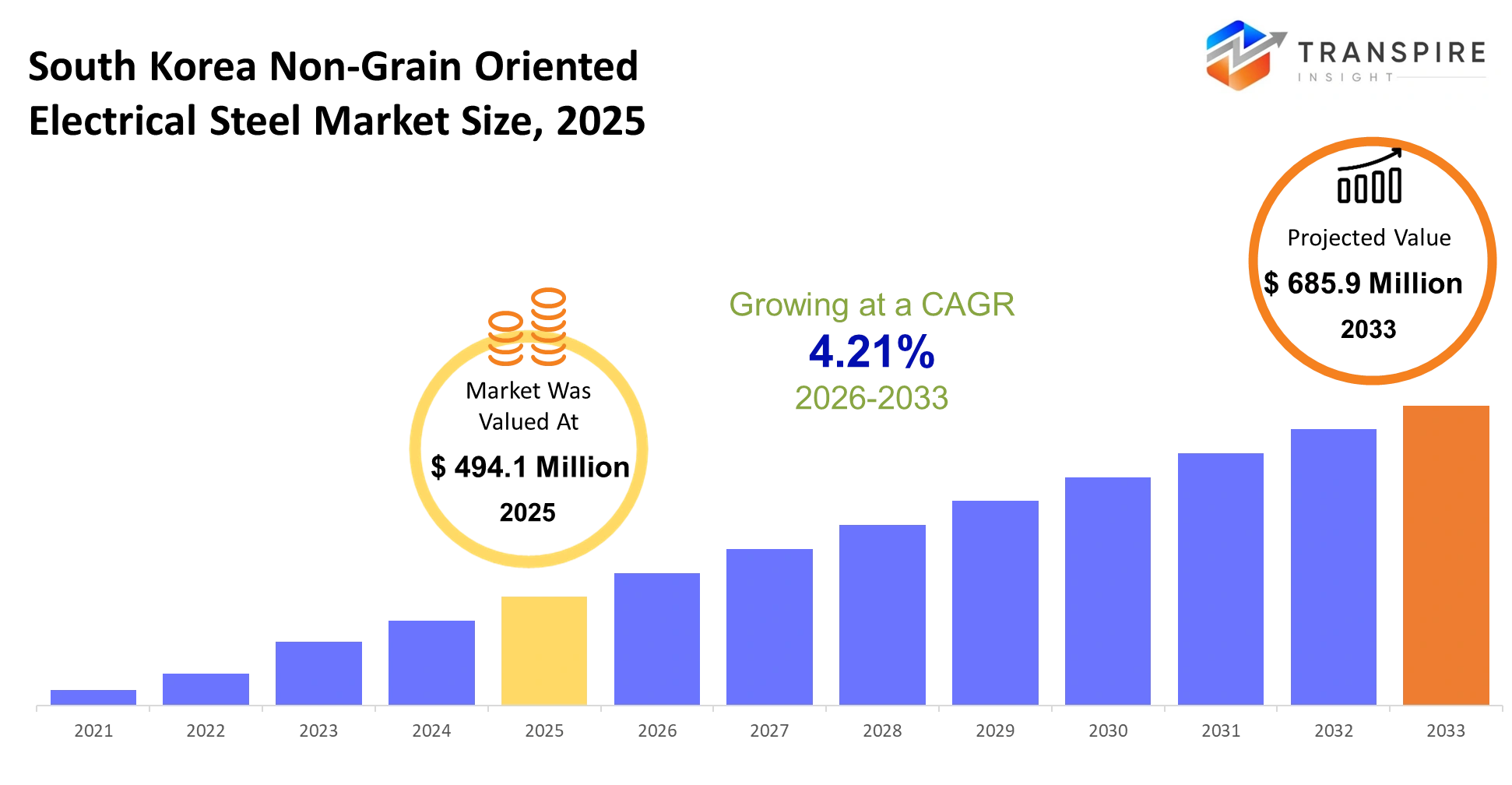
- South Korea Non-Grain Oriented Electrical Steel Market Size 2025: USD 494.1 Million
- South Korea Non-Grain Oriented Electrical Steel Market Size 2033: USD 685.9 Million
- South Korea Non-Grain Oriented Electrical Steel Market CAGR: 4.21%
- South Korea Non-Grain Oriented Electrical Steel Market Segments: By Product Type (Fully Processed NGO Steel, Semi-processed NGO Steel, Thin Gauge NGO Steel, Others); By Application (Electric Vehicle Motors, Industrial Motors, Transformers, Household Appliances, Others); By Thickness (Below 0.35 mm, 0.35–0.50 mm, Above 0.50 mm, Others); By End User (Automotive Industry, Power Generation Industry, Electronics Industry, Industrial Manufacturing, Others); By Coating Type (Insulated Coatings, Organic Coatings, Inorganic Coatings, Others)
To learn more about this report,  Download Free Sample Report
South Korea Non-Grain Oriented Electrical Steel Market Summary
The South Korea Non-Grain Oriented Electrical Steel Market was valued at USD 494.1 Million in 2025. It is forecast to reach USD 685.9 Million by 2033. That is a CAGR of 4.21%over the period.
South Korea’s non-grain oriented electrical steel industry kinda helps the country’s electrification whole ecosystem by boosting the efficiency and overall performance of motors, generators, compressors, and transformers that end up in electric vehicles , industrial automation systems , home appliances, and renewable energy setups. The thing is, manufacturers depend on NGO electrical steel to cut down energy loss during magnetic cycling, and that matters because it reshapes motor efficiency, changes the operating temperature, and also influences long-term electricity use. Over the past five years , the market slowly moved away from older conventional industrial needs, toward high-efficiency EV traction motors and more premium industrial drives as South Korea sped up both automotive electrification and factory automation investments. A big trigger came after 2021, with global supply chain disruptions and energy price volatility , so Korean makers had to localize more advanced steel sourcing , and push energy efficiency improvements across industrial equipment. This whole shift created demand for thinner gauge material and high-silicon grades, with better magnetic traits, and that’s the part where suppliers can lock in higher margin agreements linked to electric mobility, and also to next generation industrial systems.
Key Market Insights
- In 2025, South Gyeongsang plus Gyeonggi regions basically racked up over 45% market share, mostly because automotive and electronics manufacturing clusters are concentrated there a bit too much.
- Thin gauge NGO steel showed up as the fastest-growing product after 2022, not just because of demand, but also since EV traction motors need lower core loss materials, so it sort of fits.
- Fully processed NGO steel actually dominated revenue contribution, landing at nearly 52% in 2025, and that happens because downstream annealing requirements get reduced, so the whole process looks more streamlined.
- Electric vehicle motor uses expanded sharply when Hyundai Motor increased domestic EV platform investments between 2023 and 2025, and then it kept building momentum.
- Industrial motor demand stayed resilient, even while Korean factories moved faster on smart manufacturing upgrades and energy-efficiency retrofits across heavy industries.
- For thickness, the 0.35–0.50 mm segment kept a big share since it balances magnetic efficiency with manufacturing flexibility across motor systems.
- POSCO and Hyundai Steel also boosted investments in high-grade electrical steel processing lines, in order to strengthen the local supply chain competitiveness.
- Meanwhile, Japanese suppliers like Nippon Steel and JFE Steel leaned into premium magnetic performance grades, aiming at high-speed EV motor manufacturers.
- After stricter efficiency standards came in, manufacturers started shifting toward insulated coatings because they wanted to minimize interlaminar electrical losses, quietly but firmly.
- Since 2024, collaborations between automakers and steel producers intensified, mainly to secure stable supplies of advanced motor core materials, and to avoid shortages later on.
What are the Key Drivers, Restraints, and Opportunities in the South Korea Non-Grain Oriented Electrical Steel Market?
The strongest growth driver comes from South Korea’s shift toward electric mobility, and also toward energy-efficient industrial systems, it’s kind of like everything is leaning that way. Hyundai Motor Group, domestic appliance makers, and industrial equipment producers have increased their ordering of high-performance NGO electrical steel, because motor efficiency now directly nudges vehicle range, industrial power draw, and export competitiveness too. Government-backed carbon neutrality objectives, along with tighter efficiency rules, really accelerated this movement after 2021, especially in EV traction motors and premium inverter-controlled appliances. As automakers scale high-speed motor outputs suppliers that can deliver low-core-loss, thin gauge steel, tend to lock in higher-value deals and longer production visibility.
The main brake is still the structural complexity involved in producing the advanced electrical steel grades. Making high-silicon NGO steel needs dedicated rolling, annealing, and coating infrastructure with strict process governance, not the “close enough” kind of control. Because of that, capacity growth ends up requiring heavy capital outlays and long setup timelines, so it can’t respond quickly when demand suddenly jumps. There’s also dependence on imported raw inputs, plus exposure to volatile energy costs, and that combination squeezes margins for domestic processors. These structural hurdles slow adoption among smaller downstream manufacturers, since they can’t comfortably absorb the premium price tag on the material.
A noticeable opportunity is starting to appear through next-generation mobility, and renewable energy integration. High-speed motors used in hybrid aircraft systems, robotics, advanced HVAC equipment and offshore wind setups need better magnetic behavior, and thermal stability that holds up in tough conditions.
What Has the Impact of Artificial Intelligence Been on the South Korea Non-Grain Oriented Electrical Steel Market?
Artificial intelligence, and advanced digital manufacturing systems, are kind of reshaping production efficiency and quality oversight across South Korea’s NGO electrical steel industry. Steel producers are increasingly rolling out AI based process monitoring setups, in order to tune rolling pressure, annealing heat levels, and coating steadiness while the steel is being made. These solutions sift through thousands of operational signals, in real time, and they let manufacturers lower core loss fluctuation and keep magnetic consistency stronger, especially for EV motor usage. On top of that, predictive maintenance approaches also cut down unwanted stoppages by spotting early clues of equipment fatigue, in rolling mills as well as heat-treatment lines.
Machine learning is further helping with yield tuning and defect recognition in premium electrical steel manufacturing. Vision centered inspection systems now catch micro scale surface flaws and coating unevenness faster than manual checks, which means fewer rejections and better throughput efficiency. A few companies have even stated directional improvements in energy efficiency and production steadiness after bringing AI supported operational controls into their smart factory ecosystems.
Meanwhile, digital twin platforms are supporting motor makers down the line, by letting them model electromagnetic performance ahead of large scale output. This reduces prototyping expenses and shortens development timelines, which is pretty useful. Still, the big catch is that upfront adoption costs are high, and high-quality operational datasets are not always easy to find, so those issues become noticeable barriers. Advanced AI depends on lots of historical production records, plus integration with older manufacturing infrastructure, and smaller facilities often do not have what’s required.
Key Market Trends
- Since 2022 Korean automakers have been, well increasing procurement of thin gauge NGO steel for high speed EV traction motors, which comes with lower magnetic losses, they say.
- POSCO meanwhile expanded its premium electrical steel investments after global supply disruptions made it more obvious dependence on imported specialty grades.
- Industrial equipment makers shifted toward inverter compatible motor systems, and with that the demand grew for advanced insulated coating technologies, kind of quietly but steadily.
- Japanese suppliers also leaned harder into premium automotive grade exports as Korean EV production capacity ramped up between 2023 and 2025, even more.
- For domestic appliances manufacturers, they adopted higher efficiency compressor motors following stricter regional energy performance regulations that rolled out after 2021.
- Steel producers then started integrating AI based quality inspection systems , mainly to cut defect rates and keep production consistency for export grade materials.
- At the same time demand for semi processed NGO steel declined gradually, because downstream manufacturers wanted shorter production cycles and a more stable magnetic performance.
- Strategic partnerships between automakers and steel suppliers increased too, to lock in long term access to specialized electrical steel inventories.
- Renewable energy equipment manufacturers began sourcing advanced NGO grades for wind generator systems and also for grid modernization projects.
- And after 2024 competition got sharper, but it wasn’t really about pure production volume anymore, instead it centered on coating technology and core loss performance.
South Korea Non-Grain Oriented Electrical Steel Market Segmentation
By Product Type
Fully Processed NGO Steel holds the dominant market place because manufacturers seem to want ready-to-use magnetic materials that cut down on extra heat treatment stuff during motor production, so yeah, it saves time and energy. Adoption keeps going strong across electric vehicles, industrial motors, and even premium appliance manufacturing, which is still supporting large scale consumption. Semi-processed NGO Steel keeps an important role too, mainly because some companies want tailored annealing steps that give flexibility for magnetic performance tuning. Thin Gauge NGO Steel is getting more relevance lately, partly from rising demand for compact arrangements and energy saving electrical systems, not just in theory but in real production plans.
Fully Processed NGO Steel continues expanding as automotive and electronics manufacturers now put more emphasis on better efficiency and lower energy loss across motor assemblies. Thin Gauge NGO Steel gains momentum from the miniaturization trend in EV drivetrains plus advanced industrial automation gear, which practically pushes for lighter and more compact motor designs. Semi-processed NGO Steel might run into moderate growth bounds, since extra processing stages can raise operating costs and add production complexity for end users. Others are things like specialty NGO steel grades shaped for high frequency uses, plus customized industrial setups that need specific magnetic characteristics.
By Application
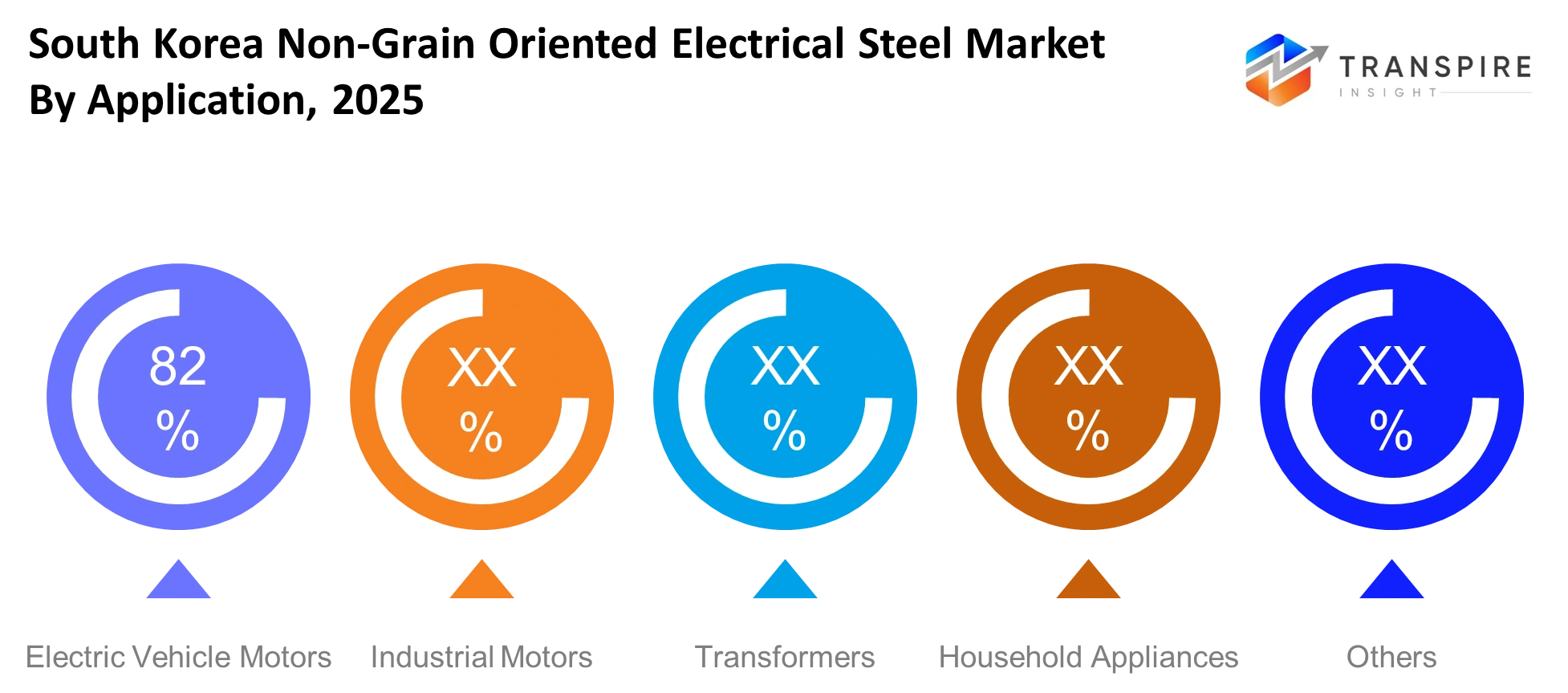
Electric Vehicle Motors sort of represent the leading application segment, in the sense that South Korea keeps pushing ahead with electric vehicle production, also battery manufacturing strengths. For high-performance motor systems, low core loss is basically non-negotiable, and magnetic efficiency has to be superior, so demand climbs for advanced NGO electrical steel grades that can really deliver. Industrial Motors, on the other hand, keep a solid market position because they are broadly used across factory automation systems, heavy industrial machinery, and manufacturing operations that aim for energy efficiency. Transformers still hold a fairly stable share too, since power infrastructure modernization projects carry on supporting demand for electrical equipment.
Electric Vehicle Motors are expected to show the fastest growth during the forecast period because automotive manufacturers accelerate EV platform expansion and related local supply chain investments. Industrial Motors keep getting a boost from smart factory adoption, and from industrial automation needs that keep rising across manufacturing sectors. Household Appliances also maintain steady growth, mostly because energy efficiency regulations encourage appliance producers to move toward higher-grade magnetic materials, particularly in compressors and motors. “Others” includes railway systems, renewable energy equipment, and specialized machinery applications, and these are expected to open up niche chances for premium NGO steel suppliers.
To learn more about this report, Download Free Sample Report
By Thickness
The 0.35–0.50 mm slice holds the leading market position, mainly because this thickness window gives a rather solid compromise between magnetic efficiency, mechanical strength, and the reality of manufacturing cost. Motor and transformer makers tend to select this range for everyday industrial use as well as automotive work. Under 0.35 mm, materials keep taking more of the market, since thinner electrical steel helps energy efficiency go up, while also cutting core losses in high-speed motors and the newer EV architectures. Over 0.50 mm products are still used where the industry cares most about heavy-duty robustness, and structural steadiness stays a priority.
Under 0.35 mm steel is set to show the fastest growth, because compact electric motor output keeps rising, and premium vehicle platforms increasingly demand better operating efficiency. Manufacturers are putting more money into advanced rolling and coating technologies, to keep ultra-thin electrical steel consistent, at lot of times. The 0.35–0.50 mm segment should remain commercially significant, because wide industrial fit supports steady, long-term demand across many fields. The remaining share is often filled by other offerings, like customized thickness requirements created for specialized machines, renewable energy gear, and niche industrial uses where distinct magnetic performance standards are required.
By End User
Automotive Industry still sits at the top as the end-user, since electric vehicle production and hybrid powertrain work keep pushing solid use of high-efficiency electrical steel, like it’s just the natural outcome. South Korean automotive makers are more and more focused on lightweight yet energy-saving motor systems to boost vehicle output and meet rules properly. Industrial Manufacturing comes right after, because automation devices, robotics, and industrial motors need dependable magnetic materials for nonstop operation. Electronics Industry also keeps a notable appetite, especially where compressors, cooling setups, and precision motor parts are involved, and people don’t really want downtime there.
Automotive Industry is also likely to stay the quickest growing segment because electric mobility investment continues to widen across local as well as export-oriented vehicle plants. Power Generation Industry is getting a lift from grid upgrades and renewable energy integration projects, which in turn raise transformer and generator demand. Electronics Industry keeps expanding as energy-efficient home appliances and semiconductor manufacturing equipment need advanced electrical steel components that cut energy loss. The “Others” bucket includes transport systems, defense gear, and niche industrial use cases, these support a smaller but steady, long-run demand that doesn’t vanish quickly.
By Coating Type
Insulated Coatings kind of dominate the market because electrical insulation between steel laminations helps reduce eddy current losses, and that in turn improves motor efficiency . You can see strong usage across electric vehicles, industrial motors , and transformer applications, which keeps adoption of insulated coating systems moving steadily. Organic Coatings also hold a key position since makers really like better corrosion resistance, surface protection, and processing flexibility during stamping and motor assembly activities . Meanwhile Inorganic Coatings stay relevant too, especially in high-temperature operating environments where stronger thermal resistance becomes pretty nonnegotiable.
Insulated Coatings are expected to keep long-term leadership since energy efficiency regulations keep increasing demand for low-loss electrical steel products. Organic Coatings, on the other hand, benefit from the uptick in appliance production and automotive motor manufacturing, both of which want durable surface protection, along with enhanced formability during high-speed processing. Inorganic Coatings are likely to gain gradual traction in industrial power systems and heavy-duty use cases that are exposed to elevated operating temperatures. Other options include hybrid approaches and specialty coating technologies, aimed at advanced EV motors, renewable energy systems, and tailored industrial equipment that needs improved magnetic and mechanical performance .
What are the Key Use Cases Driving the South Korea Non-Grain Oriented Electrical Steel Market?
Electric vehicle traction motors still are, like the main situation pushing market demand , because motor efficiency really tugs at driving range , acceleration behavior, and how well the battery is used. Korean automakers more and more often go after premium NGO electrical steel for their high-speed motor setups, the kind that need reduced magnetic losses and also stay compact.
At the same time, industrial automation systems and energy-saving compressors are showing up as secondary workarounds. Semiconductor plants, robotics builders, and smart factory owners keep swapping old-style motors with inverter-driven configurations , which means they need magnetic materials that behave reliably under heat conditions, not just good on paper.
Then there are the newer directions, offshore wind generator systems for example, plus advanced robotics and even aerospace electrification technologies. Those areas are still growing into the commercial stage, but they already ask for ultra-thin electrical steel grades that can handle high-frequency operation while burning as little energy as possible.
|
Report Metrics |
Details |
|
Market size value in 2025 |
USD 494.1 Million |
|
Market size value in 2026 |
USD 513.9 Million |
|
Revenue forecast in 2033 |
USD 685.9 Million |
|
Growth rate |
CAGR of4.21% from 2026 to 2033 |
|
Base year |
2025 |
|
Historical data |
2021 - 2024 |
|
Forecast period |
2026 - 2033 |
|
Report coverage |
Revenue forecast, competitive landscape, growth factors, and trends |
|
Regional scope |
South Korea |
|
Key company profiled |
POSCO, Nippon Steel, JFE Steel, Baowu Steel Group, ArcelorMittal, Thyssenkrupp Steel, Tata Steel, Cleveland-Cliffs, AK Steel, Voestalpine, Aperam, United States Steel Corporation, Hyundai Steel, NLMK Group, Shougang Group |
|
Customization scope |
Free report customization (country, regional & segment scope). Avail customized purchase options to meet your exact research needs. |
|
Report Segmentation |
By Product Type (Fully Processed NGO Steel, Semi-processed NGO Steel, Thin Gauge NGO Steel, Others); By Application (Electric Vehicle Motors, Industrial Motors, Transformers, Household Appliances, Others); By Thickness (Below 0.35 mm, 0.35–0.50 mm, Above 0.50 mm, Others); By End User (Automotive Industry, Power Generation Industry, Electronics Industry, Industrial Manufacturing, Others); By Coating Type (Insulated Coatings, Organic Coatings, Inorganic Coatings, Others) |
Which Regions are Driving the South Korea Non-Grain Oriented Electrical Steel Market Growth?
The Seoul Capital Area , covering Gyeonggi Province and the nearby industrial corridors, seems to help market revenue generation because it’s packed with automotive, electronics, and so-called advanced manufacturing backbone. A lot of major EV supply chains, appliance manufacturers, and semiconductor equipment producers run big facilities here , and that steady footprint basically translates into reliable demand for high-grade NGO electrical steel . Good logistics connectivity, plus being close to research institutions, also makes it easier to commercialize premium magnetic materials faster. On top of that, large scale investments by Hyundai Motor, along with electronics manufacturers , keep reinforcing the region’s pull in high-efficiency motor production.
Then there are the Southeastern industrial regions , like Ulsan, Busan , and South Gyeongsang , which keep a strong market position thanks to heavy industrial manufacturing and steel processing strengths. But unlike the capital region’s tech leaning demand model, these areas lean more toward shipbuilding equipment, industrial motors, petrochemical systems , and big factory like manufacturing operations. They already have long-established steelmaking ecosystems, and the export oriented industrial infrastructure helps keep procurement volumes steady , even when automotive demand wobbles. Continued factory modernization programs, and upgrades focused on industrial energy efficiency , support long term material consumption too.
Chungcheong and North Jeolla are also showing up as the quickest-growing regions, largely driven by expanding battery manufacturing, renewable energy investments , and next generation mobility projects. Since 2023, new industrial development initiatives and infrastructure spending have really sped up plant construction connected to EV supply chains and energy storage systems .
Who are the Key Players in the South Korea Non-Grain Oriented Electrical Steel Market and How Do They Compete?
Competition is still kind of moderately consolidated, mostly because advanced NGO electrical steel production needs specialized rolling, annealing, and coating infrastructure, so smaller manufacturers can’t jump in super fast. Firms usually fight it out on magnetic performance, thin gauge making abilities, the coating know-how and then of course those long term supply ties with automotive and industrial OEMs. The current big producers keep defending their share with capacity expansion and more premium product work, not so much with aggressive price moves , it’s more like stable positioning.
POSCO really leans in on premium electrical steel know how for EV traction motors, plus high efficiency industrial systems. The company has been adding investments in high grade electrical steel production lines , to help domestic EV supply chains and also to cut down on dependence on imported specialty materials. Hyundai Steel has an advantage because it is tightly linked with Hyundai Motor Group, which makes it easier to sync around next generation drivetrain material needs. That connection improves long range purchasing visibility and it speeds up commercialization of tailored motor core materials.
Nippon Steel and JFE Steel go head to head using advanced magnetic performance and ultra thin gauge technologies that are built for high speed EV motors. The Japanese players stay especially strong in premium automotive uses where efficiency plus thermal stability matters more than pure pricing. Baowu Steel Group keeps pushing export competitiveness through large scale production and cost optimization strategies, while European producers like Thyssenkrupp Steel focus more on specialized industrial and energy sector applications , supported by advanced coating technologies.
Company List
- POSCO
- Nippon Steel
- JFE Steel
- Baowu Steel Group
- ArcelorMittal
- Thyssenkrupp Steel
- Tata Steel
- Cleveland-Cliffs
- AK Steel
- Voestalpine
- Aperam
- United States Steel Corporation
- Hyundai Steel
- NLMK Group
- Shougang Group
Recent Development News
“In March 2025, Hyundai Steel announced a USD 5.8 billion investment to build a new steel plant in Louisiana, United States. The facility, developed with Hyundai Motor Group, is expected to strengthen electrical steel supply chains for EV and industrial motor applications, supporting rising demand for non-grain oriented electrical steel products.https://www.reuters.com
“In April 2025, POSCO Holdings entered a strategic partnership with Hyundai Motor Group for Hyundai’s planned U.S. steel plant project. POSCO agreed to make an equity investment in the facility, a move expected to enhance advanced electrical steel production capabilities and improve supply security for EV-related applications.https://www.reuters.com
“In January 2026, Hyundai Steel secured a USD 2.9 billion capital increase for investment in its U.S. steel plant through Hyundai-POSCO Louisiana LLC. The funding commitment is expected to accelerate production infrastructure for high-value electrical steel products, including materials used in energy-efficient motors and EV systems.https://www.reuters.com
What Strategic Insights Define the Future of the South Korea Non-Grain Oriented Electrical Steel Market?
The market seems, kind of, structurally drifting toward premium ultra-thin low-core-loss electrical steel meant for high-speed electrified systems, not the usual industrial motor kind of thing. At the same time, EV platform expansion, robotics uptake, and industrial energy-efficiency regulations keep driving the shift, and revenue is increasingly focused on more technologically advanced material grades. But there is also a less obvious risk that people don’t notice: namely, that the very best end of production capacity is being concentrated among just a few suppliers. If something goes wrong with speciality coatings, or if silicon feedstock availability gets weird, or if the energy-hungry processing infrastructure gets disrupted, then supply can get tighter and downstream manufacturers may see pricing volatility rise across multiple sectors.
There’s a meaningful emerging chance too, especially in aerospace electrification and next-generation robotics, where compact high-frequency motors need extremely efficient magnetic materials. If Korean producers invest early in AI-assisted quality checks, plus ultra-thin rolling methods, they could build real export advantages. In practice, market players should aim for long-term collaborations with EV makers and industrial automation companies, and at the same time widen local premium-grade production capacity so exposure to global supply hiccups stays lower.
South Korea Non-Grain Oriented Electrical Steel Market Report Segmentation
By Product Type
- Fully Processed NGO Steel
- Semi-processed NGO Steel
- Thin Gauge NGO Steel
- Others
By Application
- Electric Vehicle Motors
- Industrial Motors
- Transformers
- Household Appliances
- Others
By Thickness
- Below 0.35 mm
- 0.35–0.50 mm
- Above 0.50 mm
- Others
By End User
- Automotive Industry
- Power Generation Industry
- Electronics Industry
- Industrial Manufacturing
- Others
By Coating Type
- Insulated Coatings
- Organic Coatings
- Inorganic Coatings
- Others
Frequently Asked Questions
Find quick answers to common questions.
The expected South Korea Non-Grain Oriented Electrical Steel Market size for the market will be USD 66.8 Billion in 2033.
Key segments for the South Korea Non-Grain Oriented Electrical Steel Market are By Product Type (Fully Processed NGO Steel, Semi-processed NGO Steel, Thin Gauge NGO Steel, Others); By Application (Electric Vehicle Motors, Industrial Motors, Transformers, Household Appliances, Others); By Thickness (Below 0.35 mm, 0.35–0.50 mm, Above 0.50 mm, Others); By End User (Automotive Industry, Power Generation Industry, Electronics Industry, Industrial Manufacturing, Others); By Coating Type (Insulated Coatings, Organic Coatings, Inorganic Coatings, Others).
Major South Korea Non-Grain Oriented Electrical Steel Market players are POSCO, Nippon Steel, JFE Steel, Baowu Steel Group, ArcelorMittal, Thyssenkrupp Steel, Tata Steel, Cleveland-Cliffs, AK Steel, Voestalpine, Aperam, United States Steel Corporation, Hyundai Steel, NLMK Group, Shougang Group.
The South Korea Non-Grain Oriented Electrical Steel Market size is USD 494.1 Million in 2025.
The South Korea Non-Grain Oriented Electrical Steel Market CAGR is 4.21% from 2026 to 2033.
- POSCO
- Nippon Steel
- JFE Steel
- Baowu Steel Group
- ArcelorMittal
- Thyssenkrupp Steel
- Tata Steel
- Cleveland-Cliffs
- AK Steel
- Voestalpine
- Aperam
- United States Steel Corporation
- Hyundai Steel
- NLMK Group
- Shougang Group
Recently Published Reports
-
May 2026
Healthcare Polymer Packaging Market
Healthcare Polymer Packaging Market Size, Share & Analysis Report By Packaging Type (Syringes, IV Bottles and Pouches, Clamshells, Blisters, Bottles & Jars, Containers, Tubes, IV Parental Packaging, Others), By Type (Regulated, Non-regulated), By Polymer Type (LDPE (Low-Density Polyethylene), HDPE (High-Density Polyethylene), Homo-polymer (Homo), Random Copolymer (Random), Block Copolymer (Block), PET, Polystyrene, Polyvinyl Chloride, Polyamide/EVOH, Others), and Geography (North America, Europe, Asia-Pacific, Middle East and Africa, South and Central America), 2021 - 2031
-
Apr 2026
Hydrophilic Tape (Waterstop) Market
Hydrophilic Tape (Waterstop) Market Size, Share & Analysis Report By Type (Bentonite-Based Hydrophilic Tape, Rubber-Based Hydrophilic Tape), By Application (Residential Buildings, Commercial Buildings, Infrastructure Projects), and Geography (North America, Europe, Asia-Pacific, Middle East and Africa, South and Central America), 2021 - 2031
-
Apr 2026
Metalens Market
Metalens Market Size, Share & Analysis Report By Type (Visible Light Metalens, and Infrared Metalens), By Application (Consumer Electronics, Automotive Electronics, Industrial, Medical, and Others), and Geography (North America, Europe, Asia-Pacific, Middle East and Africa, South and Central America), 2021 - 2031
-
Apr 2026
PBT Resin Market
PBT Resin Market Size, Share & Analysis Report By Type (Reinforced PBT Resin, Unreinforced PBT Resin), By Processing Method (Injection Molding, Extrusion, Blow Molding, Others), By End-User (Automotive, Electrical & Electronics, Consumer Appliances, Industrial Machinery, Medical Devices, Packaging, Others), and Geography (North America, Europe, Asia-Pacific, Middle East and Africa, South and Central America), 2021 - 2031