

North America Steel Rebar Market Size & Forecast:
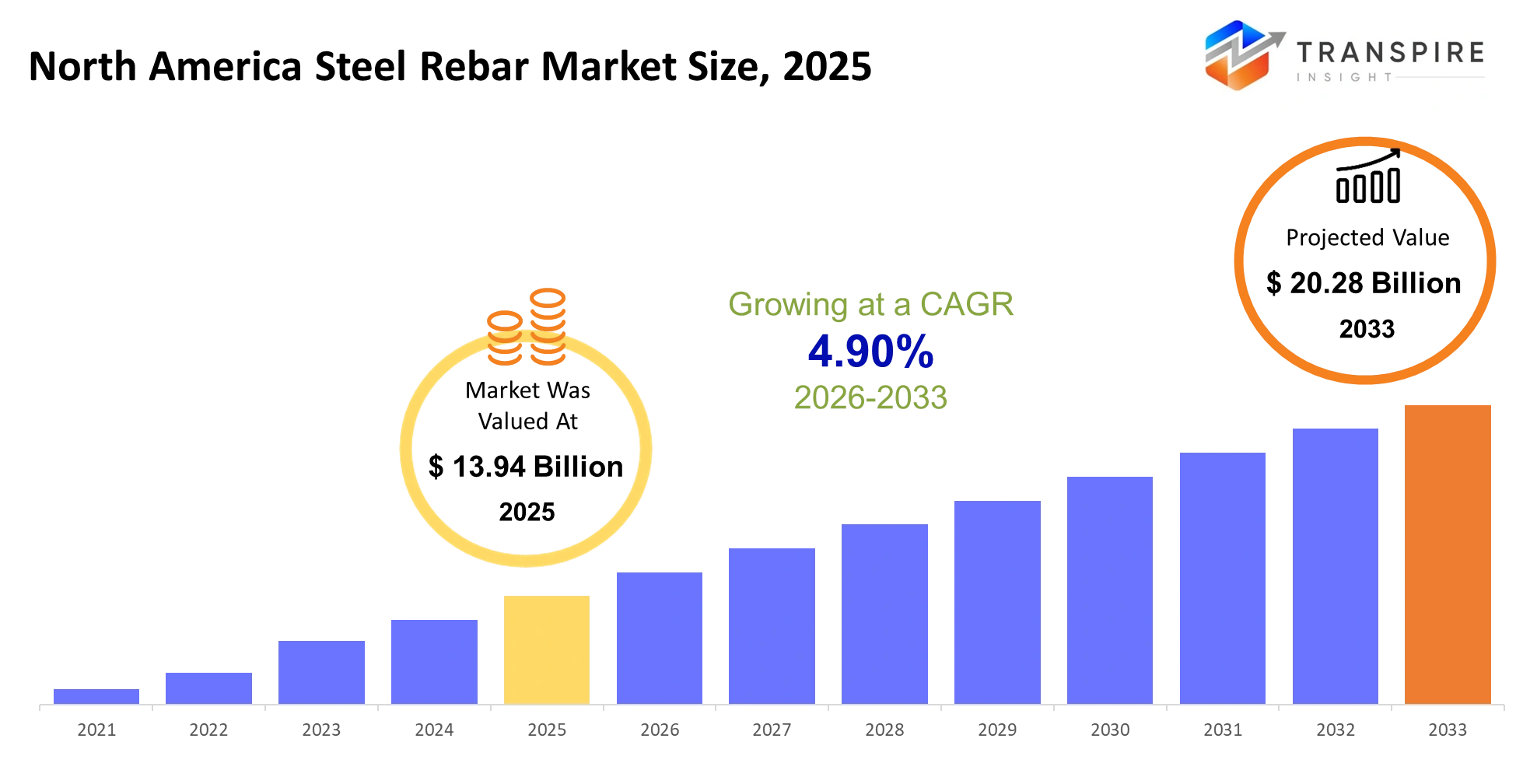
- North America Steel Rebar Market Size 2025: USD 13.94 Billion
- North America Steel Rebar Market Size 2033: USD 20.28 Billion
- North America Steel Rebar Market CAGR: 4.90%
- North America Steel Rebar Market Segments:
- By Type (Carbon Steel, Alloy Steel, Stainless Steel, Epoxy-coated, Galvanized, Welded, Deformed); By Application (Construction, Infrastructure, Industrial, Residential, Commercial, Bridges, Roads); By End-User (Construction Firms, Govt, Contractors, Real Estate, Industrial, Infrastructure, Developers); By Size (Small, Medium, Large, Heavy-duty, Custom, Standard, High strength); By Distribution (Direct, Distributors, Retail, Bulk, Export, Online, OEM).
To learn more about this report,  Download Free Sample Report
North America Steel Rebar Market Summary:
The North America Steel Rebar Market size is estimated at USD 13.94 Billion in 2025 and is anticipated to reach USD 20.28 Billion by 2033, growing at a CAGR of 4.90% from 2026 to 2033. The North America Steel Rebar Market experiences continuous growth because infrastructure development activities and urbanization processes are taking place throughout the United States and Canada. The demand for steel rebar experiences significant growth because investors are funding construction activities which include building highways and bridges and developing residential and commercial areas. The market experiences accelerated growth because government programs which support infrastructure modernization work together with steel rebar as an essential material that maintains building strength and durability.
The North America Steel Rebar Market receives its main direction from two important elements which include construction industry advancements and the use of environmentally friendly materials for building projects. The industry requires manufacturers to develop rebar products which include corrosion-resistant features and high-strength capabilities because of the current environmental regulations and industry standards which undergo continuous change. The steel production process needs to develop innovative solutions because construction projects increasingly use recyclable materials which create a market opportunity that will support sustainable growth.
What Has the Impact of Artificial Intelligence Been on the North America Steel Rebar Market?
AI technology is currently changing the North American Steel Rebar Market by creating new methods that help stakeholders track market changes and make demand predictions through their data analysis.
The North American Steel Rebar Market uses AI for its advanced market research capabilities which include using machine learning algorithms to analyze extensive datasets and discover consumption patterns while providing precise future predictions. This technology enables manufacturers and suppliers to manage construction demand patterns through their pricing decisions which synchronize with current infrastructure building activities to enhance their choice-making processes.
The North American Steel Rebar Market uses artificial intelligence to develop automated systems that operate across manufacturing and distribution processes. The use of AI-powered systems in manufacturing processes helps businesses achieve better production accuracy while decreasing material losses and enhancing their ability to manage product defects which results in greater productivity and lower costs.
Predictive analytics enables supply chain optimization through its ability to predict inventory requirements while reducing supply chain interruptions and enhancing logistics operations. North American Steel Rebar Market companies that implement AI technologies gain an edge over their competitors because they can create new products and respond faster while providing personalized services that meet the changing construction standards and sustainability needs of their clients.
Key Market Trends & Insights:
- The North America Steel Rebar Market shows strong demand growth because of infrastructure modernization which the U.S. market maintains with a 75% market share.
- The construction industry experiences a key trend which results from the growing use of high-strength corrosion-resistant rebar that improves project durability and extended lifespan.
- The North America Steel Rebar Market achieves environmental compliance through its growing adoption of sustainable production practices that use recycled steel materials.
- Businesses achieve their production efficiency goals through digital transformation implementation together with smart automation technology while they reduce operational costs and develop market competitive advantages.
- The industry's continuous expansion occurs because residential and commercial construction activities create ongoing demand, driving market growth.
- The United States Steel Rebar Market controls over 75% of the North American market when it reaches 2025 because of its extensive infrastructure and urban development projects.
- With public infrastructure investment, Canada emerges as the fastest-growing region because it will achieve a projected CAGR above 5% until 2030.
- The market shows deformed steel rebar as the dominant product, with more than 65% market share, due to its superior bonding strength and widespread use in construction.
- Mild steel rebar maintains the second-largest market share because it offers cost savings for construction projects that require low load-bearing capacity.
- Epoxy-coated rebar is the fastest-growing market segment because of its ability to resist corrosion in environments that experience extreme conditions according to projections which show growth until 2030.
- Infrastructure construction dominates with over 60% share, driven by highways, bridges, and public utility projects across the region.
- The residential construction market establishes itself as the fastest-growing application because urban housing demand along with population growth patterns drives its expansion.
North America Steel Rebar Market Segmentation
By Type
Construction projects utilize carbon steel because it delivers strong performance at affordable prices. Alloy steel delivers better operational capabilities when exposed to extreme heat and intense pressure conditions which makes it suitable for use in specialized industrial applications. Facilities operating in damp locations with extreme environmental conditions typically select stainless steel because it delivers effective corrosion protection. The market demand for epoxy-coated and galvanized products will increase because these materials provide effective rust protection and extended operational duration.
Welded and deformed rebar types will continue to support structural integrity through better bonding with concrete. Deformed variants, in particular, will remain preferred for large-scale infrastructure projects due to enhanced grip and load-bearing capacity. The project requirements will determine which rebar type to use based on environmental conditions and budget factors. Material innovation will further support durability and performance improvements.
By Application
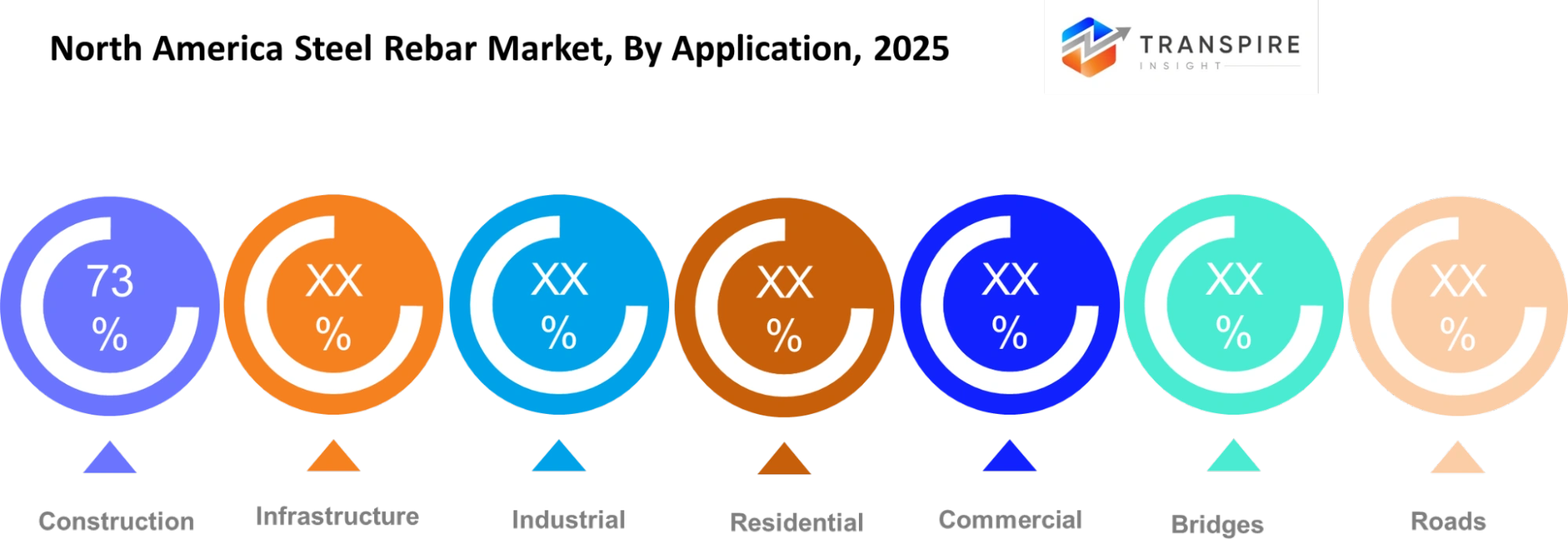
The primary area where construction work is applied remains operational because construction work continues in both residential and commercial building sites. Infrastructure projects which include bridges and roads will receive ongoing demand because government funding and repair projects create a need for these construction works. The industrial sector will experience slow growth because manufacturing and logistics operations will expand their facilities. The need for housing will increase because the population will grow which will boost residential construction activities.
Commercial development will create continuous demand in urban areas. The construction of bridges and road projects will need strong reinforcement materials which ensure both safety and long-lasting performance. Application demand will vary based on economic conditions and investment cycles. The market will remain stable because these segments grow at a balanced rate.
To learn more about this report, Download Free Sample Report
By End-User
The construction industry depends on rebar as the primary structural reinforcement material which both construction firms and contractors use. Government agencies will keep affecting demand through their infrastructure expenditures and public works initiatives. Real estate developers will drive usage through residential and commercial project expansion.The industrial sector will sustain consistent market requirements through its construction projects and facility enhancements.
The construction industry requires infrastructure organizations to deliver essential support for executing extensive projects which include highway systems and bridge construction. The collaborative efforts between contractors and developers will result in both effective project execution and optimal material utilization. The demand from end-users will change based on three factors which include funding availability and project schedules and economic conditions. The various segments of the market will experience growth which will lead to stable consumption patterns.
By Size
The construction industry will preferentially use standard and medium-sized rebar products because these materials serve common construction needs. The infrastructure and industrial sectors will use large and heavy-duty rebar products which provide higher load capacity. Projects which require high durability and safety standards will see increasing use of high-strength rebar. The custom sizes will meet particular design and engineering requirements.
The construction industry will continue to use small-sized rebar for its essential role in minor construction and repair work.
The option to select different sizes will accommodate various structural requirements. The demand for high-strength products will rise because construction projects now prioritize building materials which last a long time. The ability to change product dimensions will enable multiple industries to meet their various operational needs.
By Distribution
Direct sales will continue to serve as the primary method of distribution for large construction companies and their contractors. The distributors will act as essential partners who help access smaller customer segments and regional market areas. The bulk supply channels will provide essential support for both infrastructure development and industrial operations. Export activity will contribute to cross-border trade within North America.
The retail and online channels will evolve over time to offer customers convenient options for making small purchases while enjoying quick access to products. OEM partnerships will help businesses establish connections with construction and industrial equipment supply chains. The distribution networks will deliver products on time while keeping operational expenses under control. Customer access to logistics and digital platforms will expand as these operations grow.
What are the Main Challenges for the North America Steel Rebar Market Growth?
The North America Steel Rebar Market encounters various technological and operational problems which reduce its operational performance and ability to expand. The production process and cost structure experience instability because raw material prices especially iron ore and scrap steel undergo unpredictable changes.
Supply chain disruptions together with transportation delays, create ongoing difficulties which hinder project delivery and execution progress. The North America Steel Rebar Market experiences continuous challenges which restrict its operational capabilities while forcing manufacturers to deliver products with consistent quality and production levels.The growth capacity of the North America Steel Rebar Market faces multiple restrictions because manufacturing and commercialization barriers exist.
The combination of high energy consumption and strict environmental regulations creates production costs which require manufacturers to make ongoing investments toward cleaner technologies. The need to meet quality and safety standards adds extra difficulties to the manufacturing process. The North America Steel Rebar Market experiences growth barriers which lead to project execution delays and decreased profit earnings for major companies in the industry.
Regions with insufficient infrastructure development and skilled labor shortages face adoption challenges which remain a significant issue. The North America Steel Rebar Market relies primarily on construction activity which experiences fluctuations based on economic conditions and available funding. The market expansion faces obstacles because people lack knowledge about advanced rebar solutions and the adoption of new materials progresses at a slow speed. The construction industry faces market restrictions which determine the speed of innovation implementation across various construction sectors.
Regional Insights
The United States maintains its top position because its states invest heavily in infrastructure projects while developing urban areas. The transportation sector and public utilities sector maintain high demand which the federal funding programs help to support. Canada demonstrates stable economic growth through increased funding for eco-friendly construction projects and energy-efficient building development which drives ongoing regional development.
The industrial sector and rising construction activity in urban areas of Mexico are transforming the country into a developing market for the region. The regional demand patterns will depend on three factors which include economic stability and government policies and infrastructure development priorities. The availability of construction materials and their pricing patterns throughout North America will be determined by cross-border trade and supply chain connections.
Developing areas will experience growth at different rates because established regions will have consistent demand while new areas will take time to grow. The development of transportation systems and intelligent urban projects will create economic benefits that last for many years. The market will achieve stability when development activities reach an equal level and logistics operations function properly and both public and private organizations work together effectively.
Recent Development News
In April 2026, U.S. Steel Demand Outlook Revised Amid Global Disruptions: Global steel demand projections were adjusted in April 2026, reflecting changing consumption patterns that also influence U.S. construction materials demand. The update highlights how external geopolitical factors can indirectly impact domestic steel and rebar consumption trends.
Source: https://www.reuters.com
In April 2026, U.S. Steel Shipments Show Yearly Growth Despite Monthly Dip: Recent data from early April 2026 shows U.S. steel shipments increased year-over-year, indicating stable underlying demand across construction-related sectors. However, a slight monthly decline signals short-term fluctuations affecting supply planning and pricing strategies.
Source: https://www.indexbox.io
|
Report Metrics |
Details |
|
Market size value in 2025 |
USD 13.94 Billion |
|
Market size value in 2026 |
USD 14.51 Billion |
|
Revenue forecast in 2033 |
USD 20.28 Billion |
|
Growth rate |
CAGR of 4.90% from 2026 to 2033 |
|
Base year |
2025 |
|
Historical data |
2021 – 2024 |
|
Forecast period |
2026 – 2033 |
|
Report coverage |
Revenue forecast, competitive landscape, growth factors, and trends |
|
Country scope |
North America (Canada, The United States, and Mexico) |
|
Key company profiled |
Nucor, Gerdau, ArcelorMittal, Commercial Metals, Steel Dynamics, US Steel, POSCO, Tata Steel, JSW Steel, Hyundai Steel, Nippon Steel, Voestalpine, Evraz, Severstal, Liberty Steel. |
|
Customization scope |
Free report customization (country, regional & segment scope). Avail customized purchase options to meet your exact research needs. |
|
Report Segmentation |
By Type (Carbon Steel, Alloy Steel, Stainless Steel, Epoxy-coated, Galvanized, Welded, Deformed); By Application (Construction, Infrastructure, Industrial, Residential, Commercial, Bridges, Roads); By End-User (Construction Firms, Govt, Contractors, Real Estate, Industrial, Infrastructure, Developers); By Size (Small, Medium, Large, Heavy-duty, Custom, Standard, High strength); By Distribution (Direct, Distributors, Retail, Bulk, Export, Online, OEM). |
How Can New Companies Establish a Strong Foothold in the North America Steel Rebar Market?
New companies in the North America Steel Rebar Market can create strong market positions by concentrating on specialized market segments which show increasing demand and have low competition levels. The company will establish unique value through its development of corrosion-resistant rebar dedicated to coastal infrastructure projects and its high-strength rebar solutions designed for smart city applications. New businesses need to achieve proper market entry through their understanding of current industry trends and local construction requirements which will help them establish market presence while they work to solve performance deficiencies.
The North America Steel Rebar Market needs innovation strategies which use advanced materials and digital technologies for their development. Gerdau Graphene and other startups research graphene-based rebar solutions which enhance material strength and durability. The solutions described above enable new businesses to compete in the market because they address fundamental sustainability concerns and help decrease operational costs throughout product development.
The North America Steel Rebar Market will benefit from strategic partnerships which establish local production facilities. The company will enhance its market presence through partnerships with construction companies and infrastructure developers and government organizations which will provide both market entry points and project opportunities. The company will achieve operational growth through its investment in smart automation and predictive analytics which will enhance both production effectiveness and supply chain dependability.
The North America Steel Rebar Market will experience success based on two key factors which include technological differences and effective cost management. The new market entrants that adopt digital technologies to deliver personalized services while monitoring market demands will establish their business presence in the industry.
Key North America Steel Rebar Market Company Insights
The competitive landscape shows strong presence of established manufacturers who maintain extensive production facilities and operate comprehensive distribution systems throughout the market. The companies maintain their focus on three priorities which include maintaining product quality, controlling expenses and establishing extended partnerships with construction companies.
The market maintains high competition because customers react to price changes and the prices of raw materials fluctuate which will affect both profitability and market positioning efforts.
Leading players continue to invest in advanced manufacturing technologies and sustainable production methods to improve efficiency and meet regulatory standards.
The company will achieve its market growth through three key strategies which include establishing strategic partnerships and expanding into new regions and enhancing supply chain efficiency. Smaller companies will compete in the market by delivering niche products which come with adaptable price options and rapid shipping services to fulfill evolving requirements of their construction projects.
Company List
- Nucor
- Gerdau
- ArcelorMittal
- Commercial Metals
- Steel Dynamics
- US Steel
- POSCO
- Tata Steel
- JSW Steel
- Hyundai Steel
- Nippon Steel
- Voestalpine
- Evraz
- Severstal
- Liberty Steel
What are the Key Use-Cases Driving the Growth of the North America Steel Rebar Market?
The North America Steel Rebar Market experiences ongoing growth because large-scale infrastructure projects and construction activities create strong demand throughout the entire area. The primary applications of the material require reinforced strength and durability for construction projects which include highways and bridges and tunnels and public transit systems.
Government-funded modernization programs in the North America Steel Rebar Market enable direct benefits through their focus on permanent materials which ensure safe structural performance.The North America Steel Rebar Market receives strong support from residential and commercial construction activities. The increasing demand for housing and urbanization are driving developers to implement high-strength rebar in their foundation and slab and high-rise building projects.
Reinforced steel functions as a fundamental element of present-day construction because it provides essential structural stability which architects implement in their design work.The North America Steel Rebar Market receives major support from industrial and manufacturing facilities which create a robust foundation.
Warehouses and factories and logistics hubs depend on reinforced concrete structures which must withstand heavy loads during their extended operational lifetimes. The development of smart city projects and renewable energy infrastructure which includes wind and energy storage facilities creates fresh opportunities that enhance scalability while expanding advanced regional applications.
North America Steel Rebar Market Report Segmentation
By Type
- Carbon Steel
- Alloy Steel
- Stainless Steel
- Epoxy-coated
- Galvanized
- Welded
- Deformed
By Application
- Construction
- Infrastructure
- Industrial
- Residential
- Commercial
- Bridges
- Roads
By End-User
- Construction Firms
- Govt
- Contractors
- Real Estate
- Industrial
- Infrastructure
- Developers
By Size
- Small
- Medium
- Large
- Heavy-duty
- Custom
- Standard
- High strength
By Distribution
- Direct
- Distributors
- Retail
- Bulk
- Export
- Online
- OEM
Frequently Asked Questions
Find quick answers to common questions.
The approximate North America Steel Rebar Market size for the market will be USD 20.28 Billion in 2033.
The key segments of the North America Steel Rebar Market are By Type (Carbon Steel, Alloy Steel, Stainless Steel, Epoxy-coated, Galvanized, Welded, Deformed); By Application (Construction, Infrastructure, Industrial, Residential, Commercial, Bridges, Roads); By End-User (Construction Firms, Govt, Contractors, Real Estate, Industrial, Infrastructure, Developers); By Size (Small, Medium, Large, Heavy-duty, Custom, Standard, High strength); By Distribution (Direct, Distributors, Retail, Bulk, Export, Online, OEM).
Major players in the North America Steel Rebar Market are Nucor, Gerdau, ArcelorMittal, Commercial Metals, Steel Dynamics, US Steel, POSCO, Tata Steel, JSW Steel, Hyundai Steel, Nippon Steel, Voestalpine, Evraz, Severstal, Liberty Steel.
The current market size of the North America Steel Rebar Market is USD 13.94 Billion in 2025.
The North America Steel Rebar Market CAGR is 4.90%.
- Nucor
- Gerdau
- ArcelorMittal
- Commercial Metals
- Steel Dynamics
- US Steel
- POSCO
- Tata Steel
- JSW Steel
- Hyundai Steel
- Nippon Steel
- Voestalpine
- Evraz
- Severstal
- Liberty Steel
Recently Published Reports
-
Dec 2024
Healthcare Polymer Packaging Market
Healthcare Polymer Packaging Market Size, Share & Analysis Report By Packaging Type (Syringes, IV Bottles and Pouches, Clamshells, Blisters, Bottles & Jars, Containers, Tubes, IV Parental Packaging, Others), By Type (Regulated, Non-regulated), By Polymer Type (LDPE (Low-Density Polyethylene), HDPE (High-Density Polyethylene), Homo-polymer (Homo), Random Copolymer (Random), Block Copolymer (Block), PET, Polystyrene, Polyvinyl Chloride, Polyamide/EVOH, Others), and Geography (North America, Europe, Asia-Pacific, Middle East and Africa, South and Central America), 2021 - 2031
-
Jan 2025
Hydrophilic Tape (Waterstop) Market
Hydrophilic Tape (Waterstop) Market Size, Share & Analysis Report By Type (Bentonite-Based Hydrophilic Tape, Rubber-Based Hydrophilic Tape), By Application (Residential Buildings, Commercial Buildings, Infrastructure Projects), and Geography (North America, Europe, Asia-Pacific, Middle East and Africa, South and Central America), 2021 - 2031
-
Jan 2025
Metalens Market
Metalens Market Size, Share & Analysis Report By Type (Visible Light Metalens, and Infrared Metalens), By Application (Consumer Electronics, Automotive Electronics, Industrial, Medical, and Others), and Geography (North America, Europe, Asia-Pacific, Middle East and Africa, South and Central America), 2021 - 2031
-
Jan 2025
PBT Resin Market
PBT Resin Market Size, Share & Analysis Report By Type (Reinforced PBT Resin, Unreinforced PBT Resin), By Processing Method (Injection Molding, Extrusion, Blow Molding, Others), By End-User (Automotive, Electrical & Electronics, Consumer Appliances, Industrial Machinery, Medical Devices, Packaging, Others), and Geography (North America, Europe, Asia-Pacific, Middle East and Africa, South and Central America), 2021 - 2031