

South Korea Organic Peroxide Market Size & Forecast:
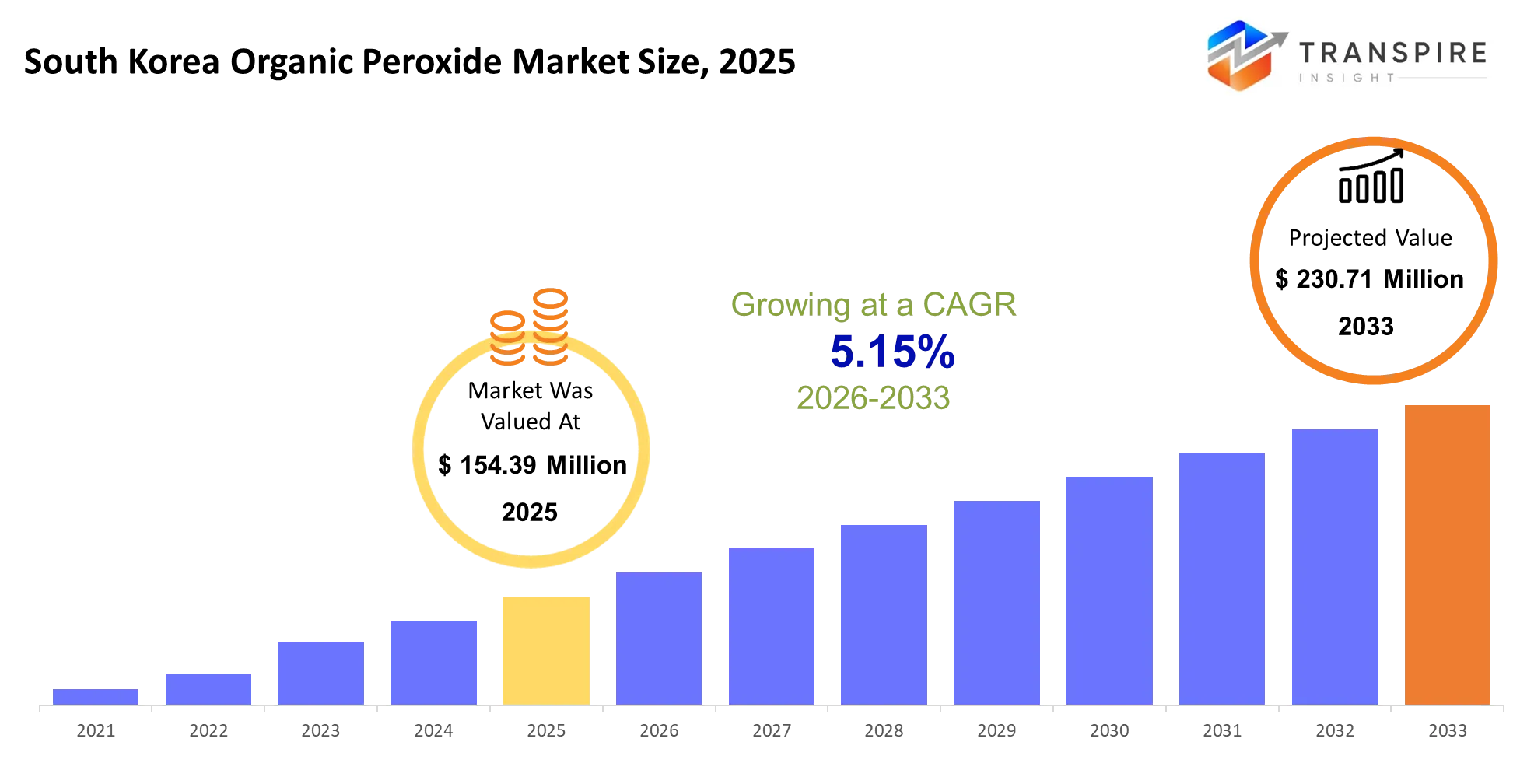
- South Korea Organic Peroxide Market Size 2025: USD 154.39 Million
- South Korea Organic Peroxide Market Size 2033: USD 230.71 Million
- South Korea Organic Peroxide Market CAGR: 5.15%
- South Korea Organic Peroxide Market Segments: By Type (Ketone Peroxides, Dialkyl Peroxides, Diacyl Peroxides, Peroxyesters, Others); By Application (Polymerization Initiators, Cross-linking Agents, Curing Agents, Chemical Synthesis, Others); By End User (Plastics Industry, Rubber Industry, Chemical Industry, Coatings Industry, Others); By Form (Liquid Organic Peroxides, Paste Organic Peroxides, Powder Organic Peroxides, Others); By Distribution Channel (Direct Sales, Chemical Distributors, Online Distribution, Others)
To learn more about this report,  Download Free Sample Report
South Korea Organic Peroxide Market Summary
The South Korea Organic Peroxide Market was valued at USD 154.39 Million in 2025. It is forecast to reach USD 230.71 Million by 2033. That is a CAGR of 5.15%over the period.
South Korea Organic Peroxide Market matters in a kind of underlying way for the country industrial manufacturing chain, because it helps chemical and polymer makers move faster with production, it also boosts rubber cross-linking performance, and it backs up stronger composite parts that show up in automotive, electronics, coatings, and construction. Organic peroxides work as important reaction starters and curing agents, so producers can push overall output efficiency ,keep the material characteristics more stable, and still comply with tough product durability expectations.
In the past five years, the market has basically tilted toward specialty peroxide formulations, these are made for newer polymers and lightweight automotive materials. That shift really picked up after COVID-19 supply chain disruptions ,which quietly revealed how much South Korea leaned on imported chemical intermediates, so domestic manufacturers started localizing specialty chemical sourcing instead. Around the same time, tighter rules on industrial safety and emissions, pushed producers to upgrade processing infrastructure ,and to use higher-purity peroxide compounds. As a result, demand became stronger from electronics encapsulation, EV battery materials, and engineered plastics manufacturing, which also opened up higher-margin chances for suppliers who focus on tailored formulations, and on dependable process performance.
Key Market Insights
- After 2021 the South Korea Organic Peroxide Market kind of shifted into high-purity peroxide formulations, and by 2025 specialty grades were almost 38% of all industrial peroxide usage, not just a small chunk.
- In the same period domestic specialty chemical production grew by more than 12% between 2021 and 2024, mostly since makers tried to lower reliance on imported initiators after those Asian supply chain disruptions, you know.
- Ketone peroxides are still the biggest by industry size, they add up to about 34% market share in 2025, and that holds mainly because fiberglass reinforced plastics manufacturing keeps pulling hard on demand.
- Peroxyesters, meanwhile, showed up as the quickest moving category and they’re expected to expand at over 6.8% CAGR through 2033, since EV and electronics uses need more controlled polymerization performance, with a pretty steady hand.
- Polymerization initiators also take around 41% of total application revenue, and that’s supported by ongoing growth in engineered plastics and synthetic resin production facilities, all connected really.
- Cross-linking agents got extra momentum after 2022, and for automotive related rubber applications peroxide consumption rose by nearly 9% year over year , though the reasons are pretty standard.
- For end use, plastics still sits at the top, bringing nearly 37% of total market revenue through packaging films, automotive plastics, and industrial resin work.
- Electronics and semiconductor linked chemical manufacturing became a big demand driver after South Korea boosted advanced chip packaging investments by more than 15% from 2022 to 2025.
- And for form factor, liquid organic peroxides keep the strongest adoption, at nearly 62% share in 2025, because industrial reactors like easier dosing, faster dispersion, and stable continuous processing conditions , so it’s just smoother on site.
What are the Key Drivers, Restraints, and Opportunities in the South Korea Organic Peroxide Market?
The strongest growth driver sort of comes from South Korea’s expansion in advanced polymer manufacturing, linked to electric vehicles, semiconductor packaging, and lightweight industrial materials, in a connected way. Organic peroxides became more important after automotive and electronics manufacturers changed direction toward engineered plastics and high-performance composites that really need precise curing and tight polymerization control, basically. Investments in EV battery production clusters and advanced resin processing facilities sped up specialty peroxide consumption because makers needed stronger thermal stability, quicker reaction efficiency, and fewer defects during steady, continuous industrial output.
The most significant restraint still remains the hazardous handling profile of organic peroxide compounds, plus the strict regulatory framework that covers storage, transportation, and industrial processing. Organic peroxides remain chemically unstable under certain temperature conditions, so manufacturers and distributors end up investing heavily in cold-chain logistics, explosion prevention systems, and compliance infrastructure. These kinds of structural costs make it harder for smaller suppliers to scale operations quickly, and they also dampen broader market penetration, especially among medium-sized industrial processors working with narrow operating margins.
A major opportunity is starting to show up, driven by South Korea’s growing investment in recyclable composites, battery insulation materials, and semiconductor encapsulation compounds. Specialty peroxide suppliers are increasingly developing low-residue, high-purity initiators designed for electronics-grade polymers and advanced adhesive systems. Expansion of domestic semiconductor fabrication capacity, along with government-backed materials localization programs, could unlock new long-term
What Has the Impact of Artificial Intelligence Been on the South Korea Organic Peroxide Market?
Artificial intelligence, and advanced industrial analytics, are basically changing how production runs across South Korea’s specialty chemical manufacturing side, even for peroxide processing operations. More and more chemical producers are putting AI driven monitoring in place, to tune reactor temperature control, to kind of automate batch consistency checking and to curb instability risks while peroxide synthesis is happening. Machine learning models also help forecast thermal behavior during storage and transport, so manufacturers can lower spoilage chances, and at the same time boost operational safety through chemical logistics routes.
Predictive maintenance setups have gotten really useful in continuous polymer production settings where peroxide initiators directly affect curing speed and the final product quality. AI based process optimization platforms look at viscosity, pressure fluctuation, and reaction timing in real time, helping facilities reduce material waste and keep output levels steady. Some big industrial plants have said they saw clear decreases in unexpected downtime and better energy use once they rolled out digital process monitoring inside polymerization workflows, which feels like a pretty direct win.
On top of that, advanced analytics support emissions tracking and regulatory compliance by flagging strange reaction conditions before those issues turn into risky operating scenarios. Still, adoption is not fully smooth, since the integration costs can be high, and there aren’t always enough training datasets for specialty peroxide reactions under all the variable conditions found in real plants. Because of that, a lot of mid-sized chemical manufacturers keep using the more conventional process management tools, since AI rollouts often demand lots of sensor infrastructure, very well calibrated production data, and specialized industrial automation know-how.
Key Market Trends
- South Korean manufacturers started grabbing more domestic peroxide sourcing, up by almost 14% after 2020, partly so they can reduce exposure to imported chemical intermediate shortages. Across Asian supply chains it kinda became the safer move, even if it sounds a bit overkill.
- Automotive suppliers also seemed to speed up how fast they adopted advanced curing agents, and the usage of lightweight composite materials in EV production rose by more than 18% from 2021, and to 2025. not exactly subtle.
- In electronics-grade polymer applications, influence kept building, especially after semiconductor packaging investments in South Korea climbed over 20% from 2022 and then into 2025, basically.
- Chemical producers went with AI-enabled reactor monitoring systems, which helped big manufacturing facilities push batch consistency rates up by around 10% while also lowering operational risks. It’s a neat outcome, though.
- Then specialty peroxide formulations, specifically those with lower residue content, got more traction commercially. Precision adhesive and encapsulation applications saw annual demand growth, more than 7% each year.
- Industrial buyers, meanwhile, shifted toward longer-term supplier agreements, because raw material volatility pushed specialty chemical procurement costs up nearly 12% during global logistics disruptions. So yeah, planning became the thing.
- Liquid peroxide formulations ended up strengthening market leadership too, and they accounted for almost 62% of total product demand in 2025, mainly due to automated industrial processing advantages.
- On the safety side, investments in storage and transportation infrastructure increased by more than 15% after stricter hazardous chemical handling regulations were introduced in 2021. everyone tightened up, that part is clear.
- Finally, regional suppliers expanded technical service partnerships with plastics and rubber manufacturers, helping customized peroxide formulation contracts grow by nearly 9% after 2023, like a steady build.
South Korea Organic Peroxide Market Segmentation
By Type
Ketone Peroxides still seem to have the top spot, mainly because fiberglass reinforced plastics along with unsaturated polyester resin manufacturing keep pulling in strong industrial demand for automotive, marine and construction work. It’s mostly the stable curing efficiency, the cost effective way they process, and how well they fit into large scale composite making that keeps them broadly accepted. Dialkyl Peroxides are usually placed second, largely driven by strong use in high temperature polymer processing, where thermal stability plus a controlled decomposition behavior is basically non-negotiable. Then Diacyl Peroxides, Peroxyesters, and Others keep showing up for specialty polymer production and more advanced industrial formulations, where reaction control has to stay precise.
Peroxyesters look like the fastest-growing type segment , because electronics-grade polymer inputs, EV battery related materials and semiconductor encapsulation compounds demand tighter process consistency, and less leftover residue after curing. On top of that, advanced adhesive systems and engineered plastics production also help push the demand for specialty peroxide formulations that bring improved thermal performance. Dialkyl Peroxides keep a fairly steady expansion too, with the growing need for heat resistant elastomers and industrial rubber use in general. Over the forecast period, you can expect investment activity to lean more and more toward higher purity and safer peroxide variants, made for advanced manufacturing niches and for stricter industrial compliance rules.
By Application
Polymerization Initiators seem to take the leading spot , because synthetic resin, thermoplastic and engineered plastic plants really lean on peroxide based reaction starts, sort of constantly. The industrial demand stays strong mostly from packaging materials, automotive plastics, and consumer electronics production, where regular output, and reaction speed stay sort of non-negotiable. Cross-linking Agents sit in the second place, mostly as rubber processing keeps widening, and heat resistant elastomer manufacturing keeps moving forward. Curing Agents, Chemical Synthesis, and some other categories still support coatings, bonding materials, and those specialty industrial chemical uses in general.
Cross-linking Agents keep getting more commercial grip too, as car makers raise production of lightweight rubber pieces and durable composite materials for electric vehicle platforms. Curing Agents are growing as well, since industrial coatings and more advanced adhesive systems need better thermal resistance , and chemical staying power. Chemical Synthesis use cases keep a steady pace thanks to specialty chemical manufacturing and performance material production overall. Through the forecast window, growth will increasingly lean toward advanced polymer processing systems that want high purity peroxide compounds with reduced emissions and better day to day operational stability.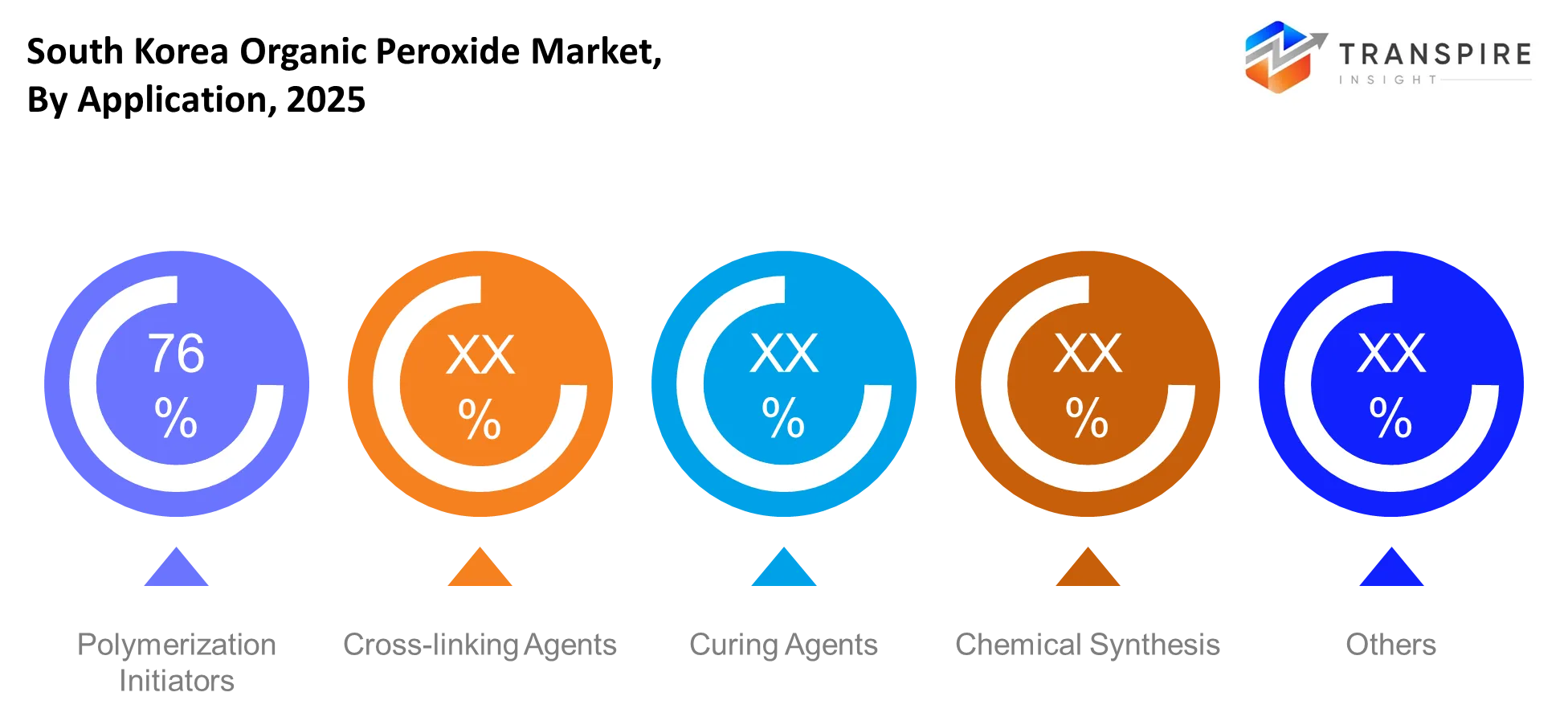
To learn more about this report, Download Free Sample Report
By End User
The Plastics Industry really has the dominant position, since engineered polymers, synthetic resins, and thermoplastic materials are still kinda in the middle of South Korea’s manufacturing and export economy. Strong consumption shows up in automotive parts, industrial packaging, consumer electronics, and construction materials that need efficient polymerization and curing performance. Then there’s the Rubber Industry which ranks second, mostly because demand stays steady for tires, seals, hoses, and industrial elastomers. Meanwhile, the Chemical Industry, the Coatings Industry, and Others keep pushing forward, driven by specialty material production, plus more advanced industrial processing operations, not really slowing down.
For the fastest-growing end-user segment, the Chemical Industry comes first, because semiconductor packaging materials, battery insulation compounds, and industrial adhesives demand more and more specialized peroxide formulations. The Coatings Industry is also picking up momentum, thanks to the need for higher-durability industrial coatings and corrosion-resistant protective systems. The Rubber Industry holds a fairly consistent growth rate, especially as EV manufacturing keeps increasing the requirement for heat-resistant and lightweight elastomer components. Over the forecast period, suppliers are expected to focus on customized peroxide solutions and long-term industrial partnerships, to reinforce their positioning across higher value specialty manufacturing sectors.
By Form
Liquid Organic Peroxides still seem to have the upper hand in the market, mostly because factories doing industrial processing really like simpler dosing, quicker material dispersion, and a higher level of compatibility with automated production workflows. At the same time , big polymer and resin manufacturing sites keep choosing liquid versions due to smoother operation and more even reaction consistency during continuous processing, you know, the kind where everything keeps moving. Paste Organic Peroxides sit in a solid second place, since the reaction tends to stay more controlled and transportation feels safer, which is handy for certain targeted uses. Powder Organic Peroxides and Others keep their demand because specialty polymer blending needs them, and also because some storage-sensitive manufacturing setups just work better that way.
Meanwhile , Liquid Organic Peroxides continue to build on their market share as modern manufacturing systems adopt automated chemical feeding and digitally watched production networks. Powder Organic Peroxides are holding steady in parts of the market where long shelf life and specialized blending performance matter under well controlled industrial conditions. Paste formulations are still used in smaller, niche operations where handling safety is a priority, and where slower reaction profiles are actually preferred. Over the forecast period, product development will likely focus more on stabilized liquid peroxide systems , aiming for the balance between higher productivity, safer handling, and stricter compliance requirements that industry expects every day.
By Distribution Channel
Direct Sales basically hold the upper hand, mostly because big industrial buyers like the long term procurement stuff, plus technical consultations, and that customized formulation help they get straight from peroxide manufacturers. A lot of major plastics, rubber, and specialty chemical producers want a stable supply setup, and they also lean into close collaboration so product performance can be optimized. Chemical Distributors sit in second place, mainly due to wide regional reach and flexible procurement volumes, which really helps medium sized industrial processors keep moving. Online Distribution and Others are still creeping forward slowly, in a more standardized industrial chemical purchasing environment, kind of steady and unhurried.
On top of that, Chemical Distributors keep growing by stacking technical support services, inventory management ability, and easier access to specialty peroxide formulations across regional industrial markets. Online Distribution is probably the quickest ramping option, since digital procurement systems are steadily boosting transaction efficiency, and also making standardized industrial chemical sourcing feel simpler. Yet, transportation rules for hazardous material still slow down fast online growth, especially for peroxide compounds that are considered sensitive. During the forecast period, competition in distribution should increasingly pivot toward supply chain dependability, deeper technical service integration, and compliance-first logistics infrastructure that can support specialized industrial applications.
What are the Key Use Cases Driving the South Korea Organic Peroxide Market?
The largest share of peroxide consumption comes from polymerization processes used in plastics and synthetic resin manufacturing. Industrial producers rely on peroxide initiators to control reaction speed, improve material consistency, and strengthen engineered plastics used in automotive components, packaging materials, and electronic devices. High-volume thermoplastic production facilities continue generating stable procurement demand because production efficiency depends heavily on reliable curing performance.
Secondary applications are expanding across rubber processing and industrial coatings production. Automotive suppliers increasingly use peroxide-based cross-linking systems to manufacture heat-resistant elastomers, seals, and lightweight rubber components for electric vehicle platforms. Coatings manufacturers also apply advanced curing agents to improve chemical resistance and durability in industrial protective coatings and specialty adhesives.
Emerging use cases include semiconductor encapsulation compounds, battery insulation materials, and advanced composite structures used in aerospace and electronics manufacturing. Specialty peroxide formulations designed for low residue output and precise thermal control are gaining attention as South Korea expands domestic semiconductor and next-generation materials production capacity.
|
Report Metrics |
Details |
|
Market size value in 2025 |
USD 154.39 Million |
|
Market size value in 2026 |
USD 162.34 Million |
|
Revenue forecast in 2033 |
USD 230.71 Million |
|
Growth rate |
CAGR of 5.15%from 2026 to 2033 |
|
Base year |
2025 |
|
Historical data |
2021 - 2024 |
|
Forecast period |
2026 - 2033 |
|
Report coverage |
Revenue forecast, competitive landscape, growth factors, and trends |
|
Regional scope |
United States; Canada; Mexico; United Kingdom; Germany; France; Italy; Spain; Denmark; Sweden; Norway; China; Japan; India; Australia; South Korea; Thailand; Brazil; Argentina; South Africa; Saudi Arabia; United Arab Emirates |
|
Key company profiled |
Arkema, Nouryon, United Initiators, Pergan GmbH, Akzo Nobel, NOF Corporation, MPI Chemie, Chinasun Specialty Products, Lanzhou Auxiliary Agent Plant, Kawaguchi Chemical Industry, ACE Chemical, Taicang Plastic Additives, Solvay, BASF, Evonik Industries |
|
Customization scope |
Free report customization (country, regional & segment scope). Avail customized purchase options to meet your exact research needs. |
|
Report Segmentation |
By Type (Ketone Peroxides, Dialkyl Peroxides, Diacyl Peroxides, Peroxyesters, Others); By Application (Polymerization Initiators, Cross-linking Agents, Curing Agents, Chemical Synthesis, Others); By End User (Plastics Industry, Rubber Industry, Chemical Industry, Coatings Industry, Others); By Form (Liquid Organic Peroxides, Paste Organic Peroxides, Powder Organic Peroxides, Others); By Distribution Channel (Direct Sales, Chemical Distributors, Online Distribution, Others) |
Which Regions are Driving the South Korea Organic Peroxide Market Growth?
The Seoul Capital Area basically has the stronger position because the region pools South Korea’s biggest semiconductor, electronics, petrochemical and advanced materials manufacturing clusters in one place. It has solid industrial infrastructure, plus more or less integrated chemical logistics networks, and it sits close to key research institutions. So, in practice it supports big scale use of specialty peroxide formulations inside high value manufacturing operations. Also, major polymer producers and electronics material suppliers keep investing in high purity processing systems that kind of need advanced peroxide initiators and curing agents.
The southeastern industrial corridor, meaning Ulsan, Busan, and Changwon, is usually treated as the second largest contributor. This happens because the area has strong petrochemical processing, automotive manufacturing, and rubber production capacity. And unlike the Seoul metro area, the growth here feels more “older and steady” since it leans on long-established heavy industrial infrastructure and relatively stable export oriented manufacturing operations, not semiconductor driven expansion. Large automotive suppliers and elastomer producers still keep steady procurement volumes for cross-linking agents and curing systems that support tire production industrial rubber and also those lightweight vehicle components. With deep water port connectivity and an integrated refinery ecosystem, raw material access stays easier and industrial investment stability tends to hold up over the long run.
The Chungcheong region is now growing the quickest, mostly because battery materials, semiconductor packaging, and advanced electronics manufacturing investments sped up quite a lot after 2022. When EV battery production facilities expanded and government-backed advanced materials projects kicked in, demand increased for high-purity peroxide compounds used
Who are the Key Players in the South Korea Organic Peroxide Market and How Do They Compete?
Competition still seems moderately consolidated since specialty peroxide production really hinges on strict safety compliance , advanced formulation know how, and dependable hazardous chemical logistics infrastructure. The big multinational producers keep trying to hold onto market share by leaning on technical support resources, product customization, and long-running industrial supply agreements rather than just pushing lower pricing. More and more, market participants are actually competing on formulation stability, low-residue processing performance, and how well their systems integrate with more advanced polymer manufacturing setups used for electronics, automotive, and semiconductor work.
Arkema differentiates by leaning on advanced peroxide formulation technology and they keep investing heavily in safer curing systems for elastomers and polymers. They expanded Asian production capacity, and also rolled out Luperox® NeatCure® granules meant to improve curing efficiency while trimming down handling risks for industrial operations. Nouryon competes via broad peroxide product diversity plus long-running industrial safety support programs that are tailored for polymer and composite manufacturers. Strong technical training services, and specialized peroxide brands like Trigonox® and Perkadox®, help keep customer relationships close across plastics and rubber processing sectors.
United Initiators puts most of the emphasis on customized initiator systems, and also on niche specialty peroxide applications where reaction control has to be precise. NOF Corporation improves its competitive position with high-purity peroxide products that fit electronics materials and more advanced industrial processing environments. Evonik Industries and BASF continue expanding specialty materials integration approaches, aligning peroxide technologies with high-performance polymers, and coating systems that need tighter performance control
Company List
- Arkema
- Nouryon
- United Initiators
- Pergan GmbH
- Akzo Nobel
- NOF Corporation
- MPI Chemie
- Chinasun Specialty Products
- Lanzhou Auxiliary Agent Plant
- Kawaguchi Chemical Industry
- ACE Chemical
- Taicang Plastic Additives
- Solvay
- BASF
- Evonik Industries
Recent Development News
“In March 2025, Arkema announced expansion of its Changshu organic peroxide production facility in Asia. The investment increased site capacity by 2.5 times and strengthened regional supply support for advanced polymers, renewable energy materials, and specialty chemical manufacturing.https://www.arkema.com
“In October 2025, Arkema launched Luperox® NeatCure® organic peroxide granules during K 2025. The new formulation improved curing speed and workplace safety for elastomer and polymer processing applications while helping manufacturers meet tighter regulatory requirements.https://www.arkema.com
“In December 2025, Nouryon entered a strategic distribution partnership extension with Safic-Alcan for Perkadox® and Trigonox® organic peroxide products across Europe. The agreement expanded regional market coverage to more than 40 countries and strengthened supply access for high-performance polymer cross-linking applications.https://corporate.safic-alcan.com
What Strategic Insights Define the Future of the South Korea Organic Peroxide Market?
The market seems to be moving, kind of quietly, toward high-purity peroxide formulations that are more specialty grade, like made for semiconductor packaging, EV battery materials, and advanced engineered polymers. This change is being pushed by South Korea’s deeper investment in localized advanced manufacturing supply chains, plus stricter industrial safety rules across chemical processing operations… and yes it all adds up. As a result, the higher value uses will tend to replace more basic peroxide demand, because manufacturers care more about precision processing, less residue left behind, and stronger thermal stability.
But there’s a less obvious risk, it’s the kind you only notice later. It comes from how concentrated peroxide use is within electronics and EV-related demand cycles. If a supplier is heavily tied to semiconductor and battery spending, they could get hit by sudden procurement slowdowns if export markets weaken or if technology substitution cuts back peroxide-intensive methods. Still, at the same time, there’s a newer opportunity showing up: peroxide formulations tuned for recyclable composites and next-generation battery insulation materials. That could have longer-term growth potential, assuming the industry keeps going there.
For market participants, the sensible move is to focus on localized technical service support, plus partnerships for collaborative product development with electronics, polymer, and battery manufacturers. Also, early investment in safer handling technologies, together with AI-enabled process optimization systems, will likely shape who stays competitive through 2033.
South Korea Organic Peroxide Market Report Segmentation
By Type
- Ketone Peroxides
- Dialkyl Peroxides
- Diacyl Peroxides
- Peroxyesters
- Others
By Application
- Polymerization Initiators
- Cross-linking Agents
- Curing Agents
- Chemical Synthesis
- Others
By End User
- Plastics Industry
- Rubber Industry
- Chemical Industry
- Coatings Industry
- Others
By Form
- Liquid Organic Peroxides
- Paste Organic Peroxides
- Powder Organic Peroxides
- Others
By Distribution Channel
- Direct Sales
- Chemical Distributors
- Online Distribution
- Others
Frequently Asked Questions
Find quick answers to common questions.
The Estimated South Korea Organic Peroxide Market size for the Market will be USD 230.71 Million in 2033.
Key Segments for the South Korea Organic Peroxide Market are By Type (Ketone Peroxides, Dialkyl Peroxides, Diacyl Peroxides, Peroxyesters, Others); By Application (Polymerization Initiators, Cross-linking Agents, Curing Agents, Chemical Synthesis, Others); By End User (Plastics Industry, Rubber Industry, Chemical Industry, Coatings Industry, Others); By Form (Liquid Organic Peroxides, Paste Organic Peroxides, Powder Organic Peroxides, Others); By Distribution Channel (Direct Sales, Chemical Distributors, Online Distribution, Others).
Major South Korea Organic Peroxide Market players are Arkema, Nouryon, United Initiators, Pergan GmbH, Akzo Nobel, NOF Corporation, MPI Chemie, Chinasun Specialty Products, Lanzhou Auxiliary Agent Plant, Kawaguchi Chemical Industry, ACE Chemical, Taicang Plastic Additives, Solvay, BASF, Evonik Industries.
The Current South Korea Organic Peroxide Market size is USD 154.39 Million in 2025.
The South Korea Organic Peroxide Market CAGR is 5.15% from 2026 to 2033.
- Arkema
- Nouryon
- United Initiators
- Pergan GmbH
- Akzo Nobel
- NOF Corporation
- MPI Chemie
- Chinasun Specialty Products
- Lanzhou Auxiliary Agent Plant
- Kawaguchi Chemical Industry
- ACE Chemical
- Taicang Plastic Additives
- Solvay
- BASF
- Evonik Industries
Recently Published Reports
-
May 2026
Healthcare Polymer Packaging Market
Healthcare Polymer Packaging Market Size, Share & Analysis Report By Packaging Type (Syringes, IV Bottles and Pouches, Clamshells, Blisters, Bottles & Jars, Containers, Tubes, IV Parental Packaging, Others), By Type (Regulated, Non-regulated), By Polymer Type (LDPE (Low-Density Polyethylene), HDPE (High-Density Polyethylene), Homo-polymer (Homo), Random Copolymer (Random), Block Copolymer (Block), PET, Polystyrene, Polyvinyl Chloride, Polyamide/EVOH, Others), and Geography (North America, Europe, Asia-Pacific, Middle East and Africa, South and Central America), 2021 - 2031
-
Apr 2026
Hydrophilic Tape (Waterstop) Market
Hydrophilic Tape (Waterstop) Market Size, Share & Analysis Report By Type (Bentonite-Based Hydrophilic Tape, Rubber-Based Hydrophilic Tape), By Application (Residential Buildings, Commercial Buildings, Infrastructure Projects), and Geography (North America, Europe, Asia-Pacific, Middle East and Africa, South and Central America), 2021 - 2031
-
Apr 2026
Metalens Market
Metalens Market Size, Share & Analysis Report By Type (Visible Light Metalens, and Infrared Metalens), By Application (Consumer Electronics, Automotive Electronics, Industrial, Medical, and Others), and Geography (North America, Europe, Asia-Pacific, Middle East and Africa, South and Central America), 2021 - 2031
-
Apr 2026
PBT Resin Market
PBT Resin Market Size, Share & Analysis Report By Type (Reinforced PBT Resin, Unreinforced PBT Resin), By Processing Method (Injection Molding, Extrusion, Blow Molding, Others), By End-User (Automotive, Electrical & Electronics, Consumer Appliances, Industrial Machinery, Medical Devices, Packaging, Others), and Geography (North America, Europe, Asia-Pacific, Middle East and Africa, South and Central America), 2021 - 2031