
South Korea Night Vision Devices Market Size & Forecast:
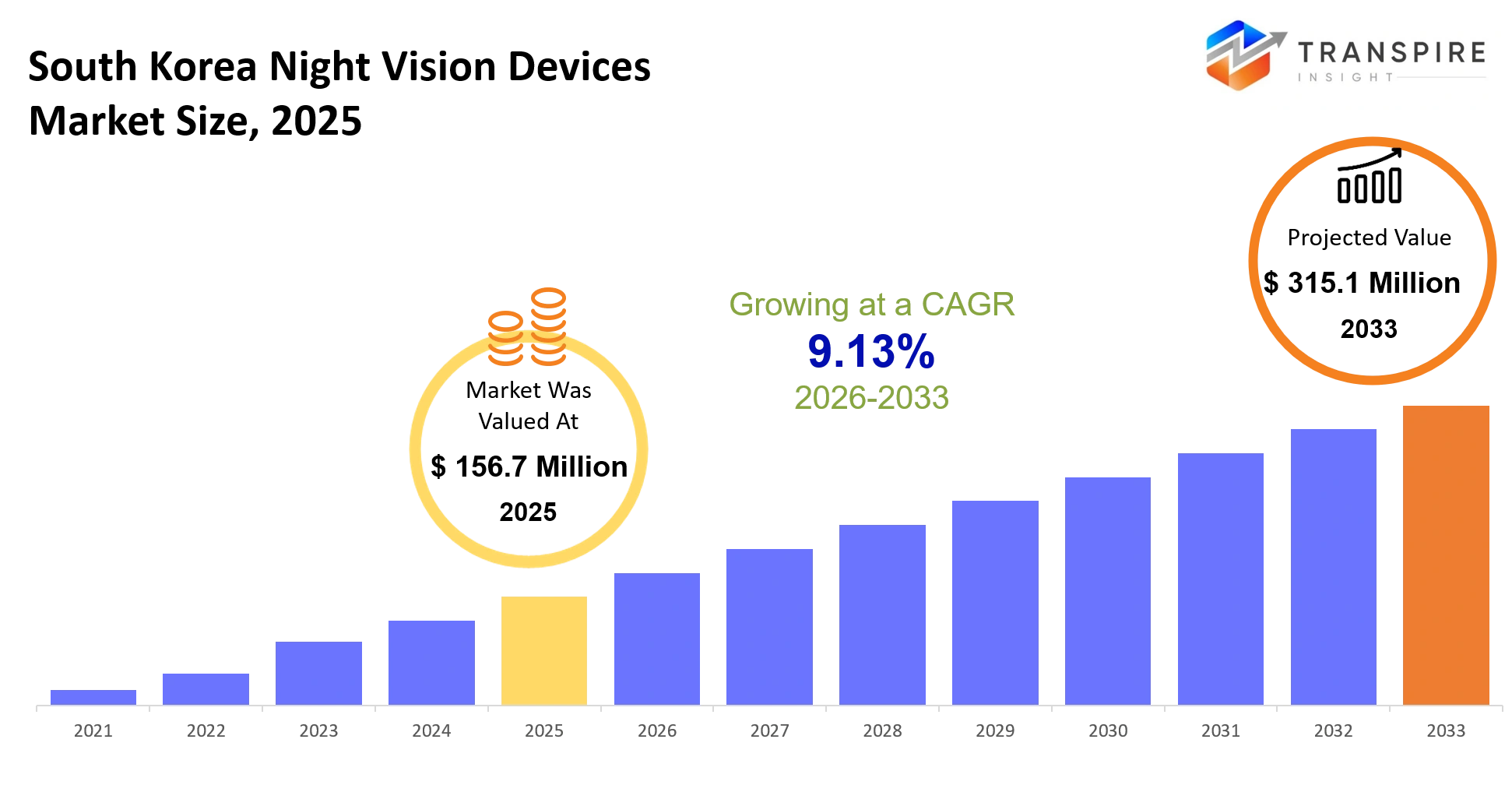
- South Korea Night Vision Devices Market Size 2025: USD 156.7 Million
- South Korea Night Vision Devices Market Size 2033: USD 315.1 Million
- South Korea Night Vision Devices Market CAGR: 9.13%
- South Korea Night Vision Devices Market Segments: By Device Type (Goggles, Cameras, Scopes, Binoculars, Monoculars, Thermal Vision Devices, Others) | By Technology (Image Intensification, Thermal Imaging, Infrared Illumination, Digital Night Vision, Fusion Systems, Others) | By Application (Defense, Surveillance, Hunting, Navigation, Rescue Operations, Others) | By End User (Military, Law Enforcement, Commercial, Consumers, Others)
South Korea Night Vision Devices Market Summary
The South Korea Night Vision Devices Market was valued at USD 156.7 Million in 2025. It is forecast to reach USD 315.1 Million by 2033. That is a CAGR of 9.13% over the period.
In South Korea, night vision devices are being rolled out to support naval patrols, coastal monitoring teams, and industrial operators so they can keep visibility, and kind of make decisions, when it’s dark and low light across ports, shipyards , border zones, and also around critical infrastructure corridors. Over the last 3–5 years , the market has moved away from classic image intensifier type optics toward digital and thermal imaging systems that are paired with sensor fusion and AI-assisted target recognition. So, instead of just seeing , they can deliver more real time situational awareness inside networked defense platforms.
This change is not just technical, it has been reinforced by rising regional security pressures that tie back to recurring North Korean missile activities, plus wider Indo-Pacific militarization patterns. Together those factors pushed faster procurement cycles in defense and maritime security.
At the same time, supply chain disruptions worldwide after the Russia-Ukraine conflict sped up localization in South Korea. The result was more domestic production and system-level integration, rather than buying stand alone devices. That has helped drive upgrade-oriented demand, and it also tends to lift the average contract value for end users.
Key Market Insights
- South Korea Night Vision Devices Market is kinda moving toward thermal and digital hybrid optics, which improves detection accuracy for maritime surveillance missions, and overall more dependable visibility at night.
- Also defense procurement modernization, has made governments spend more on integrated vision systems so adoption is getting wider across naval and coastal security units.
- The thermal imaging part leads, with around 42% share in 2025, mostly because low light maritime navigation needs and border monitoring requirements really keep pushing demand.
- After that, helmet-mounted night vision systems take the second-largest slice, driven by infantry modernization, plus tactical mobility upgrades that field teams care about day and night.
- Then the AI-enabled digital imaging devices are growing the fastest through 2030, since they strengthen real-time threat identification, more quickly than before, kind of like instant clue detection in dark settings.
- For applications, coastal surveillance still dominates, at about 48% share, and that lines up with South Korea Night Vision Devices Market defense readiness priorities.
- Border security monitoring is the fastest growing application too, because geopolitical tensions push continuous night-time surveillance investments without slowing down.
- On end users, military users lead at over 60% share, reflecting strong defense procurement budgets and rapid modernization cycles.
- Meanwhile, homeland security agencies are emerging as a high-growth end-user group, and they’re expanding urban night surveillance infrastructure in a more noticeable way.
- Key companies include Hensoldt, Thales Group, Elbit Systems, L3Harris Technologies, and BAE Systems, all focusing on sensor fusion, miniaturization, and AI integration, to make the systems smarter rather than just brighter.
What are the Key Drivers, Restraints, and Opportunities in the South Korea Night Vision Devices Market?
The main driver behind the South Korea Night Vision Devices Market feels like accelerated defense modernization, tied to rising regional maritime frictions and North Korean missile activity. That change has, in practice, set off steady government spending for advanced surveillance and night-time situational awareness tools across naval fleets plus coastal watch stations. And as buying habits shift toward integrated sensor platforms, the companies involved tend to land bigger , higher-value contracts where imaging, tracking, and AI-assisted targeting arrive together, which in turn bumps revenue per single deployment.
Now the big restraint is the heavy lifecycle cost of these advanced thermal and digital night vision systems, especially if they’re being plugged into older naval vessels or legacy ground platforms. This isn’t just a temporary issue, it’s structural because every upgrade means full compatibility testing, custom calibration, and then personnel retraining. All of that stretches the timeline, so procurement cycles get delayed. So even with strong demand signals, smaller security agencies and auxiliary forces often postpone upgrades, which keeps market penetration modest in the short term.
The major opportunity is basically the domestic, integrated defense electronics ecosystem in South Korea, especially when global OEMs collaborate with local defense contractors. For example, a joint development push for AI-enabled electro-optical modules with Korean shipbuilders and defense integrators could reduce import reliance and speed up deployment schedules. If this localization trend keeps building, it can open up new mid-tier demand pockets and also grow longer-term, recurring upgrade revenues.
What Has the Impact of Artificial Intelligence Been on the South Korea Night Vision Devices Market?
Artificial intelligence is kind of reshaping the South Korea Night Vision Devices Market, mostly by pushing automated target recognition and real-time decision support in low-visibility maritime and border settings. With AI powered image processing, systems can now label objects like vessels, drones, and even unclear coastal movements without someone constantly watching. This lowers the operator load, and it also speeds up responses for naval surveillance, which is pretty important.
On the predictive maintenance side, machine learning models dig into thermal sensor aging cues, plus the usage logs, to estimate when optical calibration is going to be needed. The whole point is to avoid device breakdowns during those critical missions. As a result, there’s been better uptime across integrated defense imaging setups, and at the same time fewer surprise maintenance bills during long-run naval deployments, not just short tests.
Day to day, AI assisted fusion systems are mixing infrared, low-light, and radar-linked imaging so detection becomes more dependable. That, in turn, makes situational awareness feel more consistent, especially when coastal weather is messy and rapidly changing. Defense teams also mention smoother mission flow, along with quicker threat validation loops, particularly from automated coastal monitoring stations.
Still, adoption hits a few real problems. One big limitation is the uneven availability of training data across actual maritime conditions. Things like fog, salt contamination, and fast shifting sea reflections can cut algorithm accuracy, so the models end up needing ongoing retraining, plus recalibration that costs money. On top of that, integration expenses stay steep when you try retrofitting AI modules into older night vision infrastructure. Because of this, wide scale deployment across legacy fleets tends to move slower than expected, and it can get pretty stubborn.
Key Market Trends
- South Korea moved from analog image intensifiers toward digital night vision systems somewhere in 2022–2025, and this boosted battlefield data integration speed, a bit.
- Also the thermal imaging push grew fast after 2023, especially after naval surveillance upgrades, where old optical-only setups got swapped out in coastal monitoring areas. Not just like that though, because the transition seemed pretty abrupt.
- At the same time, the defense procurement game shifted into multi-sensor fusion platforms, so the request for integrated electro-optical and infrared gear went up.
- Border surveillance deployments rose after the 2022 geopolitical tensions, and now there is more continuous night-time monitoring infrastructure across coastal regions, more or less.
- Then in the new procurements after 2024, AI-assisted targeting systems became the norm, and that apparently improved automated threat classification accuracy in practice.
- On top of that, localization of the supply chain accelerated after the global semiconductor disruptions, which helped reinforce domestic assembly of imaging subsystems, step by step.
- Procurement cycles got shorter too, since South Korean defense agencies started prioritizing quick deployment , over long-term phased upgrades.
- Meanwhile demand for helmet-mounted systems climbed alongside infantry modernization programs that were started across 2023–2025.
- Even private maritime security firms began using compact night vision systems for port logistics and offshore monitoring, kind of quietly at first.
- And finally, strategic partnerships between global OEMs and Korean defense contractors increased technology transfer, plus system customization rates, overall.
South Korea Night Vision Devices Market Segmentation
By Device Type :
In South Korea, the device type segment in the night vision devices market is kind of broad—goggles, scopes, binoculars, and monoculars are the main options. They’re used for low-light visibility during defense patrols and security monitoring across key zones, and they help during field work where straight visual clarity is limited, but quick identification still has to happen.
Thermal vision devices along with thermal cameras are getting more traction, largely because detection stays steadier in fog, smoke, and night conditions. With them, operators usually get better target clarity, lower response time, and more reliable surveillance decisions, whether that’s coastal monitoring or border security tasks.
By Technology :
Meanwhile, image intensification plus infrared illumination systems are still present and they back the more traditional low-light approach, mostly within older defense setups. These systems amplify the light that’s already available, but the practical ceiling on performance has meant a gradual swap-out in newer programs.
Looking ahead, thermal imaging, digital night vision, and fusion systems seem to be growing faster as operators move toward clearer imaging and multi-layered sensing. Fusion systems pull together multiple inputs, so detection accuracy improves and situational awareness arrives sooner, especially in complex environments where conditions are rarely simple.
By Application :
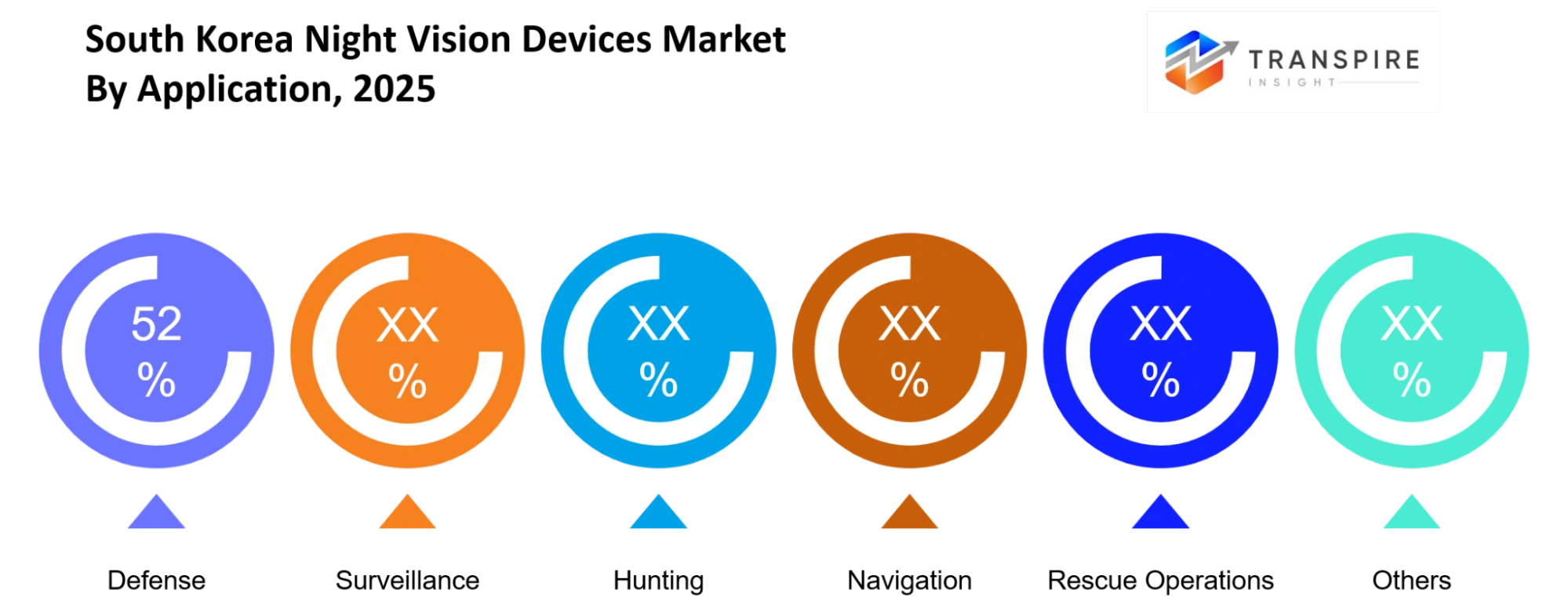
In South Korea, the night vision devices market is mostly pulled by defense and surveillance tasks, mostly because security monitoring never really stops and border protection stays on the priority list. For these use cases, dependable night time visibility matters a lot so teams can catch movement earlier and keep operational readiness up in those sensitive areas.
Rescue operations ,and anything navigation related, also keep pushing demand higher, especially as emergency response groups begin using more advanced imaging tools. With these systems, locating people in low light becomes more practical, and safety outcomes improve during short-notice events, where visibility directly shapes how fast and how right the response is.
By End User :
The military is still the main end user here, backed by modernization programs and a bigger emphasis on upgraded surveillance platforms. Purchases tend to focus on raising detection accuracy and boosting overall effectiveness for night missions.
Meanwhile law enforcement, along with commercial users, grows at a steady pace as security expectations rise in dense city zones and industrial districts. Consumer take up stays fairly restrained, but it is gradually inching forward for personal security and outdoor monitoring, where compact units and reasonably priced equipment get more attention.
What are the Key Use Cases Driving the South Korea Night Vision Devices Market?
Defense and national security operations are basically the main thing pushing adoption in the South Korea Night Vision Devices Market , you know. Military units depend on advanced night vision tools for things like border monitoring, coastal watching, reconnaissance tasks, and tactical work in the dark. Because there are continuous modernization efforts, plus the constant need for dependable visibility in low-light spaces, this part remains the biggest source of demand and procurement money.
At the same time adoption is spreading into law enforcement and maritime surveillance as well. Coast guard teams, port security operators, and people managing critical infrastructure increasingly put thermal and digital imaging solutions to work to catch any unauthorized movement, speed up response times and generally tighten security around strategic sites and transport corridors.
More “new” uses are starting to show up too, especially in autonomous security platforms and smart surveillance networks. Right now there’s a lot of focus on pairing night vision sensors with artificial intelligence, unmanned ground vehicles and drone-based monitoring, so fresh opportunities are popping up. Still , these uses are fairly early stages, though they’re expected to pick up steam as South Korea ramps up spending on automated defense capabilities and next generation security infrastructure during the forecast period.
|
Report Metrics |
Details |
|
Market size value in 2025 |
USD 156.7 Million |
|
Market size value in 2026 |
USD 170.9 Million |
|
Revenue forecast in 2033 |
USD 315.1 Million |
|
Growth rate |
CAGR of 9.13% from 2026 to 2033 |
|
Base year |
2025 |
|
Historical data |
2021 - 2024 |
|
Forecast period |
2026 - 2033 |
|
Report coverage |
Revenue forecast, competitive landscape, growth factors, and trends |
|
Country scope |
South Korea |
|
Key company profiled |
FLIR, L3Harris, BAE Systems, Elbit Systems, Thales, Leonardo, RTX, AGM Global Vision, ATN Corp, Hikmicro, Hanwha Vision, InfiRay, Pulsar, Teledyne FLIR, Hensoldt |
|
Customization scope |
Free report customization (country, regional & segment scope). Avail customized purchase options to meet your exact research needs. |
|
Report Segmentation |
By Device Type (Goggles, Cameras, Scopes, Binoculars, Monoculars, Thermal Vision Devices, Others) | By Technology (Image Intensification, Thermal Imaging, Infrared Illumination, Digital Night Vision, Fusion Systems, Others) | By Application (Defense, Surveillance, Hunting, Navigation, Rescue Operations, Others) | By End User (Military, Law Enforcement, Commercial, Consumers, Others) |
Which Regions are Driving the South Korea Night Vision Devices Market Growth?
North America still feels like the top part in the whole global night vision devices space, mostly because of solid defense budgets, ongoing military modernization, and this never-ending investment into surveillance infrastructure. The United States really pulls most of the regional need, through big procurement programs covering thermal imaging, digital night vision, and those integrated targeting systems that get used in both military missions and homeland security routines. There’s also a kind of mature defense manufacturing base , plus a long-standing research ecosystem, and government contracts that keep showing up long-term… so the market leadership stays steady. And honestly, the back-and-forth cooperation between defense agencies and tech developers seems to speed up the rollout of newer imaging solutions, faster than you’d expect.
Europe shows up as the second biggest regional contributor, but the growth pattern is a bit different from North America. The demand there is tied to fairly stable defense spending, border protection efforts, and coordinated modernization steps across NATO members. Germany, France, and the United Kingdom in particular lean toward upgrading the already existing surveillance networks while keeping procurement cycles calm , and not too jumpy. With this dependable investment style manufacturers get a more reliable revenue flow and it supports longer term adoption of newer technology without the procurement volatility you sometimes see in a few emerging markets.
Asia Pacific is anticipated to log the quickest growth during the 2026–2033 period. With rising geopolitical tensions, ongoing military modernization programs, and more spending on coastal surveillance in places like South Korea, Japan, India, and Australia, demand for advanced night vision systems has been pushed up quite a bit. Regional governments have also sped up the procurement of thermal imaging, plus AI-enabled surveillance technologies, for the purpose of shoring up border monitoring and maritime security.This rapid shift ends up opening substantial chances for market entrants, tech providers, and investors who want some exposure to fast-growing defense and security use cases.
Who are the Key Players in the South Korea Night Vision Devices Market and How Do They Compete?
Competition in the South Korea Night Vision Devices Market still feels moderately consolidated but not fully locked down, where big defense technology firms rub shoulders with more specialized imaging and electro-optical system players. In practice, tech performance is what seems to drive the competition more than price, especially for military and surveillance use cases, because things like image sharpness, how far targets can be detected, and how well the sensors get stitched into the rest of the system, all matter a lot during buying decisions. Incumbent manufacturers keep trying to hold onto share via steady research budgets, meanwhile newer, tech-focused entrants look for openings in digital imaging, artificial intelligence, and multi-sensor fusion setups.
L3Harris Technologies is centered on advanced digital night vision along with integrated aiming and targeting systems for military missions. What really separates it, at least according to typical market positioning, is its long experience in soldier modernization programs and network-enabled battlefield technology. The firm keeps expanding through defense partnerships, and it also leans into the development of lighter equipment so mobility improves, without trimming operational capability too much. Elbit Systems competes heavily through sensor fusion methods that bring thermal imaging and night vision together into one working platform. With that setup, situational awareness gets better, and it also lines up with the needs of defense agencies that want unified surveillance solutions, not separate modules.
Hensoldt keeps pushing high-performance electro-optical systems and really sharp thermal imaging ability for border security, and defense surveillance. They keep investing in imaging tech, to really boost detection performance even when the surroundings are hard or unstable, like in tough operating conditions. Thales Group, on the other hand, stands out with integrated mission systems that essentially tie night vision devices into wider command and surveillance networks. BAE Systems leans into advanced thermal sensing plus digital imaging technologies, and by doing defense modernization programs, they expand their market footprint. They also run collaborative technology development initiatives, which try to match changing operational needs.
Company List
- FLIR
- L3Harris
- BAE Systems
- Elbit Systems
- Thales
- Leonardo
- RTX
- AGM Global Vision
- ATN Corp
- Hikmicro
- Hanwha Vision
- InfiRay
- Pulsar
- Teledyne FLIR
- Hensoldt
Recent Development News
In April 2026, L3Harris Technologies secured a U.S. Army contract worth up to $465 million for the NOVA™ night vision goggle system under the Binocular Night Observation Device (BiNOD) program. The award strengthens next-generation night vision production capacity and supports broader military modernization efforts that influence global procurement trends.
Source https://www.l3harris.com/
In January 2026, L3Harris Technologies launched the NOVA™ Binocular System, a new night vision platform designed to provide scalable and lower lifecycle-cost deployment for military and public safety users. The launch expands the company's product portfolio and addresses growing demand for cost-effective advanced night vision solutions.
Sourcehttps://www.l3harris.com/
What Strategic Insights Define the Future of the South Korea Night Vision Devices Market?
The South Korea Night Vision Devices Market is kind of moving toward intelligent, network-linked imaging ecosystems, not just standalone optical stuff. Over the next five to seven years, the momentum is going to be pushed more and more by the incorporation of artificial intelligence, sensor fusion, and real-time battlefield communication systems. Procurement is also shifting, away from simply buying devices, and toward mission effectiveness, so customers want platforms that bundle detection, identification, and data sharing in one operational setup.
There’s another risk that is less obvious, but still real: supply chain concentration for advanced infrared sensors, semiconductors , and certain specialized optical components. Even if domestic defense capabilities are strong, leaning on only a few global technology suppliers could put manufacturers in a spot where production gets delayed, costs start climbing, and procurement gets a bit uncertain during geopolitical strain.
At the same time, there’s a growing opening for putting night vision technologies into autonomous surveillance platforms, think unmanned ground vehicles, and drone-based security systems. Market players should probably aim for alliances with artificial intelligence developers and domestic defense integrators. Because ecosystem positioning will likely count more, as a competitive edge than hardware performance alone, at least over time.
South Korea Night Vision Devices Market Report Segmentation
By Device Type
- Goggles
- Cameras
- Scopes
- Binoculars
- Monoculars
- Thermal Vision Devices
By Technology
- Image Intensification
- Thermal Imaging
- Infrared Illumination
- Digital Night Vision
- Fusion Systems
By Application
- Defense
- Surveillance
- Hunting
- Navigation
- Rescue Operations
By End User
- Military
- Law Enforcement
- Commercial
- Consumers
Frequently Asked Questions
Find quick answers to common questions.
The South Korea Night Vision Devices Market size is USD 315.1 Million in 2033.
Key segments for the South Korea Night Vision Devices Market are By Device Type (Goggles, Cameras, Scopes, Binoculars, Monoculars, Thermal Vision Devices, Others) | By Technology (Image Intensification, Thermal Imaging, Infrared Illumination, Digital Night Vision, Fusion Systems, Others) | By Application (Defense, Surveillance, Hunting, Navigation, Rescue Operations, Others) | By End User (Military, Law Enforcement, Commercial, Consumers, Others).
Major South Korea Night Vision Devices Market players are FLIR, L3Harris, BAE Systems, Elbit Systems, Thales, Leonardo, RTX, AGM Global Vision, ATN Corp, Hikmicro, Hanwha Vision, InfiRay, Pulsar, Teledyne FLIR, Hensoldt.
The South Korea Night Vision Devices Market size is USD 156.7 Million in 2025.
The South Korea Night Vision Devices Market CAGR is 9.13% from 2026 to 2033.
- FLIR
- L3Harris
- BAE Systems
- Elbit Systems
- Thales
- Leonardo
- RTX
- AGM Global Vision
- ATN Corp
- Hikmicro
- Hanwha Vision
- InfiRay
- Pulsar
- Teledyne FLIR
- Hensoldt
About the Authors

Mayur Shinde
I am Mayur Shinde, a Senior Research Analyst at Transpire Insight, specializing in the Automotive & Transportation and Information & Communication Technology (ICT) Industry. My work focuses on analyzing emerging market trends, technological advancements, competitive landscapes, and industry developments to deliver accurate, data-driven insights. I am passionate about transforming complex market information into clear, actionable content that helps businesses, professionals, and decision-makers stay informed and make confident strategic decisions.

Chakradhar Khansole
Chakradhar serves as the Research Director at Transpire Insight, bringing over 8 years of experience in technology, innovation, and strategic market intelligence. He specializes in transforming complex market data into actionable business insights that enable organizations to make informed, growth-oriented decisions. Recognized for his strategic vision and analytical expertise, Chakradhar leads high-impact research initiatives, delivering comprehensive market assessments, competitive intelligence, and forward-looking industry analysis.
Recently Published Reports
-
Apr 2026
3D Optical Profiler Market
3D Optical Profiler Market Size, Share & Analysis Report By Type (Desktop 3D Optical Profiler, and Portable 3D Optical Profiler), By Technology (Confocal Technology, and White Light Interference), By End-Use Industry (Manufacturing, Research Institutions, Automotive, Aerospace and Defense, Medical Devices, and Other), and Geography (North America, Europe, Asia-Pacific, Middle East and Africa, South and Central America), 2021 - 2031
-
Apr 2026
Depth Sensor Market
Depth Sensor Market Size, Share & Analysis Report By Type (Infrared Depth Sensors, Time-of-Flight (ToF) Sensors, Stereo Vision Sensors, Structured Light Sensors, Ultrasonic Depth Sensors), By Application (Automotive, Robotics, Gaming, Consumer Electronics, Industrial Automation, Healthcare, Security & Surveillance, Others), By End Users (Automotive Manufacturers, Consumer Electronics Companies, Healthcare Providers, Industrial Companies, Security Agencies, Gaming Companies, Robotics Companies, Others), and Geography (North America, Europe, Asia-Pacific, Middle East and Africa, South and Central America), 2021 – 2031
-
Apr 2026
Digital Manufacturing Market
Digital Manufacturing Market Size, Share & Analysis Report By Component (Hardware, Software, and Services), By Technology (Robotics, 3D Printing, Internet of Things (IoT), and Others), By Application (Automotive and Transportation, Aerospace and Defense, Consumer Electronics, Industrial Machinery, and Others), By Process Type (Computer-Based Designing, Computer-Based Simulation, Computer 3D Visualization, Analytics, and Others), and Geography (North America, Europe, Asia-Pacific, Middle East and Africa, South and Central America), 2021 – 2031
-
Apr 2026
Digital Visa Services Market
Digital Visa Services Market Size, Share & Analysis Report By Type (Individual Travelers, Group Travelers), By Application (Tourism, Business Travel, Others), and Geography (North America, Europe, Asia-Pacific, Middle East and Africa, South and Central America), 2021 – 2031