Asia Pacific Maritime Security Market Size & Forecast:
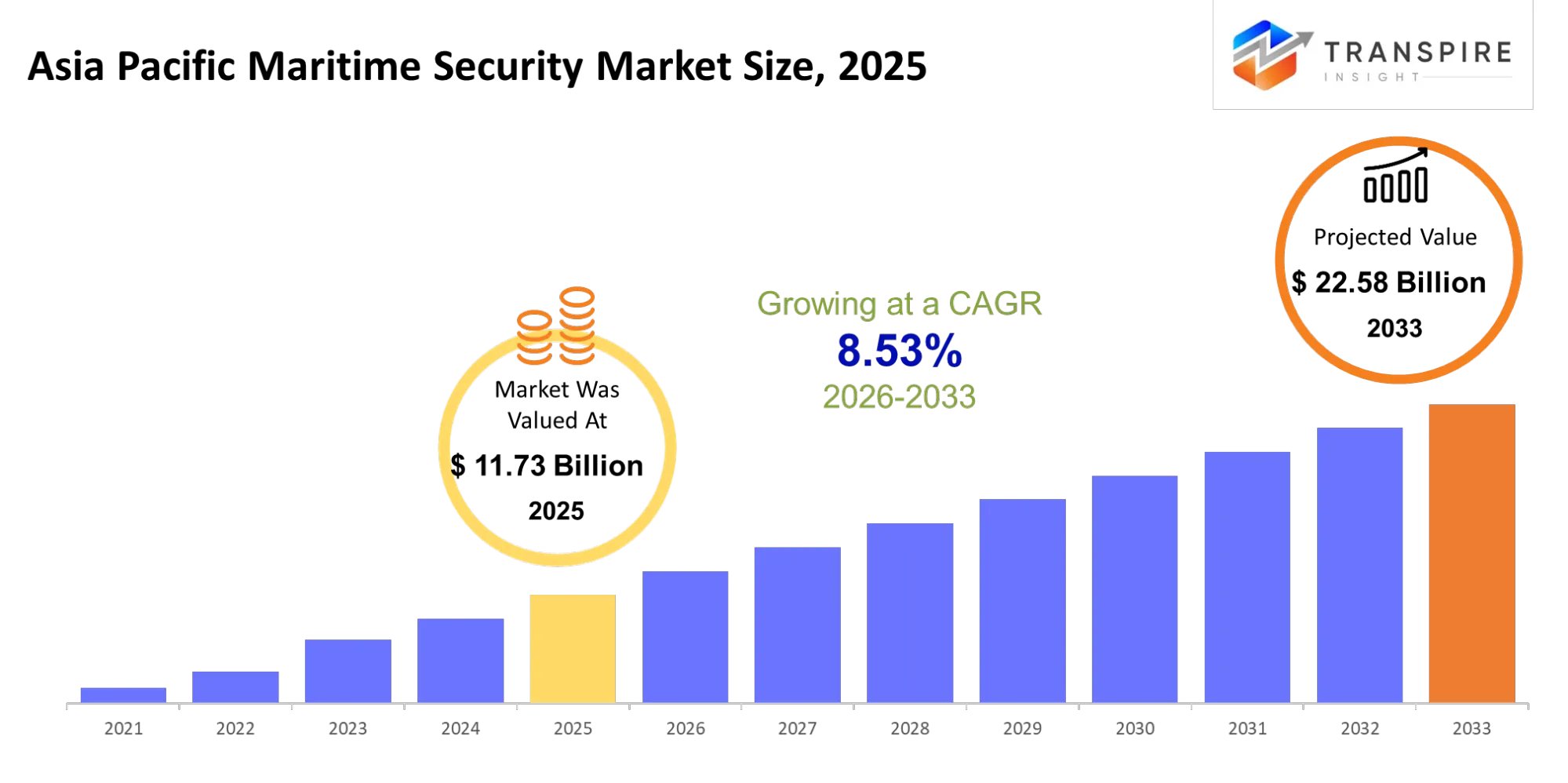
- Asia Pacific Maritime Security Market Size 2025: USD 11.73 Billion
- Asia Pacific Maritime Security Market Size 2033: USD 22.58 Billion
- Asia Pacific Maritime Security Market CAGR: 8.53%
- Asia Pacific Maritime Security Market Segments: By Security Type (Port Security, Vessel Security, Coastal Surveillance, Cybersecurity, Anti-Piracy Systems, Access Control Systems, Others); By Component (Hardware, Software, Services, Monitoring Systems, Analytics Platforms, Others); By Application (Commercial Shipping, Naval Defense, Offshore Platforms, Ports & Harbors, Others); By End User (Government, Defense Forces, Shipping Companies, Port Authorities, Others)
Asia Pacific Maritime Security Market Summary
The Asia Pacific Maritime Security Market was valued at USD 11.73 Billion in 2025. It is forecast to reach USD 22.58 Billion by 2033. That is a CAGR of 8.53% over the period.
The Asia Pacific maritime security market can be understood as the solutions and services that provide surveillance, security and facilitation of activities occurring along busy shipping lanes, within ports, and within exclusive economic zones. In practice, they are the solutions and services that enable coastguards, navies and port authorities to locate illegal vessels, prevent smuggling, manage piracy situations, and retain awareness of standard commercial traffic. Over the past five years, this space has moved from stand alone coastal radar, into a more combined maritime domain awareness approach, with satellite AIS, AI analytics, drones, and cloud based command arrangements all working together.
That change feels like a push for data fusion and quick on-the-spot decisions, because earlier, piecemeal surveillance wasn’t enough when maritime corridors got more contested. Geopolitical tensions in the South China Sea and the shipping chaos created by the pandemic raised some red flags about chokepoint vulnerability. This encouraged significant government spending on interoperable maritime and naval tools. Vendors can benefit from increased demand for interoperable, integrated systems that improve real-time decision making and operational readiness in regional maritime routes.
Key Market Insights
- Asia Pacific Maritime Security Market is moving towards AI enabled maritime domain awareness platforms which integrates satellite AIS, radar, and drone based monitoring systems.
- Network-centric naval modernization is impacting the Asia Pacific Maritime Security Market, wherein the integrated command systems share the largest share in the integrated command systems market with almost 38% of the share in 2025.
- Coastal surveillance market is the leading segment of the market with almost 42% share in the overall market on account of increasing concerns related to illegal fishing, piracy, and border monitoring.
- Vessel traffic management systems market is the fastest growing segment expected to surge at a rapid pace till 2030 with the adoption of digital port automation.
- Port security applications is holding almost 36% share of the market on account of increased concerns over trade corridor security and increasing containerized cargo throughput across ASEAN ports.
- The naval defense end-user segment takes the top position with a market share of approximately 48%, as governments across regions tend to boost their security capabilities in areas like coastal border defense, and blue-water navy enhancement.
- Commercial shipping security is the rapidly expanding segment of end-user, owing to an increased necessity for cyber security and cargo monitoring capabilities.
- The North Pacific sub-region acquires a market share of around 45%, as a result of the considerable defense spending in both Japan and South Korea.
- The Southeast Asia segment witnesses the most robust growth on account of rapidly growing maritime routes and ever increasing geostrategic concerns.
What are the Key Drivers, Restraints, and Opportunities in the Asia Pacific Maritime Security Market?
Increasing geopolitical tension along the key maritime routes especially in the South China Sea has been a prime mover for the Asia Pacific Maritime Security Market. Government procurement has seen a boost for upgrading their coastal surveillance capabilities. This also comes along with the policy push for integration of Maritime Domain Awareness through a fusion of radar, satellite AIS and unmanned surveillance platforms. This is pushing the procurement cycles of maritime surveillance systems up and defense institutions are pushing for long-term digital security contracts instead of single equipment procurement.
The single largest deterrent factor has been the sheer complexity of integrating the legacy naval systems with the new age digital surveillance platforms. Countries within the region mostly use legacy and disintegrated coast monitoring systems, leading to high upfront and long implementation time costs of integrated and interoperable systems. This constraint in structural setup continues to postpone the full adoption of these systems, throttling down the near-term conversion to revenues despite favorable policy drive.
AI driven autonomous maritime surveillance networks across the archipelagos of South East Asia is a key opportunity within the segment. Countries like Indonesia and Philippines are seeing high investment levels towards unmanned surface vehicles and satellite integrated monitoring system for a holistic monitoring of their respective large water territory. This generates sustained demand for a scalable cloud-based maritime intelligence platform offering a blend of real-time detection and forward threat and route forecasting.
What Has the Impact of Artificial Intelligence Been on the Asia Pacific Maritime Security Market?
The operational effectiveness in Asia Pacific Maritime Security Market is being transformed by artificial intelligence due to automated vessel tracking, detection of anomaly and classifying the threats in near real-time at the busy shipping lanes. AI-based analytical platforms are now capable of evaluating the satellite AIS data and radar feeds concurrently, which helps reduce manual supervision by the coast guards and naval operators and enhances situational awareness. The algorithms for predicting failures in the surveillance systems like coastal radars and unmanned aerial vehicles have been developed using machine learning, resulting in a decrease of approximately 15-20% in the system operational downtime while significantly cutting down operating cost.
AI-driven optimization of route compliance and maritime traffic movement management is also contributing to higher operational efficiency particularly in larger ports like Singapore and Shanghai. Controlling traffic flow is linked directly to fuel consumption and ship turnover time. Efficiency improvements due to accurate scheduling and minimized port idle time are noticeable. High quality maritime training data are lacking, whereas unreliable connectivity at sea is decreasing the model accuracy on real-time data at open waters. High costs associated with integration of AI-enabled surveillance systems are hampering the adoption in small Southeast Asian coastal countries, while the overall gains in the long run are promising.
Key Market Trends
- Traditional land-based radar coast watching declined post 2022 with increased government focus on satellite aided AIS and combined maritime intelligence solutions.
- AI based anomaly detection uptake surged by almost 40% from 2021 to 2025, enhancing real-time threat detection on contested waterways.
- Naval procurement changed post 2023 from hardware purchases for specific observation devices towards integrated digital commands platforms interoperable with one another.
- The number of unmanned surface/air vessels used by Southeast Asian states increased significantly from post 2022 due to rising monitoring demands for their territories.
- Port authorities in Singapore and China adopted cloud based vessel traffic control systems from post 2023 resulting in double digit percentage reductions in congestion caused delays.
- Multinational cooperation in maritime security saw a dramatic increase from post 2022 thanks to cooperative anti-piracy and anti-smuggling efforts.
- Thales and Lockheed Martin began aggressively expanding their respective AI based maritime surveillance capabilities from post 2023 to secure their positions with regional militaries.
- Japan and South Korea enacted stronger regulations governing maritime surveillance post 2021 to fuel demand for automated coastal surveillance systems and compliance verification.
- Demand for predictive maritime analytics began a rise post 2024 as an alternative to reactive surveillance capabilities.
- There was an increased number of legacy system updates in ASEAN ports starting from post 2022 to transition from independent radar surveillance networks to coordinated platforms.
Asia Pacific Maritime Security Market Segmentation
By Security Type :
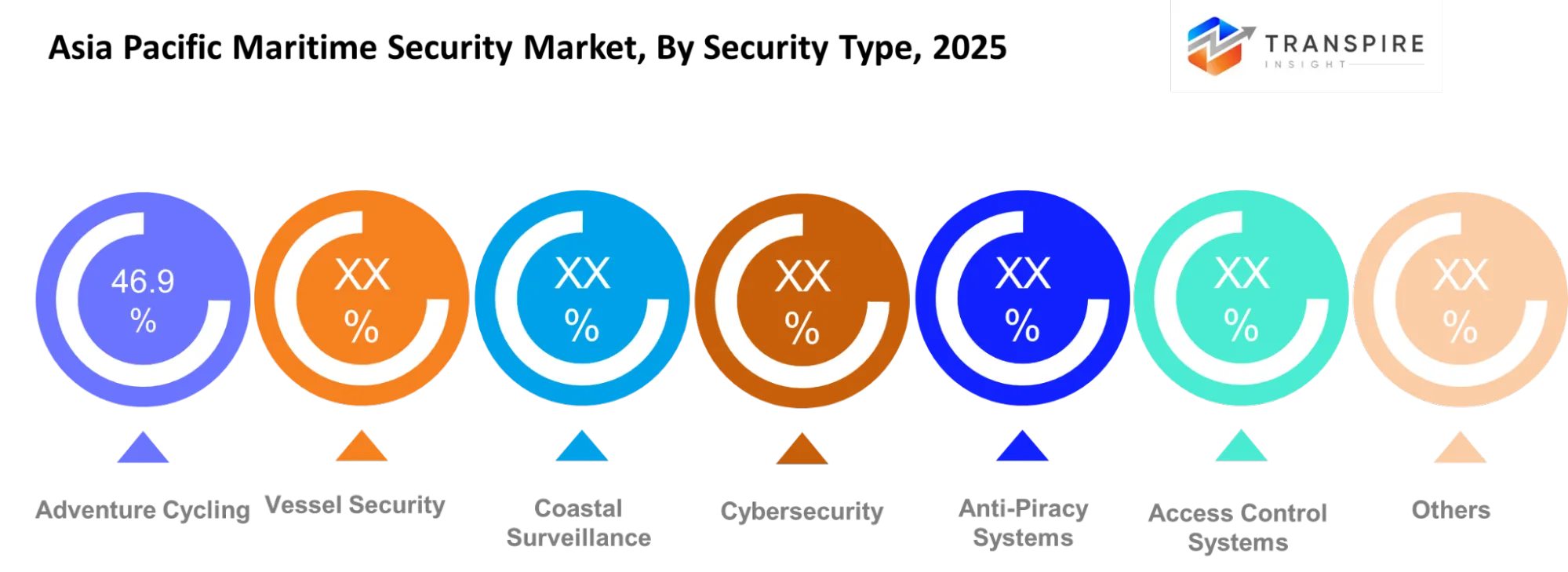
Protecting the trade routes and strategic maritime spaces in the Asia Pacific Maritime Security Market are supported by port security, vessel security, coastal surveillance, cyber security and anti-piracy systems. The focus has shifted from simple monitoring devices to integrated networked systems which allow real time notification and comprehensive awareness across the maritime region, including within port limits and across coastlines.
With the rise in cyber threats and trans border challenges, systems to combat cyber security and anti-piracy threats were prioritized after 2022. Coastal surveillance moved beyond isolated radar monitoring to an integrated digital detection and tracking solution.
By Component :
The fundamental components of systems operating in the Asia Pacific Maritime Security Market revolve around hardware, software, service components, monitoring systems and analytics platforms. Previously the system was hardware dominated but with time, the software components and analytics platforms have taken the foreground in the domain of decision support and threat detection across maritime areas.
Demand shifted to a service driven model, along with cloud based analytics, rather than single item purchases of hardware components, after 2021. Systems used to alert have been coupled with a predictive tool to quicken the response time of operators and decrease work associated with manual tracking within ports and coastal boundaries.
By Application :
Maritime security systems are used in Commercial Shipping, Naval Defense, Offshore Platforms and Ports & Harbors, and address issues related to safety, surveillance, and command & control. Naval Defense is a very stable end use and Ports and Harbors has the largest growing market due to increased cargo volume and increasing congestion problems.
Starting 2022, ports and harbors started implementing automated traffic management systems, while the Commercial Shipping segment has been seen with greater investments in tracking and compliance solutions. Monitoring systems have gained preference from the offshore platforms sector due to rigorous safety and environmental guidelines.
By End User :
Government bodies, Defense Forces, shipping companies and Port Authorities form the main stakeholders driving demand within the Asia Pacific Maritime Security Market. Defense Forces continue to be major investors, while Port Authorities have concentrated on high volume areas where security and operational efficiency has become a concern.
Since 2021, a growing number of modernization projects initiated by the government have increased government allocations to digital surveillance, shipping companies have invested in security systems to enhance security of cargo and ensure compliance with trade policies and regulations, and port authorities have started implementing command and control platforms for integrated systems and improved response capabilities.
What are the Key Use Cases Driving the Asia Pacific Maritime Security Market?
Port & coastal surveillance is the primary use case fuelling the Asia Pacific Maritime Security market. Increased volume of cargo, requirements for territorial surveillance, and increasing incidents of illegal fishing prompt governments and ports to invest in real-time tracking and integrated monitoring systems. This use case drives the most revenue due to its direct role in the safety of the nation and its trade and the direct impact of uninterrupted visibility in crowded shipping lanes.
The second highest use case driving revenue is commercial shipping monitoring and naval fleet coordination. Shipping organizations utilize tracking and compliance systems to ensure compliance with regulations and minimize route-related risks while defense organizations utilize the integrated command platforms for quicker responses in contested waters.
The emergent use cases of Cybersecurity for ports and predictive risk analytics for offshore installations are still relatively niche and in early stages, however demonstrate significant potential in the longer term due to digitisation of port operations and the need to constantly monitor offshore energy platforms for safety and environmental protection.
|
Report Metrics |
Details |
|
Market size value in 2025 |
USD 11.73 Billion |
|
Market size value in 2026 |
USD 12.73 Billion |
|
Revenue forecast in 2033 |
USD 22.58 Billion |
|
Growth rate |
CAGR of 8.53% from 2026 to 2033 |
|
Base year |
2025 |
|
Historical data |
2021 - 2024 |
|
Forecast period |
2026 - 2033 |
|
Report coverage |
Revenue forecast, competitive landscape, growth factors, and trends |
|
Regional scope |
Asia Pacific (India, China, Japan, Australia, South Korea, Rest of Asia Pacific) |
|
Key company profiled |
Thales, Saab, Lockheed Martin, Raytheon, Leonardo, BAE Systems, Northrop Grumman, Elbit Systems, Kongsberg, Rohde & Schwarz, Honeywell, Cisco, NEC, Fujitsu, Airbus Defence |
|
Customization scope |
Free report customization (country, regional & segment scope). Avail customized purchase options to meet your exact research needs. |
|
Report Segmentation |
By Security Type (Port Security, Vessel Security, Coastal Surveillance, Cybersecurity, Anti-Piracy Systems, Access Control Systems, Others); By Component (Hardware, Software, Services, Monitoring Systems, Analytics Platforms, Others); By Application (Commercial Shipping, Naval Defense, Offshore Platforms, Ports & Harbors, Others); By End User (Government, Defense Forces, Shipping Companies, Port Authorities, Others) |
Which Regions are Driving the Asia Pacific Maritime Security Market Growth?
The North Pacific is by far the dominant region for the Asia Pacific Maritime Security Market, mostly due to Japan and South Korea. Their constant, rigorous technology advancements are facilitated by rapid naval upgrades and an insistence on meticulous maritime monitoring. A highly automated port infrastructure and abundant maritime traffic necessitate effective monitoring technology, in addition to the fact that solid defense procurement systems provide prolonged supply arrangements with the globe’s foremost technology providers. China will always be a significant consumer of the Asia Pacific Maritime Security Market.
Driven by the sheer scale of its coastline and its constant endeavor to develop maritime enforcement power, the region will grow steadily by the size of operations as opposed to technology upgrade cycles. Its growing port capacity, coastal patrol networks and consistent technology adoption facilitated by state funded investments will create constant, predictable demand for monitoring systems and vessel trackers.
The fastest growing region in the Asia Pacific Maritime Security Market will be South East Asia, owing to consistent growth in maritime infrastructure and expanding security needs. The scale of investment in new ports across countries like the Philippines, Indonesia and Vietnam has led to the proliferation of patrol systems and surveillance devices, and the demand for digital platforms for port security upgrade and territorial monitoring will boost adoption up to 2026-2033, yielding the largest growth opportunities for technology suppliers.
Who are the Key Players in the Asia Pacific Maritime Security Market and How Do They Compete?
The competitive landscape of the Asia Pacific Maritime Security Market is moderately consolidated with a clear dichotomy between defense technology companies offering high-value contract capabilities and regional integrators performing localized deployment operations. Competitiveness will largely be determined by superior surveillance technology, system interoperability, and long-term service ability, not merely pricing. Established incumbents have a significant advantage due to established relationships with governments, while challengers will need to compete by leveraging AI analytics capabilities and modular design. Vendors will need to have the ability to merge capabilities of radar, satellite imagery, and cybersecurity to a single operator platform.
Technology differentiation will remain the key for Thales Group's focus on integrated maritime surveillance systems leveraging radar and satellite data fusion and AI analytics, expanding by continuing its collaborations with local defense agencies and reinforcing its command and control systems with coast surveillance networks. Lockheed Martin's success relies on large-scale defense integration and advanced sensor technologies for naval applications and will grow by securing government contracts and joint modernization projects to upgrade existing maritime surveillance.
RTX's competitive edge will stem from its advanced radar and communications systems optimized for naval and coast operations, leveraging its expertise in secure communications technologies for multi-domain maritime applications. Saab's competitive advantage lies in its niche specialization and its growing focus on coastal surveillance and autonomous systems and will seek expansion in regional partnerships for flexible deployment across small-to-medium size maritime authorities.
Lastly, L3Harris Technologies' expansion through the deployment of robust electronic warfare and maritime communications systems for increased maritime situation awareness, and will increase competitiveness by building robust interoperable systems integrated with the alliance naval assets.
Company List
- Thales
- Saab
- Lockheed Martin
- Raytheon
- Leonardo
- BAE Systems
- Northrop Grumman
- Elbit Systems
- Kongsberg
- Rohde & Schwarz
- Honeywell
- Cisco
- NEC
- Fujitsu
- Airbus Defence
Recent Development News
In May 2026, the Quad nations (United States, India, Japan, and Australia) launched a maritime surveillance initiative. The program integrates regional surveillance systems and improves real-time data sharing to strengthen maritime domain awareness across the Indo-Pacific, directly enhancing coordinated security response capabilities. Source: https://apnews.com/
In May 2026, India hosted the MILAN 2026 maritime exercise under its MAHASAGAR Vision framework. The initiative focused on improving naval interoperability and multinational cooperation to address emerging maritime threats and strengthen regional security coordination across Indo-Pacific waters. Source: https://timesofindia.indiatimes.com/
What Strategic Insights Define the Future of the Asia Pacific Maritime Security Market?
It is important that we consider where the Asia Pacific Maritime Security market is going over the next 5-7 years to be tightly integrated maritime domain awareness and a digital surveillance system which replaces disparate coast-line monitoring systems. There are numerous sources, including political tension, pushing Governments toward centralized command infrastructures instead of singular security devices that use fused real time data across naval, port, and commercial shipping.
It can be argued that a less readily visible risk comes in terms of reliance on cross border information sharing protocols. Although high levels of infrastructure investment may exist, a policy shift or diplomatic tensions could curtail information flow thereby limiting system effectiveness. This implies an operational risk that integrated systems will rely on perpetual regional connectivity.
A key developing opportunity is in autonomous maritime surveillance using USVs and UAVs powered by AI based edge analytics, in archipelagos such as Southeast Asia due to the complex topography. This has not fully developed on a commercial scale but is now achieving support within government through pilot projects and market players will likely benefit most from interoperable modular systems which will need to integrate into developing autonomous fleets and maintain a robust cyber security structure over dispersed maritime systems.
Asia Pacific Maritime Security Market Report Segmentation
By Security Type
- Port Security
- Vessel Security
- Coastal Surveillance
- Cybersecurity
- Anti-Piracy Systems
- Access Control Systems
By Component
- Hardware
- Software
- Services
- Monitoring Systems
- Analytics Platforms
By Application
- Commercial Shipping
- Naval Defense
- Offshore Platforms
- Ports & Harbors
By End User
- Government
- Defense Forces
- Shipping Companies
- Port Authorities
Regional Outlook
North America
- United States
- Canada
- Mexico
Europe
- Germany
- United Kingdom
- France
- Spain
- Italy
- Rest of Europe
Asia Pacific
- Japan
- China
- Australia & New Zealand
- South Korea
- India
- Rest of Asia Pacific
South America
- Brazil
- Argentina
- Rest of South America
Middle East & Africa
- Saudi Arabia
- United Arab Emirates
- South Africa
- Rest of the Middle East & Africa
Frequently Asked Questions
Find quick answers to common questions.
The Asia Pacific Maritime Security Market size is USD 22.58 Billion in 2033.
Key segments for the Asia Pacific Maritime Security Market are By Security Type (Port Security, Vessel Security, Coastal Surveillance, Cybersecurity, Anti-Piracy Systems, Access Control Systems, Others); By Component (Hardware, Software, Services, Monitoring Systems, Analytics Platforms, Others); By Application (Commercial Shipping, Naval Defense, Offshore Platforms, Ports & Harbors, Others); By End User (Government, Defense Forces, Shipping Companies, Port Authorities, Others).
Major Asia Pacific Maritime Security Market players are Thales, Saab, Lockheed Martin, Raytheon, Leonardo, BAE Systems, Northrop Grumman, Elbit Systems, Kongsberg, Rohde & Schwarz, Honeywell, Cisco, NEC, Fujitsu, Airbus Defence.
The Asia Pacific Maritime Security Market size is USD 11.73 Billion in 2025.
The Asia Pacific Maritime Security Market CAGR is 8.53% from 2026 to 2033.
- Thales
- Saab
- Lockheed Martin
- Raytheon
- Leonardo
- BAE Systems
- Northrop Grumman
- Elbit Systems
- Kongsberg
- Rohde & Schwarz
- Honeywell
- Cisco
- NEC
- Fujitsu
- Airbus Defence
About the Authors

Tejashri Dhatrak
I am Tejashri Dhatrak, a Senior Research Analyst at Transpire Insight, specializing in the Aerospace and Defence sector. My work focuses on analyzing industry trends, defence technologies, market developments, and emerging innovations that shape the global aerospace and security landscape. At Transpire Insight, I research complex topics, evaluate credible sources, and transform technical insights into accurate, well-structured, and easy-to-understand content for industry professionals and decision-makers. My goal is to provide reliable, research-backed information that helps readers stay informed about defence capabilities, aerospace advancements, strategic developments, and the evolving dynamics of the global defence ecosystem.

Chakradhar Khansole
Chakradhar serves as the Research Director at Transpire Insight, bringing over 8 years of experience in technology, innovation, and strategic market intelligence. He specializes in transforming complex market data into actionable business insights that enable organizations to make informed, growth-oriented decisions. Recognized for his strategic vision and analytical expertise, Chakradhar leads high-impact research initiatives, delivering comprehensive market assessments, competitive intelligence, and forward-looking industry analysis.
Recently Published Reports
-
Apr 2026
Aerospace Fluoropolymers Market
Aerospace Fluoropolymers Market Size, Share & Analysis Report By Type (PTFE, FEP, PFA, ETFE, and Others), By Application (Electrical Insulation, Seals & Gaskets, Coatings, and Others), By End User (Commercial Aviation, Military Aviation, General Aviation, and Others), and Geography (North America, Europe, Asia-Pacific, Middle East and Africa, South and Central America), 2021 - 2031
-
Apr 2026
Airborne SATCOM System Market
Airborne SATCOM System Market Size, Share & Analysis Report By Type (SATCOM Terminals, Transceivers, Airborne Radio, Modems and Routers, SATCOM Radomes, and Other), By Application (Government and Defense and Commercial), and Geography (North America, Europe, Asia-Pacific, Middle East and Africa, South and Central America), 2021 – 2031
-
Apr 2026
Ship Leasing Market
Ship Leasing Market Size, Share & Analysis Report By Vessel Type (Container Ships, Bulk Carriers, Tankers, and Specialized Vessels), By Lease Duration (Short-Term Lease (Less than 1 year), Medium-Term Lease (1-5 years), and Long-Term Lease (More than 5 years)), By Lease Type (Bareboat Charter, Time Charter, Financial Lease, and Others), By End-User Industry (Oil and Gas, Manufacturing and Industrial, Automotive, Agriculture and Food, Retail and Consumer Goods, and Others), and Geography (North America, Europe, Asia-Pacific, Middle East and Africa, South and Central America), 2021 – 2031
-
Apr 2026
Thread Rolling Dies Market
Thread Rolling Dies Market Size, Share & Analysis Report By Type (Flat Thread Rolling Dies, Circular (Cylindrical) Dies, Tangential Thread Rolling Dies, Planetary Thread Rolling Dies, and Other Types), By Material Type (High-Speed Steel (HSS), Carbide, Tool Steel, Alloy Steel, and Other Specialized Alloys), By Distribution Channel (Direct Sales, Distributors and Dealers, and Online Platforms), By Application (Automotive Industry, Aerospace and Defense, Construction and Infrastructure, Industrial Machinery, Electronics and Electrical Components, Medical Devices, and Fastener Production), and Geography (North America, Europe, Asia-Pacific, Middle East and Africa, South and Central America), 2021 – 2031
Our Clients