
United States Cybersecurity Market Size & Forecast:
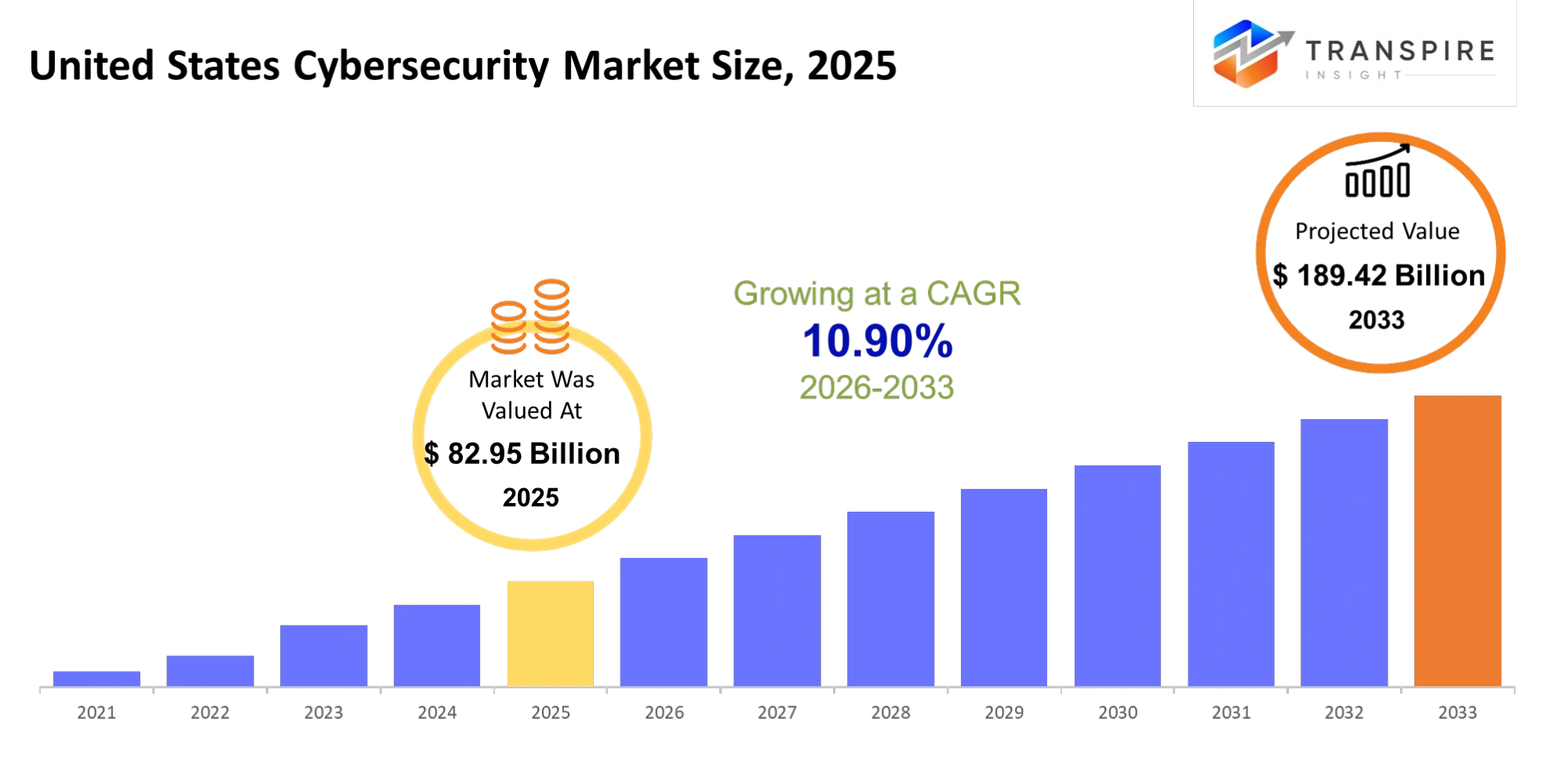
- United States Cybersecurity Market Size 2025: USD 82.95 Billion
- United States Cybersecurity Market Size 2033: USD 189.42 Billion
- United States Cybersecurity Market CAGR: 10.90%
- United States Cybersecurity Market Segments:By Component (Hardware, Software, Services), By Security Type (Network Security, Cloud Security, Endpoint Security, Application Security), By End User (BFSI, Government, Healthcare, IT & Telecom).
To learn more about this report,  Download Free Sample Report
United States Cybersecurity Market Summary:
The United States cybersecurity market size is estimated at USD 82.95 billion in 2025 and is anticipated to reach USD 189.42 billion by 2033, growing at a CAGR of 10.90% from 2026 to 2033. The United States cybersecurity market experiences rapid development because organisations need to defend against increasing digital threats and data breaches. Businesses across all industries spend significant resources on advanced security solutions, which include cloud security and AI-driven threat detection and zero-trust frameworks. The market experiences increased demand because government programmes and strict regulatory standards create additional requirements. The demand for effective security solutions increases because remote work and digital transformation processes continue to grow. The cyber risk environment develops more complex threats which will drive market growth because organisations require continuous protection of their confidential data.
Key Market Trends & Insights:
- Companies are increasing their use of artificial intelligence-based systems which enable them to identify and mitigate security threats throughout the day. The technologies enable organisations to decrease human mistakes while they achieve faster and more precise results during threat detection.
- Organisations are moving away from traditional perimeter security and embracing zero-trust frameworks. The system requires all users and devices to undergo complete identity validation before accessing any parts of the system.
- As more organisations continue to adopt cloud technology, companies now consider cloud security measures their most critical security need. Companies are increasing their demand for cloud-native security solutions because they need to safeguard their scattered data and software systems.
- The increase of hybrid work models and remote work options has created new security challenges. Organisations are spending money on secure access solutions and endpoint protection systems to protect workers who operate from different locations.
- The increasing demands of regulatory frameworks force companies to establish better cybersecurity defences. Organisations allocate funds to develop advanced security systems because of their need to fulfil compliance standards.
- Organisations are increasingly choosing managed security service providers because they offer professional assistance in cybersecurity. Small and medium-sized enterprises without internal cybersecurity capabilities show a strong preference for this emerging trend.
United States Cybersecurity Market Segmentation
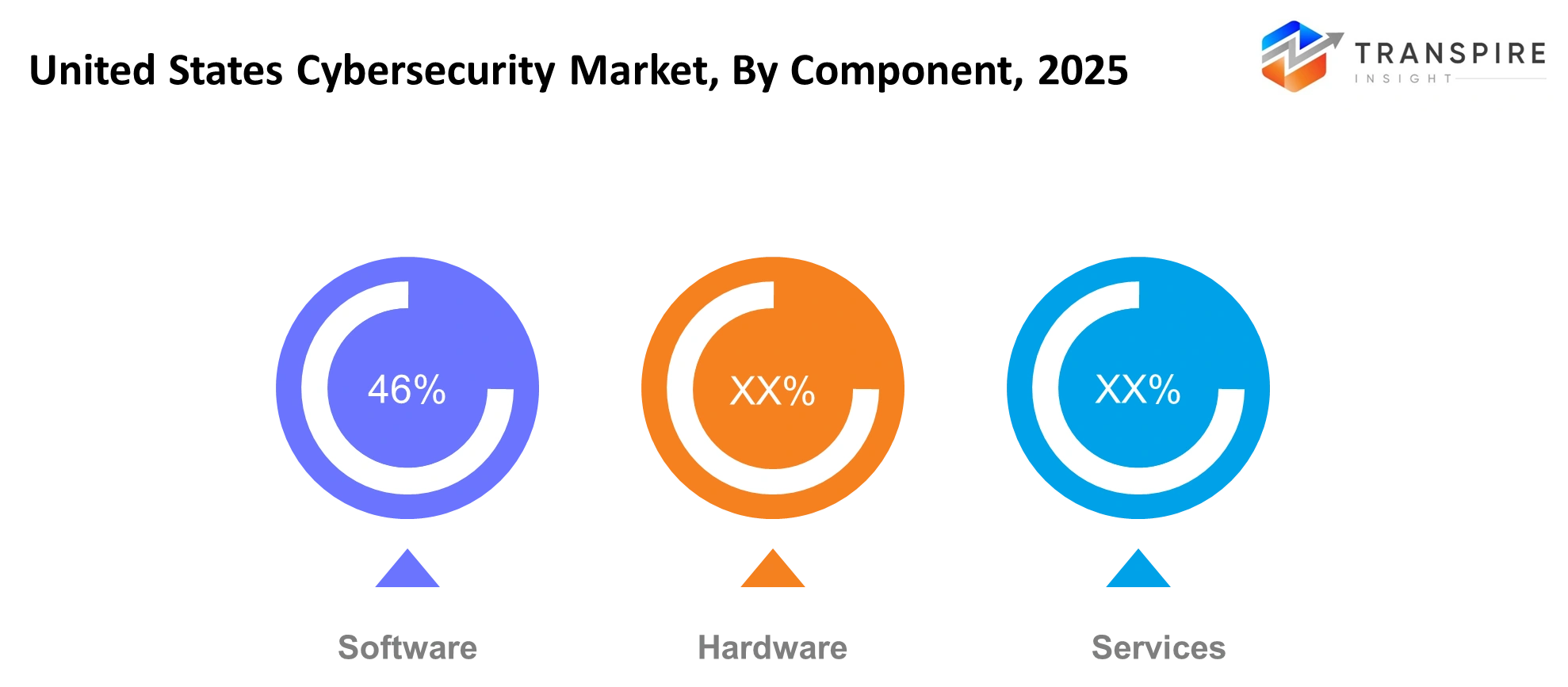
By Component
- Hardware: The fundamental elements of cybersecurity require hardware components, which include firewalls, secure routers and intrusion detection devices. The physical systems establish the primary defence system which monitors network traffic while controlling access to network resources. The growing cyber threats push organisations to update their hardware systems, as they need better security solutions which can handle emerging security threats.
- Software: Cybersecurity serves as the essential component of contemporary protection methods because it provides antivirus programs and encryption tools and threat intelligence platforms. The systems enable businesses to identify and stop and handle cyberattacks through their continuous monitoring capabilities. The software solutions maintain their protective abilities because developers create ongoing updates and new features which address advanced security threats.
- Services: The demand for cybersecurity services continues to rise because organisations need professional assistance to handle their intricate security requirements. These organisations provide consulting services together with risk assessment and incident response and managed security solutions. Many smaller businesses choose to outsource their security needs because they want specialised experts to deliver ongoing monitoring and protective advice.
To learn more about this report, Download Free Sample Report
By Security Type
- Network Security: Network security protects data during its transmission across different systems and networks. It includes three components, which are firewalls, intrusion prevention systems and secure access controls. Network cyberattacks have increased, so businesses are increasing their security measures to protect their communication systems and block unauthorised access to vital data.
- Cloud Security: Cloud security has become essential because organisations are rapidly adopting cloud platforms to safeguard their remote data and applications. The process includes two steps, which are securing cloud infrastructure and managing user access and preventing unauthorised data access. Organisations are investing in advanced cloud security tools to maintain trust and ensure compliance in digital environments.
- Endpoint Security: Endpoint security protects devices, which include laptops and smartphones and desktops, that users connect to company networks. Remote work practices have created security weaknesses which make these endpoints more likely to suffer cyberattacks. Businesses use advanced endpoint protection solutions to track and identify security threats while eliminating them before they reach critical systems.
- Application Security: Application security protects software and applications from vulnerabilities which hackers can exploit. The process includes three activities, which are testing procedures and code assessments and security updates. Businesses need application security because their digital platform usage has increased, which helps them protect user data and build customer trust.
By End User
- BFSI (Banking, Financial Services, and Insurance): It is those financial institutions within the BFSI industry that are so important where cybersecurity measures are adapted. Organisations spend substantial amounts on security technologies to stop fraudulent activities and data security violations. The sector requires organisations to implement cybersecurity systems because they need to protect customer confidence and meet their regulatory obligations.
- Government: Cyber attackers specifically target government organisations because these agencies maintain extensive collections of confidential and restricted data. The government sector protects national security and public information through its development of strong cybersecurity systems and advanced monitoring technologies and its ongoing collection of threat intelligence to prevent attacks.
- Healthcare: The healthcare sector has become dependent on digital technology and electronic health record systems, which need strong cybersecurity measures. Organisations must protect patient data from breaches because any data breach will create major negative effects. Healthcare organisations are implementing advanced security practices to maintain their data protection and system operational efficiency.
- IT & Telecom: Digital communication networks depend on IT and telecom companies to operate their systems, while these businesses face major risks from cyberattacks. These organisations allocate significant financial resources to cybersecurity efforts which protect their systems and maintain service continuity and safeguard customer information. The rising need for advanced security technologies emerges as network accessibility expands.
Country Insights
The United States cybersecurity market operates as one of the most advanced and dynamic markets in the world because its digital ecosystem and technological innovations continue to evolve. The nation faces a complex and evolving threat landscape due to the presence of many tech companies, financial institutions, and government agencies. Cutting-edge security solutions received significant investments, which included artificial intelligence and cloud security and zero-trust architectures.
Market growth receives support from government initiatives and strict regulatory frameworks because they promote organisations to implement strong security measures. The rising number of cyberattacks has created security awareness, which forces all businesses including small and medium-sized enterprises, to make cybersecurity their top priority. The market benefits from two factors, which are the presence of top cybersecurity companies and the availability of skilled workers. The United States leads cybersecurity research and development, which establishes international standards and safeguards essential data and infrastructure systems.
Recent Development News
US bans foreign-made routers over cybersecurity concerns: The US government is tightening hardware security regulations to reduce cyber risks linked to foreign technology supply chains.
AI agents emerge as a key workforce in cybersecurity firms: AI agents are transforming cybersecurity operations by automating threat detection and reducing workloads.
|
Report Metrics |
Details |
|
Market size value in 2025 |
USD 82.95 Billion |
|
Market size value in 2026 |
USD 91.83 Billion |
|
Revenue forecast in 2033 |
USD 189.42 Billion |
|
Growth rate |
CAGR of 10.90% from 2026 to 2033 |
|
Base year |
2025 |
|
Historical data |
2021 – 2024 |
|
Forecast period |
2026 – 2033 |
|
Report coverage |
Revenue forecast, competitive landscape, growth factors, and trends |
|
Country scope |
United States |
|
Key company profiled |
Cisco Systems Inc., Palo Alto Networks Inc., Fortinet Inc., Check Point Software Technologies Ltd., IBM Corporation, Microsoft Corporation, CrowdStrike Holdings Inc., Broadcom Inc., Trend Micro Inc., Zscaler Inc., Okta Inc., McAfee Corp., FireEye Inc., Sophos Ltd., SentinelOne Inc. |
|
Customization scope |
Free report customization (country, regional & segment scope). Avail customized purchase options to meet your exact research needs. |
|
Report Segmentation |
By Component (Hardware, Software, Services), By Security Type (Network Security, Cloud Security, Endpoint Security, Application Security), By End User (BFSI, Government, Healthcare, IT & Telecom). |
Key United States Cybersecurity Company Insights
The United States cybersecurity market exists because major technology companies and dedicated security firms operate within it. Organisations are developing new technologies which include artificial intelligence threat detection systems and cloud security solutions and complete risk management frameworks. Organisations use strategic alliances and business mergers and acquisitions to develop new skills and maintain their market position. Organisations allocate funds to research and development activities so they can defend against new cyber threats. The companies work to create a safe digital environment because their services are needed by various industries which operate in the market.
Company List
- Cisco Systems Inc.
- Palo Alto Networks Inc.
- Fortinet Inc.
- Check Point Software Technologies Ltd.
- IBM Corporation
- Microsoft Corporation
- CrowdStrike Holdings Inc.
- Broadcom Inc.
- Trend Micro Inc.
- Zscaler Inc.
- Okta Inc.
- McAfee Corp.
- FireEye Inc.
- Sophos Ltd.
- SentinelOne Inc.
United States Cybersecurity Market Report Segmentation
By Component
- Hardware
- Software
- Services
By Security Type
- Network Security
- Cloud Security
- Endpoint Security
- Application Security
By End User
- BFSI
- Government
- Healthcare
- IT & Telecom
Frequently Asked Questions
Find quick answers to common questions.
The approximate United States Cybersecurity Market size for the market will be USD 189.42 Billion in 2033.
The key segments of the United States Cybersecurity Market are By Component (Hardware, Software, Services), By Security Type (Network Security, Cloud Security, Endpoint Security, Application Security), By End User (BFSI, Government, Healthcare, IT & Telecom).
Major players in the United States Cybersecurity Market are Cisco Systems Inc., Palo Alto Networks Inc., Fortinet Inc., Check Point Software Technologies Ltd., IBM Corporation, Microsoft Corporation, CrowdStrike Holdings Inc., Broadcom Inc., Trend Micro Inc., Zscaler Inc., Okta Inc., McAfee Corp., FireEye Inc., Sophos Ltd., SentinelOne Inc.
The current Market size of the United States Cybersecurity Market is USD 82.95 billion in 2025.
The United States Cybersecurity Market CAGR is 10.90%.
- Cisco Systems Inc.
- Palo Alto Networks Inc.
- Fortinet Inc.
- Check Point Software Technologies Ltd.
- IBM Corporation
- Microsoft Corporation
- CrowdStrike Holdings Inc.
- Broadcom Inc.
- Trend Micro Inc.
- Zscaler Inc.
- Okta Inc.
- McAfee Corp.
- FireEye Inc.
- Sophos Ltd.
- SentinelOne Inc.
Recently Published Reports
-
Apr 2026
3D Optical Profiler Market
3D Optical Profiler Market Size, Share & Analysis Report By Type (Desktop 3D Optical Profiler, and Portable 3D Optical Profiler), By Technology (Confocal Technology, and White Light Interference), By End-Use Industry (Manufacturing, Research Institutions, Automotive, Aerospace and Defense, Medical Devices, and Other), and Geography (North America, Europe, Asia-Pacific, Middle East and Africa, South and Central America), 2021 - 2031
-
Apr 2026
Depth Sensor Market
Depth Sensor Market Size, Share & Analysis Report By Type (Infrared Depth Sensors, Time-of-Flight (ToF) Sensors, Stereo Vision Sensors, Structured Light Sensors, Ultrasonic Depth Sensors), By Application (Automotive, Robotics, Gaming, Consumer Electronics, Industrial Automation, Healthcare, Security & Surveillance, Others), By End Users (Automotive Manufacturers, Consumer Electronics Companies, Healthcare Providers, Industrial Companies, Security Agencies, Gaming Companies, Robotics Companies, Others), and Geography (North America, Europe, Asia-Pacific, Middle East and Africa, South and Central America), 2021 – 2031
-
Apr 2026
Digital Manufacturing Market
Digital Manufacturing Market Size, Share & Analysis Report By Component (Hardware, Software, and Services), By Technology (Robotics, 3D Printing, Internet of Things (IoT), and Others), By Application (Automotive and Transportation, Aerospace and Defense, Consumer Electronics, Industrial Machinery, and Others), By Process Type (Computer-Based Designing, Computer-Based Simulation, Computer 3D Visualization, Analytics, and Others), and Geography (North America, Europe, Asia-Pacific, Middle East and Africa, South and Central America), 2021 – 2031
-
Apr 2026
Digital Visa Services Market
Digital Visa Services Market Size, Share & Analysis Report By Type (Individual Travelers, Group Travelers), By Application (Tourism, Business Travel, Others), and Geography (North America, Europe, Asia-Pacific, Middle East and Africa, South and Central America), 2021 – 2031