

Japan Self-hosted Cloud Platform Market Size & Forecast:
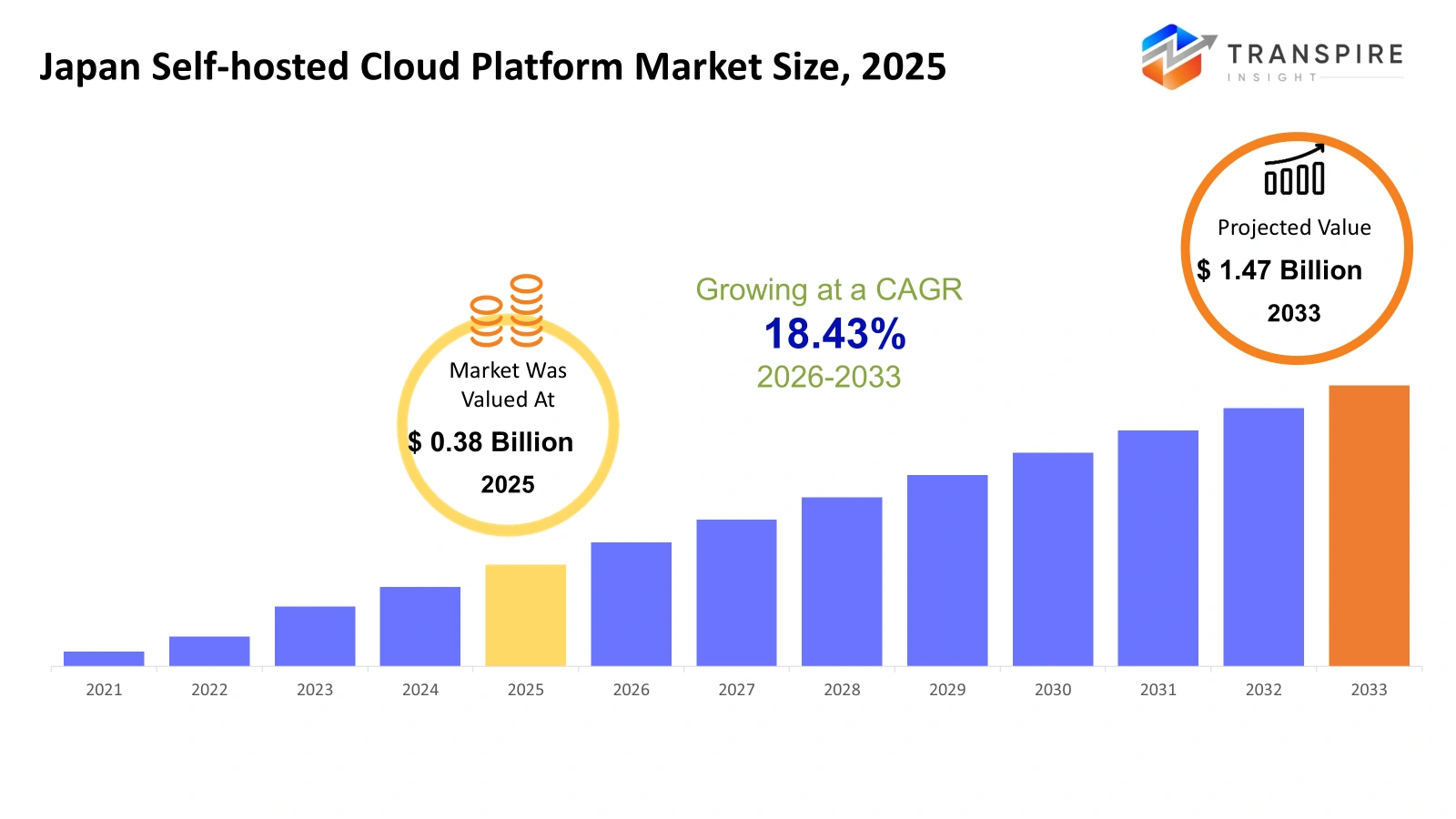
- Japan Self-hosted Cloud Platform Market Size 2025: USD 0.38 Billion
- Japan Self-hosted Cloud Platform Market Size 2033: USD 1.47 Billion
- Japan Self-hosted Cloud Platform Market CAGR: 18.43%
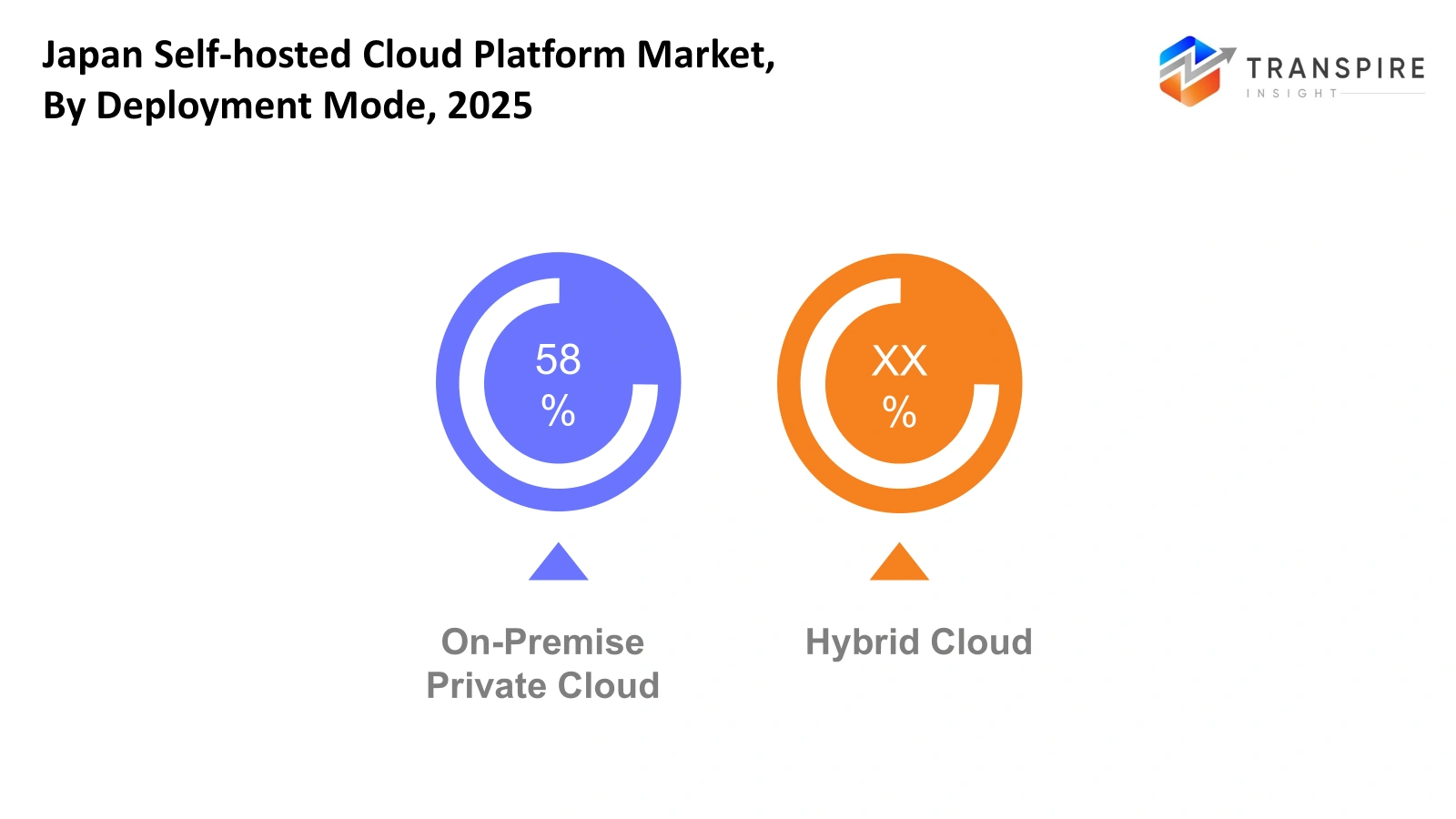
- Japan Self-hosted Cloud Platform Market Segments:By Deployment Type (On-Premise Private Cloud, Hybrid Cloud), By Component (Software, Services), By End User (SMEs, Large Enterprises).
To learn more about this report,  Download Free Sample Report
Japan Self-hosted Cloud Platform Market Summary:
The Japan self-hosted cloud platform market size is estimated at USD 0.38 billion in 2025 and is anticipated to reach USD 1.47 billion by 2033, growing at a CAGR of 18.43% from 2026 to 2033. The Japan Self-hosted Cloud Platform Market is growing steadily because enterprises need IT solutions that provide security and flexibility and cost savings. Japanese companies use self-hosted cloud platforms to achieve better data control, stronger compliance and higher operational performance. The demand for cybersecurity solutions and customised services is increasing among organisations of all sizes. Key players develop new features and regional assistance and smooth system integration to meet business needs and support digital transformation processes.
Key Market Trends & Insights:
- Japanese organisations are increasingly prioritising data control. Businesses can protect their sensitive data through self-hosted cloud platforms while meeting stringent local security requirements, which decreases their need for public cloud solutions.
- Japanese small and medium enterprises have started to use self-hosted solutions because these systems provide them with better operational flexibility and financial advantages. The platforms permit organisations to build customised IT systems that do not require extensive use of external service providers.
- Organisations use a combination of self-hosted systems and public cloud services to achieve their performance objectives. This hybrid approach enables organisations to distribute their resources between two systems, which creates backup systems and enhances their operational capabilities.
- Organisations are now using self-hosted platforms in combination with AI technologies and analytical tools and Internet of Things systems. The system integration process improves three business functions, which include automation, decision-making and organisational business intelligence.
- Japanese providers deliver comprehensive local assistance together with customisable service options. The current trend is essential for companies that require customised solutions to satisfy their distinct business operations and compliance requirements.
- Japanese companies are making substantial investments in self-hosted cloud systems to create sustainable business operations. The modernisation process aims to achieve three objectives, which are improved system scalability, enhanced system reliability and decreased operational interruptions.
Japan Self-hosted Cloud Platform Market Segmentation
By Deployment Type
- On-Premise Private Cloud: Japanese organisations are increasingly adopting on-premise private clouds because these systems provide full data control to their organisations. The system establishes complete security measures together with compliance requirements and customisability options, which make it appropriate for organisations that handle confidential data in the fields of finance, healthcare and government services.
- Hybrid Cloud: The business world is increasingly adopting hybrid cloud solutions, which enable organisations to use both their on-site data centres and public cloud services. The flexible system provides organisations with two advantages because it enables them to save money while improving their operational results and expanding their business, and it allows them to control their confidential operations while integrating easily with their current IT systems.
To learn more about this report, Download Free Sample Report
By Component
- Software: Self-hosted cloud software in Japan develops advanced features that include automation and analytics and resource management. Organisations value software that allows tailored configurations, robust security, and integration with legacy systems because it helps them implement digital transformation and manage their enterprise IT systems.
- Services: The demand for professional services has increased because businesses require consulting and deployment and maintenance support. Japanese businesses depend on expert consultants to help them successfully implement self-hosted solutions because this approach enables them to achieve peak performance while reducing downtime and maintaining their system upgrades and custom operational needs.
By End User
- SMEs: Japanese small and medium enterprises use self-hosted cloud platforms to decrease their IT expenses while gaining operational flexibility. The solutions provide SMEs access to enterprise-level infrastructure which they can customise according to their business needs without depending on third-party cloud services.
- Large Enterprises: Corporate organisations choose self-hosted platforms because these systems provide better security protections and compliance features and allow businesses to expand their operations. Organisations with intricate IT environments require tailored solutions that work together with their current systems and provide support for essential operations and digital transformation projects that involve multiple business units.
Country Insights
Japan's self-hosted cloud platform market experiences substantial growth because the country prioritises data security and data protection and technological advancements. Japanese companies choose self-hosted solutions because they want to control their sensitive data while meeting local data protection requirements, which result from increasing digital transformation efforts across different sectors. Both large corporations and SMEs use these platforms to build IT systems which they can scale and customise while protecting their critical operations.
The government spends time on cybersecurity protection and uses advanced technologies like AI and IoT for research, which creates higher market demand. Domestic vendors deliver local support and customised solutions, which helps enterprises that want to construct unique infrastructure to enhance their service offerings. Businesses now prefer hybrid and on-premise deployment models because they need to achieve optimal results while maintaining control over their expenses and system performance. Japan's market shows increasing demand for cloud platforms which offer organisations secure and resilient features while helping them develop modern operational procedures to compete in the digital business environment.
Recent Development News
Japanese Voice Platform Expands Cloud Platform Internationally: Advanced Media launched an English version of its AmiVoice Cloud Platform website to support broader global usage of its cloud AI‑based voice recognition services.
Japan Exchange (JPX) Explores Cloud Tech for Trading System: Tokyo Stock Exchange (JPX) announced a proof‑of‑concept partnership using cloud technologies to assess long‑term viability for its equity trading system.
|
Report Metrics |
Details |
|
Market size value in 2025 |
USD 0.38 Billion |
|
Market size value in 2026 |
USD 0.45 Billion |
|
Revenue forecast in 2033 |
USD 1.47 Billion |
|
Growth rate |
CAGR of 18.43% from 2026 to 2033 |
|
Base year |
2025 |
|
Historical data |
2021 – 2024 |
|
Forecast period |
2026 – 2033 |
|
Report coverage |
Revenue forecast, competitive landscape, growth factors, and trends |
|
Country scope |
Japan |
|
Key company profiled |
VMware Inc., Red Hat Inc., Canonical Ltd., Microsoft Corporation, IBM Corporation, Oracle Corporation, SAP SE, Hewlett Packard Enterprise, Dell Technologies Inc., Alibaba Cloud, Google LLC, Amazon Web Services Inc., Nutanix Inc., SUSE Group, OpenStack Foundation. |
|
Customization scope |
Free report customization (country, regional & segment scope). Avail customized purchase options to meet your exact research needs. |
|
Report Segmentation |
By Deployment Type (On-Premise Private Cloud, Hybrid Cloud), By Component (Software, Services), By End User (SMEs, Large Enterprises). |
Key Japan Self-hosted Cloud Platform Company Insights
The top Japanese companies which provide self-hosted cloud platforms for their customers are currently developing new products while protecting their systems and offering localised technical support services to meet increasing needs for adaptable IT solutions. The major companies in the market provide customisable platforms which work together with their current corporate systems while maintaining compliance with stringent data protection laws. Companies are spending money on new technologies, which include artificial intelligence, data analytics and automated processes, to improve their productivity. Companies use their solid customer service combined with personalised deployment methods and ongoing software updates to strengthen their market position while building lasting partnerships with clients.
Company List
- VMware Inc.
- Red Hat Inc.
- Canonical Ltd.
- Microsoft Corporation
- IBM Corporation
- Oracle Corporation
- SAP SE
- Hewlett Packard Enterprise
- Dell Technologies Inc.
- Alibaba Cloud
- Google LLC
- Amazon Web Services Inc.
- Nutanix Inc.
- SUSE Group
- OpenStack Foundation
Japan Self-hosted Cloud Platform Market Report Segmentation
By Deployment Type
- On-Premise Private Cloud
- Hybrid Cloud
By Component
- Software
- Services
By End User
- SMEs
- Large Enterprises
Frequently Asked Questions
Find quick answers to common questions.
The approximate Japan Self-hosted Cloud Platform Market size for the Market will be USD 1.47 Billion in 2033.
The key segments of the Japan Self-hosted Cloud Platform Market are By Deployment Type (On-Premise Private Cloud, Hybrid Cloud), By Component (Software, Services), By End User (SMEs, Large Enterprises).
Major players in the Japan Self-hosted Cloud Platform Market are VMware Inc., Red Hat Inc., Canonical Ltd., Microsoft Corporation, IBM Corporation, Oracle Corporation, SAP SE, Hewlett Packard Enterprise, Dell Technologies Inc., Alibaba Cloud, Google LLC, Amazon Web Services Inc., Nutanix Inc., SUSE Group, OpenStack Foundation.
The current Market size of the Japan Self-hosted Cloud Platform Market is USD 0.38 Billion in 2025.
The Japan Self-hosted Cloud Platform Market CAGR is 18.43%.
- VMware Inc.
- Red Hat Inc.
- Canonical Ltd.
- Microsoft Corporation
- IBM Corporation
- Oracle Corporation
- SAP SE
- Hewlett Packard Enterprise
- Dell Technologies Inc.
- Alibaba Cloud
- Google LLC
- Amazon Web Services Inc.
- Nutanix Inc.
- SUSE Group
- OpenStack Foundation
Recently Published Reports
-
Apr 2026
3D Optical Profiler Market
3D Optical Profiler Market Size, Share & Analysis Report By Type (Desktop 3D Optical Profiler, and Portable 3D Optical Profiler), By Technology (Confocal Technology, and White Light Interference), By End-Use Industry (Manufacturing, Research Institutions, Automotive, Aerospace and Defense, Medical Devices, and Other), and Geography (North America, Europe, Asia-Pacific, Middle East and Africa, South and Central America), 2021 - 2031
-
Apr 2026
Depth Sensor Market
Depth Sensor Market Size, Share & Analysis Report By Type (Infrared Depth Sensors, Time-of-Flight (ToF) Sensors, Stereo Vision Sensors, Structured Light Sensors, Ultrasonic Depth Sensors), By Application (Automotive, Robotics, Gaming, Consumer Electronics, Industrial Automation, Healthcare, Security & Surveillance, Others), By End Users (Automotive Manufacturers, Consumer Electronics Companies, Healthcare Providers, Industrial Companies, Security Agencies, Gaming Companies, Robotics Companies, Others), and Geography (North America, Europe, Asia-Pacific, Middle East and Africa, South and Central America), 2021 – 2031
-
Apr 2026
Digital Manufacturing Market
Digital Manufacturing Market Size, Share & Analysis Report By Component (Hardware, Software, and Services), By Technology (Robotics, 3D Printing, Internet of Things (IoT), and Others), By Application (Automotive and Transportation, Aerospace and Defense, Consumer Electronics, Industrial Machinery, and Others), By Process Type (Computer-Based Designing, Computer-Based Simulation, Computer 3D Visualization, Analytics, and Others), and Geography (North America, Europe, Asia-Pacific, Middle East and Africa, South and Central America), 2021 – 2031
-
Apr 2026
Digital Visa Services Market
Digital Visa Services Market Size, Share & Analysis Report By Type (Individual Travelers, Group Travelers), By Application (Tourism, Business Travel, Others), and Geography (North America, Europe, Asia-Pacific, Middle East and Africa, South and Central America), 2021 – 2031