
Middle East and Africa Military Tactical Radio Market Size & Forecast:
- Middle East and Africa Military Tactical Radio Market Size 2025: USD 627.4 Million
- Middle East and Africa Military Tactical Radio Market Size 2033: USD 913.6 Million
- Middle East and Africa Military Tactical Radio Market CAGR: 4.85%
- Middle East and Africa Military Tactical Radio Market Segments: By Type (Handheld Radios, Vehicle Radios, Manpack Radios, Airborne Radios, Naval Radios, Others, Others, Others); By Frequency (HF, VHF, UHF, SATCOM, Multi-Band, Others, Others, Others); By Application (Ground Forces, Air Force, Navy, Special Operations, Border Security, Others, Others, Others); By End User (Defense Forces, Homeland Security, Government Agencies, Others, Others, Others, Others, Others)
Middle East and Africa Military Tactical Radio Market Summary
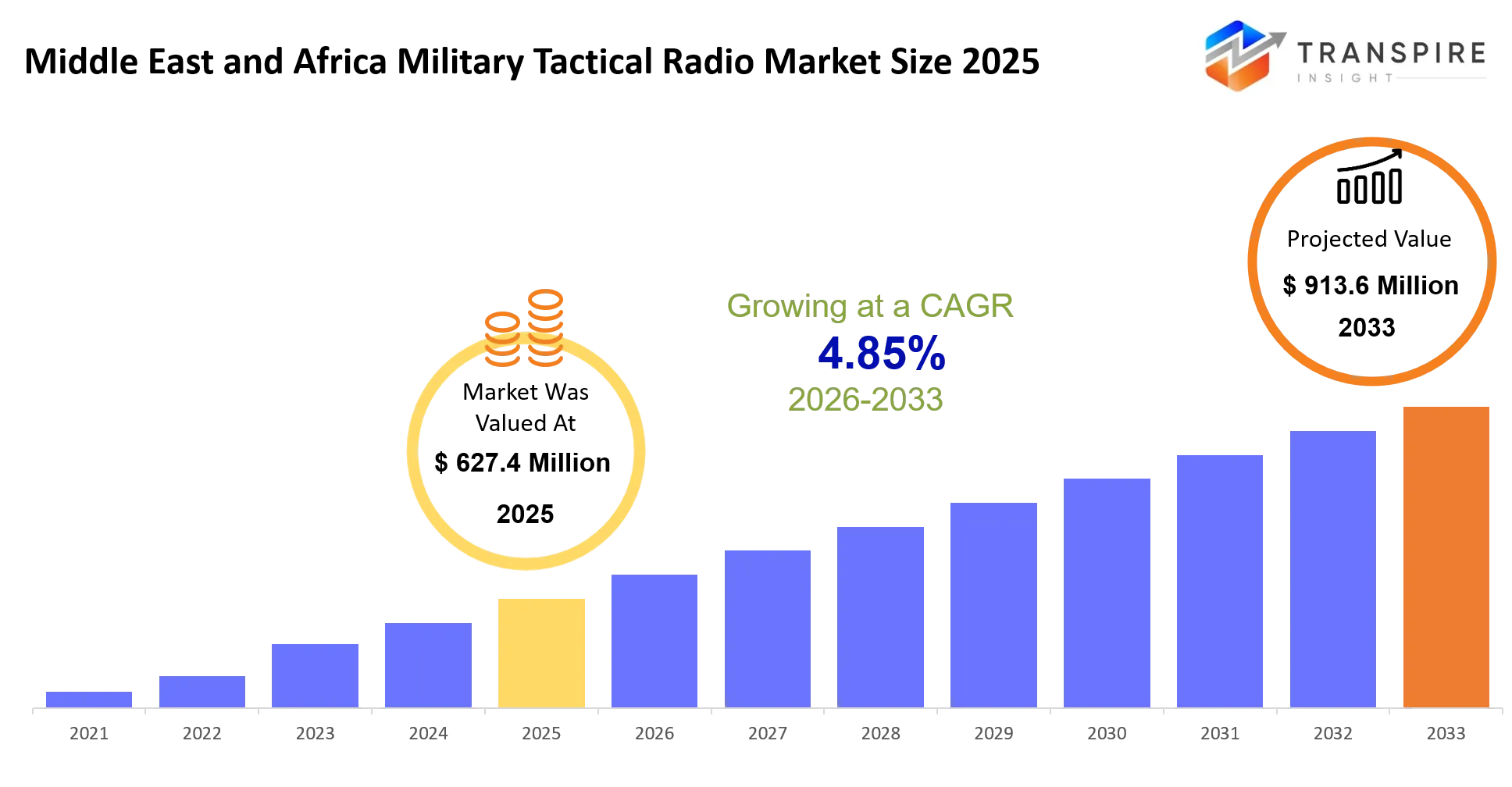
The Middle East and Africa Military Tactical Radio Market was valued at USD 627.4 Million in 2025. It is forecast to reach USD 913.6 Million by 2033. That is a CAGR of 4.85% over the period.
Military tactical radios kind of act as the communication core for today’s defense activities, letting soldiers, vehicles, aircraft, naval units, and command centers swap secure voice, data, and that real-time situational intel stuff. They help coordinate missions even when the terrain is rough, the border regions are hard to reach, the maritime zones are busy, or the overall conflict environment makes normal connectivity unreliable. Commercial networks can’t always keep up, so these radios step in.
In the last 5 years, the market has moved away from old school analog gear, and single-band radios toward software-defined, multi-band, network-centric communication systems. Those newer setups can handle encrypted data, video relays, and interoperability across joint forces without the usual headaches. Meanwhile, regional security pressure, tighter border surveillance duties, and military modernization efforts have sped up procurement timing, and pushed governments to sink money into sturdy communications infrastructure.
As armed forces roll out integrated battlefield management systems and multi-domain operations, tactical radios are basically turning into key nodes inside wider digital defense networks. This shift boosts deployment numbers, raises spending for ongoing system refreshes, and also opens up repeat revenue chances, via software updates, cybersecurity upgrades, and longer lifecycle support services.
Key Market Insights
- The Middle East and Africa Military Tactical Radio Market keeps moving away from legacy radios to software defined kind of platforms for secure voice ,data, and video communications, in practice it kind of shifts step by step.
- In 2025, Gulf countries accounted for around 45% of regional defense communication spending, so the Middle East stays the biggest regional contributor, at least by share.
- Software defined radios made up nearly 55% of the new military radio procurements in 2025 , mainly because interoperability and upgrade flexibility fit real procurement cycles.
- Handheld radios still held over 30% market share in 2025, largely from infantry modernization efforts and soldier communication programs that keep getting funded.
- Multi band radio deployments are forecast to grow at more than 6% annually through 2033, as armed forces want smoother spectrum management ,and less hassle when conditions change.
- For ground force applications, they brought in roughly 40% of market revenue in 2025, driven by tactical battlefield communication needs that don’t really pause.
- Border security communication programs are also emerging, they’re one of the fastest growing application areas across North Africa and Gulf states, according to recent procurement signals.
- Defense forces represented more than 70% of total end user spending in 2025, because ongoing military modernization investments are still the main engine.
- Key players like L3Harris Technologies, Thales, BAE Systems, Leonardo, and Elbit Systems are pushing ahead via software defined radio innovation and regional partnerships, in different combinations.
- Overall strategic focus has been leaning toward AI enabled network management ,anti jamming solutions, satellite communication integration ,and secure multi domain interoperability that can play across several systems at once .
What are the Key Drivers, Restraints, and Opportunities in the Middle East and Africa Military Tactical Radio Market?
The most powerful growth comes from military modernization programs that sort of emphasize network centric warfighting, and also real time situational awareness on the ground. In SaudiArabia, the UAE, South Africa, and a handful of North African states, armed forces are swapping older communication hardware for software defined radios that can handle encrypted voice, plus data and video traffic. This move really got going because joint operations have become way more intricate, involving land, air, maritime, and unmanned platforms. Newer radios boost operational coordination and cut down communication latency, so defense agencies respond by putting bigger procurement funds into tactical communications infrastructure. That in turn backs equipment sales, software licensing, systems integration services, and longer term maintenance agreements.
The biggest brake, though, is the persistent high price tag for acquiring and integrating advanced tactical radio networks. Military comms systems have to clear encryption certification, interoperability testing, spectrum management rules, and they must still fit with the current command and control backbone. Because of these checks, purchasing timelines stretch out, and deployment costs stay heavy. On top of that, budget limits across several African defense organizations keep modernization on hold for longer, which shrinks near term revenue odds and slows uptake for smaller units.
One major opening is tying tactical radios together with satellite communications, artificial intelligence, and unmanned systems. Many governments now want hardened, resilient communications networks that still function beyond line of sight, even when the environment is contested.
What Has the Impact of Artificial Intelligence Been on the Middle East and Africa Military Tactical Radio Market?
Artificial intelligence is kind of transforming military communication networks from plain standalone radio set ups into something more “intelligent” battlefield communication platforms, and yes it’s moving fast. Instead of humans constantly tuning and adjusting everything, advanced AI algorithms are being used to automate spectrum management, improve routing decisions, and—when things get busy in high traffic operations—prioritize the most mission-critical communications. With these changes, military operators can keep connectivity more stable, while also cutting down the manual network configuration work that otherwise eats time.
Machine learning models are also showing up in predictive maintenance programs for tactical radio fleets. They can analyze operational performance, battery health, signal quality, and even patterns of component wear-and-tear or degradation. Predictive systems then flag likely failures before those failures start affecting mission readiness. That translates into better equipment availability for defense organizations, lower maintenance expenses, and longer operational lifecycles. On top of that, AI enabled communication management platforms further boost network efficiency by automatically choosing suitable frequencies and reducing interference, especially in crowded electromagnetic environments.
The practical gains tend to look like this: more reliable communication uptime, sharper situational awareness, quicker information spread, and battlefield connectivity that holds up better under stress. Also, when these tools get integrated with satellite communication networks and command-and-control systems, decision making speed across multi domain operations can improve noticeably.
Still, AI adoption is not unlimited. Integration costs, strict cybersecurity requirements, and a shortage of operational datasets from real world combat environments can all slow the process. Many defense organizations also struggle to validate AI performance across different terrains and contested electromagnetic conditions, so large-scale deployment ends up moving at a slower pace.
Key Market Trends
- Since 2021, procurement of software-defined radio has started to rise quite a lot, kinda like militaries are chasing upgradeable platforms, to match future communication standards that keep showing up.
- Multi band radio deployments actually grew by almost 30% from 2022 to 2025, which in turn reduced equipment complexity during joint operations, even when units are not using the exact same setup.
- Features for anti jamming and electronic warfare protection became a bigger priority after regional security issues got more intense, not just a small shift.
- SATCOM enabled tactical radios saw stronger adoption once military forces put more weight on beyond-line-of-sight communications, so yes the link distance mattered.
- Defense agencies now often demand interoperability spanning land, air, naval, and unmanned platforms, instead of isolated communication networks that don’t talk easily.
- In several Gulf modernization programs, communication budgets were increased more noticeably across 2023–2025, meant to back digital battlefield initiatives that are supposed to be faster and more connected.
- L3Harris Technologies also leaned harder into resilient communications and tactical networking technologies during 2025–2026, sort of moving the emphasis.
- Thales, meanwhile, boosted investment into software-defined radio production plus local industrial partnerships, during 2025–2026 as well.
- Buyers are now frequently assessing lifecycle software support and cybersecurity resilience, along with pure hardware performance, not treating it as an afterthought.
- More recently, AI assisted network optimization, and even autonomous communication management, came up as strategic procurement needs after 2024, because the systems have to adapt in near real time.
Middle East and Africa Military Tactical Radio Market Segmentation
By Type
Handheld radios still stay essential for infantry units, patrol groups, and frontline personnel who need light weight and secure comms hardware during tactical ops. Vehicle radios, for their part, fit armored vehicles, command vehicles, and mobile military platforms where longer communication reach and integration with battlefield management systems is kind of a must. Manpack radios land in the middle of things, giving you movement plus solid communication ability, so they work well for long range field missions and expeditionary deployments.
Airborne radios let aircraft talk securely with ground forces and command centers, all while helping with mission coordination and intelligence sharing, sort of in one flow. Naval radios help with communications across naval vessels, coastal tasks, and maritime security missions, especially over those strategic waterways. Beyond that, there are other radio categories too, basically specialized comm systems built for unmanned platforms, command posts, electronic warfare units, and mission specific defense applications that demand distinct operational traits.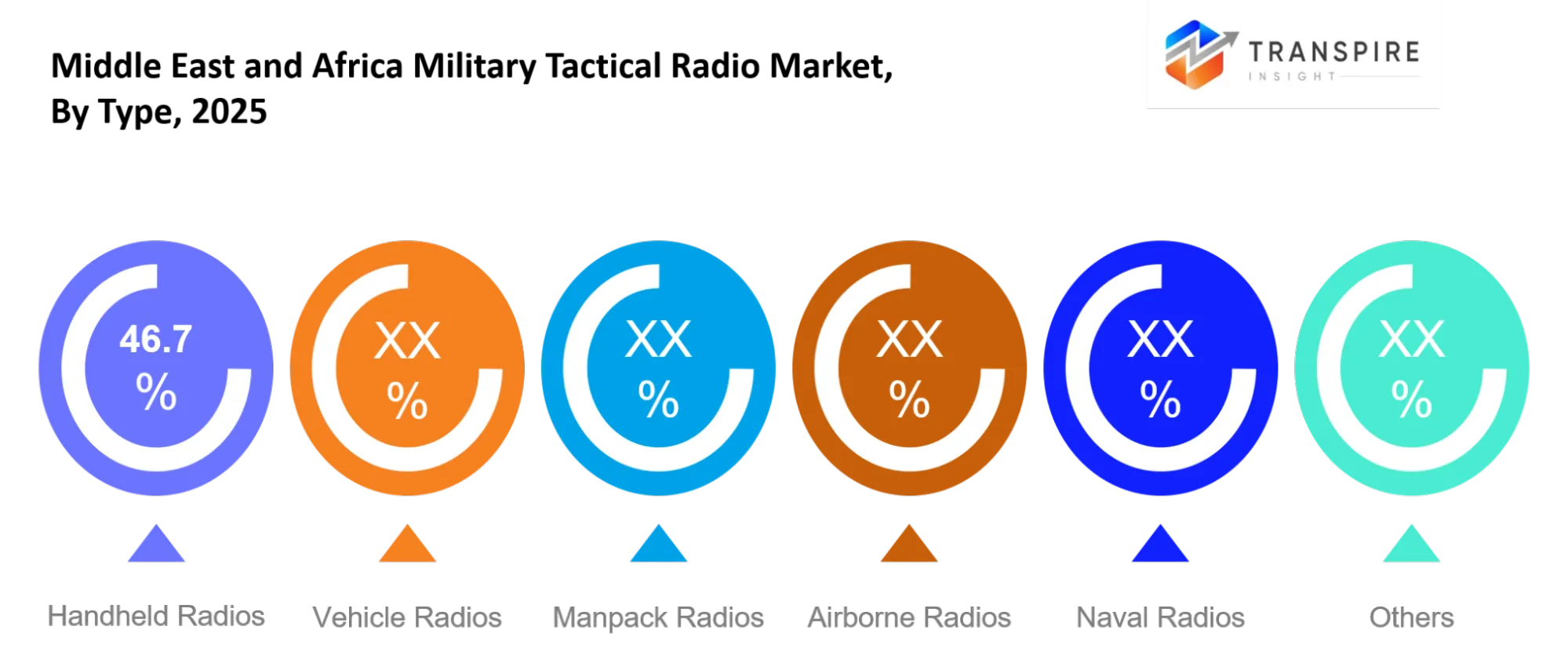
By Frequency
HF systems still kind of matter a lot for long distance communication, especially when the infrastructure is thin, and you need beyond line of sight connectivity. VHF radios get used broadly for tactical ground communications, because they tend to deliver steady performance across different kinds of terrain, which is kind of a big deal. UHF frequencies, on the other hand help in city environments, they’re also often used for airborne work and other specialized military operations.
SATCOM communication systems, provide global connectivity and help with missions in remote regions, where terrestrial networks are simply not there. Multi band radios have been getting a lot of attention lately because one platform can operate across more than one frequency band, which improves interoperability and can reduce equipment complexity. There are also other frequency technologies, they exist for specialized military applications, for spectrum management requirements, and for mission specific communication needs, all those little details.
By Application
Ground forces are probably the biggest use case, mainly because infantry units, armored formations, and the command structures, count on secure channels for tactical coordination and a sort of battlefield awareness. Air force use more often needs constant communication, not only between aircraft but also among air defense systems and command centers , so the mission can be carried out safely and without surprises. For naval scenarios the emphasis tends to be on fleet coordination, maritime observation, and coastal security operations, where timing and coverage really matter.
Special operations groups are also leaning more toward modern tactical communication systems, they deliver encrypted exchanges, shared data, and operational flexibility even when the environment gets complicated or dense. Border security agencies use tactical radios to manage surveillance tasks, patrol routines, and fast reaction missions across long territorial stretches. Then you also see it in peacekeeping deployments, emergency response support, intelligence activities, plus joint military exercises where interoperability is the main concern.
By End User
Defense forces end up taking the largest slice of spending, largely because military organizations need massive communication networks that keep things ready for combat, enable modernization work, and support multi domain operations, somehow all at once. In that whole mix, tactical radios are a real cornerstone for keeping command and control effective across very different operational environments. Also the long procurement cycles, plus ongoing upgrade programs, keep feeding the budget, even when everyone thinks the purchasing is already done.
On the other hand, homeland security organizations use tactical radios for counterterrorism work, border monitoring, and the protection of critical infrastructure. Government agencies lean on secure communication systems for emergency management and for disaster response coordination , and they also use them during public safety operations. Other end users show up too, like specialized security organizations, peacekeeping units, and defense related institutions, all of them needing mission critical communication capabilities so the work does not stall when conditions change.
What are the Key Use Cases Driving the Middle East and Africa Military Tactical Radio Market?
The main use case, kind of, involves battlefield communication along with command coordination between land forces. Tactical radio systems help with real-time voice, data, and situational awareness exchange, between infantry units, armored formations , and command centers. This purpose creates the strongest demand because operational effectiveness depends on dependable and protected communication while in combat conditions.
Other uses are also growing, in border security activities and maritime surveillance . Security agencies rely on modern communication networks, to align patrol missions, watch distant zones, and keep contact across wide operational areas. At the same time airborne mission coordination and joint force operations contribute to the increasing deployment need.
New and emerging use cases include communication support for autonomous systems , unmanned aerial platforms and AI-enabled battlefield management environments. Upcoming deployments will more and more emphasize an integrated communication ecosystem where tactical radios act like smart network nodes within broader defense digitalization programs.
|
Report Metrics |
Details |
|
Market size value in 2025 |
USD 627.4 Million |
|
Market size value in 2026 |
USD 655.9 Million |
|
Revenue forecast in 2033 |
USD 913.6 Million |
|
Growth rate |
CAGR of 4.85% from 2026 to 2033 |
|
Base year |
2025 |
|
Historical data |
2021 - 2024 |
|
Forecast period |
2026 - 2033 |
|
Report coverage |
Revenue forecast, competitive landscape, growth factors, and trends |
|
Regional scope |
Middle East and Africa (Saudi Arabia, United Arab Emirates, South Africa, Rest of Middle East and Africa) |
|
Key company profiled |
L3Harris, Thales, BAE Systems, Collins Aerospace, Leonardo, Elbit Systems, Saab, Rohde & Schwarz, Codan, General Dynamics, RTX, Aselsan, Bharat Electronics, Motorola Solutions, Hytera |
|
Customization scope |
Free report customization (country, regional & segment scope). Avail customized purchase options to meet your exact research needs. |
|
Report Segmentation |
By Type (Handheld Radios, Vehicle Radios, Manpack Radios, Airborne Radios, Naval Radios, Others, Others, Others); By Frequency (HF, VHF, UHF, SATCOM, Multi-Band, Others, Others, Others); By Application (Ground Forces, Air Force, Navy, Special Operations, Border Security, Others, Others, Others); By End User (Defense Forces, Homeland Security, Government Agencies, Others, Others, Others, Others, Others) |
Which Regions are Driving the Middle East and Africa Military Tactical Radio Market Growth?
The Middle East looks like the biggest regional market due to heavy spending on defense modernization, bigger military purchasing programs, and a lot of government backing for those security plans. Nations such as Saudi Arabia, the United Arab Emirates, and Qatar keep pushing forward the upgrade of communications networks across their armed forces . With major defense budgets, they also fund big purchases, meaning software-defined radios and overall integrated communication systems. Partnerships with global defense suppliers , also help tighten that regional leading position.
Africa brings a meaningful contribution through modernization work, especially around border protection, peacekeeping missions, and counterinsurgency missions. The way growth plays out is a bit different versus the Middle East because purchasing choices often lean on operational endurance, and cost efficiency. Defense organizations want communication systems that can keep working in far off and rough areas. And even when budgets get tight, longer term modernization roadmaps keep the market moving steadily.
Within the broader market, the Gulf area shows the strongest growth energy. New investments in digital defense infrastructure, joined command-and-control tools, and network centric warfare strengths increased procurement pace. Governments are also stressing interoperability between manned and unmanned platforms, which then creates demand for smarter communication technologies. That kind of momentum opens up solid openings for suppliers, technology builders, and defense investors during most of the forecast period .
Who are the Key Players in the Middle East and Africa Military Tactical Radio Market and How Do They Compete?
The Middle East looks like the biggest regional market due to heavy spending on defense modernization, bigger military purchasing programs, and a lot of government backing for those security plans. Nations such as Saudi Arabia, the United Arab Emirates, and Qatar keep pushing forward the upgrade of communications networks across their armed forces . With major defense budgets, they also fund big purchases, meaning software-defined radios and overall integrated communication systems. Partnerships with global defense suppliers , also help tighten that regional leading position.
Africa brings a meaningful contribution through modernization work, especially around border protection, peacekeeping missions, and counterinsurgency missions. The way growth plays out is a bit different versus the Middle East because purchasing choices often lean on operational endurance, and cost efficiency. Defense organizations want communication systems that can keep working in far off and rough areas. And even when budgets get tight, longer term modernization roadmaps keep the market moving steadily.
Within the broader market, the Gulf area shows the strongest growth energy. New investments in digital defense infrastructure, joined command-and-control tools, and network centric warfare strengths increased procurement pace. Governments are also stressing interoperability between manned and unmanned platforms, which then creates demand for smarter communication technologies. That kind of momentum opens up solid openings for suppliers, technology builders, and defense investors during most of the forecast period .
Company List
- L3Harris Technologies
- Thales
- BAE Systems
- Collins Aerospace
- Leonardo
- Elbit Systems
- Saab
- Rohde & Schwarz
- Codan
- General Dynamics
- RTX
- Aselsan
- Bharat Electronics
- Motorola Solutions
- Hytera Communications
Recent Development News
In March 2026, L3Harris and Comtech launched a first-of-its-kind tactical SATCOM modem. The solution enables secure multi-orbit communications and strengthens beyond-line-of-sight connectivity for military tactical networks.https://www.l3harris.com/newsroom/editorial/2026/03/l3harris-and-comtech-introduce-first-its-kind-tactical-satcom-modem (L3Harris).
In April 2026, L3Harris entered a partnership with RFTEQ. The collaboration advances sovereign electronic warfare and radio-frequency capabilities while supporting next-generation defense communication solutions.https://www.l3harris.com/newsroom/editorial/2026/04/l3harris-rfteq-sign-agreement-advance-sovereign-electronic-warfare (L3Harris).
In March 2025, L3Harris signed a long-term agreement with the Dutch Ministry of Defence for Falcon IV radios. The contract strengthens secure military communications and demonstrates continued investment in advanced tactical radio technologies.https://www.l3harris.com/newsroom/press-release/2025/03/l3harris-dutch-ministry-defence-sign-foxtrot-long-term-agreement (L3Harris).
What Strategic Insights Define the Future of the Middle East and Africa Military Tactical Radio Market?
The market is kind of moving toward fully connected, software defined communication ecosystems that tie together soldiers, vehicles, aircraft, naval assets, satellites and autonomous platforms, inside one unified operational network. And the driving factor behind it all is this shift to multi domain warfare where the pace of communication and interoperability actually affect how well a mission works. So the next budgets are going to lean more into software upgrades , plus cybersecurity and network resilience, not just buying standalone hardware, as much.
There’s also a quieter problem, more like a growing dependency on specialized semiconductor components, encryption technologies, and some pretty advanced software architectures. If there’s supply disruption or export limits, modernization timelines can slip, and procurement costs could go up. Meanwhile, there’s a real upside too: pairing tactical radios with AI enabled command systems and satellite communication networks, it’s a big opportunity, but it’s still pretty early for widespread adoption.
Market players should lean toward open architecture platforms, the kind that lets future software upgrades happen without too much lock-in and that also meet interoperability needs. The organizations that blend secure communications, AI powered network management, and satellite connectivity in scalable solutions will likely be the ones best set to win long term growth across the region.
Middle East and Africa Military Tactical Radio Market Report Segmentation
By Type
- Handheld Radios
- Vehicle Radios
- Manpack Radios
- Airborne Radios
- Naval Radios
- Others
By Frequency
- HF
- VHF
- UHF
- SATCOM
- Multi-Band
- Others
By Application
- Ground Forces
- Air Force
- Navy
- Special Operations
- Border Security
- Others
By End User
- Defense Forces
- Homeland Security
- Government Agencies
- Others
Frequently Asked Questions
Find quick answers to common questions.
The Expected Middle East and Africa Military Tactical Radio Market size for the Market will be USD 913.6 Million in 2033.
Key Segments for the Middle East and Africa Military Tactical Radio Market are By Type (Handheld Radios, Vehicle Radios, Manpack Radios, Airborne Radios, Naval Radios, Others, Others, Others); By Frequency (HF, VHF, UHF, SATCOM, Multi-Band, Others, Others, Others); By Application (Ground Forces, Air Force, Navy, Special Operations, Border Security, Others, Others, Others); By End User (Defense Forces, Homeland Security, Government Agencies, Others, Others, Others, Others, Others).
Major Middle East and Africa Military Tactical Radio Market Players are L3Harris, Thales, BAE Systems, Collins Aerospace, Leonardo, Elbit Systems, Saab, Rohde & Schwarz, Codan, General Dynamics, RTX, Aselsan, Bharat Electronics, Motorola Solutions, Hytera
The Current Middle East and Africa Military Tactical Radio Market size is USD 627.4 Million in 2025.
The Middle East and Africa Military Tactical Radio Market CAGR is 4.85% from 2026 to 2033.
- L3Harris Technologies
- Thales
- BAE Systems
- Collins Aerospace
- Leonardo
- Elbit Systems
- Saab
- Rohde & Schwarz
- Codan
- General Dynamics
- RTX
- Aselsan
- Bharat Electronics
- Motorola Solutions
- Hytera Communications
About the Authors

Tejashri Dhatrak
I am Tejashri Dhatrak, a Senior Research Analyst at Transpire Insight, specializing in the Aerospace and Defence sector. My work focuses on analyzing industry trends, defence technologies, market developments, and emerging innovations that shape the global aerospace and security landscape. At Transpire Insight, I research complex topics, evaluate credible sources, and transform technical insights into accurate, well-structured, and easy-to-understand content for industry professionals and decision-makers. My goal is to provide reliable, research-backed information that helps readers stay informed about defence capabilities, aerospace advancements, strategic developments, and the evolving dynamics of the global defence ecosystem.

Chakradhar Khansole
Chakradhar serves as the Research Director at Transpire Insight, bringing over 8 years of experience in technology, innovation, and strategic market intelligence. He specializes in transforming complex market data into actionable business insights that enable organizations to make informed, growth-oriented decisions. Recognized for his strategic vision and analytical expertise, Chakradhar leads high-impact research initiatives, delivering comprehensive market assessments, competitive intelligence, and forward-looking industry analysis.
Recently Published Reports
-
Apr 2026
Aerospace Fluoropolymers Market
Aerospace Fluoropolymers Market Size, Share & Analysis Report By Type (PTFE, FEP, PFA, ETFE, and Others), By Application (Electrical Insulation, Seals & Gaskets, Coatings, and Others), By End User (Commercial Aviation, Military Aviation, General Aviation, and Others), and Geography (North America, Europe, Asia-Pacific, Middle East and Africa, South and Central America), 2021 - 2031
-
Apr 2026
Airborne SATCOM System Market
Airborne SATCOM System Market Size, Share & Analysis Report By Type (SATCOM Terminals, Transceivers, Airborne Radio, Modems and Routers, SATCOM Radomes, and Other), By Application (Government and Defense and Commercial), and Geography (North America, Europe, Asia-Pacific, Middle East and Africa, South and Central America), 2021 – 2031
-
Apr 2026
Ship Leasing Market
Ship Leasing Market Size, Share & Analysis Report By Vessel Type (Container Ships, Bulk Carriers, Tankers, and Specialized Vessels), By Lease Duration (Short-Term Lease (Less than 1 year), Medium-Term Lease (1-5 years), and Long-Term Lease (More than 5 years)), By Lease Type (Bareboat Charter, Time Charter, Financial Lease, and Others), By End-User Industry (Oil and Gas, Manufacturing and Industrial, Automotive, Agriculture and Food, Retail and Consumer Goods, and Others), and Geography (North America, Europe, Asia-Pacific, Middle East and Africa, South and Central America), 2021 – 2031
-
Apr 2026
Thread Rolling Dies Market
Thread Rolling Dies Market Size, Share & Analysis Report By Type (Flat Thread Rolling Dies, Circular (Cylindrical) Dies, Tangential Thread Rolling Dies, Planetary Thread Rolling Dies, and Other Types), By Material Type (High-Speed Steel (HSS), Carbide, Tool Steel, Alloy Steel, and Other Specialized Alloys), By Distribution Channel (Direct Sales, Distributors and Dealers, and Online Platforms), By Application (Automotive Industry, Aerospace and Defense, Construction and Infrastructure, Industrial Machinery, Electronics and Electrical Components, Medical Devices, and Fastener Production), and Geography (North America, Europe, Asia-Pacific, Middle East and Africa, South and Central America), 2021 – 2031
Our Clients





