

Middle East and Africa Combat Drone Market Size & Forecast:
- Middle East and Africa Combat Drone Market Size 2025: USD 82.53 Million
- Middle East and Africa Combat Drone Market Size 2033: USD 246.97 Million
- Middle East and Africa Combat Drone Market CAGR: 14.70%
- Middle East and Africa Combat Drone Market Segments: By Drone Type (Fixed-Wing Drones, Rotary-Wing Drones, Hybrid Drones, Loitering Munitions, UCAVs, Tactical Drones, MALE Drones, Others); By Application (Surveillance, Combat Operations, Border Security, Target Acquisition, Electronic Warfare, Intelligence Gathering, Counter-Terrorism, Others); By Range (Short, Medium, Long, Extended, BLOS, Strategic, Tactical, Others); By End User (Army, Air Force, Navy, Border Security, Defense Organizations, Special Forces, Intelligence Agencies, Others).
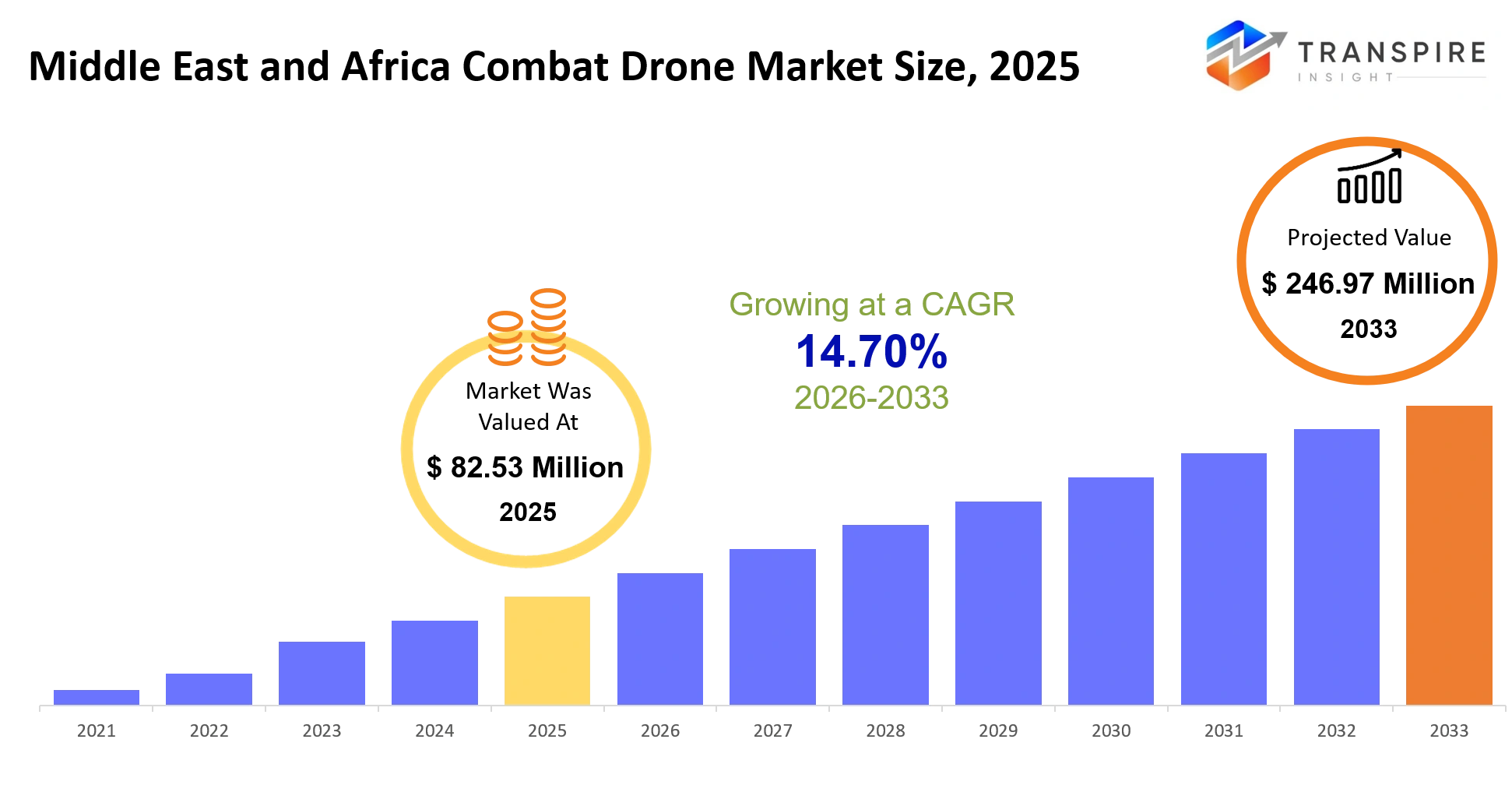
Middle East and Africa Combat Drone Market Summary
The Middle East and Africa Combat Drone Market was valued at USD 82.53 Million in 2025. It is forecast to reach USD 246.97 Million by 2033. That is a CAGR of 14.70% over the period.
The Middle East and Africa Combat Drone Market is basically helping today’s military operations happen, by using unmanned systems that can carry weapons plus intelligence capabilities , and then they do things like surveillance, precision strikes, border monitoring, target tracking, and tactical reconnaissance, all while avoiding sending people straight into the worst parts of the battlefield. In practice these unmanned platforms have turned into crucial tools for defense teams that need persistent situational awareness across wide and often complicated operational landscapes.
In the last five years , the market moved away from simpler remotely piloted setups and toward more independent combat platforms , with artificial intelligence, upgraded sensing suites , and networked combat features. Ongoing regional security tensions—especially around the Middle East and North Africa—pushed procurement programs faster, and also encouraged governments to build up stronger local defense production capacity. Meanwhile, armed forces are looking for longer endurance, lower operating expenses, and quicker decision cycles, so combat drones are taking over certain parts of what used to be manned missions. That shift is then increasing procurement spending, backing technology partnerships, and opening up repeat revenue chances across platform manufacturing , software integration, upkeep , and mission support services.
Key Market Insights
- The Middle East and Africa Combat Drone Market is seeing steady tailwinds from ongoing defense modernization plans across Gulf states and a few picked African countries. It’s kind of like, the momentum keeps going in a quieter way, even if timelines shift here and there.
- In terms of regional size, Middle East countries take the lead, with a major slice of demand. This is mostly tied to higher defense spending and the push toward domestic UAV manufacturing efforts, not just imports.
- Africa looks like the fastest mover, because border security programs and counterinsurgency operations keep expanding through 2033. So yeah, demand is likely to pick up rather than flatten.
- When you look at the product side, UCAVs are the main choice, since they cover multiple missions. They can handle reconnaissance, precision strikes, and electronic warfare type tasks all in one umbrella, basically.
- MALE drones sit in the second place, mainly due to extended endurance and that wide operational flexibility that commanders like. They can stay up longer and shift roles without too much drama.
- For drone categories, loitering munitions are growing the quickest. Armed forces seem to be leaning into cost-efficient precision engagement systems, and they want results that feel measurable.
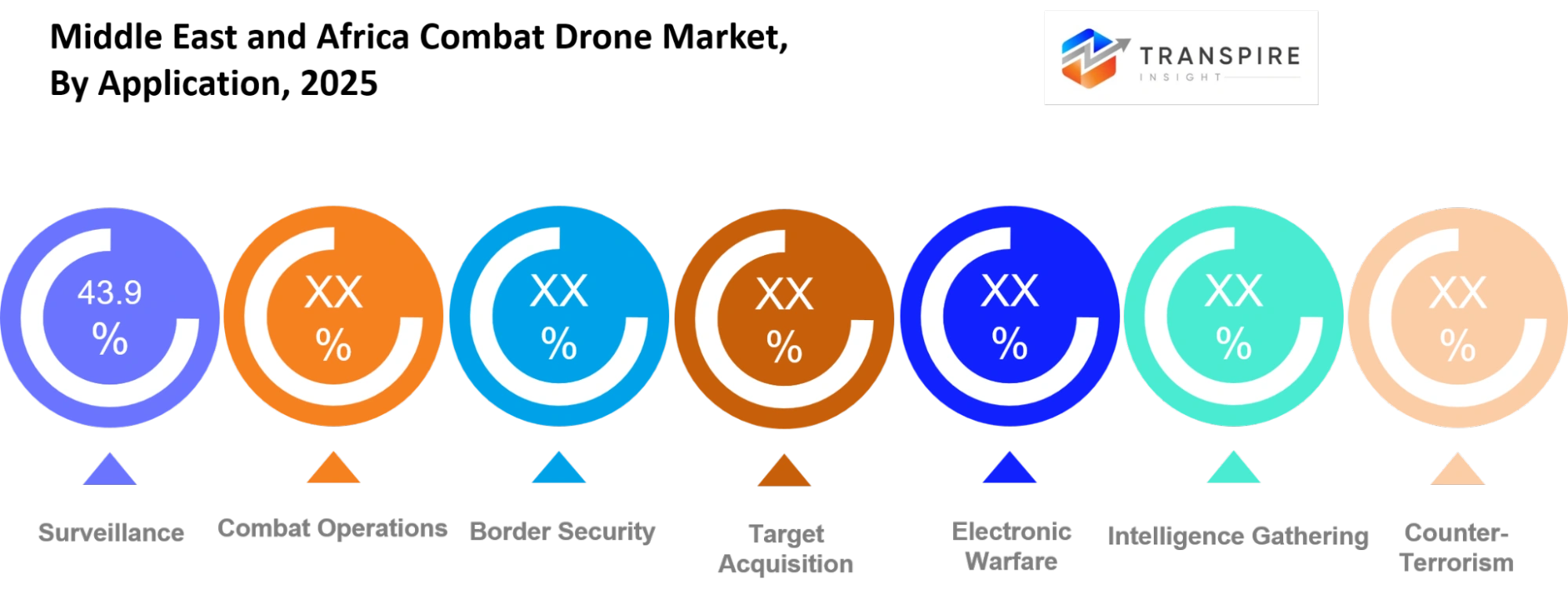
- As for applications, surveillance remains the leading segment, driven by nonstop intelligence collection and threat monitoring needs. Combat operations, though, are adopting at the quickest pace as military units fold unmanned systems into frontline missions.
- On the end-user map, Army forces take the largest share, because they deploy a lot across both tactical and strategic operations. Special forces plus intelligence agencies are also expanding quickly, they’re adopting advanced autonomous systems more aggressively.
- Competition is getting more intense around AI integration, autonomous navigation, swarm technologies, and long-range strike capabilities. Big players in this space include General Atomics, Baykar, IAI, Elbit Systems, Lockheed Martin, and EDGE Group.
What are the Key Drivers, Restraints, and Opportunities in the Middle East and Africa Combat Drone Market?
Defense modernization has kind of emerged as the strongest driving force behind market expansion, and it’s not just by a little bit. Military organizations increasingly require persistent intelligence, precision engagement, and long-duration surveillance abilities, usually at lower operating costs than conventional aircraft. Meanwhile, improvements in satellite communications, sensor fusion, autonomous navigation, and precision-guided munitions have improved combat drone effectiveness a lot, to the point where it feels like the bar has shifted. Because of that, governments across the Gulf region have expanded procurement budgets and, sort of in parallel , launched domestic production initiatives. These investments directly boost platform acquisitions, software integration contracts, maintenance services , and training programs, so the revenue streams stay active across the entire value chain.
Still, export restrictions, technology transfer controls , and complicated regulatory frameworks remain the most important structural hurdle. Advanced combat drones depend on sophisticated sensors, propulsion systems, encrypted communications , and weapons integration technologies, and those pieces are still heavily subject to international controls. A lot of regional buyers end up dealing with lengthy approval processes, plus limited access to certain higher-end capabilities. This limitation tends to slow procurement timelines , increases acquisition costs, and it also restricts technology diffusion across defense markets that are still emerging.
The strongest future opportunity feels like it’s tied to AI-enabled autonomous combat ecosystems. Military organizations increasingly want integrated platforms that can coordinate reconnaissance, targeting, electronic warfare, and strike missions through one unified operational network. Investments in swarm technologies, collaborative combat aircraft concepts , and autonomous mission management systems are moving forward faster than before.
What Has the Impact of Artificial Intelligence Been on the Middle East and Africa Combat Drone Market?
Artificial intelligence has kind of turned combat drone work from “remote control only” type missions into pretty automated military systems that can chew through huge piles of battlefield information, real time. Today’s platforms commonly rely on AI algorithms to spot targets , sort out threats, decide what matters first , and help the operator make sense of everything faster. At the same time automated flight control kind of smooths out navigation routes, drops the workload on the pilot, and stretches mission endurance too.
Machine learning models are also used for predictive upkeep, by watching engine behavior, sensor readings, battery status, and how parts slowly get worn out over time. Because of that, defense groups can cut down on surprise downtime, increase fleet readiness, and usually lower overall service costs. On top of it, AI based image processing can review surveillance video at a much quicker pace and flag likely threats sooner than manual watching methods.
Beyond that, more advanced autonomy can enable swarm style operations, coordinated targeting, and electronic warfare tasks. Newer systems are folding in AI driven mission preparation plus adaptive reaction features, and this can boost effectiveness when the situation changes fast, mid engagement. More recently, industry updates have pointed to rising focus on AI enabled loitering munitions and autonomous strike systems.
Still, even with all the upside, the integration expenses are not small. Military organizations often run into problems with cybersecurity obligations, interoperability with older platforms, and not enough training datasets for the really complicated battlefield conditions. Those issues, in practice, tend to keep wider deployment of fully autonomous combat abilities from happening as quickly as people would like.
Key Market Trends
- Since 2021, governments have kind of shifted procurement priorities away from just surveillance drones, more toward multi role armed platforms that can do precision engagement and not only watch.
- AI enabled target recognition systems, which used to be sort of experimental programs, have moved into operational deployments across several military forces, almost overnight, you know.
- Regional manufacturers also started expanding domestic production capabilities, to reduce dependence on foreign defense suppliers and keep things inside.
- Meanwhile, loitering munition adoption picked up faster after battlefield demonstrations showed lower-cost precision strike benefits , compared to what some buyers expected.
- Military buyers are now increasingly asking for integrated weapons, sensors, and command systems— not standalone drone platforms alone.
- And during 2025 and 2026, cross border defense partnerships grew too, to accelerate technology transfer as well as platform integration, without too much delay.
- Swarm technology testing advanced a lot during 2026, with new autonomous coordination capabilities moving into demonstration phases.
- Longer range precision strike needs then pushed integration of advanced guided munitions onto MALE and UCAV platforms.
- At the same time, counter drone technologies gained more strategic weight as armed forces adjusted to these emerging UAV threats in the field.
- And yes, indigenous defense investment increased across Gulf countries, because governments wanted more technological self-sufficiency, rather than relying on others.
Middle East and Africa Combat Drone Market Segmentation
By Drone Type
Fixed-Wing Drones have an important role in long-duration surveillance and reconnaissance missions, mainly because they sip fuel efficiently and can stay out for extended periods. Rotary-Wing Drones, on the other hand offer true vertical takeoff, and they tend to work well in dense city settings and in confined spaces. Hybrid Drones mix longer endurance with more adaptable launch and recovery options, which makes them a pretty appealing choice for multi-role tasks. Loitering Munitions also keep drawing more interest, because they bring precise strike ability, and they usually come with lower deployment costs.
UCAVs are a big category here since they blend surveillance and strike actions into one aircraft. Tactical Drones back battlefield awareness and the needs of front-line operations, largely through quick start and rapid deployment. MALE Drones bring longer time on station, high-altitude capability, and a wide mix of mission roles, from monitoring to combat. Then there are the Others, which cover specialized autonomous systems made for electronic warfare, communication relay, and a range of experimental military uses.
By Application
Surveillance still is a kind of foundational application, mainly because ongoing monitoring help with operational planning and threat evaluation tasks. Combat Operations use armed drones for those precision strikes and also for force protection, plus the whole tactical engagement missions side of things. Border Security programs lean on unmanned systems for persistent observation across far off and hard terrain, you know the kind that makes traditional patrols difficult. Then Target Acquisition benefits from more advanced sensor technologies, which raise the precision engagement effectiveness overall.
Electronic Warfare missions are starting to include unmanned platforms that can do jamming, signal intelligence gathering, and communication disruption, at the same time, kind of. Intelligence Gathering supports military planning by means of real time information collection and analysis. For Counter Terrorism, drones are used to watch hostile activities while cutting down on operational risk and exposure. Other uses also pop up, like disaster response support, communication relay functions, and specialized defense tasks that do not fit neatly in one bucket.
By Range
Short-range systems back localized tactical efforts, with quick launch timing and some operational pliability. Medium-range platforms tend to juggle endurance along with mobility needs, especially for regional security work. Long-range drones provide more time-on-station type surveillance, so strategic runs can happen over larger patches of land. Extended-range systems do persistent intelligence plus strike tasks, even when it goes past the usual operational boundaries.
BLOS abilities let operators run missions without staying directly under visual control, using satellite links and more advanced communication networks. Strategic platforms usually lean toward high-value intelligence and long-duration requirements. Tactical systems mostly emphasize rapid reaction and what feels like battlefield adaptability. Other variants include mission specific setups tuned for specialized operational environments, with different payload arrangements and operating rhythms.
By End User
Army forces end up accounting for a lot of utilization since land operations need constant intelligence , surveillance, reconnaissance, and strike ability; there's no real pause. The Air Force organizations usually field advanced unmanned systems to work alongside regular aviation assets and to stretch operational reach farther out, you know. Navy forces then bring combat drones into the mix for maritime watch, coastal monitoring, and assorted naval mission support, not just one job. Border Security agencies rely on unmanned platforms to keep an eye on remote and fragile areas where it’s hard to get personnel there quickly.
Defense Organizations still keep investing in advanced autonomous capabilities to push military readiness up and to improve operational efficiency at the same time. Special Forces increasingly deploy compact and mission-adaptable systems during high-risk operations , like sudden raids or tense recoveries. Intelligence Agencies also use advanced drones for collecting strategic information and for supporting national security objectives in a more direct way. Others involve homeland security entities , along with specialized government defense units that handle particular threats and regions.
What are the Key Use Cases Driving the Middle East and Africa Combat Drone Market?
Surveillance and intelligence gathering still show up as the most important use cases, more or less. For military organizations, it tends to mean continuous monitoring of borders, strategic infrastructure, conflict zones, and also those remote operational areas that are hard to reach. With persistent aerial coverage commanders can spot threats, follow movements and adjust mission planning, while personnel stays safer and is kept to less exposure overall.
Combat operations are a pretty fast-growing application space too. Armed forces are using unmanned systems more and more, not just for precision strikes, but for target acquisition and general battlefield support type tasks. Border security agencies and special operations units also rely on advanced drones, they watch infiltration routes, help with quick response activities, and run counter-terrorism operations even when the terrain is difficult.
Newer and emerging uses are starting to include autonomous swarm missions, electronic warfare activities, and collaborative combat aircraft ideas. AI-enabled drone teams that share intelligence and coordinate attacks are drawing noticeable investment attention. On top of that, advanced maritime security and critical infrastructure protection still look like they have real long-term promise.
|
Report Metrics |
Details |
|
Market size value in 2025 |
USD 82.53 Million |
|
Market size value in 2026 |
USD 94.58 Million |
|
Revenue forecast in 2033 |
USD 246.97 Million |
|
Growth rate |
CAGR of 14.70% from 2026 to 2033 |
|
Base year |
2025 |
|
Historical data |
2021 - 2024 |
|
Forecast period |
2026 - 2033 |
|
Report coverage |
Revenue forecast, competitive landscape, growth factors, and trends |
|
Regional scope |
United States; Canada; Mexico; United Kingdom; Germany; France; Italy; Spain; Denmark; Sweden; Norway; China; Japan; India; Australia; South Korea; Thailand; Brazil; Argentina; South Africa; Saudi Arabia; United Arab Emirates |
|
Key company profiled |
General Atomics, Baykar, IAI, Elbit Systems, Boeing, Lockheed Martin, Northrop Grumman, BAE Systems, RTX, Leonardo, Thales, Saab, Airbus Defence, EDGE Group, AeroVironment. |
|
Customization scope |
Free report customization (country, regional & segment scope). Avail customized purchase options to meet your exact research needs. |
|
Report Segmentation |
By Drone Type (Fixed-Wing Drones, Rotary-Wing Drones, Hybrid Drones, Loitering Munitions, UCAVs, Tactical Drones, MALE Drones, Others); By Application (Surveillance, Combat Operations, Border Security, Target Acquisition, Electronic Warfare, Intelligence Gathering, Counter-Terrorism, Others); By Range (Short, Medium, Long, Extended, BLOS, Strategic, Tactical, Others); By End User (Army, Air Force, Navy, Border Security, Defense Organizations, Special Forces, Intelligence Agencies, Others). |
Which Regions are Driving the Middle East and Africa Combat Drone Market Growth?
The Middle East kind of represents the main regional market, like really dominant. With strong defense spending, ongoing military modernization programs,and strategic security priorities, adoption of combat drone technologies keeps getting pushed forward. Countries such as Saudi Arabia, the United Arab Emirates, and Israel continue to put money into homegrown manufacturing, research strengths, and more advanced autonomous systems. A mature defense ecosystem and already-established procurement programs also make it easier to keep that regional leadership in place.
Israel is also a major factor, mostly because of technological innovation and a defense manufacturing setup that is export oriented. Instead of being driven mainly by huge procurement demand, growth is more supported by research excellence, advanced sensor development, and operational experience. Ongoing investment in electronic warfare, autonomous systems, and precision guided technologies helps keep the market expanding in a stable way. Plus, strong export activity helps keep regional revenue generation more solid.
Africa is expected to show the highest growth momentum across the forecast period. Border security headaches, counterinsurgency needs,and military modernization initiatives have led to more investment in unmanned systems. Several governments are widening surveillance capabilities while also upgrading defense infrastructure and improving operational readiness. All that momentum basically opens up new options for suppliers, technology providers, and investors looking for long-term market exposure between 2026 and 2033.
Who are the Key Players in the Middle East and Africa Combat Drone Market and How Do They Compete?
Competition still looks like it’s pretty moderately concentrated, mostly around those established defense manufacturers with serious technological capabilities, solid export networks and a lot of operational experience. Over time, winning seems to hinge more and more on autonomous functionality, endurance performance, weapons integration, sensor sophistication, and even lifecycle support services. Also, a number of regional governments tend to favor suppliers who are ready to support local manufacturing plus technology transfer programs, kind of like it’s part of the deal.
General Atomics sorta stands out because of its long-endurance MQ-9 platforms, and because it keeps pushing toward continuous mission capability expansion. Some of their newer efforts include advanced surveillance configurations, along with expanded strike capabilities, and that basically improves operational flexibility in practice.
Baykar meanwhile leans into cost-effective combat systems, AI integration, and growth that’s driven hard by exports. Lately they’ve been working on autonomous swarm technologies, plus they expanded weapons integration partnerships, which helps strengthen overall mission effectiveness.
EDGE Group tries to build integrated defense ecosystems using precision-guided munitions, autonomous systems, and strategic partnerships. The cooperation with Baykar, helps platform capabilities improve, and it also broadens market reach.
IAI and Elbit Systems keep their competitive edge through advanced sensors, electronic warfare capabilities, and extensive operational experience. At the same time, Lockheed Martin, Northrop Grumman, and Leonardo continue investing into next-generation autonomous and collaborative combat technologies, which is more or less where the future is heading.
Company List
- General Atomics
- Baykar
- IAI
- Elbit Systems
- Boeing
- Lockheed Martin
- Northrop Grumman
- BAE Systems
- RTX
- Leonardo
- Thales
- Saab
- Airbus Defence
- EDGE Group
- AeroVironment
Recent Development News
"In May 2026, Baykar and EDGE Group entered a strategic partnership and signed agreements to integrate AL TARIQ precision-guided munitions onto the Bayraktar AKINCI combat drone. The agreement strengthens UAV strike capabilities and expands integrated defense offerings for export markets.
Source: https://thedefensepost.com/
"In March 2026, Baykar launched the K2 Kamikaze UAV with AI-enabled swarm capabilities. The platform demonstrates growing industry focus on autonomous operations and coordinated unmanned combat missions.
Source: https://breakingdefense.com/
"In November 2025, General Atomics confirmed discussions with Saudi Arabia regarding a potential acquisition package involving up to 130 MQ-9B drones. The proposed deal highlights expanding regional investment in advanced long-endurance combat and surveillance platforms.
Source: https://www.armyrecognition.com/
What Strategic Insights Define the Future of the Middle East and Africa Combat Drone Market?
The market seems to be shifting toward much more autonomous, networked combat ecosystems , where drones are not really “just” standalone platforms anymore, but more like one integrated piece inside wider defense architectures . In practice, Artificial intelligence, sensor fusion , autonomous mission management, and also precision-guided weapons integration will end up shaping how companies compete. And the whole push for defense self sufficiency across the Gulf region, that kind of initiative will likely speed up homegrown manufacturing, plus technology partnerships too.
There’s also a more low key risk, not everyone talks about it , where you get growing dependence on complex electronics, advanced semiconductors, and secure communications technologies . If a supply chain gets disrupted, or export restrictions hit those components , then deployments can get pushed out and acquisition costs can climb. On top of that, when technology is concentrated with only a few suppliers , it creates a kind of strategic weak point, because you have less flexibility.
On the opportunity side, an emerging angle is autonomous swarm warfare and cooperative combat aircraft programs. If investments start early, there can be real long term advantages, especially as military doctrines keep evolving. Market actors might want to focus on partnerships that cover AI software, autonomous mission systems , and localized production capabilities, since that should help strengthen competitiveness, and also improve access to the next round of procurement programs.
Middle East and Africa Combat Drone Market Report Segmentation
By Drone Type
- Fixed-Wing Drones
- Rotary-Wing Drones
- Hybrid Drones
- Loitering Munitions
- UCAVs
- Tactical Drones
- MALE Drones
- Others
By Application
- Surveillance
- Combat Operations
- Border Security
- Target Acquisition
- Electronic Warfare
- Intelligence Gathering
- Counter-Terrorism
- Others
By Range
- Short
- Medium
- Long
- Extended
- BLOS
- Strategic
- Tactical
- Others
By End User
- Army
- Air Force
- Navy
- Border Security
- Defense Organizations
- Special Forces
- Intelligence Agencies
- Others
Frequently Asked Questions
Find quick answers to common questions.
The expected Middle East and Africa Combat Drone Market size for the market will be USD 66.8 Million in 2033.
Key segments for the Middle East and Africa Combat Drone Market are By Drone Type (Fixed-Wing Drones, Rotary-Wing Drones, Hybrid Drones, Loitering Munitions, UCAVs, Tactical Drones, MALE Drones, Others); By Application (Surveillance, Combat Operations, Border Security, Target Acquisition, Electronic Warfare, Intelligence Gathering, Counter-Terrorism, Others); By Range (Short, Medium, Long, Extended, BLOS, Strategic, Tactical, Others); By End User (Army, Air Force, Navy, Border Security, Defense Organizations, Special Forces, Intelligence Agencies, Others).
Major Middle East and Africa Combat Drone Market players are General Atomics, Baykar, IAI, Elbit Systems, Boeing, Lockheed Martin, Northrop Grumman, BAE Systems, RTX, Leonardo, Thales, Saab, Airbus Defence, EDGE Group, AeroVironment.
The Middle East and Africa Combat Drone Market size is USD 82.53 Million in 2025.
The Middle East and Africa Combat Drone Market CAGR is 14.70% from 2026 to 2033.
- General Atomics
- Baykar
- IAI
- Elbit Systems
- Boeing
- Lockheed Martin
- Northrop Grumman
- BAE Systems
- RTX
- Leonardo
- Thales
- Saab
- Airbus Defence
- EDGE Group
- AeroVironment
About the Authors

Tejashri Dhatrak
I am Tejashri Dhatrak, a Senior Research Analyst at Transpire Insight, specializing in the Aerospace and Defence sector. My work focuses on analyzing industry trends, defence technologies, market developments, and emerging innovations that shape the global aerospace and security landscape. At Transpire Insight, I research complex topics, evaluate credible sources, and transform technical insights into accurate, well-structured, and easy-to-understand content for industry professionals and decision-makers. My goal is to provide reliable, research-backed information that helps readers stay informed about defence capabilities, aerospace advancements, strategic developments, and the evolving dynamics of the global defence ecosystem.

Chakradhar Khansole
Chakradhar serves as the Research Director at Transpire Insight, bringing over 8 years of experience in technology, innovation, and strategic market intelligence. He specializes in transforming complex market data into actionable business insights that enable organizations to make informed, growth-oriented decisions. Recognized for his strategic vision and analytical expertise, Chakradhar leads high-impact research initiatives, delivering comprehensive market assessments, competitive intelligence, and forward-looking industry analysis.
Recently Published Reports
-
Apr 2026
Aerospace Fluoropolymers Market
Aerospace Fluoropolymers Market Size, Share & Analysis Report By Type (PTFE, FEP, PFA, ETFE, and Others), By Application (Electrical Insulation, Seals & Gaskets, Coatings, and Others), By End User (Commercial Aviation, Military Aviation, General Aviation, and Others), and Geography (North America, Europe, Asia-Pacific, Middle East and Africa, South and Central America), 2021 - 2031
-
Apr 2026
Airborne SATCOM System Market
Airborne SATCOM System Market Size, Share & Analysis Report By Type (SATCOM Terminals, Transceivers, Airborne Radio, Modems and Routers, SATCOM Radomes, and Other), By Application (Government and Defense and Commercial), and Geography (North America, Europe, Asia-Pacific, Middle East and Africa, South and Central America), 2021 – 2031
-
Apr 2026
Ship Leasing Market
Ship Leasing Market Size, Share & Analysis Report By Vessel Type (Container Ships, Bulk Carriers, Tankers, and Specialized Vessels), By Lease Duration (Short-Term Lease (Less than 1 year), Medium-Term Lease (1-5 years), and Long-Term Lease (More than 5 years)), By Lease Type (Bareboat Charter, Time Charter, Financial Lease, and Others), By End-User Industry (Oil and Gas, Manufacturing and Industrial, Automotive, Agriculture and Food, Retail and Consumer Goods, and Others), and Geography (North America, Europe, Asia-Pacific, Middle East and Africa, South and Central America), 2021 – 2031
-
Apr 2026
Thread Rolling Dies Market
Thread Rolling Dies Market Size, Share & Analysis Report By Type (Flat Thread Rolling Dies, Circular (Cylindrical) Dies, Tangential Thread Rolling Dies, Planetary Thread Rolling Dies, and Other Types), By Material Type (High-Speed Steel (HSS), Carbide, Tool Steel, Alloy Steel, and Other Specialized Alloys), By Distribution Channel (Direct Sales, Distributors and Dealers, and Online Platforms), By Application (Automotive Industry, Aerospace and Defense, Construction and Infrastructure, Industrial Machinery, Electronics and Electrical Components, Medical Devices, and Fastener Production), and Geography (North America, Europe, Asia-Pacific, Middle East and Africa, South and Central America), 2021 – 2031
Our Clients





