Asia Pacific Artificial Intelligence In Military Market Size & Forecast:
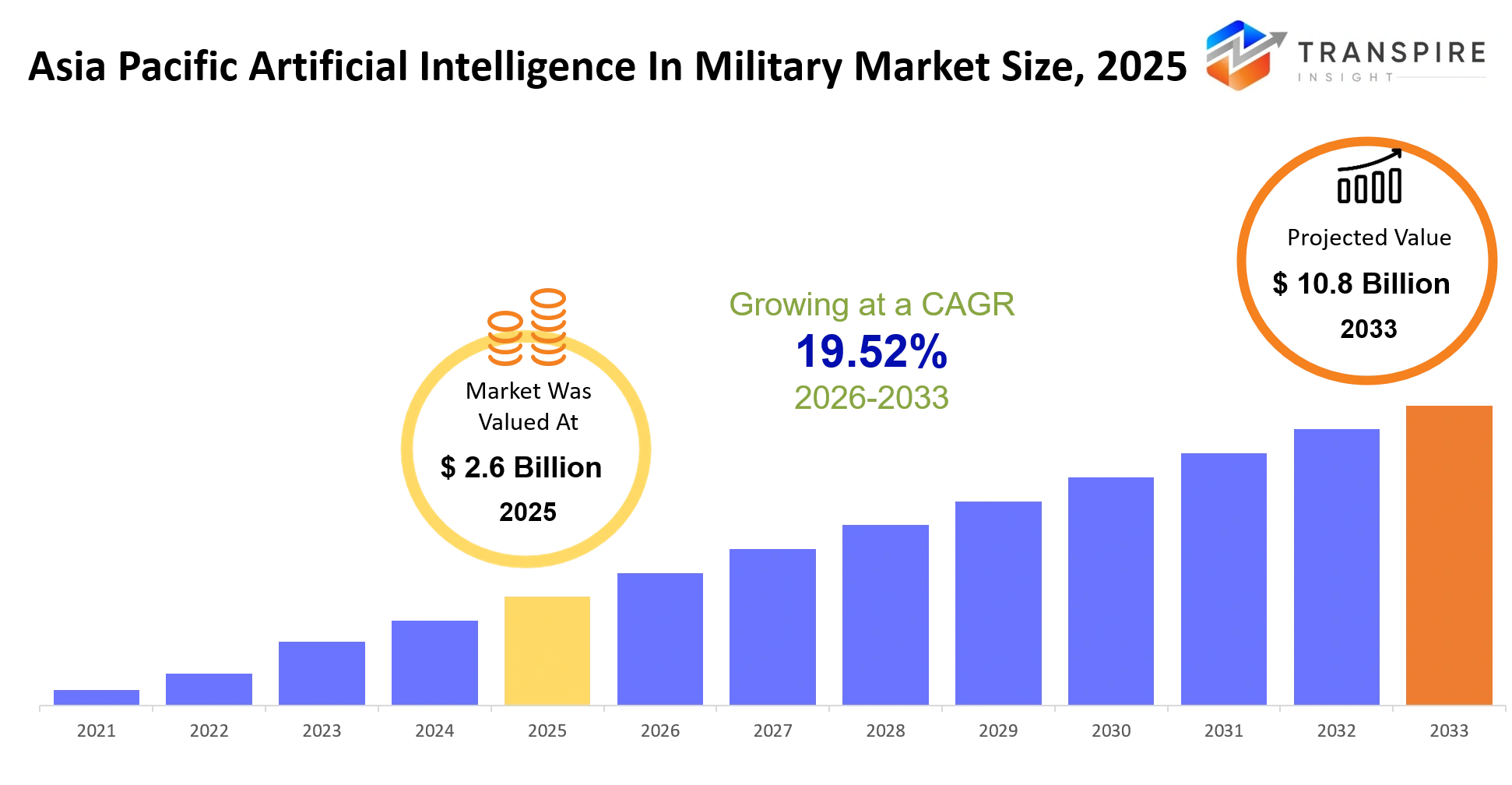
- Asia Pacific Artificial Intelligence In Military Market Size 2025: USD 2.6 Billion
- Asia Pacific Artificial Intelligence In Military Market Size 2033: USD 10.8 Billion
- Asia Pacific Artificial Intelligence In Military Market CAGR: 19.52%
- Asia Pacific Artificial Intelligence In Military Market Segments: By Technology (Machine Learning, Computer Vision, NLP, Autonomous Systems, Predictive Analytics, Others); By Platform (Airborne, Naval, Land-based, Space, Others); By Application (Surveillance, Cybersecurity, Logistics, Combat Systems, Intelligence, Others); By End User (Army, Navy, Air Force, Defense Agencies, Others).
To learn more about this report,  Download Free Sample Report
Asia Pacific Artificial Intelligence In Military Market Summary
The Asia Pacific Artificial Intelligence In Military Market was valued at USD 2.6 Billion in 2025. It is forecast to reach USD 10.8 Billion by 2033. That is a CAGR of 19.52% over the period.
The Asia Pacific Artificial Intelligence in Military Market entails the use of various AI technologies to perform defense functions like surveillance, intelligence processing, autonomous systems operation, battlefield decision support, cybersecurity, and logistics planning. Through these functions, AI makes it easier for military organizations to analyze enormous data sets quickly while enhancing situational awareness. During the past five years, the market has seen a change in structure that saw the adoption of experimental AI initiatives being replaced by operational deployments of the same across defense organizations. The governments in question have been incorporating AI into command control systems, autonomous unmanned vehicles, and threat detection systems. One of the key factors that have accelerated this move is the increased political tension within the Indo-Pacific region, prompting the various parties to invest heavily in defense capabilities through enhanced military readiness. With the need for quick decision-making and high efficiency among other things, defense technology partnerships as well as procurements will see more revenue being realized by AI solution providers.
Key Market Insights
- The Asia Pacific Artificial Intelligence In Military Market is anticipated to grow significantly until 2030 owing to the adoption of AI-based Command & Control & Intelligence (C2I).
- East Asia commands dominance in the Asia Pacific market share, with more than 45% market share forecasted for 2025, thanks to substantial investments in defense technologies.
- Southeast Asia is seen growing at the highest CAGR during the forecast period on account of increasing military modernization initiatives and rising use of autonomous military vehicles.
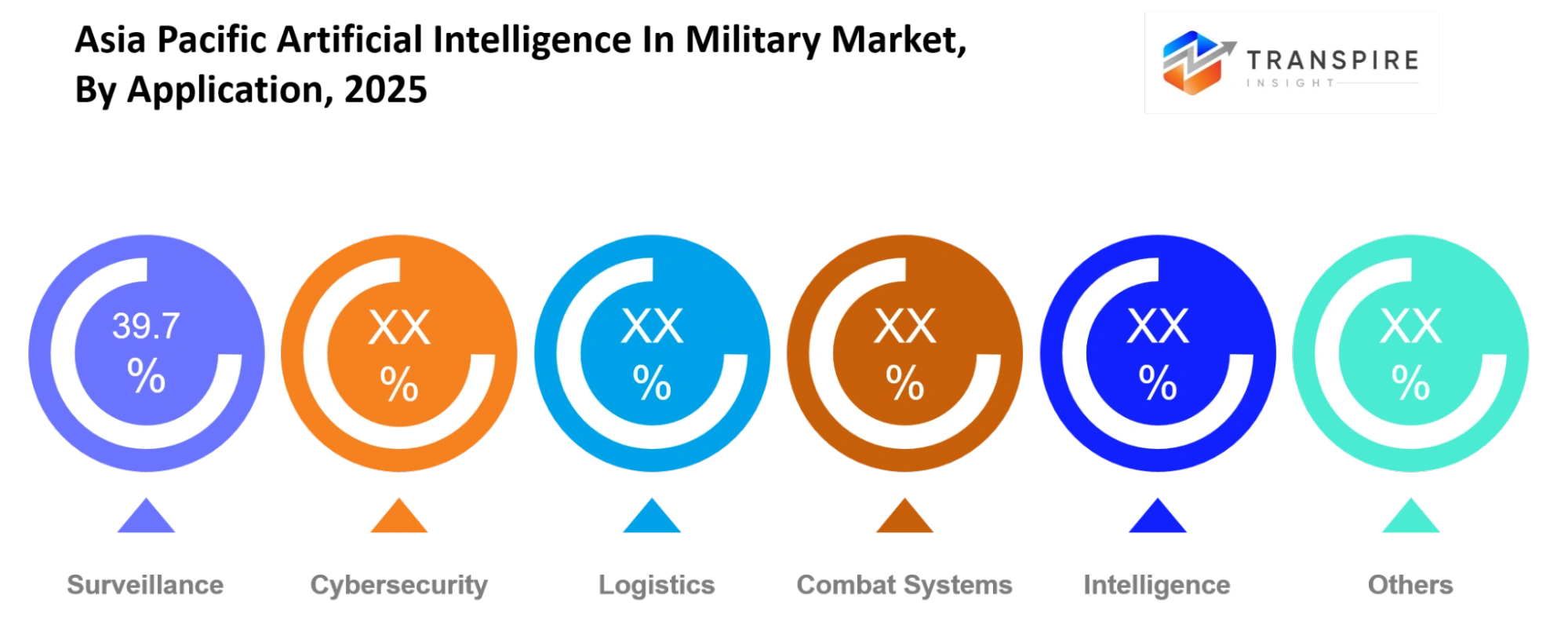
- AI-powered surveillance and reconnaissance solutions occupy the largest share of the market and constitute almost 30% of the industry size in 2025.
- Autonomous weapons & unmanned solutions emerge as the second-most lucrative solution segments, owing to increasing defense budget spend across Asia Pacific.
- The cybersecurity & threat intelligence solutions are the fastest-growing solution segments during 2025-2030 period owing to increasing cyber warfare capabilities.
- Intelligence, Surveillance & Reconnaissance (ISR) remains the most preferred applications segment, commanding nearly 35% of the market share.
- The decision support & predictive analysis applications emerge as fast-rising segments, as the military seeks to enhance decision-making process.
- The defense sector accounts for more than 70% of the market share in 2025, thanks to their efforts to enhance national security and preparedness.
- Major firms like Lockheed Martin, RTX, Northrop Grumman, BAE Systems, Thales, and Hanwha Aerospace are working hard to increase their market share through AI technology, collaborations, expansion into new regions, and autonomous defense systems.
What are the Key Drivers, Restraints, and Opportunities in the Asia Pacific Artificial Intelligence In Military Market?
Driver
The main reason the Asia Pacific Artificial Intelligence in Military Market is growing fast is that military operations now need to handle a lot of data. This data is too much for people to process on their own. The Asia Pacific Artificial Intelligence in Military Market is also growing because of the situation in the Indo-Pacific region. Countries are spending money on defense and Artificial Intelligence in Military to modernize their military operations. Artificial Intelligence in the Military helps soldiers do their jobs better like finding targets and understanding threats. The Asia Pacific Artificial Intelligence in Military Market is important for countries to use Artificial Intelligence in Military to stay
Restraint
One thing that could slow down the growth of the Asia Pacific Artificial Intelligence in Military Market is that it is hard to use Artificial Intelligence in Military with military systems. Many countries still use military equipment and ways of communicating. This makes it difficult to use Artificial Intelligence in Military in the Asia Pacific Artificial Intelligence in Military Market.
Opportunity
A big trend that could help the Asia Pacific Artificial Intelligence in Military Market is the use of cooperative military systems. Countries like Japan, South Korea and Australia are buying drones and other unmanned systems that can work on their own. These systems can watch over the seas and shores without people being involved. The Asia Pacific Artificial Intelligence in Military Market will benefit from these systems, which can work faster and better than before thanks to sensors and the ability to process data in real-time. The Asia Pacific Artificial Intelligence in Military Market is going to be important for countries to use Artificial Intelligence in the Military to work with these systems.
What Has the Impact of Artificial Intelligence Been on the Asia Pacific Artificial Intelligence In Military Market?
AI technology, along with other advanced digital innovations, is reshaping the conduct of military operations within the Asia Pacific through automation and increased efficiency in decision-making processes. AI-enabled command and control systems are employed to automate the processing of data from satellites, radar arrays, unmanned systems, and sensors in battlefields. These solutions decrease the workload of human operators and assist military formations in threat identification and response coordination.
Moreover, armed forces are relying on machine learning techniques to improve their ability to anticipate problems and take preemptive actions. Predictive maintenance systems based on AI are used to analyze data on the condition of different combat vehicles – planes, ships, and cars. Thus, they can detect possible malfunctions in advance and avoid downtime.
Such developments have had a significant impact on military operations. Defense organizations reported an increase in responsiveness, situational awareness, and readiness rate of assets. Machine learning models are also applied in logistics planning and intelligence gathering, resulting in optimized resource allocation.
Key Market Trends
- Since 2020, AI budgets have been moved from experimental pilots to full-fledged deployments in command, control, and intelligence functions for the defense sector.
- Military purchases have turned towards drones and unmanned vehicles that operate independently; their use has risen rapidly in Japan, South Korea, Australia, and India.
- The use of intelligent platforms based on AI technologies has substituted traditional manual processes used for data analysis, reducing the timeframe from several hours to minutes.
- Cyber defense is an important area of investment since 2021 due to increased vulnerability of military information systems to sophisticated digital attacks.
- Moreover governments are now asking their partners to develop AI solutions which is really encouraging innovation in their own countries.
- Defense companies like Lockheed Martin, RTX, Thales and Hanwha Aerospace are forming partnerships to win contracts in this region.This is a move for them.
- There has been a jump in edge computing projects that use AI for military operations since 2022It's clear that AI is becoming more important.
- The military is using AI solutions along with satellite images and surveillance to get better at finding targets.
- They want to make sure they are accurate.The way defense companies buy things is. Now they are more interested in software solutions.This is a shift from what they used to buy.
- Since 2023 there has been focus on human-machine teaming programs in the region.The idea is to move from using machines for help to actually working together on the battlefield.This is a change.
Asia Pacific Artificial Intelligence In Military Market Segmentation
By Technology
Technology is an important element that helps to enhance military capabilities in the Asia Pacific region. With technologies such as machine learning, computer vision, natural language processing, autonomous technology, prediction analytics, among others, defense agencies are able to analyze the collected military data faster and more accurately. The use of technologies such as machine learning will play a crucial role in helping to predict future events.
Technological innovation is becoming an important priority for militaries, and therefore the use of predictive analysis has become common in order to achieve certain tasks. For instance, technologies like computer vision and machine learning have helped in improving image analysis and making decisions respectively. The use of natural language processing helps to conduct intelligence analysis.Platform Category:
By platform
The platform category comprises airborne, naval, land-based, space and other military platforms that make use of innovative AI capabilities. Airborne platforms continue to be significant owing to the extensive usage of AI in surveillance planes, drones, and other reconnaissance-related activities. Naval platforms, as well as land-based platforms, still continue to adopt AI technology to support monitoring and threat detection.
Modernization initiatives by the Defense Department facilitate increased adoption of technology solutions. The Defense forces require integrated systems that aid in boosting situational awareness. Adoption of autonomous platforms and defense systems drives innovation within the platform segment. Investment in digital transformation will drive growth in the air, naval, land, and space segments.
By Applications
The application section discusses the uses of intelligent technologies within areas like surveillance, cybersecurity, logistics, combat systems, intelligence, among others. Surveillance continues to be an important area in which intelligent technologies are used by the military as constant surveillance of borders, strategic resources, and operational areas is needed. The development of cybersecurity applications helps protect military systems from potential digital attacks. Logistics and intelligence functions continue to make use of intelligent technologies that facilitate data processing and automation processes.
There is increased use of intelligent technologies in combat systems through improved operations and coordination in targeting, mission planning, and awareness on the battlefield. Advancements in digital technologies present new chances for more applications of intelligent technologies in the military sector.
To learn more about this report, Download Free Sample Report
By End User
End user segments include army, navy, air force, defense agencies, and other military organizations. The army sector is responsible for high adoption owing to the increased need for battlefield management, surveillance, logistics, and operational plans. Navy forces are increasingly using intelligent systems to enhance their security and fleet operations while air forces have been able to incorporate advanced technologies in their operations.
Defense agencies play a big part in driving adoption through the use of advanced analytical solutions in cyber security, intelligence, and strategic planning. Cooperation between various military units results in higher technology adoption levels. Increasing security risks keep shaping the purchasing decisions for defense organizations.
What are the Key Use Cases Driving the Asia Pacific Artificial Intelligence In Military Market?
The use of Artificial Intelligence for things like surveillance and intelligence will be really important for groups in this area. Military groups use Artificial Intelligence systems to look at information that is coming in from satellites, drones and other devices that can see things from away. This helps the military groups know what is going on and can react fast if there is a problem. Artificial Intelligence will help military groups deal with security issues at the borders and other security problems in the area. Artificial Intelligence is useful for surveillance and intelligence because it can help keep people safe.Newer use cases in this industry are those of cybersecurity and logistics management. The digital nature of defense forces has prompted their use of sophisticated analytic tools that will aid in securing their cyber networks and protecting critical communication infrastructures. Logistics operations also stand to benefit from advanced prediction planning systems which would enable them to improve their supply chain operations.
Other emerging use cases involve autonomous battlefield systems and human-machine teams. There are various tests being conducted by defense forces on unmanned aircraft and vessels that could be used for reconnaissance purposes. There have also been advances in decision-making systems powered by artificial intelligence.
|
Report Metrics |
Details |
|
Market size value in 2025 |
USD 2.6 Billion |
|
Market size value in 2026 |
USD 3.1 Billion |
|
Revenue forecast in 2033 |
USD 10.8 Billion |
|
Growth rate |
CAGR of 19.52% from 2026 to 2033 |
|
Base year |
2025 |
|
Historical data |
2021 - 2024 |
|
Forecast period |
2026 - 2033 |
|
Report coverage |
Revenue forecast, competitive landscape, growth factors, and trends |
|
Regional scope |
Asia Pacific |
|
Key company profiled |
Lockheed Martin, RTX, Northrop Grumman, BAE Systems, Thales, Leonardo, Hanwha Aerospace, LIG Nex1, Boeing, Airbus Defence, Palantir, IBM, Microsoft, Anduril, Saab. |
|
Customization scope |
Free report customization (country, regional & segment scope). Avail customized purchase options to meet your exact research needs. |
|
Report Segmentation |
By Technology (Machine Learning, Computer Vision, NLP, Autonomous Systems, Predictive Analytics, Others); By Platform (Airborne, Naval, Land-based, Space, Others); By Application (Surveillance, Cybersecurity, Logistics, Combat Systems, Intelligence, Others); By End User (Army, Navy, Air Force, Defense Agencies, Others). |
Which Regions are Driving the Asia Pacific Artificial Intelligence In Military Market Growth?
East Asia holds the leading position in the market due to strong defense technology capabilities, substantial military budgets, and long-term government support for artificial intelligence integration. Countries such as China, Japan, and South Korea continue to invest heavily in autonomous systems, intelligence platforms, and advanced surveillance networks. A well-developed ecosystem of defense contractors, semiconductor manufacturers, software developers, and research institutions supports continuous innovation. Strong domestic production capabilities and established defense modernization programs help sustain regional leadership.
Oceania represents the second-largest contributor and differs from East Asia through a greater focus on interoperability, defense partnerships, and stable procurement planning. Australia continues to invest in artificial intelligence through long-term defense capability programs designed to strengthen intelligence, cybersecurity, and autonomous operations. Consistent government funding and close collaboration with allied defense organizations create a reliable environment for technology deployment. This steady approach supports predictable market activity and provides a stable source of revenue for defense technology providers.
Southeast Asia is emerging as the fastest-growing region as governments accelerate military modernization efforts and strengthen national security capabilities. Increased investment in surveillance systems, unmanned platforms, and digital command infrastructure has gained momentum in recent years. Rising maritime security concerns and growing defense cooperation programs have encouraged wider adoption of advanced military technologies. Growth across the region will create attractive opportunities for technology suppliers, defense contractors, and investors seeking expansion between 2026 and 2033.
Who are the Key Players in the Asia Pacific Artificial Intelligence In Military Market and How Do They Compete?
Competitive structure reveals a concentrated structure, where large-scale defense contractors compete with specialized artificial intelligence and software providers. The competition is based on product performance, ability to handle large amounts of processed data, autonomous system integration, and meeting high military specifications. Defense contractors have significant market presence due to long-term contracts and diversified portfolios within defense, while new entrants achieve success because of their unique software-driven technologies and autonomous platform integration. Competitive success implies providing effective solutions that increase efficiency and decision speed of intelligence gathering operations.
Attracting Lockheed Martin lies in its expertise in integrating artificial intelligence to command and control systems, autonomous platforms, and defense networks. Being strong in large-scale military programs enables the company to successfully introduce AI technologies to various operational environments. RTX's competitiveness derives from the integration of sensor technologies, radar capabilities, and intelligence solutions, which incorporate advanced analytic solutions with real-time data collected during combat operations. Both firms are constantly growing through developing partnerships with defense agencies, developing technology solutions, and working with military organizations of the region.
The main attraction of Palantir involves its intelligence analytics and data integration platform, which helps to process large volumes of operational data for defense agencies.
Company List
- Lockheed Martin
- RTX
- Northrop Grumman
- BAE Systems
- Thales
- Leonardo
- Hanwha Aerospace
- LIG Nex1
- Boeing
- Airbus Defence and Space
- Palantir Technologies
- IBM
- Microsoft
- Anduril Industries
- Saab
Recent Development News
In March 2026, Palantir and GE Aerospace expanded a strategic partnership focused on military aircraft readiness with artificial intelligence. The collaboration aims to improve maintenance planning, fleet availability, and operational decision-making for defense customers, strengthening AI adoption across military aviation programs.
Source: https://investors.palantir.com
In March 2026, Hanwha Aerospace entered a partnership with KRAFTON to develop physical AI-driven defense solutions and expand autonomous military technologies. The agreement includes plans for significant investment in the physical AI ecosystem and supports the development of next-generation defense platforms that combine artificial intelligence with aerospace and defense capabilities.
Source: https://www.koreaherald.com
In May 2026, Hanwha Aerospace and Hanwha Systems showcased and advanced AI-powered ISR, unmanned ground vehicle, and multi-domain defense solutions at BSDA 2026 while expanding regional partnerships. The initiative strengthens the companies’ position in AI-enabled military systems and supports broader international deployment opportunities through localization and defense collaboration programs.
Source: https://www.hanwha.com
What Strategic Insights Define the Future of the Asia Pacific Artificial Intelligence In Military Market?
The Asia Pacific Artificial Intelligence In Military Market is moving toward deeper integration of artificial intelligence across connected defense ecosystems rather than standalone applications. Over the next five to seven years, competitive advantage will increasingly depend on the ability to combine intelligence data, autonomous systems, cyber defense tools, and command networks into unified operational platforms. This shift is being driven by the growing volume of battlefield data and the need for faster decision-making in complex security environments.
One less visible risk is the concentration of advanced semiconductor production and critical AI infrastructure within a limited number of countries. Supply chain disruptions, export controls, or restrictions on advanced computing technologies could slow deployment timelines and increase system costs for defense programs across the region.
A promising opportunity is emerging in edge AI for autonomous military platforms, particularly in Southeast Asia, where defense modernization programs are accelerating. Organizations that invest early in secure, interoperable, and scalable AI architectures while building local technology partnerships will be better positioned to secure long-term defense contracts and benefit from future procurement cycles.
Asia Pacific Artificial Intelligence In Military Market Report Segmentation
By Technology
- Machine Learning
- Computer Vision
- Natural Language Processing (NLP)
- Autonomous Systems
- Predictive Analytics
- Others
By Platform
- Airborne
- Naval
- Land-based
- Space
- Others
By Application
- Surveillance
- Cybersecurity
- Logistics
- Combat Systems
- Intelligence
- Others
By End User
- Army
- Navy
- Air Force
- Defense Agencies
- Others
Frequently Asked Questions
Find quick answers to common questions.
The expected Asia Pacific Artificial Intelligence In Military Market size for the market will be USD 10.8 Billion in 2033.
Key segments for the Asia Pacific Artificial Intelligence In Military Market are By Technology (Machine Learning, Computer Vision, NLP, Autonomous Systems, Predictive Analytics, Others); By Platform (Airborne, Naval, Land-based, Space, Others); By Application (Surveillance, Cybersecurity, Logistics, Combat Systems, Intelligence, Others); By End User (Army, Navy, Air Force, Defense Agencies, Others).
Major Asia Pacific Artificial Intelligence In Military Market players are Lockheed Martin, RTX, Northrop Grumman, BAE Systems, Thales, Leonardo, Hanwha Aerospace, LIG Nex1, Boeing, Airbus Defence, Palantir, IBM, Microsoft, Anduril, Saab.
The Asia Pacific Artificial Intelligence In Military Market size is 2.6 Billion in 2025.
The Asia Pacific Artificial Intelligence In Military Market CAGR is 19.52% from 2026 to 2033.
- Lockheed Martin
- RTX
- Northrop Grumman
- BAE Systems
- Thales
- Leonardo
- Hanwha Aerospace
- LIG Nex1
- Boeing
- Airbus Defence and Space
- Palantir Technologies
- IBM
- Microsoft
- Anduril Industries
- Saab
About the Authors

Tejashri Dhatrak
I am Tejashri Dhatrak, a Senior Research Analyst at Transpire Insight, specializing in the Aerospace and Defence sector. My work focuses on analyzing industry trends, defence technologies, market developments, and emerging innovations that shape the global aerospace and security landscape. At Transpire Insight, I research complex topics, evaluate credible sources, and transform technical insights into accurate, well-structured, and easy-to-understand content for industry professionals and decision-makers. My goal is to provide reliable, research-backed information that helps readers stay informed about defence capabilities, aerospace advancements, strategic developments, and the evolving dynamics of the global defence ecosystem.

Chakradhar Khansole
Chakradhar serves as the Research Director at Transpire Insight, bringing over 8 years of experience in technology, innovation, and strategic market intelligence. He specializes in transforming complex market data into actionable business insights that enable organizations to make informed, growth-oriented decisions. Recognized for his strategic vision and analytical expertise, Chakradhar leads high-impact research initiatives, delivering comprehensive market assessments, competitive intelligence, and forward-looking industry analysis.
Recently Published Reports
-
Apr 2026
Aerospace Fluoropolymers Market
Aerospace Fluoropolymers Market Size, Share & Analysis Report By Type (PTFE, FEP, PFA, ETFE, and Others), By Application (Electrical Insulation, Seals & Gaskets, Coatings, and Others), By End User (Commercial Aviation, Military Aviation, General Aviation, and Others), and Geography (North America, Europe, Asia-Pacific, Middle East and Africa, South and Central America), 2021 - 2031
-
Apr 2026
Airborne SATCOM System Market
Airborne SATCOM System Market Size, Share & Analysis Report By Type (SATCOM Terminals, Transceivers, Airborne Radio, Modems and Routers, SATCOM Radomes, and Other), By Application (Government and Defense and Commercial), and Geography (North America, Europe, Asia-Pacific, Middle East and Africa, South and Central America), 2021 – 2031
-
Apr 2026
Ship Leasing Market
Ship Leasing Market Size, Share & Analysis Report By Vessel Type (Container Ships, Bulk Carriers, Tankers, and Specialized Vessels), By Lease Duration (Short-Term Lease (Less than 1 year), Medium-Term Lease (1-5 years), and Long-Term Lease (More than 5 years)), By Lease Type (Bareboat Charter, Time Charter, Financial Lease, and Others), By End-User Industry (Oil and Gas, Manufacturing and Industrial, Automotive, Agriculture and Food, Retail and Consumer Goods, and Others), and Geography (North America, Europe, Asia-Pacific, Middle East and Africa, South and Central America), 2021 – 2031
-
Apr 2026
Thread Rolling Dies Market
Thread Rolling Dies Market Size, Share & Analysis Report By Type (Flat Thread Rolling Dies, Circular (Cylindrical) Dies, Tangential Thread Rolling Dies, Planetary Thread Rolling Dies, and Other Types), By Material Type (High-Speed Steel (HSS), Carbide, Tool Steel, Alloy Steel, and Other Specialized Alloys), By Distribution Channel (Direct Sales, Distributors and Dealers, and Online Platforms), By Application (Automotive Industry, Aerospace and Defense, Construction and Infrastructure, Industrial Machinery, Electronics and Electrical Components, Medical Devices, and Fastener Production), and Geography (North America, Europe, Asia-Pacific, Middle East and Africa, South and Central America), 2021 – 2031
Our Clients