South Korea Military Drone Market Size & Forecast:
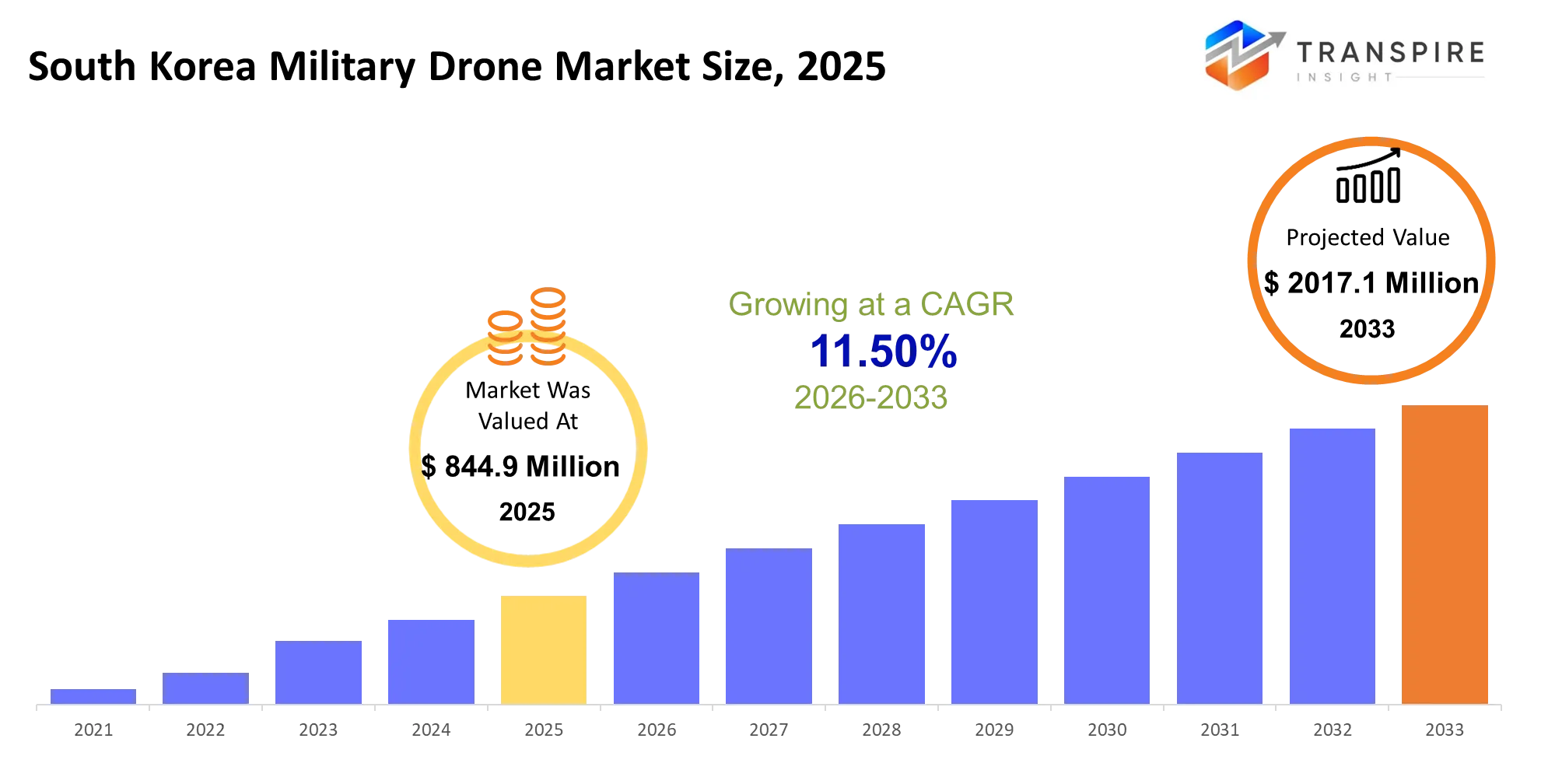
- South Korea Military Drone Market Size 2025: USD 844.9 Million
- South Korea Military Drone Market Size 2033: USD 2017.1 Million
- South Korea Military Drone Market CAGR: 11.50%
- South Korea Military Drone Market Segments: By Drone Type (Fixed-wing Drones, Rotary-wing Drones, Hybrid Drones, Nano Drones, Others); By Application (Surveillance & Reconnaissance, Combat Operations, Border Security, Electronic Warfare, Others); By Technology (AI-enabled Drones, Autonomous Navigation, Swarm Drone Technology, Stealth Technology, Others); By End User (Army, Navy, Air Force, Homeland Security Agencies, Others); By Payload (Electro-optical Sensors, Radar Systems, Weapons Payloads, Communication Systems, Others)
To learn more about this report,  Download Free Sample Report
South Korea Military Drone Market Summary
The South Korea Military Drone Market was valued at USD 844.9 Millionin 2025. It is forecast to reach USD 2017.1 Million by 2033. That is a CAGR of 11.50%over the period.
South Korea Military Drone Market acts as a pivotal sector with regards to bordermonitoring, surveillance, precision, targeting, and unmanned combat support operations in both land-based and maritime military operations. South Korea uses military drones to conduct surveillance on any movements made by North Korean troops, to avoid any danger posed to pilots through aerial attacks within contested regions, and to improve the ability of its forces in gathering intelligence rapidly and effectively. The South Korea Military Drone Market has seen a shift over the past five years from the use of foreign unmanned systems towards the production of military drones locally by homegrown aerospace and defense contractors. Increased regional tension in the region, along with the war between Ukraine and Russia, has seen a huge increase in investment into unmanned systems for surveillance purposes and offensive loitering strike drones. Investments have also been made by South Korea’s Defense Acquisition Program Administration into manned and unmanned teeming and artificial intelligence-based ISR systems.
Key Market Insights
- Local ISR drones are increasingly favored in the South Korea Military Drone Market, accounting for nearly 90% local content in the development of new MUAVs by 2026.
- Long endurance medium-altitude drones commanded more than 35% market share in 2025 owing to the need for constant surveillance along the Korean DMZ.
- Tactical reconnaissance drones have remained the leading category due to increased surveillance activities at battalion level and along the borders from 2023 in the South Korea Military Drone Market.
- Swarm drones are the fastest-growing category following South Korea’s move to modernize its artillery and urban warfare capabilities in 2025.
- Use of defense AI technology became increasingly common in South Korea Military Drone Market through enhanced target recognition, route optimization, and efficiency in mission endurance.
- Military drone deployment in ISR/surveillance applications reached up to 40% as the military sought to constantly monitor threat situations.
- Deployment of naval drones became increasingly common after 2024 as South Korea increased its capability to monitor and combat submarine threats.
- Development of export-oriented drones became popular when South Korean defense contractors started focusing on NATO and Southeast Asia procurement projects during the period between 2025 to 2026.
- Electronic warfare and counter-drone technologies became critical due to their effectiveness in disrupting drones used on the Ukrainian battlefield.
What are the Key Drivers, Restraints, and Opportunities in the South Korea Military Drone Market?
The key factor behind the growth of the South Korea Military Drone Market is the country’s fast adoption of autonomous and AI-enabled combat systems. With rising tensions regarding regional security issues such as missile testing from North Korea and advances in electronic warfare, South Korea made efforts to enhance its defense capabilities through rapid indigenization and development of UAVs under the Defense Acquisition Program Administration. The country’s investment in ISR, swarming drones, and loyal wingmen saw significant rises in recent years, increasing procurement activities of military drones in South Korea. As new operational doctrines focus more on using unmanned aircraft for reconnaissance and precision engagement missions, there has been an upsurge in the number of military drones used in army, navy, and air force.
On the other hand, the biggest restraining factor in this industry has been the difficulty involved in integrating autonomous systems within the existing military networks. For military drones to be fully functional, secure communication, satellites, AI-enabled battlefield analysis, and electronic warfare need to be achieved. Besides, there are high costs and long certification processes associated with each of the factors. Additionally, South Korea continues to be reliant on imports of semiconductor components, propulsion technology, and sensors.
One potential growth area for the future is going to be the development of manned/unmanned team combat aircraft, along with drone technology known as the “loyal wingman.” The cooperation projects between Hanwha Aerospace and Korea Aerospace Industries indicate that the South Korean defense manufacturing industry will be increasingly investing in AI-equipped systems like these in the coming years.
What Has the Impact of Artificial Intelligence Been on the South Korea Military Drone Market?
AI technologies have been transforming the South Korea Military Drone Market through the automation of analysis on battlefields, self-navigation features, and real-time target detection in ISR and combat situations. Increasingly, AI-powered algorithms are being used by defense manufacturers from South Korea to carry out mission planning, sensor integration, and target selection in challenging operating conditions. Machine learning technologies now make it possible to use autonomous corrections to routes and tracking of objects and swarms during reconnaissance operations around the Korean Demilitarized Zone.
The role played by predictive analytics in boosting efficiency in the operation of drones also increased. By analyzing data on vibrations, battery condition, and flight telemetry, military drones now use AI-based systems for preventive maintenance to minimize unplanned downtimes and maintain optimal levels of equipment readiness. Many UAV programs are incorporating AI-based electronic warfare technologies as well as adaptive controls to maximize the endurance of aircraft while saving fuel.
Interoperability of drones, radars, and command centers through digital battlefield networks was also improved as a result of such technological advancement. Nevertheless, artificial intelligence technology faces constraints due to security concerns, costly integration, and lack of tested databases on electronic warfare for autonomous decision making. The functioning of such technology is highly challenging when there is no global positioning system (GPS).
Key Market Trends
- South Korea switched from its reliance on UAV imports to homegrown drone development as the pace of localizing defenses increased from 2022 to 2026.
- Drones that employ artificial intelligence for ISR missions have become prevalent in place of aircraft used for surveillance operations because of reduced costs and easier implementation.
- Drones swarming techniques were deployed by the military as a result of research conducted into how drones are used in war in Ukraine since 2023.
- Deployments of medium altitude long endurance UAVs increased owing to the country's efforts to conduct sustained surveillance of missiles and border-related facilities.
- Collaboration on developing UAV engines and manned-unmanned teaming capabilities improved in 2026 as Hanwha Aerospace and Korea Aerospace Industries worked together.
- The use of naval unmanned systems increased as security organizations at sea began funding advanced autonomous monitoring technologies for coastlines and subs.
- Counter-drone measures became more sophisticated as electronic warfare exposed the weaknesses of traditional UAV military systems.
- Battlefield tactical drones got smaller, lighter, and more autonomous owing to developments in AI guidance systems and small-sized sensors.
- Defenses adopted interoperable drone platforms that could be integrated into satellites, radar systems, and command centers.
South Korea Military Drone Market Segmentation
By Drone Type
Fixed-wing drones account for the largest share of the market since they have an extended surveillance period, high altitude, and large area intelligence gathering capabilities. The defense industry prefers these drones because of their border monitoring, maritime patrols, and continuous surveillance around the defense installations. They are useful for strategic intelligence surveillance missions as they have more payload capability and extended range. Defense procurement programs involving sophisticated surveillance systems assist in keeping them in use among the defense industries.
Rotary-wing drones have experienced robust adoption because of their vertical takeoff capability, agile flight, and low altitude. Hybrid drones will record significant growth since defense institutions want drones which have both high endurance and agility.The Nano Drone segment aids in battlefield surveillance in urban combat zones, whereas Others consist of loitering munition drones and autonomous drones that are under testing in laboratories. In the future, hybrid and nano drones are projected to register higher growth than other categories.
By Application
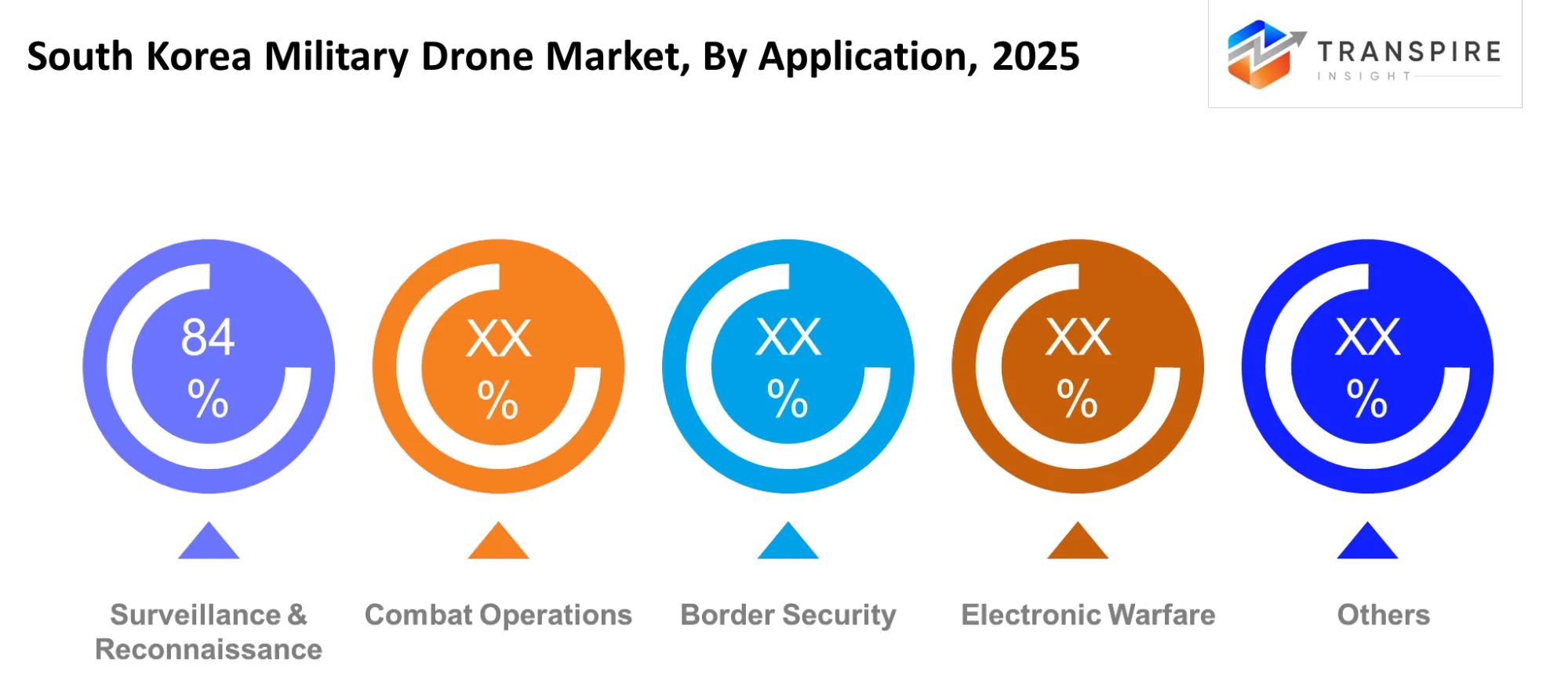
Applications for Surveillance & Reconnaissance dominate demand driven by continuous surveillance needs for military operations along borders, coastlines, and missile launch locations. Continuous ISR activities contribute to consistent application demand since timely intelligence is key for operational preparedness and response effectiveness. Electro-optical trackers, radar integration, and AI-based imagery capabilities contribute to bolstering the importance of this segment. The increasing trend in mission duration and automation of data analysis enhances deployment efficiency for defense entities.
Combat Operations present an impressive growth rate with autonomous combat systems and loitering munitions gaining prominence within modern military doctrine. Border Security exhibits robust adoption on account of ongoing surveillance needs in restricted military zones and coastal infiltration. Applications for Electronic Warfare will grow consistently through investments in signal jammers, cyber defense, and drone countermeasures. Others encompass applications related to disaster management and military logistics support. Looking forward to the forecast period, combat operations and electronic warfare are anticipated to witness enhanced investments as autonomous battlefield operations assume critical importance in future military operations.
To learn more about this report, Download Free Sample Report
By Technology
AI-Enabled Drones are currently the leading segment in the market because of the growing preference for autonomous target detection and mission optimization by military agencies. AI provides faster decision-making capabilities, minimizes pilots' workload, and enhances surveillance accuracy in dangerous missions. The rapid development of military modernization projects involving artificial intelligence systems has resulted in the growth of the defense software ecosystem, which adds to the segment leadership.
The Autonomous Navigation segment is gaining popularity gradually because of military operators' preference to minimize manual piloting. Among the rapidly developing segments of the market is that of the Swarm Drone Technology driven by rising interest in the use of multi-drone teams in electronic warfare operations. The segment of Stealth Technology remains popular among investors due to covert reconnaissance and penetration needs, while Other Technologies include satellite-based communications and sensor fusion technology. During the forecast period, the technologies of swarm drones and stealth will dominate procurement trends.
By End User
The Army segment occupies the largest market share due to the need for constant reconnaissance, tactical intelligence, artillery fire guidance, and battlefield coordination assistance. Increased deployments in border patrols and combat readiness programs ensure high procurement volume of portable and medium-range unmanned systems. In addition, army modernization programs promote the adoption of AI-powered surveillance and loitering attack drones. Broad coverage area ensures stable investments in tactical drones.
Adoption of drones by the Air Force is constantly growing owing to long-range ISR programs and development projects of manned-unmanned aircraft teams. Increasing adoption by the Navy segment is attributed to rising maritime surveillance and anti-submarine reconnaissance requirements. Homeland Security agencies use drones for infrastructure security, terrorist monitoring, and emergency response coordination services, while the 'Others' category includes special operations and defense intelligence forces. During the forecast period, the navy and Air Force segments will see the highest increase in demand for drones driven by autonomous maritime and aerial combat systems integration programs.
By Payload
Electro-Optical Sensors will dominate market share due to their high-resolution imagery, thermal imaging capability, and real-time video intelligence capabilities that continue being necessary for military surveillance applications. Military operators depend greatly on such payloads when it comes to target tracking and monitoring during night time. The continuous improvement in thermal imaging and artificial intelligence-enabled object recognition helps boost the competitiveness in the segment. Massive investments in ISR systems contribute to the ongoing high demand for imaging payloads.
Radar Systems gain popularity due to the increasing need for all-weather detection and range detection technology. Weapon Payloads will have rapid growth prospects due to the expanding use of combat drones for conducting precise attack missions and autonomous missions. Communication Systems play an important role in battlefield communications and secure drone communications while Others involve electronic warfare equipment and multispectral sensors. For the coming years, the radar and weapon payload segments will have increased rates of innovations due to the evolving military strategies emphasizing autonomous capabilities and communications capabilities.
What are the Key Use Cases Driving the South Korea Military Drone Market?
The leading application area of the South Korea Military Drone Market is intelligence, surveillance, and reconnaissance (ISR). Drones are constantly conducting surveillance in the Korean Demilitarized Zone, coastal zones, and missiles with lower risks than manned aircraft. The largest purchase volumes are generated by ISR missions, as they ensure instant situational awareness and military decision-making on the battlefield.
Increasingly utilized applications are tactical support and surveillance missions at sea. Tactical UAVs are used more often by the South Korean Army for targeting with artillery, conducting electronic warfare operations, and performing recon in urban areas. Additionally, naval drones are widely used for coastal patrol, anti-submarine operations, and border patrol at sea.
Potential application fields are drones operating in autonomous swarms and "loyal wingmen" accompanying fighter jets. Moreover, South Korea has started investments into AI-powered loitering munitions able to perform autonomous engagements with targets in wartime. While these applications are still in the early development stages, they have huge potential to revolutionize the battlefield in the coming years.
|
Report Metrics |
Details |
|
Market size value in 2025 |
USD 844.9 Million |
|
Market size value in 2026 |
USD 941.2 Million |
|
Revenue forecast in 2033 |
USD 2017.1 Million |
|
Growth rate |
CAGR of 11.50%from 2026 to 2033 |
|
Base year |
2025 |
|
Historical data |
2021 - 2024 |
|
Forecast period |
2026 - 2033 |
|
Report coverage |
Revenue forecast, competitive landscape, growth factors, and trends |
|
Regional scope |
South Korea |
|
Key company profiled |
Hanwha Aerospace, Korea Aerospace Industries, LIG Nex1, Boeing, Lockheed Martin, Northrop Grumman, General Atomics, Elbit Systems, BAE Systems, Thales Group, Leonardo, AeroVironment, DJI, Saab, Israel Aerospace Industries |
|
Customization scope |
Free report customization (country, regional & segment scope). Avail customized purchase options to meet your exact research needs. |
|
Report Segmentation |
By Drone Type (Fixed-wing Drones, Rotary-wing Drones, Hybrid Drones, Nano Drones, Others); By Application (Surveillance & Reconnaissance, Combat Operations, Border Security, Electronic Warfare, Others); By Technology (AI-enabled Drones, Autonomous Navigation, Swarm Drone Technology, Stealth Technology, Others); By End User (Army, Navy, Air Force, Homeland Security Agencies, Others); By Payload (Electro-optical Sensors, Radar Systems, Weapons Payloads, Communication Systems, Others) |
Which Regions are Driving the South Korea Military Drone Market Growth?
North America continues to be the leader within the military drones regional market due to its developed ecosystem of defense procurement, massive demands for ISR drones, and successful autonomous warfare investments programs. The United States is leading by large defense budget sizes, high numbers of deployed combat drones, and the ability to integrate AI into combat zones efficiently. Military UAV production is accelerated through large defense contractors and advanced semiconductor industries. Besides, North America is known for its powerful military testing sites and its export-oriented defense strategies.
Europe is the second-largest regional market within the industry. However, its development path contrasts that of North America. European nations do not seek large-scale expeditionary warfare programs, but their needs for strategic defense resilience, NATO goals of modernization, and cross-border surveillance create an environment beneficial for UAVs. Countries like Poland, the United Kingdom, and Germany steadily grew their budgets allocated for ISR drones and counter-drone technology development after 2022. Defense collaboration and stable procurement systems generate revenues steadily for military drones companies.
The Asia-Pacific region appears to be the most promising one to grow rapidly owing to its increased geopolitical unrest and military upgrades, coupled with the emergence of native production of defensive equipment. The most remarkable increase in spending on the use of autonomous drones took place in South Korea, Japan, India, and Australia within 2024-2026. New security concerns led to increased spending on UAV systems that were AI-powered. Such dynamics bring many business opportunities for drone producers, manufacturers of propulsion units, and providers of battlefield software.
Who are the Key Players in the South Korea Military Drone Market and How Do They Compete?
The South Korea Military Drone Market is still moderately concentrated, with competition revolving around autonomy, ISR, propulsion, and defense integration technology. The growing number of domestic producers are now challenging their international counterparts, taking advantage of government-supported localization and export-oriented initiatives. Competition in the market mainly depends on AI integration, endurance capability, electronic warfare resistance, and integration with current battle management systems.
Hanwha Aerospace concentrates on developing its own propulsion systems, autonomous AI-combined fighter aircraft, and manned-unmanned teaming capabilities. Partnership with Korea Aerospace Industries improves Hanwha's aircraft engine capabilities, contributing to the further development of loyal wingman drones. Korea Aerospace Industries distinguishes itself from others in terms of its expertise in developing aircraft and manufacturing ISR platforms, including its long-endurance UAV programs designed for South Korean forces. LIG Nex1 stands out in the market with its range of defense electronics, surveillance and autonomous targeting technologies enhancing UAV battlefield situational awareness.
Global contenders like Lockheed Martin and Northrop Grumman enjoy their competitive edge with the help of their stealth drones, ISR satellite communications, and autonomous combat vehicles. General Atomics will continue to utilize its operational experience with long-endurance combat UAVs, whereas Elbit Systems will enhance its competitive advantage using modularity in drones and electronic warfare capabilities.
Company List
- Hanwha Aerospace
- Korea Aerospace Industries
- LIG Nex1
- Boeing
- Lockheed Martin
- Northrop Grumman
- General Atomics
- Elbit Systems
- BAE Systems
- Thales Group
- Leonardo
- AeroVironment
- DJI
- Saab
- Israel Aerospace Industries
Recent Development News
In April 2026, Hanwha Systems and LIG Defense & Aerospace launched South Korea’s first domestically developed medium-altitude unmanned aerial vehicle (MUAV). The surveillance drone, built with nearly 90% local components, strengthens South Korea’s indigenous ISR and military drone manufacturing capabilities.https://koreajoongangdaily.joins.com
In February 2026, Hanwha Aerospace entered a strategic partnership with Korea Aerospace Industries (KAI) to jointly develop and export unmanned aerial vehicles and aircraft equipped with domestically produced engines. The collaboration is expected to accelerate South Korea’s military drone exports and strengthen the country’s autonomous defense aviation ecosystem.https://www.koreatimes.co.kr
In May 2026, the United States and South Korea launched a joint counter-drone alliance focused on reconnaissance drones, loitering munitions, and counter-UAS technologies. The agreement created a framework for interoperable drone systems and shared unmanned defense supply chains across allied military operations.https://armyrecognition.com
What Strategic Insights Define the Future of the South Korea Military Drone Market?
AI-Driven Autonomous Ecosystems for Combat Missions in South Korean Military Drones are set to develop from Indigenous Manufacturing, Network-Centric Warfare, and Exporting Military Drones Markets in South Korea. The most important driver pushing the market development towards such changes is South Korea’s efforts towards decreasing its reliance on foreign military technologies as well as developing advanced response strategies to potential emerging security threats. Within a decade, collaborative combat drones, autonomous unmanned intelligence, surveillance, and reconnaissance aircraft as well as drone swarms technologies can be expected to take center stage in procurement processes.
A lesser-known threat includes concentration of semiconductors and propulsion systems in international defense logistics. The use of autonomous systems implies certain dependency on advanced UAV production technology which is sensitive to geopolitical tensions and potential trade restrictions.
The emerging growth opportunities include loyal wingmen drones and AI-driven naval UAVs for the Indo-Pacific theater. Companies should focus on collaboration with producers of autonomous systems, propulsion systems and defense electronics.
South Korea Military Drone Market Report Segmentation
By Drone Type
- Fixed-wing Drones
- Rotary-wing Drones
- Hybrid Drones
- Nano Drones
- Others
By Application
- Surveillance & Reconnaissance
- Combat Operations
- Border Security
- Electronic Warfare
- Others
By Technology
- AI-enabled Drones
- Autonomous Navigation
- Swarm Drone Technology
- Stealth Technology
- Others
By End User
- Army
- Navy
- Air Force
- Homeland Security Agencies
- Others
By Payload
- Electro-optical Sensors
- Radar Systems
- Weapons Payloads
- Communication Systems
- Others
Frequently Asked Questions
Find quick answers to common questions.
The estimated South Korea Military Drone Market size for the market will be USD 2017.1 Million in 2033.
Key segments for the South Korea Military Drone Market are By Drone Type (Fixed-wing Drones, Rotary-wing Drones, Hybrid Drones, Nano Drones, Others); By Application (Surveillance & Reconnaissance, Combat Operations, Border Security, Electronic Warfare, Others); By Technology (AI-enabled Drones, Autonomous Navigation, Swarm Drone Technology, Stealth Technology, Others); By End User (Army, Navy, Air Force, Homeland Security Agencies, Others); By Payload (Electro-optical Sensors, Radar Systems, Weapons Payloads, Communication Systems, Others).
Major South Korea Military Drone Market players are Hanwha Aerospace, Korea Aerospace Industries, LIG Nex1, Boeing, Lockheed Martin, Northrop Grumman, General Atomics, Elbit Systems, BAE Systems, Thales Group, Leonardo, AeroVironment, DJI, Saab, Israel Aerospace Industries.
The South Korea Military Drone Market size is USD 844.9 Million in 2025.
The South Korea Military Drone Market CAGR is 11.50% from 2026 to 2033.
- Hanwha Aerospace
- Korea Aerospace Industries
- LIG Nex1
- Boeing
- Lockheed Martin
- Northrop Grumman
- General Atomics
- Elbit Systems
- BAE Systems
- Thales Group
- Leonardo
- AeroVironment
- DJI
- Saab
- Israel Aerospace Industries
Recently Published Reports
-
Apr 2026
Aerospace Fluoropolymers Market
Aerospace Fluoropolymers Market Size, Share & Analysis Report By Type (PTFE, FEP, PFA, ETFE, and Others), By Application (Electrical Insulation, Seals & Gaskets, Coatings, and Others), By End User (Commercial Aviation, Military Aviation, General Aviation, and Others), and Geography (North America, Europe, Asia-Pacific, Middle East and Africa, South and Central America), 2021 - 2031
-
Apr 2026
Airborne SATCOM System Market
Airborne SATCOM System Market Size, Share & Analysis Report By Type (SATCOM Terminals, Transceivers, Airborne Radio, Modems and Routers, SATCOM Radomes, and Other), By Application (Government and Defense and Commercial), and Geography (North America, Europe, Asia-Pacific, Middle East and Africa, South and Central America), 2021 – 2031
-
Apr 2026
Ship Leasing Market
Ship Leasing Market Size, Share & Analysis Report By Vessel Type (Container Ships, Bulk Carriers, Tankers, and Specialized Vessels), By Lease Duration (Short-Term Lease (Less than 1 year), Medium-Term Lease (1-5 years), and Long-Term Lease (More than 5 years)), By Lease Type (Bareboat Charter, Time Charter, Financial Lease, and Others), By End-User Industry (Oil and Gas, Manufacturing and Industrial, Automotive, Agriculture and Food, Retail and Consumer Goods, and Others), and Geography (North America, Europe, Asia-Pacific, Middle East and Africa, South and Central America), 2021 – 2031
-
Apr 2026
Thread Rolling Dies Market
Thread Rolling Dies Market Size, Share & Analysis Report By Type (Flat Thread Rolling Dies, Circular (Cylindrical) Dies, Tangential Thread Rolling Dies, Planetary Thread Rolling Dies, and Other Types), By Material Type (High-Speed Steel (HSS), Carbide, Tool Steel, Alloy Steel, and Other Specialized Alloys), By Distribution Channel (Direct Sales, Distributors and Dealers, and Online Platforms), By Application (Automotive Industry, Aerospace and Defense, Construction and Infrastructure, Industrial Machinery, Electronics and Electrical Components, Medical Devices, and Fastener Production), and Geography (North America, Europe, Asia-Pacific, Middle East and Africa, South and Central America), 2021 – 2031
Our Clients