
Global Military Helicopter Market & Forecast:
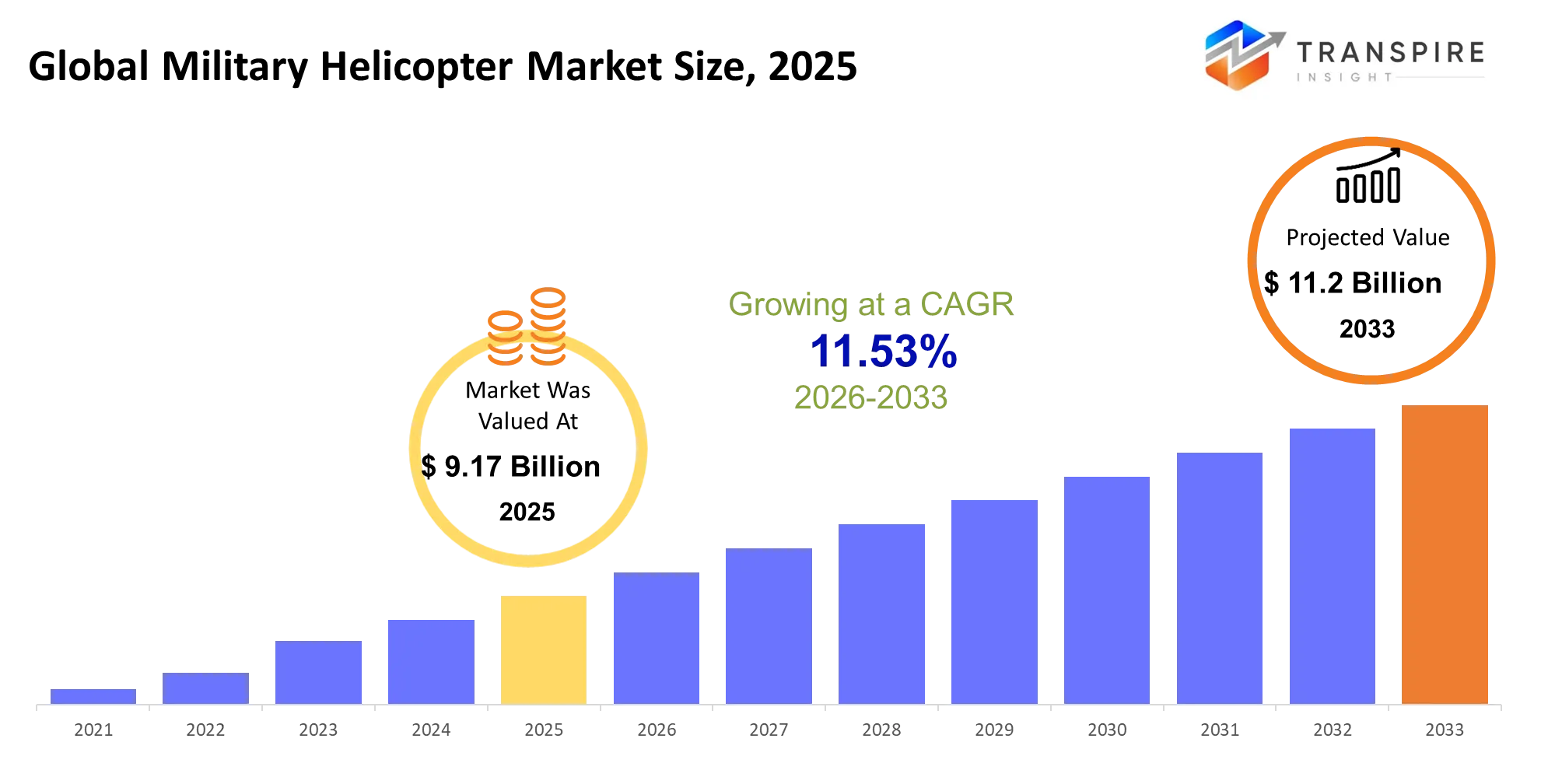
- Global Military Helicopter Market Size 2025: USD 9.17 Billion
- Global Military Helicopter Market Size 2033: USD 11.2 Billion
- Global Military Helicopter Market CAGR: 11.53%
- Global Military Helicopter Market Segments: By Type (Attack Helicopters, Transport Helicopters, Utility Helicopters, Reconnaissance Helicopters), By Application (Defence, Combat, Rescue, Surveillance), By End-User (Military, Defence Agencies, Governments, Contractors).
To learn more about this report,  Download Free Sample Report
Global Military Helicopter Market Summary:
The Global Military Helicopter Marketsize is estimated at USD 9.17 Billion in 2025 and is anticipated to reach USD 11.2 Billion by 2033, growing at a CAGR of 11.53% from 2026 to 2033.
The military helicopter space has shifted from just shuttling troops to more complex, "software-defined," airborne command posts. Following the war in Ukraine between Russia and Ukraine, where old helicopters proved vulnerable against new missiles, the industry is rapidly upgrading its obsolete 20th-century fleets. Through the use of Open System Architecture, it becomes possible to incorporate artificial intelligence-driven sensors and electronic warfare equipment, thereby ensuring that all necessary conditions – such as survivability, stealth, speed, and, importantly, vertical lift – are met for dangerous medical airlifts and tactical operations over rough terrain.
Key Market Insights:
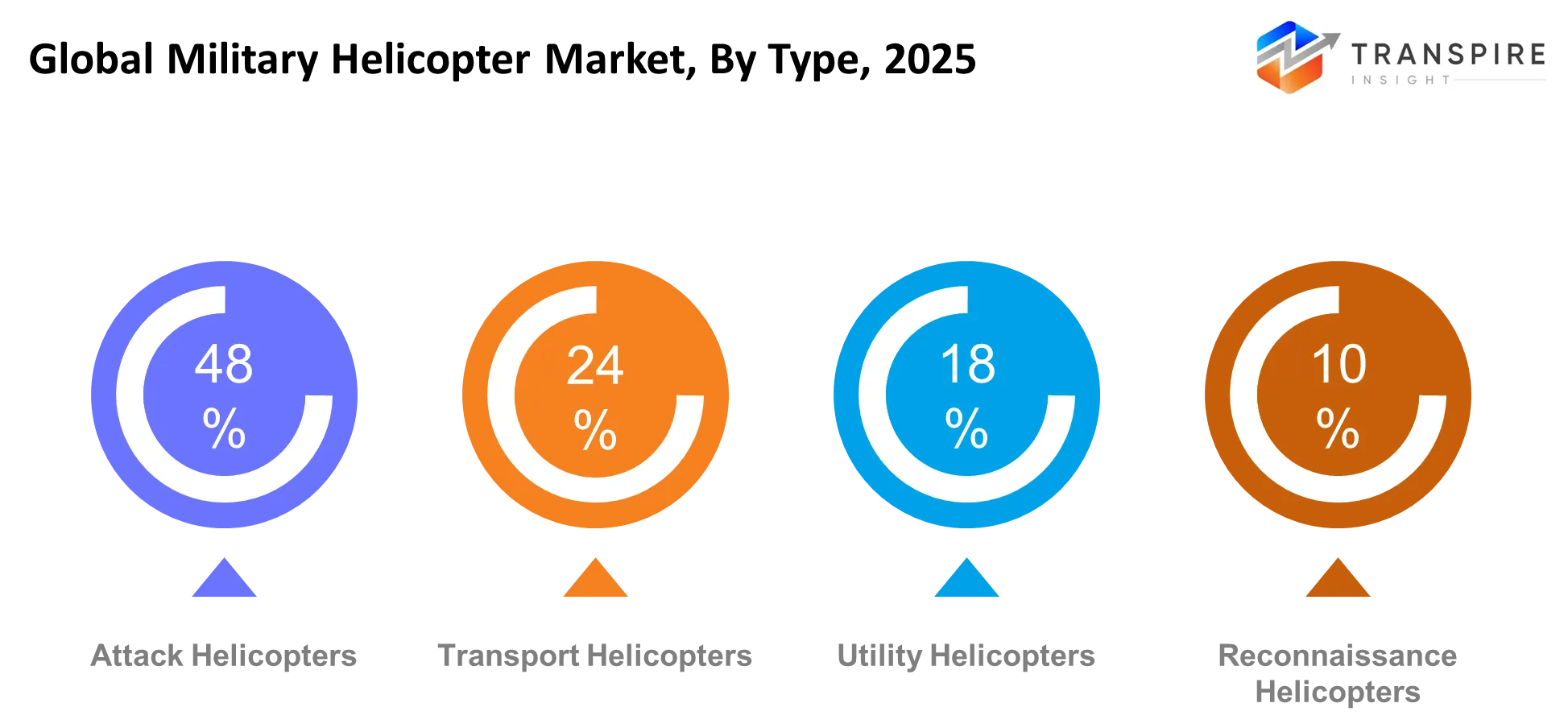
- The industry leaders have upgraded the fire-control system and radar jamming capabilities to continue functioning efficiently in hazardous areas. Market share is 48%,
- A quarter of the market belongs to Transport Helicopters and is the most rapidly growing segment at 14.8% CAGR, due to companies focusing on maximizing lift capacity for fast tactical deployment.
- Utility Helicopters' market share is 18%, with manufacturing companies redesigning their helicopters to be able to quickly switch from casualty evacuation duties to transporting troops.
- The market share of Reconnaissance Helicopters is 10%, with engineering departments focusing on developing silent flying craft and live data transmission capabilities.
- Military organizations are shifting from schedule-based maintenance to data-based service approaches using onboard sensors to diagnose and fix equipment problems prior to failures.
- Defense companies tend to provide regional licenses to assemble equipment to enable countries to construct their own helicopter fleets rather than import through a worldwide supply chain.
- Military designers include modular armor and active countermeasure capability to allow units to increase/decrease armor depending on threat level in theaters of operation.
What are the Key Drivers, Restraints, and Opportunities in the Global Military Helicopter Market?
Geopolitical turbulence from Eastern Europe to the Indo-Pacific region is leading to a shift towards peer combat, multi-billion-dollar acquisitions, and naval ASW. In parallel, countries are replacing ageing aircraft with twin-engine aircraft designed under MOSA, which have a technology ceiling and astronomical MRO expenses. Riding on increased defence budgets, the estimated value is projected to reach $46.1B in 2035. Future helicopters will act as data hubs, commanding drone swarms through MUM-T, and generate an additional 15%-20% in revenue. The extreme capital intensity and rising unit costs will present a zero-sum structural budget issue for defence ministries, resulting in smaller orders per aircraft and less money allocated to operations.
A significant opportunity exists in building Integrated Battlefield Ecosystems, enabled by software-defined helicopters that can be updated once per week via OMS. These changes will be driven primarily by the US and NATO FVL long-range tiltrotor projects focused on out-of-area Indo-Pacific missions, complemented by a large push in domestic production in countries such as South Korea (KAI) and Turkey.
What Has the Impact of Artificial Intelligence Been on the Global Military Helicopter Market?
AI technology has revolutionised the helicopter business industry by changing from manual flights to intelligent flights through the use of complex data processing for flight control. Some important advances include real-time terrain avoidance and sensor fusion. In sensor fusion, AI processes data from LIDAR and infrared sensors at over 500 Hz to enable safe nap-of-the-earth flight paths.
Predictive analytics is on the rise for helicopters. Vibration, temperature, and sensor data are collected and used by machine learning algorithms to predict possible equipment failures with an 85% accuracy.
Compatibility issues still arise from differences between older hardware and modern AI programs. Incorporating faster-processing computers and sensors into already-built rotary-wing aircraft has proved expensive and challenging. This results in a consistent "digital divide" worldwide as cost prohibits total parity.In May 2026, analysis by the industry reveals that the defense sector is successfully implementing software into rotorcraft that will enable them to fly and land without the assistance of a pilot, thereby decreasing the workload of pilots and proving the practicality of retrofitting old technology.
Key Market Trends:
- Kinetic Defense to Electronic Superiority: In today's EW, we see an evolution from detection to AI-managed active defenses to combat threats before their arrival.
- Hybrid-Electric Operations: The new hybrid-electric power plant uses less energy than diesel engines and reduces the risks of hostile fuel convoys.
- Decentralized Management (MUM-T): Mission management moves to cockpits, where pilots use unmanned drones for preliminary reconnaissance.
- Composite Aircraft: Composite materials replace metallic airframes, enabling faster high-altitude flights.
- Digital Twin & Maintenance: Digital Twin sensors monitor operations, allowing time-based maintenance to be replaced with malfunction forecasting.
- MOSA: Open-architecture software replaces closed-architecture systems and allows easy switching between sensors and weapons.
- High-Speed Platforms: Future platforms strike a balance between helicopter operational flexibility and fixed-wing speed.
- AI & Cockpit: The AI filters the data and enables pilots to act as aircraft mission managers.
- Asia-Pacific Supply Chains: Political instability in Asia drives self-production, reducing reliance on Western components.
- Urban Combat Design: Urban combat zone design requires quieter and more manoeuvrable aircraft.
Global Military Helicopter Market Segmentation:
By Type
Market segmentation within the military helicopter industry takes place according to its different functions. For instance, Attack Helicopters represent the dominant segment with a market share of about 59%, and fast growth at 48%, because they involve the integration of precise weapons as well as the lethal control of drone swarms from a network hub, which will push manufacturers into developing more stealth helicopters with high survivability rates. Another segment that represents a 14.8% CAGR is transport helicopters, which have the mission versatility to convert between combat and humanitarian support missions, supporting the development of a long-range tilt-rotor helicopter.
To learn more about this report, Download Free Sample Report
By Application
The application landscape is characterized by different strategic segments. In Defence, Search and Rescue, logistics support for evacuation is key and has been enhanced through the use of "mission modularity," which involves changes in roles such as airframes being changed from cargo, medevac, and defence functions to reduce costs of maintenance; hence, the emergence of automatic cargo. The high investment Combat segment dominates the market through "precision strike" and electronic warfare using "networked lethality" that involves turning the helicopters into control hubs for drone swarm and optionally manned mother ships.
By End-User
The military helicopter end-user market includes different strategic segments. The Military is a leading segment due to significant investments and upgrades in helicopters, with electronics and warfare systems, and is moving towards Future Vertical Lift initiatives that involve software and modularity in airframe technologies. The Government & Defense Agencies segments grow with multi-purpose use of helicopters for homeland defence and disaster relief operations, indicating a trend towards using military helicopters for national emergencies. Defense Contractors develop due to outsourcing services in terms of logistics, training, and transport operations in high-threat environments, resulting in a "Service as a Product" concept.
What are the Key Use Cases Driving the Global Military Helicopter Market?
Tactical mobility is important for troop transportation and logistics, hence facilitating global mobility on land. Some applications include anti-submarine warfare, medical evacuations, search and rescue, and border patrols. The latest development has seen unmanned autonomous systems and MUM-T become important, with helicopters serving as control stations for drones as electronic warfare determines their aerial use.
|
Report Metrics |
Details |
|
Market size value in 2025 |
USD 9.17 Billion |
|
Market size value in 2026 |
USD 9.4 Billion |
|
Revenue forecast in 2033 |
USD 11.2 Billion |
|
Growth rate |
CAGR of 11.53% from 2026 to 2033 |
|
Base year |
2025 |
|
Historical data |
2021 - 2024 |
|
Forecast period |
2026 - 2033 |
|
Report coverage |
Revenue forecast, competitive landscape, growth factors, and trends |
|
Regional scope |
United States; Canada; Mexico; United Kingdom; Germany; France; Italy; Spain; Denmark; Sweden; Norway; China; Japan; India; Australia; South Korea; Thailand; Brazil; Argentina; South Africa; Saudi Arabia; United Arab Emirates |
|
Key company profiled |
Boeing, Airbus, Lockheed Martin, Bell Helicopter, Leonardo, Sikorsky, Russian Helicopters, HAL, Kawasaki Heavy Industries, Mitsubishi Heavy Industries, Textron, MD Helicopters, KAI, AVIC, Hindustan Aeronautics |
|
Customization scope |
Free report customisation (country, regional & segment scope). Avail customised purchase options to meet your exact research needs. |
|
Report Segmentation |
By Type (Attack Helicopters, Transport Helicopters, Utility Helicopters, Reconnaissance Helicopters), By Application (Defence, Combat, Rescue, Surveillance), By End-User (Military, Defence Agencies, Governments, Contractors). |
Which Regions are Driving the Global Military Helicopter Market Growth?
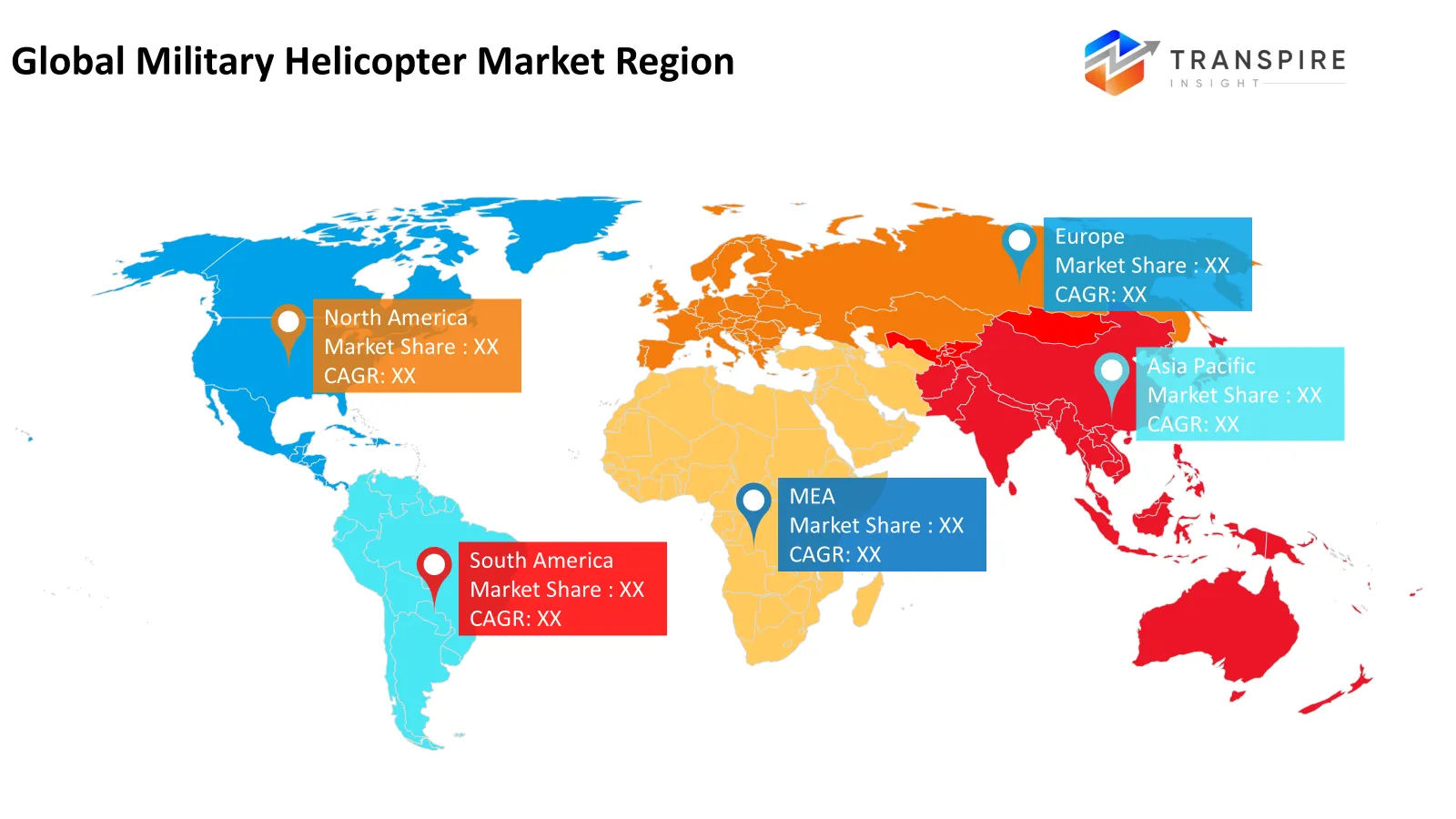
North America continues to dominate in terms of military aviation, with a CAGR of 15.6%. The area acts as the principal center for the design and procurement of rotary-wing aircraft, owing to extensive investment to secure dominance. This has been possible through a conducive environment that includes effective laws, high safety levels, and indigenous manufacturing facilitated by companies such as Boeing and Lockheed Martin. In May 2026, North America will maintain its dominance as the most significant center of rotorcraft design and purchasing due to consistent budget allocation and a domestic manufacturing base.
Europe is yet another pillar of the market with an overwhelming domination of 40%. Alternatively, some sources say that it has 25%. The importance of Europe lies in its focus on compatibility with strategies, modern technology used by NATO, and cooperation between countries to replace outdated equipment. In December 2025, countries in southern Europe, such as Spain, will have increased their defense capabilities through a contract that involves the acquisition of 31 tactical transport helicopters.
Being one of the most dynamic regions on the globe, the Asia-Pacific claims 25% of the total market share. The strategy of self-sufficiency and domestic production is being pursued in India and South Korea to reduce dependence on other countries. In turn, such a strategy allows developing the possibility of future cooperation and obtaining technologies needed for updating squadrons with custom helicopters in the Pacific region. The rest of the World (ROW) represents only 10% of the total market share. In January 2026, rapid growth is evident in the Asia-Pacific region, where countries such as India and South Korea are working towards becoming self-reliant in manufacturing to reduce their dependence on foreign arms manufacturers.
To learn more about this report, Download Free Sample Report
Who are the Key Players in the Global Military Helicopter Market and how do they Compete?
The military helicopter industry is an area of intense competition where technological advancement and political changes will determine the winner. This somewhat fragmented market has evolved from its traditional hardware-based model to emphasise digital ecosystems and autonomy, with the market leaders striving for robust supply chains and localised production facilities.
Boeing (US) employs an innovation strategy in which it updates its existing flight-tested helicopters by incorporating advanced artificial-intelligence avionics. Boeing distinguishes itself with superior situational awareness, whereas its growth strategy is based on forming alliances with technology companies. The second competitor, Lockheed Martin (US), follows a niche strategy that emphasises integrating manned aircraft with drones. The company differentiates itself through autonomous flexibility while expanding by acquiring niche aerospace companies. Lastly, Airbus (FR) implements a cost and sustainability strategy where it distinguishes itself by employing carbon-neutral manufacturing processes.
Key Global Military Helicopter Market Companies
- Boeing
- Lockheed Martin
- Bell Helicopter
- Leonardo
- Sikorsky
- Russian Helicopters
- HAL
- Kawasaki Heavy Industries
- Mitsubishi Heavy Industries
- Textron
- MD Helicopters
- KAI
- AVIC
- Hindustan Aeronautics
Recent Development News
In May 2026, GE Aerospace entered into a logistics contract with Boeing Defence UK that would last for three years. This contract guarantees the maintenance of the T700 engine that powers the British Army’s AH-64E Apache helicopters. https://avitrader.com
In March 2025, the Ministry of Defence of India entered into two agreements with Hindustan Aeronautics Limited for purchasing 156 Light Combat Helicopters.
This purchase will contribute to the development of defense infrastructure and strengthen the production base within the nation. https://www.pib.gov.in
What Strategic Insights Define The Future Of The Global Military Helicopter Market?
The shift is towards tilt-rotor/hybrid aircraft that perform better in contested environments, with an emphasis on hardware purchases to software-enabled solutions for MDO purposes. The rapid advancement of VTOL capabilities in unmanned drones threatens existing light reconnaissance aircraft, as the FARA was cancelled because expensive manned systems could not match the low-cost capabilities of autonomous drones. OEMS need to master their digital backbone systems, including plug-and-play avionics, to win more profitable MRO upgrades. The future will see marketing connectivity versus hardware, with research on MUM-T capabilities and survivability kits.
Key Global Military Helicopter Market Segmentation
By Type
- Attack Helicopters
- Transport Helicopters
- Utility Helicopters
- Reconnaissance Helicopters
By Application
- Defence
- Combat
- Rescue
- Surveillance
By End-User
- Military
- Defence Agencies
- Governments
- Contractors
Frequently Asked Questions
Find quick answers to common questions.
The expected Global Military Helicopter Market size for the market will be USD 11.2 Billion in 2033.
Key segments for the Global Military Helicopter Market are Type (Attack Helicopters, Transport Helicopters, Utility Helicopters, Reconnaissance Helicopters), By Application (Defence, Combat, Rescue, Surveillance), and by end-user (Military, Defence Agencies, Governments, Contractors).
The major Global Military Helicopter Market players are Boeing, Lockheed Martin (Sikorsky), Airbus Helicopters, Leonardo S.p.A., Bell Textron Inc., Hindustan Aeronautics Limited (HAL), Aviation Industry Corp of China (AVIC), Russian Helicopters (Rostec), MD Helicopters, Turkish Aerospace Industries (TAI), and Korea Aerospace Industries (KAI).
The Global Military Helicopter Market size is USD 9.17 Billion in 2025.
The Global Military Helicopter Market CAGR is 11.53%.
- Boeing
- Lockheed Martin
- Bell Helicopter
- Leonardo
- Sikorsky
- Russian Helicopters
- HAL
- Kawasaki Heavy Industries
- Mitsubishi Heavy Industries
- Textron
- MD Helicopters
- KAI
- AVIC
- Hindustan Aeronautics
Recently Published Reports
-
Apr 2026
Aerospace Fluoropolymers Market
Aerospace Fluoropolymers Market Size, Share & Analysis Report By Type (PTFE, FEP, PFA, ETFE, and Others), By Application (Electrical Insulation, Seals & Gaskets, Coatings, and Others), By End User (Commercial Aviation, Military Aviation, General Aviation, and Others), and Geography (North America, Europe, Asia-Pacific, Middle East and Africa, South and Central America), 2021 - 2031
-
Apr 2026
Airborne SATCOM System Market
Airborne SATCOM System Market Size, Share & Analysis Report By Type (SATCOM Terminals, Transceivers, Airborne Radio, Modems and Routers, SATCOM Radomes, and Other), By Application (Government and Defense and Commercial), and Geography (North America, Europe, Asia-Pacific, Middle East and Africa, South and Central America), 2021 – 2031
-
Apr 2026
Ship Leasing Market
Ship Leasing Market Size, Share & Analysis Report By Vessel Type (Container Ships, Bulk Carriers, Tankers, and Specialized Vessels), By Lease Duration (Short-Term Lease (Less than 1 year), Medium-Term Lease (1-5 years), and Long-Term Lease (More than 5 years)), By Lease Type (Bareboat Charter, Time Charter, Financial Lease, and Others), By End-User Industry (Oil and Gas, Manufacturing and Industrial, Automotive, Agriculture and Food, Retail and Consumer Goods, and Others), and Geography (North America, Europe, Asia-Pacific, Middle East and Africa, South and Central America), 2021 – 2031
-
Apr 2026
Thread Rolling Dies Market
Thread Rolling Dies Market Size, Share & Analysis Report By Type (Flat Thread Rolling Dies, Circular (Cylindrical) Dies, Tangential Thread Rolling Dies, Planetary Thread Rolling Dies, and Other Types), By Material Type (High-Speed Steel (HSS), Carbide, Tool Steel, Alloy Steel, and Other Specialized Alloys), By Distribution Channel (Direct Sales, Distributors and Dealers, and Online Platforms), By Application (Automotive Industry, Aerospace and Defense, Construction and Infrastructure, Industrial Machinery, Electronics and Electrical Components, Medical Devices, and Fastener Production), and Geography (North America, Europe, Asia-Pacific, Middle East and Africa, South and Central America), 2021 – 2031
Our Clients