
South Korea Civil & Commercial Helicopter Market Size & Forecast:
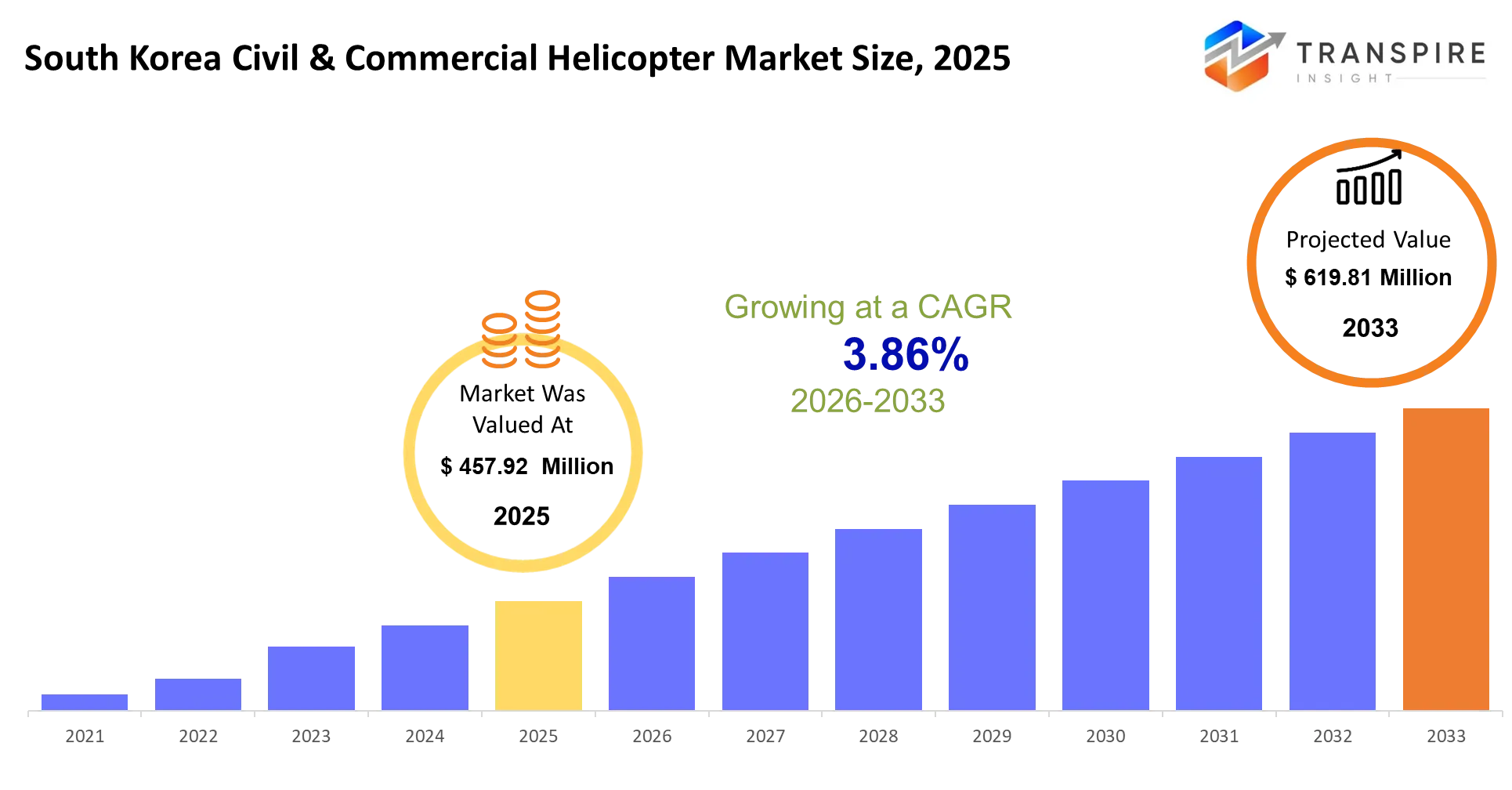
- South Korea Civil & Commercial Helicopter Market Size 2025: USD 457.92 Million
- South Korea Civil & Commercial Helicopter Market Size 2033: USD 619.81 Million
- South Korea Civil & Commercial Helicopter Market CAGR: 3.86%
- South Korea Civil & Commercial Helicopter Market Segments: By Helicopter Type (Light Helicopters, Medium Helicopters, Heavy Helicopters, Others); By Application (Passenger Transport, Emergency Medical Services, Offshore Operations, Tourism, Others); By End User (Commercial Operators, Government Agencies, Defense Organizations, Others); By Engine Type (Single-engine Helicopters, Twin-engine Helicopters, Others)
To learn more about this report,  Download Free Sample Report
South Korea Civil & Commercial Helicopter Market Summary
The South Korea Civil & Commercial Helicopter Market was valued at USD 457.92 Million in 2025. It is forecast to reach USD 619.81 Million by 2033. That is a CAGR of 3.86% over the period.
In South Korea, civil and commercial helicopters mainly act like airborne response assets, tying together remote maritime areas, industrial locations, and city-based emergency networks where ground access is slow, or basically impossible. They help with coast guard surveillance, do offshore checks around shipbuilding and energy facilities, support medevac flights from islands, and also move industrial people quickly when schedules get tight.
Over the last 3–5 years the whole market has sort of shifted in a more permanent way, from defense-linked fleet use toward broader civilian mission integration, particularly for emergency medical services and offshore infrastructure monitoring. One clear nudge was the post pandemic jump in the need for time-critical patient transport and well that pushed provincial agencies and private operators to widen, sort of expand their dedicated EMS helicopter coverage. At the same time , stricter maritime safety enforcement after a few offshore incident reviews, kind of actually raised the count of flight hours spent on surveillance and inspection tasks. Between these changes, utilization rates improved, and operators started leaning into newer multi-mission helicopters, which then helps fleet modernization and keeps longer-term procurement moving forward.
Key Market Insights
- South Korea’s Civil and Commercial Helicopter market kind of looks like EMS is, always, the main thing. In 2025 EMS is estimated at nearly 33% of total demand, mostly because emergency response still has to cover islands and coastal pockets, which is a big operational need.
- Seoul and the Gyeonggi area together take about 28% market share in 2025, helped along by tight hospital clustering, and also by government aviation infrastructure, that sort of steady base.
- Southern coastal provinces are expected to grow the quickest. There are projections that wind-farm related work, offshore wind-linked operations specifically, will push helicopter utilization up by 40%+ all the way by 2033.
- Offshore inspection plus maritime surveillance missions make up a notable slice too, and they’re supporting more than 30% of yearly flight-hour usage within industrial applications.
- In aircraft type terms, light twin-engine helicopters hold around 40% share in 2025. They are chosen a lot for EMS flexibility, and for being cost-efficient on short-range runs.
- Medium-lift helicopters sit as the second-largest slice, and they’re commonly used for port logistics and offshore crew transfer services.
- Heavy-lift helicopters meanwhile are the fastest-growing category, with momentum expected to rise because of big energy and infrastructure programs getting underway.
- On the application side, emergency medical services are still the dominant use case. This is tied to rapid-response demand across remote coastal areas and island territories, where ground access can be slow, or just not reliable.
- Offshore wind energy inspection is also turning into a high-growth use case, and it rides on South Korea’s renewable capacity expansion targets.
- When it comes to end-use, government agencies lead adoption, with nearly 45% operational share, which basically shows strong public-sector aviation deployment.
- Private charter operators are growing fast too, and they help diversify services across healthcare, industrial, and logistics contracts, so the missions can look pretty mixed.
- The competitive edge seems to come from AI-enabled predictive maintenance, multi-mission platform upgrades, and longer-term public-private operational partnerships, which is where the advantage tends to stick.
What are the Key Drivers, Restraints, and Opportunities in the South Korea Civil & Commercial Helicopter Market?
The main driver seems to be this expansion of time sensitive emergency and offshore operational needs, particularly around coastal provinces and places that are basically island-heavy. The demand really picked up after healthcare systems put more weight on rapid trauma response, so helicopter based emergency medical services became a kind of vital extension to hospital networks. At the same time, offshore shipbuilding yards and wind energy installations leaned more on aerial inspection, and crew transfer too, which ends up lifting flight utilization pretty directly, and it helps operators keep revenue steadier through contracted service models.
A big restraint is the high life cycle cost of buying and keeping these aircraft running, especially when we talk about advanced multi role helicopters. This is kind of structural, because South Korea’s demand is split between government agencies, private operators, and industrial users, so fleet standardization at scale is hard. Because of that, operators tend to push back replacement schedules, and older airframes stay active longer than they really should, which lowers the efficiency improvements and it can also limit how much aftermarket activity grows.
One notable opportunity shows up with the expansion of offshore wind development zones and smart port infrastructure projects along the southern, and western coasts. As these efforts grow larger, the need for dedicated aerial inspection, logistics support, and environmental monitoring should rise. Operators that bring in long range, sensor equipped helicopters as part of industrial service contracts can open up recurring revenue, linked to infrastructure lifecycle management.
What Has the Impact of Artificial Intelligence Been on the South Korea Civil & Commercial Helicopter Market?
Artificial intelligence is getting more and more embedded inside flight operations and maintenance routines across South Korea’s civil as well as commercial helicopter world. A lot of operators are turning to AI-enabled fleet management platforms, not just for convenience but to help automate engine health monitoring, keep component lifecycles straight, and handle regulatory compliance reporting. In practice, these platforms reduce the manual inspection workload, because they keep chewing through sensor readings from avionics and drivetrain systems , then flagging odd behavior well before the next scheduled maintenance cycle kicks in.
At the same time predictive analytics models are being used to map, or rather forecast, component wear. This is especially noticeable for rotor setups and turbine engines that spend time around harsh coastal conditions. Operators often link vibration signals with temperature patterns and also older failure records, so they can expect when maintenance is needed, and ideally cut down on unscheduled downtime. In a few fleet cases, the outcome has been better aircraft availability and a smoother plan for emergency and offshore missions. That sort of change, indirectly, seems to lower fuel and maintenance costs per flight hour too.
Still, adoption is not widespread, mainly because high quality real-world operational datasets are scarce. This is even more true for low-altitude maritime routes where weather variability is pretty intense. On top of that, the integration cost is still a big barrier, since legacy helicopter platforms usually need substantial retrofitting before AI-driven systems can work reliably at scale, without causing extra headaches.
Key Market Trends
- Emergency medical service deployments kinda climbed to almost 33% operational share in 2025, as provinces pushed out island based trauma response networks, a bit faster than before.
- Offshore inspection flight hours went up 30%+ since 2021, mainly because stricter maritime safety audits rolled out across shipbuilding strongholds like Busan and Ulsan.
- In the South Korea Civil & Commercial Helicopter market, adoption shifted toward multi mission aircraft after 2022 procurement reforms, where flexible fleet utilization got favored more than single role platforms.
- Government aviation agencies also increased helicopter utilization intensity about 25% between 2020–2025, which lines up with higher disaster response readiness requirements.
- Offshore wind infrastructure expansion, seems to have triggered a 40% jump in aerial inspection contracts since 2023, especially across the southern coastal development zones.
- Airbus Helicopters and KAI strengthened their regional footprint with joint maintenance programs launched post 2022, aimed at better lifecycle efficiency and higher fleet uptime.
- Digital avionics integration started moving faster after 2021, and operators said they saw 15–20% improvement in mission scheduling efficiency, when they used predictive maintenance tools.
- Private charter operators expanded their service portfolio after the pandemic, raising commercial flight utilization share across healthcare and logistics linked contracts in urban corridors, more or less.
- Bell Textron and Leonardo S.p.A. also broadened strategic partnerships with South Korean operators, focusing on upgraded light and medium lift platform deployment.
- And finally, regulatory tightening for coastal surveillance operations after 2023, increased helicopter deployment frequency for compliance driven environmental and maritime monitoring missions.
South Korea Civil & Commercial Helicopter Market Segmentation
By Helicopter Type
Light helicopters kind of hold the dominant position in the South Korea Civil & Commercial Helicopter Market, mostly because they’re getting deployed a lot for emergency medical services, coastal patrol, and short-range transport jobs. Their maneuverability stays high while operating costs are lower, plus the turnaround and deployment cycle is faster, so this group ends up being the go to option for government-backed EMS networks and private charter operators. Medium helicopters sit as a steadier second tier, supported by offshore logistics and the ongoing inter-island passenger movement, but of course they need higher payload capacity to really work. Heavy helicopters stay more niche, mostly for specialized lift operations and disaster response missions where the payload requirement goes beyond the usual operational comfort limits. “Others” are more fragmented, with only limited commercial penetration , overall.
Demand for light helicopters is pulled by those frequent EMS dispatch duties, and also by the need for near immediate response across island-heavy regions. Medium helicopter growth tends to follow offshore infrastructure development and the expansion of port logistics operations. Heavy helicopter usage is held back by acquisition costs that are really high, but it still becomes more relevant in large scale emergency response scenarios. Over the forecast period, medium helicopters are expected to slowly gain share, since offshore wind and maritime industries keep expanding, which in turn nudges manufacturers toward multi role platform optimization and better fuel efficiency systems.
By Application
Emergency medical services take a kind of leading role in the South Korea Civil & Commercial Helicopter Market, mostly because quick patient transfer from islands and coastal areas is still a major must-have in healthcare. Government supported trauma response frameworks plus hospital linked aviation arrangements keep the demand for EMS deployments pretty steady. Passenger transport sits more like a secondary lane, and it is mainly about inter island movement and executive trips between industrial belts. Offshore work keeps getting bigger too, driven by shipbuilding momentum and the ongoing need for energy infrastructure inspections, whereas tourism is still seasonal, very much tied to weather windows.
The EMS side grows because there are real healthcare coverage gaps in remote locations, where ground transport just can’t reliably hit emergency timelines. Offshore operations keep expanding as inspection frequency rises across shipyards and offshore energy assets. Passenger transport is comparatively steady, but it is also kind of constrained by short travel corridors and cost sensitivity issues. During the forecast period, offshore operations are expected to accelerate faster than the other uses, as renewable energy installations ramp up and maritime safety compliance expectations become stricter , so operators lean more toward sensor packed , long endurance helicopter platforms that can handle the mission rhythm.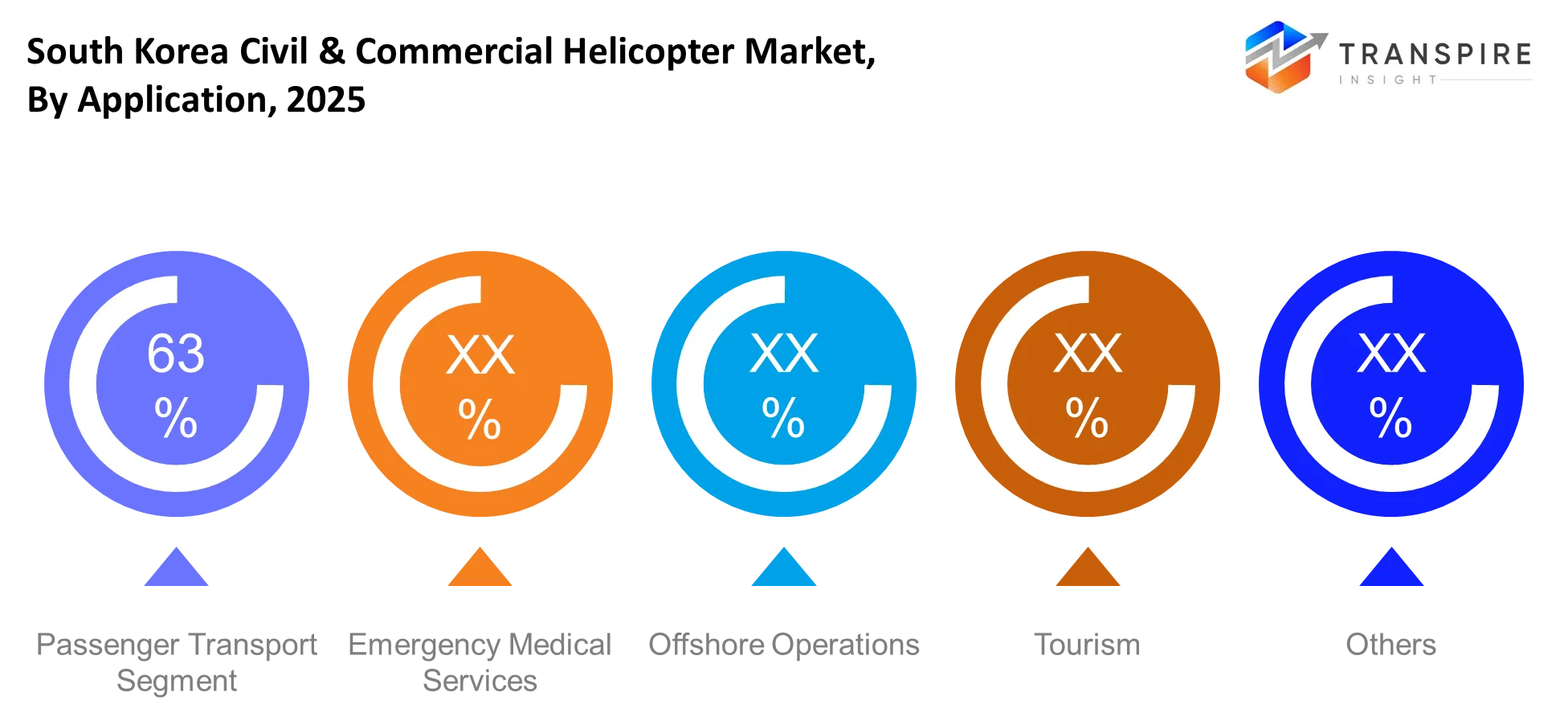
To learn more about this report, Download Free Sample Report
By End User
Government agencies kinda dominate the South Korea Civil & Commercial Helicopter Market, mainly because there’s heavy investment tied to disaster response , maritime surveillance and general public safety aviation infrastructure. They use centralized fleet procurement, plus standardized mission deployment frameworks, so everything stays coordinated and that keeps them ahead overall. Commercial operators are close behind as the second-largest segment, doing logistics, offshore inspection work, and also charter based passenger services. Defense organizations still matter a lot too, especially via dual-use platforms for border surveillance and quick reaction missions, and then there are the other users—municipal and institutional teams—usually with smaller fleet sizes and more limited deployment needs.
On the demand side , government agencies need to come from policy mandates around disaster readiness and coastal monitoring efficiency. For commercial operators, growth is connected to more outsourcing of inspection and transport tasks by industrial companies and by port authorities. Defense organizations keep steady utilization with multi role aircraft that can support both civil emergencies and security actions at the same time. Over the forecast period, commercial operators are expected to build momentum faster, since privatization of aerial services increases, which encourages investment into fleet diversification and more long term service contracts.
By Engine Type
Twin engine helicopters kind of keep the leading position in the South Korea Civil & Commercial Helicopter Market because they feel safer in practice , and they also fit offshore and EMS work better when you have water, plus remote terrain ,involved. The rules for flying over water really push fleets , both government and commercial, to go with them. Meanwhile, single engine helicopters still sit in that cost-friendly lane and are often picked for training, short range transport, and other low risk missions. The rest… they stay narrow , mostly linked to experimental propulsion setups and those specialized configurations that are not used that often.
So the reason behind twin engine demand is mostly safety regulations and the need for operational dependability , especially in higher risk areas like offshore wind zones, and maritime patrol routes. For single engine growth, it’s more about lower operating costs, plus training academies are adopting them more, and short haul missions keep needing them. Still, their overall use stays capped when offshore operations are heavily regulated. Over the forecast window, twin engine platforms are expected to tighten their hold even more, as mission complexity keeps going up, which then nudges manufacturers to emphasize fuel efficiency, redundancy systems, and more advanced avionics integration so safety and compliance remain on track.
What are the Key Use Cases Driving the South Korea Civil & Commercial Helicopter Market?
Emergency medical services is the core use case , where helicopters get sent out for quick patient transfer from islands, coastal areas, and disaster zones, to tertiary hospitals on mainland cities. That’s still the main thing driving demand, because the healthcare clock is literally time critical , and road connections tend to be limited.
Then there are the secondary uses, which are growing around offshore industrial support, mainly for shipbuilding yards, port logistics hubs, and energy infrastructure inspection work. In those settings, helicopters do more than just move crew, they also handle equipment delivery, plus some level of safety surveillance.
On top of that you can see emerging use cases like maintenance flights for offshore wind farms and environmental monitoring missions tied to coastal pollution tracking. These are still scaling up, but they should start to pick up pace, as renewable energy infrastructure keeps expanding and as regulatory supervision becomes stricter.
|
Report Metrics |
Details |
|
Market size value in 2025 |
USD 457.92 Million |
|
Market size value in 2026 |
USD 475.58 Million |
|
Revenue forecast in 2033 |
USD 619.81 Million |
|
Growth rate |
CAGR of3.86%from 2026 to 2033 |
|
Base year |
2025 |
|
Historical data |
2021 - 2024 |
|
Forecast period |
2026 - 2033 |
|
Report coverage |
Revenue forecast, competitive landscape, growth factors, and trends |
|
Regional scope |
South Korea |
|
Key company profiled |
Airbus Helicopters, Bell Textron, Leonardo, Sikorsky, Korea Aerospace Industries, Robinson Helicopter Company, MD Helicopters, Boeing, Russian Helicopters, Hindustan Aeronautics, Enstrom Helicopter, Kawasaki Heavy Industries, NHIndustries, Lockheed Martin, Textron Aviation |
|
Customization scope |
Free report customization (country, regional & segment scope). Avail customized purchase options to meet your exact research needs. |
|
Report Segmentation |
By Helicopter Type (Light Helicopters, Medium Helicopters, Heavy Helicopters, Others); By Application (Passenger Transport, Emergency Medical Services, Offshore Operations, Tourism, Others); By End User (Commercial Operators, Government Agencies, Defense Organizations, Others); By Engine Type (Single-engine Helicopters, Twin-engine Helicopters, Others) |
Which Regions are Driving the South Korea Civil & Commercial Helicopter Market Growth?
South Korea’s Seoul and Gyeonggi area kinda leads the civil and commercial helicopter market, mainly because there’s a pretty dense cluster of national emergency response stuff plus aviation command systems. The region seems to get a direct kind of linkage with tertiary hospitals, government aviation units, and centralized disaster management agencies. On top of that, strong regulatory oversight from national aviation authorities keeps the fleet deployment standards steady, and mission readiness stays high. So overall this setup supports nonstop demand for EMS flights , air policing, and those administrative transport missions too.
Then you’ve got the southern coastal belt—Busan, Ulsan, and Geoje included—that brings in steady demand, pretty reliable. That steady pull is tied to shipbuilding, port logistics, and offshore industrial activity. But unlike the capital region, the growth there leans more toward commercial utility rather than emergency response intensity. Long-term commitments from shipbuilders and logistics operators keep helicopter usage consistent, especially for crew transfers and inspection services. Basically it turns into a revenue contributor that keeps showing up even when public sector procurement is a bit weaker.
Meanwhile the Jeju and southwest island corridor is the fastest mover, mostly driven by rapid offshore wind expansions and the modernization of island healthcare. After 2023, new renewable energy permits were issued, and that increased aerial inspection obligations a lot across those coastal waters. Also government-backed connectivity programs improved medical evacuation frequency from the more remote islands. This direction, it kinda points to strong entry openings for operators aiming at multi-role aircraft deployment , plus longer-term infrastructure-linked aviation contracts from 2026 into 2033.
Who are the Key Players in the South Korea Civil & Commercial Helicopter Market and How Do They Compete?
The South Korea Civil & Commercial Helicopter Market still looks moderately consolidated, kind of like global OEMs running the high value stuff, while domestic operators and service groups are busy with mission oriented operations. The fights between companies usually come down to tech integration, how efficiently they support the lifecycle, and how well the aircraft can adapt to different mission needs, not only price. Incumbent manufacturers are also trying to lock in longer term fleet agreements, because governments and private operators are moving toward multi-role aircraft procurement models.
Airbus Helicopters tends to win by pushing advanced avionics integration and maintaining strong EMS-certified platform portfolios, which helps it capture long term public service contracts. Leonardo S.p.A. stands out with lightweight multi-mission helicopters aimed at coastal surveillance and offshore transport tasks. Bell Textron Inc. is gaining traction through a modular aircraft structure, so operators can reconfigure the same platform for EMS, logistics, and patrol work.
Korea Aerospace Industries leans on domestic production strengths, plus government collaborations, to land national procurement programs and reduce import dependency. Sikorsky Aircraft leans hard into heavy-lift performance and defense adjacent civil usage, and it’s expanding via integrated maintenance and upgrade contracts. These days, differentiation feels more tied to predictive maintenance systems, fleet uptime commitments and localized service hubs rather than just selling the airframe itself.
Company List
- Airbus Helicopters
- Bell Textron
- Leonardo
- Sikorsky
- Korea Aerospace Industries
- Robinson Helicopter Company
- MD Helicopters
- Boeing
- Russian Helicopters
- Hindustan Aeronautics
- Enstrom Helicopter
- Kawasaki Heavy Industries
- NHIndustries
- Lockheed Martin
- Textron Aviation
Recent Development News
In April 2026, Korea Aerospace Industries (KAI) completed the maiden production test flight of the first mass-produced KF-21 airframe, strengthening its advanced rotorcraft and aerospace manufacturing ecosystem. The milestone improves domestic aerospace validation capacity and indirectly supports civil helicopter platform development and certification infrastructure in South Korea.https://www.wikipedia.org
In April 2026, Bell Textron Inc. entered a strategic partnership with Korea Aerospace Industries (KAI) to explore MV-75-based helicopter solutions for South Korea’s High-Speed Medium Utility Helicopter program. The collaboration strengthens technology transfer in next-generation rotorcraft systems and enhances South Korea’s multi-mission helicopter capabilities for civil and dual-use operations.https://helihub.com
What Strategic Insights Define the Future of the South Korea Civil & Commercial Helicopter Market?
The South Korea Civil & Commercial Helicopter Market is starting to head toward a more sort of service led model, where owning the aircraft is less important than having the mission ready, plus lifecycle efficiency. The momentum feels less about one-off buying rounds and more about sustained use, especially tied to offshore renewable infrastructure, upgrading disaster response capabilities, and linking up integrated air medical networks. Over the next 5–7 years, it seems operators will push harder on fleet interoperability, and also on sensor enabled helicopters, because the missions are getting more complicated, day by day.
One quieter risk though is the dependency on imported airframes and components, this can open the door to currency swings, and also global supply chain hiccups. So even if demand signals are getting stronger, it could still slow down the fleet renewal pace, because parts and delivery timing become a bottleneck.
At the same time, there’s an emerging opening in AI enabled aerial inspection services, especially for offshore wind farms and smart port ecosystems. These use cases are still kind of in early adoption, so the first movers may shape the standards a bit. Operators that blend analytics driven maintenance with real time monitoring should end up with stronger long term contract positions. A practical recommendation is to start investing early in multi mission platform partnerships with domestic agencies, in order to secure recurring operational agreements before the market fully standardizes.
South Korea Civil & Commercial Helicopter Market Report Segmentation
By Helicopter Type
- Light Helicopters
- Medium Helicopters
- Heavy Helicopters
- Others
By Application
- Passenger Transport
- Emergency Medical Services
- Offshore Operations
- Tourism
- Others
By End User
- Commercial Operators
- Government Agencies
- Defense Organizations
- Others
By Engine Type
- Single-engine Helicopters
- Twin-engine Helicopters
- Others
Frequently Asked Questions
Find quick answers to common questions.
The Estimated South Korea Civil & Commercial Helicopter Market size for the Market will be USD 619.81 Million in 2033.
Key Segments for the South Korea Civil & Commercial Helicopter Market are By Helicopter Type (Light Helicopters, Medium Helicopters, Heavy Helicopters, Others); By Application (Passenger Transport, Emergency Medical Services, Offshore Operations, Tourism, Others); By End User (Commercial Operators, Government Agencies, Defense Organizations, Others); By Engine Type (Single-engine Helicopters, Twin-engine Helicopters, Others).
Major South Korea Civil & Commercial Helicopter Market Players are Airbus Helicopters, Bell Textron, Leonardo, Sikorsky, Korea Aerospace Industries, Robinson Helicopter Company, MD Helicopters, Boeing, Russian Helicopters, Hindustan Aeronautics, Enstrom Helicopter, Kawasaki Heavy Industries, NHIndustries, Lockheed Martin, Textron Aviation.
The Current South Korea Civil & Commercial Helicopter Market size is USD 457.92 Million in 2025.
The South Korea Civil & Commercial Helicopter Market CAGR is 3.86% from 2026 to 2033.
- Airbus Helicopters
- Bell Textron
- Leonardo
- Sikorsky
- Korea Aerospace Industries
- Robinson Helicopter Company
- MD Helicopters
- Boeing
- Russian Helicopters
- Hindustan Aeronautics
- Enstrom Helicopter
- Kawasaki Heavy Industries
- NHIndustries
- Lockheed Martin
- Textron Aviation
Recently Published Reports
-
Apr 2026
Aerospace Fluoropolymers Market
Aerospace Fluoropolymers Market Size, Share & Analysis Report By Type (PTFE, FEP, PFA, ETFE, and Others), By Application (Electrical Insulation, Seals & Gaskets, Coatings, and Others), By End User (Commercial Aviation, Military Aviation, General Aviation, and Others), and Geography (North America, Europe, Asia-Pacific, Middle East and Africa, South and Central America), 2021 - 2031
-
Apr 2026
Airborne SATCOM System Market
Airborne SATCOM System Market Size, Share & Analysis Report By Type (SATCOM Terminals, Transceivers, Airborne Radio, Modems and Routers, SATCOM Radomes, and Other), By Application (Government and Defense and Commercial), and Geography (North America, Europe, Asia-Pacific, Middle East and Africa, South and Central America), 2021 – 2031
-
Apr 2026
Ship Leasing Market
Ship Leasing Market Size, Share & Analysis Report By Vessel Type (Container Ships, Bulk Carriers, Tankers, and Specialized Vessels), By Lease Duration (Short-Term Lease (Less than 1 year), Medium-Term Lease (1-5 years), and Long-Term Lease (More than 5 years)), By Lease Type (Bareboat Charter, Time Charter, Financial Lease, and Others), By End-User Industry (Oil and Gas, Manufacturing and Industrial, Automotive, Agriculture and Food, Retail and Consumer Goods, and Others), and Geography (North America, Europe, Asia-Pacific, Middle East and Africa, South and Central America), 2021 – 2031
-
Apr 2026
Thread Rolling Dies Market
Thread Rolling Dies Market Size, Share & Analysis Report By Type (Flat Thread Rolling Dies, Circular (Cylindrical) Dies, Tangential Thread Rolling Dies, Planetary Thread Rolling Dies, and Other Types), By Material Type (High-Speed Steel (HSS), Carbide, Tool Steel, Alloy Steel, and Other Specialized Alloys), By Distribution Channel (Direct Sales, Distributors and Dealers, and Online Platforms), By Application (Automotive Industry, Aerospace and Defense, Construction and Infrastructure, Industrial Machinery, Electronics and Electrical Components, Medical Devices, and Fastener Production), and Geography (North America, Europe, Asia-Pacific, Middle East and Africa, South and Central America), 2021 – 2031
Our Clients