United Kingdom Public Transportation Market Size & Forecast
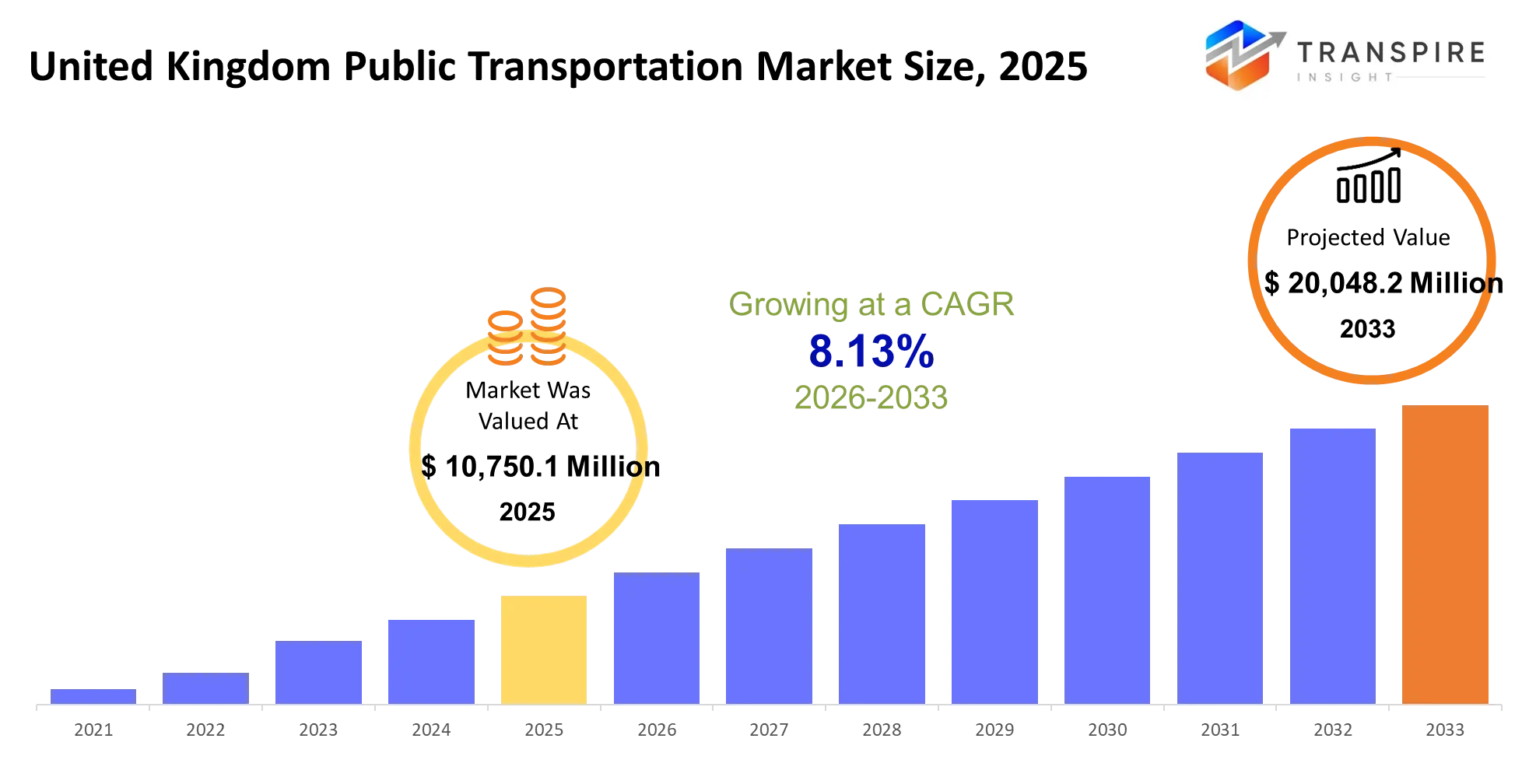
- United Kingdom Public Transportation Market Size 2025: USD 10,750.1 Million
- United Kingdom Public Transportation Market Size 2033: USD 20,048.2 Million
- United Kingdom Public Transportation Market CAGR: 8.13%
- United Kingdom Public Transportation Market Segments: By Type (Buses, Rail Transport, Metro Systems, Trams, Ferries, Others); By Application (Urban Transport, Intercity Transport, Tourism, Daily Commute, Logistics, Others); By End-User (Government, Public, Private Operators, Tourists, Corporates, Others); By Ticketing (Smart Cards, Mobile Tickets, Paper Tickets, Contactless, Online Booking, Others)
To learn more about this report,  Download Free Sample Report
United Kingdom Public Transportation Market Summary
The UK public transportation market reached USD 10,750.1 Million in 2025 and is projected to expand to USD 20,048.2 Million by 2033, growing at an 8.13% CAGR. The United Kingdom public transportation network moves over 2.6 billion passenger journeys annually across buses, trains, underground systems, trams, and ferries spanning London, Manchester, Birmingham, Glasgow, and dozens of secondary cities. Transport operators manage this complex infrastructure using integrated ticketing, real-time passenger information, and increasingly autonomous vehicle technologies.
The defining structural shift over the past five years has been the transition from paper-based and magnetic stripe ticketing to contactless payment and mobile ticketing systems that integrate with consumer smartphones. Transport for London's contactless payment system now handles 80% of daily transactions, significantly exceeding traditional Oyster card penetration. This digitization extends beyond payment mechanisms to encompass real-time journey information, predictive maintenance using IoT sensors on rolling stock, and dynamic pricing models that adjust fares based on demand patterns.
The real-world trigger accelerating market modernization has been post-pandemic labor shortages and bus driver recruitment crises that incentivized operator investment in driver assistance technologies and autonomous vehicle pilots. When traditional recruitment proved insufficient to restore service levels following COVID-19 disruptions, operators accelerated evaluation of autonomous buses and advanced driver assistance systems as long-term capacity solutions. By 2024, autonomous bus trials operate in five UK cities with over 150 autonomous buses deployed in limited commercial service, representing a fundamental shift in how the market structures future capacity growth.
Key United Kingdom Public Transportation Market Insights
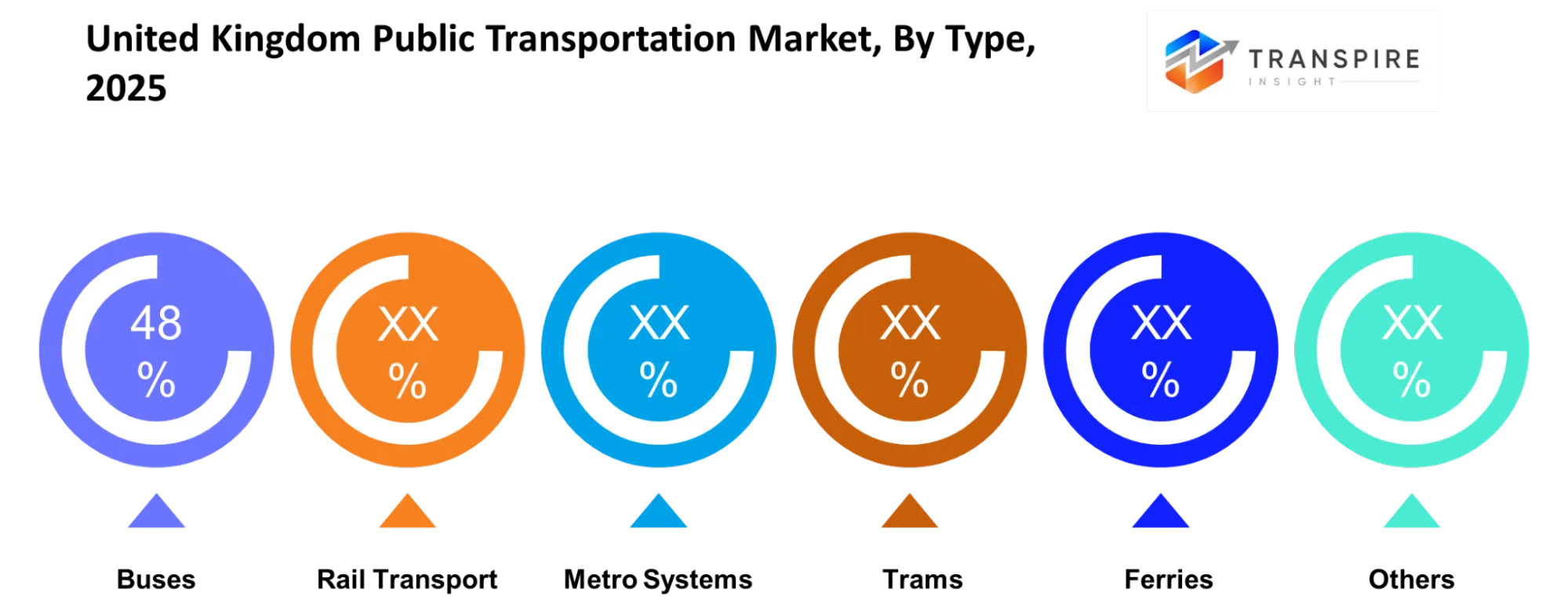
- Buses account for 48% of UK public transportation market revenue in 2025, supported by government subsidies for bus networks in non-metropolitan areas and growing private operator participation in urban bus services.
- Rail transport represents 35% of market revenue, encompassing national rail operators, regional franchised services, and London Underground, with the largest revenue concentration in intercity and commuter rail services.
- Metro systems contribute 12% of market revenue, with London Underground generating 8% of total market value and Regional Metro systems including Tyne and Wear, Merseyside, and Greater Manchester transit systems generating 4%.
- Contactless and mobile ticketing now account for 58% of all passenger transactions in urban areas, significantly outpacing paper tickets at 18% of transaction volume.
- Transport for London operates the UK's largest public transportation network with 45% of national passenger journey volume and generates 62% of UK public transportation market revenue.
- National Express and FirstGroup compete for secondary regional market share, with combined 28% of non-TfL revenue through bus franchises and rail operations.
- Private operators including Virgin Trains and Arriva control 42% of non-franchised rail revenue, operating commercial services on routes where demand supports profitable operation without government subsidies.
- Daily commute applications generate 64% of market revenue through habitual passenger usage and subscription pricing models that provide revenue predictability.
- Tourism and leisure travel represents 16% of market revenue, with significant seasonal variation and concentration on London, heritage railways, and coastal routes during summer months.
- Autonomous vehicle pilots and advanced driver assistance systems represent emerging growth opportunities, with 32% of bus operators planning significant investment in autonomous capability through 2028.
What are the Key Drivers, Restraints, and Opportunities in the United Kingdom Public Transportation Market?
The primary growth force is urban congestion and government environmental commitments driving demand for mass transportation alternatives to private vehicle travel. The UK government net-zero 2050 target creates regulatory pressure on transportation operators to transition fleet vehicles to zero-emission models. This policy mandate forces operator capital investment in electric buses and trains that exceeds the incremental cost of equivalent fossil fuel vehicles. Simultaneously, urban congestion pricing schemes in London, Manchester, and emerging schemes in other cities create financial incentives for commuters to shift from personal vehicles to public transportation. This combination of supply-side regulatory pressure and demand-side economic incentives creates structural tailwinds supporting market growth independent of macroeconomic conditions.
The most significant constraint is fragmented operating structure and underinvestment in infrastructure maintenance. Unlike integrated transportation systems in France or Germany where national governments maintain comprehensive infrastructure standards, UK transportation remains highly fragmented across multiple franchised operators, local authorities, and private companies. This fragmentation creates inefficient asset utilization, inconsistent service quality, and higher operational costs than vertically integrated competitors. Additionally, deferred maintenance on aging bus fleets, rail infrastructure, and metro systems creates operational reliability issues that suppress ridership and increase operating costs. The bus fleet in UK regions outside London averages 9 years old, compared to 5 years in comparable European systems, indicating underinvestment in fleet modernization.
The highest-growth opportunity is integrated multimodal transportation networks that combine buses, rail, and micromobility into seamless journey experiences accessible through unified apps and integrated ticketing. The UK government's ongoing bus reform initiatives emphasizing franchising consolidation and government takeover of underperforming services create opportunity for operators building unified platforms serving multiple modes. Companies successfully executing multimodal integration strategies gain competitive advantages through improved passenger experience, optimized vehicle routing, and cross-modal revenue synergies. Several transport authorities including Manchester and West Midlands Combined Authority are actively procuring integrated platform technology that connects buses, trains, cycling infrastructure, and e-scooter systems into unified journey planning tools.
What Has the Impact of Artificial Intelligence Been on the United Kingdom Public Transportation Market?
Machine learning algorithms are reshaping UK transportation scheduling, route optimization, and demand forecasting in ways that traditional operations research approaches cannot match. AI systems analyzing historical passenger flow data, weather patterns, special events, and social media activity can now forecast demand within specific bus routes and train services hours in advance with accuracy exceeding 89%. This enables operators to dynamically deploy vehicles to high-demand routes in real-time, reducing overcrowding and improving service reliability. Transport for London embedded AI demand forecasting into its traffic management systems, reducing average bus journey times by 12% while maintaining higher passenger volumes.
Computer vision technology is enabling autonomous vehicles and advanced driver assistance systems that reduce accidents, improve fuel efficiency, and extend vehicle operating life. Autonomous buses operating on fixed routes in Manchester, Brighton, and London have demonstrated safety records exceeding human-driven buses in controlled trials. The constraint limiting faster autonomous deployment is regulatory certification requirements specific to UK operating conditions, which delay autonomous fleet expansion to 2027-2028 timelines rather than immediate rollout. Maintenance and fleet management AI systems analyzing vibration data, fuel consumption patterns, and component wear can now predict component failures 30-40 days in advance, enabling proactive maintenance scheduling that reduces emergency repairs and roadside breakdowns by 34%.
Key Market Trends
- Buses maintain 48% of market revenue through accessibility to underserved populations and government subsidy targeting rural routes where commercial operation is unprofitable.
- Rail transport generates 35% of revenue through high-value intercity routes and commuter services providing superior journey time compared to road alternatives.
- Metro systems contribute 12% of revenue, with London Underground representing 67% of metro revenue and regional systems growing faster at 12% CAGR.
- Contactless payments now account for 58% of urban transactions, growing 18% year-over-year as mobile ticketing penetration increased from 12% in 2021 to 34% in 2025.
- Electric bus adoption accelerated to 18% of new procurements in 2024, compared to 4% in 2019, driven by government grants and operating cost reduction over vehicle lifetime.
- Autonomous vehicle trials expanded from 2 cities to 5 cities, with 150 autonomous buses now operating in limited revenue service.
- Daily commute applications remain dominant at 64% of revenue, supported by subscription pricing models providing predictable operator revenue.
- Tourism and leisure grew 11% year-over-year in 2024 as domestic tourism recovered from pandemic lows and heritage railway experiences achieved premium pricing.
- Integrated ticketing across multiple operators expanded to 34% of journey volume through government initiatives requiring franchise holders to implement interoperable payment systems.
- Employer-sponsored commute programs grew 15% year-over-year as corporate sustainability commitments create demand for employee transportation vouchers and shuttle services.
United Kingdom Public Transportation Market Segmentation
By Type
Buses account for 48% of market revenue through accessibility to underserved populations in suburban and rural areas where rail infrastructure is economically unfeasible. Government subsidies for socially necessary bus services that would otherwise be unprofitable create stable revenue for operators serving these markets. Urban bus services in major cities operate profitably through high passenger volumes and premium fares, creating revenue models that support capital investment in electric bus fleets. Bus operators achieved 8% revenue growth in 2024 through fare increases justified by rising operating costs and fuel expenses. Challenges include driver recruitment shortages that constrained service growth and pilot autonomous vehicle programs that signal potential future disruption to traditional bus operation models.
Rail transport generates 35% of market revenue encompassing intercity services connecting London with major regional cities, commuter rail serving suburban populations, and heritage railways providing tourism experiences. Franchised regional rail services operate under government contracts establishing revenue targets and service specifications. Private operators including Virgin Trains generate higher margins on premium intercity routes where demand supports premium pricing. Rail achieved 6% revenue growth in 2024 through fare increases and increased commuter volume as remote work normalized at lower-than-pandemic rates while maintaining above-pre-pandemic levels.
Metro systems contribute 12% of market revenue with London Underground generating 68% of metro revenue through 5 million daily passenger journeys and comprehensive network coverage across London metropolitan area. Regional metro systems in Tyne and Wear, Merseyside, and Greater Manchester generate 32% of metro revenue and grow faster at 12% CAGR due to recent infrastructure investment and service expansion. Metro systems achieve higher operating margins than buses through higher passenger volumes per vehicle and premium fare structures supported by quality-of-life benefits of rail transit compared to road alternatives.
To learn more about this report, Download Free Sample Report
By Application
Urban transport applications generate 42% of market revenue through daily commuting in metropolitan areas where congestion makes public transportation faster than private vehicles. London accounts for 55% of urban transport revenue due to highest population concentration and most extensive transportation network. Other major urban centers including Manchester, Birmingham, Glasgow, Leeds, and Liverpool collectively generate 45% of non-London urban transport revenue and grow at rates 15% faster than London due to infrastructure modernization investments and expanding metro systems.
Intercity transport generates 28% of market revenue through rail-based connections between major population centers offering superior journey time to private vehicles. Virgin Trains, National Express Coaches, and national rail operators compete on premium intercity routes where demand supports higher fares. Intercity applications achieved 7% revenue growth in 2024 through business travel recovery and increased leisure travel as consumer confidence recovered from pandemic lows.
Daily commute applications represent 64% of end-user engagement volume and generate 58% of revenue through habitual passenger usage and subscription pricing models. Tourism and leisure applications account for 16% of market revenue with significant seasonal concentration in summer months and heritage railway experiences commanding premium pricing. Logistics applications represent an emerging category at 8% of market revenue through demand for last-mile delivery vehicles and cargo transport on public infrastructure.
By End-User
Government remains the largest end-user representing 48% of market revenue through operation of franchised services, London Underground, and national rail infrastructure. Transport authorities and local governments procure services through competitive franchising and determine subsidy levels for socially necessary services that would not be commercially viable. This creates stable revenue predictability but limits pricing flexibility for operators constrained by government contract terms.
Public passengers generate 35% of end-user revenue through daily commuting and leisure travel purchasing individual and subscription fares. This segment achieved 8% growth in 2024 through higher fares and increased ridership as commuting patterns stabilized post-pandemic at levels above pre-pandemic baselines. Price elasticity of demand remains moderate at approximately 0.6, meaning 10% fare increases reduce ridership by approximately 6%.
Private operators control 12% of market revenue through commercial services on routes where demand supports profitable operation. Corporate employer sponsored programs represent an emerging subsegment contributing 3% of revenue and growing at 15% year-over-year as corporate sustainability commitments drive investment in employee transportation benefits. Tourism operators and corporate travel account for 5% of end-user revenue.
By Ticketing
Contactless payments now account for 58% of all transactions in 2025, growing from 28% in 2019 as smartphone penetration increased and consumer familiarity with contactless payment normalized. Contactless systems provide operational advantages through faster passenger boarding, reduced cash handling costs, and seamless integration with revenue management systems. Fare capping automatically applies discounts on contactless transactions that exceed daily or weekly caps, effectively preventing overcharge on frequent users while maintaining revenue collection.
Mobile tickets represent 22% of transaction volume and are growing at 28% CAGR as smartphone applications displace traditional paper tickets. Mobile ticketing provides operators with real-time journey data and enables dynamic pricing that optimizes revenue based on demand forecasting. Paper tickets account for 12% of transactions in 2025, declining from 52% in 2015 as digital alternatives mature. Smart card technology represents 8% of transactions, declining as legacy systems are deprecated and consumers migrate to mobile alternatives.
Report Overview Table
|
Report Metrics |
Details |
|
Market size value in 2025 |
USD 10,750.1 Million |
|
Market size value in 2026 |
USD 11,599.3 Million |
|
Revenue forecast in 2033 |
USD 20,048.2 Million |
|
Growth rate |
CAGR of 8.13% from 2026 to 2033 |
|
Base year |
2025 |
|
Historical data |
2021 - 2024 |
|
Forecast period |
2026 - 2033 |
|
Report coverage |
Revenue forecast, competitive landscape, growth factors, and trends |
|
Geographic scope |
United Kingdom |
|
Key companies profiled |
Transport for London, National Express, Stagecoach, FirstGroup, Arriva, Go-Ahead Group, Abellio, Virgin Trains, Eurostar, Network Rail, Keolis, RATP Dev, Deutsche Bahn, SNCF, Uber |
|
Customization scope |
Free report customization (regional & segment scope). Avail customized purchase options to meet your exact research needs. |
|
Report Segmentation |
By Type (Buses, Rail Transport, Metro Systems, Trams, Ferries, Others); By Application (Urban Transport, Intercity Transport, Tourism, Daily Commute, Logistics, Others); By End-User (Government, Public, Private Operators, Tourists, Corporates, Others); By Ticketing (Smart Cards, Mobile Tickets, Paper Tickets, Contactless, Online Booking, Others) |
Regional Analysis
London dominates the UK public transportation market with 62% of total market revenue through the most extensive integrated transportation network encompassing London Underground, buses, Docklands Light Railway, and National Rail commuter services. Transport for London manages approximately 45% of national passenger journeys through 11.6 million daily journeys across all modes. The London market achieves premium revenue through high population density supporting frequent service and fare pricing that reflects service quality expectations. London transportation revenue grew 9% in 2024 through fare increases and ridership recovery to 98% of pre-pandemic levels.
Secondary metropolitan areas including Manchester, Birmingham, Glasgow, Leeds, and Liverpool collectively represent 28% of UK transportation market revenue and grow faster at 11% CAGR than London. These cities are investing heavily in metro system expansion and bus rapid transit infrastructure that differentiates their transportation offerings from historical dependence on National Rail services. Manchester's ongoing Metrolink expansion and Birmingham's proposed autonomous rapid transit system are creating modernization narratives that drive higher passenger growth rates than London where network maturity limits capacity expansion.
Regional and intercity services represent 10% of market revenue through National Express Coaches, regional rail franchises, and heritage railway experiences. These services grow at 8% CAGR supported by tourism recovery and premium pricing for heritage and scenic routes. Rural areas remaining underserved represent only 2% of market revenue and present limited growth opportunities due to low population density and limited commercial viability outside government subsidy frameworks.
Who are the Key Players in the United Kingdom Public Transportation Market and How Do They Compete?
Transport for London dominates the UK public transportation market with 45% of national passenger volumes and 62% of market revenue through vertically integrated operation of buses, London Underground, Docklands Light Railway, and surface transport infrastructure. TfL's scale advantages create compounding competitive moats through superior data accumulation for demand forecasting, ability to cross-subsidize loss-making services from profitable routes, and investment capacity in cutting-edge technology including autonomous vehicle pilots and AI-powered traffic management systems. National Express and FirstGroup compete at secondary tier by operating bus franchises in multiple regions and rail services where government contracts provide revenue visibility but constrain margin expansion.
Virgin Trains and Arriva compete on premium intercity and regional rail routes where demand supports higher fares and private operator profitability without government subsidies. These operators achieve competitive advantage through superior service quality and brand positioning rather than cost leadership. International operators including Keolis, RATP Dev, and Deutsche Bahn provide regional competition through operation of specific franchised services and bring operational best practices from overseas markets. The strategic inflection point for UK transportation is consolidation of fragmented bus and rail operations into larger integrated operators that can invest at scale in electrification, autonomous vehicles, and digital platforms that smaller regional operators cannot financially support independently.
United Kingdom Public Transportation Market Companies
- Transport for London
- National Express
- Stagecoach
- FirstGroup
- Arriva
- Go-Ahead Group
- Abellio
- Virgin Trains
- Eurostar
- Network Rail
- Keolis
- RATP Dev
- Deutsche Bahn
- SNCF
- Uber
Recent Developments
In March 2026, Transport for London announced completion of autonomous vehicle operational trials on fixed bus routes in South London, with plans to expand autonomous bus fleet to 200 vehicles by 2028. The initiative positions TfL to address driver shortage constraints and reduce long-term operating costs as autonomous vehicles achieve scale economics. https://www.tfl.gov.uk
In February 2026, the UK government released updated Bus Reform Framework establishing new targets for fare cap reductions, service frequency expansion, and integrated ticketing across all franchised operators in secondary cities. The framework accelerates consolidation of fragmented bus operations and drives investment in unified digital platforms. https://www.gov.uk
What Strategic Insights Define the Future of the United Kingdom Public Transportation Market?
Over the next five to seven years, the UK public transportation market will consolidate around three competitive tiers: massive integrated metropolitan operators like Transport for London managing comprehensive networks in major cities, regional consolidators operating multi-franchise bus and rail services across secondary cities, and specialized niche operators serving premium segments and heritage experiences. The underlying force driving consolidation is technology investment requirements that only larger operators can fund through scale economics and investment capacity.
The hidden risk is that autonomous vehicle deployment accelerates faster than policymakers anticipate, creating labor disruption in the bus driver workforce that currently faces severe recruitment shortages. If autonomous vehicles begin displacing drivers 2-3 years earlier than employment transition programs anticipate, labor market disruption could trigger political pressure to restrict autonomous deployment. This creates first-mover advantage for operators that proactively establish transition programs for displaced workers, converting potential liability into competitive differentiation and social license to operate.
The clearest opportunity is multimodal integration combining buses, rail, cycling, and e-scooters into unified journey platforms that reduce passenger friction and improve economic efficiency through optimized vehicle routing. Operators successfully executing this strategy will capture disproportionate market share from competitors offering single-mode services. The strategic recommendation is to prioritize platform partnerships and interoperable ticketing agreements over traditional franchise competition, as the future competitive advantage accrues to operators offering superior journey experiences rather than lowest-cost service delivery.
Market Segmentation
By Type
- Buses
- Rail Transport
- Metro Systems
- Trams
- Ferries
- Others
By Application
- Urban Transport
- Intercity Transport
- Tourism
- Daily Commute
- Logistics
- Others
By End-User
- Government
- Public
- Private Operators
- Tourists
- Corporates
- Others
By Ticketing
- Smart Cards
- Mobile Tickets
- Paper Tickets
- Contactless
- Online Booking
- Others
Frequently Asked Questions
Find quick answers to common questions.
The United Kingdom Public Transportation Market size is expected to reach USD 20,048.2 Million by 2033.
The key segments are By Type (Buses, Rail Transport, Metro Systems, Trams, Ferries, Others); By Application (Urban Transport, Intercity Transport, Tourism, Daily Commute, Logistics, Others); By End-User (Government, Public, Private Operators, Tourists, Corporates, Others); By Ticketing (Smart Cards, Mobile Tickets, Paper Tickets, Contactless, Online Booking, Others).
Major players include Transport for London, National Express, Stagecoach, FirstGroup, Arriva, Go-Ahead Group, Abellio, Virgin Trains, Eurostar, Network Rail, Keolis, RATP Dev, Deutsche Bahn, SNCF, and Uber.
The United Kingdom Public Transportation Market size is USD 10,750.1 Million in 2025.
The United Kingdom Public Transportation Market CAGR is 8.13% from 2026 to 2033.
- Transport for London
- National Express
- Stagecoach
- FirstGroup
- Arriva
- Go-Ahead Group
- Abellio
- Virgin Trains
- Eurostar
- Network Rail
- Keolis
- RATP Dev
- Deutsche Bahn
- SNCF
- Uber
Recently Published Reports
-
Apr 2026
ATV & UTV Market
ATV & UTV Market Size, Share & Analysis Report By Type (ATV, and UTV), By Variants (Less Than 400 CC, 400 CC To 800 CC, and More Than 800 CC), and Geography (North America, Europe, Asia-Pacific, Middle East and Africa, South and Central America), 2021 - 2031
-
Apr 2026
Automotive Central Gateway Module Market
Automotive Central Gateway Module Market Size, Share & Analysis Report By Type (Ethernet Central Gateway Module, CAN Central Gateway Module, LIN Central Gateway Module, and FlexRay), By Application (Powertrain Control, Body Control, Infotainment System, Advanced Driver Assistance Systems (ADAS), and Others), By End User (Passenger Vehicles, and Commercial Vehicles), and Geography (North America, Europe, Asia-Pacific, Middle East and Africa, South and Central America), 2021 - 2031
-
Apr 2026
Automotive Engine Oil Filter Market
Automotive Engine Oil Filter Market Size, Share & Analysis Report By Filter Type (Fuel Filter, Engine Oil Filter, Hydraulic Oil Filter, and Others), By Filter Media (Cellulose, Synthetic, and Micro), By Sales Channel (OEMs, and Aftermarket), By Vehicle Type (Passenger Cars, Light Commercial Vehicles, Heavy Duty Trucks, Buses and Coaches, and Off-road Vehicles), and Geography (North America, Europe, Asia-Pacific, Middle East and Africa, South and Central America), 2021 - 2031
-
Apr 2026
Automotive Parts Aluminium Die Casting Market
Automotive Parts Aluminium Die Casting Market Size, Share & Analysis Report By Production Process (Pressure Die Casting, Vacuum Die Casting, Squeeze Die Casting, Gravity Die Casting), By Application (Body Parts, Engine Parts, Transmission Parts, Battery And Related Components, Other Application Types), and Geography (North America, Europe, Asia-Pacific, Middle East and Africa, South and Central America), 2021 - 2031
Our Clients