
Market Summary
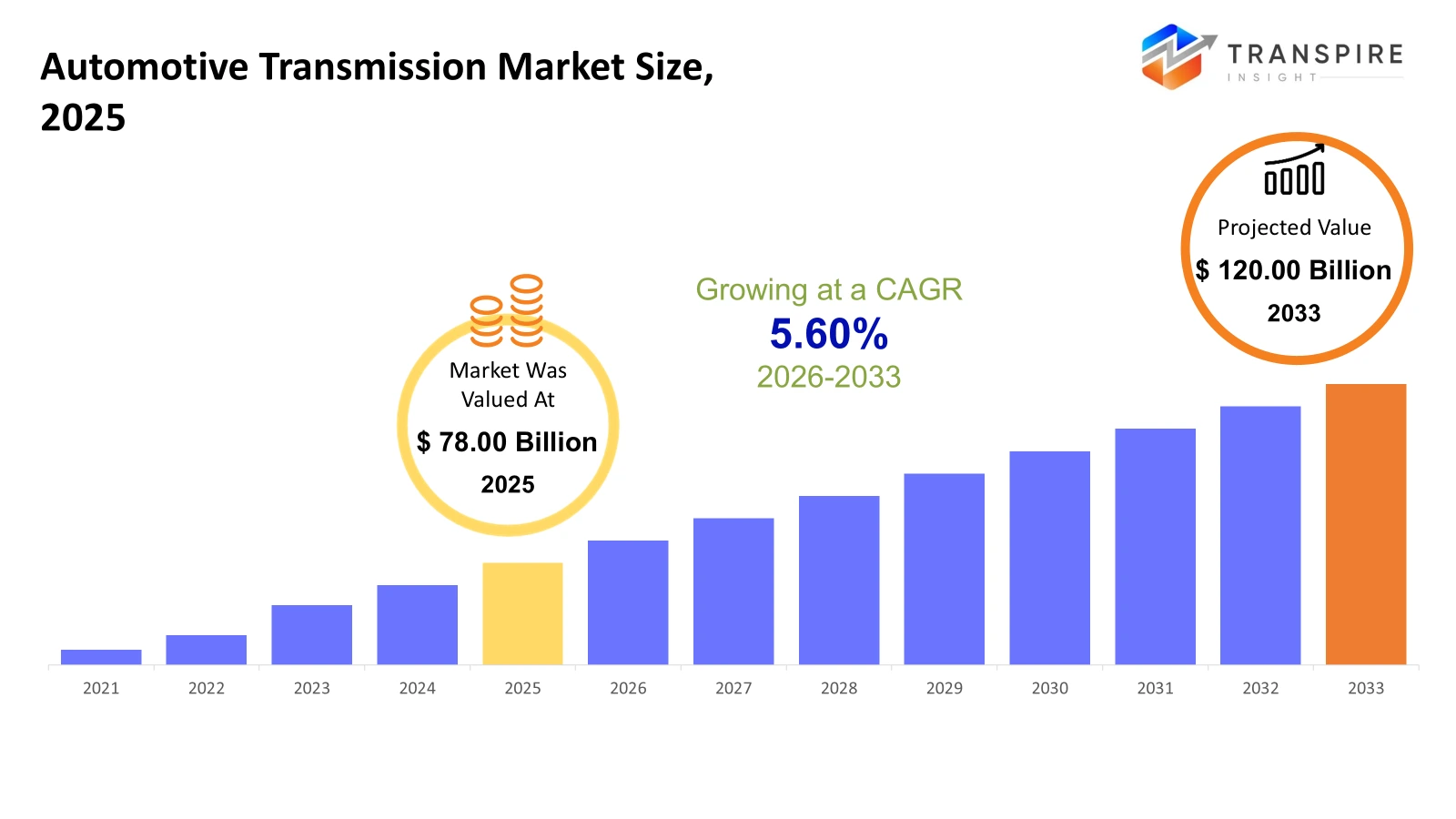
The global Automotive Transmission market size was valued at USD 78.00 billion in 2025 and is projected to reach USD 120.00 billion by 2033, growing at a CAGR of 5.60% from 2026 to 2033. Vehicle output climbs worldwide, so does the need for better gas mileage, along with smoother rides. Newer cars now carry more automatic setups like dual-clutch or variable types, pushing the transmission sector forward. What's building momentum is not just volume but what drivers expect under the hood these days.
Market Size & Forecast
- 2025 Market Size: USD 78.00 Billion
- 2033 Projected Market Size: USD 120.00 Billion
- CAGR (2026-2033): 5.60%
- North America: Largest Market in 2026
- Asia Pacific: Fastest Growing Market
To learn more about this report,  Download Free Sample Report
Key Market Trends Analysis
- The North American market share is estimated to be approximately 37% in 2026. With folks wanting high-tech gearboxes, North America sees steady gains. Because cars and smaller trucks sell well there, progress keeps moving. Driven by what buyers choose, upgrades roll out often. Since drivers lean toward new features, shifts happen regularly across roads.
- Automobile buyers in the United States tend to favor transmissions that shift on their own, packed with modern features. This choice pushes companies to grow what they offer. Machines that think ahead while driving sell more here than older types. Demand rises because people want less effort behind the wheel. New tech built into gearboxes catches attention easily across showrooms nationwide.
- A surge in car manufacturing across Asia-Pacific is reshaping the landscape. Middle-income households now own more vehicles than before. That shift, combined with newer transmission systems entering mainstream use, pushes expansion forward. Growth here runs on fresh demand and tech upgrades alike.
- Automatic Transmission shares approximately 41% in 2026. Sure, thing drives more people toward automation these days. Smoother rides pull interest where older models once clunked through gears. Comfort matters now that city commutes stretch longer. Drivers skip the hassle without thinking twice. Shifting happens behind the scenes while focus stays on the road ahead.
- Gas-powered cars still lead the pack because they are everywhere on roads today. Their staying power comes from how common they are in everyday driving and long-standing availability across regions. Even with shifts happening, most people stick with what’s already there when it comes to personal transport.
- Fueled by rising car ownership worldwide, passenger vehicles keep setting the pace. Replacement patterns add momentum, keeping transmissions in steady need across markets.
- A shift toward smarter vehicles pushes control tech into the spotlight. Electronics now play bigger roles where once mechanics ruled alone. Performance gains come through precise digital oversight rather than raw power tweaks. As cars do more on their own, the brains behind actions grow critical. These systems shape how smoothly a car responds, adapts, and learns. Automation leans heavily on signals, feedback loops, and constant adjustments. Optimization is not just about speed anymore; efficiency matters twice as much. Brains over brawn becomes the quiet rule under the hood.
Growth in automotive transmission market keeps moving forward, thanks to more vehicles being built worldwide, along with a stronger push for better drive quality and less fuel use. When people want easier shifting and greater ride ease, companies respond by building smarter transmission tech that matches higher standards.
Now driving faster shifts, dual-clutch setups change how cars respond on the road. While CVTs stretch gear ratios smoothly, they cut fuel burn without sudden jumps in engine speed. Automated manuals act like hybrids between old sticks and modern autos, fitting neatly into budget models. Each system moves energy better from the motor to the wheels than before. Less waste shows up in tailpipe output, helping meet tighter rules. Car builders adopt them because performance gains come without extra cost spikes. Buyers notice sharper pickup and quieter highway cruising as added perks.
Nowhere is change clearer than in how transmissions are being rethought for hybrid cars. With both electric motors and gasoline engines needing to work together, engineers face fresh puzzles to solve. These challenges open paths where entirely new ideas can grow. Instead of old methods, smarter systems emerge to handle shifting duties between two power sources. Every small step forward reveals a chance to do things differently.
Still, the move toward electric cars that usually need less complex transmissions creates lasting hurdles. Yet improvements in lighter parts, smaller setups, or smarter components keep pushing growth through different kinds of vehicles.
Automotive Transmission Market Segmentation
By Transmission Type
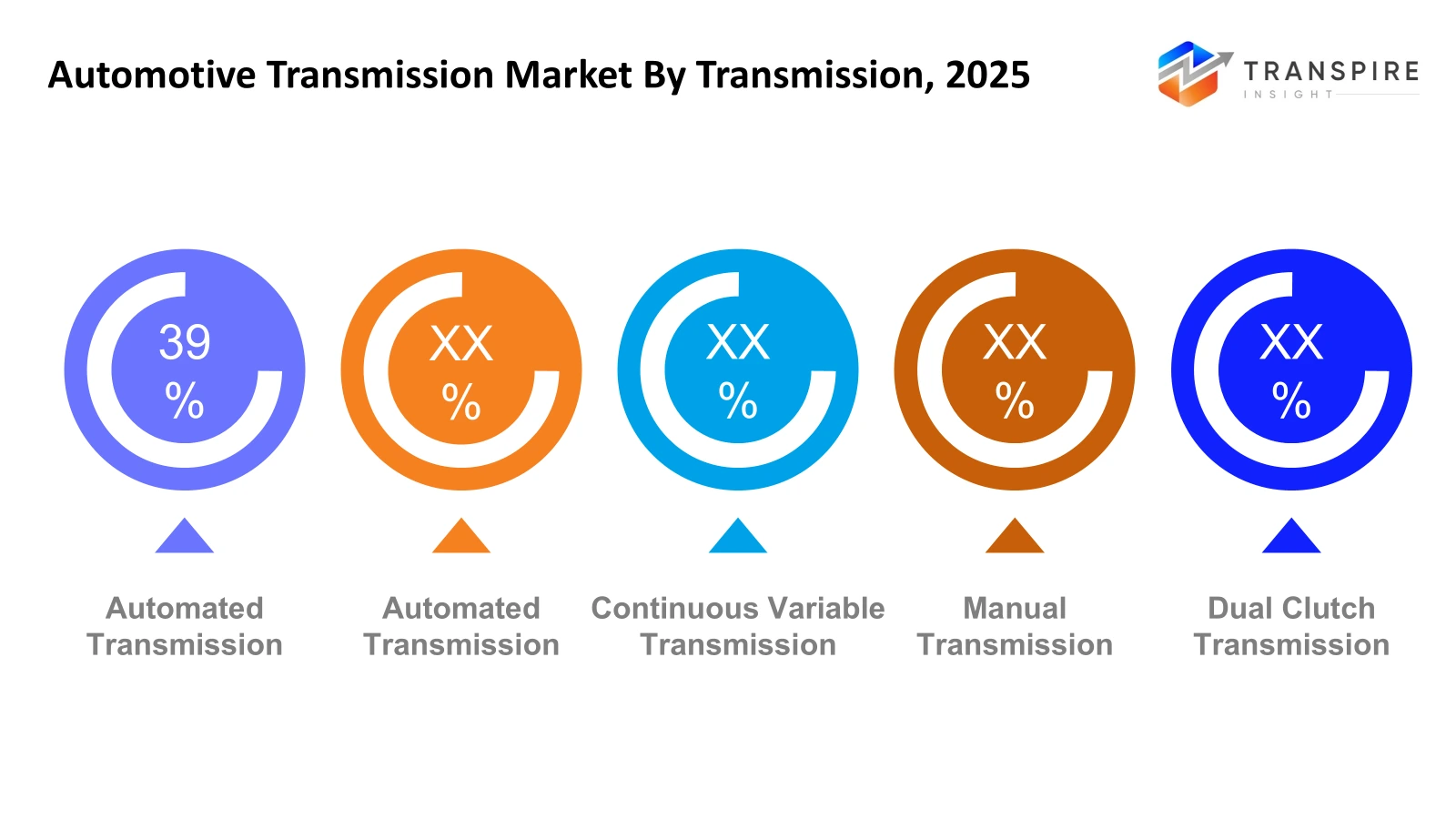
- Manual Transmission
Cost-effective system offering driver-controlled gear shifting.
- Automatic Transmission
Faster shifts happen on their own, making motion feel effortless through changing gears without effort. Motion flows more easily when the system decides timing, removing guesswork from speed adjustments.
- Automated Transmission
A driver still shifts gears by hand, yet the system handles clutch work alone. This setup uses a regular gearbox but adds electronics to cut effort.
- Continuously Variable Transmission
A smooth ride comes from a transmission that shifts without steps. Efficiency climbs because the engine runs where it works best. Motion flows more easily when changes happen on the fly.
- Dual Clutch Transmission
Shifting gears feels quicker with a dual-clutch transmission. Performance gains come through smoother transitions between speeds.
To learn more about this report, Download Free Sample Report
By Fuel Type
- Gasoline
Fueled by a surge in making cars for people, gasoline stays on top. Yet every new vehicle rolling out pushes its lead further.
- Diesel
Diesel fits the role often. Trucks hauling loads rely on their strength regularly.
- Hybrid
A mix of electric and internal combustion needs custom-built gearboxes. Though complex, these units merge two power sources into one smooth drive.
- Electric Vehicles
One gear does the job in electric cars. Motors handle speed changes without help. Not needed here. Power flows straight to the wheels. Fewer parts mean less trouble over time.
By Vehicle Type
- Passenger Cars
Most cars on the roads are passenger vehicles. Ownership worldwide keeps this part busy. That fact shapes what companies build.
- Light Commercial Vehicles
They test a transmission’s strength daily. City routes demand resilience - each delivery adds strain. Bumpy streets, constant shifting, tight turns; these vehicles face it all. Tough gearboxes handle repeated loads without faltering. Reliability hides inside metal housings, working mile after mile silently.
- Heavy Commercial Vehicles
Big trucks run on tough setups built for heavy cargo and miles of road. Their machinery handles strain without slowing down. Strength matters when routes stretch far. These vehicles push through demands that others can’t. Durability defines their design at every stage.
By Component
- Gears
Spinning wheels inside machines handle power shifts plus changes in turn rate.
- Clutch
Gears shift smoothly when the clutch steps in. Power flow stops or starts because of its role. Without it, movement transfers without pause. It acts like a gatekeeper between the engine and the wheels. Motion waits until the system decides.
- Torque Converter
A spinning link inside helps motion flow without jerks in self-shifting setups. Power moves more easily when parts glide together behind the scenes.
- Transmission Shaft
A spinning rod moves energy through the machine. This component carries force from one part to another. Inside, motion travels along its length. Power flows where needed because of its rotation. Movement passes thanks steadily to this piece.
- Control Systems
Fine-tuned shifts happen through electronic oversight, keeping power delivery smooth. Gear changes follow precise signals instead of mechanical cues alone.
Regional Insights
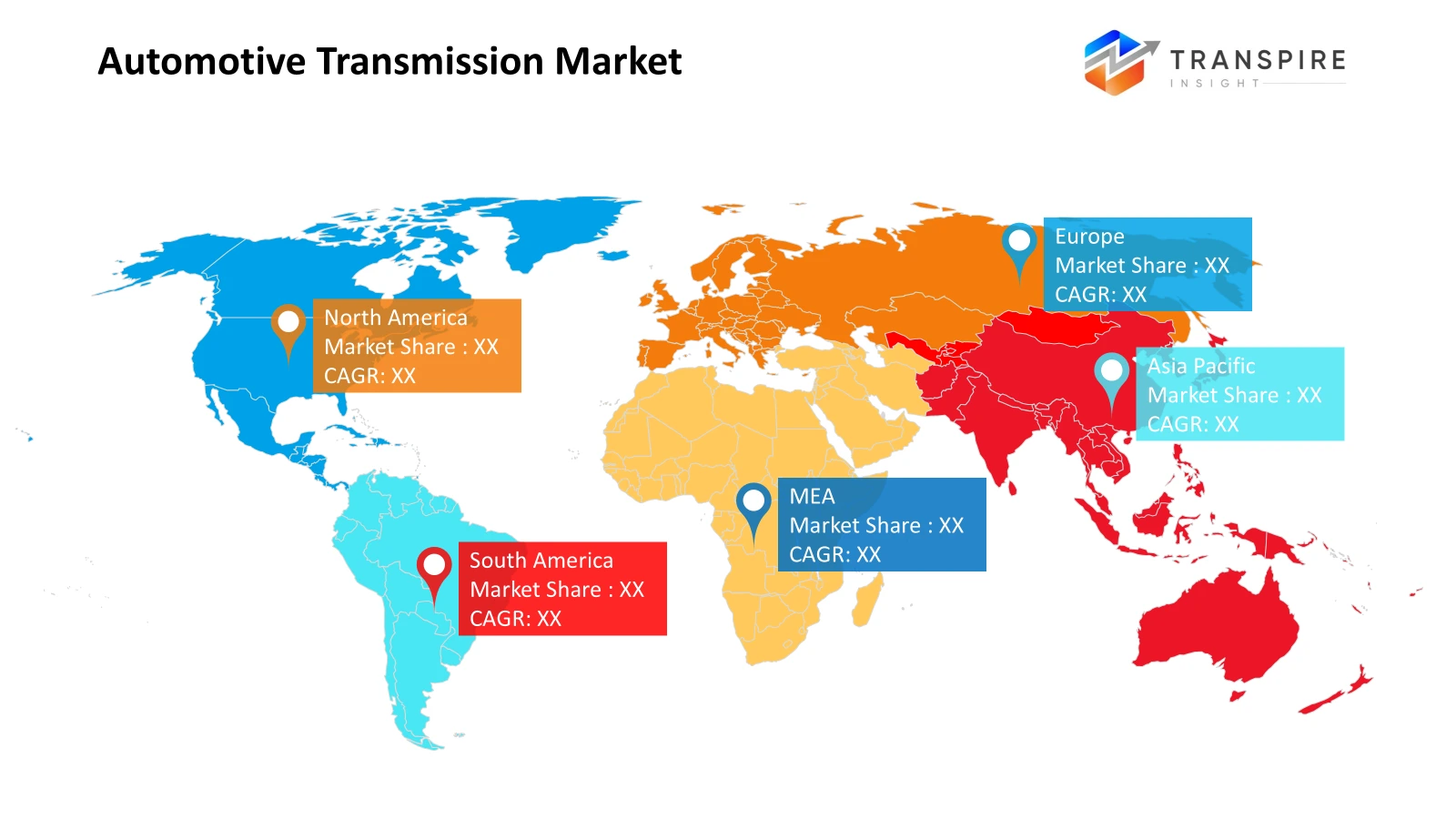
Out of nowhere, the Asia-Pacific area tops global automotive transmission use. This happens because places such as China, Japan, South Korea, and India build huge numbers of vehicles. Their solid factory networks play a big role too. As cities grow faster, more people can afford cars. With pay going up, buying power rises sharply. Because of that shift, demand climbs for personal vehicles. That trend pulls transmission systems into wider use throughout the region.
Heavy buying of self-shifting cars and small trucks keeps North America deeply involved. Major carmakers settled here to push the movement forward, while people lean toward modern gearboxes like auto and twin-clutch types. Growth stays alive because choices match what drivers want.
Ahead of the pack, Europe keeps its edge through fresh tech advances along with tighter fuel rules. Not far behind, regions like Latin America plus parts of Africa and the Middle East gain ground as car demand rises and roads get smarter.
To learn more about this report, Download Free Sample Report
Recent Development News
- January 29, 2026 – Volkswagen to launch 5 new cars in 2026, across SUV, Sedan, and Hatch body styles.
- January 20, 2026 – Skoda Auto unveils the new Kushaq in India.
(Source:https://www.skoda-auto.co.in/news/news-detail/skoda-auto-unveils-the-new-kushaq-in-india)
|
Report Metrics |
Details |
|
Market size value in 2025 |
USD 78.00 Billion |
|
Market size value in 2026 |
USD 82.00 Billion |
|
Revenue forecast in 2033 |
USD 120.00 Billion |
|
Growth rate |
CAGR of 5.60% from 2026 to 2033 |
|
Base year |
2025 |
|
Historical data |
2021 – 2024 |
|
Forecast period |
2026 – 2033 |
|
Report coverage |
Revenue forecast, competitive landscape, growth factors, and trends |
|
Regional scope |
North America; Europe; Asia Pacific; Latin America; Middle East & Africa |
|
Country scope |
United States; Canada; Mexico; United Kingdom; Germany; France; Italy; Spain; Denmark; Sweden; Norway; China; Japan; India; Australia; South Korea; Thailand; Brazil; Argentina; South Africa; Saudi Arabia; United Arab Emirates |
|
Key company profiled |
Aisin Seiki Co., Ltd., ZF Friedrichshafen AG, Getrag (Magna), BorgWarner Inc., Jatco Ltd., Hyundai Transys, Continental AG, Schaeffler AG, Tremec, Allison Transmission, Denso Corporation, Honda Gear, Toyo Denso Co., Ltd., Mahle GmbH, Robert Bosch GmbH, Eaton Corporation, and Toyo Corporation |
|
Customization scope |
Free report customization (country, regional & segment scope). Avail customized purchase options to meet your exact research needs. |
|
Report Segmentation |
By Transmission Type (Manual Transmission, Automatic Transmission, Automated Transmission, Continuously Variable Transmission, Dual Clutch Transmission), By Fuel Type (Gasoline, Diesel, Hybrid, Electric Vehicles), By Vehicle Type (Passenger Cars, Light Commercial Vehicles, Heavy Commercial Vehicles), By Component (Gears, Clutch, Torque, Converter, Transmission Shaft and Control Systems) |
Key Automotive Transmission Company Insights
Starting strong, ZF Friedrichshafen AG stands out in the auto transmission field with smart designs for automatic and hybrid setups. Its 8-speed and 9-speed models move quickly into cars built by major manufacturers around the globe - fuel savings plus sharper driving response help drive that shift. Innovation pulses through the team, especially when it comes to powertrains for electric and partly electric vehicles. Research never slows down here; fresh ideas keep flowing, pushing their edge forward across international markets.
Key Automotive Transmission Companies:
- Aisin Seiki Co., Ltd.
- ZF Friedrichshafen AG
- Getrag (Magna)
- BorgWarner Inc.
- Jatco Ltd.
- Hyundai Transys
- Continental AG
- Schaeffler AG
- Tremec
- Allison Transmission
- Denso Corporation
- Honda Gear
- Toyo Denso Co., Ltd.
- Mahle GmbH
- Robert Bosch GmbH
- Eaton Corporation
- Toyo Corporation
Global Automotive Transmission Market Report Segmentation
By Transmission Type
- Manual Transmission
- Automatic Transmission
- Automated Transmission
- Continuously Variable Transmission
- Dual Clutch Transmission
By Fuel Type
- Gasoline
- Diesel
- Hybrid
- Electric Vehicles
By Vehicle Type
- Passenger Cars
- Light Commercial Vehicles
- Heavy Commercial Vehicles
By Component
- Gears
- Clutch
- Torque
- Converter
- Transmission Shaft and Control Systems
Regional Outlook
- North America
- United States
- Canada
- Mexico
- Europe
- Germany
- United Kingdom
- France
- Spain
- Italy
- Rest of Europe
- Asia Pacific
- Japan
- China
- Australia & New Zealand
- South Korea
- India
- Rest of Asia Pacific
- South America
- Brazil
- Argentina
- Rest of South America
- Middle East & Africa
- Saudi Arabia
- United Arab Emirates
- South Africa
- Rest of the Middle East & Africa
Frequently Asked Questions
Find quick answers to common questions.
The approximate Automotive Transmission Market size for the market will be USD 120.00 billion in 2033.
Key segments for the Automotive Transmission market are By Transmission Type (Manual Transmission, Automatic Transmission, Automated Transmission, Continuously Variable Transmission, Dual Clutch Transmission), By Fuel Type (Gasoline, Diesel, Hybrid, Electric Vehicles), By Vehicle Type (Passenger Cars, Light Commercial Vehicles, Heavy Commercial Vehicles), By Component (Gears, Clutch, Torque, Converter, Transmission Shaft and Control Systems).
Major Automotive Transmission Market players are Aisin Seiki Co., Ltd., ZF Friedrichshafen AG, Getrag (Magna), BorgWarner Inc., and Jatco Ltd.
The North America region is leading the Automotive Transmission Market.
The Automotive Transmission Market CAGR is 5.60%.
- Aisin Seiki Co., Ltd.
- ZF Friedrichshafen AG
- Getrag (Magna)
- BorgWarner Inc.
- Jatco Ltd.
- Hyundai Transys
- Continental AG
- Schaeffler AG
- Tremec
- Allison Transmission
- Denso Corporation
- Honda Gear
- Toyo Denso Co., Ltd.
- Mahle GmbH
- Robert Bosch GmbH
- Eaton Corporation
- Toyo Corporation
Recently Published Reports
-
Apr 2026
ATV & UTV Market
ATV & UTV Market Size, Share & Analysis Report By Type (ATV, and UTV), By Variants (Less Than 400 CC, 400 CC To 800 CC, and More Than 800 CC), and Geography (North America, Europe, Asia-Pacific, Middle East and Africa, South and Central America), 2021 - 2031
-
Apr 2026
Automotive Central Gateway Module Market
Automotive Central Gateway Module Market Size, Share & Analysis Report By Type (Ethernet Central Gateway Module, CAN Central Gateway Module, LIN Central Gateway Module, and FlexRay), By Application (Powertrain Control, Body Control, Infotainment System, Advanced Driver Assistance Systems (ADAS), and Others), By End User (Passenger Vehicles, and Commercial Vehicles), and Geography (North America, Europe, Asia-Pacific, Middle East and Africa, South and Central America), 2021 - 2031
-
Apr 2026
Automotive Engine Oil Filter Market
Automotive Engine Oil Filter Market Size, Share & Analysis Report By Filter Type (Fuel Filter, Engine Oil Filter, Hydraulic Oil Filter, and Others), By Filter Media (Cellulose, Synthetic, and Micro), By Sales Channel (OEMs, and Aftermarket), By Vehicle Type (Passenger Cars, Light Commercial Vehicles, Heavy Duty Trucks, Buses and Coaches, and Off-road Vehicles), and Geography (North America, Europe, Asia-Pacific, Middle East and Africa, South and Central America), 2021 - 2031
-
Apr 2026
Automotive Parts Aluminium Die Casting Market
Automotive Parts Aluminium Die Casting Market Size, Share & Analysis Report By Production Process (Pressure Die Casting, Vacuum Die Casting, Squeeze Die Casting, Gravity Die Casting), By Application (Body Parts, Engine Parts, Transmission Parts, Battery And Related Components, Other Application Types), and Geography (North America, Europe, Asia-Pacific, Middle East and Africa, South and Central America), 2021 - 2031
Our Clients