
Middle East and Africa Military Helicopter Market Size & Forecast:
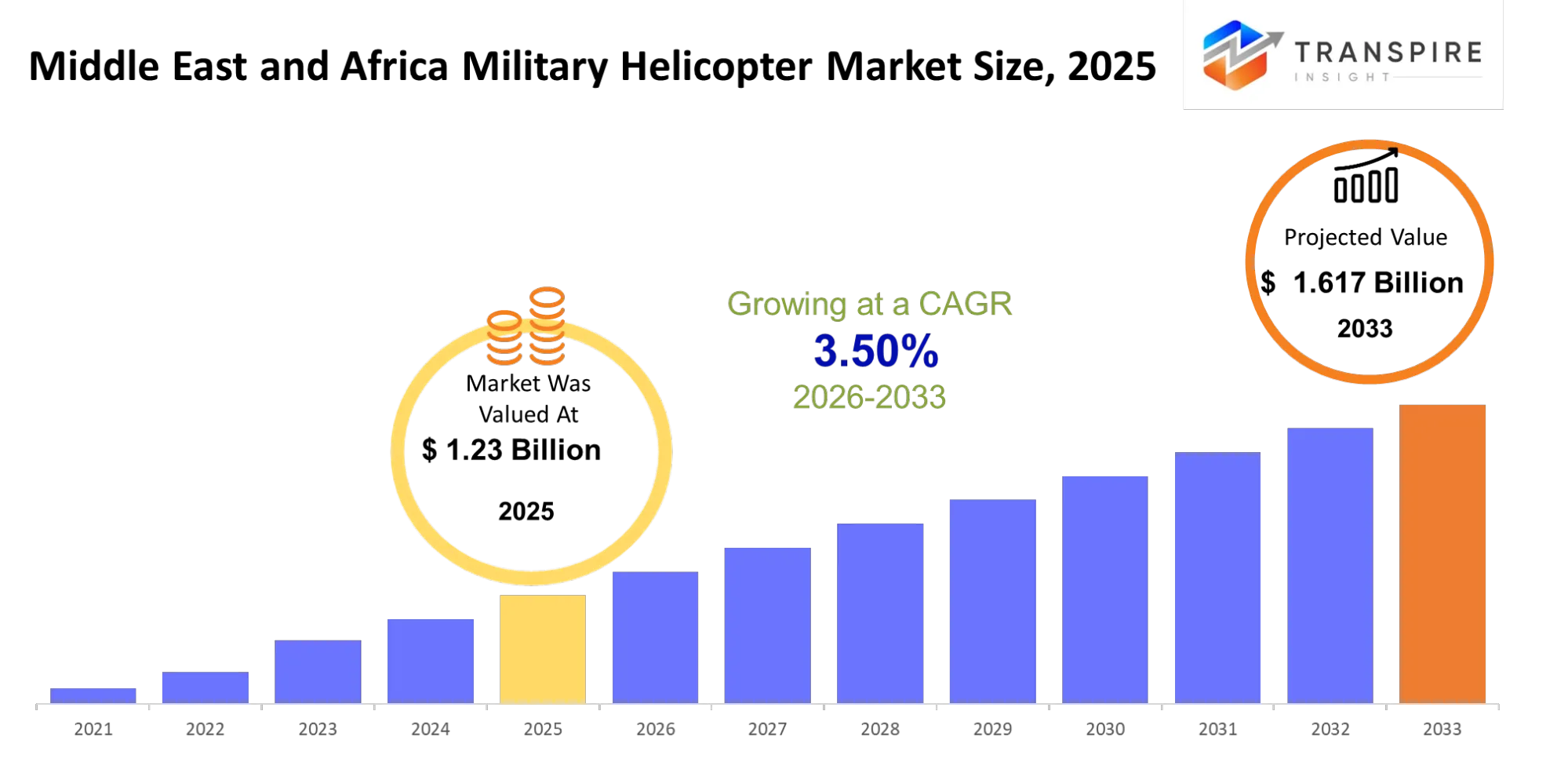
- Middle East and Africa Military Helicopter Market Size 2025: USD 1.23 Billion
- Middle East and Africa Military Helicopter Market Size 2033: USD 1.617 Billion
- Middle East and Africa Military Helicopter Market CAGR: 3.50%
- Middle East and Africa Military Helicopter Market Segments: By Type (Attack Helicopters, Transport Helicopters, Reconnaissance Helicopters, Utility Helicopters, Others); By Application (Defense Operations, Search & Rescue, Transport, Surveillance, Combat Missions, Others); By End-User (Defense Forces, Government, Aerospace Firms, Others); By Technology (Conventional, Advanced Avionics, Autonomous Systems, Others)
To learn more about this report,  Download Free Sample Report
Middle East and Africa Military Helicopter Market Summary
The Middle East and Africa Military Helicopter Market was valued at USD 1.23 Billion in 2025. It is forecast to reach USD 1.617 Billion by 2033. That is a CAGR of 3.50% over the period.
Military helicopters sorta play a key operational role all across the Middle East and Africa, helping with fast troop movement, border watch, quick combat response, medical evacuation and even disaster help especially in places where fixed wing aircraft can’t really work well enough. In practice armed forces lean on rotary platforms to keep mobility over desert terrain, offshore areas, and those politically unstable border zones where speed, plus day to day operational flexibility, ends up mattering a lot for mission success. Over the past five years the market has kind of pivoted, moving away from just growing fleets, toward more tech heavy modernization efforts. These focus on advanced avionics, electronic warfare systems, and predictive maintenance kind of stuff.
A big push behind this whole change was the rise in regional security tensions and cross border threat behavior after 2021. That, in turn accelerated procurement schedules and basically forced governments to beef up rapid response aviation capabilities. At the same time supply chain disruptions, along with geopolitical export restrictions, nudged several Gulf nations toward localized aerospace production plus maintenance partnerships. As a result, the sector’s long term contract worth is trending higher, because operators now lean into lifecycle support, digital fleet management, and mission adaptability, alongside just buying aircraft.
Key Market Insights
- The Middle East, sort of dominated more than 58% of the Middle East and Africa Military Helicopter Market revenue in 2025, mainly from high value defense modernization deals and advanced fleet replacement programs, even if it sounds a bit repetitive.
- North Africa came up as the fastest-growing regional market right after 2024 because border surveillance investments kept rising, plus counterterrorism aviation capabilities kept expanding through 2033 or something like that.
- Attack helicopters held nearly 34% market share in 2025 since defense agencies leaned harder toward precision strike and battlefield mobility, which is pretty straightforward but still a point.
- Transport helicopters stayed as the second biggest industry share. Military logistics, humanitarian deployment, and rapid troop movement requirements increased across desert operations, so yeah.
- Reconnaissance helicopters are forecast to be the fastest-growing segment between 2026 and 2033. That’s because maritime surveillance needs, along with intelligence gathering missions, keep getting more attention.
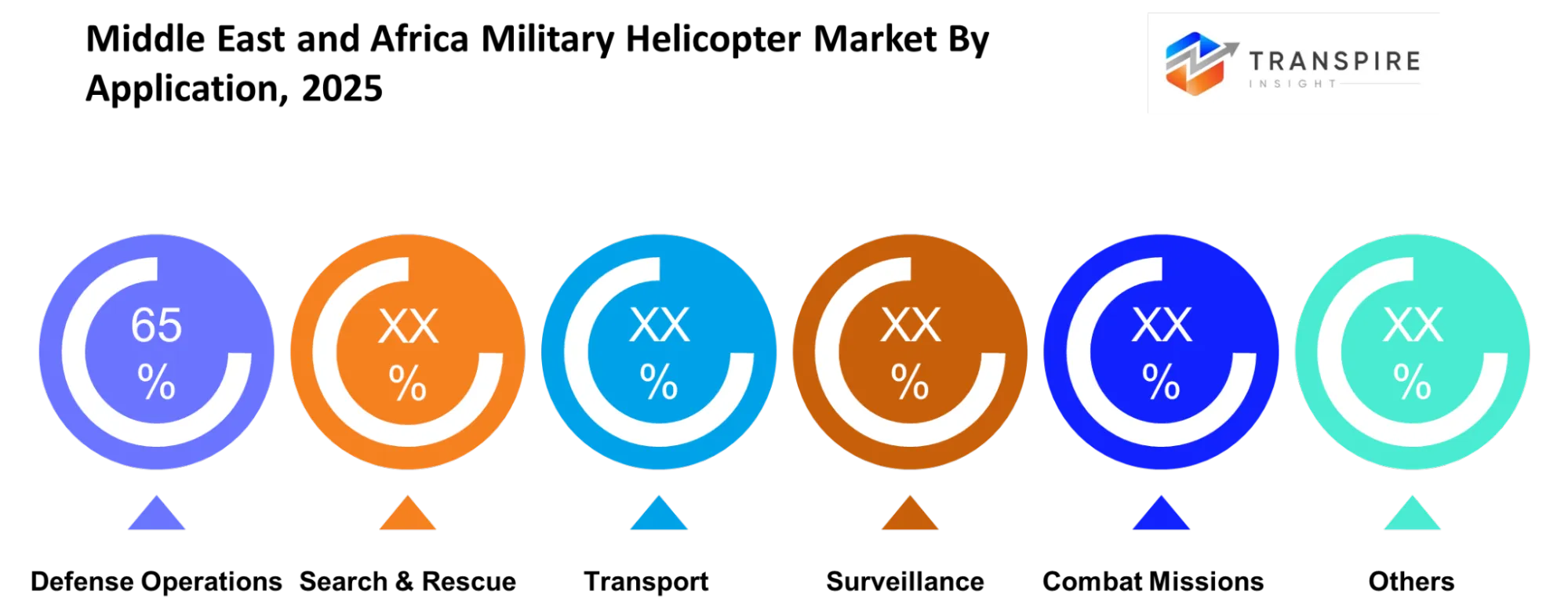
- Defense operations accounted for over 40% application share in 2025. Regional governments ramped up aerial combat readiness, and also favored rapid response military strategies, pretty aggressively.
- Defense forces remained the top end-user segment, with more than 62% share, driven by procurement budgets growing steadily, and by long-term helicopter modernization initiatives, it all ties together.
- Government agencies and homeland security departments, showed the quickest growth pace after 2024, thanks to investments in border patrol and surveillance aviation systems, more monitoring, less waiting.
- Companies like Lockheed Martin, Boeing, Leonardo, Airbus Helicopters, and HAL strengthened their competitive position through localized partnerships, predictive maintenance technologies, and advanced avionics integration.
- Helicopter manufacturers also started leaning more into regional MRO partnerships during 2025 and 2026, to reduce supply chain exposure and improve fleet readiness rates, basically a pragmatic shift.
What are the Key Drivers, Restraints, and Opportunities in the Middle East and Africa Military Helicopter Market?
The main factor speeding up the military helicopter field across the Middle East and Africa seems to be the quick spread of defense upgrades linked to boundary protection and asymmetric conflict readiness, you know. In Saudi Arabia, the United Arab Emirates, Egypt, and Algeria, authorities have bumped up procurement funding after more than a few regional security disruptions, plus the growing needs for cross border monitoring since 2022. As a result, armed forces are leaning harder toward multi role helicopters, not just basic airframes, with better avionics onboard, electronic warfare suites, and precision engagement features. Big buying deals, along with long range sustainment contracts, are pretty much adding to revenue channels for helicopter makers, parts suppliers, and regional MRO firms.
Still, the biggest drag on the market is the expensive whole lifecycle cost tied to keeping military helicopters flying and ready. Buying the aircraft is only a portion of the total burden. On top of that you have the pilot preparation timelines, spare parts reliance, routine engine servicing, and even infrastructure work, which all pile on sustained financial strain for defense agencies. This restraint feels structural too, because many operators across Africa keep using older fleets, and their maintenance networks are rather thin, or at least they cannot be upgraded quickly. Tight budget conditions continue to postpone fleet refresh initiatives, and they also limit how fast next generation platforms get adopted.
A noticeable opportunity for what comes next is starting to show up via local aircraft production, plus defense industrial collaborations. Gulf states are asking global contractors more and more for domestic assembly, parts manufacturing, and technology transfer arrangements. This is happening especially as they seek greater control over supply chains and operational continuity, and it can reshape how value is captured across the ecosystem.Recent, partnership involving Leonardo and various regional defense firms show how localization push could, kind of, build new supply chain ecosystems , and also open long term investment chances between 2026 and 2033, at least that’s how it looks.
What Has the Impact of Artificial Intelligence Been on the Middle East and Africa Military Helicopter Market?
Artificial intelligence and advanced digital technologies are kind of reshaping military helicopter operations across the Middle East and Africa, improving mission readiness , maintenance efficiency, and battlefield coordination in ways that feel more immediate than before. Defense operators are more and more adding AI-enabled flight management systems, automated threat detection software, and digital mission planning platforms into multi role helicopter fleets. The advanced avionics now also help with automated terrain mapping, target recognition, and real time battlefield data processing, which reduces pilot workload during surveillance, transport, and combat missions. At the same time several Gulf defense agencies have expanded their use of digital fleet monitoring platforms, they track aircraft health, fuel consumption, and mission performance through centralized command systems.
Machine learning models are taking on a bigger role in predictive maintenance by quietly watching vibration patterns, catching engine temperature drifts, and estimating component fatigue before failures really pop up. Helicopter makers, like Lockheed Martin and Leonardo, are bringing in predictive diagnostics and digital twin type technologies, trying to lift aircraft availability while also trimming down unscheduled maintenance events. With these tools operators can push fleet uptime higher, stretch component life cycles out further, and reduce maintenance costs through condition based servicing instead of just waiting for the obvious breakdowns to show themselves. But broader AI adoption still has limits, mostly because of pricey integration efforts, cybersecurity worries, and uneven operational data quality across older helicopter fleets that are used in multiple African defense environments.
Key Market Trends
- After 2023, several Gulf nations started putting more money into AI-enabled avionics, kinda shifting what they buy, from basic transport platforms toward helicopters that are more digitally stitched into combat systems. It’s not just a small update either, more like a procurement change, even if the wording stays similar.
- Leonardo and Airbus Helicopters meanwhile expanded their regional localization partnerships across 2025 and 2026, which shows a stronger government push for domestic aerospace manufacturing capabilities, so yeah that “local build” theme keeps coming up.
- Across Africa, defense agencies did something kind of quieter but also steady, they reduced their reliance on older Soviet-era fleets, and leaned into modular helicopters instead, mainly because upkeep is lower and the lifecycle operating costs feel less heavy.
- Reconnaissance helicopter demand also picked up fast after 2024, because border surveillance and maritime security missions intensified across parts of North Africa and along Red Sea corridors, it just became more urgent, you know.
- Military buyers kept leaning toward multi-role helicopters rather than single-purpose aircraft, which gives more operational flexibility, and at the same time it trims long term fleet management complexity. That combo matters.
- Since 2025, predictive maintenance technologies have gained real traction within Gulf air forces, helping operators cut downtime and improving mission readiness rates too.
- Procurement strategies have shifted as well, less emphasis on buying aircraft by themselves, more emphasis on long-term maintenance and training agreements, so OEMs can tap stronger recurring revenue opportunities instead of only one-time sales.
- Between 2024 and 2026, regional governments increased investment in local MRO infrastructure, to work around geopolitical export restrictions and to prevent spare-parts supply disruptions, without waiting on external deliveries that can get stuck.
- Meanwhile, Boeing, Lockheed Martin, and Leonardo have been competing more aggressively around survivability systems, plus electronic warfare integration, rather than trying to win mostly on acquisition pricing.And finally, autonomous flight assistance systems moved from mostly experimental testing to limited operational deployment, especially for reconnaissance and high-risk tactical support missions where the conditions are… well, less forgiving.
Middle East and Africa Military Helicopter Market Segmentation
By Type
Attack helicopters keep taking up a big chunk of revenue, mainly because defense modernization keeps rolling and lots of Gulf nations are investing more into rotary platforms that are ready for combat . Defense organizations lean toward attack helicopters for border control, anti armor work, and fast tactical reaction when the situation is high risk. Also, strong interest in precision targeting systems, night-vision compatibility, and integrated weapons platforms is keeping purchase activity steady across more advanced defense economies.
Transport helicopters still show fairly stable demand. The armed forces need flexible air mobility for moving troops, logistics support, and humanitarian deployment. These platforms benefit from long operating ranges and solid payload capacity, so they become pretty important for desert operations and getting to remote areas. Looking ahead, procurement is expected to tilt toward multi role transport variants, with upgraded avionics and reduced maintenance, which opens chances for manufacturers that can offer modular mission configurations.
Reconnaissance plus utility helicopters are picking up momentum because defense agencies are expanding surveillance coverage, and also strengthening disaster response. Reconnaissance helicopters support intelligence gathering, maritime patrol and border monitoring operations, especially where politics are more sensitive. Utility helicopters are being used more widely too, including medical evacuation and infrastructure protection missions. With more integration of lightweight sensors, AI enabled imaging systems , and platforms that have lower operating costs, long term investment in these groups should get even stronger.
By Application
Defense operations are really the dominant slice of the market, mostly because regional military strategies now rely more and more on fast deployment, plus some operational flexibility that cannot really wait. Helicopters help with troop insertion, but also with air coordination, supply transport, and even counterinsurgency assignments across all kinds of terrain and weather. Ongoing regional security worries and bigger military budgets keep pushing procurement toward mission-ready rotary aircraft.
On the other hand, combat missions, and surveillance applications are growing at a steady pace as governments pour money into battlefield intelligence, and also for real time threat reaction. Surveillance helicopters with electro-optical sensors, along with radar systems are getting more or less treated as must haves for border watch, maritime security, and anti smuggling operations. Combat oriented platforms that include missile systems, and digital targeting tech are getting stronger procurement attention too, especially in countries sharpening aerial defense capabilities.
Meanwhile, search and rescue plus transport use cases are expected to pick up even more momentum during the forecast period, mainly due to rising needs for disaster response and humanitarian actions. Governments and defense organizations are sending helicopters for floods, wildfires, offshore incidents, and medical evacuation work in remote areas. Product developers who focus on endurance improvement, autonomous navigation support, and multi mission versatility are likely to see benefits from this broader range of work, right as adoption grows.
To learn more about this report, Download Free Sample Report
By End-User
Defense forces account for the largest share of helicopter procurement because, military organizations remain the primary operators of combat , transport, and reconnaissance fleets. Ongoing fleet modernization programs and rising geopolitical tensions continue to push long-term acquisition contracts across the Middle East and Africa. In this area, procurement decisions usually put survivability systems first, then mission versatility as well, and also compatibility with advanced weapons integration.
Government agencies are increasing helicopter deployment for internal security, disaster management, border surveillance, and law enforcement support. Coast guards, emergency response departments, and homeland security organizations are expanding their aerial mobility capabilities to strengthen rapid-response infrastructure. Stable public sector funding, plus growing investment in national security programs, helps keep demand steady within this segment, even when conditions shift a bit.
Aerospace firms and specialized service providers are also becoming key contributors through maintenance, repair, overhaul, and pilot training operations. Expansion of localized manufacturing partnerships, along with defense offset agreements is encouraging private-sector involvement in helicopter support ecosystems. Looking ahead, market growth is expected to generate investment opportunities for regional aerospace suppliers focused on lifecycle management, simulation systems ,and advanced maintenance technologies.
By Technology
Conventional helicopter systems keep holding a substantial market share, because a lot of regional operators—really— prioritize operational reliability and lower acquisition costs, even if it’s not the fanciest option. A number of African and mid-sized defense economies are still leaning on mechanical platforms that are already proven for transport, patrol, and tactical activities. It’s also the cost-effective maintenance structure and those established pilot training systems that quietly make conventional helicopter technology stick around longer than people might expect.
Meanwhile, advanced avionics systems are getting quite a bit of momentum as military organizations push for better situational awareness, stronger navigation accuracy, and smoother mission coordination. Newer cockpit displays, sensor fusion methods, and electronic warfare integration are becoming pretty much required during procurement for freshly acquired fleets. At the same time , the growing need for night operations, precision targeting, and real-time battlefield communication is steadily pulling investment toward digitally enhanced rotary platforms.
Then there’s autonomous systems and AI-assisted operational technologies, which are basically the fastest-developing segment in the whole market. Defense agencies are increasingly experimenting with autonomous flight support, predictive maintenance software, and unmanned teaming, all to boost mission efficiency and reduce operational risk. Looking forward, semi-autonomous rotary platforms are expected to reshape procurement priorities, and that should open strategic opportunities for software developers, avionics suppliers, and defense technology investors.
What are the Key Use Cases Driving the Middle East and Africa Military Helicopter Market?
Military transport and tactical troop deployment still kinda stay the main, if not the biggest, use cases behind helicopter demand across the Middle East and Africa. Defense forces lean on multi role helicopters for quick mobility over desert ground, border activities and counterterrorism assignments where fixed wing aircraft simply do not give the same operational flexibility. This kind of application keeps pushing the top procurement totals too, since governments really prioritize fast response air mobility and battlefield logistics, almost as a default.
Search and rescue work and maritime surveillance are also rising steadily, especially for naval and coast guard units in Gulf and North African countries. At the same time, governments are ramping up helicopter use for disaster response, medical evacuation, and infrastructure safeguarding near offshore energy sites and in far off industrial areas.
More emerging items are showing up as well, like unmanned teaming operations and AI assisted reconnaissance missions, integrated with advanced military helicopter platforms. A number of regional defense agencies are looking into helicopters with predictive maintenance systems plus autonomous navigation support for dangerous combat and surveillance settings.
|
Report Metrics |
Details |
|
Market size value in 2025 |
USD 1.23 Billion |
|
Market size value in 2026 |
USD 1.271 Billion |
|
Revenue forecast in 2033 |
USD 1.617 Billion |
|
Growth rate |
CAGR of 3.50% from 2026 to 2033 |
|
Base year |
2025 |
|
Historical data |
2021 - 2024 |
|
Forecast period |
2026 - 2033 |
|
Report coverage |
Revenue forecast, competitive landscape, growth factors, and trends |
|
Regional scope |
Middle East and Africa (Saudi Arabia, United Arab Emirates, South Africa, Rest of Middle East and Africa) |
|
Key company profiled |
Lockheed Martin, Boeing, Airbus Helicopters, Leonardo, Bell Helicopter, Sikorsky, Russian Helicopters, HAL, Kawasaki Heavy Industries, NHIndustries, Textron, KAI, MD Helicopters, AVIC, Denel Aviation |
|
Customization scope |
Free report customization (country, regional & segment scope). Avail customized purchase options to meet your exact research needs. |
|
Report Segmentation |
By Type (Attack Helicopters, Transport Helicopters, Reconnaissance Helicopters, Utility Helicopters, Others); By Application (Defense Operations, Search & Rescue, Transport, Surveillance, Combat Missions, Others); By End-User (Defense Forces, Government, Aerospace Firms, Others); By Technology (Conventional, Advanced Avionics, Autonomous Systems, Others) |
Which Regions are Driving the Middle East and Africa Military Helicopter Market Growth?
The Middle East still shows up as the leading region in the Military Helicopter Market , mostly because defense modernization keeps moving forward, military spending stays high, and procurement is heavily supported by governments. Saudi Arabia, the United Arab Emirates, and Qatar in particular keep putting money toward advanced multi-role , and also attack helicopter fleets, all for bolstering border security, faster deployment, and counterinsurgency readiness. There is also a defense ecosystem there that feels pretty mature and settled, with long-term procurement deals, local assembly efforts, and more maintenance, repair, and overhaul facilities getting built out. On top of that, strategic tie-ups with Western aerospace manufacturers help with day to day operational readiness and they also make sure access continues to advanced avionics, weapons integration, and pilot training systems , which matters a lot.
Africa is the second major regional contributor , though its market story does not really match the Gulf states. In many African countries the pull is more about operational necessity, peacekeeping deployments, and internal security needs, not so much about big force projection plans. Egypt, Algeria, and South Africa still tend to direct defense budgets toward fleet sustainment , plus a few targeted modernization programs, so the procurement cycle is usually more stable and predictable. International defense cooperation and financing arrangements also play a role, they help operators keep using older fleets while gradually bringing in cost-effective rotary platforms , for surveillance, transport, and humanitarian operations.
North Africa plus a few Sub Saharan countries seem to be becoming the fastest-growing parts of the wider regional market, mainly because military modernization is really speeding up and infrastructure investment keeps climbing. In other words Governments are more and more upgrading air mobility capabilities not just because of cross border security worries, also for maritime monitoring requirements and for staying ready for disaster response.
Lately there has been a noticeable push toward localized defense manufacturing, along with maintenance and support partnerships, and that has helped with procurement flexibility. At the same time, long term operating costs have come down a bit, so advanced helicopter acquisitions are becoming more feasible even when a mid sized defense budget is involved. All this momentum should translate into some pretty solid openings for aerospace suppliers, component makers, and MRO providers that want to get in early, meaning well before things fully mature in those defense aviation ecosystems, roughly between 2026 and 2033.
Who are the Key Players in the Middle East and Africa Military Helicopter Market and How Do They Compete?
The Middle East and Africa Military Helicopter Market is still kinda moderately consolidated, you know, a relatively small circle of big aerospace players keeps grabbing the higher-value defense work , along with long-term service deals. What’s happening now, in competition terms , is less about pure airframe price and more about stuff like better avionics, multi-role versatility, and lifecycle assistance. Meanwhile, current leaders try to hold ground via government ties, local production footprints, and maintenance ecosystems, but some newer regional players are pushing in through joint ventures and industrial offset commitments . Procurement groups across the Gulf and Africa are also focusing on operational adaptability, so they want helicopters that can do combat, transport , surveillance, and humanitarian work , all using one platform design approach.
Leonardo has lately reinforced its stance with medium-lift multi-role helicopters like the AW149, which fit countries looking for NATO compatible platforms but with reduced operational burden. Their plan leans heavily on localization partnerships and long-term backing infrastructure , especially where defense manufacturing is still developing. Airbus Helicopters , on the other hand, tends to stand out by offering modular mission setups and it has solid presence in African security and rescue use cases. The firm keeps moving ahead via government-to-government arrangements and regional support hubs, which helps fleet availability and makes training access feel more immediate.
Boeing kind of leans hard on the higher end attack and the heavy lift side, using platforms like the AH-64 Apache and the CH-47 Chinook, mostly aiming at countries with bigger modernization budgets and those who really care about interoperability, especially with Western defense systems. Lockheed Martin via Sikorsky is pushing back with advanced survivability systems, plus more digital maintenance technologies plugged into Black Hawk variants, so operators get lower lifecycle risk, even in high intensity places. At the same time, HAL feels like it’s getting more traction thanks to cost efficient indigenous helicopter programs and export focused partnerships, which tend to attract price sensitive buyers that want less reliance on Western suppliers.
Company List
- Lockheed Martin
- Boeing
- Airbus Helicopters
- Leonardo
- Bell Helicopter
- Sikorsky
- Russian Helicopters
- HAL
- Kawasaki Heavy Industries
- NHIndustries
- Textron
- KAI
- MD Helicopters
- AVIC
- Denel Aviation
Recent Development News
In February 2026, Leonardo entered a strategic partnership with Adani Defence & Aerospace to develop and sustain a helicopter manufacturing ecosystem in India. The collaboration includes localized assembly, MRO, pilot training, and phased indigenization capabilities, strengthening regional military helicopter supply chains and positioning India as a future export and support hub for defense rotorcraft.
(https://www.leonardo.com
In January 2026, Airbus Helicopters secured a contract from Ghana’s Ministry of Defence for multi-mission H175M helicopters. The agreement marked Ghana’s first order for Airbus military rotorcraft and expanded Airbus’ defense helicopter footprint in Africa, supporting regional modernization and multi-role mission capabilities including search and rescue and disaster response.
(https://aeromorning.com
What Strategic Insights Define the Future of the Middle East and Africa Military Helicopter Market?
The Middle East and Africa Military Helicopter Market seems to be moving, kinda, toward fleet modernization and mission built rotary platforms, but not really because governments are simply buying more like before. It’s more about asymmetric fighting, border watch needs, and fast response mobility, you know, the stuff that happens when the situation changes quickly. Over the next five to seven years procurement plans will likely lean toward multi-role helicopters with AI enabled avionics, predictive upkeep features, and unmanned teaming options built in, even if the marketing language makes it sound smoother. Still, there’s a quieter concern too, it’s the supply chain clumping around critical aerospace parts , especially engines and related technologies. That kind of concentration can lead to delivery slowdowns and geopolitical export limits even when demand looks healthy on paper. At the same time, a real chance is showing up via more localized maintenance repair and overhaul (MRO) ecosystems in Gulf and North African defense centers, mainly because countries are pushing defense industrial self reliance. Market players should focus on strategic deals with regional governments and tech providers so localized manufacturing and lifecycle support can start early, before any localization requirements get stricter, or like, more enforceable.
Middle East and Africa Military Helicopter Market Report Segmentation
By Type
- Attack Helicopters
- Transport Helicopters
- Reconnaissance Helicopters
- Utility Helicopters
- Others
By Application
- Defense Operations
- Search & Rescue
- Transport
- Surveillance
- Combat Missions
- Others
By End-User
- Defense Forces
- Government
- Aerospace Firms
- Others
By Technology
- Conventional
- Advanced Avionics
- Autonomous Systems
- Others
Frequently Asked Questions
Find quick answers to common questions.
The estimated Middle East and Africa Military Helicopter Market size is USD 1.617 Billion in 2033.
Key segments for the Middle East and Africa Military Helicopter Market are By Type (Attack Helicopters, Transport Helicopters, Reconnaissance Helicopters, Utility Helicopters, Others); By Application (Defense Operations, Search & Rescue, Transport, Surveillance, Combat Missions, Others); By End-User (Defense Forces, Government, Aerospace Firms, Others); By Technology (Conventional, Advanced Avionics, Autonomous Systems, Others).
Major Middle East and Africa Military Helicopter Market players are Lockheed Martin, Boeing, Airbus Helicopters, Leonardo, Bell Helicopter, Sikorsky, Russian Helicopters, HAL, Kawasaki Heavy Industries, NHIndustries, Textron, KAI, MD Helicopters, AVIC, Denel Aviation.
The Middle East and Africa Military Helicopter Market size is USD 1.23 Billion in 2025.
The Middle East and Africa Military Helicopter Market CAGR is 3.50% from 2026 to 2033.
- Lockheed Martin
- Boeing
- Airbus Helicopters
- Leonardo
- Bell Helicopter
- Sikorsky
- Russian Helicopters
- HAL
- Kawasaki Heavy Industries
- NHIndustries
- Textron
- KAI
- MD Helicopters
- AVIC
- Denel Aviation
Recently Published Reports
-
Apr 2026
Aerospace Fluoropolymers Market
Aerospace Fluoropolymers Market Size, Share & Analysis Report By Type (PTFE, FEP, PFA, ETFE, and Others), By Application (Electrical Insulation, Seals & Gaskets, Coatings, and Others), By End User (Commercial Aviation, Military Aviation, General Aviation, and Others), and Geography (North America, Europe, Asia-Pacific, Middle East and Africa, South and Central America), 2021 - 2031
-
Apr 2026
Airborne SATCOM System Market
Airborne SATCOM System Market Size, Share & Analysis Report By Type (SATCOM Terminals, Transceivers, Airborne Radio, Modems and Routers, SATCOM Radomes, and Other), By Application (Government and Defense and Commercial), and Geography (North America, Europe, Asia-Pacific, Middle East and Africa, South and Central America), 2021 – 2031
-
Apr 2026
Ship Leasing Market
Ship Leasing Market Size, Share & Analysis Report By Vessel Type (Container Ships, Bulk Carriers, Tankers, and Specialized Vessels), By Lease Duration (Short-Term Lease (Less than 1 year), Medium-Term Lease (1-5 years), and Long-Term Lease (More than 5 years)), By Lease Type (Bareboat Charter, Time Charter, Financial Lease, and Others), By End-User Industry (Oil and Gas, Manufacturing and Industrial, Automotive, Agriculture and Food, Retail and Consumer Goods, and Others), and Geography (North America, Europe, Asia-Pacific, Middle East and Africa, South and Central America), 2021 – 2031
-
Apr 2026
Thread Rolling Dies Market
Thread Rolling Dies Market Size, Share & Analysis Report By Type (Flat Thread Rolling Dies, Circular (Cylindrical) Dies, Tangential Thread Rolling Dies, Planetary Thread Rolling Dies, and Other Types), By Material Type (High-Speed Steel (HSS), Carbide, Tool Steel, Alloy Steel, and Other Specialized Alloys), By Distribution Channel (Direct Sales, Distributors and Dealers, and Online Platforms), By Application (Automotive Industry, Aerospace and Defense, Construction and Infrastructure, Industrial Machinery, Electronics and Electrical Components, Medical Devices, and Fastener Production), and Geography (North America, Europe, Asia-Pacific, Middle East and Africa, South and Central America), 2021 – 2031
Our Clients