
Market Summary
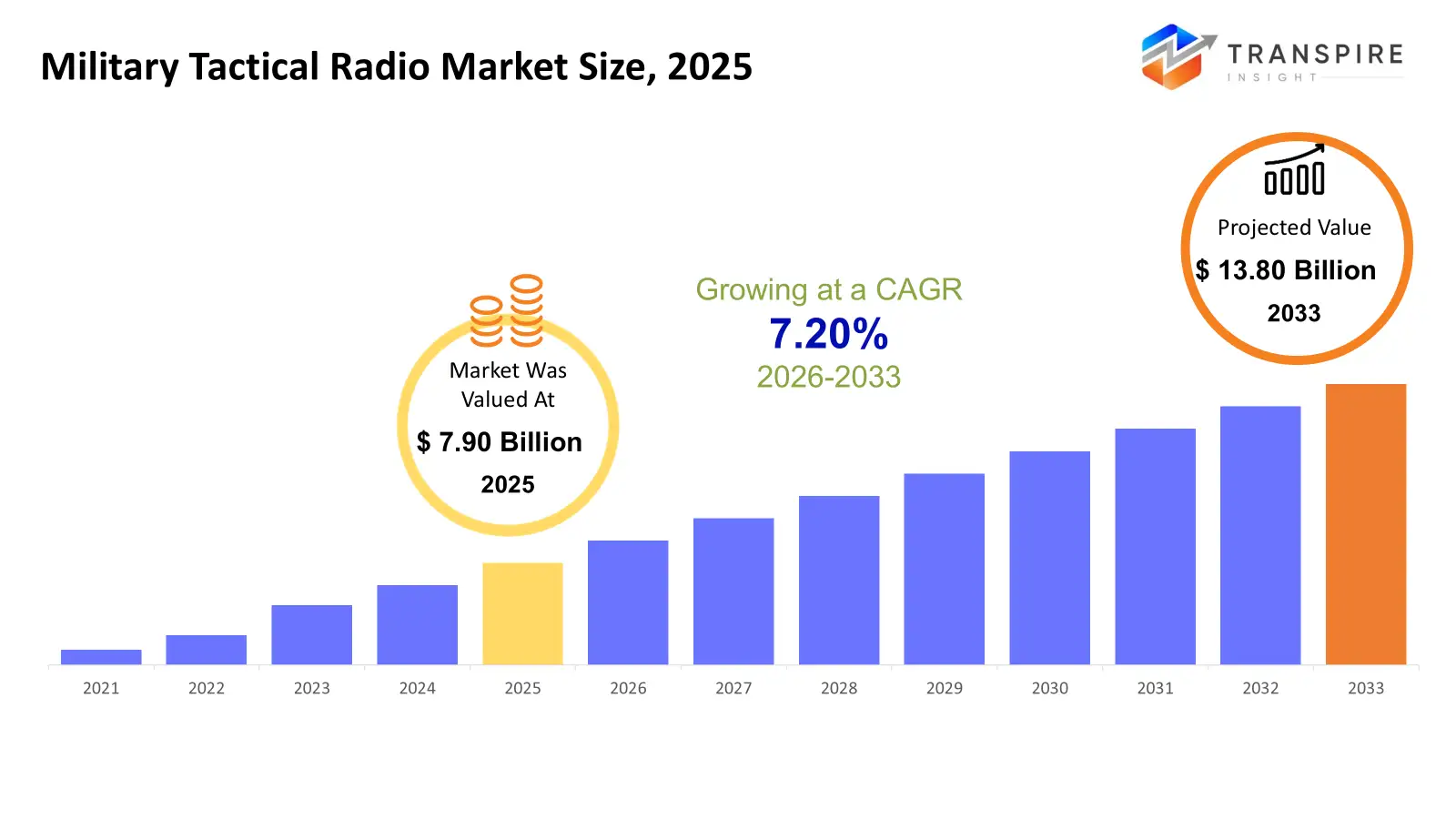
The global Military Tactical Radio market size was valued at USD 7.90 billion in 2025 and is projected to reach USD 13.80 billion by 2033, growing at a CAGR of 7.20% from 2026 to 2033. The military tactical radios market is witnessing a steady growth in terms of CAGR, fueled by the rise in modernization programs in the defense sector and the increasing usage of SDR and digital technology-based radios. The escalation of geopolitical tensions and border security has led to the purchase of more portable and vehicle-based communication systems. The development of technology in SDR, encryption, and multi-band systems has improved the interoperability of the forces, thus increasing the demand. The rise of new markets in the emerging regions, where the defense budget is increasing, is a positive factor for the growth of the market.
Market Size & Forecast
- 2025 Market Size: USD 7.90 Billion
- 2033 Projected Market Size: USD 13.80 Billion
- CAGR (2026-2033): 7.20%
- North America: Largest Market in 2026
- Asia Pacific: Fastest Growing Market
To learn more about this report,  Download Free Sample Report
Key Market Trends Analysis
- North America is a leader in tactical radio adoption, with advanced defense infrastructure, and investments in SDR and digital radio technologies by army, navy, and air force divisions, driving the adoption of tactical radio systems in the region.
- United States is witnessing a surge in demand for handheld, manpack, and vehicle-mounted tactical radios, integrated with multi-band and secure communication technologies, a move towards a strategic network-centric warfare doctrine, and ensuring interoperability across different divisions of the military force.
- Asia Pacific is witnessing robust growth, driven by increasing defense spending, modernization of army, navy, and air force divisions, adoption of UHF and VHF radio technologies, increasing adoption of SDR, and digital communication technologies.
- High Frequency radio technologies are gaining preference for long-range military communication, while software-defined radio technologies are being adopted for multi-band and secure operations.
- Handheld radios are witnessing a surge in demand, with the armed forces focusing on mobility, lightweight equipment, and quick deployability and technology updates providing features such as secure communication, enhanced battery life and integration with soldier modernization programs to improve awareness and flexibility.
- Software-defined radios have become the major technology trend, with features such as adaptability, multi-band support, and the ability to meet changing communication protocol requirements, thus enabling the armed forces to update their systems via software updates and ensuring secure and interoperable communication in complex mission environments.
- The army end users have been driving the overall market demand, with factors such as the requirement for large-scale deployments, diverse mission scenarios, and the need for portable and vehicle-integrated communication systems to support coordinated battlefield execution, secure command structures and improved efficiency during mission execution.
So, The military tactical radio market includes communication systems used for secure, reliable, and robust operations. The segment includes handheld, manpack, vehicle-mounted, and base station radio systems using HF, VHF, and UHF frequency bands. The increasing modernization initiatives and digitization of warfare operations will positively impact the global military tactical radio market. Technologies such as software-defined radio and digital radio technologies offer multi-frequency communication, data transfer, and network-centric warfare. The increasing demand for tactical radio systems by army, navy, air force, and special forces will shape the global tactical radio market. The increasing geopolitical tensions and strategic warfare operations will propel the demand for tactical radio systems. The tactical radio segment will witness a surge in demand due to the emphasis on network-centric warfare, mobility, and interoperability, which will fuel the growth of the global tactical radio market. The emerging markets will offer opportunities for defense companies to expand their tactical radio product portfolio.
Military Tactical Radio Market Segmentation
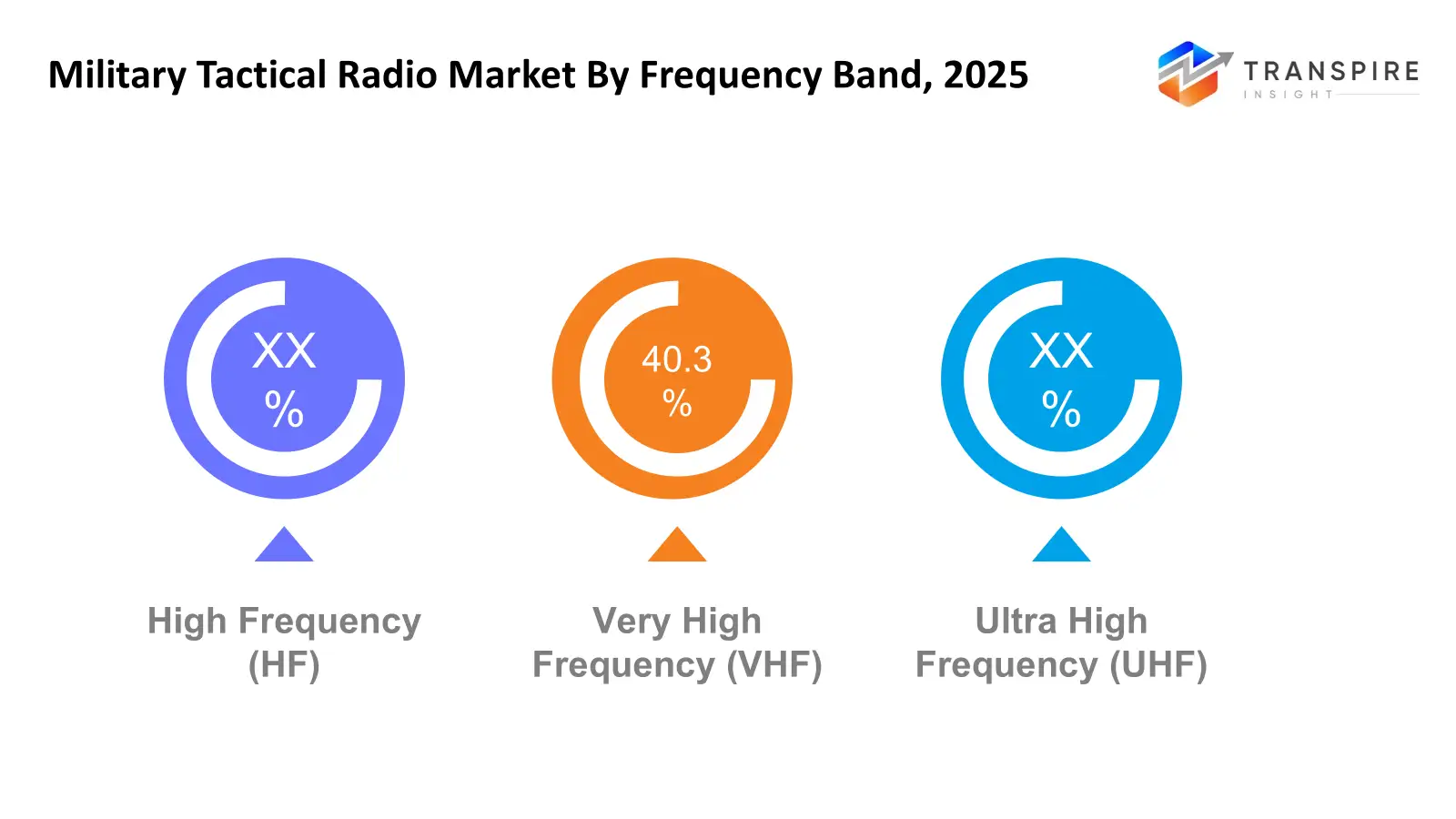
By Frequency Band
- High Frequency (HF)
HF radios are generally employed for long-range communications because they are able to cover vast distances, extending to hundreds of kilometers, without the need for repeaters. They are commonly employed for strategic military operations.
- Very High Frequency (VHF)
VHF radios are the most employed on the battlefield because of their clear and reliable performance for medium-range communications. They are commonly employed by land forces for tactical operations and are less prone to interference.
- Ultra High Frequency (UHF)
UHF radios are best employed for short-range, line-of-sight communications. They are commonly employed for urban warfare, making them a popular choice for modern military operations.
To learn more about this report, Download Free Sample Report
By Type
- Handheld Radios
They are portable, lightweight, and offer real-time communication for front-line soldiers. The versatility of handheld radios, coupled with their compatibility with headsets or wearable devices, ensures maximum efficiency in complex terrains.
- Vehicle-Mounted Radios
They offer extended range communication while in motion. The mounted radio system is suitable for armored vehicles, allowing coordination across different units with maximum signal stability and integration with command centers.
- Manpack Radios
They offer a balance of portability and transmission power, making them suitable for mobile operations in a wide range of operational areas. The manpack radio system bridges the gap between handheld and vehicle-mounted radio systems, ensuring maximum efficiency and endurance in complex environments.
- Base Station Radios
The base station radio system offers a robust solution for command centers, ensuring maximum security and stability in communication with tactical units. The system is essential for coordinating multi-unit operations, integrating different communication channels, and ensuring maximum efficiency.
By Technology
- Software Defined Radio (SDR)
SDRs are highly adaptable, with the ability to change frequencies and communication protocols quickly. Their software-based system allows for encrypted, multi-band, and multi-mode communication, making it essential in the modern, network-centric warfare scenario.
- Analog Radio
Analog radios are used because of their cost-effectiveness and ease of use. They are effective for simple voice communication in well-established networks, but they are not as effective as digital or SDRs, especially in the areas of flexibility and security.
- Digital Radio
Digital radios are becoming increasingly popular because of the need for better voice clarity and the ability to transmit data, as well as the security required in the modern battlefield scenario.
By End User
- Army
The army ranks the highest in terms of the consumption of tactical radios, with different variants used for different purposes, including handheld, manpack, and vehicle-mounted radios.
- Navy
The tactical radios used by the naval forces are used for ship-to-ship, ship-to-shore, and ship-to-amphibious operations. The most commonly used tactical radios in the naval forces are the VHF and UHF variants, which are used for secure and line-of-sight communication.
- Air Force
The tactical radios used in the air forces are lightweight, high-frequency, and long-range variants, with secure communication being the main aspect.
- Special Forces
The tactical radios used by the special forces are compact, highly secure, and multi-band variants, with SDR and digital variants being used for highly secure and covert operations.
Regional Insights
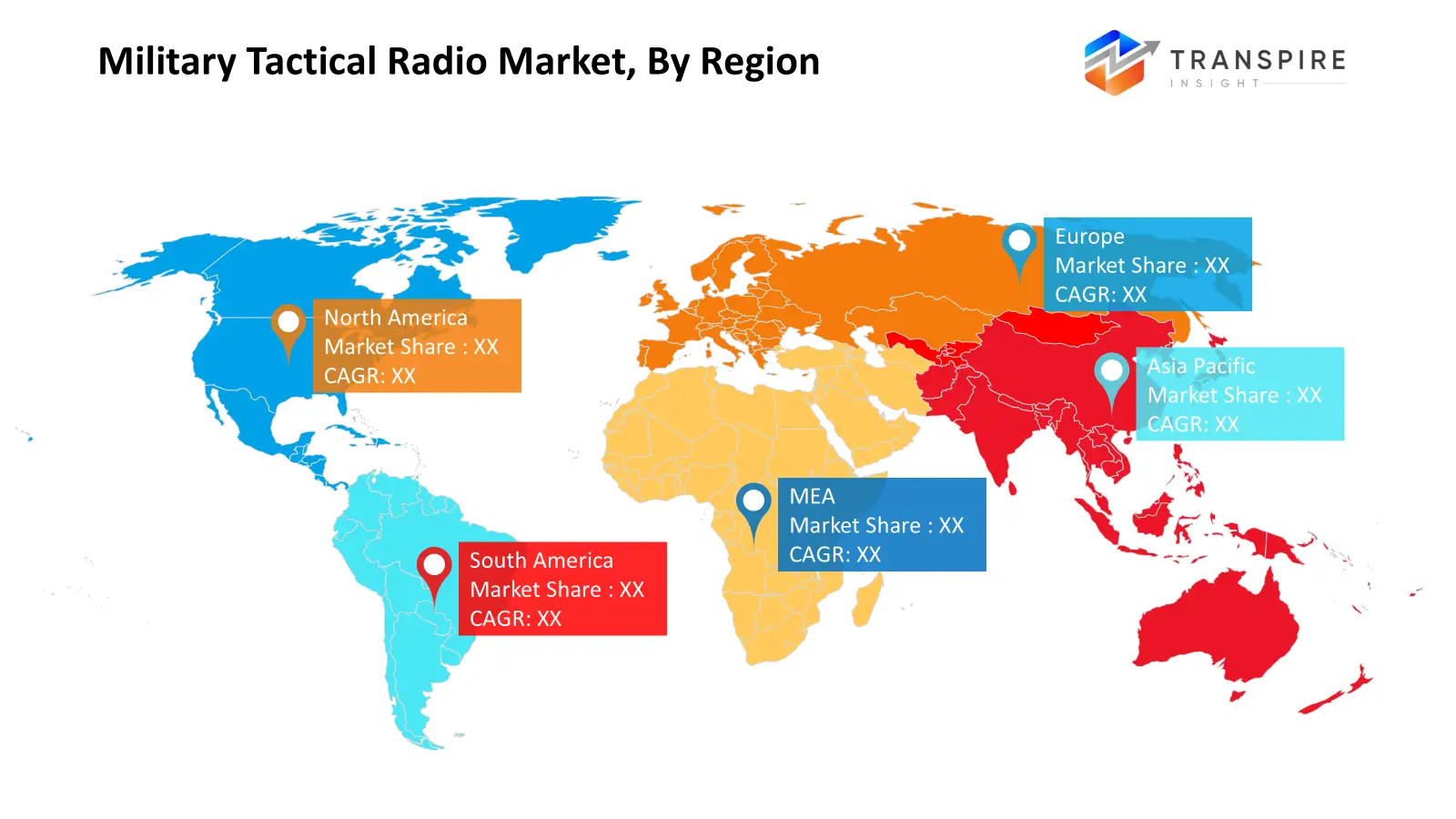
North America, including the US, Canada, and Mexico, is the largest market, given its high defense spending, technology adoption, and modernization programs. Europe, including Germany, UK, France, Spain, Italy, and the rest of Europe, is focused on interoperability, SDR adoption, and digital tactical solutions. These are primarily driven by NATO standards. Asia Pacific, including Japan, China, Australia & New Zealand, South Korea, India, and the rest of Asia Pacific, shows a high growth market with increasing defense spending, modernization of armies, and adoption of VHF/UHF technology for land and naval forces. South America, including Brazil, Argentina, and the rest of South America, is gradually moving towards modernization, replacing analog technology with selective digital and SDR technology. The region is dominated by army modernization.
Middle East & Africa, including Saudi Arabia, UAE, South Africa, and the rest of Middle East & Africa, is witnessing increasing demand for portable and vehicle-mounted radios, primarily driven by security concerns along borders and conflicts. Tier 1 countries are ahead in technology adoption, whereas tier 2 regions are focused on gradual modernization and integration of digital communication technology.
To learn more about this report, Download Free Sample Report
Recent Development News
- December 2025, L3Harris Technologies organized a demo that brought together various tactical communications systems, as well as counter-UAS solutions and advanced imaging technology, under a unified platform for federal agencies. The interoperable network enabled the agencies to experience the connectivity of different systems and solutions, including the tactical data device and 5G gateway radios, such as the AN/PRC-158C.
- In January 2025, The US Army has ordered nearly $300 million of full-rate production contracts for resilient handheld and manpack radios under the HMS program with L3 Harris. The AN/PRC-158 and AN/PRC-163 radios are designed to provide secure and interoperable communications from the tactical edge to the air domain to meet the needs of today's battlefield.
|
Report Metrics |
Details |
|
Market size value in 2025 |
USD 7.90 Billion |
|
Market size value in 2026 |
USD 8.50 Billion |
|
Revenue forecast in 2033 |
USD 13.80 Billion |
|
Growth rate |
CAGR of 7.20% from 2026 to 2033 |
|
Base year |
2025 |
|
Historical data |
2021 – 2024 |
|
Forecast period |
2026 – 2033 |
|
Report coverage |
Revenue forecast, competitive landscape, growth factors, and trends |
|
Regional scope |
North America; Europe; Asia Pacific; Latin America; Middle East & Africa |
|
Country scope |
United States; Canada; Mexico; United Kingdom; Germany; France; Italy; Spain; Denmark; Sweden; Norway; China; Japan; India; Australia; South Korea; Thailand; Brazil; Argentina; South Africa; Saudi Arabia; United Arab Emirates |
|
Key company profiled |
L3Harris Technologies, Thales Group, General Dynamics Corporation, Raytheon Technologies, BAE Systems plc, Leonardo S.p.A, Northrop Grumman Corporation, Rohde & Schwarz GmbH & Co KG, Elbit Systems Ltd., Cobham Limited, Barrett Communications, Codan Limited, Motorola Solutions Inc., Rheinmetall AG, and Kongsberg Gruppen. |
|
Customization scope |
Free report customization (country, regional & segment scope). Avail customized purchase options to meet your exact research needs. |
|
Report Segmentation |
By Frequency Band (High Frequency (HF), Very High Frequency (VHF), Ultra High Frequency (UHF)), By Type (Handheld Radios, Vehicle-Mounted Radios, Manpack Radios, Base Station Radios), By Technology (Software Defined Radio (SDR), Analog Radio, Digital Radio) and By End User (Army, Navy, Air Force, Special Forces) |
Key Military Tactical Radio Company Insights
L3Harris Technologies is a major player in the tactical radio space, with a reputation for its complete range of highly secure, software-defined tactical radios and communication systems used by major defense forces around the world. The company’s established position in tactical and strategic communication markets is a result of its commitment to innovation in modular radio designs and advanced encryption technologies, which enable joint force operations. The company’s global reach is also a result of long-term contracts, heavy investment in R&D, and adaptable technologies designed for a changing threat environment, making L3Harris a supplier of choice for modernization programs in North America, Europe, and Asia-Pacific.
Key Military Tactical Radio Companies:
- L3Harris Technologies
- Thales Group
- General Dynamics Corporation
- Raytheon Technologies
- BAE Systems plc
- Leonardo S.p.A
- Northrop Grumman Corporation
- Rohde & Schwarz GmbH & Co KG
- Elbit Systems Ltd.
- Cobham Limited
- Barrett Communications
- Codan Limited
- Motorola Solutions Inc.
- Rheinmetall AG
- Kongsberg Gruppen
Global Military Tactical Radio Market Report Segmentation
By Frequency Band
- High Frequency (HF)
- Very High Frequency (VHF)
- Ultra High Frequency (UHF)
By Type
- Handheld Radios
- Vehicle-Mounted Radios
- Manpack Radios
- Base Station Radios
By Technology
- Software Defined Radio (SDR)
- Analog Radio
- Digital Radio
By End User
- Army
- Navy
- Air Force
- Special Forces
Regional Outlook
- North America
- United States
- Canada
- Mexico
- Europe
- Germany
- United Kingdom
- France
- Spain
- Italy
- Rest of Europe
- Asia Pacific
- Japan
- China
- Australia & New Zealand
- South Korea
- India
- Rest of Asia Pacific
- South America
- Brazil
- Argentina
- Rest of South America
- Middle East & Africa
- Saudi Arabia
- United Arab Emirates
- South Africa
- Rest of the Middle East & Africa
Frequently Asked Questions
Find quick answers to common questions.
The approximate Military Tactical Radio Market size for the market will be USD 13.80 billion in 2033.
Key segments for the Military Tactical Radio Market By Frequency Band (High Frequency (HF), Very High Frequency (VHF), Ultra High Frequency (UHF)), By Type (Handheld Radios, Vehicle-Mounted Radios, Manpack Radios, Base Station Radios), By Technology (Software Defined Radio (SDR), Analog Radio, Digital Radio) and By End User (Army, Navy, Air Force, Special Forces).
Major Military Tactical Radio Market players are L3Harris Technologies, Thales Group, General Dynamics Corporation, Raytheon Technologies, BAE Systems plc
The North America region is leading the Military Tactical Radio Market.
The CAGR of the Military Tactical Radio Market is 7.20%.
- L3Harris Technologies
- Thales Group
- General Dynamics Corporation
- Raytheon Technologies
- BAE Systems plc
- Leonardo S.p.A
- Northrop Grumman Corporation
- Rohde & Schwarz GmbH & Co KG
- Elbit Systems Ltd.
- Cobham Limited
- Barrett Communications
- Codan Limited
- Motorola Solutions Inc.
- Rheinmetall AG
- Kongsberg Gruppen
Recently Published Reports
-
Apr 2026
Aerospace Fluoropolymers Market
Aerospace Fluoropolymers Market Size, Share & Analysis Report By Type (PTFE, FEP, PFA, ETFE, and Others), By Application (Electrical Insulation, Seals & Gaskets, Coatings, and Others), By End User (Commercial Aviation, Military Aviation, General Aviation, and Others), and Geography (North America, Europe, Asia-Pacific, Middle East and Africa, South and Central America), 2021 - 2031
-
Apr 2026
Airborne SATCOM System Market
Airborne SATCOM System Market Size, Share & Analysis Report By Type (SATCOM Terminals, Transceivers, Airborne Radio, Modems and Routers, SATCOM Radomes, and Other), By Application (Government and Defense and Commercial), and Geography (North America, Europe, Asia-Pacific, Middle East and Africa, South and Central America), 2021 – 2031
-
Apr 2026
Ship Leasing Market
Ship Leasing Market Size, Share & Analysis Report By Vessel Type (Container Ships, Bulk Carriers, Tankers, and Specialized Vessels), By Lease Duration (Short-Term Lease (Less than 1 year), Medium-Term Lease (1-5 years), and Long-Term Lease (More than 5 years)), By Lease Type (Bareboat Charter, Time Charter, Financial Lease, and Others), By End-User Industry (Oil and Gas, Manufacturing and Industrial, Automotive, Agriculture and Food, Retail and Consumer Goods, and Others), and Geography (North America, Europe, Asia-Pacific, Middle East and Africa, South and Central America), 2021 – 2031
-
Apr 2026
Thread Rolling Dies Market
Thread Rolling Dies Market Size, Share & Analysis Report By Type (Flat Thread Rolling Dies, Circular (Cylindrical) Dies, Tangential Thread Rolling Dies, Planetary Thread Rolling Dies, and Other Types), By Material Type (High-Speed Steel (HSS), Carbide, Tool Steel, Alloy Steel, and Other Specialized Alloys), By Distribution Channel (Direct Sales, Distributors and Dealers, and Online Platforms), By Application (Automotive Industry, Aerospace and Defense, Construction and Infrastructure, Industrial Machinery, Electronics and Electrical Components, Medical Devices, and Fastener Production), and Geography (North America, Europe, Asia-Pacific, Middle East and Africa, South and Central America), 2021 – 2031
Our Clients