
Feb 03, 2026
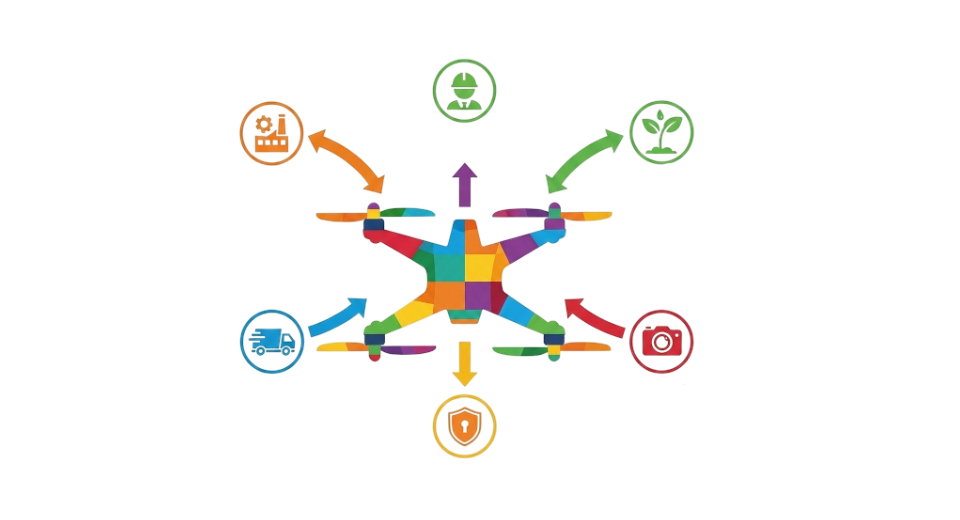
The report “Commercial Drone Market By Product Type (Rotary Blade / Multi?rotor Drones, Fixed?Wing Drones, Hybrid Drones, Others), By Technology (Remotely Piloted / Operated, Semi?Autonomous, Fully Autonomous), By Application (Filming & Photography, Inspection & Maintenance, Mapping & Surveying, Precision Agriculture, Surveillance & Monitoring, Delivery & Logistics, Other Niche Uses) and By End-Use Industry (Agriculture, Delivery & Logistics, Energy & Utilities, Media & Entertainment, Real Estate & Construction, Security & Law Enforcement, Public Safety & Government, Others)” is expected to reach USD 79.40 billion by 2033, registering a CAGR of 17.30% from 2026 to 2033, according to a new report by Transpire Insight.
The global commercial drone market is experiencing strong expansion, owing to the growing popularity of unmanned aerial vehicles across industries such as logistics, agriculture, media, construction, and energy inspection. Businesses are able to improve operational efficiency, cut expenses, and obtain real-time aerial insights thanks to advanced drone technologies, such as multi-rotor, fixed-wing, and hybrid platforms. The integration of AI, machine learning, and autonomous flight capabilities, which enable businesses to carry out activities like surveillance, mapping, and inspections with previously unheard-of precision and safety, further drives demand. Growing applications in industrial inspection, e-commerce logistics, and precision agriculture have been important drivers of market growth. While logistics firms investigate last-mile delivery and warehouse automation options, farmers can utilize drones to check crop health, maximize production, and automate spraying operations. Drones have the ability to revolutionize company operations, as seen by the energy, construction, and public safety sectors using UAVs for routine inspections, infrastructure monitoring, and catastrophe management.
Progressive legislative frameworks and pilot programs in North America, Europe, and Asia Pacific are also helping the market by facilitating the broader deployment of autonomous drone operations and BVLOS (Beyond Visual Line of Sight). Leading manufacturers' ongoing R&D investments have improved flight endurance, payload capacity and software capabilities, enabling complicated commercial missions and growing the addressable market. Additionally, better decision-making and real-time operational insights are made possible by developments in data analytics and IoT integration, which further motivates businesses to use drone solutions in a variety of industries.
The Rotary Blade / Multi?rotor Drones segment is projected to witness the highest CAGR in the Commercial Drone during the forecast period.
According to Transpire Insight, Due to their remarkable maneuverability, vertical takeoff and landing capabilities, and precision hovering, rotary blade and multi-rotor drones continue to dominate the commercial market. Multi-rotor platforms are highly adaptable for applications like aerial filming, pipeline and bridge inspection, and security surveillance; their compact form factor, dependability, and versatility enable operators to deploy drones in environments where fixed-wing UAVs would be impractical, making them a preferred choice for short-range, high-accuracy missions.
Innovations in AI, autonomous navigation, and sensor integration, which enable improved operating safety and data collection, are driving the expansion of multi-rotor drones. Businesses may quickly obtain relevant insights by integrating LiDAR, thermal imaging, and high-resolution cameras, which lowers operational expenses and manual intervention. These drones provide scalable solutions for a variety of commercial applications, guaranteeing their continued dominance in the worldwide UAV market as enterprises place a higher priority on operational efficiency.
The Semi?Autonomous segment is projected to witness the highest CAGR in the Commercial Drone during the forecast period.
Semi-autonomous drones represent the leading technology segment within the commercial drone market as they strike a balance between operational control and automation. These systems are appropriate for controlled commercial settings because they incorporate GPS navigation, obstacle avoidance, automated flight planning and data collecting while maintaining human oversight. In order to increase productivity without completely depending on autonomous decision-making systems, industries like agricultural, infrastructure inspection, mapping and logistics are increasingly favoring semi-autonomous drones.
With the development of camera payloads, autonomous flight planning, and obstacle avoidance technologies, the market for aerial filming is growing. There is a growing need for dependable and user friendly UAVs as more businesses and individual content producers use drones for live event coverage and professional-caliber photography. The convergence of software-enabled editing and real time monitoring with drone platforms further boosts operational efficiency, cementing cinematography and photography as a prominent commercial drone application.
The Filming & Photography segment is projected to witness the highest CAGR in the Commercial Drone during the forecast period.
According to Transpire Insight, One of the most common uses of commercial drones is aerial filming and photography which is driven by the need for media, advertising, real estate and movie production. UAVs make it possible to capture affordable and creative footage by providing a new and unprecedented aerial perspective and high-definition imaging. Due to their stability multi-rotor drones are particularly useful for such purposes. They allow users to take precise photos in difficult conditions without the logistical constraints of traditional camera systems.
Thanks to the emergence of camera systems, autonomous route planning, and obstacle avoidance systems, the market for aerial filming is expanding. There is a growing demand for reliable and easy-to-use UAVs as more companies and content creators start using drones for live event coverage and professional-grade photography. The integration of software based video editing and real-time monitoring capabilities with drone technology further increases productivity making cinematography and photography one of the most popular commercial drone applications.
The Agriculture segment is projected to witness the highest CAGR in the Commercial Drone during the forecast period.
Because of the rising need for precision farming and data-driven crop management, agriculture emerges as the most prominent end-use segment in the commercial drone market. Farmers can now optimize their yields while using fewer resources because of the rising adoption of drones for crop health analysis, soil analysis, irrigation and pesticide spraying. The adoption of UAV technologies is most attractive for large-scale farming because of their cost-effectiveness and scalability.
The rising need for food, labor shortages and government-supported digital farming initiatives in the Asia Pacific and North American regions are all factors that contribute to the growth of this market. Farmers can now make well informed decisions in real-time by incorporating multispectral sensors, AI-driven analytics and automated flight systems. Agricultural drones are expected to remain a prominent revenue-generating segment in the commercial drone market because of the rising popularity of sustainable farming practices.
The North America region is projected to witness the highest CAGR in the Commercial Drone during the forecast period.
North America remains the largest commercial drone market worldwide, with the US at the forefront of adoption due to its sophisticated infrastructure, forward-thinking UAV regulations and heavy investments in autonomous flight technology. Drone integration initiatives and FAA-approved BVLOS testing allow for the broad enterprise application of the market. Commercial drones are increasingly being employed by companies for industrial inspection, delivery pilots and surveillance. This makes possible enhanced safety in high-risk applications as well as cost reductions and improved efficiency.
The region's prowess in R&D an existing manufacturing infrastructure and its early adoption of AI-driven autonomous drones are factors that have led to its preeminence. Commercial drone users are able to employ drones for high-value, long-range missions with reduced operational risk due to regulatory clarity especially in the US. The growing number of drone-as-a-service companies and emerging partnerships with the energy, infrastructure and e-commerce sectors will ensure that North America remains at the forefront of the global commercial drone industry.
Key Players
The top 15 players in the Commercial Drone market include SZ DJI Technology Co., Ltd., Parrot SA, Skydio, Inc., AeroVironment, Inc., senseFly (AgEagle Aerial Systems), Insitu (a Boeing Company), 3D Robotics, Inc., Yuneec International Co., Ltd., Teledyne FLIR, Delair, PrecisionHawk, Inc., Autel Robotics, EHang Holdings Ltd., Wingcopter GmbH, and Kespry, Inc.
Drop us an email at:
Call us on:
+91 7666513636

 inquiry@transpireinsight.com
 APAC:+91 7666513636
 Address





