
Feb 03, 2026
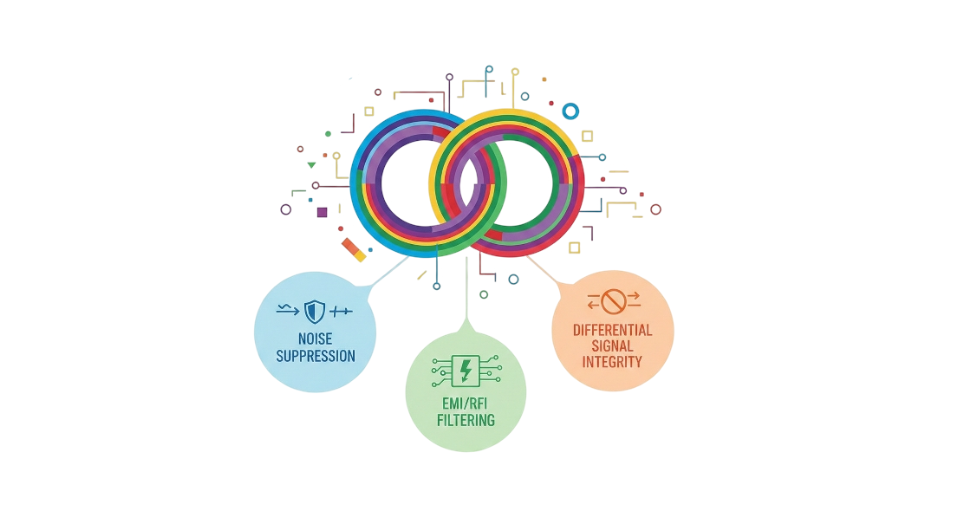
The report “Common-mode Chokes By Type (Surface Mount / SMD Common-mode Chokes, Through-Hole Common-mode Chokes, Other Form Factors), By Functional Type (Signal Line Chokes, Power Line Chokes, Multi-line / Toroidal Chokes), By Technology (Ferrite, Nanocrystalline, Iron Powder, Other Specialty Materials) and By Application (Power Electronics, Automotive Electronics, Industrial Equipment, Telecommunications, Consumer Electronics, Others)” is expected to reach USD 5.80 billion by 2033, registering a CAGR of 13.40% from 2026 to 2033, according to a new report by Transpire Insight.
The increasing use of EMI mitigation solutions in the consumer electronics, automotive, and industrial sectors is propelling the steady rise of the global common-mode choke market. These electromagnetic elements are essential for maintaining signal integrity, guaranteeing steady system functioning, and reducing noise in power and signal lines. The market for small, high-frequency chokes is being driven by the trend of electronics becoming smaller as well as the growing use of EVs and renewable energy sources. Manufacturers are increasingly focused on Surface Mount (SMD) and multi-line toroidal designs to fulfill modern circuit requirements, which supports market expansion. One of the main factors driving growth is industrial applications, especially in automation and power electronics. To guarantee operational effectiveness and regulatory compliance, industrial machinery, inverters, and variable frequency motors need strong EMI suppression. Additionally, the use of signal line chokes in telecom networks has increased due to the quick development of 5G infrastructure and high-speed data transfers. The demand for small SMD chokes is boosted by consumer electronics, including as PCs, smartphones, and Internet of Things devices.
The dynamics of the market are also greatly impacted by regional developments. Due to strong electronics manufacturing centers in China, Japan, and South Korea as well as rising EV adoption and the use of renewable energy, Asia-Pacific continues to develop at the quickest rate. Due to strict EMC rules, industrial automation, and automobile electrification, North America and Europe are developed markets. Adoption is happening gradually in emerging economies in South America, the Middle East, and Africa, especially in telecom and industrial infrastructure. Performance and efficiency are being improved by technological developments in core materials, such as ferrite, nanocrystalline, and iron powder. Advanced core technologies are becoming more and more important for high-frequency and high-current applications in order to minimize energy losses and preserve system stability. Global adoption is further accelerated by strict EMC regulations, which offer chances for creative choke designs that provide excellent EMI suppression while adhering to thermal and spatial limitations.
The Surface Mount / SMD Common-mode Chokes segment is projected to witness the highest CAGR in the Common-mode Chokes during the forecast period.
According to Transpire Insight, The market is dominated by SMD chokes because of their small size and compatibility with automated PCB assembly. They are extensively utilized in high frequency telecom equipment, consumer electronics and automobile ECUs. As manufacturers target high density circuits without sacrificing performance, miniaturization trends and space efficient designs are propelling growth. Their reliability in handling high-frequency noise and EMI suppression makes them desirable solutions for current electronic systems maintaining continuous market demand.
Rapid advancements in IoT devices, industrial automation, and EV power electronics further support the use of SMD chokes. OEMs increasingly integrate SMD designs to meet severe EMC standards, especially in high-speed signal lines. In many applications, SMD chokes are taking the place of conventional through-hole versions due to their increased current capacity and enhanced thermal stability. The segment benefits from substantial R&D investment, enabling novel, high-performance products customized to evolving end-user requirements.
The Signal Line Chokes segment is projected to witness the highest CAGR in the Common-mode Chokes during the forecast period.
The functional section is dominated by signal line chokes because of the growing dependence on high-speed data transmission and communication networks. They successfully reduce electromagnetic interference (EMI) in computing, telecom, and Internet of Things devices while preserving signal integrity. Since accurate noise filtration is essential for high-speed and low-latency communication, demand for signal line chokes has increased with the growth of 5G networks and cloud infrastructure.
Additionally, the industry benefits from strict regional regulations that mandate EMC compliance in consumer, automotive, and industrial electronics. Signal line chokes are becoming more and more important for high-frequency applications in servers, networking devices, and industrial controllers to avoid interference. This sector is positioned as a major driver of market growth in the near future due to the combination of performance reliability, small design, and compliance adherence.
The Ferrite segment is projected to witness the highest CAGR in the Common-mode Chokes during the forecast period.
According to Transpire Insight, Due to their affordability, strong magnetic permeability and appropriateness for high-frequency EMI suppression, ferrite cores continue to be the preferred option. They support both SMD and through-hole designs and are widely used in consumer, industrial, and automotive electronics. The material’s blend of efficiency and cost makes it perfect for large-scale use in high-volume electronics manufacturing.
Ferrite cores are not only economical but also provide dependable performance over a variety of frequencies, guaranteeing system stability and little energy loss. OEMs are more flexible thanks to their ability to adapt to various choke designs, such as toroidal and multi-line formats. Ferrite core-based chokes continue to hold a dominant position in the global market as businesses concentrate more on compact and energy-efficient solutions.
The Automotive Electronics segment is projected to witness the highest CAGR in the Common-mode Chokes during the forecast period.
The fastest-growing application category is automotive electronics especially for EVs and hybrid cars. In order to reduce EMI and guarantee regulatory compliance, common-mode chokes are crucial for onboard chargers, battery management systems, and motor drives. Strong growth is being driven by the introduction of EVs, tighter EMC regulations and electrification programs in both established and emerging markets.
Innovations in power electronics and high-current handling designs, which enable effective EMI suppression in small places, also assist this segment. car electronics is a major growth engine because car OEMs want dependable, high-performance chokes to handle complex electrical systems. Ongoing market expansion in this application category is ensured by constant innovation in ferrite-based chokes and high-frequency SMD.
The North America region is projected to witness the highest CAGR in the Common-mode Chokes during the forecast period.
The expanded usage of automotive electronics, industrial automation, and high-performance power electronics are the main drivers of the mature but valuable common-mode choke market in North America. The United States leads regional demand because to strong adoption of electric vehicles, renewable energy systems, and data-intensive infrastructure. OEMs are forced to incorporate dependable EMI suppression components due to strict electromagnetic compatibility (EMC) and safety rules in the automotive, industrial, and telecom industries. This directly supports the demand for common-mode chokes. Furthermore, the use of superior SMD, power line, and signal line chokes is accelerated by the presence of top electronics manufacturers and system integrators. By producing automobiles, assembling power electronics, and integrating cross-border supply chains, Canada and Mexico further contribute to the stability of the regional market.
North America's leadership position is further strengthened by technological innovation and diversity of applications. Growing expenditures in EV charging infrastructure, smart grids, and industrial digitization increase demand for high-current and high-frequency choke solutions with improved thermal and electrical performance. Data centers and high-speed networking equipment are examples of telecom upgrades that enhance the use of signal line chokes to preserve signal integrity. In order to fulfill changing performance criteria and maintain compliance with EMC regulations, manufacturers in the area give priority to ferrite and sophisticated core materials. Strong R&D capabilities, early adoption of next-generation technology, and constant demand from regulated sectors position North America as a strategically significant region with sustained growth potential in the common-mode chokes market.
Key Players
The top 15 players in the Common-mode Chokes market include Murata Manufacturing Co., Ltd., TDK Corporation, Chilisin Electronics Corp., Taiyo Yuden Co., Ltd., Cyntec Co., Ltd., Sunlord Electronics Co., Ltd., Vishay Intertechnology, Inc., TAI?TECH Advanced Electronic Co., Ltd., Sumida Corporation, and YAGEO Corporation., Eaton Corporation plc, Schaffner Holding AG, Laird Performance Materials, Bourns, Inc., AVX Corporation.
Drop us an email at:
Call us on:
+91 7666513636

 inquiry@transpireinsight.com
 APAC:+91 7666513636
 Address





