Global Military Communications Market Size & Forecast:
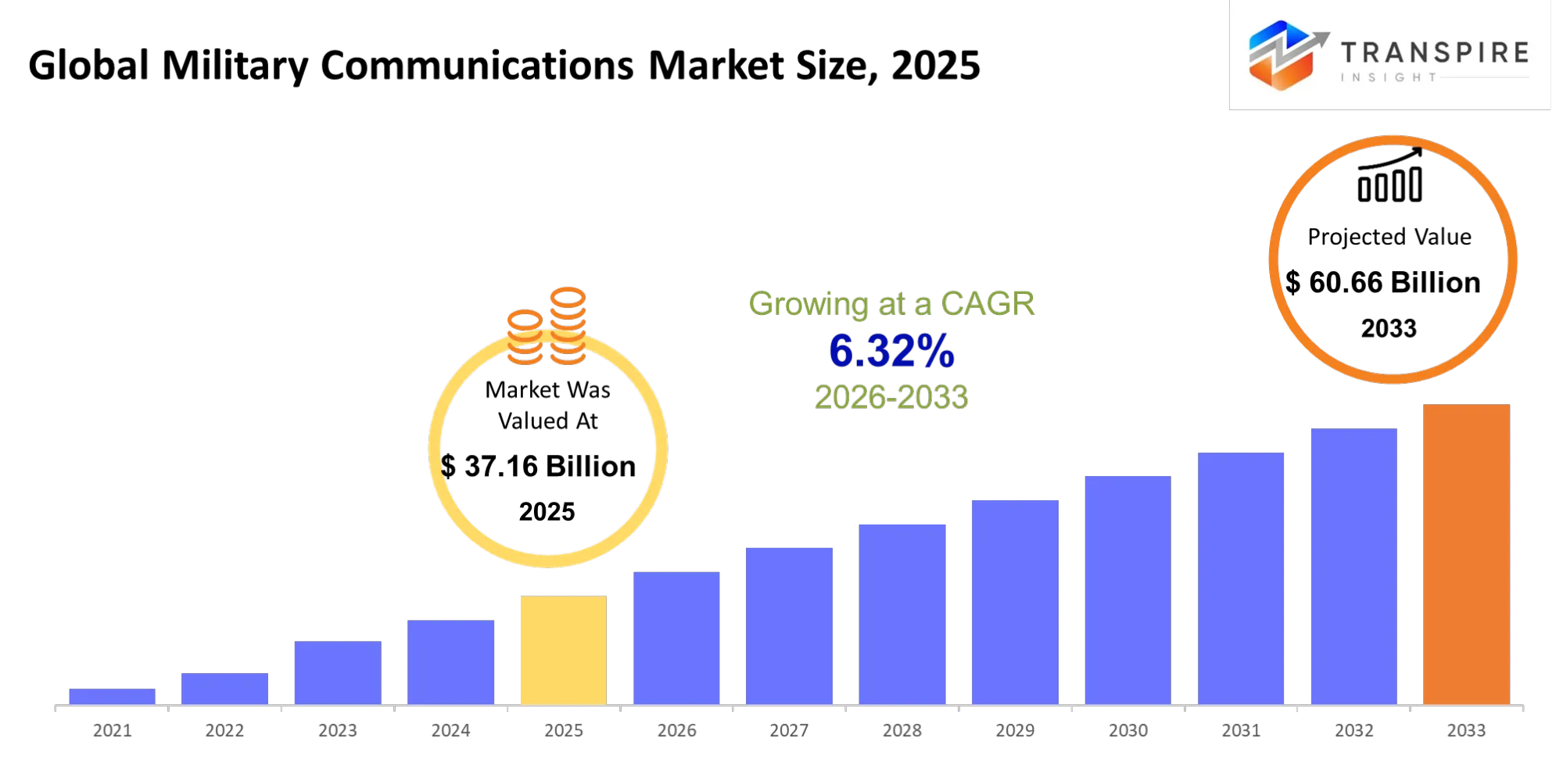
- Global Military Communications Market Size 2025: USD 37.16 Billion
- Global Military Communications Market Size 2033: USD 60.66 Billion
- Global Military Communications Market CAGR: 6.32%
- Global Military Communications Market Segments: By Type (Satellite Communication Systems, Tactical Radio Systems, Secure Communication Networks, Battlefield Communication Systems, Airborne Communication Systems, Naval Communication Systems, Others); By Application (Defense Operations, Intelligence & Surveillance, Cybersecurity Operations, Border Security, Disaster Response, Others); By End-User (Army, Navy, Air Force, Defense Agencies, Others); By Technology (Encrypted Communication, Software-defined Radios, AI-assisted Communication Systems, Hybrid Communication Platforms, Others).
Global Military Communications Market Summary:
The Global Military Communications Market size is estimated at USD 37.16 billion in 2025 and is anticipated to reach USD 60.66 billion by 2033, growing at a CAGR of 6.32% from 2026 to 2033. The Global Military Communications Market is building the unshakeable, real-time nervous system of the twenty-first century defense. Rather than simply transmitting rudimentary radio signals, it connects satellites with drones and frontline troops, enabling the high-speed encrypted transmission of real-time video footage, GEOS force-coordinates, and data without interception.
The greatest structural change over the last few years is to move away from standalone, legacy radio systems and toward integrated, software-driven networks and cloud-centric tactical systems. This acceleration in reality was catalyzed by the ongoing war in Ukraine, where we learned how vulnerable legacy communications were to jamming and localization by modern electronic warfare.
As a result, the market is expanding because, thanks to this, nobody has understood that stationary systems are a huge risk for defense forces. And as electronic jamming has become a veritable fear, it is directly pushing governments to aggressively fund multi-domain, resilient satellite networks (assumedly like LEO constellations) so that troops never lose connectivity in high-tech war.
Key Market Insights:
The Global Military Communications Market is growing across every region of the world. Various technical as well as systematic changes have been introduced.
- North America has 44% market share.
- Asia Pacific is the fastest-growing region with a CAGR of 10.6%.
- ROW holds 8% of the Global Military Communications Market.
- Asia Pacific has a market share of 22%.
- Tactical radio systems are a dominant sub-segment with a 51% market share.
- AI-assisted communication systems are the fastest-growing sub-segment with a CAGR of 11.5%.
- Europe has a market share of 26%.
What are the Key Drivers, Restraints, and Opportunities in the Global Military Communications Market?
Drivers
The push for network-centric warfare, where data can be shared instantly between interconnected land, air, and sea assets, is helping to drive growth. The global escalation of asymmetric warfare and regional conflict spurred this change. As a result, military departments are quickly buying high-buck software-defined radio and high-end SATCOM gear to phase out legacy devices that are isolated and outdated. In recent years, SpaceX has been awarded a $2.29 billion contract to construct a secure, high-speed satellite communications network called the Space Data Network (SDN) Backbone that will connect military sensors and weapons systems globally. Resilient, low-latency, global data transport capabilities essential for missile defense and battlefield connectivity are the foundation of the project, enhancing the capabilities of next-generation military communications. In May 2026, SpaceX secured a $2.29 billion contract from the U.S. Space Force to build the Space Data Network (SDN) Backbone, a secure, high-speed satellite communications network linking military sensors and weapons systems worldwide.
Restraints
The implementation of advanced technologies with legacy systems is hindered by the complexity of interoperability issues that can stifle market growth. This continues due to the fact that the defense architectures are based on a lot of legacy architectures with lots of different contractors, which have been developed over the years. These deeply rooted and mismatched structures will need a tremendous amount of money and time to overhaul, preventing fast adoption of technologies.
Opportunities
The use of Low Earth Orbit (LEO) satellite constellations is a game-changer that opens up a path for fast market growth. This shift from traditional geostationary systems to more vulnerable satellites enables providers to provide high-speed, low-latency coverage around the globe. An example of this is the recent substantial military investment in SpaceX's Starshield network, which shows how commercial LEO technology can transform secure tactical field communications.
What Has the Impact of Artificial Intelligence Been on the Global Military Communications Market?
The Global Military Communications Market has undergone a dramatic shift with the advent of Artificial Intelligence (AI), enhancing the efficiency, reliability, and security of defense communication networks. Automated systems with AI capabilities streamline network management by dynamically allocating bandwidth, routing signals, monitoring spectrum usage, and identifying threats, thus minimizing the risk of human error and accelerating decision-making in military scenarios.
AI can also improve predictive maintenance by scanning vast amounts of communication and operations data to detect potential network issues, cyber threats, signal interference, and equipment maintenance needs before they happen.
The U.S. Department of Defense recently inked deals with OpenAI, Google, Microsoft, NVIDIA, Oracle, Amazon Web Services, SpaceX, and Reflection AI to aid in classified military operations and speed up AI implementation throughout the defense network. This has been used to augment the military communication process with AI-based situational awareness, quicker decision-making, data processing, and secure information sharing across operational domains. In May 2026, the U.S. Department of Defense signed agreements with OpenAI, Google, Microsoft, NVIDIA, Oracle, Amazon Web Services, SpaceX, and Reflection AI to support classified military operations and accelerate AI adoption across defense networks.
Key Market Trends:
- Military networks have been transitioning from a hardware-based system to a software-defined communication system
- This is from using AI to monitor functions to using AI to automate network optimization.
- The communications systems are heading for an integrated land, air, sea, and space connectivity.
- Now, demand is moving from bandwidth extension to intelligent spectrum management.
- The mindset on cybersecurity has shifted from perimeter defence to ongoing threat detection.
- Satellite communications are going towards LEO constellation deployments with low latency.
- Armed forces are shifting to cloud-based command and communication systems.
- Communication devices for the military are getting smaller, lighter, and more energy efficient.
- Allied forces are moving towards real-time interoperability in data sharing.
- The employment of edge computing is expanding to help accelerate the decision-making process on the battlefield.
Global Military Communications Market Segmentation
By Type
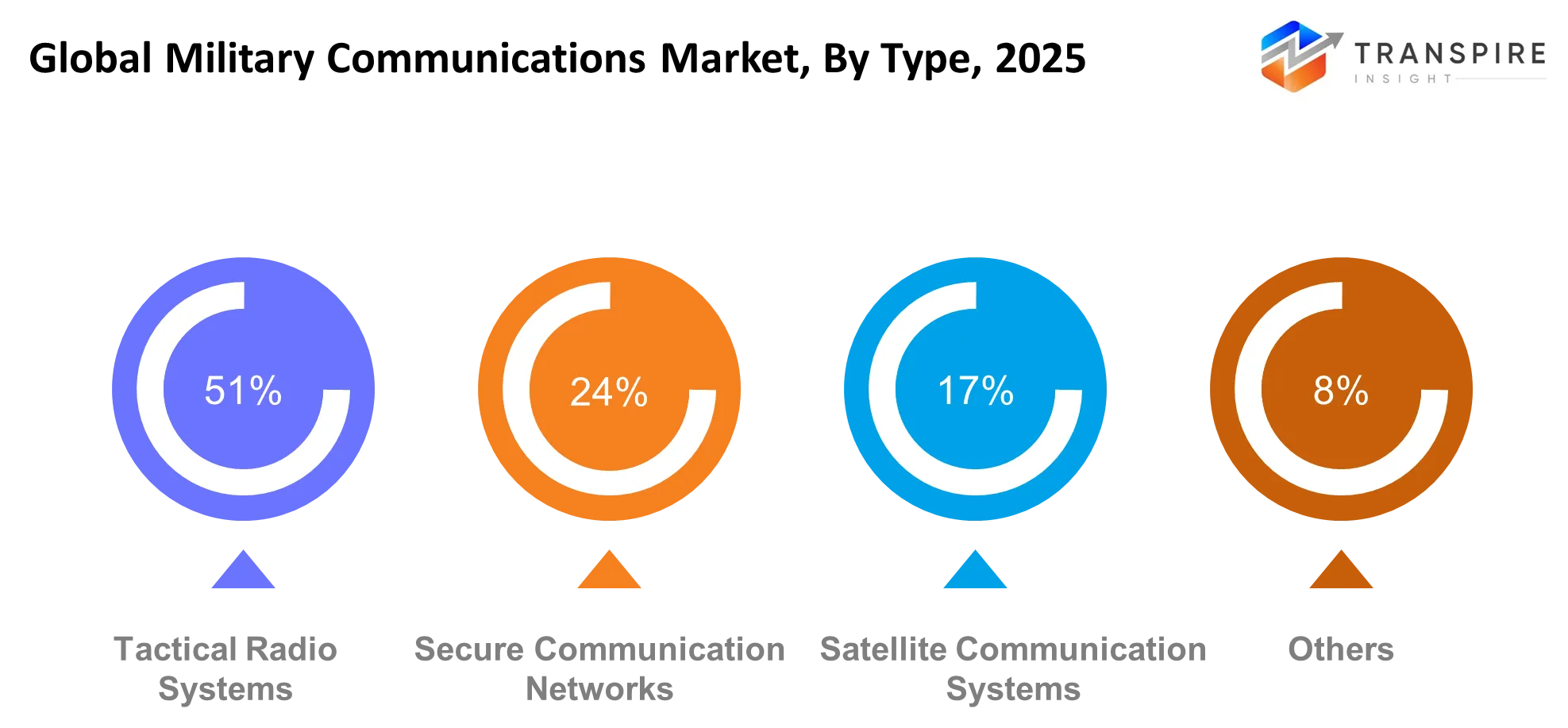
The number one player by far is now Tactical Radio Systems, which has an estimated market share of 51%. This huge base of installed equipment is a steady revenue generator for the market since the military needs to upgrade soldier-portable and vehicle-mounted radios that will be capable of operating in an electronic warfare environment. Future implications, however, are more favorable: As long as tactical software continues to develop, it will be integrated through tactical radios, which means that defense tech suppliers will have all maintenance and upgrades secured for a long time.
While the technology base for AI-assisted Communication Systems is smaller, they are projected to grow at a blistering 11.5% CAGR. These AI systems can adapt and analyze electronic threats in real-time, unlike human operators, who have to handle this process manually and at cycle frequencies.
The second tier of the market is made up of Secure Communication Networks with a 24% share and Satellite Communication Systems with a 17% share, followed by specialized niche segments such as Battlefield, Airborne, and Naval Communication Systems, which are 8% of the market. Satellite systems, especially, are being deployed at an increasingly rapid pace because the military is increasingly reliant on high-bandwidth long-range drone deployments and remote field tracking.
By Application
The global market is led by Defense Operations, which represents the largest share of the funds raised and infrastructure deployed. Unique logic for this positioning is the need for an unbroken and secure command and control network during the fight.
The fastest-growing application in this category is Intelligence & Surveillance, which is growing rapidly to satisfy the need for data in today's era of reconnaissance. The growth of unmanned aerial vehicles, sensors, and satellite imagery feeds is driving an exponential increase in pipelines of data that need to be transmitted securely back to command centres, and this is a unique growth logic.
The remaining market share goes to Cybersecurity Operations, Border Security, and Disaster Response applications, which are the backbone of contemporary defense operations. Here, there are several growth logic points. Safeguarding networks against state-sponsored cyber intrusions requires cybersecurity applications, long-range perimeter tracking networks are needed to ensure border security, and interoperability with civilian systems is a must for disaster response in order to execute rapidly and easily.
By End-User
The Army will remain the predominant end-user within the Global Military Communications Market, and will always take the biggest share of the contract. The special growth logic behind this position boils down to pure scale, and the ground forces have the most individual people, tactical vehicles, and decentralized command posts that need to be connected at all times and with reliability.
Defense Agencies include centralized joint-command structures and intelligence organizations, and are the fastest-growing end-user segment. The growth logic is the move towards unified, multi-domain command structures worldwide and the phasing out of operating in communication silos amongst separate branches.
The other end users are the Air Force, Navy, and various coastal and border guards, which were combined into the other category. They have been closely linked to the high-value platform modernization, in which a single naval destroyer or fighter jet needs incredibly sophisticated, long-range, costly satellite and line-of-sight tracking arrays.
By Technology
Traditional hardwired single-frequency legacy radios are effectively becoming a thing of the past, with Software-Defined Radios (SDRs) the latest technology paradigm in the market today. This enables militaries to switch how they communicate to suit allied forces or newly identified jamming technologies during the battle.
The fastest growing technological segment is the AI-assisted Communication Systems, which is growing at an 11.5% CAGR. This growth logic was in response to the mass of data that now floods the modern battlefield, which humans cannot process quickly enough from drones, satellites, and cyber networks. AI technology takes over to automatically filter data, compress network bandwidth, and forecast network failures before they occur.
The remaining market share consists of Encrypted Communication, Hybrid Communication Platforms, and other emerging technologies. The fearsome nature of near-peer eW is forcing a re-thinking of the type of system that these are and the need to get ready to switch from one channel to another, from satellite to cellular to line-of-sight, to evade tracking. This forms a very complicated technologically layered security space.
What are the Key Use Cases Driving the Global Military Communications Market?
The core use case driving the market is secure, real-time command and control (C2) at the tactical edge, directly reinforcing the dominant Tactical Radio Systems segment. Ground troops rely on these resilient field lines to transmit voice and telemetry data, ensuring immediate situational awareness during high-intensity combat operations.
Expanding applications focus heavily on Intelligence, Surveillance, and Reconnaissance (ISR) data streaming. High-bandwidth tactical networks must seamlessly pipe massive data feeds from unmanned aerial vehicles and remote naval sensors to centralized defense agencies, accelerating the need for advanced Satellite Communication Systems.
Emerging use cases center on autonomous network optimization and counter-electronic warfare within contested spectrums. Driven by the fastest-growing AI-assisted technologies, these systems dynamically outmaneuver adversary jamming, unlocking self-healing tactical communication capabilities for multi-domain missions.
Report Metrics
|
Report Metrics |
Details |
|
Market size value in 2025 |
USD 37.16 Billion |
|
Market size value in 2026 |
USD 39.51 Billion |
|
Revenue forecast in 2033 |
USD 60.66 Billion |
|
Growth rate |
CAGR of 6.32% from 2026 to 2033 |
|
Base year |
2025 |
|
Historical data |
2021 - 2024 |
|
Forecast period |
2026 - 2033 |
|
Report coverage |
Revenue forecast, competitive landscape, growth factors, and trends |
|
Regional scope |
United States; Canada; Mexico; United Kingdom; Germany; France; Italy; Spain; Denmark; Sweden; Norway; China; Japan; India; Australia; South Korea; Thailand; Brazil; Argentina; South Africa; Saudi Arabia; United Arab Emirates |
|
Key company profiled |
Lockheed Martin, Northrop Grumman, Raytheon Technologies, BAE Systems, L3Harris Technologies, Thales Group, General Dynamics, Elbit Systems, Rohde & Schwarz, Leonardo, Saab AB, Cobham, Viasat, Harris Corporation, Honeywell Aerospace. |
|
Customization scope |
Free report customization (country, regional & segment scope). Avail customized purchase options to meet your exact research needs. |
|
Report Segmentation |
By Type (Satellite Communication Systems, Tactical Radio Systems, Secure Communication Networks, Battlefield Communication Systems, Airborne Communication Systems, Naval Communication Systems, Others); By Application (Defense Operations, Intelligence & Surveillance, Cybersecurity Operations, Border Security, Disaster Response, Others); By End-User (Army, Navy, Air Force, Defense Agencies, Others); By Technology (Encrypted Communication, Software-defined Radios, AI-assisted Communication Systems, Hybrid Communication Platforms, Others). |
Which Regions are Driving the Global Military Communications Market Growth?
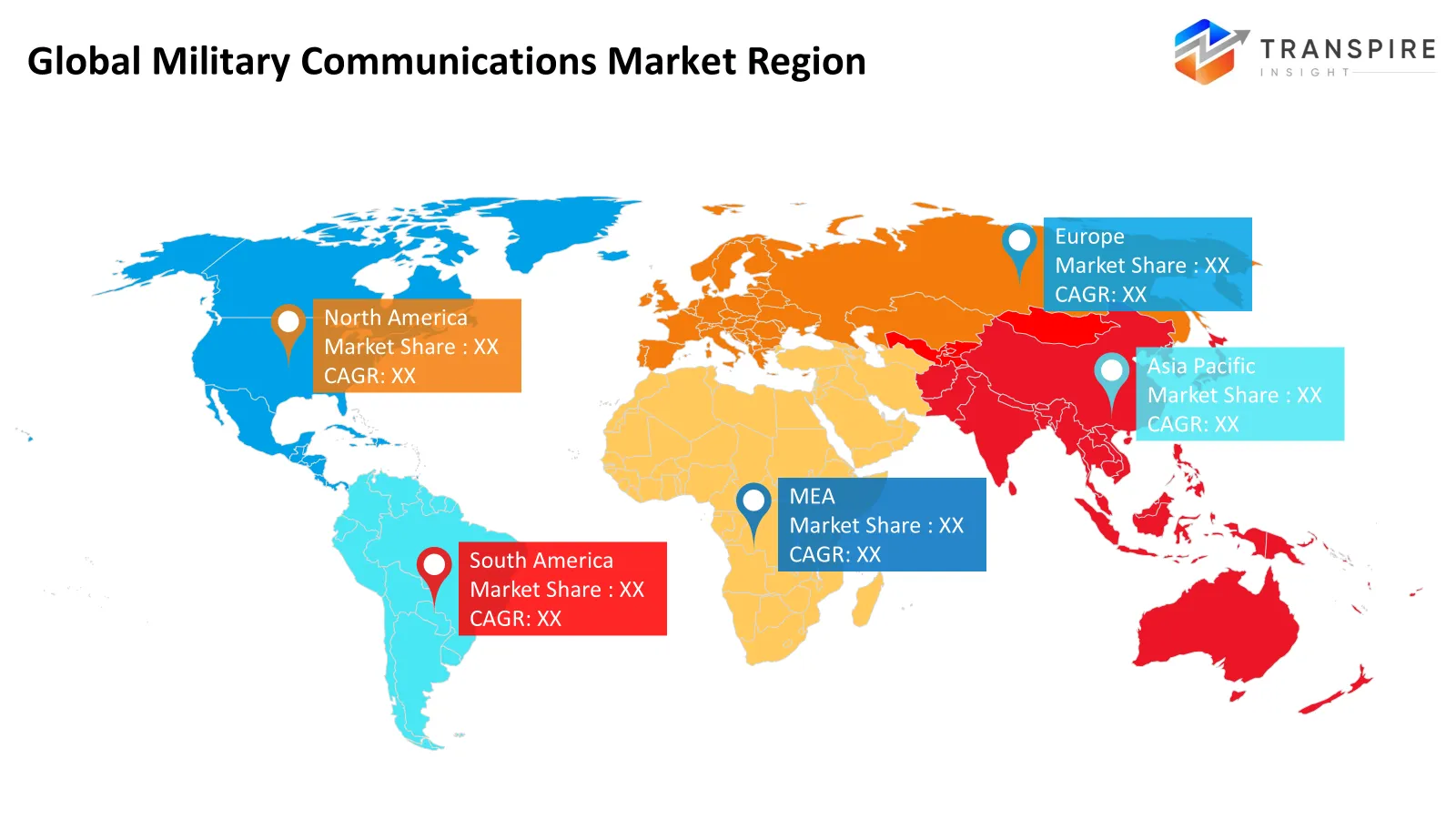
North America holds the largest share in the global military communication market, accounting for 44% of the market share. The key factor is the aggressive pursuit of multi-domain command and control modernization in the region, especially focused on the U.S. military's Joint All-Domain Command and Control (JADC2) initiative. This is further bolstered by a strong defense ecosystem, strong and regular U.S. government funding, and a well-developed network of top defense contractors. This one-of-a-kind mix of strategic policy and industrial infrastructure will help keep North America the main region for high-dollar communication technology deployments. L3, the Northrop Grumman Corporation, and General Dynamics Corporation are among the major firms in this area. Recently, Terra Quantum announced an agreement with the U.S. Air Force for the development of software to simulate military communications in hostile environments, which is resistant to quantum attacks. The deployment helps to build next-generation secure communications that can function in electronic warfare, bandwidth restrictions, and jamming environments. In May 2026, Terra Quantum announced a contract with the U.S. Air Force to provide software for simulating quantum-secure military communications in contested environments. The deployment supports the development of next-generation secure communications capable of operating under jamming, bandwidth limitations, and electronic warfare conditions.
Europe is the second biggest market, accounting for 26% of the global market share. It is not as big as the market in North America, but Europe's market stability is specifically supported by the greater level of geopolitical fear that exists throughout Eastern Europe and a shared desire for each country to dictate its own communication routes. Some of the key players of European regions are Thales Group, BAE Systems, and Rohde & Schwarz. In recent years, Mistral AI has also been active in the defense sector and has recently announced new investments in AI infrastructure in France, as well as providing support to military applications for European defense organizations. The project enhances military communications, intelligence processing, and secure operational coordination through the application of AI in European defense networks. Part of the reason for the growth of the area. In May 2026, Mistral AI expanded its defense-sector activities and announced new AI infrastructure investments in France while supporting military applications for European defense organizations.
Asia Pacific is the fastest-growing market, growing at an impressive CAGR of 10.6% with rapid growth. The recent changes are a dramatic increase in territorial disputes along the Indo-Pacific and South China Sea and in indigenous defense budgets, which are urgently gathering steam. The explosive change creates a huge future potential for commercial and defense linkages, with countries such as India, Japan, and Australia keen to construct more sophisticated communication platforms to compete with near-peer adversaries in the region. Viasat is launching its ViaSat-3 F3 communications and internet satellite to deliver enhanced and extended internet and communications service in the Asia-Pacific market. This launch will expand the availability of cutting-edge satellite communications services, enhancing connectivity, real-time coordination, and operational effectiveness for military operations in the region. It also helps to advance defense modernization in nations like Australia, Japan, India, and South Korea. In April 2026, Viasat successfully launched the ViaSat-3 F3 satellite, designed to provide high-capacity, resilient connectivity across the Asia-Pacific region.
Who are the Key Players in the Global Military Communications Market and how do they Compete?
The Global Military Communications Market is very concentrated, with tier-one defense contractors vying with one another by differentiating their offerings with technology, making strategic acquisitions, and securing long-term government software contracts. In this environment, the shift from selling hardware to delivering end-to-end, multi-domain connectivity solutions that combine space, air, sea, and land connectivity, under one network, will be the key to success.
L3Harris Technologies and BAE Systems are both dedicated to innovation as their business strategy and tactical edge dominance. L3Harris distinguishes itself for its software-defined radio portfolio and is aggressively working to grow its market presence by winning joint tactical network modernization contracts. Meanwhile, BAE Systems is focused on niche integration through specialized, secure networks, such as Falcon and NetVIPR™, and growing through cross-domain platform integration for other international allied forces.
Thales Group and Rohde & Schwarz compete on two levels: technological innovation and operating in regions that comply with sovereignty requirements. Thales pursues an innovative approach based on a high-bandwidth differentiator, including multi-level secure IP networks, and a global strategy through collaborative communication projects with NATO. On the other hand, Rohde & Schwarz focuses on a niche approach, which is based on the SOVERON tactical radio family and the ESSOR software-defined radio standard, and expands its market footprint to become a key compliance partner to European defense digitalization.
Global Military Communications Market Companies
- Lockheed Martin
- Northrop Grumman
- Raytheon Technologies
- BAE Systems
- L3Harris Technologies
- Thales Group
- General Dynamics
- Elbit Systems
- Rohde & Schwarz
- Leonardo
- Saab AB
- Cobham
- Viasat
- Harris Corporation
- Honeywell Aerospace
Recent Development News
In May 2026, the International Conference on Military Communication and Information Systems (ICMCIS 2026) was held in the United Kingdom in conjunction with a NATO science and technology meeting focused on resilient and agile multi-domain communication systems. The event accelerated collaboration on next-generation military communication technologies, interoperability, and battlefield information-sharing among European defense stakeholders.
In May 2026, the UK intelligence agency GCHQ unveiled an AI-powered cyber defense system for real-time threat detection across critical infrastructure and telecommunications networks. Impact: The technology strengthens military and government communication security by enabling rapid anomaly detection, cyber-threat identification, and network resilience. https://www.techradar.com
What Strategic Insights Define the Future of the Global Military Communications Market?
The Global Military Communications Market is shifting from a hardware-based, siloed radio node system to a software-defined, zero-trust digital communications system. The requirements for multi-domain operations will make future architectures more cognitive and will require a space, air, sea, and land data fabric to route data around threats in electronic warfare autonomously.
There is a massive commercial/military crossover opportunity in the deployment of Private Tactical 5G/6G Mesh Networks along with Proliferated Low Earth Orbit (pLEO) satellite architectures. This combination of infrastructure enables defense organizations to take advantage of the high bandwidth speeds of commercial communications, while maintaining military-grade anti-jamming and encryption capabilities at the tactical edge.
In order to transform from a proprietary hardware-manufacturing business to Open-Architecture Software and AI-as-a-Service (AIaaS) models, defense contractors must shift their focus to these new methods. Suppliers must develop modular communication systems that separate software from the physical system and enable various cryptographic and waveform variants to be updated in real time without replacement of the actual equipment or soldier-portable hardware, whether in the vehicle or as an over-the-air update.
Global Military Communications Market Segmentation
By Type
- Satellite Communication Systems
- Tactical Radio Systems
- Secure Communication Networks
- Battlefield Communication Systems
- Airborne Communication Systems
- Naval Communication Systems
- Others
By Application
- Defense Operations
- Intelligence & Surveillance
- Cybersecurity Operations
- Border Security
- Disaster Response
- Others
By End-User
- Army
- Navy
- Air Force
- Defense Agencies
- Others
By Technology
- Encrypted Communication
- Software-defined Radios
- AI-assisted Communication Systems
- Hybrid Communication Platforms
- Others
Regional Outlook
North America
- United States
- Canada
- Mexico
Europe
- Germany
- United Kingdom
- France
- Spain
- Italy
- Rest of Europe
Asia Pacific
- Japan
- China
- Australia & New Zealand
- South Korea
- India
- Rest of Asia Pacific
South America
- Brazil
- Argentina
- Rest of South America
Middle East & Africa
- Saudi Arabia
- United Arab Emirates
- South Africa
- Rest of the Middle East & Africa
Frequently Asked Questions
Find quick answers to common questions.
The Global Military Communications Market size was valued at USD 37.16 billion in 2025 and is poised to reach USD 60.66 billion by 2033, expanding at a 6.32% CAGR.
Key segments for the Global Military Communications Market are By Type (Satellite Communication Systems, Tactical Radio Systems, Secure Communication Networks, Battlefield Communication Systems, Airborne Communication Systems, Naval Communication Systems, Others); By Application (Defense Operations, Intelligence & Surveillance, Cybersecurity Operations, Border Security, Disaster Response, Others); By End-User (Army, Navy, Air Force, Defense Agencies, Others); By Technology (Encrypted Communication, Software-defined Radios, AI-assisted Communication Systems, Hybrid Communication Platforms, Others).
The Global Military Communications Market growth is primarily driven by a rise in asymmetric warfare and geopolitical tensions, transformation toward network-centric warfare, procurement of advanced Software-Defined Radios (SDRs), and also there is a growing reliance on high-bandwidth, jam-resistant satellite communications.
The Global Military Communications Market is led by major manufacturers, such as Lockheed Martin, Northrop Grumman, Raytheon Technologies, BAE Systems, L3Harris Technologies, Thales Group, General Dynamics, Elbit Systems, Rohde & Schwarz, Leonardo, Saab AB, Cobham, Viasat, Harris Corporation, and Honeywell Aerospace.
North America holds around 44% of the Global Military Communications Market. Its dominance is driven by high defense spending, advanced communication technologies, strong defense industry presence, and continuous investments in secure satellite, AI-enabled, and cyber-resilient military communication systems.
Commercial opportunities in the Global Military Communications Market include LEO satellite networks, AI-enabled communication systems, and quantum-secure technologies. Growing investments in networks such as SpaceX’s Starshield are creating new opportunities for secure, low-latency military connectivity solutions.
- Lockheed Martin
- Northrop Grumman
- Raytheon Technologies
- BAE Systems
- L3Harris Technologies
- Thales Group
- General Dynamics
- Elbit Systems
- Rohde & Schwarz
- Leonardo
- Saab AB
- Cobham
- Viasat
- Harris Corporation
- Honeywell Aerospace
About the Authors

Tejashri Dhatrak
I am Tejashri Dhatrak, a Senior Research Analyst at Transpire Insight, specializing in the Aerospace and Defence sector. My work focuses on analyzing industry trends, defence technologies, market developments, and emerging innovations that shape the global aerospace and security landscape. At Transpire Insight, I research complex topics, evaluate credible sources, and transform technical insights into accurate, well-structured, and easy-to-understand content for industry professionals and decision-makers. My goal is to provide reliable, research-backed information that helps readers stay informed about defence capabilities, aerospace advancements, strategic developments, and the evolving dynamics of the global defence ecosystem.

Chakradhar Khansole
Chakradhar serves as the Research Director at Transpire Insight, bringing over 8 years of experience in technology, innovation, and strategic market intelligence. He specializes in transforming complex market data into actionable business insights that enable organizations to make informed, growth-oriented decisions. Recognized for his strategic vision and analytical expertise, Chakradhar leads high-impact research initiatives, delivering comprehensive market assessments, competitive intelligence, and forward-looking industry analysis.
Recently Published Reports
-
Apr 2026
Aerospace Fluoropolymers Market
Aerospace Fluoropolymers Market Size, Share & Analysis Report By Type (PTFE, FEP, PFA, ETFE, and Others), By Application (Electrical Insulation, Seals & Gaskets, Coatings, and Others), By End User (Commercial Aviation, Military Aviation, General Aviation, and Others), and Geography (North America, Europe, Asia-Pacific, Middle East and Africa, South and Central America), 2021 - 2031
-
Apr 2026
Airborne SATCOM System Market
Airborne SATCOM System Market Size, Share & Analysis Report By Type (SATCOM Terminals, Transceivers, Airborne Radio, Modems and Routers, SATCOM Radomes, and Other), By Application (Government and Defense and Commercial), and Geography (North America, Europe, Asia-Pacific, Middle East and Africa, South and Central America), 2021 – 2031
-
Apr 2026
Ship Leasing Market
Ship Leasing Market Size, Share & Analysis Report By Vessel Type (Container Ships, Bulk Carriers, Tankers, and Specialized Vessels), By Lease Duration (Short-Term Lease (Less than 1 year), Medium-Term Lease (1-5 years), and Long-Term Lease (More than 5 years)), By Lease Type (Bareboat Charter, Time Charter, Financial Lease, and Others), By End-User Industry (Oil and Gas, Manufacturing and Industrial, Automotive, Agriculture and Food, Retail and Consumer Goods, and Others), and Geography (North America, Europe, Asia-Pacific, Middle East and Africa, South and Central America), 2021 – 2031
-
Apr 2026
Thread Rolling Dies Market
Thread Rolling Dies Market Size, Share & Analysis Report By Type (Flat Thread Rolling Dies, Circular (Cylindrical) Dies, Tangential Thread Rolling Dies, Planetary Thread Rolling Dies, and Other Types), By Material Type (High-Speed Steel (HSS), Carbide, Tool Steel, Alloy Steel, and Other Specialized Alloys), By Distribution Channel (Direct Sales, Distributors and Dealers, and Online Platforms), By Application (Automotive Industry, Aerospace and Defense, Construction and Infrastructure, Industrial Machinery, Electronics and Electrical Components, Medical Devices, and Fastener Production), and Geography (North America, Europe, Asia-Pacific, Middle East and Africa, South and Central America), 2021 – 2031
Our Clients