

South Korea Nail Care Products Market Size & Forecast:
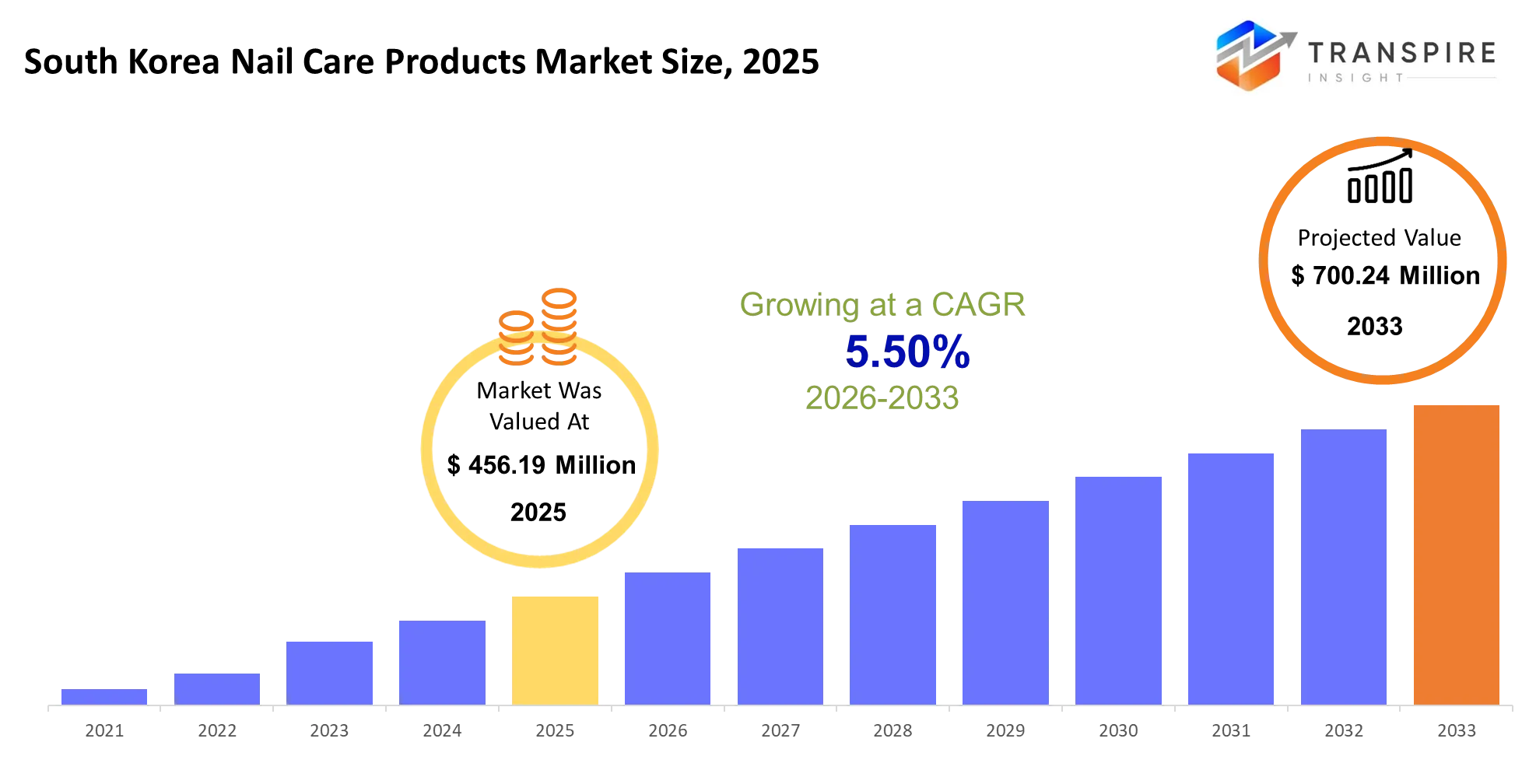
- South Korea Nail Care Products Market Size 2025: USD 456.19 Million
- South Korea Nail Care Products Market Size 2033: USD 700.24 Million
- South Korea Nail Care Products Market CAGR: 5.50%
- South Korea Nail Care Products Market Segments: By Product Type (Nail Polish, Nail Polish Removers, Artificial Nails, Nail Strengtheners, Cuticle Care Products, Others); By Distribution Channel (Supermarkets, Specialty Beauty Stores, Online Retail, Salons & Spas, Others); By Application (Personal Use, Professional Salon Use, Nail Art, Therapeutic Nail Care, Others); By End User (Women, Men, Teenagers, Beauty Professionals, Others); By Ingredient Type (Organic Ingredients, Gel-based Products, Vegan Nail Care Products, Others)
To learn more about this report,  Download Free Sample Report
South Korea Nail Care Products Market Summary
The South Korea Nail Care Products Market was valued at USD 456.19 Million in 2025. It is forecast to reach USD 700.24 Million by 2033. That is a CAGR of 5.50% over the period.
The South Korea nail care products market kind of supports both personal grooming and professional beauty services, by rolling out long-wear polish systems, nail strengthening treatments, gel coatings, plus salon-grade manicure solutions that help people keep their look, hygiene, and that fashion-driven kind of self expression going. Over the last five years, things have moved away from simple color cosmetics toward multifunctional nail solutions, which blend durability, quick dry performance, vegan formulations, and at-home results that feel more like a salon visit. This change really picked up during the pandemic , when salons were closed, so consumers leaned on self application kits, gel systems, and those e-commerce beauty buys. Korean beauty retailers and also global brands responded by widening their direct-to-consumer channels, and releasing professional quality home-care products. The outcome is more premiumization overall , and repeat buying that seems much stronger. Now growth is linked to hybrid consumption patterns, where customers swing back and forth between salon services and at-home upkeep, which lets brands earn across different price bands and distribution routes.
Key Market Insights
- South Korea’s Nail Care Products Market is kinda shifting away from the old school nail polish, toward gel-based stuff and more treatment focused formulations, with those longer wear cycles that people actually notice.
- In 2025 the Seoul Capital Area basically grabbed nearly 45% of South Korea’s wider cosmetics industry revenue, which kinda confirms how strong its beauty retail infrastructure stays.
- Online beauty commerce was the fastest-growing distribution channel from 2022 to 2025, mainly because purchasing is mobile first for most cosmetic buyers now, so the behavior fits the channel too.
- Even so, nail polish still sat on top in 2025, supported by strong seasonal launches, influencer-led color waves, and that high repurchase rhythm that keeps coming back.
- Nail treatment products moved into the second-largest category, as customers increasingly bought repair serums, stronger strengthening formulas, and cuticle therapies.
- For growth after 2023, gel polish systems were the quickest uptick, since people wanted salon-grade durability for at home routines, not just for visits.
- Household consumers drove most of the market revenue in 2025, while professional salons grew fast too, boosted by premium manicure subscription services and social media branding that basically sells before anyone walks in.
- Amorepacific and LG Household & Health Care improved their competitive stance via premiumization, plus wider digital channel reach , not just offline shelf space.
- OPI Products also pushed ahead with innovation around fast-dry and Intelli-Gel technologies, built for both salon and home users, depending on the day.
- And global beauty players like L’Oréal and Shiseido increased attention on Asia-Pacific nail cosmetics portfolios, using localized color collections plus e-commerce collaborations and partner models.
What are the Key Drivers, Restraints, and Opportunities in the South Korea Nail Care Products Market?
The main thing driving the South Korea nail care products market is basically this overlap between premium beauty culture and the fact that digital retail is more accessible now. Korean shoppers seem to want that salon-like results from home use items, so manufacturers have been pushing quick curing gel systems, longer wear top coats, and nail recovery treatments. This momentum got stronger after 2020, when home beauty routines were kind of normalized via mobile commerce, plus influencer led tutorials. And since brands started leaning harder into direct-to-consumer channels, and even subscription based beauty sales, people are buying more often—both in mass and premium tiers, so it ends up raising revenue per customer too.
One of the biggest limits still comes from how saturated South Korea’s beauty sector already is. There are a lot of domestic and global cosmetic brands, and they compete in pretty similar product categories. That makes promotions cost a lot more, and margins get squeezed. Unfortunately this isn’t something you can just fix fast, because retailers, online platforms, and salon networks are already tangled in an extremely competitive environment. A lot of companies end up giving up some pricing strength just to keep shelf space and visibility, so even if unit sales look steady, profitability still gets hit.
A big future opportunity could come from AI assisted personalized nail care, along with smarter beauty diagnostics. Some Korean beauty tech firms are putting money into skin and nail imaging systems, those can suggest tailored treatments depending on things like nail hydration, brittleness, or even how the color is looking. Premium beauty retailers, and also salon chains, have started to link digital consultation tools with mobile commerce platforms. And as wearable beauty tech and connected mirrors get more common across urban Asia, brands that combine diagnostics with personalized
What Has the Impact of Artificial Intelligence Been on the South Korea Nail Care Products Market?
Artificial intelligence plus advanced digital technologies are kind of reshaping South Korea’s nail care ecosystem, maybe mostly through personalized beauty analytics, automated product suggestion engines, and operational forecasting tools that feel pretty smart. Bigger cosmetic brands are now tapping AI-based models of consumer behavior to monitor seasonal shade preferences, estimate when people will buy again, and tune inventory distribution across online and offline channels. E-commerce sites are also leaning into machine learning, they look at browsing trails, earlier purchases, and social media engagement, then they push nail colors, gel systems, and even repair treatments that have a better chance to convert.
At the same time, AI is improving day to day efficiency inside professional salon networks. “Smart” appointment systems can forecast the busiest booking windows and automate technician planning, so salons can raise service utilization rates while cutting idle labor expenses. Some Korean beauty-tech startups are folding in computer vision features that can inspect nail texture, dryness, and surface wear to suggest more focused strengthening products or gel treatments. In practice this boosts upselling moments and supports steadier customer loyalty.
From an operational angle, predictive analytics helps manufacturers curb surplus stock and speed up new product rollouts, especially when beauty trends change fast. Still, AI adoption has real limits because accurate beauty diagnostics depend on high quality image capture and also on big localized datasets. Smaller brands and independent salons often don’t have enough capital to connect advanced analytics platforms, or linked retail systems, at scale, and that kind of holds everything back.
Key Market Trends
- Since 2022, a lot of consumers kind of shifted away from traditional lacquer products , and toward gel systems that promise around three week durability, plus a faster curing performance overall (it just feels smoother in daily use).
- From 2024 to 2026, Korean beauty retailers expanded same day delivery partnerships, which shortened the cosmetic fulfillment windows especially for urban shoppers, like it was a steady move not a sudden thing.
- OPI Products rolled out Intelli-Gel systems in 2025 , aimed at improving self leveling precision and getting a more consistent professional finish quality.
- Premium nail treatment products also gained more shelf space after repeated gel use raised concerns about nail brittleness, and surface damage that shows up over time.
- Between 2023 and 2026, domestic beauty brands increasingly launched vegan and HEMA free formulas, basically responding to ingredient transparency expectations that viewers kept asking for.
- Social commerce platforms changed purchasing behavior when Korean influencers showed nail tutorials through livestream shopping campaigns, and people followed along in real time, sort of.
- Professional salons expanded subscription manicure programs after recurring beauty memberships gained traction in metropolitan Seoul during 2025 , and that created a more routine style of buying services.
- Cross border beauty exports got stronger as Korean nail aesthetics became more visible through K-beauty content, plus international influencer collaborations helped push awareness.
- Fast dry technologies became commercially important after hybrid work routines increased demand for low maintenance personal grooming products, because nobody wants to wait around.
- Beauty companies leaned harder into AI based consumer analytics investments , to predict color trends and reduce the risk of unsold seasonal inventory exposure.
South Korea Nail Care Products Market Segmentation
By Product Type
Nail Polish basically has the dominant market place because color cosmetics still sit as the core of nail beauty routines, for both everyday people and professional stylists. They keep switching shades pretty often, plus seasonal fashion trends, and then all those social media manicure looks , they really keep pushing people to buy again and again. On top of that, gel-based polish systems make even more money because shoppers now care more about durability, quick curing, and that salon-like surface when they do it at home. Also you’ve got intense brand rivalry, and everyone refreshing products pretty fast, and that keeps category leadership strong in both the premium and mass-market segments.
Nail Polish Removers keep a pretty steady demand since replacing old polish is kind of automatic , so it keeps driving repeat consumption across the whole manicure routine. Artificial Nails are also getting more attention from younger buyers who want custom aesthetics, longer lasting wear, and a salon style appearance without having to book appointments repeatedly. Nail Strengtheners and Cuticle Care Products are rising gradually too, since more gel treatments and more artificial nail use has turned recovery and hydration into a bigger priority. The “others” slice includes multifunctional manicure kits, nail serums, and decorative accessories, and these are expected to pull in niche innovation investment during the forecast window.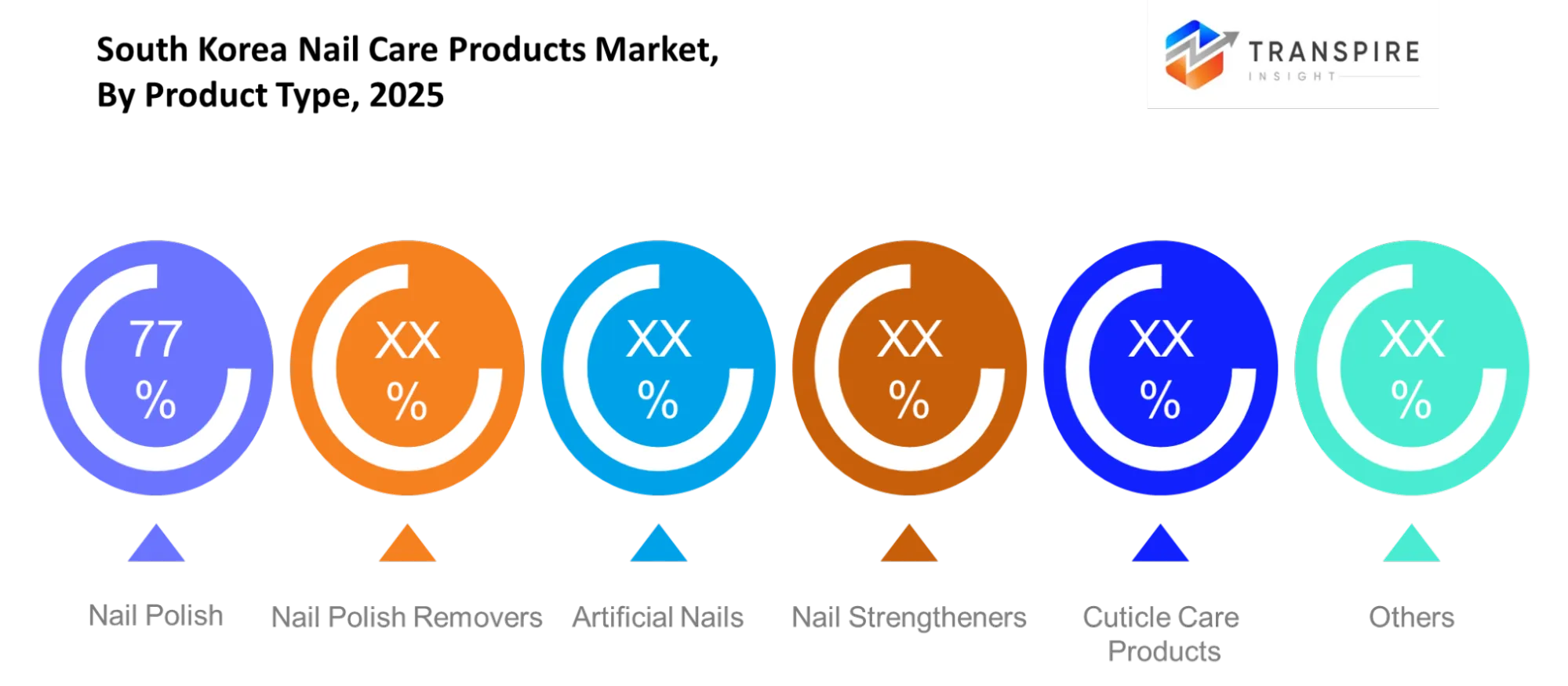
To learn more about this report, Download Free Sample Report
By Distribution Channel
Specialty Beauty Stores still take the biggest slice of the market, mostly because shoppers keep leaning on professional product guidance, doing in store testing, and enjoying that more premium cosmetic retail feel before they actually decide. Korean beauty chains plus department store counters stay really visible for both local and international nail care brands , thanks to carefully picked product displays and merchandising that follows trends pretty closely. And honestly, the existing retail setup in most cities also helps people adopt these more expensive items quicker, especially when seasonal collections roll out. With steady foot traffic in the busy beauty districts, this channel keeps getting extra momentum, like it’s just staying on top.
Meanwhile Online Retail is moving the fastest, because mobile commerce apps and influencer driven shopping habits make it easier for consumers to buy straight away without the usual detour. Supermarkets meanwhile hold fairly steady demand for mass market nail products and the cheaper manicure essentials people grab while doing normal household errands. Salons & Spas remain a key piece too, since professional technicians can shape which products get tried first and which premium treatments recurring clients end up choosing. Other outlets, like pharmacy chains and convenience retailers, are also expected to gain from smaller footprint beauty expansions and those impulse based cosmetic purchases that pop up when people are already out.
By Application
Personal Use is kind of the main application segment, sure, because home manicure routines got really woven into everyday consumer beauty habits once digital beauty tutorials started rolling in more often, and self-care purchasing also sped up during these last few years. People are more and more into gel polish systems , quick dry coatings , and treatment kits, basically to get that salon look without doing appointments too frequently. There is also constant swapping of products , plus color experiments that follow whatever trend is loudest at the moment, and that keeps transaction numbers pretty high in this category. And honestly the fact that you can buy these things easily across both online and offline retail makes the long term demand feel steady.
Professional Salon Use still contributes a lot to the market because high end manicure services stay tied closely with fashion cycles, social events, and that luxury beauty kind of spending, especially in big city areas. Nail Art is getting serious momentum, partly because Korean beauty culture is blending more and more customized patterns, little embellishments, and influencer inspired aesthetics directly into what salons offer. Therapeutic Nail Care is rising too, since nails get damaged from repeated gel applications, so consumers end up needing stronger fortifying treatments and restorative care systems. Others include hybrid beauty applications where wellness oriented treatments mix with cosmetic enhancement services, and that could open up some premium niche space over the forecast period.
By End User
Women keep ending up as the main end-user, mostly because nail cosmetics are still tied to fashion coordination, workplace grooming, and this beauty led self-expression that shows up across several age groups. People keep trying new products, and then they spend on premium beauty more often, plus they stay really engaged with K-beauty trends, so the whole segment keeps buying at scale. Even professional salons lean heavily toward women, through subscription manicure programs, and also premium treatment services. On top of that, strong social media engagement kind of boosts the whole thing, so people purchase more frequently and they adopt seasonal collections sooner.
Teenagers are looking like a fast-rising consumer group because digital beauty content, plus influencer marketing, made early-stage cosmetic experimentation happen much earlier. Men still sit in a smaller lane, but they’re growing steadily through transparent coatings, grooming oriented nail treatments, and minimalist manicure products that connect to workplace appearance expectations. Beauty Professionals keep pushing the premium side, since salons need durable formulations, advanced curing systems, and high performance treatment products to serve clients again and again. Other groups include aging consumers, who often look for therapeutic nail repair solutions, and wellness minded manicure products designed for sensitive nails, like more careful and soothing options.
By Ingredient Type
Gel based products still seem to be in the lead in the ingredient type space, mostly because shoppers kinda want that longer wear time, a glossy look, and honestly less maintenance hassle than the regular lacquer systems. At the same time, both salons and at home users keep leaning toward UV cured, and LED cured formulas. These give that extra durability and better chip resistance, which people notice pretty fast. On top of that, product development around low odor plus quick setting gel systems has helped push the category outward in premium beauty channels. And in salon environments, the need for repeat appointments stays high so this segment keeps making the strongest revenue contribution.
Organic ingredients and vegan nail care products are growing fairly steadily, partly since ingredient transparency and overall formulation safety have started mattering more for younger consumers. The “chemical free” angle, plus cruelty free certification, and plant based alternatives, are becoming real deciding factors when people buy premium cosmetics, especially on digital retail platforms. There are also other options like hybrid formulations that mix strengthening minerals, hydration compounds, and some breathable polish technologies. These are often designed for those with more sensitive nail conditions. Looking ahead through the forecast period, clean label and wellness focused formulations should pull in more investment activity, as brands compete using product differentiation, not just color variety, alone.
What are the Key Use Cases Driving the South Korea Nail Care Products Market?
The main use situation still seems to be daily cosmetic improvement, through nail polish and gel manicure systems. People use these things so they can keep a professional look, align their style with fashion trends, and get those long-lasting salon type results. This segment keeps pulling the most demand because nail color products bring both frequent buying and kind of fast-moving trend changes, too.
Going beyond that, more people are reaching for nail strengthening and recovery treatments, especially when their nails get a bit rough from repeated gel sessions or artificial extensions. At the same time nail salons are also turning more toward premium curing systems, cuticle care, and multi-function manicure kits, to stand out, and help keep customers in the urban beauty districts.
What’s starting to show up more are newer use cases like AI assisted nail diagnostics and customized treatment subscriptions that connect to digital beauty platforms. Some higher end Korean beauty stores are even trialing smart imaging tools that read nail hydration and then suggest specific repair formulas. During the forecast window, these personalization driven beauty tools could end up making a new kind of premium niche, where wellness, diagnostics and cosmetic care are all tied together.
|
Report Metrics |
Details |
|
Market size value in 2025 |
USD 456.19 Million |
|
Market size value in 2026 |
USD 481.29 Million |
|
Revenue forecast in 2033 |
USD 700.24 Million |
|
Growth rate |
CAGR of 5.50% from 2026 to 2033 |
|
Base year |
2025 |
|
Historical data |
2021 - 2024 |
|
Forecast period |
2026 - 2033 |
|
Report coverage |
Revenue forecast, competitive landscape, growth factors, and trends |
|
Regional scope |
South Korea |
|
Key company profiled |
Amorepacific, LG Household & Health Care, OPI Products, Revlon, Coty, Estée Lauder, L'Oréal, Shiseido, Sally Hansen, Orly International, Essie Cosmetics, Innisfree, Etude House, Nature Republic, Missha |
|
Customization scope |
Free report customization (country, regional & segment scope). Avail customized purchase options to meet your exact research needs. |
|
Report Segmentation |
By Product Type (Nail Polish, Nail Polish Removers, Artificial Nails, Nail Strengtheners, Cuticle Care Products, Others); By Distribution Channel (Supermarkets, Specialty Beauty Stores, Online Retail, Salons & Spas, Others); By Application (Personal Use, Professional Salon Use, Nail Art, Therapeutic Nail Care, Others); By End User (Women, Men, Teenagers, Beauty Professionals, Others); By Ingredient Type (Organic Ingredients, Gel-based Products, Vegan Nail Care Products, Others) |
Which Regions are Driving the South Korea Nail Care Products Market Growth?
The Seoul Capital Area still feels like the main regional market, mainly because it sort of pulls together the country’s biggest cluster of beauty retailers, premium department stores, nail salons, and consumers who basically follow trends faster than everywhere else. Seoul also has that dense digital commerce setup, plus a pretty strong influencer marketing ecosystem, so product adoption cycles move quicker, like in a chain reaction. For most premium cosmetic launches, they first go through flagship stores and the high-traffic retail districts in Seoul, and only after that do they start rolling out more broadly. You can see the leadership again and again in the strong purchasing power, the high salon penetration, and the constant exposure to K-beauty themes coming through media and entertainment channels.
Yeongnam, meanwhile, sits as the second-largest contributor, but it grows in a different way than Seoul, because it leans more on steady middle-income spending and regional retail expansion, not as much on trend-driven luxury purchases. Places like Busan and Daegu keep demand for beauty products steady, supported by long-established department stores, pharmacies, and franchised salon chains. In this region, consumer behavior tends to favor practical long-wear items and mid-range pricing, rather than quick seasonal experimenting. That kind of steadiness ends up making Yeongnam a reliable revenue base for both domestic brands and international cosmetic companies.
Then there’s Jeju and the other secondary urban regions, which are showing the fastest growth lately, mostly due to tourism coming back, more beauty retail investment, and wider e-commerce logistics coverage after 2023. Local retailers are increasingly adding premium manicure systems and imported nail products, aiming at younger travelers as well as people who are digitally engaged. With better nationwide same-day delivery networks now, the older gap between metro availability and regional access has shrunk a lot, and it makes regional customers feel like they’re not waiting as long for the same beauty products.
Who are the Key Players in the South Korea Nail Care Products Market and How Do They Compete?
Competition in the South Korea nail care products market stays kind of moderately fragmented, with domestic beauty conglomerates going head to head with specialized international nail brands and also those fast-moving indie cosmetic labels. Most companies seem to compete by pushing product innovation, betting on formulation quality, expanding digital retail reach, and reacting quickly to whatever trends are popping, not so much by price only. The more established beauty groups defend their market share via omnichannel distribution and strong brand ecosystems, while newer entrants often aim at smaller pockets like vegan nail formulas, quick-dry systems, and higher-end gel technologies… you know, the stuff that feels a bit more modern.
Amorepacific separates itself through premium K-beauty branding, rapid product localization, and a lot of spending on beauty technology research. Its digital commerce integration plus a multi-brand portfolio gives the company room to serve both luxury buyers and mass-market consumers in one sweep. LG Household & Health Care competes with deep retail penetration and a premium beauty stance that links tightly to department stores and broader global expansion approaches. It also improved overseas reach through acquisition activity in North America, so it’s not only growing organically.
OPI Products leans into professional salon performance and technological differentiation, especially through systems like Intelli-Gel, and then those rapid-dry formulations that people notice quickly. Essie Cosmetics rides on fashion-style seasonal color releases and strong salon visibility. Shiseido meanwhile keeps a premium Asian beauty position, plus formulation know-how, to stay relevant with higher-income consumers. More international players now collaborate with Korean e-commerce platforms and influencers, to compete in a tighter way against domestic K-beauty brands, because that’s where attention is going lately, honestly.
Company List
- Amorepacific
- LG Household & Health Care
- OPI Products
- Revlon
- Coty
- Estée Lauder
- L'Oréal
- Shiseido
- Sally Hansen
- Orly International
- Essie Cosmetics
- Innisfree
- Etude House
- Nature Republic
- Missha
Recent Development News
"In January 2025, OPI Products launched the RapiDry™ Fast-Drying Nail Color collection. The new 60-second drying technology strengthened the company’s position in premium at-home manicure solutions and accelerated competition in quick-performance nail care products.http://www.wellacompany.com
"In June 2025, LG Household & Health Care announced acquisition of LG Electronics’ beauty device brand ‘Pra.L’. The acquisition expanded LG H&H’s beauty technology ecosystem by integrating AI-connected cosmetic devices with its broader premium beauty portfolio.https://cm.asiae.co.kr/
"In February 2026, OPI Products launched the OPIcons Collection for Spring 2026. The anniversary collection introduced new GelColor Intelli-Gel System™ formulations and expanded premium salon-grade nail offerings across global beauty markets.http://www.wellacompany.com
What Strategic Insights Define the Future of the South Korea Nail Care Products Market?
South Korea's nail care products market is structurally moving toward premium hybrid beauty ecosystems that mix salon services, tailored treatments, and digital retail interaction, not just simple e-commerce. The basic driver behind this change seems like K-beauty trend acceleration meeting consumer expectations for convenience, durability, and real customization too. Over the next five to seven years, brands that tie in AI-assisted diagnostics, subscription commerce , and multifunctional formulations will probably grab a disproportionate chunk of the market share.
One not so obvious risk is margin compression, mostly from overdoing promotions across online beauty platforms. Once domestic and international brands cluster into the same digital channels, customer acquisition costs can jump quicker than product pricing power, especially in the mid-range product lanes. Meanwhile, personalized nail treatment technology is also a big, pretty fresh opportunity. Smart beauty diagnostics connected to customized strengthening systems, plus digital consultation platforms could form that kind of premium recurring revenue stream.
Market players should really put emphasis on data-driven consumer engagement moves, rather than leaning only on quick product launches. Firms that blend localized trend sensing with treatment-centric innovation, will likely be in a better spot to keep profitability steady in a beauty environment that’s getting more crowded every year.
South Korea Nail Care Products Market Report Segmentation
By Product Type
- Nail Polish
- Nail Polish Removers
- Artificial Nails
- Nail Strengtheners
- Cuticle Care Products
- Others
By Distribution Channel
- Supermarkets
- Specialty Beauty Stores
- Online Retail
- Salons & Spas
- Others
By Application
- Personal Use
- Professional Salon Use
- Nail Art
- Therapeutic Nail Care
- Others
By End User
- Women
- Men
- Teenagers
- Beauty Professionals
- Others
By Ingredient Type
- Organic Ingredients
- Gel-based Products
- Vegan Nail Care Products
- Others
Frequently Asked Questions
Find quick answers to common questions.
The Expected South Korea Nail Care Products Market size for the Market will be USD 700.24 Million in 2033.
Key Segments for the South Korea Nail Care Products Market are By Product Type (Nail Polish, Nail Polish Removers, Artificial Nails, Nail Strengtheners, Cuticle Care Products, Others); By Distribution Channel (Supermarkets, Specialty Beauty Stores, Online Retail, Salons & Spas, Others); By Application (Personal Use, Professional Salon Use, Nail Art, Therapeutic Nail Care, Others); By End User (Women, Men, Teenagers, Beauty Professionals, Others); By Ingredient Type (Organic Ingredients, Gel-based Products, Vegan Nail Care Products, Others).
Major South Korea Nail Care Products Market Players are Amorepacific, LG Household & Health Care, OPI Products, Revlon, Coty, Estée Lauder, L'Oréal, Shiseido, Sally Hansen, Orly International, Essie Cosmetics, Innisfree, Etude House, Nature Republic, Missha.
The Current South Korea Nail Care Products Market size is USD 456.19 Million in 2025.
The South Korea Nail Care Products Market CAGR is 5.50% from 2026 to 2033.
- Amorepacific
- LG Household & Health Care
- OPI Products
- Revlon
- Coty
- Estée Lauder
- L'Oréal
- Shiseido
- Sally Hansen
- Orly International
- Essie Cosmetics
- Innisfree
- Etude House
- Nature Republic
- Missha
Recently Published Reports
-
Apr 2026
Bottled Water Market
Bottled Water Market Size, Share & Analysis Report By Product Type (Still Bottled Water, Carbonated Bottled Water, Functional Bottled Water, and Others), By Packaging (PET, Cans, and Others), By Sales Channel (Supermarkets/Hypermarkets, Convenience Stores/Drug Stores, Grocery Stores/Club Stores, Foodservice, and Others) and Geography (North America, Europe, Asia-Pacific, Middle East and Africa, South and Central America), 2021 - 2032
-
Apr 2026
Color Cosmetic Packaging Market
Color Cosmetic Packaging Market Size, Share & Analysis Report By Application (Mascara Packaging, Liquid Packaging, and Liquid Face), By Type (Tubes & Bottles, Pens & Markers, Compacts & Containers, and Droppers & Pumps), and Geography (North America, Europe, Asia-Pacific, Middle East and Africa, South and Central America), 2021 - 2031
-
Apr 2026
External Microphone For Camera Market
External Microphone For Camera Market Size, Share & Analysis Report By Type (Shotgun Microphone, Lavalier Microphone, and Others), By Application (Digital Camera, Professional Video Camera, and Others), and Geography (North America, Europe, Asia-Pacific, Middle East and Africa, South and Central America), 2021 - 2031
-
Apr 2026
Foot Orthotic Insoles Market
Foot Orthotic Insoles Market Size, Share & Analysis Report By Type (Pre-fabricated, and Custom-made), By Material (Thermoplastic, Composite Carbon Fiber, and Others), By Distribution Channel (Drug Stores, Hospitals & Clinics, and Others), and Geography (North America, Europe, Asia-Pacific, Middle East and Africa, South and Central America), 2021 - 2031