
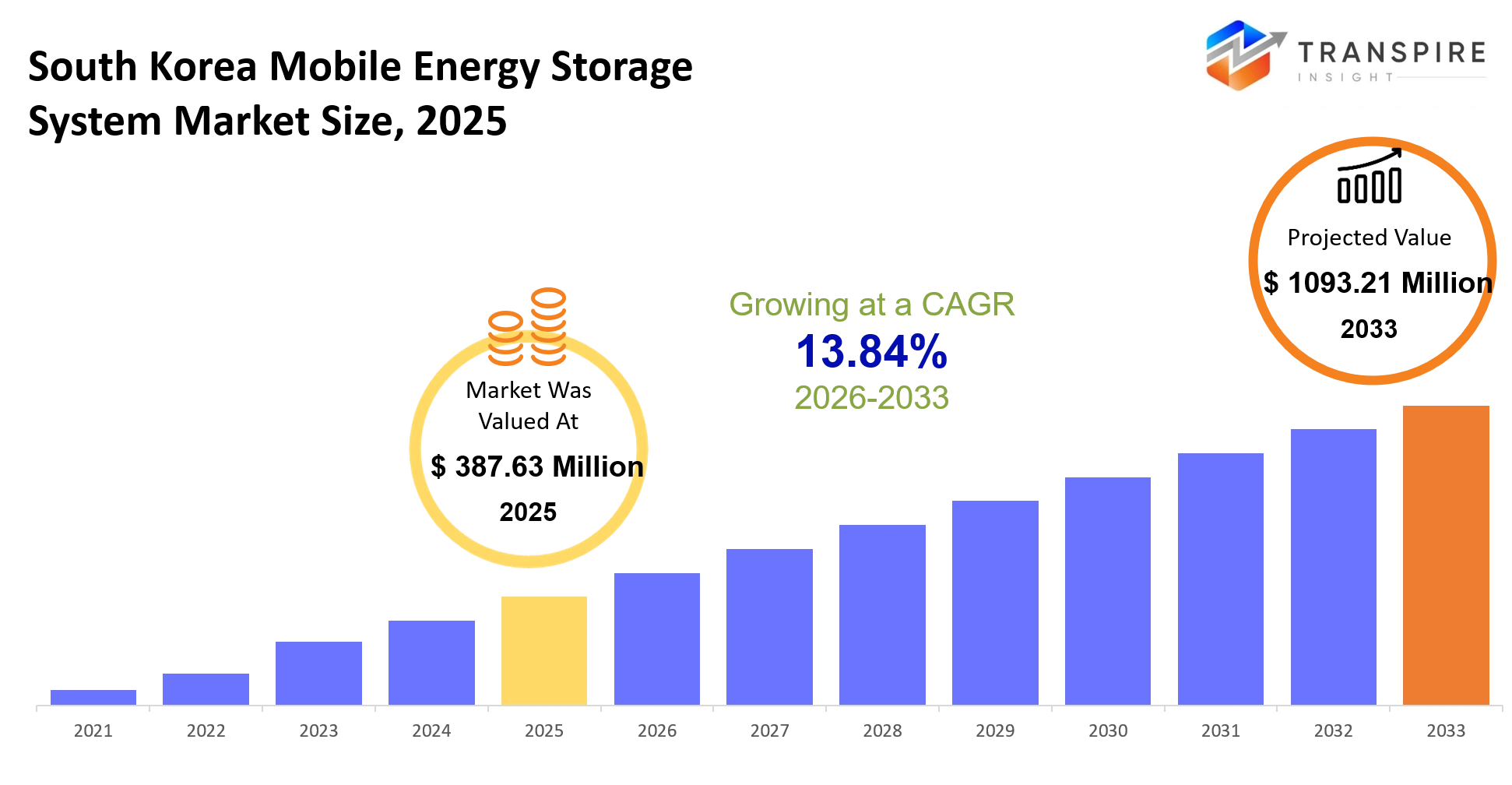
South Korea Mobile Energy Storage System Market Size & Forecast:
- South Korea Mobile Energy Storage System Market Size 2025:USD 387.63 Million
- South Korea Mobile Energy Storage System Market Size 2033: USD 1093.21 Million
- South Korea Mobile Energy Storage System Market CAGR: 13.84%
- South Korea Mobile Energy Storage System Market Segments: By Battery Type (Lithium-ion, LFP, Lead Acid, Others); By Application (Grid Support, EV Charging, Emergency Power, Construction Sites, Others); By End User (Utilities, Commercial, Industrial, Others)
To learn more about this report,  Download Free Sample Report
South Korea Mobile Energy Storage System Market Summary
The South Korea Mobile Energy Storage System Market was valued at USD 387.63 Million in 2025. It is forecast to reach USD 1093.21 Million by 2033. That is a CAGR of 13.84% over the period.
In South Korea, mobile energy storage systems kinda work like flexible power modules that handle temporary electricity needs when the grid starts acting up, during peak demand moments, or when parts of the infrastructure are offline. These container style, or trailer mounted setups are pretty often seen at construction sites, EV charging locations, and emergency response zones, where the fixed power options are either not enough or just not there at all. They also help utilities during maintenance shutdowns, keeping load balancing steady across the most important nodes, so things don’t get too unstable.
Over the last 3–5 years, the market moved more and more toward lithium-ion, and especially LFP-based mobile units, mainly because the energy density and cycle life got better in a noticeable way. A pretty big change is that mobile storage is now being treated as part of grid flexibility planning, not only as “backup” in the narrow sense. The Russia-Ukraine conflict basically acted as a real-world trigger, it disrupted global energy supply chains and pushed stronger energy security policies across Asia, and yes that includes South Korea. As a result, utilities and industrial operators have leaned into distributed storage that can be deployed fast, which in turn strengthens revenue opportunities for system integrators and battery suppliers.
Key Market Insights
- In South Korea, mobile energy storage systems kinda act like flexible power modules, dealing with short term electricity needs when the grid starts acting weird.
- during peak-demand windows, or when parts of the infrastructure are offline.
- The container style, or trailer-mounted arrangements are something you can see pretty often at construction sites, EV charging spots, and emergency response areas.
- where fixed power options are not enough or just aren’t there at all.
- They also support utilities during maintenance shutdowns, keeping load balancing more stable across the key nodes so things don’t get too unsteady.
- Over the last 3–5 years, the market has shifted more and more toward lithium-ion, and especially LFP based mobile units, mostly because the energy density plus cycle life improved in a very noticeable way.
- One important shift is that mobile storage is being planned as part of grid flexibility, not only as “backup” in the narrow sense.
- The Russia-Ukraine conflict kind of served as a real world trigger.
- it disrupted global energy supply chains and pushed tougher energy security policies across Asia, and yep that includes South Korea too.
- So utilities and industrial operators have leaned harder into distributed storage that can be rolled out quickly.
- which then creates clearer revenue chances for system integrators and battery providers.
What are the Key Drivers, Restraints, and Opportunities in the South Korea Mobile Energy Storage System Market?
Honestly the main thing driving the South Korea Mobile Energy Storage System Market is the very fast, kind of relentless, expansion of renewable energy capacity plus a noticeable rise in grid instability during the peak load windows. When solar and wind are getting bolted in more widely, their output can be a bit erratic, so utilities start needing fast-response balancing. That’s where mobile storage units start showing up, because they can react quickly and help smooth the intermittency, not just in theory, but in actual dispatch situations. On top of that, the government-backed grid modernization programs speed up procurement cycles, especially across those urban energy corridors and industrial zones. So overall deployment frequency goes up, and mobile ESS fleets are used more efficiently across South Korea too.
Meanwhile, the biggest brake on the market is the high upfront deployment cost, also the kind of layered permitting process plus grid interconnection approvals that take time. Mobile systems have to meet a bunch of safety, transport, and electrical standards. Because of that it’s slower for everyone to scale, and it tends to prevent big rollouts. This kind of structural friction hurts scalability most for smaller commercial users, since they usually cannot really justify that large capital expenditure. Because of that, market growth tends to stay concentrated with utilities and big industrial operators, rather than spreading into more decentralized adoption.
Still there’s a really strong opening in EV charging infrastructure, where mobile energy storage can reduce grid upgrade delays. South Korea is expanding high-capacity fast-charging corridors, and that naturally creates demand for temporary power buffering solutions. If mobile ESS units are deployed at highway charging hubs, operators can often avoid some of the more expensive grid reinforcement work while maintaining stable charging-speed reliability. This portion is expected to become a major driver of adoption as EV penetration continues to rise through 2030.
What Has the Impact of Artificial Intelligence Been on the South Korea Mobile Energy Storage System Market?
Artificial intelligence is getting mixed in, increasingly, with mobile energy storage operations in South Korea, mainly through real time load optimization, fleet coordination and predictive upkeep systems. With these AI based energy management platforms, charging and discharging cycles are steered across distributed mobile units, so grid swings stay steadier during peak demand moments. In practice the systems boost dispatch efficiency by handing out stored energy according to demand forecasting models and also location driven consumption habits.
Machine learning algorithms then look through past usage data, to forecast battery wear and tear, so the operators can plan maintenance earlier before output starts to slip. As a result, there’s less unexpected downtime, and the fleet can be used more consistently across construction sites and EV charging hubs too. AI driven optimization has also improved how energy gets dispatched by as much as 15–20 percent for grid support use cases, especially in those dense, city style load balancing scenarios.
Still, adoption isn’t fully smooth because connectivity can be inconsistent at remote deployment spots, and that undermines the accuracy of real time data transfer. Plus, the integration fees are high, which makes it harder for smaller operators to roll out these advanced AI enabled setups. Even with those frictions, digital control platforms are starting to feel like a baseline feature in fresh mobile ESS deployments, particularly among big utility operators.
Key Market Trends
- After 2023, South Korea Mobile Energy Storage System Market seem to shift—more into active grid balancing stuff, not only the backup-only way people used before, thanks to the energy policy reforms.
- Between 2024 and 2026, mobile ESS rollouts climbed by more than 25% along EV charging corridors, kind of a noticeable uptick in that lane.
- Utilities also leaned more into procurement of containerized storage units, specifically for short term grid stabilization whenever maintenance cycles kick in, and yeah it’s temporary but still critical.
- LFP based mobile systems got about 18% higher adoption rates, mainly because of better thermal safety and lifecycle efficiency, and that combination matters.
- In the construction sector, adoption rose significantly as temporary electrification replaced diesel generators on urban sites, a practical switch.
- ABB expanded mobile storage integration with smart grid control systems across Asia, and they didn’t really slow down there.
- Schneider Electric meanwhile introduced modular mobile ESS platforms designed for rapid deployment, and the “use cases” angle is more prominent now.
- Regulatory frameworks in South Korea tightened safety certification requirements for transportable battery systems after 2024, so compliance became a bigger deal.
- Industrial users increased their reliance on mobile ESS to lower peak electricity tariff exposure and, in general, improve operational efficiency in day to day work.
South Korea Mobile Energy Storage System Market Segmentation
-
By Battery Type
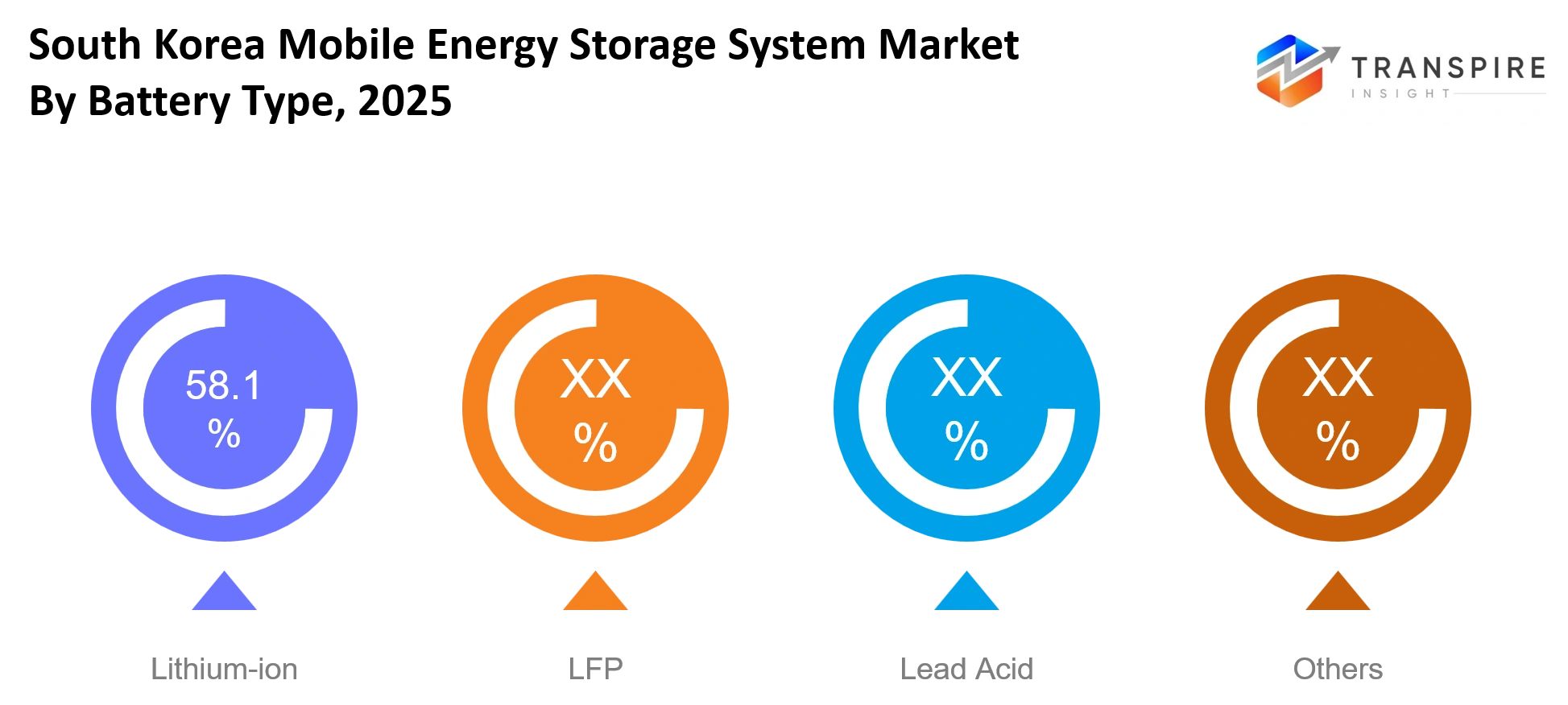
Lithium-ion batteries kinda dominate a lot of mobile energy storage deployments, mostly cause they bring high energy density and they respond pretty fast, which matters in the real world. With these setups you can do rapid charge and discharge cycles, you know the kind of thing that grid balancing needs and EV charging kinda leans on too. LFP batteries are getting more traction as well, mainly because their thermal stability is better, and the lifecycle costs are coming in lower, which is a big deal really. Lead acid batteries still show up in a limited kind of way for low-cost backup tasks, where energy density isn’t as important as other factors. The other category mostly includes emerging chemistries, used in specialized industrial deployments, where the energy output profile has to be tuned, and sometimes that tuning is done on purpose, pretty deliberately.
Lithium-ion remains the default choice for utility-scale mobile systems, largely because it keeps working reliably even during high-frequency cycling conditions. LFP adoption is rising in city deployments, where safety rules are really strict. Lead acid systems are slowly dropping off, mostly due to lower efficiency, and a shorter lifecycle track record. Battery innovation keeps shifting how these deployments get planned across different mobile energy platforms.
To learn more about this report, Download Free Sample Report
-
By Application
Grid support kind of comes across as the leading application, utilities deploy mobile systems for peak load balancing and emergency stabilization, it’s like the default choice. EV charging applications are expanding rapidly, mainly because the fast-charging corridor idea is spreading across major highways and urban centers, pretty quickly. Emergency power still matters a lot for disaster response, and also for managing infrastructure downtime, even when conditions get messy. On construction sites, mobile ESS is used more and more to replace diesel generators for a cleaner on-site energy supply, which feels like a practical swap. Other use cases cover event power supply and temporary industrial installations.
Grid support ends up dominating due to growing renewable integration and the constant fluctuations in power demand patterns. EV charging stays the fastest-growing, because electric vehicle adoption is expanding across the nation. Emergency power keeps steady demand, partly due to regulatory requirements for critical infrastructure resilience. Overall application trends show a noticeable shift toward flexible, on-demand energy deployment models, rather than fixed arrangements.
-
By End User
Utilities are kinda the biggest end user segment, mostly because of large scale grid balancing stuff and the whole infrastructure modernization programs. Commercial users deploy mobile systems for cost optimization and also for backup power when peak tariff periods hit, you know. Industrial users take up mobile ESS for construction projects and temporary manufacturing setups, they need stable power supply. Others, well, include government and event based applications, those usually want a short term energy deployment solution.
Utilities keep their dominance because regulatory driven grid stability requirements just don’t go away. Industrial users show the quickest growth, linked to electrification of temporary worksites and this manufacturing flexibility demand. Commercial adoption is going up steadily, mainly with the rising energy cost pressure you get in urban areas. End user demand seems to be leaning more toward decentralized and flexible power management strategies, which feels like the direction everyone is moving in.
What are the Key Use Cases Driving the South Korea Mobile Energy Storage System Market?
Core demand mostly comes from grid support applications, where a mobile energy storage setup helps keep electricity supply steady during high peak periods and when renewables swing around. Utilities end up using these systems to keep voltage stable, and to prevent the grid from getting overloaded while maintenance cycles are happening, even if things are already running tight.
More broadly, you can see this expanding into EV charging stations and construction sites, where there’s a real need for temporary high capacity power on short notice. In practice, these deployments reduce how much people rely on long fixed grid upgrades, and also cut back on diesel generators, while supporting smoother day to day operations.
Then there are the newer uses, like disaster response energy deployment and support for smart city infrastructure. Mobile storage units are getting pulled into emergency recovery work more often, plus temporary urban energy setups, and this is being pushed further by tougher resilience planning rules and by ongoing infrastructure modernization programs.
|
Report Metrics |
Details |
|
Market size value in 2025 |
USD 387.63 Million |
|
Market size value in 2026 |
USD 441.27 Million |
|
Revenue forecast in 2033 |
USD 1093.21 Million |
|
Growth rate |
CAGR of 13.84% from 2026 to 2033 |
|
Base year |
2025 |
|
Historical data |
2021 - 2024 |
|
Forecast period |
2026 - 2033 |
|
Report coverage |
Revenue forecast, competitive landscape, growth factors, and trends |
|
Regional scope |
South Korea |
|
Key company profiled |
Tesla, CATL, BYD, LG Energy Solution, Samsung SDI, SK On, Fluence, Sungrow, Powin, Wärtsilä, Hitachi Energy, ABB, Schneider Electric, Eaton, Delta Electronics |
|
Customization scope |
Free report customization (country, regional & segment scope). Avail customized purchase options to meet your exact research needs. |
|
Report Segmentation |
By Battery Type (Lithium-ion, LFP, Lead Acid, Others); By Application (Grid Support, EV Charging, Emergency Power, Construction Sites, Others); By End User (Utilities, Commercial, Industrial, Others) |
Which Regions are Driving the South Korea Mobile Energy Storage System Market Growth?
North America sort of leads the global mobile energy storage system scene, mainly because it has advanced grid flexibility programs and a solid push toward utility-scale battery fleets. On top of that, federal and state-level incentives tied to clean energy transition policies are speeding up the uptake of containerized storage, especially for grid balancing and the need for emergency resilience. The whole place also gets a boost from a pretty mature EV charging network which in turn needs distributed power support when demand starts climbing. Big utilities and independent power producers have basically built a well developed ecosystem for mobile storage integration across renewable-heavy states like California and Texas, so the combination of policy backing and infrastructure readiness just keeps North America in a top position.
Europe, on the other hand, is more of a steady, policy-led region in the South Korea Mobile Energy Storage System Market, where demand is shaped by tougher decarbonization requirements rather than everyone racing to expand capacity. Different from North America, Europe tends to focus on improving and optimizing what’s already there in the grid, instead of scaling in a more aggressive way. Germany, the Netherlands, and the UK in particular highlight mobile storage for renewable smoothing and dependable industrial backup reliability. There’s also a consistent regulatory rollout under EU Green Deal style frameworks, which helps keep investment cycles predictable for utilities and commercial operators. So overall, that stability centered demand approach makes Europe a dependable revenue contributor, even if it feels less like a sprint.
Asia Pacific is, kind of, the fastest-growing region because of aggressive electrification programs, and also this rapid EV infrastructure roll out across South Korea, China, and India. Then there was this big shift after governments added large-scale fast-charging highway corridors and renewable integration targets sometime post 2023, which kind of changed the pace. Even so, port and industrial hubs have started putting in mobile storage units to ease grid congestion, and also reduce diesel reliance. All of that expansion is laying out a real runway for technology providers, plus system integrators who move into the region during 2026 to 2033, in particular around modular and containerized ESS solutions, you know.
Who are the Key Players in the South Korea Mobile Energy Storage System Market and How Do They Compete?
Competition in the South Korea Mobile Energy Storage System market is sorta moderately consolidated, even if it feels like a few bigger players still carry most of the weight. There’s strong dominance from integrated energy storage and battery manufacturers. Most big incumbents, at least for now, push their advantage on system efficiency, software integration, and lifecycle performance, not just price. The market is also seeing a bit of a shake-up, mostly because energy software firms and grid solution providers are bundling storage together with digital energy management platforms. So, competitive edge is moving toward system intelligence, quicker deployment capability, and interoperability with renewable grids, which sounds simple but is actually hard to deliver.
Tesla leans hard on a vertically integrated mobile storage setup, combining batteries, inverters, and software based energy optimization—this helps with rapid deployment in EV charging and grid support use cases. CATL stands out with high energy density LFP battery platforms, which can reduce lifecycle cost and also improve safety for mobile ESS applications. Fluence differentiates via AI driven energy management software that optimizes dispatch across distributed storage fleets. Hitachi Energy strengthens its role through utility partnerships that run deep, plus grid automation knowledge. Schneider Electric expands by plugging mobile ESS into smart grid and industrial energy management systems, which lets customers handle peak demand cost optimization and resilience strategies more smoothly, or at least that’s how they position it.
Company List
- Tesla
- CATL
- BYD
- LG Energy Solution
- Samsung SDI
- SK On
- Fluence
- Sungrow
- Powin
- Wärtsilä
- Hitachi Energy
- ABB
- Schneider Electric
- Eaton
- Delta Electronics
Recent Development News
In November 2025, Sungrow entered a partnership with a South Korean utility consortium to deploy containerized mobile storage systems for EV charging corridors. The collaboration strengthens fast-charging infrastructure reliability and reduces dependency on fixed grid upgrades.https://www.sungrowpower.com
In January 2026, ABB announced a strategic collaboration with regional grid operators to integrate mobile ESS into automated grid stabilization systems. The initiative improves renewable integration efficiency and reduces outage response time.https://www.abb.com
What Strategic Insights Define the Future of the South Korea Mobile Energy Storage System Market?
The South Korea Mobile Energy Storage System Market is kind of sliding toward distributed, software led grid flexibility answers, where utilities are caring more about fast response energy balancing than adding fixed infrastructure, all the time. Over the next 5–7 years, the push will be pulled by EV charging density, renewable intermittency, and the rising need for temporary high capacity power in urban development pockets. There’s also a quieter concern, sort of a creeping risk of leaning too hard on lithium-ion supply chains, because raw material swings and geopolitical clustering could throw off deployment schedules and make pricing feel unstable.
On the other hand, there’s an emerging opening too in mobile-to-grid trading models, where mobile ESS units jump into real time electricity markets for peak arbitrage and ancillary services, particularly in smart city zones. Players in this space should put money into software enabled fleet orchestration, and also look toward long duration battery chemistries, while building partnerships with utilities to get early access to grid integration deals before the competitive saturation gets too intense.
South Korea Mobile Energy Storage System Market Report Segmentation
By Battery Type
- Lithium-ion
- LFP
- Lead Acid
- Others
By Application
- Grid Support
- EV Charging
- Emergency Power
- Construction Sites
- Others
By End User
- Utilities
- Commercial
- Industrial
- Others
Frequently Asked Questions
Find quick answers to common questions.
The expected South Korea Mobile Energy Storage System Market size for the market will be USD 1093.21 Million in 2033.
By Battery Type (Lithium-ion, LFP, Lead Acid, Others); By Application (Grid Support, EV Charging, Emergency Power, Construction Sites, Others); By End User (Utilities, Commercial, Industrial, Others)
Major South Korea Mobile Energy Storage System Market players areTesla, CATL, BYD, LG Energy Solution, Samsung SDI, SK On, Fluence, Sungrow, Powin, Wärtsilä, Hitachi Energy, ABB, Schneider Electric, Eaton, Delta Electronics
The South Korea Mobile Energy Storage System Market size is USD 387.63 Million in 2025.
The South Korea Mobile Energy Storage System Market CAGR is 13.84% from 2026 to 2033.
- Tesla
- CATL
- BYD
- LG Energy Solution
- Samsung SDI
- SK On
- Fluence
- Sungrow
- Powin
- Wärtsilä
- Hitachi Energy
- ABB
- Schneider Electric
- Eaton
- Delta Electronics
About the Authors

Avinash Kumar
I’m Avinash Kumar, a Senior Research Analyst at Transpire Insight, with expertise in the Electronics and Semiconductor and Energy & Power industry. My work focuses on analyzing emerging technologies, market trends, industry developments, and innovation across these sectors. I specialize in transforming complex technical and market insights into clear, research-backed content that helps professionals, businesses, and decision-makers stay informed. Through continuous industry research and data-driven analysis, I strive to deliver accurate, reliable, and practical perspectives on the latest advancements shaping the semiconductor and energy landscape.

Chakradhar Khansole
Chakradhar serves as the Research Director at Transpire Insight, bringing over 8 years of experience in technology, innovation, and strategic market intelligence. He specializes in transforming complex market data into actionable business insights that enable organizations to make informed, growth-oriented decisions. Recognized for his strategic vision and analytical expertise, Chakradhar leads high-impact research initiatives, delivering comprehensive market assessments, competitive intelligence, and forward-looking industry analysis.
Recently Published Reports
-
Apr 2026
Active Power Filter Market
Active Power Filter Market Size, Share & Analysis Report By Type (Shunt Active Power Filters, Series Active Power Filter, Hybrid Active Power Filter), By Application (Harmonics Mitigation, Reactive Power Compensation, Voltage Regulation, Power Factor Correction), By Phase (Single Phase, Three Phase), By End-User Industry (Manufacturing, Healthcare, Commercial, Automotive, Oil and Gas, Others), and Geography (North America, Europe, Asia-Pacific, Middle East and Africa, South and Central America), 2021 - 2031
-
Apr 2026
Electrical Transformer Market
Electrical Transformer Market Size, Share & Analysis Report By Core (Closed, Shell, and Berry), By Insulation (Gas, Oil, Solid, Air, and Other), By Phase (Single, and Three), By Rating (100 MVA to 500 MVA, 501 MVA to 800 MVA, and 801 MVA to 1200 MVA), and Geography (North America, Europe, Asia-Pacific, Middle East and Africa, South and Central America), 2021 – 2031
-
Apr 2026
Hydraulic Piston Pumps Market
Hydraulic Piston Pumps Market Size, Share & Analysis Report By Type (Axial Piston Pumps, Radial Piston Pumps), By Operating Pressure (Low Pressure, Medium Pressure, High Pressure), By Application (Construction, Mining, Agriculture, Automotive, Oil & Gas, Industrial Machinery, Others), By End-User (OEMs, Aftermarket), and Geography (North America, Europe, Asia-Pacific, Middle East and Africa, South and Central America), 2021 – 2031
-
Apr 2026
Laboratory Gas Generators Market
Laboratory Gas Generators Market Size, Share & Analysis Report By Product (Nitrogen Gas Generator, Hydrogen Gas Generator, Zero Air Gas Generator, Purge Gas Generator, TOC Gas Generators, Others), By Application (Gas Chromatography, Liquid Chromatography-mass Spectrometry (LC-MS), Gas Analyzers, Others), By End-user (Life Science, Chemical & Petrochemical, Food & Beverage, Others), and Geography (North America, Europe, Asia-Pacific, Middle East and Africa, South and Central America), 2021 – 2031