
Asia Pacific Automotive Artificial Intelligence Market Size & Forecast:
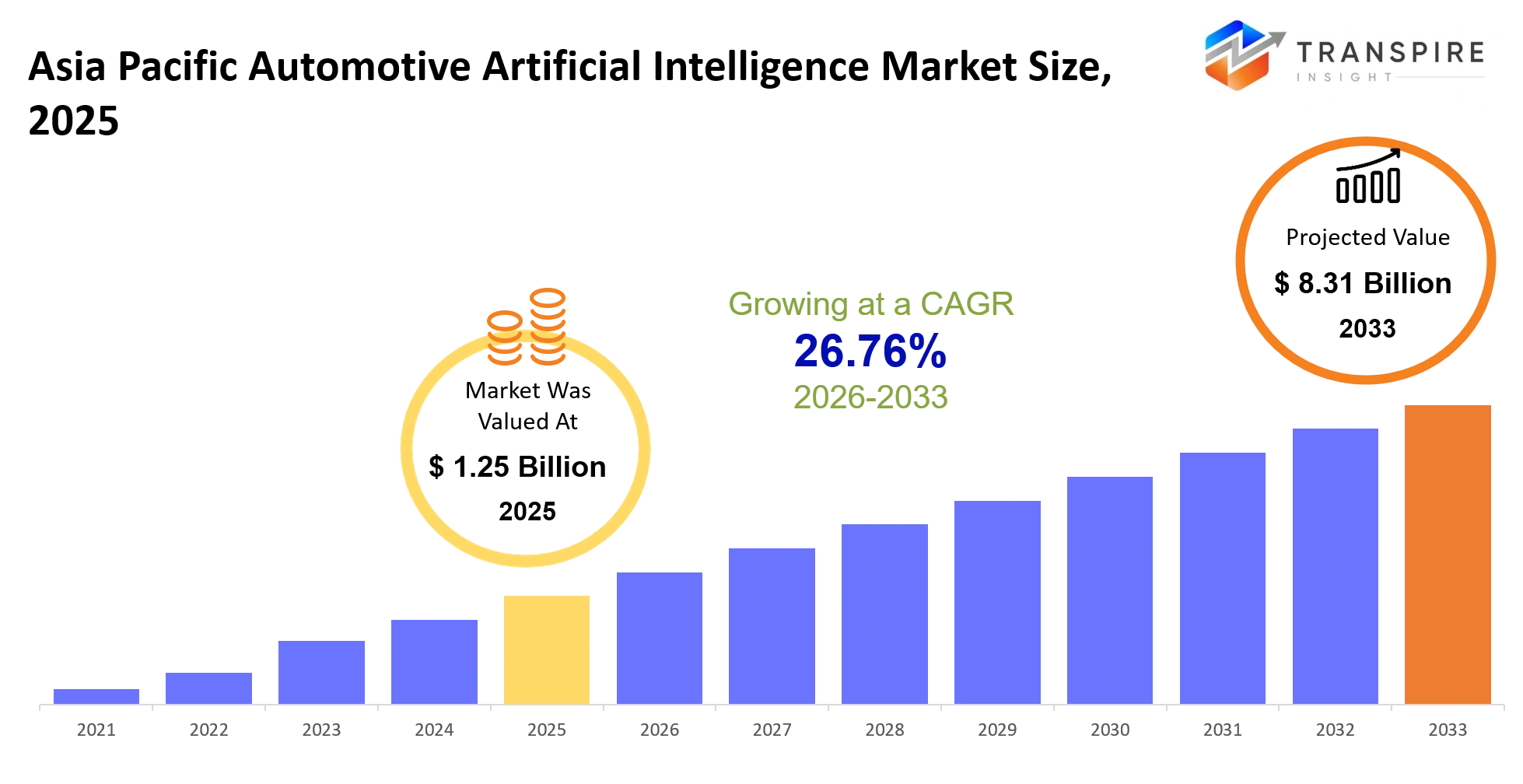
- Asia Pacific Automotive Artificial Intelligence Market Size 2025: USD 1.25 Billion
- Asia Pacific Automotive Artificial Intelligence Market Size 2033: USD 8.31 Billion
- Asia Pacific Automotive Artificial Intelligence Market CAGR: 26.76%
- Asia Pacific Automotive Artificial Intelligence Market Segments: By Technology (Machine Learning, Computer Vision, Natural Language Processing, Predictive Analytics, Others); By Application (Autonomous Driving, Driver Assistance Systems, Predictive Maintenance, Fleet Management, Others); By End User (Passenger Vehicles, Commercial Vehicles, Automotive OEMs, Others).
To learn more about this report,  Download Free Sample Report
Asia Pacific Automotive Artificial Intelligence Market Summary
The Asia Pacific Automotive Artificial Intelligence Market was valued at USD 1.25 Billion in 2025. It is forecast to reach USD 8.31 Billion by 2033. That is a CAGR of 26.76% over the period.
The Asia Pacific Automotive Artificial Intelligence market focuses on software and embedded systems that allow vehicles to interpret road conditions, make driving decisions, and control the fleet in real time. In reality it provides functions that range from avoiding collisions, monitoring driver behavior, optimizing routes, and predictive maintenance for commercial and passenger cars in a busy urban environment. The market evolved over the last five years from disparate, rule-based driver assistance systems toward centrally controlled, software-defined vehicle architectures relying on deep learning and sensor fusion. Simultaneously the post-COVID semiconductors supply chain shortages have pushed OEMs to reconfigure vehicle architectures for better resource efficiency. This led to an adoption of edge-based AI and scalable computing stacks. Today the manufacturer relies on integrated AI architectures reducing the reliance on hardware and increasing revenues through a subscription-based approach and quicker deployment of features across the entire line-up of cars.
Key Market Insights
- China dominates the Asia Pacific Automotive Artificial Intelligence Market by capturing the largest share of nearly 35% in 2025. The growth is led by huge deployment of large scale EV and smart mobility.
- India is expected to be the fastest-growing region through 2030, driven by connected vehicle adoption and the digitization of urban mobility
- In the Asia Pacific Automotive Artificial Intelligence Market, the majority share of about 42% is held by Software based solutions led by ADAS, an autonomous driving platform.
- Hardware components comprise the second largest given the massive growth in sensors, AI chips and in-vehicle computing systems.
- AI-enabled services are the fastest growing segment to 2026-2030, due to OTA updates and the proliferation of cloud analytics.
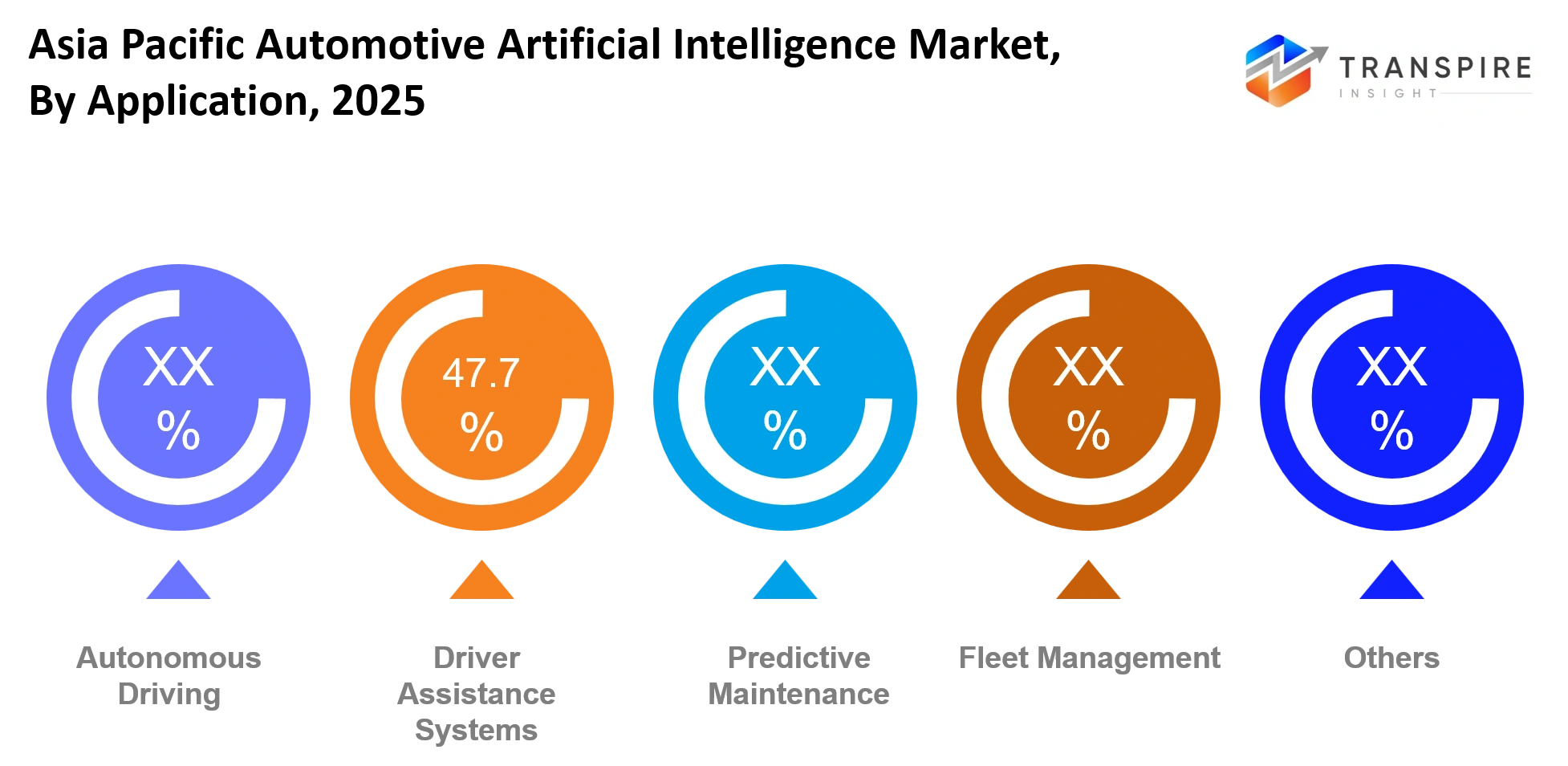
- APAC Automotive Artificial Intelligence Market: Advanced Driver Assistance Systems has the largest application share of nearly 38% in the Asia Pacific Automotive Artificial Intelligence Market.
- Development of autonomous driving-the fastest growing application, supported by the regulatory sandbox programs in China and Japan.
- Fleet management and predictive maintenance become popular among logistics and ride-hailing providers.
- Demand is led by passenger cars (~55%), as they incorporate ADAS on every new model as a mass-market feature.
- Commercial vehicles- the first and second largest end-user, are growing rapidly due to optimization in logistics and safety compliance.
What are the Key Drivers, Restraints, and Opportunities in the Asia Pacific Automotive Artificial Intelligence Market?
The strongest growth driver is the accelerate trend to software defined vehicles with the edge AI chip capability increase and ADAS regulatory converge in China, Japan and South Korea. After the AI inference shifted from the cloud to in vehicle,OEM can remove latency limit and develop the safety functions in real-time for adapt cruise control and prediction for collision, which directly lead the OEM spending increase in the AI stack. Then, the high-profit income can be unlocked through premium in-vehicle software and subscription of mobility service.
A major structural barrier is the incoherence in data governance and the safety certification of automotive across the Asia Pacific market. Every major market has a separate validation process for the autonomous systems which lead automakers to spend much time and money to redesign and retest the AI models. As a result, the development cycle is extended and the spending for compliance is increased which delays the volume implementation of the autonomous features. Although the demand for autonomous features is strong in the short-term, the revenue monetization is weakened.
A significant opportunity is in urban autonomous mobility trials which mainly appear in Tier-1 cities of China and testing corridors of Singapore. Companies utilize high-definition maps, 5G-V2X infrastructure and fleet scale learning systems to realize robo-taxi and delivery service. The integration across the entire system can speed up the next growth phase for Asia Pacific Automotive Artificial Intelligence Market through the conversion of trials into scalable revenue streams.
What Has the Impact of Artificial Intelligence Been on the Asia Pacific Automotive Artificial Intelligence Market?
References in the prompt to scrubber monitoring and marine emission control systems have been omitted, as they are not directly related to the Asia Pacific Automotive Artificial Intelligence Market. In the automotive field, equivalent artificial intelligence is applied to connected car systems, electrified powertrains, and fleet level telematics.
Automation and compliance monitoring using AI are emerging in automotive operations, especially in commercial vehicle fleet applications. Driver behavior, system status and vehicle compliance monitoring systems powered by telematics technology automatically log operator performance, lowering manual compliance efforts for the logistics operator. Quality and abnormality detection in an automotive manufacturing environment as well as mobile platforms are enabled using computer vision systems.
Predictive function becomes the other transformation layer that includes models forecasting the rate of degradation for batteries, likely system failures or optimizations based on driver behavior and conditions-resulting in gains up to 10-20% improvement in vehicle uptime and 8-15% improvements in fleet fuel or energy efficiency through route optimization and performance adjustments.
However, high costs of integration and fragmented data resulting from road infrastructure diversity, climate variation and sensor calibration across Asia Pacific pose as a limitation on widespread adoption; delays in connectivity update between edges and cloud slow the update frequency, limiting real-time learning updates.
Key Market Trends
- Between 2021 and 2025, the automakers transitioned from the rule-based ADAS to deep learning perception systems that are embedded in a platform-based vehicle computing architecture.
- Post 2021 semiconductor shortages, OEMs reengineered supply chain, fast tracking adoption of edge AI chips by NVIDIA and Qualcomm worldwide in APAC Automotive Artificial Intelligence Market.
- 2002 saw the launch of China's regulatory sandbox programs, allowing autonomous driving pilots in Tier-1 cities. This materially enhanced the real-world testing volume.
- From 2023 to 2025, auto OEMs boosted its OTA software rollout a bit, kind of turning the revenue engine into ongoing, sort of continuous subscriptions for AI powered service feeds , not just one off upgrades.
- At the same time, automotive AI semiconductor capacity expanded in Japan and South Korea, and Toyota along with Hyundai pushed forward those partnerships on sensor fusion, perception frameworks, and similar stuff.
- Singapore and China set up managed autonomous mobility corridors which enhanced the collection of fleet-scale data for AI training and validation.
- In India and south east Asia, AI telematics was kinda adopted by fleet operators after 2022, it sorta led to more optimized routes and cost savings, not exactly in a straight line though.
- Automakers went ahead and built Mobileye and NVIDIA architectures into ADAS stack ,which in turn heightened the race for real time perception and autonomous control, especially when the system needs to react fast.
Asia Pacific Automotive Artificial Intelligence Market Segmentation
By Technology:
Machine learning techniques are employed in several ways in the APAC region to enhance driving decisions, analyze traffic patterns, and manage intelligent driving systems within automotive ecosystems. The use of computer vision enabled vehicles to interpret traffic signs, traffic lanes, obstacles, and improve vehicle safety. Natural language processing is being deployed in car voice interfaces while predictive analytics has found its place in speeding up the vehicle system performance.
These technologies work together on connected car platforms where all sensors, cameras and other equipment are processed rapidly to help the car read the world and understand in real-time to avoid accidents. This has helped automotive companies reduce driver error, reaction time and improve the overall safety features and driver behavior. Predictive models have helped manufacturers refine their system response to driving environment and user behavior to avoid errors and optimize system performance.
By Application:
Autonomous driving applications, designed to enable vehicles with minimal or no human intervention, integrate the various data from sensors, mapping systems and the AI decision layer. Assistance driving systems are more prevalently used and currently comprise of Lane Support, Adaptive Cruise Control and Collision Alert systems for passengers and commercial vehicles.
Predictive maintenance applications in the automotive domain enable vehicles to track wear and tear and predict failure of a certain component so that the breakdown can be prevented from happening, thus reducing time spent and other costs. Fleet management systems utilize AI to analyze performance, track routes and predict fuel or energy consumption and optimize vehicle performance so that delays are minimized in transport networks.
To learn more about this report, Download Free Sample Report
By End User:
Vehicle Passenger CarsPassenger cars account for the greatest AI application, including safety features like warning, control infotainment, and driver-assist systems used daily to improve mobility.Consumer demand for intelligent in-car driving experience is leading to greater adoption among car owners in Asian countries.
Commercial VehiclesThe vehicles depend greatly on AI technology for route planning and optimization, driver identification, efficiency reporting, to lower costs.OEMAutomotiveCompaniesAutomotive OEMs adopt AI across their design, manufacturing and testing stages for higher accuracy in Production and improved vehicle performance. Other. Mobility providersThe sector integrates AI features to offer an enhanced Shared mobility solution, a logistics plan, etc.
What are the Key Use Cases Driving the Asia Pacific Automotive Artificial Intelligence Market?
In Asia Pacific advanced driver assistance systems are, honestly the biggest AI use case, because it helps with driver safety more or less, especially in really congested city traffic scenarios , and it also trims down accident costs for insurers and OEMs too.Demand is high for these applications like collision warning and adaptive cruise control because their deployment is expanding beyond premium and mid-tier vehicles in this region.
Predictive maintenance and vehicle fleet optimization have been experiencing rapid growth driven by the uptake from logistics companies and ride-hailing services. These AI use cases combine vehicle telematics and navigation to ensure efficient transit operations through reduced vehicle downtime. These are particularly useful for commercial vehicle operations on large transport arteries across the Asia Pacific region.
The Asia Pacific Automotive AI market is also seeing growth in autonomous mobility services and software-defined vehicle platforms as key emerging use cases. This development is spearheaded by vehicle platooning on highway test tracks, robotaxi deployment on road networks in major economies like China and Japan, and the development of advanced V2X (vehicle-to-everything) technologies in Japan, Korea and other countries in APAC.
|
Report Metrics |
Details |
|
Market size value in 2025 |
USD 1.25 Billion |
|
Market size value in 2026 |
USD 1.58 Billion |
|
Revenue forecast in 2033 |
USD 8.31 Billion |
|
Growth rate |
CAGR of 26.76% from 2026 to 2033 |
|
Base year |
2025 |
|
Historical data |
2021 - 2024 |
|
Forecast period |
2026 - 2033 |
|
Report coverage |
Revenue forecast, competitive landscape, growth factors, and trends |
|
Regional scope |
Asia Pacific (India, China, Japan, Australia,South Korea, Rest of Asia Pacific) |
|
Key company profiled |
Tesla, NVIDIA, Intel Mobileye, Bosch, Continental AG, Qualcomm, Waymo, Aptiv, ZF Friedrichshafen, Hyundai Mobis, Valeo, Denso, Baidu Apollo, Tata Elxsi, Microsoft. |
|
Customization scope |
Free report customization (country, regional & segment scope). Avail customized purchase options to meet your exact research needs. |
|
Report Segmentation |
By Technology (Machine Learning, Computer Vision, Natural Language Processing, Predictive Analytics, Others); By Application (Autonomous Driving, Driver Assistance Systems, Predictive Maintenance, Fleet Management, Others); By End User (Passenger Vehicles, Commercial Vehicles, Automotive OEMs, Others). |
Which Regions are Driving the Asia Pacific Automotive Artificial Intelligence Market Growth?
The Asia Pacific Automotive Artificial Intelligence Market is dominated by China, driven by active state-supported mobility policies and widespread implementation of connected vehicle infrastructure. The market has an extensive automotive manufacturing base and a fast adoption of AI within electric vehicles. Major cities like Shanghai and Shenzhen have large autonomous driving test zones, facilitating rapid testing in real-world conditions. This scenario allows for faster commercialization of AI in mobility services than in any other market in the region.
Japan and South Korea provide a consistent second region with high automotive engineering and long-term OEM investment. OEMs like Toyota and Hyundai implement AI gradually within existing vehicle architectures rather than causing radical change. The established and strict safety standards and consistent regulatory systems guarantee gradual roll-out of ADAS technologies throughout passenger cars and commercial vehicles, establishing a consistent demand for high-performance sensors and AI compute modules.
The Indian and Southeast Asian market display significant growth pace on the back of accelerating vehicle digitization and increasing urban transport requirements. Governments have in recent times ramped up investments in smart mobility corridors and digital infrastructure. Fleet operators deploy AI tools in their logistics operations for traffic management and optimization. Therefore, these regions would become prime opportunity markets for global automotive AI tech companies from 2026-2033.
Who are the Key Players in the Asia Pacific Automotive Artificial Intelligence Market and How Do They Compete?
The competition in the Asia Pacific Automotive Artificial Intelligence Market is moderately fragmented but also rapidly converging into the hands of a few suppliers of high-performance computing platforms and software platforms. Traditionally well established suppliers still form part of the ecosystem, while tech companies, with its AI chips, perception software, and data based platforms are controlling the heart of value creation. Competition is no longer merely focused on hardware price, but on real-time processing power, software scalability, and the depth of its integration into OEM's development ecosystem.
Current industry participants are trying to preserve its market share through locking in long-term contracts with automakers and in parallel, new entrants are trying to break down the incumbents' market share with new edge AI features and faster deployments. NVIDIA has managed to strengthen its competitive advantage through its DRIVE platform, a high-performance GPU combined with automotive grade AI software for autonomous driving and driver assistance system development. NVIDIA can leverage tight integration among simulation, training and deployment phases of vehicle development, helping OEMs shorten development cycle time.
Qualcomm's strategy is primarily through the Snapdragon Ride platform which bundles the connection function and edge AI computation capability allowing OEMs to scale its deployment on the mass segment up to the premium segment of automobiles. In China, Huawei is taking a strong hold by embedding the Harmony OS based smart cockpit system directly with the OEM's production process. Intel, with its in-house ADAS related solutions and its ownership of Mobileye, is primarily focused on vision-based autonomous systems, and navigation map systems for extensive deployment on ADAS at urban level.
Company List
- Tesla
- NVIDIA
- Intel Mobileye
- Bosch
- Continental AG
- Qualcomm
- Waymo
- Aptiv
- ZF Friedrichshafen
- Hyundai Mobis
- Valeo
- Denso
- Baidu Apollo
- Tata Elxsi
- Microsoft
Recent Development News
In April 2026, Huawei announced a multi-year investment commitment exceeding US$10 billion to expand computing power for smart driving and automotive AI systems. The initiative strengthens Huawei’s position as a core AI infrastructure provider for Asia Pacific automakers by enabling large-scale deployment of advanced driver-assistance and intelligent cockpit technologies across partner vehicles.
Source: https://www.reuters.com/
What Strategic Insights Define the Future of the Asia Pacific Automotive Artificial Intelligence Market?
In the Asia Pacific Automotive AI market structure-wise, the market is progressing toward all-software defined vehicle ecosystems, with intelligence being updated continuously on-the-go through cloud and edge capabilities. Accelerated semiconductor technology advancement coupled with OEMs' interest in sustainable recurring software revenues instead of one-time hardware sales contribute to this shift. By the coming 5-7 years, AI will act as the core value proposition of a vehicle, instead of an added option, more so as electric vehicles normalize digital architecture across key APAC manufacturing territories.
A less obvious threat may arise from increasing concentration in a few global chip and AI platform suppliers, thus creating OEM dependency leverage for these suppliers, making the market susceptible to price and supply shocks in times of intensified geopolitical tensions. Conversely, differences in regulations among the APAC region, if significant, may put constraints on the faster implementation of automated systems across countries, hindering the market scalability potential.
Emerging opportunity, an all-software enabled fully integrated and automated city-wide mobility network, will likely occur in China and Singapore as their current regulatory and infrastructure support the transition from pilot to scale deployment. For market players, focusing on building region-specific AI training data sets and forming deep partnerships with local OEMs for guaranteed long-term platform access and de-risking platform dependency is crucial.
Asia Pacific Automotive Artificial Intelligence Market Report Segmentation
By Technology
- Machine Learning
- Computer Vision
- Natural Language Processing
- Predictive Analytics
By Application
- Autonomous Driving
- Driver Assistance Systems
- Predictive Maintenance
- Fleet Management
By End User
- Passenger Vehicles
- Commercial Vehicles
- Automotive OEMs
Frequently Asked Questions
Find quick answers to common questions.
The Asia Pacific Automotive Artificial Intelligence Market size is USD 8.31 Billion in 2033.
Key segments for the Asia Pacific Automotive Artificial Intelligence Market are By Technology (Machine Learning, Computer Vision, Natural Language Processing, Predictive Analytics, Others); By Application (Autonomous Driving, Driver Assistance Systems, Predictive Maintenance, Fleet Management, Others); By End User (Passenger Vehicles, Commercial Vehicles, Automotive OEMs, Others).
Major Asia Pacific Automotive Artificial Intelligence Market players are Tesla, NVIDIA, Intel Mobileye, Bosch, Continental AG, Qualcomm, Waymo, Aptiv, ZF Friedrichshafen, Hyundai Mobis, Valeo, Denso, Baidu Apollo, Tata Elxsi, Microsoft.
The Asia Pacific Automotive Artificial Intelligence Market size is USD 1.25 Billion in 2025.
The Asia Pacific Automotive Artificial Intelligence Market CAGR is 26.76% from 2026 to 2033.
- Tesla
- NVIDIA
- Intel Mobileye
- Bosch
- Continental AG
- Qualcomm
- Waymo
- Aptiv
- ZF Friedrichshafen
- Hyundai Mobis
- Valeo
- Denso
- Baidu Apollo
- Tata Elxsi
- Microsoft
About the Authors

Mayur Shinde
I am Mayur Shinde, a Senior Research Analyst at Transpire Insight, specializing in the Automotive & Transportation and Information & Communication Technology (ICT) Industry. My work focuses on analyzing emerging market trends, technological advancements, competitive landscapes, and industry developments to deliver accurate, data-driven insights. I am passionate about transforming complex market information into clear, actionable content that helps businesses, professionals, and decision-makers stay informed and make confident strategic decisions.

Chakradhar Khansole
Chakradhar serves as the Research Director at Transpire Insight, bringing over 8 years of experience in technology, innovation, and strategic market intelligence. He specializes in transforming complex market data into actionable business insights that enable organizations to make informed, growth-oriented decisions. Recognized for his strategic vision and analytical expertise, Chakradhar leads high-impact research initiatives, delivering comprehensive market assessments, competitive intelligence, and forward-looking industry analysis.
Recently Published Reports
-
Apr 2026
ATV & UTV Market
ATV & UTV Market Size, Share & Analysis Report By Type (ATV, and UTV), By Variants (Less Than 400 CC, 400 CC To 800 CC, and More Than 800 CC), and Geography (North America, Europe, Asia-Pacific, Middle East and Africa, South and Central America), 2021 - 2031
-
Apr 2026
Automotive Central Gateway Module Market
Automotive Central Gateway Module Market Size, Share & Analysis Report By Type (Ethernet Central Gateway Module, CAN Central Gateway Module, LIN Central Gateway Module, and FlexRay), By Application (Powertrain Control, Body Control, Infotainment System, Advanced Driver Assistance Systems (ADAS), and Others), By End User (Passenger Vehicles, and Commercial Vehicles), and Geography (North America, Europe, Asia-Pacific, Middle East and Africa, South and Central America), 2021 - 2031
-
Apr 2026
Automotive Engine Oil Filter Market
Automotive Engine Oil Filter Market Size, Share & Analysis Report By Filter Type (Fuel Filter, Engine Oil Filter, Hydraulic Oil Filter, and Others), By Filter Media (Cellulose, Synthetic, and Micro), By Sales Channel (OEMs, and Aftermarket), By Vehicle Type (Passenger Cars, Light Commercial Vehicles, Heavy Duty Trucks, Buses and Coaches, and Off-road Vehicles), and Geography (North America, Europe, Asia-Pacific, Middle East and Africa, South and Central America), 2021 - 2031
-
Apr 2026
Automotive Parts Aluminium Die Casting Market
Automotive Parts Aluminium Die Casting Market Size, Share & Analysis Report By Production Process (Pressure Die Casting, Vacuum Die Casting, Squeeze Die Casting, Gravity Die Casting), By Application (Body Parts, Engine Parts, Transmission Parts, Battery And Related Components, Other Application Types), and Geography (North America, Europe, Asia-Pacific, Middle East and Africa, South and Central America), 2021 - 2031
Our Clients



