Germany Automotive Artificial Intelligence Market Size & Forecast:
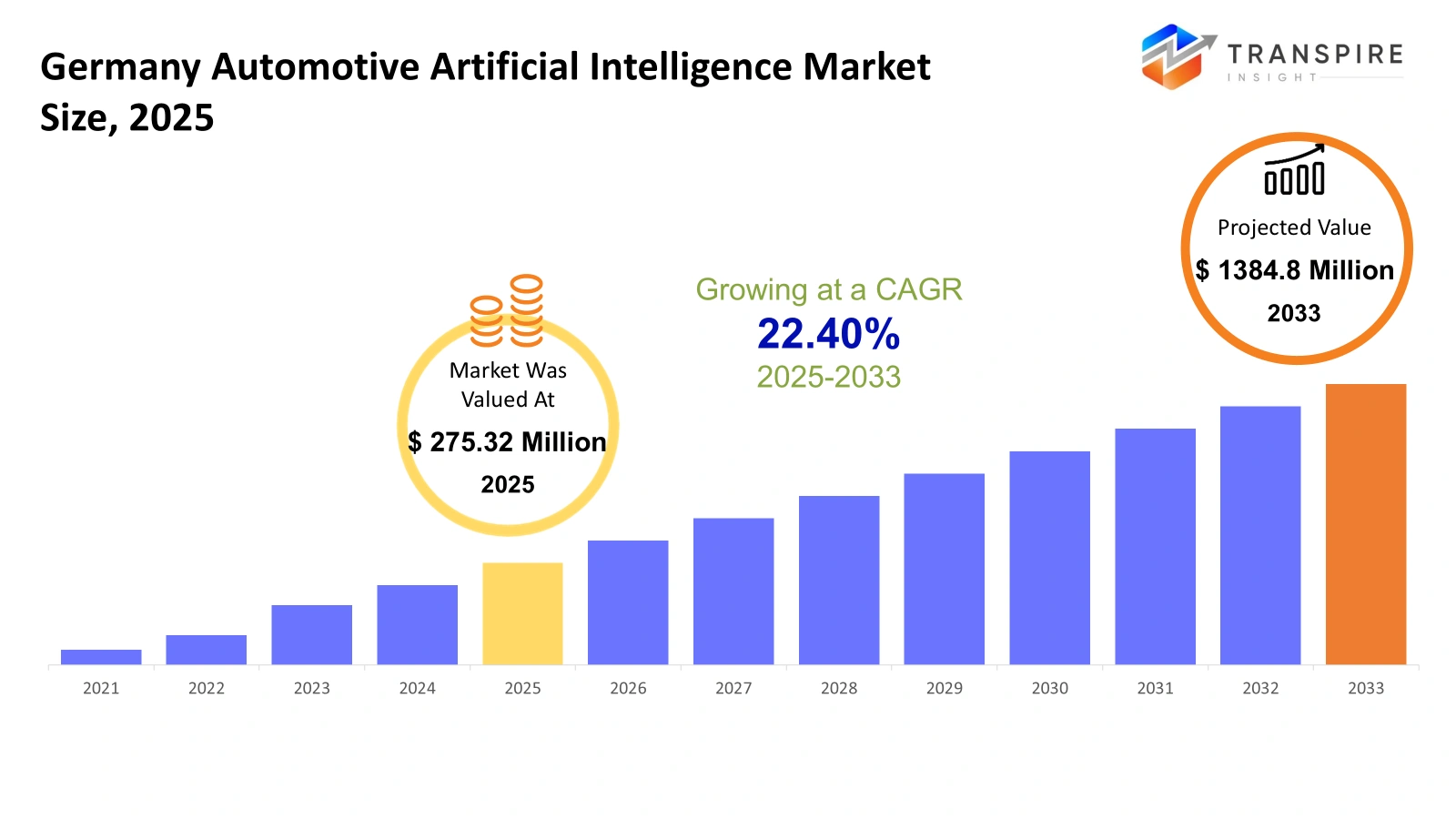
- Germany Automotive Artificial Intelligence Market Size 2025: USD 275.32 Million
- Germany Automotive Artificial Intelligence Market Size 2033: USD 1384.8 Million
- Germany Automotive Artificial Intelligence Market CAGR: 22.40%
- Germany Automotive Artificial Intelligence Market Segments: By Component (Hardware, Software, Services), By Application (Autonomous Driving, Driver Monitoring Systems, Predictive Maintenance, Voice Recognition), by Vehicle Type (Passenger Vehicles, Commercial Vehicles).
To learn more about this report,  Download Free Sample Report
Germany Automotive Artificial Intelligence Market Summary:
The Germany Automotive Artificial Intelligence Market size was estimated at USD 275.32 Millionin 2025 and is anticipated to reach USD 1384.8 Million by 2033, growing at a CAGR of 22.40% from 2026 to 2033.
The market for automotive artificial intelligence technology in Germany operates within the advanced automotive and mobility technology sector of the country, which will use digital systems to control vehicle design and testing and operational processes. Manufacturing companies and technology providers will develop intelligent vehicle systems that use data-based software to combine Germany's engineering heritage with modern data research methods. The automotive industry will use artificial intelligence to build vehicle systems that analyze large sensor data streams, which will enable vehicles to correctly understand road conditions and traffic patterns and driver actions. The market shows how German mobility demonstrations will evolve through the replacement of traditional mechanical skills with modern digital software solutions. Automakers will use machine learning models together with cloud-based systems to enhance driver assistance systems and predictive maintenance capabilities and digital cockpit functionalities. At the same time, German consumers will increasingly expect vehicles to deliver safer and more responsive driving support, personalized infotainment, and seamless connectivity with mobile devices and smart infrastructure.
The sector will experience directional changes because of new regulations and public demands for improved safety and automation and data protection standards. German authorities and European institutions will continue refining rules for automated driving functions, cybersecurity standards and the responsible handling of vehicle data which will lead manufacturers to invest more in trustworthy AI systems. Research partnerships between automotive firms and universities and software companies will expand as the demand for advanced algorithms and simulation platforms grows. The German automotive artificial intelligence market will therefore reflect a transition in the country’s mobility landscape which will establish intelligent software as an essential component of vehicle operations alongside traditional vehicle hardware. Artificial intelligence will enhance traffic management systems and vehicle performance prediction capabilities through its deployment in mobility services and electric vehicles and connected infrastructure. The upcoming change will transform German vehicle design and user experience by replacing existing mechanical systems with digitally controlled mobility systems that provide intelligent driver assistance and environmental awareness.
Key Market Trends & Insights:
- The market for automotive artificial intelligence in Germany demonstrates ongoing progress as automotive manufacturing plants adopt artificial intelligence technology. Advanced algorithms drive quality inspection processes and predictive maintenance efforts and robotic systems operate during assembly work. German automotive manufacturers increasingly rely on data-driven automation to improve manufacturing accuracy and decrease operational errors while maintaining consistent production standards.
- The German automotive artificial intelligence market develops further as autonomous driving technology and advanced driver assistance systems achieve faster technological progress. Artificial intelligence technology enables vehicles to understand road conditions while identifying obstacles that help drivers make safer choices. The strong engineering capabilities together with the ongoing testing programs throughout German automotive clusters drive the adoption of intelligent driving systems.
- The German automotive artificial intelligence market benefits from the increasing development of connected vehicles which transmit current data to digital systems. Artificial intelligence analyzes traffic conditions together with navigation information and vehicle operation data. The mobility networks in Germany adopt intelligent connectivity technologies to enhance route optimization and decrease traffic delays while improving driver performance.
- The German automotive artificial intelligence market experiences significant growth because of the fast expansion of electric vehicle manufacturing in Germany. Artificial intelligence supports battery management systems and energy usage tracking and charging station management. Automotive engineering teams utilize intelligent software models to evaluate battery performance while determining the maximum driving range and reliability of their vehicles.
- The Germany Automotive Artificial Intelligence Market shows increased collaboration between automotive manufacturers and software developers and research institutions. The organizations work together to develop intelligent mobility platforms and AI vehicle systems and data analysis solutions. The combination of German innovation programs with technology partnerships leads to faster development of artificial intelligence solutions for the automotive industry.
Germany Automotive Artificial Intelligence Market Segmentation
By Component :
- Hardware: Germany Automotive Artificial Intelligence Market will show strong demand for hardware as modern vehicles rely on physical computing units that process large volumes of driving data. Sensors, cameras, radar modules, and high-performance processors support machine learning functions within vehicles. Expansion of advanced driver assistance systems will increase hardware installation across production lines in Germany.
- Software: Germany Automotive Artificial Intelligence Market will see software as a central element that allows vehicle intelligence to operate efficiently. Software platforms manage algorithms for object detection, driving decision systems, and vehicle behavior analysis. Continuous updates will improve safety and performance. Automotive manufacturers in Germany will integrate specialized software to support data processing and smart vehicle control.
- Services: Germany Automotive Artificial Intelligence Market will experience growing need for services that support system design, implementation, and maintenance. Automotive companies will rely on technical consulting, integration support, and data management solutions to deploy artificial intelligence systems effectively. Service providers will assist manufacturers in optimizing vehicle intelligence platforms and ensuring smooth operation across different automotive technologies.
By Application :
- Autonomous Driving: Germany Automotive Artificial Intelligence Market will expand significantly in autonomous driving as artificial intelligence technologies analyze traffic data, road conditions, and surrounding vehicle movement. AI-enabled systems will support decision making and navigation without direct driver control. German automotive manufacturers will focus on developing reliable automated driving functions to improve safety and driving convenience.
- Driver Monitoring Systems: Germany Automotive Artificial Intelligence Market will grow in driver monitoring systems that track driver behavior and alertness through cameras and intelligent analysis. These systems will detect signs of fatigue, distraction, or unsafe driving patterns. Increasing road safety requirements in Germany will encourage integration of advanced monitoring technologies within modern vehicles.
- Predictive Maintenance: Germany Automotive Artificial Intelligence Market will gain importance in predictive maintenance as artificial intelligence analyzes vehicle performance data to identify potential component failures before breakdown occurs. Data from sensors and onboard diagnostics will support early detection of wear and operational issues. Automotive operators in Germany will use predictive insights to reduce repair costs and improve vehicle reliability.
- Voice Recognition: Germany Automotive Artificial Intelligence Market will benefit from voice recognition technologies that allow drivers to control vehicle functions through spoken commands. Artificial intelligence systems will process language input to operate navigation, climate settings, and entertainment systems. Growth of connected vehicles in Germany will increase demand for voice-enabled vehicle interfaces.
By Vehicle Type :
- Passenger Vehicles: Germany Automotive Artificial Intelligence Market will witness large adoption in passenger vehicles as automotive brands integrate intelligent driving systems and digital features for everyday mobility. Artificial intelligence will support safety assistance, navigation, and in-vehicle connectivity. Rising consumer interest in advanced technology will encourage manufacturers to expand AI features within passenger car models.
- Commercial Vehicles: Germany Automotive Artificial Intelligence Market will also grow in commercial vehicles where fleet efficiency and operational safety are important. Artificial intelligence systems will assist with route optimization, driver monitoring, and predictive maintenance for logistics vehicles. Transportation companies in Germany will adopt intelligent technologies to improve productivity and reduce operational risks.
Country Insights
Germany maintains its position as the top country in the global automotive industry through its combined advanced manufacturing facilities and its highly skilled engineering workforce. Research and development funding has led to increased use of artificial intelligence technology in vehicles which enables autonomous driving and predictive maintenance and smart mobility solutions. German automotive companies use advanced AI algorithms to enhance vehicle performance and safety through their ongoing development of new AI technologies. The country's regulatory framework together with government incentives provides support for automotive production to adopt AI technology while maintaining compliance with international safety and environmental regulations. German cities offer perfect locations to test AI-based transportation systems which include connected vehicles and advanced traffic management technologies. The existence of highly skilled software and hardware engineers in Germany has strengthened the country's ability to lead in automotive AI technology development.
Germany's automotive industry receives advantages from partnerships between car manufacturers and artificial intelligence solution providers. Organizations allocate resources to develop artificial intelligence software which enables them to track vehicles in real time and optimize routes and conduct predictive analysis. The initiatives create an integrated system which improves organizational performance while decreasing production interruptions. Factories now use artificial intelligence quality control systems to identify product defects which leads to improved operational efficiency. Artificial intelligence technology helps businesses understand customer patterns which leads to better vehicle customization and after-sales support. Germany has made AI-powered electric vehicle development a major priority because the country wants to achieve its sustainability goals and reduce greenhouse gas emissions. The cooperation between academic institutions and industrial research facilities leads to innovative developments which enable Germany to preserve its leadership position in conventional automotive technologies and AI-powered solutions. AI technology helps manufacturers achieve improved market agility and cost-effective operations through its ability to enhance supply chain management processes.
Recent Development News
AI Robotics & Automation in German Automotive Plants
Humanoid AI robots introduced into BMW production — Pilot projects at BMW’s Leipzig plant are integrating AI‑powered humanoid robots (“Physical AI”) to assist in complex manufacturing tasks — a notable shift toward advanced automation.
Industry faces headwinds but remains innovative — At the IAA Mobility show in Munich, analysts noted ongoing struggles for Germany’s automotive sector but also showcased a lineup of AI‑enabled technologies.
|
Report Metrics |
Details |
|
Market size value in 2025 |
USD 275.32 Million |
|
Market size value in 2026 |
USD 336.43 Million |
|
Revenue forecast in 2033 |
USD 1384.8 Million |
|
Growth rate |
CAGR of 22.40% from 2026 to 2033 |
|
Base year |
2025 |
|
Historical data |
2021 - 2024 |
|
Forecast period |
2026 - 2033 |
|
Report coverage |
Revenue forecast, competitive landscape, growth factors, and trends |
|
Country scope |
Germany |
|
Key company profiled |
NVIDIA Corporation, Intel Corporation, Mobileye, Tesla Inc., Waymo LLC, Robert Bosch GmbH, Continental AG, Aptiv PLC, Qualcomm Technologies, Baidu Apollo, Huawei Technologies, ZF Friedrichshafen, Valeo SA, Denso Corporation, Aurora Innovation. |
|
Customization scope |
Free report customization (country, regional & segment scope). Avail customized purchase options to meet your exact research needs. |
|
Report Segmentation |
by Component (Hardware, Software, Services),by Application (Autonomous Driving, Driver Monitoring Systems, Predictive Maintenance, Voice Recognition), by Vehicle Type (Passenger Vehicles, Commercial Vehicles) |
Key Germany Automotive Artificial Intelligence Company Insights
Germany leads vehicle innovation through its companies which develop both technology and software solutions which enable drivers to operate their vehicles in a smarter and safer manner. The traditional auto industry now leads the development of digital technologies which enable automated vehicle operation and precise vehicle diagnostics through their combination of traditional engineering methods and contemporary computer technologies which enhance operational efficiency and product quality. Companies spend money to develop sensor technology together with software systems and cloud computing infrastructure which enable them to create advanced control systems and navigation features and driver assistance systems. The local business environment has become more competitive through these advancements which have established Germany as a center for smart mobility research and development.
The BMW Group contributes significantly to the development of artificial intelligence capabilities which support automotive design processes and manufacturing operations and self-driving technology development. The research demonstrates that the company employs digital technologies to decrease development timelines while implementing machine learning across its operations and accelerating new product development. The method enables organizations to respond to market shifts while minimizing operational mistakes.
Volkswagen Group operates as a key force which develops digital technologies and intelligent vehicle systems through its work on cloud-based systems and artificial intelligence technologies for both manufacturing operations and vehicle functionalities. The organization develops strategic technology alliances which enable them to accelerate the implementation of automated systems and data-driven operational methods. These methods enhance product quality while decreasing expenses and enabling quick product development..
The Bosch Group supplies advanced vehicle components together with AI-based electronic systems which they distribute throughout their vehicle system operations. The company provides automated driving and predictive maintenance and smart production line solutions by combining its engineering expertise with software and sensor technology. Their research work focuses on enhancing safety features and extending product durability while improving performance capabilities of automotive systems.
Germany Automotive Artificial Intelligence Market Companies:
- NVIDIA Corporation
- Intel Corporation
- Mobileye
- Tesla Inc.
- Waymo LLC
- Robert Bosch GmbH
- Continental AG
- Aptiv PLC
- Qualcomm Technologies
- Baidu Apollo
- Huawei Technologies
- ZF Friedrichshafen
- Valeo SA
- Denso Corporation
- Aurora Innovation.
Germany Automotive Artificial Intelligence Market Segmentation
By Component
- Hardware
- Software
- Services
By Application
- Autonomous Driving
- Driver Monitoring Systems
- Predictive Maintenance
- Voice Recognition
By Vehicle Type
- Passenger Vehicles
- Commercial Vehicles
Frequently Asked Questions
Find quick answers to common questions.
The approximate Germany Automotive Artificial Intelligence Market size for the market will be USD 1384.8 Million in 2033.
Key segments for the Germany Automotive Artificial Intelligence market are by Component (Hardware, Software, Services),by Application (Autonomous Driving, Driver Monitoring Systems, Predictive Maintenance, Voice Recognition), by Vehicle Type (Passenger Vehicles, Commercial Vehicles).
Major Germany Automotive Artificial Intelligence market players NVIDIA Corporation, Intel Corporation, Mobileye, Tesla Inc., Waymo LLC, Robert Bosch GmbH, Continental AG, Aptiv PLC, Qualcomm Technologies, Baidu Apollo, Huawei Technologies, ZF Friedrichshafen, Valeo SA, Denso Corporation, Aurora Innovation.
The Germany Automotive Artificial Intelligence Market size is USD 275.32 Million in 2025.
The Germany Automotive Artificial Intelligence market CAGR is 22.40%.
- NVIDIA Corporation
- Intel Corporation
- Mobileye
- Tesla Inc.
- Waymo LLC
- Robert Bosch GmbH
- Continental AG
- Aptiv PLC
- Qualcomm Technologies
- Baidu Apollo
- Huawei Technologies
- ZF Friedrichshafen
- Valeo SA
- Denso Corporation
- Aurora Innovation.
Recently Published Reports
-
Apr 2026
ATV & UTV Market
ATV & UTV Market Size, Share & Analysis Report By Type (ATV, and UTV), By Variants (Less Than 400 CC, 400 CC To 800 CC, and More Than 800 CC), and Geography (North America, Europe, Asia-Pacific, Middle East and Africa, South and Central America), 2021 - 2031
-
Apr 2026
Automotive Central Gateway Module Market
Automotive Central Gateway Module Market Size, Share & Analysis Report By Type (Ethernet Central Gateway Module, CAN Central Gateway Module, LIN Central Gateway Module, and FlexRay), By Application (Powertrain Control, Body Control, Infotainment System, Advanced Driver Assistance Systems (ADAS), and Others), By End User (Passenger Vehicles, and Commercial Vehicles), and Geography (North America, Europe, Asia-Pacific, Middle East and Africa, South and Central America), 2021 - 2031
-
Apr 2026
Automotive Engine Oil Filter Market
Automotive Engine Oil Filter Market Size, Share & Analysis Report By Filter Type (Fuel Filter, Engine Oil Filter, Hydraulic Oil Filter, and Others), By Filter Media (Cellulose, Synthetic, and Micro), By Sales Channel (OEMs, and Aftermarket), By Vehicle Type (Passenger Cars, Light Commercial Vehicles, Heavy Duty Trucks, Buses and Coaches, and Off-road Vehicles), and Geography (North America, Europe, Asia-Pacific, Middle East and Africa, South and Central America), 2021 - 2031
-
Apr 2026
Automotive Parts Aluminium Die Casting Market
Automotive Parts Aluminium Die Casting Market Size, Share & Analysis Report By Production Process (Pressure Die Casting, Vacuum Die Casting, Squeeze Die Casting, Gravity Die Casting), By Application (Body Parts, Engine Parts, Transmission Parts, Battery And Related Components, Other Application Types), and Geography (North America, Europe, Asia-Pacific, Middle East and Africa, South and Central America), 2021 - 2031
Our Clients