
_in_Manufacturing_Market,_Forecast_to_2033.png)
Market Summary
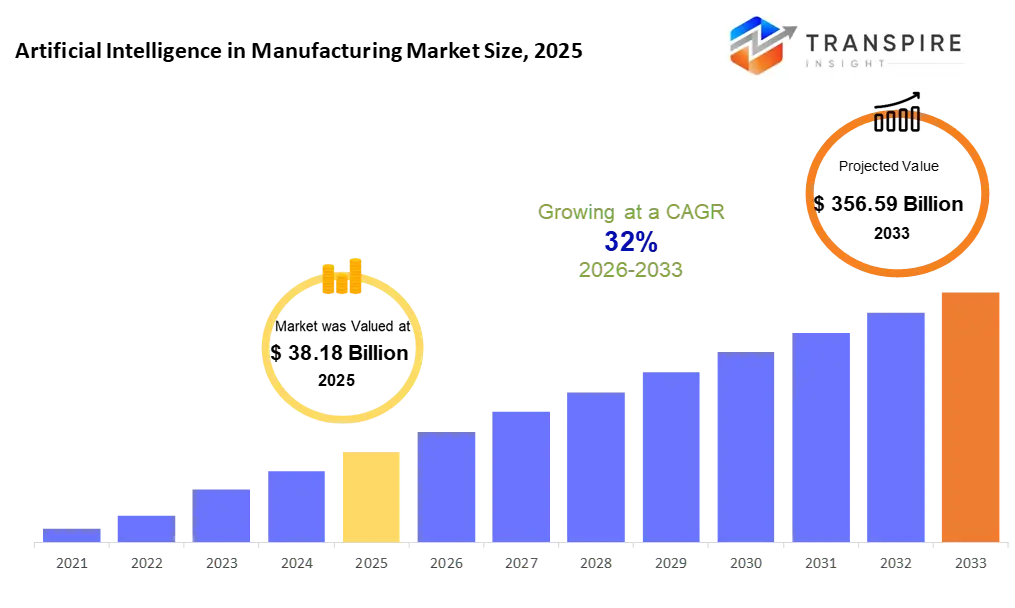
The global artificial intelligence (AI) in manufacturing market might hit $356.59 billion by 2033, thanks to faster automation and smarter factory setups. Machine learning, paired with computer vision or predictive tools, is changing how smoothly things get made - also boosting output quality. Real-time tracking pulls more interest now; robots are linking into systems more easily, while better supply chain control pushes growth even quicker.
Market Size & Forecast
- 2025 Market Size: USD 38.18 Billion
- 2033 Projected Market Size: USD 356.59 Billion
- CAGR (2026-2033): 32%
- North America: Largest Market in 2026
- Asia Pacific: Fastest Growing Market
Key Market Trends Analysis
- The North America AI in manufacturing market held the largest global share of 37.5% in 2026, due to increasing industrial automation and infrastructure.
- The U.S. AI in the manufacturing industry is expected to grow significantly from 2026 to 2033, supported by the growing use of robotics, predictive analytics, and smart factory investments.
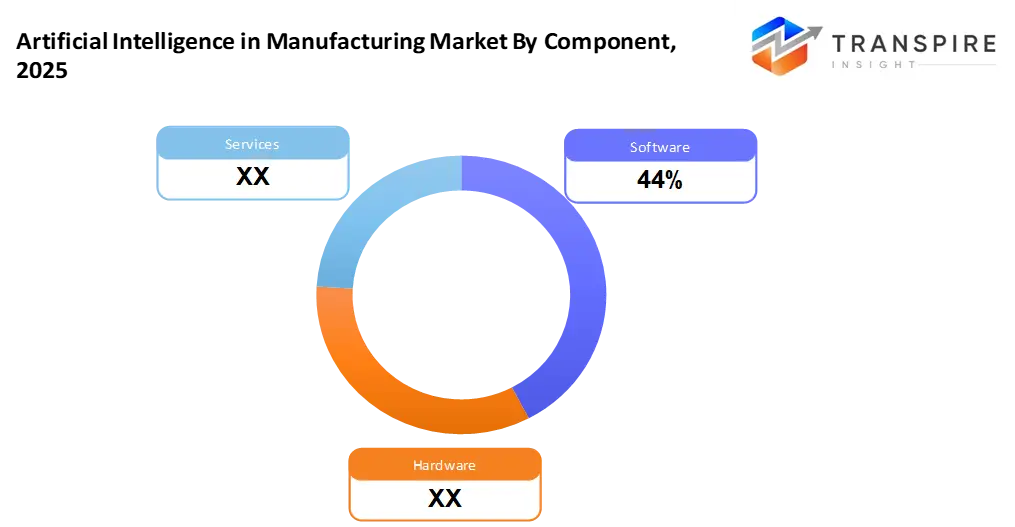
- By component type, the software segment held the highest market share of 47% in 2026, due to an enhancement in AI deployment and robotics.
- Within hardware, processors and sensors accounted for the dominant share in 2026, due to an enhancement in demand for AI devices and real-time monitoring systems.
- By application, predictive maintenance & machinery inspection dominated the market in 2026, used more due to the need to reduce downtime and analyze equipment performance.
- By end-user industry, the automotive sector held the highest market share in 2026, supported by AI automation and robotics.
- Asia-Pacific is expected to record the fastest growth from 2026 to 2033, led by China, Japan, and South Korea, due to increasing investment in AI and industrialization.
AI in manufacturing means machines acting smart like people, handling situations on their own, reacting to what’s happening around or inside them, sometimes even before it happens. In factories, this tech works through both computer systems and machinery setups, using tricks like deep learning or pattern recognition to make production smoother. It boosts how things run every day, not just cutting steps but also shaping how new products are built faster, getting them out quicker than rivals. Instead of real-world trials that take ages, simulated spaces let teams test ideas digitally, saving effort and hours. In the past, checking products meant long studies, different labs, or direct testing on-site. Now, artificial intelligence handles most steps without extra weight, cutting expenses while speeding up launch times.
AI use in factories is hitting record levels because companies can boost output, save money on daily costs, and also make better products. Firms across manufacturing now apply AI tools to fine-tune workflows, spot flaws using visual systems like vision.ai, avoid machine breakdowns through prediction tech, or streamline logistics behind the scenes. With sectors pushing hard toward digital plants and what's called Industry 4.0, artificial intelligence slips right into core tasks, quietly becoming standard gear.
The big plus of AI in factories. It speeds things up, cuts waste, while boosting how well stuff runs. Put simply, smart tech helps makers get further, work smarter, not harder. Firms building physical products, especially heavy industry players, find this a solid reason to jump in. Yet the examples shown reveal deeper wins when blending AI into modern plant setups.
The rise of AI in factories pushes standards up, productivity climbs, workflows get easier, and efficiency hits peak levels. On top of that, smart systems give companies an edge, meaning more plants will likely bring AI on board soon.
Artificial Intelligence (AI) in Manufacturing Market Segmentation
By Component
- Hardware
Factories use AI because tools, programs, and support work together so machines run on their own, info gets checked fast, or choices are smarter.
- Software
GPUs, CPUs, sensors plus cameras work together with edge tech to handle machine learning tasks - also help power live video checks along with instant data tracking.
- Services
Setting up, connecting, teaching staff, and also keeping systems updated matter more now - firms need help rolling out AI tools, plus growing them smoothly.
By Technology
- Machine Learning
The main tech behind predicting trends, watching machine condition, estimating needs, also running smart automated tasks.
- Computer Vision
Frequently used for spotting flaws, checking product standards, and confirming correct setups - also helps robots move accurately.
- Context Awareness
Fuels smart setups by checking how things run, while allowing real-time tweaks in manufacturing workflows.
- Natural Language Processing
Found in how people talk to machines, run equipment by speaking commands, and also handle paperwork automatically
By Application
- Material Movement
AI runs AMRs, also handling AGVs while boosting smart logistics so goods move smoothly through facilities.
- Predictive Maintenance & Machinery Inspection
A top AI tool spots problems early, so machines run smoothly while lasting longer thanks to fewer breakdowns.
- Production Planning
AI helps guess demand better, spread out resources wisely, set schedules smoothly, also streamline tasks - so everything runs faster.
- Field Services
Running checks from afar, helping fix machines when they act up - also spots issues before they grow. Works through smart alerts instead of waiting for breakdowns. Keeps the gear running without needing someone on-site every time.
- Quality Control & Reclamation
Computer vision plus machine learning spots flaws, keeps products uniform -so less waste piles up. That’s why this area’s expanding quickly.
- Others
Involves saving power, managing operations, tracking stock, also watching safety levels.
By End-Users
- Semiconductor & Electronics
A key user because of accurate production, checking chips, automated systems, also testing silicon wafers.
- Energy & Power
Runs power systems smarter with artificial smarts, fixes issues before they happen through smart guesses, also keeps plant work running smoothly using clever tech.
- Medical Devices
AI keeps things running smoothly, meets rules without hassle, and also boosts accuracy in making stuff.
- Automobile
Big chunk using AI in robots, plus putting things together automatically, also checking quality while running smart factories.
- Heavy Metal & Machine Manufacturing
Uses AI to track how machines run, while also automating welds. This helps tools last longer, but also makes things safer overall.
- Others
Fabric, eats, digging stuff from earth, also boxes all use smart tech to run smoother or keep better tabs.
Regional Insights
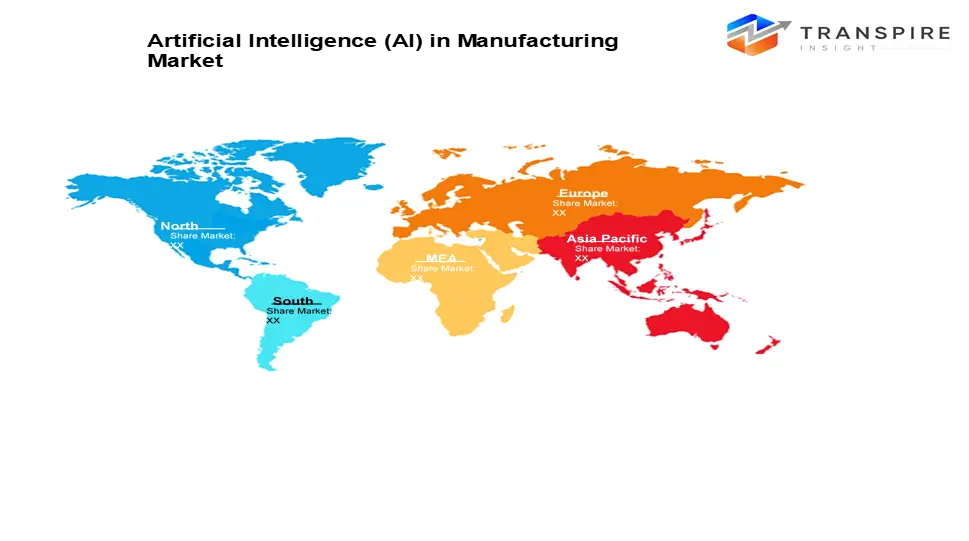
Right now, North America, along with Europe, leads in using AI for making things, thanks to jumping on Industry 4.0 early, spending big on machines that run themselves, and already having solid tech networks. The U.S., plus Canada, Germany, France, and the U.K. keep setting the pace because robots are everywhere, factories predict breakdowns before they happen, and smart systems check product quality nonstop. Out here, a few clear moves stand out. Edge AI is spreading fast, generative AI is getting baked into how products are designed, while digital twins are going mainstream in car-making, plane-building, and gadget production. These regions have highly regulated industries with strong R&D ecosystems, further accelerating the deployment of AI.
The fastest growth will come out of the APAC region, driven by rapid industrialization, large manufacturing bases, and smart factory initiatives with government support. China, Japan, and South Korea are the tier-1 markets, moving really fast in robotics, semiconductor production, and AI-enabled automation, while India, Taiwan, Singapore, Malaysia, and Vietnam are representative of the tier-2 countries that are rapidly adopting the use of AI for electronics assembly, automotive component manufacturing, and large-scale industrial automation. Key trends in APAC include an emerging increase in AI-integrated robotics, aggressive smart factory rollouts, and AI-driven supply chain optimization due to the presence of huge export-oriented manufacturing ecosystems.
The Middle East & Africa, along with South America, are stepping up as secondary hubs where factories and plants keep boosting tech use to work smarter. Driven by goals to upgrade systems, nations such as the UAE, Saudi Arabia, and Qatar pump funds into AI-powered automation, matching their wider plans for digital progress. Across Africa, companies are slowly bringing in artificial intelligence mainly for extracting minerals, generating power, or making everyday goods. Over in South America, especially backed by Brazil, Argentina, plus Chile, more businesses apply AI in car manufacturing, handling food products, and managing energy tasks. A clear shift shows that the push to use smart software helps maintain equipment, watch safety risks, and boost output stability even when budgets stay tight.
Recent Development News
- December 9, 2025 - Accenture and Anthropic launched multi-year partnerships to drive enterprise AI innovation and value across industries.(Source: Accenture Newsroom https://newsroom.accenture.com/news/2025/accenture-and-anthropic-launch-multi-year-partnership-to-drive-enterprise-ai-innovation-and-value-across-industries
- Mar 25, 2025 - HCLTech, a leading global technology company, announced the launch of HCLTech Insight, an agentic AI-powered Industry Focused Repeatable Solution (IFRS) designed to equip manufacturers with advanced data insights and analytics capabilities. (Source: HCLTech PR https://www.hcltech.com/press-releases/hcltech-launches-agentic-ai-powered-smart-manufacturing-solution-google-cloud)
- June 11, 2025 - Siemens and NVIDIA expand partnership to accelerate AI capabilities in manufacturing. (Nvidia news https://nvidianews.nvidia.com/news/siemens-and-nvidia-expand-partnership-to-accelerate-ai-capabilities-in-manufacturing
|
Report Metrics |
Details |
|
Market size value in 2025 |
USD 38.18 Billion |
|
Market size value in 2026 |
USD 50.40 Billion |
|
Revenue forecast in 2033 |
USD 356.59 Billion |
|
Growth rate |
CAGR of 32% from 2026 to 2033 |
|
Base year |
2025 |
|
Historical data |
2021 – 2024 |
|
Forecast period |
2026 – 2033 |
|
Report coverage |
Revenue forecast, competitive landscape, growth factors, and trends |
|
Regional scope |
North America; Europe; Asia Pacific; Latin America; Middle East & Africa |
|
Country scope |
U.S.; Canada; Mexico; UK; Germany; France; Italy; Spain; Denmark; Sweden; Norway; China; Japan; India; Australia; South Korea; Thailand; Brazil; Argentina; South Africa; Saudi Arabia; UAE |
|
Key company profiled |
IBM Corporation, Microsoft Corporation, Siemens AG, Alpha Software, NVIDIA, Intel, PTC, Autodesk, AWS, Schneider Electric, Rockwell, and Others. |
|
Customization scope |
Free report customization (country, regional & segment scope). Avail customized purchase options to meet your exact research needs. |
|
Report Segmentation |
By Type (Component, Hardware, Software, Services) By Technology (Machine Learning, Computer Vision, Context Awareness, Natural Language Processing) By Application (Material Movement, Predictive Maintenance & Machinery Inspection, Production Planning, Field Services, Quality Control & Reclamation, Others) By End Users (Semiconductor & Electronics, Energy & Power, Medical Devices, Automobile, Heavy Metal & Machine Manufacturing, Others) |
Key Artificial Intelligence (AI) in Manufacturing Company Insights
NVIDIA is widely regarded as a top company driving AI in manufacturing through its advanced AI hardware and software platforms that power digital twins, simulation, robotics, and factory automation. NVIDIA announced it is building the world’s first industrial AI cloud for European manufacturers. This Germany-based AI factory will feature 10,000 GPUs, including through NVIDIA DGX™ B200 systems and NVIDIA RTX PRO™ Servers, and enable Europe’s industrial leaders to accelerate every manufacturing application, from design, engineering, and simulation to factory digital twins and robotics. Announced that the nation’s leading manufacturers, industrial software developers, and robotics companies are using NVIDIA Omniverse™ technologies to build state-of-the-art robotic factories and new autonomous collaborative robots to help overcome labor shortages and drive American reindustrialization.
Key Artificial Intelligence (AI) in Manufacturing Companies:
- NVIDIA
- IBM Corporation
- Microsoft Corporation
- Siemens AG
- Alpha Software
- Intel
- PTC
- Autodesk
- AWS
- Schneider Electric
- Rockwell
Global Artificial Intelligence (AI) in Manufacturing Market Report Segmentation
By Component
- Hardware
- Software
- Services
By Technology
- Machine Learning
- Computer Vision
- Context Awareness
- Natural Language Processing
By Application
- Material Movement
- Predictive Maintenance & Machinery Inspection
- Production Planning
- Field Services
- Quality Control & Reclamation
- Others
By End-Users
- Semiconductor & Electronics
- Energy & Power
- Medical Devices
- Automobile
- Heavy Metal & Machine Manufacturing
- Others
Regional Outlook
- North America
- U.S.
- Canada
- Europe
- Germany
- U.K.
- France
- Spain
- Italy
- Rest of Europe
- Asia Pacific
- Japan
- China
- Australia & New Zealand
- South Korea
- India
- Rest of Asia Pacific
- Latin America
- Brazil
- Mexico
- Rest of Latin America
- Middle East & Africa
- GCC
- South Africa
- Rest of the Middle East & Africa
Frequently Asked Questions
Find quick answers to common questions.
The Artificial Intelligence (AI) in the Manufacturing Market size was estimated at USD 38.18 Billion in 2025 and is expected to reach USD 356.59 Billi
Some key players operating in the Artificial Intelligence (AI) in the Manufacturing Market include NVIDIA, IBM Corporation, Microsoft Corporation, Sie
Key factors that are driving the market growth include rising prevalence of AI initiatives, increasing market demand, advanced structure.
North America is holding largest market share however Asia pacific market is fastest growing market currently.
Considering technology segmentation Software gains maximum market share of 44% including GPUs, CPUs, sensors plus cameras work together.
- NVIDIA
- IBM Corporation
- Microsoft Corporation
- Siemens AG
- Alpha Software
- Intel
- PTC
- Autodesk
- AWS
- Schneider Electric
- Rockwell
Recently Published Reports
-
Apr 2026
3D Optical Profiler Market
3D Optical Profiler Market Size, Share & Analysis Report By Type (Desktop 3D Optical Profiler, and Portable 3D Optical Profiler), By Technology (Confocal Technology, and White Light Interference), By End-Use Industry (Manufacturing, Research Institutions, Automotive, Aerospace and Defense, Medical Devices, and Other), and Geography (North America, Europe, Asia-Pacific, Middle East and Africa, South and Central America), 2021 - 2031
-
Apr 2026
Depth Sensor Market
Depth Sensor Market Size, Share & Analysis Report By Type (Infrared Depth Sensors, Time-of-Flight (ToF) Sensors, Stereo Vision Sensors, Structured Light Sensors, Ultrasonic Depth Sensors), By Application (Automotive, Robotics, Gaming, Consumer Electronics, Industrial Automation, Healthcare, Security & Surveillance, Others), By End Users (Automotive Manufacturers, Consumer Electronics Companies, Healthcare Providers, Industrial Companies, Security Agencies, Gaming Companies, Robotics Companies, Others), and Geography (North America, Europe, Asia-Pacific, Middle East and Africa, South and Central America), 2021 – 2031
-
Apr 2026
Digital Manufacturing Market
Digital Manufacturing Market Size, Share & Analysis Report By Component (Hardware, Software, and Services), By Technology (Robotics, 3D Printing, Internet of Things (IoT), and Others), By Application (Automotive and Transportation, Aerospace and Defense, Consumer Electronics, Industrial Machinery, and Others), By Process Type (Computer-Based Designing, Computer-Based Simulation, Computer 3D Visualization, Analytics, and Others), and Geography (North America, Europe, Asia-Pacific, Middle East and Africa, South and Central America), 2021 – 2031
-
Apr 2026
Digital Visa Services Market
Digital Visa Services Market Size, Share & Analysis Report By Type (Individual Travelers, Group Travelers), By Application (Tourism, Business Travel, Others), and Geography (North America, Europe, Asia-Pacific, Middle East and Africa, South and Central America), 2021 – 2031