
South Korea Wireless EV Charging Market Size & Forecast:
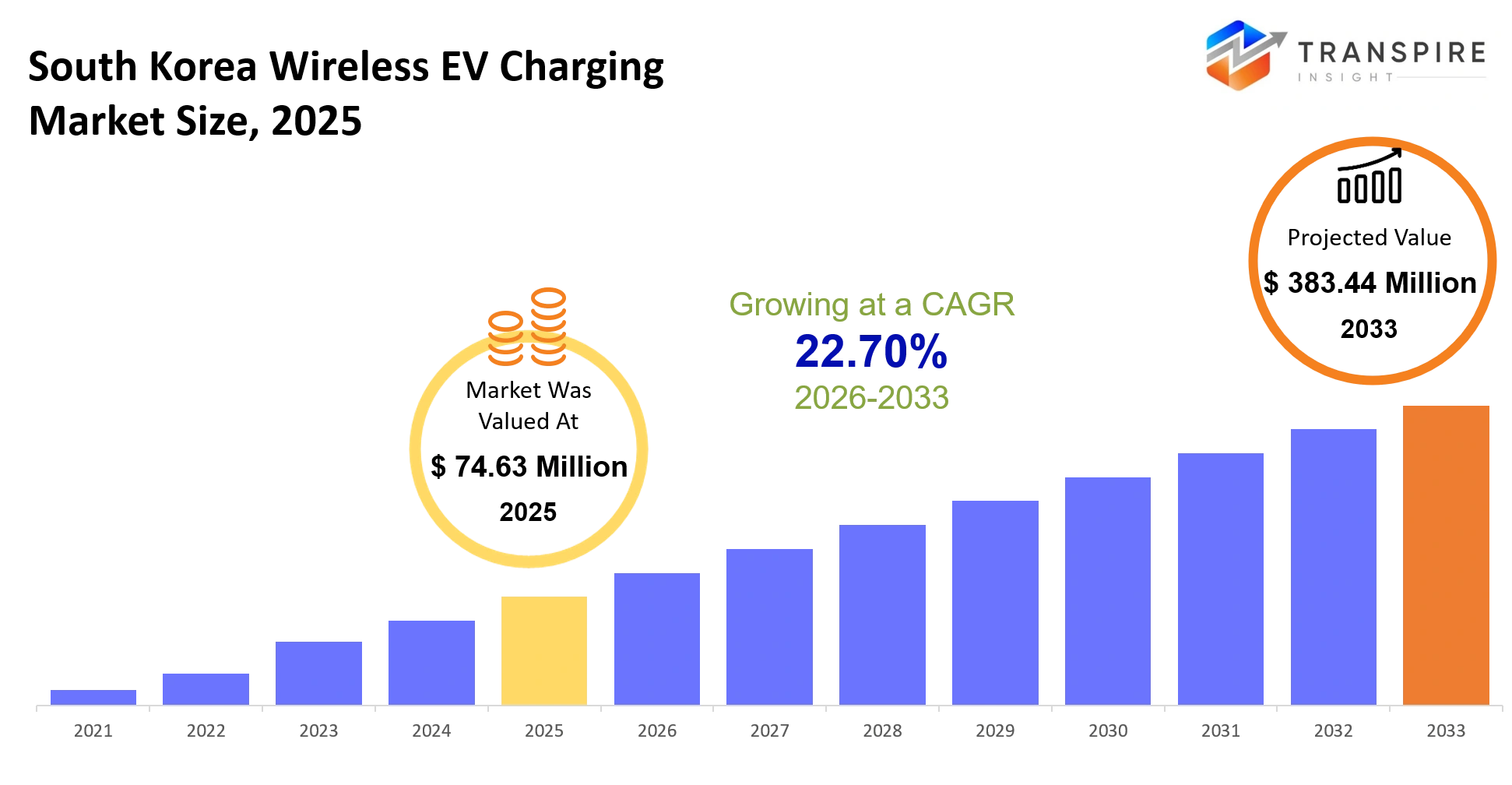
- South Korea Wireless EV Charging Market Size 2025: USD 74.63 Million
- South Korea Wireless EV Charging Market Size 2033: USD 383.44 Million
- South Korea Wireless EV Charging Market CAGR: 22.70%
- South Korea Wireless EV Charging Market Segments: By Charging Type (Static Wireless Charging, Dynamic Wireless Charging, Others); By Vehicle Type (Passenger EVs, Commercial EVs, Buses, Others); By Power Range (Below 11 kW, 11-50 kW, Above 50 kW, Others)
To learn more about this report,  Download Free Sample Report
South Korea Wireless EV Charging Market Summary
The South Korea Wireless EV Charging Market was valued at USD 74.63 Millionin 2025. It is forecast to reach USD 383.44 million by 2033. That is a CAGR of 22.70% over the period.
The South Korean wireless EV charging market is mostly about having to handle a pretty real-world problem in electric mobility: charging downtime, and that kind of annoying infrastructure inconvenience. Wireless charging systems let electric vehicles recharge automatically while they're parked, or in some limited pilot cases while moving, which reduces cables and can improve operational efficiency for fleets, public transit operators, and city-based mobility networks. This capability has started feeling a lot more important in dense urban areas, where getting to charging points and managing space really decides if EVs are actually workable.
Over the last few years, the whole market mood shifted from small deployments that were almost like experiments toward weaving wireless charging into smart transportation infrastructure and public transport. Carbon neutrality targets backed by the government, plus funding that’s going into intelligent road infrastructure, have helped push that change along. During COVID 19, and even afterward, semiconductor supply disruptions also showed up, so automakers and charging providers started looking more seriously at localizing technology partnerships and tightening domestic supply chains. Since EV adoption is still climbing for commercial fleets and public buses, wireless charging is slowly turning into a strategic infrastructure play, not just a convenience add-on but something aimed at boosting vehicle utilization rates, lowering day-to-day service tasks, and making energy management models feel more predictable.
Key Market Insights
- The South Korea Wireless EV Charging Market is going through this pretty fast transformation, mostly because EV adoption keeps expanding.
- Smart mobility investments are rising, and the government keeps pushing carbon neutrality initiatives.
- Overall, the market is expected to show solid forecast growth through 2032, with more wireless infrastructure being rolled out across public transportation routes and commercial fleet networks, all that, basically.
- The South Korea Wireless EV Charging Market seems to benefit a lot from advanced automotive manufacturing capabilities, plus nationwide investments into intelligent transportation systems since 2021.
- The Seoul metropolitan region dominated the South Korea Wireless EV Charging Market, holding nearly 42% market share in 2025, mainly due to dense EV infrastructure deployment and that kind of ready-to-go coverage.
- Busan is showing up as the fastest-growing regional market through 2032, pushed by smart port mobility projects and public electric bus electrification programs.
- Static wireless charging accounted for about 58% share in 2025, mainly because commercial deployment is comparatively easier, and infrastructure integration complexity stays lower.
- Dynamic wireless charging is the fastest-growing segment during the forecast period, as pilot smart road projects keep expanding across urban transit corridors.
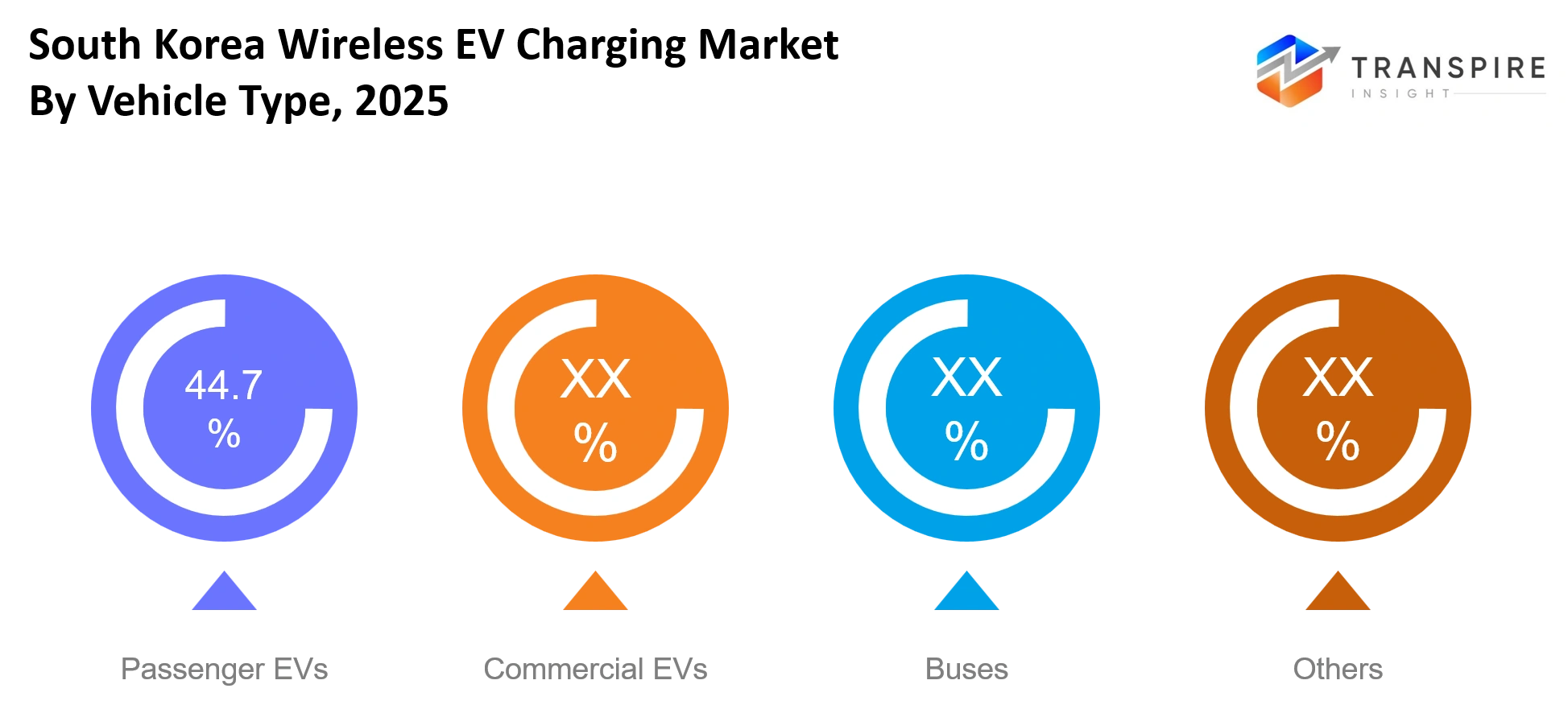
- Passenger EVs dominated the vehicle segment, with almost 48% revenue share in 2025, driven by increasing premium EV ownership and the convenience of day-to-day charging in cities.
- Commercial EV fleets are seeing the quickest progress because operational efficiency keeps improving and downtime drops in logistics, delivery, and related applications.
What are the Key Drivers, Restraints, and Opportunities in the South Korea Wireless EV Charging Market?
Really pushing the South Korea Wireless EV ChargingMarket forward is the government’s rather aggressive drive toward smart mobility infrastructure and transport electrification. In South Korea, that carbon neutrality roadmap happens alongside municipal investments in electric bus systems and these autonomous vehicle corridors, and it basically builds a solid business rationale for wireless charging rollout. As time goes on, transit operators and logistics companies are seeing wireless charging more like a productivity tool—not just an energy answer—since it cuts down on the manual plug-in downtime, and it also boosts fleet utilization rates. This shift directly supports higher infrastructure spending and long-term service revenue opportunities for charging technology providers.
The high infrastructure integration cost remains associated with wireless charging systems. Unlike regular plug-in chargers, wireless systems do need embedded ground infrastructure, some kind of grid upgrades, and also a sort of interoperability validation across different vehicle platforms. Those limitations are kinda structural, because they ride on urban planning cycles, public infrastructure budgets, and standardization agreements between automakers and the technology suppliers. In practice, i t’s less about the gadget and more about the whole civic setup, with long lead times and coordination that can be… painful sometimes. Ride upgrades and interoperability validation across vehicle platforms. These limitations are structural because they depend on urban planning cycles, public infrastructure budgets, and standardization agreements between automakers and technology suppliers. As a result, deployment timelines remain longer, particularly outside major metropolitan pilot zones, limiting broader commercial adoption and delaying revenue realization.
It is emerging through dynamic wireless charging integration for public transportation and autonomous mobility applications. South Korea’s investment in intelligent road infrastructure and connected city programs is creating favorable conditions for embedded charging lanes in high-density urban corridors. Pilot projects with electric buses and automated delivery vehicles are showing, in a kind of ongoing way, how continuous charging can shrink battery size needs and also boost day-to-day vehicle operating efficiency. This shift might open a newer phase of infrastructure investment, and some recurring, platform-led revenue models across the mobility ecosystem, too.
What Has the Impact of Artificial Intelligence Been on the South Korea Wireless EV Charging Market?
Artificial intelligence, and other advanced digital technologies are slowly (and kind of dramatically) reshaping the South Korean wireless EV charging ecosystem, mostly through improved charging efficiency,y more dependable infrastructure, and tighter grid coordination. Charging platform operators are starting to roll out AI-enabled energy management systems, which sort of automatically steer electricity loads across many charging points, based on what vehicles request the battery state, and also what the grid can actually spare at that moment. In practice, it can reduce peak electricity prices, and it makes station usage feel steadier in busy urban areas, where the fight for power is pretty much constant.
At the same time, machine learning models are being placed into predictive maintenance platforms that include wireless charging pads, power converters, and even battery communication systems. Operators scan live thermal readings, charging alignment patterns, and power transfer efficiency, to notice slow performance decline before any real failure shows up. This kind of foresight keeps the infrastructure active longer, and it reduces downtime caused by maintenance events, which is especially important for fleet operators and for public transit networks. In a few pilot deployments, AI-assisted charging optimization actually improved energy usage and lowered charging interruptions, mainly because scheduling became more precise and less “guessy” than earlier attempts.
On top of that, advanced digital twins together with connected mobility platforms are backing autonomous vehicle charging trials and flexible wireless charging corridors. Still, AI adoption is not all smooth sailing; there are real constraints, like expensive system integration work and insufficient real-world operating data for truly dynamic charging arrangements.
Key Market Trends
- Since 2022, a bunch of municipal transit agencies, you know they started pushing wireless charging pilot deployments for electric buses, sort of to ease depot congestion a bit and also improve fleet turnaround. It’s like the concept was, faster rotation with less hassle, more or less.
- South Korean automakers also tilted investment toward integrated wireless charging platforms, mainly because autonomous vehicle development got commercial priority after 2021, and you could argue that made the overall charging stack feel more urgent, kinda right away.
- Then the dynamic wireless charging projects, which used to stay mostly in research trials, moved into urban roadway demonstrations, especially across Seoul and Busan smart mobility corridors. It sounds practical now, more “in-the-wild,” instead of being stuck in labs.
- In 2021 and 2022, there were semiconductor supply disruptions, so charging technology providers ended up localizing component sourcing and strengthening domestic supplier alliances, instead of just relying on whoever had inventory at the moment.
- Fleet operators were, more and more, leaning toward automated charging systems because the plug-in approach is kinda labor-heavy, and it can generate operational delays, especially in high-frequency delivery networks where every minute counts, like really.
- Also, AI-enabled charging management platforms helped with energy distribution efficiency by optimizing charging schedules based on grid load changes and fleet usage patterns, kind of like tuning the timing constantly.
- Companies such as WiTricity and Electreon expanded collaborations with Asian mobility providers to commercialize dynamic charging infrastructure, and those partnerships widened as demand grew.
- Since 2023, wireless charging systems above 50 kW have gained traction in public transport uses that need rapid charging cycles continuously.
South Korea Wireless EV Charging Market Segmentation
By Charging Type
Static wireless charging held onto the market pretty tightly, mostly because city operators, charging stations, residential complexes, and commercial parking managers seemed to like practical choices and also lower-risk rollout. The energy transfer stayed stable, installation felt easier than some more advanced approaches, and overall compatibility with passenger EVs seemed to help it spread through metro areas. Automotive makers, plus charging technology suppliers, were also busy building partnerships, trying to sync charging systems better, and push improved energy efficiency. Meanwhile, public transport authorities kept expanding pilot efforts for static charging, in particular inside electric taxi and shuttle vehicle networks.
Dynamic wireless charging actually pulled in more attention over the last few years, since smart mobility programs slowly moved from research into controlled roadway deployments. Funding for intelligent transport infrastructure in Seoul and Busan helped nudge trials for embedded charging lanes, including arrangements for buses, and for autonomous mobility services too. Commercial partners got more involved, since ongoing charging meant less vehicle downtime, and it supported longer operating cycles. For other charging technologies, they remained kind of on the sidelines, largely because infrastructure costs were higher, and also because commercial readiness was weaker when compared with the wireless systems that are already well established.
By Vehicle Type
Passenger electric vehicles triggered a lot of deployment activity, mostly because city consumers liked a convenient charging experience, without having to deal with manual cable handling, which is honestly kinda tedious. Some premium electric vehicle brands went further and made wireless charging compatibility part of their advanced mobility platforms, too, as a way to strengthen their product positioning. Apartment complexes, office buildings, and retail parking operators went along with it, helping the installation growth so they could attract electric vehicle users. At the same time, expanding smart parking infrastructure supported even stronger adoption inhigh-densityy urban areas, where space is tight, and expectations are high.
On the commercial side, electric vehicles saw quicker infrastructure planning because logistics operators kept pushing to reduce charging delays and boost operational efficiency. Delivery networks and fleet operators increased their investment in automated charging solutions for more predictable route management and less labor dependency. Electric buses also opened up big deployment opportunities, driven by municipal transportation electrification programs and public transit modernization projects. Other vehicle categories stayed at smaller participation levels, mainly because wireless charging integration was still pretty limited, outside those core transportation use cases.
To learn more about this report, Download Free Sample Report
By Power Range
Below 11 kW charging systems got a lot of traction across residential and semi-commercial settings, because the setup was less of a hassle, so expansion could happen faster. Some property developers and parking lot operators leaned toward moderate capacity options for nighttime charging and for everyday commuting patterns. At the same time, energy management systems helped keep things steady inside the existing grid infrastructure, not just in theory, but in daily operation too. People generally liked solutions that were practical and cost-controlled, and that kind of arrangement just kept this slice visible in the market.
Then the 11 to 50 kW segment pulled in more commercial attention over time because the middle-tier charging setups offered a decent charging pace, while still keeping infrastructure spending within reason. Once you look past 50 kW, wireless charging technology showed up more often in electric bus depots, logistics centers, and other high-utilization transport operations where turnaround needs to be quick. In those cases, better thermal management and AI-guided power optimization made higher capacity installations run more efficiently. The other power brackets kinda stayed more niche, largely because they fit fewer scenarios, and operating costs can end up higher as well.
What are the Key Use Cases Driving the South Korea Wireless EV Charging Market?
Passenger electric vehicles still feel like the main use case for wireless charging systems across South Korea, mostly because urban drivers want quick, hassle-free charging right where they live and work, like in residential towers, office complexes, and commercial parking areas. So yeah, property developers and retail operators have been rolling out wireless charging pads more and more, partly to support premium mobility services and also to reduce cable management pain in super-packed city settings.
At the same time, commercial fleet work and public transportation networks are widening adoption too, especially for logistics and transit-related deployments. Delivery vehicle operators are turning to automated charging systems to cut down idle time and keep their schedules more predictable. Municipal bus authorities are also pushing out high-capacity wireless charging infrastructure inside depots and along transit corridors. Smart city efforts in Seoul and Busan keep throwing support behind it via connected mobility funding and other investment tracks.
Then there are newer, almost “future-leaning” situations like autonomous shuttles, robotic delivery vehicles, and dynamic roadway charging systems, which could end up with longer-term commercial worth. Technology providers and automotive manufacturers are testing embedded charging lanes so vehicles can recharge while moving, mainly in controlled urban mobility zones and in intelligent transport infrastructure programs.
|
Report Metrics |
Details |
|
Market size value in 2025 |
USD 74.63 Million |
|
Market size value in 2026 |
USD 91.57 Million |
|
Revenue forecast in 2033 |
USD 383.44 Million |
|
Growth rate |
CAGR of 22.70% from 2026 to 2033 |
|
Base year |
2025 |
|
Historical data |
2021 - 2024 |
|
Forecast period |
2026 - 2033 |
|
Report coverage |
Revenue forecast, competitive landscape, growth factors, and trends |
|
Regional scope |
South Korea |
|
Key company profiled |
WiTricity, Qualcomm Halo, Electreon, Plugless, Siemens, ABB, Tesla, Hyundai Mobis, Denso, Toshiba, HEVO, InductEV, Momentum Dynamics, TGOOD, Delta Electronics |
|
Customization scope |
Free report customization (country, regional & segment scope). Avail customized purchase options to meet your exact research needs. |
|
Report Segmentation |
By Charging Type (Static Wireless Charging, Dynamic Wireless Charging, Others); By Vehicle Type (Passenger EVs, Commercial EVs, Buses, Others); By Power Range (Below 11 kW, 11-50 kW, Above 50 kW, Others) |
Which Regions are Driving the South Korea Wireless EV Charging Market Growth?
Seoul metropolitan region keeps leading the market, mostly because national smart mobility policies and a pretty solid digital infrastructure made everything kinda ready for large-scale wireless charging to roll out. There are high levels of electric vehicle ownership, plus dense urban development and a fair amount of public money flowing into intelligent transport systems, so infrastructure gets integrated a lot faster than in other regions. On top of that, major automakers, battery suppliers,s and charging technology developers stay actively present around the capital area, kind of building an integrated innovation ecosystem that keeps moving. Public transit electrification work, and also premium residential developments, helped wireless charging get adopted faster across Seoul and nearby urban districts.
Busan sits as the second largest regional contributor, but the development path is a little different; it’s more about logistics efficiency and commercial transportation networks than day-to-day residential mobility demand . Port-connected freight operations and the expansion of electric delivery vehicle fleets generated relatively stable demand for automated charging infrastructure across industrial areas and logistics corridors. Municipal investment in transport modernization keeps showing up, and the connected mobility planning adds long-term stability to the grid of infrastructure. Big commercial vehicle activity, together with dependable public-private infrastructure partnerships, keeps supporting steady revenue generation across the regional market.
Incheon is kinda emerging as one of the fastest-growing regions, mostly because smart city infrastructure projects kept expanding, and also these airport-linked autonomous mobility initiatives, somehow. The local authorities sped up their investment in connected transport systems and e-mass transit, after 2023, not only for growth but to boost sustainable urban mobility capabilities too. There were also wireless charging pilot programs for autonomous shuttles and logistics vehicles, plus electric buses, which opened new chances for infrastructure providers and mobility tech companies. With solid policy alignment and transportation modernization programs growing at the same time, Incheon should probably end up as an appealing investment destination for fresh market entrants between 2026 and 2033.
Who are the Key Players in the South Korea Wireless EV Charging Market and How Do They Compete?
Competition in the South Korea wireless EV charging industry stays fairly concentrated, mostly because building infrastructure needs real engineering capability, vehicle integration know-how, and also some long-term cooperation with public sector groups, which kind of forces everyone to play in a limited space. In practice, tech performance and interoperability standards now push competitive positioning way more than price alone, and honestly, that feels a bit counterintuitive at first, like you’d expect the usual cost angle to dominate. At the same time, established automotive suppliers and energy technology firms keep defending share through research partnerships and proprietary charging platforms, while newer charging specialists often chase pilot mobility programs, plus tighter smart infrastructure integration, and it shows in how quickly they can prove reliability.
Pressure has also increased recently, because municipalities and fleet operators want systems that can actually scale, with dependable energy transfer efficiency, and less maintenance overhead, so operators do not end up spending most of their time fixing everything instead of running.WiTricity tends to lean hard on intellectual property licensing and magnetic resonance charging technology, so it feels differentiated mainly because it can work across multiple automotive platforms, rather than being stuck in one ecosystem. Through strategic collaborations with vehicle manufacturers and component suppliers it can gain wider adoption without having to directly carry the infrastructure ownership responsibilities. Hyundai Mobis, meanwhile, strengthens its edge via integrated wireless charging modules that are designed for advanced electric mobility platforms and even autonomous vehicle scenarios. Its strong domestic manufacturing capability, plus close relationships with South Korean automakers, also help speed up commercialization for local transport programs.
Electreon kinda does things differently, with dynamic wireless charging setups made for uninterrupted charging while a vehicle is moving, most of the time aimed at public transport corridors. There are pilot roadway deployments, plus transit-centered infrastructure efforts that help them land earlier in smart city mobility programs, you know. ABB then leans on grid integration know-how, alongside energy management software, and also high-capacity charging infrastructure that fits commercial fleet environments really well. Siemens, meanwhile, grows its presence via intelligent transportation partnerships and digital infrastructure solutions that link the charging systems to wider smart mobility networks and urban energy management platforms, too, basically.
Company List
- WiTricity
- Qualcomm Halo
- Electreon
- Plugless
- Siemens
- ABB
- Tesla
- Hyundai Mobis
- Denso
- Toshiba
- HEVO
- InductEV
- Momentum Dynamics
- TGOOD
- Delta Electronics
Recent Development News
"In December 2025, Hyundai Motor announced expansion of its plug-and-charge EV charging network across South Korea through partnerships with 12 domestic charging operators. The project will increase PnC-enabled chargers to more than 1,500 units by 2026, strengthening automated charging infrastructure and improving nationwide EV charging accessibility.https://en.yna.co.kr
What Strategic Insights Define the Future of the South Korean Wireless EV Charging Market?
South Korea's wireless EV charging is slowly but surely sliding into a deeper union with intelligent transportation infrastructure, not really staying as some sort of lone charging tech slice; it feels more blended than before. In the next five to seven years, you can probably expect the biggest growth to show up inside connected urban mobility ecosystems where wireless charging, autonomous transport, AI-based energy control, and smart grid coordination are all kind of running together, like one platform. Government spending on digital infrastructure and public transport electrification will keep pushing this structural change, especially across those metropolitan smart city programs.
There’s also a quieter worry, more like technology fragmentation and interoperability headaches across automotive makers, charging infrastructure providers, and the different software platforms. If competing wireless charging standards keep popping up, it could make commercial scaling slower and raise the costs to rip and replace parts of the infrastructure later on, mainly if industry standardization drags out for too long. On top of that, leaning on imported semiconductors and power electronics brings longer-term supply chain exposure, particularly when geopolitical instability shows up, plus all the disruptions that come with it.
Still, there’s a new angle worth watching. Dynamic wireless charging corridors for autonomous logistics vehicles and electric public transportation fleets are starting to take shape, for example, around Incheon and Busan. Industry players should lean into partnerships with municipal authorities, energy utilities, and mobility software developers, since integrated infrastructure ecosystems will likely translate into more durable competitive strength than just expanding hardware on its own.
South Korea Wireless EV Charging Market Report Segmentation
-
By Charging Type
- Static Wireless Charging
- Dynamic Wireless Charging
- Others
-
By Vehicle Type
- Passenger EVs
- Commercial EVs
- Buses
- Others
-
By Power Range
- Below 11 kW
- 11–50 kW
- Above 50 kW
- Others
Frequently Asked Questions
Find quick answers to common questions.
The expected South Korea Wireless EV Charging Market size for the market will be USD 383.44 Million in 2033.
By Charging Type (Static Wireless Charging, Dynamic Wireless Charging, Others); By Vehicle Type (Passenger EVs, Commercial EVs, Buses, Others); By Power Range (Below 11 kW, 11-50 kW, Above 50 kW, Others)
Major South Korea Wireless EV Charging Market players are WiTricity, Qualcomm Halo, Electreon, Plugless, Siemens, ABB, Tesla, Hyundai Mobis, Denso, Toshiba, HEVO, InductEV, Momentum Dynamics, TGOOD, and Delta Electronics.
The South Korea Wireless EV Charging Market size is USD 74.63 Million in 2025.
The South Korea Wireless EV Charging Market CAGR is 22.70% from 2026 to 2033.
- WiTricity
- Qualcomm Halo
- Electreon
- Plugless
- Siemens
- ABB
- Tesla
- Hyundai Mobis
- Denso
- Toshiba
- HEVO
- InductEV
- Momentum Dynamics
- TGOOD
- Delta Electronics
About the Authors

Mayur Shinde
I am Mayur Shinde, a Senior Research Analyst at Transpire Insight, specializing in the Automotive & Transportation and Information & Communication Technology (ICT) Industry. My work focuses on analyzing emerging market trends, technological advancements, competitive landscapes, and industry developments to deliver accurate, data-driven insights. I am passionate about transforming complex market information into clear, actionable content that helps businesses, professionals, and decision-makers stay informed and make confident strategic decisions.

Chakradhar Khansole
Chakradhar serves as the Research Director at Transpire Insight, bringing over 8 years of experience in technology, innovation, and strategic market intelligence. He specializes in transforming complex market data into actionable business insights that enable organizations to make informed, growth-oriented decisions. Recognized for his strategic vision and analytical expertise, Chakradhar leads high-impact research initiatives, delivering comprehensive market assessments, competitive intelligence, and forward-looking industry analysis.
Recently Published Reports
-
Apr 2026
ATV & UTV Market
ATV & UTV Market Size, Share & Analysis Report By Type (ATV, and UTV), By Variants (Less Than 400 CC, 400 CC To 800 CC, and More Than 800 CC), and Geography (North America, Europe, Asia-Pacific, Middle East and Africa, South and Central America), 2021 - 2031
-
Apr 2026
Automotive Central Gateway Module Market
Automotive Central Gateway Module Market Size, Share & Analysis Report By Type (Ethernet Central Gateway Module, CAN Central Gateway Module, LIN Central Gateway Module, and FlexRay), By Application (Powertrain Control, Body Control, Infotainment System, Advanced Driver Assistance Systems (ADAS), and Others), By End User (Passenger Vehicles, and Commercial Vehicles), and Geography (North America, Europe, Asia-Pacific, Middle East and Africa, South and Central America), 2021 - 2031
-
Apr 2026
Automotive Engine Oil Filter Market
Automotive Engine Oil Filter Market Size, Share & Analysis Report By Filter Type (Fuel Filter, Engine Oil Filter, Hydraulic Oil Filter, and Others), By Filter Media (Cellulose, Synthetic, and Micro), By Sales Channel (OEMs, and Aftermarket), By Vehicle Type (Passenger Cars, Light Commercial Vehicles, Heavy Duty Trucks, Buses and Coaches, and Off-road Vehicles), and Geography (North America, Europe, Asia-Pacific, Middle East and Africa, South and Central America), 2021 - 2031
-
Apr 2026
Automotive Parts Aluminium Die Casting Market
Automotive Parts Aluminium Die Casting Market Size, Share & Analysis Report By Production Process (Pressure Die Casting, Vacuum Die Casting, Squeeze Die Casting, Gravity Die Casting), By Application (Body Parts, Engine Parts, Transmission Parts, Battery And Related Components, Other Application Types), and Geography (North America, Europe, Asia-Pacific, Middle East and Africa, South and Central America), 2021 - 2031
Our Clients



