
South Korea Electric Vehicle Charging Station Market Size & Forecast:
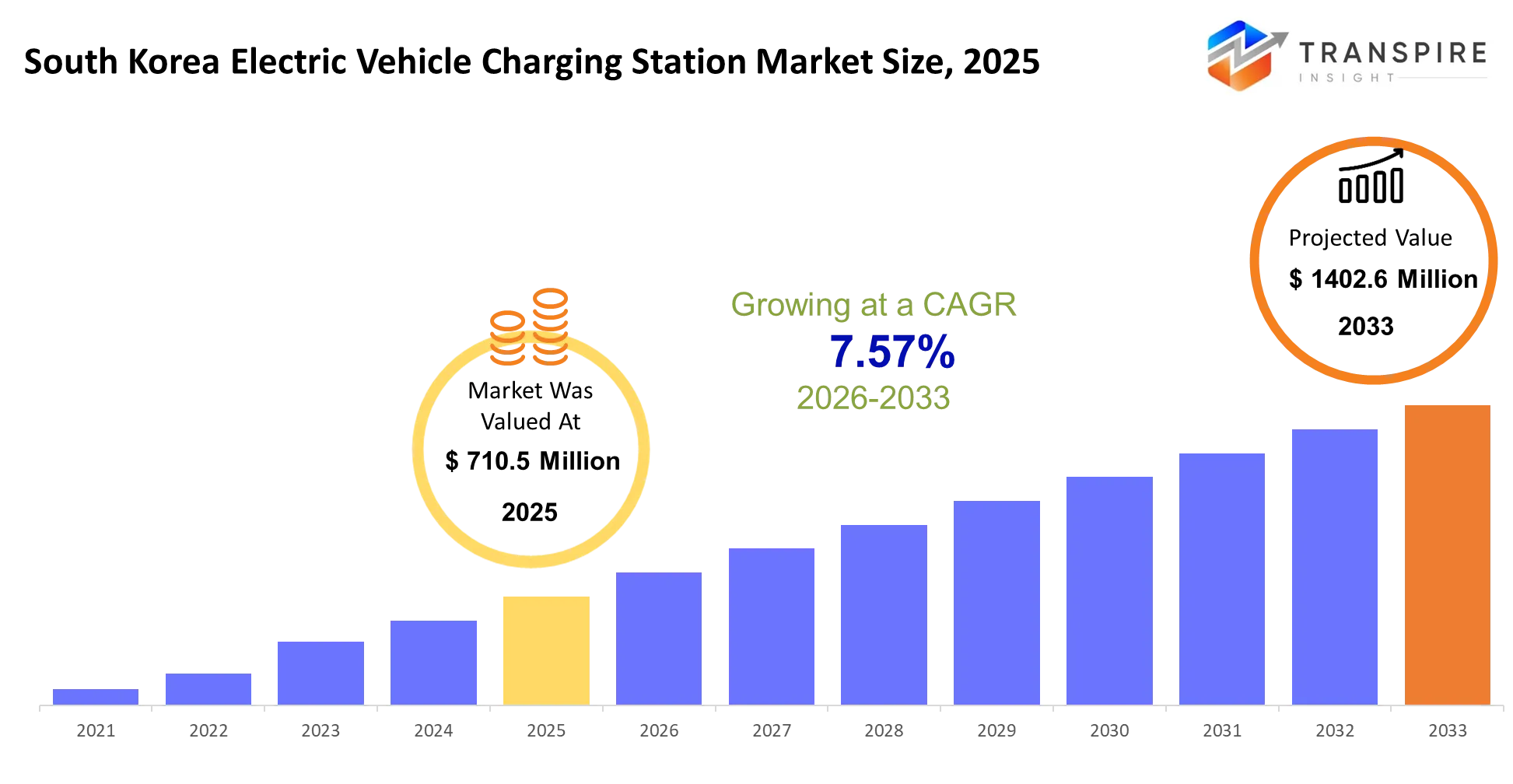
- South Korea Electric Vehicle Charging Station Market Size 2025: USD 710.5 Million
- South Korea Electric Vehicle Charging Station Market Size 2033: USD 1402.6 Million
- South Korea Electric Vehicle Charging Station Market CAGR: 7.57%
- South Korea Electric Vehicle Charging Station Market Segments: By Charger Type (AC Chargers, DC Fast Chargers, Wireless Chargers, Portable Chargers, Others); By Installation Type (Public Charging Stations, Private Charging Stations, Commercial Charging Stations, Highway Charging Stations, Others); By Vehicle Type (Passenger EVs, Commercial EVs, Electric Buses, Others); By Application (Residential Charging, Fleet Charging, Destination Charging, Others); By End User (Utilities, Fleet Operators, Residential Users, Commercial Operators, Others)
To learn more about this report,  Download Free Sample Report
South Korea Electric Vehicle Charging Station Market Summary
The South Korea Electric Vehicle Charging Station Market was valued at USD 710.5 Million in 2025. It is forecast to reach USD 1402.6 Million by 2033. That is a CAGR of 7.57% over the period.
In practice South Korea’s electric vehicle charging station market keeps urban mobility and commercial EV fleets running, more or less, by making sure drivers can quickly top-up in dense cities , on highway corridors, and at logistics hubs where even a short pause messes with productivity. Over the last five years the market sort of moved in a structural way from slow, fragmented charging points into higher capacity DC fast-charging networks, that also get folded into digital payment, plus real time availability platforms which cuts the turnaround time for both private users, and fleet managers.
One big policy trigger was the South Korean Green New Deal; it sped up charger rollout nationwide, along with tighter emissions targets. At the same time the global energy price volatility after the Russia–Ukraine conflict gave extra pressure, so both government agencies and companies acted faster to reduce petroleum reliance, instead of waiting around. Taken together these forces nudged automakers, utilities and even real estate operators to co-invest in charging infrastructure, so deployment became more coordinated, more commercially driven and easier to scale. As a result EV adoption picked up across passenger use, and also last-mile logistics segments, where reliability really matters.
Key Market Insights
- The South Korea Electric Vehicle Charging Station Market seems to be sliding toward ultra fast DC chargers, so the average EV charging time is getting cut down from hours to less than 30 minutes in practice.
- At the same time, smart grid systems are being merged with real time charging apps, and this helps the networks squeeze better utilization, plus revenue efficiency tends to climb across different charging locations.
- Also, the highway corridor charging hubs keep expanding, and that is really backing long distance EV adoption, which in turn eases range anxiety, especially for commercial fleet operators who rely on tight schedules.
- Meanwhile, Seoul Capital Area is holding more than 55% of the market share in South Korea Electric Vehicle Charging Station Market, mainly because of the dense population and heavy EV fleet concentration.
- On top of that, Southeast industrial zones are growing the fastest between 2024 and 2030, largely due to logistics electrification and port connectivity upgrades, which makes charging access more practical for moving goods and services.
- DC fast charging kind of dominates the South Korea Electric Vehicle Charging Station Market with over 60% share mostly because urban demand tends to want speed, like right now.
- Public charging networks lead overall with nearly 55% share as well, backed by municipal infrastructure rollout and the fact that it is easier for everyone to access.
- Then there are highway charging corridors which are growing the fastest, they help intercity EV mobility too, and even logistics efficiency improvements are getting a boost.
- On the demand side, commercial fleets take the lead with about 50% share, mainly due to logistics electrification efforts that businesses are pushing.
- And for end users, private residential charging is the fastest-growing category, as EV ownership keeps rising in urban apartments and housing complexes, people just seem to want simpler everyday charging, not only public points.
What are the Key Drivers, Restraints, and Opportunities in the South Korea Electric Vehicle Charging Station Market?
The main driver is a kind of aggressive national electrification policy mixed together with automaker-led EV scaling . On top of that, government mandates in Korea’s carbon neutrality roadmap have essentially pushed a faster growth of public charging infrastructure, while firms like Hyundai Motor Group have ramped up EV production volumes a lot. This match between policy pressure and vehicle availability has basically sped up charger installation rates, which is helping station utilization, and producing more steadier revenue streams for operators. That’s especially true along urban fast-charging corridors, where demand doesn’t really wait.
Still, the biggest restraint is grid capacity limitations in dense areas like Seoul and Busan. The electrical infrastructure that was already there was not originally built for simultaneous high-load DC fast charging, so you get localized bottlenecks. Then the upgrades become expensive, and the whole thing becomes a delay factor for new station rollouts. It also raises capex per site which suppresses short-term profitability and slows the push into premium urban locations where demand is highest, basically where everyone wants it.
The most interesting opportunity is vehicle-to-grid (V2G) integration plus smart charging ecosystems. Pilot programs backed by KEPCO are letting EVs send electricity back to the grid during peak demand, so charging stations become distributed energy assets rather than just places to plug in. And as renewable penetration grows, this approach can open revenue opportunities beyond charging fees, and also help position South Korea as a leader in bidirectional charging infrastructure.
What Has the Impact of Artificial Intelligence Been on the South Korea Electric Vehicle Charging Station Market?
Artificial intelligence is getting more and more embedded across the South Korea Electric Vehicle Charging Station Market, especially when it comes to handling distributed charger networks and fine tuning real time energy movement. In practice, operators rely on AI powered control systems, to basically automate charger monitoring, spot faults from a distance, and even help balance the load between different stations during those peak demand hours. On top of that, fleet operators bring in AI enabled dashboards to watch charging compliance, check vehicle readiness, and also see depot level energy usage. This cuts down the need for constant manual supervision and, somehow, it tends to improve scheduling efficiency.
Machine learning models are used a lot for predictive maintenance, where earlier charging records are taken and used to anticipate connector wear , power module degradation and software faults before they ever turn into a real breakdown. Utilities and charging providers also lean on predictive load forecasting, so they can line up electricity purchasing with the expected EV charging demand, which in turn reduces energy wastage and can lower peak tariff exposure. In many high traffic urban hubs these approaches improved charger uptime roughly by 10–20 percent, and they helped bring operational costs down too through fewer emergency repairs and better asset use.
Still, there are structural issues with AI adoption in the South Korea Electric Vehicle Charging Station Market, mainly because integration costs are high and older, fragmented infrastructure is still everywhere. A lot of smaller operators do not have standardized data architecture, so model accuracy gets capped and scaling becomes harder. Also, when real time connectivity is inconsistent in underground parking facilities, it becomes difficult to keep data streaming nonstop, which slows down the complete rollout of advanced AI optimization systems.
Key Market Trends
- Between 2021 and 2026, operators sort of shifted away from slow AC setups toward ultra-fast DC chargers, and now they’re basically making up more than 60% of the brand new deployments nationwide.
- Since 2022, SK Signet and Hyundai Motor Group have been expanding high capacity charging networks, choosing highway corridors over those scattered city standalone stations, even though the latter still show up here and there.
- The KEPCO grid integration programs that ran starting in 2023 helped cut charger downtime, mostly by improving load balancing and rolling out real time demand response across major cities.
- From 2020 to 2025 smart charging platforms replaced manual station monitoring, which boosted day to day operational efficiency and also reduced maintenance costs for operators, a lot.
- After 2022 energy price volatility, charging operators diversified tariffs and began using AI based pricing models to keep utilization steadier and to protect revenue streams, it’s been a kind of stabilization move.
- Between 2023 and 2026, commercial fleet electrification basically pushed depot charging installations, so they reduced dependence on public charging points and, at the same time increased private infrastructure investment.
- ABB and Siemens rolled out interoperable charging standards sometime after 2024, and this improved cross network compatibility, which also reduced infrastructure fragmentation across South Korea in practice.
- Since 2023, residential EV adoption in Seoul went up sharply, and that encouraged apartment complexes to install shared charging units under revised housing regulations, even when earlier plans didn’t fully cover it.
South Korea Electric Vehicle Charging Station Market Segmentation
By Charger Type:
AC chargers stay pretty common for homes and work places where overnight charging helps people do their daily commuting. DC fast chargers are growing even quicker because drivers seem to like shorter charging windows, more so in urban zones and at highway stops. Wireless and portable units still feel kind of limited, but they’re being tested in small pilot projects to make life a bit easier, and more flexible, too.
It looks like DC fast charging setups are getting better traction because infrastructure operators are trying to lower waiting time and boost the number of cars each station can handle. AC charging however keeps a dependable baseline demand, especially in apartment blocks and office buildings where cost efficiency matters more than sheer speed. Also, ongoing technology upgrades are making chargers safer, faster, and more controlled in terms of energy management across nearly all charger types.
By Installation Type:
Most people rely on public charging stations since they’re easier to find in city centers and along transport corridors. Private charging stations are also on the rise, mostly in residential complexes, helped by newer housing development guidelines. Meanwhile commercial sites and highway charging points are expanding as well, to serve long-distance travelers and logistics fleets moving along key routes.
Public infrastructure keeps widening, with government-backed rollout schemes that raise station density in major cities. Private installs are becoming normal in newly built apartments, which mirrors how housing infrastructure standards are changing, overall. Highway charging stations are increasing along expressways as well, mainly to cut down those range worries for intercity travel and freight movement.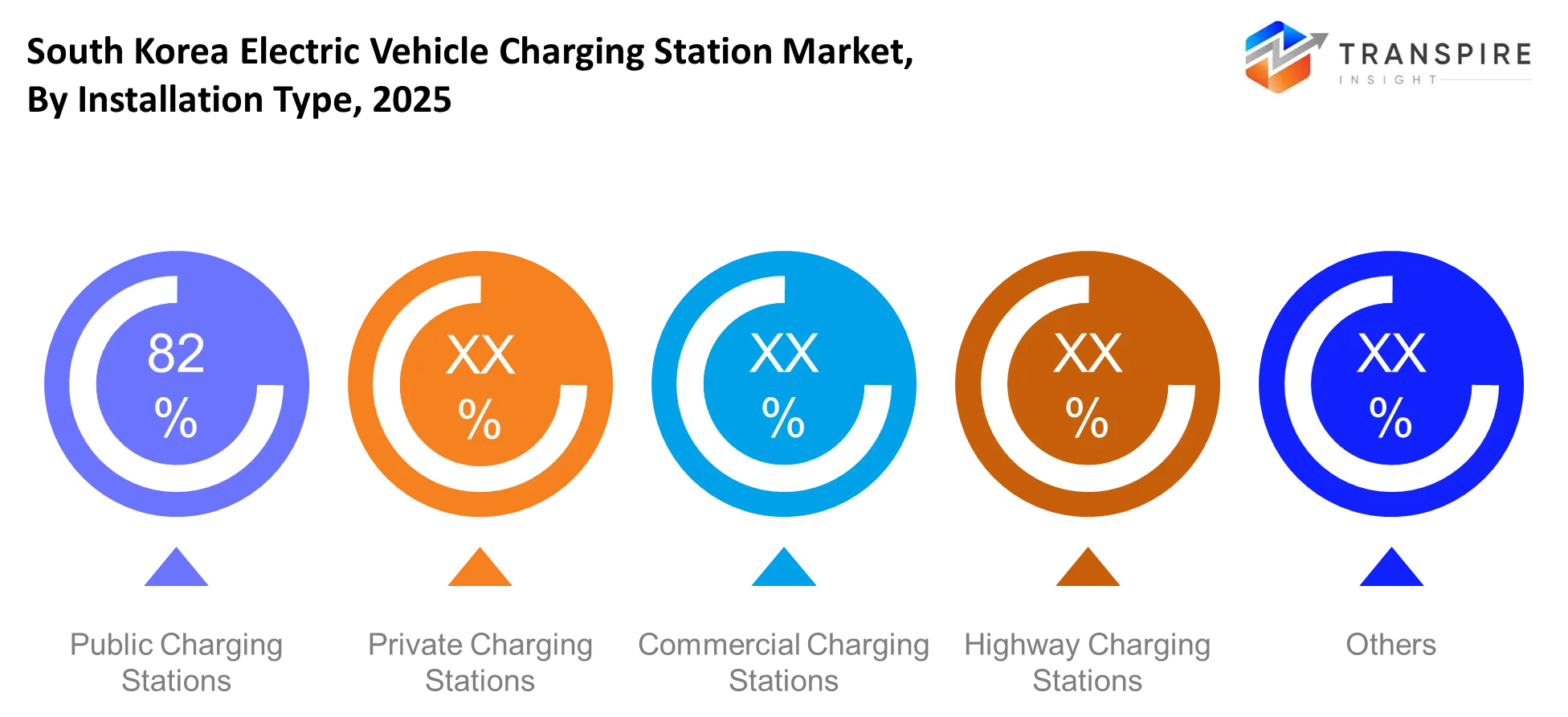
To learn more about this report, Download Free Sample Report
By Vehicle Type:
Passenger EVs still show up as the main share of charging demand, the highest by far, and it seems to keep climbing as urban adoption rises. Commercial EVs are also picking up steam, mostly because logistics electrification and more delivery service expansion are happening at the same time. Meanwhile electric buses and other specialty vehicles are getting slower, but real, traction through public transport electrification programs in big cities.
In practice it’s passenger vehicles driving the majority of charging activity, due to everyday urban routines and the steady increase in EV ownership. Commercial vehicle charging demand is climbing faster than earlier cycles, since fleet operators start looking at lower operating costs. Public transit electrification is not exploding, but it is expanding bit by bit, backed by municipal fleet upgrade initiatives.
By Application:
Residential charging stays a major usage area too , as more households adopt EVs and install home chargers. Fleet charging is moving ahead quickly, spurred by electrification across logistics and delivery. Destination charging is getting more visible across retail, hospitality, and other commercial spaces, mainly to cover those short-duration vehicle stops.
Residential charging basically supports daily EV use with overnight charging convenience and energy costs that feel lower. Fleet charging hubs are being built to boost operational efficiency for commercial operators. Destination charging is becoming increasingly common in parking areas where vehicles sit in place for limited periods, and that matters a lot for drivers.
By End User:
Utilities end up playing a major role in charging infrastructure development, not just because of power, but also because grid management and energy supply coordination kind of keep everything working. Fleet operators are also ramping up investment in dedicated charging depots, to back electrified logistics operations, and honestly it helps with planning. Residential users and commercial operators are steadily widening their installations, driven by day to day convenience, and also by regulatory support that makes it feel more possible.
Meanwhile, utilities are upgrading grid integration systems so they can better deal with the rising electricity demand coming from charging networks. Fleet operators are leaning more toward centralized charging facilities, partly to cut downtime and partly to improve overall efficiency. Residential and commercial users are doing the same, adopting charging infrastructure as EV adoption spreads across households and business operations.
What are the Key Use Cases Driving the South Korea Electric Vehicle Charging Station Market?
Passenger electric vehicles still basically end up being the main reason charging infrastructure keeps growing across South Korea. If you’re looking at everyday commutes in dense places like Seoul and Incheon, there’s a noticeable dependence on public fast-charging, particularly in apartment-heavy areas where private parking access stays pretty limited. In that kind of setting, this use case ends up delivering the highest charger utilization and the steadier sort of recurring revenue for the operators, generally.
On another track, commercial fleet charging is starting to pick up, mainly as logistics firms switch delivery vans and smaller commercial trucks to electrified options in order to cut down fuel expenses and also meet local urban emissions rules. Then there’s destination charging, which is spreading too, in shopping centers, hotels and office complexes. Property managers often treat charging access like a small edge they can use to pull in longer stays, and it helps with tenant retention as well. So yeah, it’s not just convenience, it’s also a bit of a strategy.
You also see more emerging applications, like ultra-fast highway charging hubs aimed at long-distance freight movement, and smart vehicle-to-grid arrangements that get tied into renewable energy management. Some pilot programs that involve bidirectional charging are showing a pretty strong promise, because utilities are trying to smooth out electricity demand while still backing larger EV populations over the coming forecast period.
|
Report Metrics |
Details |
|
Market size value in 2025 |
USD 710.5 Million |
|
Market size value in 2026 |
USD 841.8 Million |
|
Revenue forecast in 2033 |
USD 1402.6 Million |
|
Growth rate |
CAGR of 7.57% from 2026 to 2033 |
|
Base year |
2025 |
|
Historical data |
2021 - 2024 |
|
Forecast period |
2026 - 2033 |
|
Report coverage |
Revenue forecast, competitive landscape, growth factors, and trends |
|
Country scope |
South Korea |
|
Key company profiled |
Hyundai Electric, LG Electronics, ABB, Siemens, Schneider Electric, ChargePoint, Tesla, SK Signet, Delta Electronics, Webasto, Tritium, Blink Charging, EVBox, Wallbox, Eaton |
|
Customization scope |
Free report customization (country, regional & segment scope). Avail customized purchase options to meet your exact research needs. |
|
Report Segmentation |
By Charger Type (AC Chargers, DC Fast Chargers, Wireless Chargers, Portable Chargers, Others); By Installation Type (Public Charging Stations, Private Charging Stations, Commercial Charging Stations, Highway Charging Stations, Others); By Vehicle Type (Passenger EVs, Commercial EVs, Electric Buses, Others); By Application (Residential Charging, Fleet Charging, Destination Charging, Others); By End User (Utilities, Fleet Operators, Residential Users, Commercial Operators, Others) |
Which Regions are Driving the South Korea Electric Vehicle Charging Station Market Growth?
In a broad sense the Seoul Capital Area sort of leads the South Korea Electric Vehicle Charging Station Market, not just because of density.It sort of has a dense EV population , a more advanced digital backbone , and policy that really pushes transport electrification, you can feel it everywhere. You can see municipal governments in Seoul, Incheon, and Gyeonggi Province still expanding public fast-charging availability mostly through subsidies and urban mobility programs , it’s not just one-off stuff. Big apartment complexes, corporate campuses, and commercial zones keep the need for charging kind of steady all day long even when commuting patterns shift a little . There’s also close coordination between utilities, automakers, and charging network operators which helps stations roll out faster, and run with better utilization.
Meanwhile the Busan and Southeast industrial region contributes in a different, more industrial way, because growth tracks manufacturing activity, logistics movement, and commercial transport stability. Infrastructure spending there has stayed steady, largely due to its solid industrial economy and the way freight operations are concentrated. Charging demand comes from logistics fleets, industrial transport vehicles, and port-linked commercial corridors, not only from people driving to work. With continued investment from fleet operators and industrial businesses the region gets a more reliable long-term revenue contribution even if consumer EV penetration is slower than in Seoul.
Jeolla and Chungcheong provinces look like they are becoming the fastest growing regions, after recent government programs expanded regional charging reach beyond the biggest city zones. In the meantime, newer expressway charging hubs plus infrastructure tied to renewable energy, have speeded up charger installations from 2023 onward. Also, cheaper land prices and grid capacity that keeps getting better, are nudging operators toward bigger charging facilities with room for later scaling. In practice, this trend opens up some really interesting entry points for infrastructure investors, and for technology providers who want less served markets, with lower competitive pressure during the 2026–2033 period.
Who are the Key Players in the South Korea Electric Vehicle Charging Station Market and How Do They Compete?
Competition in the South Korea Electric Vehicle Charging Station Market stays moderately consolidated, sort of where a few major players already have a grip, mainly large energy companies, industrial technology firms, and mobility groups that run the high-value urban and highway charging web. Lately the rivalry is drifting toward charging speed, software integration, grid connectivity, and simply getting access to the nicer installation spots rather than arguing only over charger pricing. The established operators are trying to keep their share by leaning into vertically integrated service models, where they bundle hardware, maintenance, payment systems, and energy management platforms in one approach . Meanwhile, tech-tilted entrants are pushing in with ultra-fast charging systems, plus AI-enabled network optimization tools that are, more or less, hard to ignore.
SK Signet has boosted its standing through ultra-fast DC charging technology that targets high-traffic commercial corridors and fleet operations. They differentiate themselves with high-output chargers that can support shorter turnaround times for premium EV models and commercial fleets. SK Signet is also stepping outward internationally, while at the same time adding domestic partnerships with retail chains and transport operators, to lock in high-utilization charging locations. Hyundai Motor Group is basically going after a vertically linked pathway , trying to blend the whole charging infrastructure together with EV manufacturing and software ecosystems, plus those mobility services too. In a way it’s like the company is building a kind of continuous chain where the user experience can get tuned, not just once but again and again, via connected vehicle platforms. Then there are charging reservation systems that are tied directly to the vehicle data, so it feels smoother, more frictionless even when drivers are moving around, or on the road.
ABB kinda competes with industrial grade charging systems, plus the interoperability side of things so they can back multiple charging standards across public and fleet environments. They really lean into reliability and also remote maintenance services, because commercial operators care about lower downtime and less interruption. Siemens meanwhile is pushing forward with smart grid integration and energy management tech, which helps operators handle electricity demand more efficiently especially when peak usage hits. And ChargePoint sort of differentiates by leaning hard on software driven subscription models, as well as cloud based charger management systems that give operators usage analytics you can actually use, plus more flexible control over pricing.
Company List
- Hyundai Electric
- LG Electronics
- ABB
- Siemens
- Schneider Electric
- ChargePoint
- Tesla
- SK Signet
- Delta Electronics
- Webasto
- Tritium
- Blink Charging
- EVBox
- Wallbox
- Eaton
Recent Development News
In March 2026, Chaevi signed an MoU with Emirates Electrical Engineering to supply around 1,000 EV chargers in the UAE, marking a major overseas infrastructure expansion for the Korean charging operator. Source https://en.wikipedia.org/
In April 2026, Hyundai Motor reported that its March domestic EV sales rose 38% year-on-year, reflecting stronger utilization prospects for the country’s fast-charging infrastructure and E-pit charging network. Source https://www.reuters.com/
What Strategic Insights Define the Future of the South Korea Electric Vehicle Charging Station Market?
The South Korea Electric Vehicle Charging Station Market is sliding toward a pretty integrated, energy plus mobility kind of system where charging infrastructure works more like part of the national power management net, not so much as lone refueling spots. Honestly this shift is being pushed by a few things at once, like EV adoption getting wider, the smart grid getting modernized, and the need to juggle electricity demand in a more efficient way, especially across crowded urban areas. In the next five to seven years, the operators that already have solid software, energy storage, and deep grid linking abilities will probably collect more value than firms that mainly do hardware placements, you know.
There’s also a less visible risk underneath all of this, uneven charger profitability. That can happen when aggressive buildouts land in already saturated metropolitan pockets. If you get high station density but utilization does not grow in step, margins can get squeezed and smaller operators may see longer payback periods. Meanwhile, bidirectional vehicle-to-grid charging is turning into a notable opportunity, particularly as renewable capacity ramps up across various regional power systems. Market players should really push for collaborations with utilities and property developers, so they can lock in long-term access to higher-utilization locations, while also developing flexible energy management features that can adjust when grid needs change, because they definitely will.
South Korea Electric Vehicle Charging Station Market Report Segmentation
By Charger Type
- AC Chargers
- DC Fast Chargers
- Wireless Chargers
- Portable Chargers
By Installation Type
- Public Charging Stations
- Private Charging Stations
- Commercial Charging Stations
- Highway Charging Stations
By Vehicle Type
- Passenger EVs
- Commercial EVs
- Electric Buses
By Application
- Residential Charging
- Fleet Charging
- Destination Charging
By End User
- Utilities
- Fleet Operators
- Residential Users
- Commercial Operators
Frequently Asked Questions
Find quick answers to common questions.
The South Korea Electric Vehicle Charging Station Market size is USD 1402.6 Million in 2033.
Key Segments for the South Korea Electric Vehicle Charging Station Market are By Charger Type (AC Chargers, DC Fast Chargers, Wireless Chargers, Portable Chargers, Others); By Installation Type (Public Charging Stations, Private Charging Stations, Commercial Charging Stations, Highway Charging Stations, Others); By Vehicle Type (Passenger EVs, Commercial EVs, Electric Buses, Others); By Application (Residential Charging, Fleet Charging, Destination Charging, Others); By End User (Utilities, Fleet Operators, Residential Users, Commercial Operators, Others).
Major South Korea Electric Vehicle Charging Station Market Players are Hyundai Electric, LG Electronics, ABB, Siemens, Schneider Electric, ChargePoint, Tesla, SK Signet, Delta Electronics, Webasto, Tritium, Blink Charging, EVBox, Wallbox, Eaton.
The Current South Korea Electric Vehicle Charging Station Market size is USD 710.5 Million in 2025.
The South Korea Electric Vehicle Charging Station Market CAGR is 7.57% from 2026 to 2033.
- Hyundai Electric
- LG Electronics
- ABB
- Siemens
- Schneider Electric
- ChargePoint
- Tesla
- SK Signet
- Delta Electronics
- Webasto
- Tritium
- Blink Charging
- EVBox
- Wallbox
- Eaton
Recently Published Reports
-
Apr 2026
Active Power Filter Market
Active Power Filter Market Size, Share & Analysis Report By Type (Shunt Active Power Filters, Series Active Power Filter, Hybrid Active Power Filter), By Application (Harmonics Mitigation, Reactive Power Compensation, Voltage Regulation, Power Factor Correction), By Phase (Single Phase, Three Phase), By End-User Industry (Manufacturing, Healthcare, Commercial, Automotive, Oil and Gas, Others), and Geography (North America, Europe, Asia-Pacific, Middle East and Africa, South and Central America), 2021 - 2031
-
Apr 2026
Electrical Transformer Market
Electrical Transformer Market Size, Share & Analysis Report By Core (Closed, Shell, and Berry), By Insulation (Gas, Oil, Solid, Air, and Other), By Phase (Single, and Three), By Rating (100 MVA to 500 MVA, 501 MVA to 800 MVA, and 801 MVA to 1200 MVA), and Geography (North America, Europe, Asia-Pacific, Middle East and Africa, South and Central America), 2021 – 2031
-
Apr 2026
Hydraulic Piston Pumps Market
Hydraulic Piston Pumps Market Size, Share & Analysis Report By Type (Axial Piston Pumps, Radial Piston Pumps), By Operating Pressure (Low Pressure, Medium Pressure, High Pressure), By Application (Construction, Mining, Agriculture, Automotive, Oil & Gas, Industrial Machinery, Others), By End-User (OEMs, Aftermarket), and Geography (North America, Europe, Asia-Pacific, Middle East and Africa, South and Central America), 2021 – 2031
-
Apr 2026
Laboratory Gas Generators Market
Laboratory Gas Generators Market Size, Share & Analysis Report By Product (Nitrogen Gas Generator, Hydrogen Gas Generator, Zero Air Gas Generator, Purge Gas Generator, TOC Gas Generators, Others), By Application (Gas Chromatography, Liquid Chromatography-mass Spectrometry (LC-MS), Gas Analyzers, Others), By End-user (Life Science, Chemical & Petrochemical, Food & Beverage, Others), and Geography (North America, Europe, Asia-Pacific, Middle East and Africa, South and Central America), 2021 – 2031