

Asia Pacific Wireless Intrusion Prevention System Market Size & Forecast:
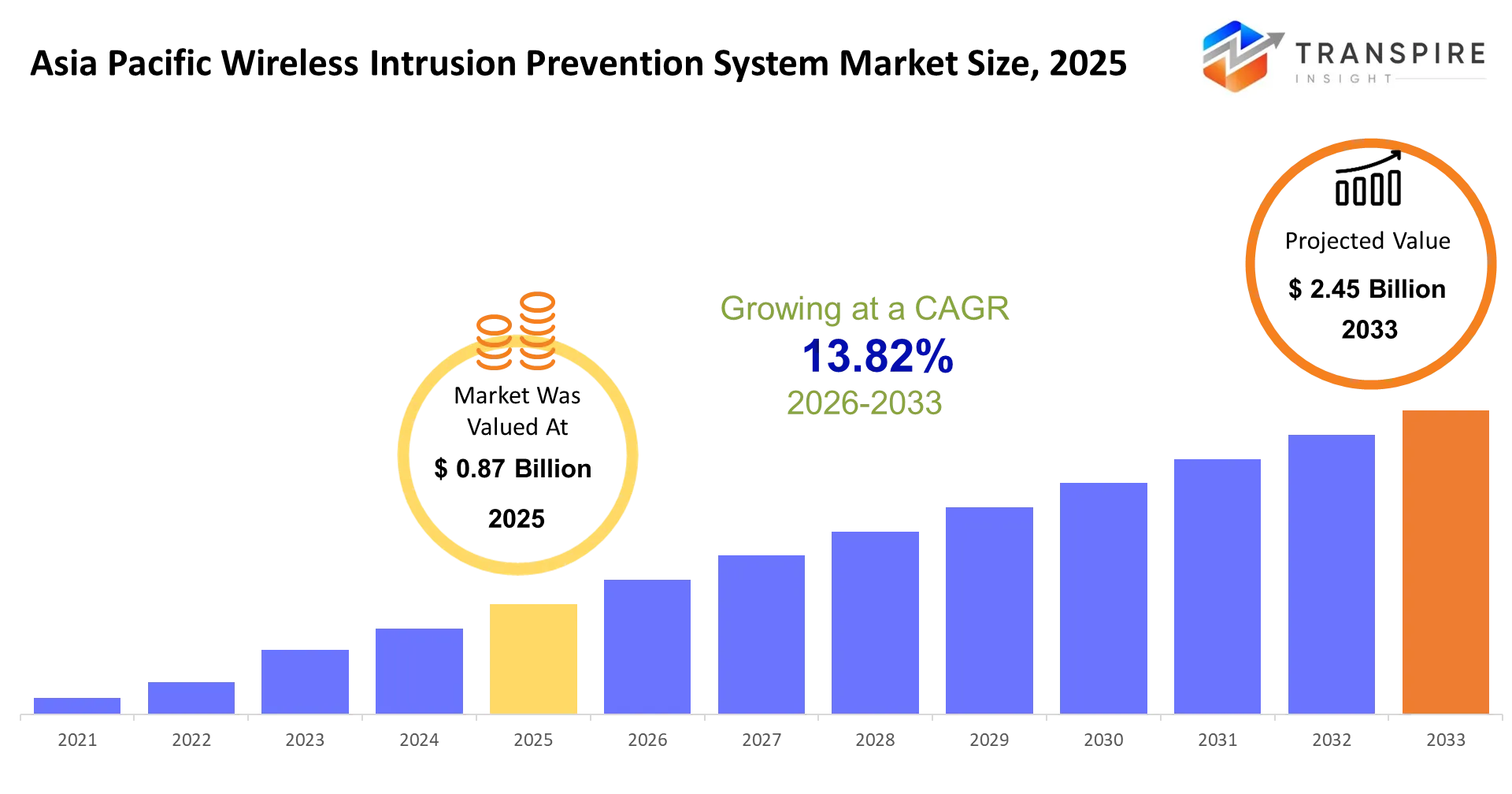
- Asia Pacific Wireless Intrusion Prevention System Market Size 2025: USD 0.87 Billion
- Asia Pacific Wireless Intrusion Prevention System Market Size 2033: USD 2.45 Billion
- Asia Pacific Wireless Intrusion Prevention System Market CAGR: 13.82%
- Asia Pacific Wireless Intrusion Prevention System Market Segments: By Type (Network-based WIPS, Host-based WIPS, Cloud-based WIPS, Others); By Application (Enterprise Security, Government Security, BFSI, Healthcare, Retail, Others); By End-User (Enterprises, SMEs, Government, IT Firms, Telecom Operators, Others); By Deployment (Cloud, On-premise, Hybrid, Others)
To learn more about this report,  Download Free Sample Report
Asia Pacific Wireless Intrusion Prevention System Market Summary
The Asia Pacific Wireless Intrusion Prevention System Market was valued at USD 0.87 Billion in 2025. It is forecast to reach USD 2.45 Billion by 2033. That is a CAGR of 13.82% over the period.
The Asia Pacific Wireless Intrusion Prevention System Market operates practically by protecting wireless operations which take place in ports and factories and logistics corridors and industrial campuses that use Wi-Fi and IoT devices and private 5G networks for their key business operations. The system uses its detection abilities to identify unauthorized access point connection attempts which include device spoofing and hidden attempts to breach the network security system that protects cargo operations and production processes and operational technology networks.
The market has experienced structural changes during the past three to five years because it now uses combined security solutions which protect both IT and operational technology through their cloud-based infrastructure which includes AI-powered security systems. The Indo-Pacific region has experienced increased cyberattacks which target ports and supply chains because of faster 5G and industrial IoT implementation and extended lockdown periods which followed the pandemic. The security system has become more vulnerable because of the fast-paced wireless attacks which exceed the protection capabilities of existing security controls. The operators of the system now concentrate their efforts on building systems which automatically stop intrusions because this practice leads to the permanent use of security services by enterprises and managed security service providers which results in subscription-based revenue generation for security services.
Key Market Insights
- China will hold almost 35 percent of the Asia Pacific Wireless Intrusion Prevention System Market in 2025 because industrial digitization and smart port projects drive its market growth.
- India will become the fastest-growing area until 2030 because of its quick 5G deployment and increasing industrial cybersecurity spending.
- Companies in Japan and South Korea use advanced manufacturing automation systems which require Internet of Things technology to operate their businesses.
- The Asia Pacific Wireless Intrusion Prevention System Market sees solution-based deployments as its leading market segment because customers demand real-time threat detection platforms.
- Enterprises use managed security services to outsource their wireless security monitoring needs which helps them decrease operational complexity.
- The period from 2024 to 2030 will see cloud-native WIPS platforms become the fastest expanding market segment because of their ability to scale and their incorporation of artificial intelligence analytics.
- The industrial and manufacturing sectors will account for approximately 38 percent of market share in 2025 because these sectors require protection for their wireless operational technology networks.
- Large enterprises hold the leading share of the Asia Pacific Wireless Intrusion Prevention System Market at over 55% in 2025.
- The government and defense sectors show the highest growth among end-user categories because of increasing geopolitical cyber threats.
- Critical infrastructure operators expand their use of wireless threat monitoring systems to achieve ongoing security surveillance and regulatory compliance.
What are the Key Drivers, Restraints, and Opportunities in the Asia Pacific Wireless Intrusion Prevention System Market?
The main factor behind industrial IoT and private wireless network growth across ports manufacturing hubs and smart cities shows rapid expansion. The enterprise shift toward continuous wireless system operations happened because 5G networks developed faster and post-pandemic supply chain improvements created new industrial needs. Organizations result from this situation to spend on tools which protect against intrusions through continuous spectrum monitoring and rogue access point detection and prevention of network hijacking. Cybersecurity platforms which vendors sell through subscription services have become more popular which helps vendors generate steady income through recurring revenue streams.
The process of implementing Wireless Intrusion Prevention System solutions in operational technology systems that use old technology creates fundamental challenges which prevent proper execution. Industrial facilities continue to use outdated network systems which lack the capability to monitor security threats in real time. The existing structural limitations create a situation which extends deployment times and raises implementation expenses while preventing mid-sized organizations from achieving complete system deployment because they lack dedicated cybersecurity resources.
The new opportunity emerges from AI-based threat analysis systems uniting with security platforms designed for cloud-native environments. India and Vietnam establish smart manufacturing zones which enable complete integration of advanced WIPS through their new deployment programs. The market now provides vendors with an opportunity to launch self-learning intrusion prevention systems which automatically learn to protect systems while enhancing their ability to detect threats.
What Has the Impact of Artificial Intelligence Been on the Asia Pacific Wireless Intrusion Prevention System Market?
The Asia Pacific Wireless Intrusion Prevention System Market undergoes transformation through artificial intelligence which creates autonomous data-driven security systems that protect industrial and maritime wireless networks instead of traditional rule-based monitoring systems. The development tracks the digitisation progress which connects scrubber performance systems and fleet infrastructure through continuous security measures that protect wireless data transmission.
AI-driven automation now handles real-time monitoring of intrusion attempts while it tracks the performance data of scrubber systems and the compliance metrics of fleet operations. The system reduces the need for human monitoring because the system detects problems more quickly through its connected marine emission control systems and industrial IoT networks.
Machine learning models support predictive maintenance of exhaust gas cleaning technology through their ability to detect initial component degradation signs which help anticipate emission deviations before they reach regulatory limits. The systems achieve better fuel efficiency through their ability to modify operational settings based on both historical records and current operational data.
The Asia Pacific Wireless Intrusion Prevention System Market shows 10 to 25 percent system uptime improvements through its first operational deployments while the automated alert system and remote analytics capabilities have resulted in reduced diagnostic and inspection expenses.
The maritime sector faces two main challenges which prevent technology adoption these challenges include insufficient maritime training data and poor at-sea network connections. The system experiences reduced model accuracy during live operations because of these two factors which also create challenges for organizations trying to implement their systems on existing ship infrastructure.
Key Market Trends
- The enterprises moved their monitoring methods away from perimeter security systems after 2022 to use artificial intelligence-based security systems which protect their networks through cloud-native Wireless Intrusion Prevention System technology.
- The implementation of 5G technology throughout the Asia Pacific region created secure wireless networks which increased the need for intrusion prevention systems that protect ports and factories and logistics networks.
- The number of maritime cyber incidents increased drastically between 2023 and 2025, which caused ports in Singapore and China to implement sophisticated wireless intrusion prevention systems.
- When enterprises chose managed security services, they delegated their monitoring tasks to external providers, which allowed them to reduce their cybersecurity personnel requirements while gaining continuous threat detection capabilities.
- Through its development of extensive smart port automation and industrial IoT systems, China enhanced its market leadership position because it increased the installation of wireless security systems throughout its territory.
- The adoption of 5G technology in India accelerated after 2023 because Digital India infrastructure programs and industrial 5G integration initiatives gained momentum throughout the country.
- The vendors, which included Cisco and Fortinet, changed their business models to create telecom partnerships, which enabled them to integrate intrusion prevention technology into their network infrastructure solutions.
- Enterprises shifted to real-time wireless monitoring systems and compliance-based security systems because critical infrastructure cybersecurity regulations became more stringent after 2024.
Asia Pacific Wireless Intrusion Prevention System Market Segmentation
By Type :
The Network-based WIPS system will perform wireless traffic monitoring at the network level while it identifies both unauthorized access points and dangerous threats. Host-based WIPS will operate on particular devices to protect their endpoints. Cloud-based WIPS functions as a cloud platform security solution which enables clients to protect their systems at various locations.
The network-based systems will enhance perimeter protection by analyzing network traffic patterns. Host-based systems will enable monitoring of laptop devices and other endpoint devices. Organizations will use cloud-based systems to control their security policies from remote locations while they benefit from scalable systems that require minimal infrastructure. The system will use hybrid detection tools which combine various methods to achieve better detection results.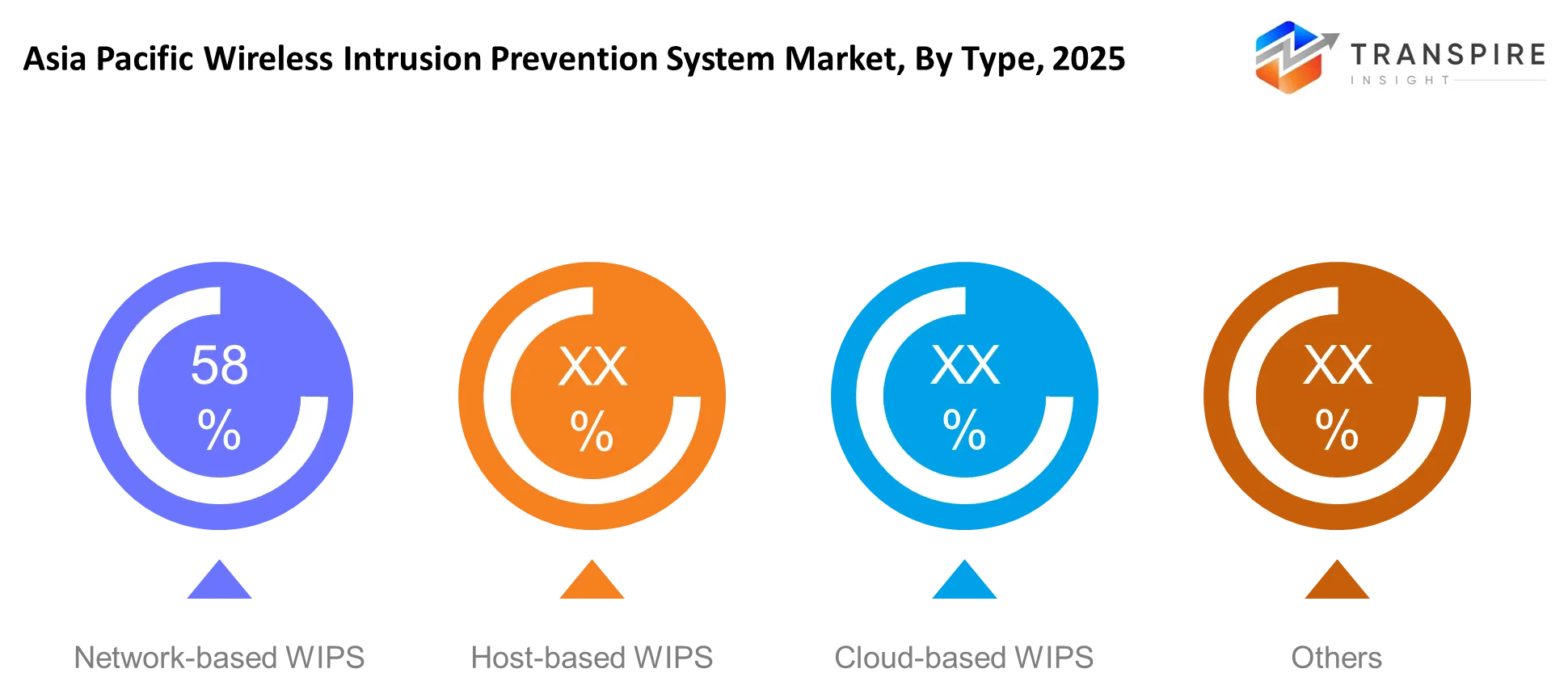
To learn more about this report, Download Free Sample Report
By Application :
Enterprise security will focus on protecting corporate networks from wireless attacks and unauthorized access. The security of government institutions will become necessary to protect their confidential communication systems. BFSI will require strong safeguards for financial data and transactions across wireless environments.
Healthcare facilities will implement WIPS systems to safeguard both patient information and their medical equipment. Retail stores will use it to protect both their payment processing systems and their customer network. The other sectors will implement identical security procedures which will enable them to defend against unauthorized wireless access while they maintain secure digital operations throughout various service areas.
By End-User :
Enterprises will adopt wireless intrusion prevention to protect large internal networks and sensitive information. SMEs will use cost-effective solutions for basic protection. Government bodies will focus on securing classified communication and public infrastructure networks.
IT firms will integrate WIPS into managed security services for clients. Telecom operators will deploy systems to secure wireless infrastructure and customer connections. Other users will include institutions requiring consistent monitoring of wireless environments to prevent unauthorized access and maintain network stability.
By Deployment :
Cloud deployment will enable remote monitoring and flexible scaling of wireless security systems. Organizations will gain direct control over their infrastructure through on-premise deployment. Hybrid deployment will combine both models to balance flexibility and control in managing wireless intrusion threats.
Cloud systems will reduce hardware needs while improving accessibility. Organizations can maintain internal security through on-premise systems. Hybrid systems will help organizations shift workloads based on security needs and operational demands, ensuring balanced protection across distributed wireless environments and evolving network structures.
What are the Key Use Cases Driving the Asia Pacific Wireless Intrusion Prevention System Market?
The main application of Wireless Intrusion Prevention Systems in Asia Pacific markets protects industrial wireless networks which IoT-based manufacturing systems require to maintain constant connectivity. Factories use these systems to block rogue access points which stop automated operations and decrease production output.
New applications are developing in maritime logistics and smart port operations that need container terminals and vessel communication systems to maintain ongoing wireless traffic assessment. Government and defense facilities are also increasing adoption to protect classified networks and ensure secure coordination across distributed installations and critical infrastructure sites.
New use cases show how wireless intrusion prevention supports remote vessel control and operational safety through its use with autonomous shipping systems and offshore energy platforms. The applications remain in their development stage yet have begun to gain popularity because digital twin technologies and AI-based navigation systems are increasingly used throughout Asia Pacific maritime and energy corridors.
|
Report Metrics |
Details |
|
Market size value in 2025 |
USD 0.87 Billion |
|
Market size value in 2026 |
USD 0.99 Billion |
|
Revenue forecast in 2033 |
USD 2.45 Billion |
|
Growth rate |
CAGR of 13.82% from 2026 to 2033 |
|
Base year |
2025 |
|
Historical data |
2021 - 2024 |
|
Forecast period |
2026 - 2033 |
|
Report coverage |
Revenue forecast, competitive landscape, growth factors, and trends |
|
Regional scope |
Asia Pacific (China, India, Japan, South Korea, Australia, Rest of Asia Pacific) |
|
Key company profiled |
Cisco, Aruba Networks, Fortinet, Juniper Networks, Check Point, Sophos, Trend Micro, IBM, Dell, Extreme Networks, WatchGuard, Barracuda, Huawei, ZTE, SonicWall |
|
Customization scope |
Free report customization (country, regional & segment scope). Avail customized purchase options to meet your exact research needs. |
|
Report Segmentation |
By Type (Network-based WIPS, Host-based WIPS, Cloud-based WIPS, Others); By Application (Enterprise Security, Government Security, BFSI, Healthcare, Retail, Others); By End-User (Enterprises, SMEs, Government, IT Firms, Telecom Operators, Others); By Deployment (Cloud, On-premise, Hybrid, Others) |
Which Regions are Driving the Asia Pacific Wireless Intrusion Prevention System Market Growth?
The Asia Pacific Wireless Intrusion Prevention System Market sees China maintaining its leading position because the country possesses advanced smart port systems and implements forceful industrial digital transformation initiatives. The government actively enforces cybersecurity regulations which protect critical infrastructure facilities resulting in faster implementation of wireless monitoring technology. The manufacturing hubs and automated distribution centers create ongoing requirements for systems that detect security breaches in real time. The existing domestic vendor network enables different companies to implement cutting-edge security solutions throughout their operational systems. The combination of these elements establishes China as the foremost global power in this area.
Japan functions as a reliable market participant who brings technological expertise to the Asia Pacific Wireless Intrusion Prevention System Market. The demand for Japan exists because advanced manufacturing and maritime operations require systems which deliver high reliability throughout their entire operational life. The industrial sector and shipowners need systems which maintain constant performance through extended periods of service, which leads to their predictable purchasing behavior. Organizations that operate under strong regulations which match international cybersecurity standards and maritime safety protocols, will follow established patterns of technology adoption. The stable business environment in Japan provides solution providers with a dependable market for their products.
India maintains its position as the fastest-growing region because of its quick 5G deployment and its extensive port modernization projects which receive funding from national infrastructure programs. Recent digital transformation in logistics corridors and industrial zones has expanded wireless network exposure significantly. The government has made critical infrastructure protection its top priority which has forced businesses to implement advanced intrusion prevention systems. India presents market entrants and investors with high-growth opportunities from 2026 to 2033 because of its developing digital ecosystems and growing industrial connectivity needs.
Who are the Key Players in the Asia Pacific Wireless Intrusion Prevention System Market and How Do They Compete?
The Asia Pacific Wireless Intrusion Prevention System Market exhibits moderate market consolidation because global cybersecurity companies compete with a limited number of operational technology security firms that focus on specific security needs. The market competition operates on platform integration abilities and AI threat detection performance and IT industrial network integration effectiveness rather than pricing strategies. The vendors compete against each other through their capacity to protect 5G infrastructure and Internet of Things systems which operate in ports and factories and logistics corridors. Enterprises now use telecom partnerships and security service management to differentiate their business operations as they move toward security subscription models.
Cisco uses wireless intrusion prevention technology as part of its network system through the deployment of Meraki and enterprise switching systems which extend its market reach. The integration enables enterprises to control their network connections and security operations through a single system which decreases their operational difficulties. Fortinet uses its Security Fabric solution to connect firewall protection with wireless security and endpoint security into one budget-friendly system which mid-sized industrial businesses find attractive. Honeywell uses its extensive operational technology knowledge to protect ports and critical infrastructure through its industrial and maritime security solutions which focus on wireless systems that could disrupt essential operations.
Palo Alto Networks uses its cloud-native security platform Prisma to create unique solutions for businesses that move their operations to hybrid and multi-cloud wireless systems. Trend Micro expands its business reach through its dedicated efforts to industrial IoT and connected manufacturing systems which enable growth in Asian markets. Check Point Software Technologies uses its advanced threat intelligence and regulatory compliance features to establish strong market presence in government and critical infrastructure security operations throughout the Asia Pacific region.
Company List
- Cisco
- Aruba Networks
- Fortinet
- Juniper Networks
- Check Point
- Sophos
- Trend Micro
- IBM
- Dell
- Extreme Networks
- WatchGuard
- Barracuda
- Huawei
- ZTE
- SonicWall
Recent Development News
In February 2025, Check Point Software Technologies announced the establishment of its first Asia-Pacific R&D Centre in Bengaluru, India. The investment is aimed at accelerating development of next-generation network and wireless security technologies, strengthening the company’s regional innovation capabilities for enterprise intrusion prevention solutions across Asia Pacific. Source https://blog.checkpoint.com/
In April 2026, Huawei Technologies developed the Xinghe AI Full-Scope Security Campus Technical White Paper together with local industry partners during Huawei Network Summit 2026. The project developed an artificial intelligence-based campus security system which specialized in detecting wireless threats and preventing unauthorized access to networks while increasing enterprise-wide WIPS systems throughout Asia-Pacific smart campus implementations. Source https://e.huawei.com/
What Strategic Insights Define the Future of the Asia Pacific Wireless Intrusion Prevention System Market?
The Asia Pacific Wireless Intrusion Prevention System Market is showing a structural trend which leads to the development of security systems that operate independently and function through cloud services while protecting industrial IoT and 5G infrastructure. The period between 2025 and 2028 will experience growth because enterprises will combine their operational technology with security systems for their wireless networks. The region experiences accelerated digital transformation through the implementation of digital solutions at ports and smart factories and their integration into connected logistics networks.
The risk of platform concentration increases because a few global vendors are gaining control over combined security systems which creates security vulnerabilities for essential infrastructure providers. The dependency creates procurement challenges for infrastructure operators because they become unable to acquire new systems when pricing or interoperability issues arise.
The Southeast Asian market presents a new opportunity for private 5G network security solutions which protect smart ports and offshore energy facilities that operate in the region's developing infrastructure. The segment has strategic importance because wireless attack surfaces are expanding yet the market remains underdeveloped. Market participants should prioritize modular, interoperable intrusion prevention solutions which can integrate with telecom-led private network deployments to maintain relevance as connectivity architectures evolve.
Asia Pacific Wireless Intrusion Prevention System Market Report Segmentation
By Type
- Network-based WIPS
- Host-based WIPS
- Cloud-based WIPS
By Application
- Enterprise Security
- Government Security
- BFSI
- Healthcare
- Retail
By End-User
- Enterprises
- SMEs
- Government
- IT Firms
- Telecom Operators
By Deployment
- Cloud
- On-premise
- Hybrid
Frequently Asked Questions
Find quick answers to common questions.
The Asia Pacific Wireless Intrusion Prevention System Market size is USD 2.45 Billion in 2033.
Key Segments for the Asia Pacific Wireless Intrusion Prevention System Market are By Type (Network-based WIPS, Host-based WIPS, Cloud-based WIPS, Others); By Application (Enterprise Security, Government Security, BFSI, Healthcare, Retail, Others); By End-User (Enterprises, SMEs, Government, IT Firms, Telecom Operators, Others); By Deployment (Cloud, On-premise, Hybrid, Others).
Major Asia Pacific Wireless Intrusion Prevention System Market Players are Cisco, Aruba Networks, Fortinet, Juniper Networks, Check Point, Sophos, Trend Micro, IBM, Dell, Extreme Networks, WatchGuard, Barracuda, Huawei, ZTE, SonicWall.
The Current Asia Pacific Wireless Intrusion Prevention System Market size is USD 0.87 Billion in 2025.
The Asia Pacific Wireless Intrusion Prevention System Market CAGR is 13.82% from 2026 to 2033.
- Cisco
- Aruba Networks
- Fortinet
- Juniper Networks
- Check Point
- Sophos
- Trend Micro
- IBM
- Dell
- Extreme Networks
- WatchGuard
- Barracuda
- Huawei
- ZTE
- SonicWall
Recently Published Reports
-
Apr 2026
3D Optical Profiler Market
3D Optical Profiler Market Size, Share & Analysis Report By Type (Desktop 3D Optical Profiler, and Portable 3D Optical Profiler), By Technology (Confocal Technology, and White Light Interference), By End-Use Industry (Manufacturing, Research Institutions, Automotive, Aerospace and Defense, Medical Devices, and Other), and Geography (North America, Europe, Asia-Pacific, Middle East and Africa, South and Central America), 2021 - 2031
-
Apr 2026
Depth Sensor Market
Depth Sensor Market Size, Share & Analysis Report By Type (Infrared Depth Sensors, Time-of-Flight (ToF) Sensors, Stereo Vision Sensors, Structured Light Sensors, Ultrasonic Depth Sensors), By Application (Automotive, Robotics, Gaming, Consumer Electronics, Industrial Automation, Healthcare, Security & Surveillance, Others), By End Users (Automotive Manufacturers, Consumer Electronics Companies, Healthcare Providers, Industrial Companies, Security Agencies, Gaming Companies, Robotics Companies, Others), and Geography (North America, Europe, Asia-Pacific, Middle East and Africa, South and Central America), 2021 – 2031
-
Apr 2026
Digital Manufacturing Market
Digital Manufacturing Market Size, Share & Analysis Report By Component (Hardware, Software, and Services), By Technology (Robotics, 3D Printing, Internet of Things (IoT), and Others), By Application (Automotive and Transportation, Aerospace and Defense, Consumer Electronics, Industrial Machinery, and Others), By Process Type (Computer-Based Designing, Computer-Based Simulation, Computer 3D Visualization, Analytics, and Others), and Geography (North America, Europe, Asia-Pacific, Middle East and Africa, South and Central America), 2021 – 2031
-
Apr 2026
Digital Visa Services Market
Digital Visa Services Market Size, Share & Analysis Report By Type (Individual Travelers, Group Travelers), By Application (Tourism, Business Travel, Others), and Geography (North America, Europe, Asia-Pacific, Middle East and Africa, South and Central America), 2021 – 2031