
France Lithium-ion Battery Market Size & Forecast:
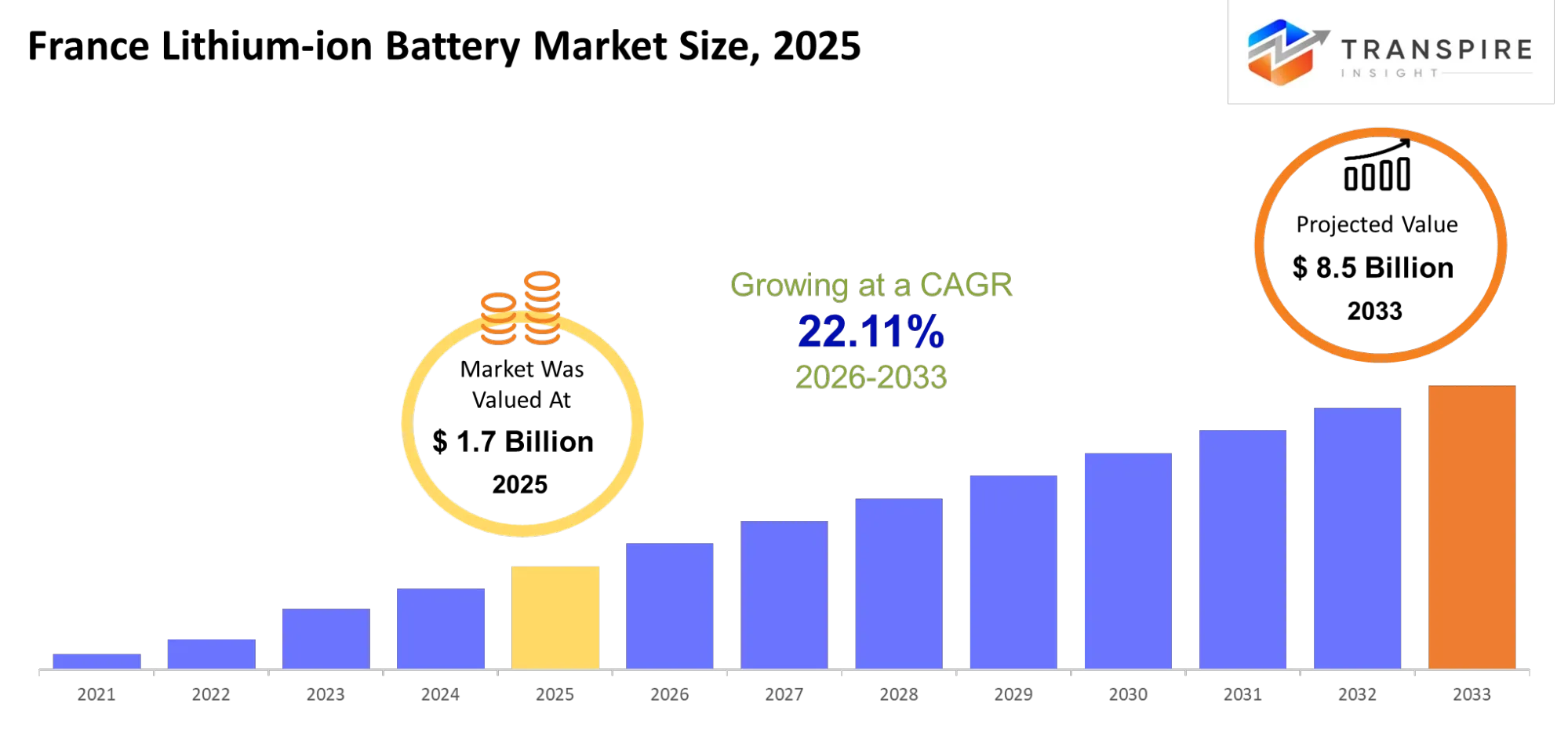
- France Lithium-ion Battery Market Size 2025: USD 1.7 Billion
- France Lithium-ion Battery Market Size 2033: USD 8.5 Billion
- France Lithium-ion Battery Market CAGR: 22.11%
- France Lithium-ion Battery Market Segments: By Type (LFP, NMC, LCO, Others); By Application (Electric Vehicles, Consumer Electronics, Energy Storage Systems, Others); By End-User (Automotive OEMs, Electronics Companies, Energy Sector, Others); By Capacity (Low, Medium, High, Others)
To learn more about this report,  Download Free Sample Report
France Lithium-ion Battery Market Summary
The France Lithium-ion Battery Market was valued at USD 1.7 Billion in 2025. It is forecast to reach USD 8.5 Billion by 2033. That is a CAGR of 22.11% over the period.
The France lithium-ion battery market plays a central role in powering electric mobility. This market supports renewable energy system stability. It enables industrial electrification across the transport sector and manufacturing sector and consumer electronics sector. The batteries deliver two benefits to customers. The batteries provide customers with high-density energy storage solutions for three applications. The market has shifted from import dependence toward European battery production during the past five years. This shift happened because France implemented its industrial decarbonization strategy together with the European Union's battery sovereignty program.
The 2022 energy crisis created supply chain disturbances which resulted from geopolitical tensions. This situation made Europe dependent on Asian cell suppliers and it drove European countries to build domestic gigafactories. Automotive manufacturers increase their electric vehicle production while utilities use more intermittent renewable energy to power national grids. Lithium-ion battery adoption has progressed from its initial use in specific applications to become essential for building infrastructure. The transition process is creating new long-term procurement contracts which will enhance revenue protection for battery manufacturers and recyclers and energy storage integrators.
Key Market Insights
- Northern France accounted for most of the regional battery investments during 2025 because gigafactory clusters produced more than 45 percent of the country's upcoming production facilities.
- Western France has become the leading rapidly developing battery manufacturing corridor because it combines renewable energy usage with industrial decarbonization programs until 2033.
- The France Lithium-ion Battery Market in 2025 established its largest market share through lithium nickel manganese cobalt batteries because automakers selected this battery type to achieve greater energy density in their electric vehicles.
- Lithium iron phosphate batteries experienced the strongest growth among battery chemistries after 2023 because of their stable raw material costs and better protection against overheating.
- French automotive manufacturers delivered more than 52 percent of total battery requirements during 2025 because they increased their production of electric vehicle models.
- Stationary energy storage systems achieved their highest growth rate after 2022 because French utilities developed renewable balancing systems to support their operations.
- The automotive manufacturing sector maintained its dominant position as the main customer group which controlled a large portion of the market because manufacturers expanded their electric vehicle production and required their fleets to switch to electric power.
- Industrial energy storage operators emerged as a rapidly expanding end-user category following large-scale renewable integration projects between 2023 and 2025.
- The companies Saft ACC Tesla LG Energy Solution and CATL established new European partnerships while developing their capacity to produce products locally.
- Battery manufacturers have started using recycling partnerships and silicon-anode research together with AI-based battery management systems to build competitive advantages while decreasing their product life expenses.
What are the Key Drivers, Restraints, and Opportunities in the France Lithium-ion Battery Market?
The France lithium-ion battery market experiences its fastest growth because European carbon reduction policies and electric mobility industrialization drive its development. The French government established purchase subsidies and fleet emission targets while building charging infrastructure and this combination of measures enabled automotive manufacturers to obtain long-term battery supply agreements. The policy-driven shift to electric vehicles resulted in major gigafactory projects for Northern France because companies needed to create domestic cell production capabilities which would decrease their Asian supply chain reliance. Localized battery production operations create better supply chain performance which allows manufacturers to maintain consistent product prices that lead to increased revenue for automotive and energy storage businesses.
The market faces its biggest challenge because Europe requires imported raw materials which include lithium and cobalt and graphite and nickel. European mining and refining operations and processing facilities continue to operate at low capacity because environmental permit requirements prevent new mining operations from starting. The situation creates ongoing risks which stem from changes in commodity prices and international conflicts. High raw material prices continue to decrease manufacturer profits while making batteries less affordable which especially impacts mid-range electric vehicles and stationary storage systems.
The recycling of batteries and second-life energy storage systems present businesses with a significant opportunity. France is expanding circular economy investments to recover lithium, nickel, and cobalt from used EV batteries. Advanced hydrometallurgical recycling technology developers have become essential partners for automakers who need domestic material sources which guarantee supply security. The trend will decrease the need for raw material imports which will establish a new section of the economy.
What Has the Impact of Artificial Intelligence Been on the France Lithium-ion Battery Market?
The lithium-ion battery industry in France undergoes transformation through artificial intelligence and advanced digital technologies which enhance manufacturing accuracy and battery performance assessment and product lifecycle management. The manufacturers of batteries now implement AI-based quality control systems which identify electrode coating faults and thermal anomalies and microstructural defects throughout the cell manufacturing process. The automated systems help gigafactories decrease material wastage while they enhance production output. Battery management systems now incorporate machine learning models which enable electric vehicles and stationary storage systems to optimize their charging processes while forecasting battery life and degradation.
Industrial energy storage operators and automotive manufacturers find predictive analytics to provide them with useful insights. AI-based forecasting systems evaluate temperature patterns and charging habits and usage levels to establish upcoming maintenance needs which will occur before any equipment failure happens. The system enhances operational dependability because it decreases downtime while it enables safer implementation of extensive battery systems. French energy operators use artificial intelligence to determine optimal times for grid-scale energy storage based on both renewable energy generation and electricity market trends which helps them use energy more efficiently while cutting their balancing expenses.
Organizations that want to implement artificial intelligence face two main challenges because they need to connect systems and they need to access essential data. The majority of predictive models need extensive operational data from real-world settings which currently exists in disjointed form throughout different manufacturing and energy distribution systems. The deployment process gets delayed for smaller battery integrators and mid-sized industrial users because they face two major challenges which include high implementation expenses and cybersecurity threats.
Key Market Trends
- French automakers developed procurement methods since 2021 which focused on domestic gigafactory partnerships instead of Asian imports to make their supply chains more reliable.
- Battery manufacturers after 2023 began to adopt lithium iron phosphate chemistry because they needed to produce cheaper batteries which had better thermal safety features.
- European countries between 2022 and 2025 increased their battery recycling investments because they aimed to decrease their need for imported critical minerals.
- Developers of energy storage systems combined their lithium-ion technology with solar and wind energy projects to create systems which would balance out the unpredictable nature of renewable power generation.
- Automotive original equipment manufacturers started using AI-based battery management systems to enhance their charging processes and prolong the operational time of electric vehicle batteries.
- European regulatory bodies required manufacturers to establish better procedures for tracing their sources of lithium cobalt and nickel materials starting in 2022.
- Verkor and Northvolt expanded their operations throughout France's new battery production area to accelerate their business development plans.
- Energy companies started to use retired electric vehicle batteries for stationary energy storage systems because they found value in second-life battery applications.
- To increase their energy density and charging speed capabilities manufacturers started using silicon-based anodes and conducting solid-state battery research activities.
- Digital twin technology developed in battery production facilities to enable manufacturers to test their process efficiency while identifying areas which lead to operational problems.
France Lithium-ion Battery Market Segmentation
By Type
The market shares LFP batteries because electric bus operators and entry-level electric vehicle manufacturers and stationary storage developers value thermal stability and lower production costs and longer cycle life. The strong safety performance of LFP chemistry combined with its lower cobalt requirement makes it suitable for large-scale energy storage projects and commercial mobility fleets that must maintain strict cost limitations. Battery manufacturers continue to grow their LFP production capacity because automotive companies need affordable battery solutions to support their mass-market electrification programs.
The market remains dominated by NMC batteries because they provide superior energy density and better performance for long-range electric vehicles and high-end automotive applications. NMC chemistry provides automotive OEMs with benefits that include faster acceleration and longer driving range and lightweight battery pack integration. Over the forecast period, LFP adoption will rise steadily in energy storage and mid-range mobility applications, while NMC technology will continue attracting investment for high-performance electric transport systems. LCO and other battery chemistries remain focused on portable electronics and specialized industrial systems and niche applications which require both compact size and consistent discharge performance.
By Application
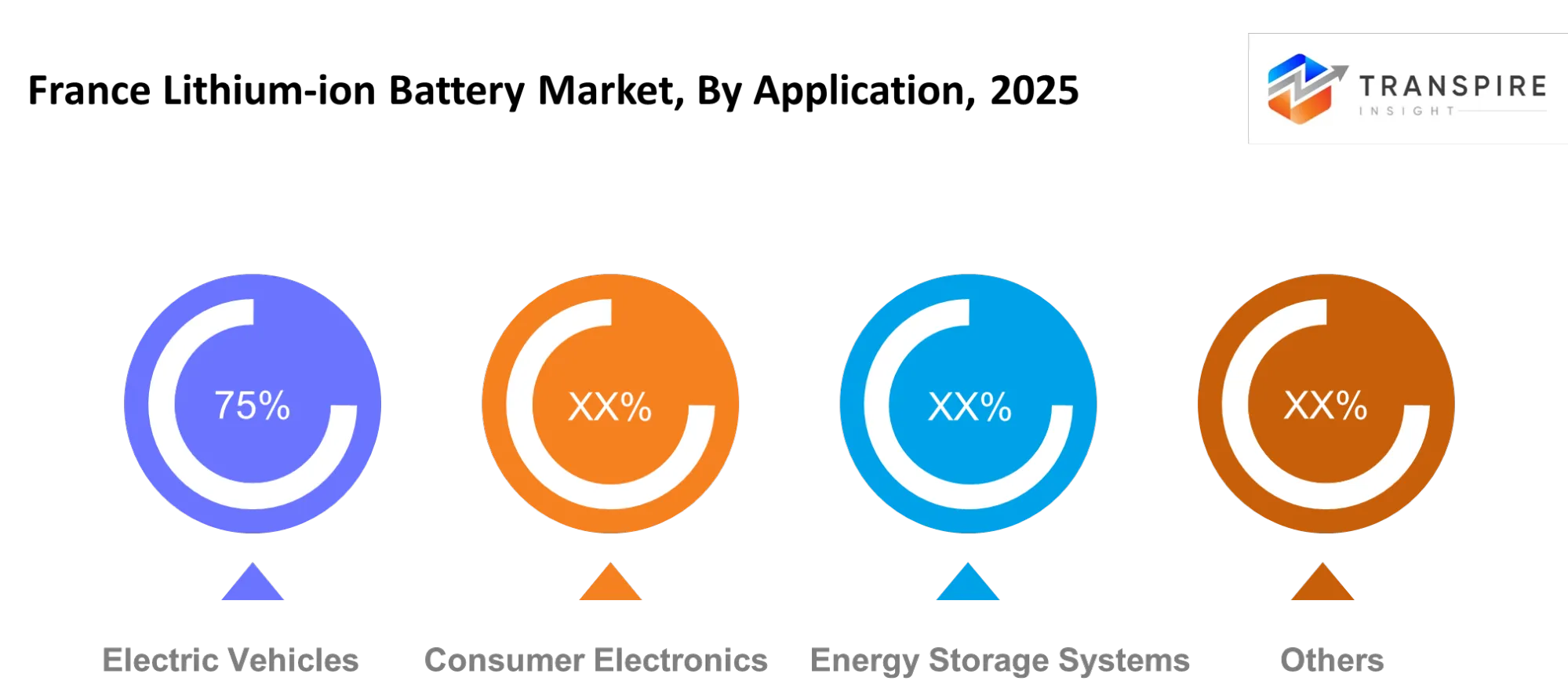
Electric vehicles represent the biggest portion of lithium-ion battery usage because car makers in France are increasing their production of passenger electric vehicles and electric delivery vans and commercial fleet vehicles. The government incentives together with fleet emission regulations and charging infrastructure development create continuous support for companies to purchase batteries from both domestic and international sources. Automotive manufacturers require high-capacity battery systems because they need solutions which can extend vehicle range and boost charging speed to remain competitive in the industry.
The market for consumer electronics remains stable because customers continue to purchase smartphones and laptops and wearable devices and wireless industrial equipment which needs small rechargeable power systems. Energy storage systems have become one of the fastest-growing application areas because utilities and industrial operators are building battery infrastructure to manage renewable power and their peak load needs. The Others category includes aerospace systems, medical equipment, and defense applications which need specialized energy storage performance and high operational reliability. The upcoming period will generate higher demand for advanced battery management systems and high-cycle-life battery technologies because grid-scale storage installations and commercial fleet electrification will increase their usage.
To learn more about this report, Download Free Sample Report
By End-User
OEMs represent the automotive industry through their role as the primary end-user groups who drive their electric vehicle production requirements through their need to purchase substantial quantities of batteries for their electric vehicle initiatives and their future manufacturing plans. The establishment of domestic electric vehicle production facilities together with local battery production sites has created stronger partnerships between automobile manufacturers and battery cell producers. Automotive companies in the European electric vehicle market regard battery performance together with charging speed and supply chain reliability as essential factors when making purchasing decisions.
Maintaining battery requirements at all times through production of consumer electronics and industrial handheld devices and smart devices with compact energy storage needs enables electronics companies to sustain their battery needs. The energy sector is experiencing rapid growth because renewable energy developers and utility operators are integrating lithium-ion storage systems into their smart grid and decentralized energy infrastructure projects. The Others category includes healthcare, aerospace, defense, and industrial automation sectors deploying batteries in specialized operational environments. The energy sector will gain market advantages through upcoming growth because France will expand its renewable energy projects and distributed power storage systems.
By Capacity
Medium-capacity batteries dominate the market because they provide electric passenger vehicles and industrial equipment and commercial backup systems with balanced energy density and operational flexibility and cost efficiency. Manufacturers prefer medium-capacity configurations for mainstream EV platforms and industrial storage systems which require them to maintain competitive weight and performance and affordability standards. Automotive and industrial sectors maintain constant demand which enables this category to sustain its high production levels.
High-capacity batteries are experiencing growth because their use is increasing in grid-scale storage systems and heavy commercial vehicles and renewable energy balancing infrastructure. Low-capacity batteries maintain steady demand across portable electronics and medical devices and compact industrial applications which require lightweight rechargeable power solutions. The Others category includes customized battery capacities which aerospace systems and defense equipment and specialized industrial machinery use. High-capacity battery investments will reach substantial growth throughout the forecast period because utilities and transportation operators are focusing on developing long-duration storage systems and high-power electrification solutions.
What are the Key Use Cases Driving the France Lithium-ion Battery Market?
The primary reason people in France use lithium-ion batteries is because they power electric vehicles. The main battery usage in the market comes from passenger electric vehicles and commercial delivery fleets and electric buses which require automakers to develop high-energy-density storage systems that meet European emission requirements while enabling longer vehicle operation. The ongoing establishment of electric vehicle manufacturing facilities throughout France generates sustained demand for battery procurement in the future.
Utilities and industrial operators are increasingly using stationary energy storage systems for applications beyond transportation. Renewable energy developers are increasingly deploying lithium-ion batteries with their solar and wind projects to regulate grid fluctuations and handle peak electricity usage. Manufacturing facilities and data centers are using battery storage systems to enhance energy resilience while protecting themselves from unpredictable energy costs.
The field of emerging applications now includes second-life battery programs and battery swapping system development. Companies are now using expired electric vehicle batteries to create commercial backup power systems and localized microgrid solutions. The logistics fleets of fast-charging operations and the transport sector of heavy-duty vehicles are testing battery swapping systems during the forecast period because they want to minimize their charging times while enhancing their operational productivity.
|
Report Metrics |
Details |
|
Market size value in 2025 |
USD 1.7 Billion |
|
Market size value in 2026 |
USD 2.1 Billion |
|
Revenue forecast in 2033 |
USD 8.5 Billion |
|
Growth rate |
CAGR of 22.11% from 2026 to 2033 |
|
Base year |
2025 |
|
Historical data |
2021 - 2024 |
|
Forecast period |
2026 - 2033 |
|
Report coverage |
Revenue forecast, competitive landscape, growth factors, and trends |
|
Regional scope |
France |
|
Key company profiled |
CATL, LG Energy Solution, Panasonic, Samsung SDI, BYD, SK On, Tesla, Northvolt, AESC, Saft, Toshiba, Sony, Hitachi, GS Yuasa, Farasis Energy |
|
Customization scope |
Free report customization (country, regional & segment scope). Avail customized purchase options to meet your exact research needs. |
|
Report Segmentation |
By Type (LFP, NMC, LCO, Others); By Application (Electric Vehicles, Consumer Electronics, Energy Storage Systems, Others); By End-User (Automotive OEMs, Electronics Companies, Energy Sector, Others); By Capacity (Low, Medium, High, Others) |
Which Regions are Driving the France Lithium-ion Battery Market Growth?
The central location for lithium-ion battery development in Northern France exists because the region contains the highest number of gigafactory facilities and automotive production systems in the country. The expansion of battery production throughout Hauts-de-France and its industrial corridors received acceleration through government industrial policies and EU funding programs. The region benefits from its location which provides access to major automotive manufacturing plants and distribution systems and export pathways that link France to European EV markets. The region maintains its dominant market position through its robust network of material suppliers and engineering companies and energy supply system providers.
Eastern France better supports market revenue generation through its industrial base which delivers both economic stability and diverse industrial output. Eastern France maintains operational manufacturing facilities and commercial energy storage systems which create industrial growth opportunities unlike Northern France which depends on new gigafactory facilities. Regional demand is supported by consistent investment from automotive suppliers, industrial operators, and grid modernization projects. The economic stability of the industrial base allows the market to depend on battery integration technologies and industrial electrification programs.
The development of renewable energy infrastructure and energy storage facilities has established Western France as the fastest growing regional market of its time. The implementation of offshore wind projects together with regional grid stabilization initiatives led to an increase in battery usage throughout coastal industrial areas after 2023. The region experienced increased battery requirements because of municipal transit electrification efforts and commercial fleet electrification upgrades. The growth trajectory of this market creates profitable business opportunities for investors which can lead to substantial returns.
Who are the Key Players in the France Lithium-ion Battery Market and How Do They Compete?
The French lithium-ion battery market now has technology-based competition which surpasses its previous cost-based competition. European localization regulations create new opportunities for regional manufacturers and strategic partnerships while Asian battery makers maintain control over most of the worldwide supply chain. Companies compete through battery chemistry innovation, charging performance, manufacturing scale, and long-term supply agreements with automotive OEMs. The cell manufacturing sector has moderate market consolidation, but new market entrants utilize their unique technologies and local production methods to compete against established players.
CATL uses its manufacturing capacity and fast development of innovative battery technologies which include sodium-ion batteries and ultra-fast charging systems to create a unique market position. The company develops strategic partnerships with both automotive manufacturers and energy storage companies while making significant investments in its European manufacturing facilities. LG Energy Solution competes through high-performance nickel-rich battery technologies designed for premium electric vehicles, supported by long-term contracts with global automotive manufacturers operating in Europe.
Northvolt operates European battery production facilities to create sustainable battery products through its low-emission manufacturing methods. The European automotive industry prefers the company's regional sourcing solution because it provides supply chain visibility and meets their regulatory needs. Saft specializes in industrial energy storage and aerospace and defense needs because these sectors require dependable systems which need specialized engineering design. Samsung SDI improves its market position by developing high-energy-density battery systems and creating advanced battery management technologies.
Company List
- CATL
- LG Energy Solution
- Panasonic
- Samsung SDI
- BYD
- SK On
- Tesla
- Northvolt
- AESC
- Saft
- Toshiba
- Sony
- Hitachi
- GS Yuasa
- Farasis Energy
Recent Development News
In April 2026, CATL launched its third-generation Shenxing and Qilin batteries alongside new sodium-ion technologies. The announcement strengthened competition in ultra-fast charging and next-generation battery chemistry markets while accelerating global commercialization timelines.http://www.electrive.com
In April 2026, CATL signed a strategic agreement with HyperStrong covering 60 GWh of sodium-ion battery supply for energy storage systems. The partnership marked one of the first large-scale commercial deployments of sodium-ion battery technology and expanded alternatives to lithium-dependent storage systems.http://www.prnewswire.com
What Strategic Insights Define the Future of the France Lithium-ion Battery Market?
The France lithium-ion battery market is structurally moving toward vertically integrated and regionally localized supply chains over the next five to seven years. The current market trend exists because Europe needs industrial sovereignty while expanding its electric vehicle production and implementing renewable energy storage solutions for grid operations.
European companies that operate complete battery systems through their control of production facilities and recycling centers and their ability to recover vital materials will achieve enhanced market pricing authority. The market faces an unforeseen threat because it increasingly depends on a limited number of global cell producers and essential mineral extraction companies. European gigafactory projects have invested substantial funds yet manufacturing companies still lack processing facilities within Europe which forces them to rely on external sources that face geopolitical risks and experience commodity pricing shifts.
The sodium-ion battery commercialization process brings forth a significant business opportunity for both stationary energy storage systems and commercial mobility solutions. Sodium-based systems will change energy storage economics whenever manufacturers achieve greater energy density and lower production costs. Market participants should invest early in recycling infrastructure, alternative chemistries, and AI-enabled battery lifecycle management platforms to strengthen long-term competitiveness and reduce supply chain exposure.
France Lithium-ion Battery Market Report Segmentation
By Type
LFP
NMC
LCO
Others
By Application
Electric Vehicles
Consumer Electronics
Energy Storage Systems
Others
By End-User
Automotive OEMs
Electronics Companies
Energy Sector
Others
By Capacity
Low
Medium
High
Others
Frequently Asked Questions
Find quick answers to common questions.
The estimated 2033 market size figure is USD 8.5 Billion.
Key segments for the France Lithium-ion Battery Market are By Type (LFP, NMC, LCO, Others); By Application (Electric Vehicles, Consumer Electronics, Energy Storage Systems, Others); By End-User (Automotive OEMs, Electronics Companies, Energy Sector, Others); By Capacity (Low, Medium, High, Others).
Major France Lithium-ion Battery Market players are CATL, LG Energy Solution, Panasonic, Samsung SDI, BYD, SK On, Tesla, Northvolt, AESC, Saft, Toshiba, Sony, Hitachi, GS Yuasa, Farasis Energy.
The France Lithium-ion Battery Market size is USD 1.7 Billion in 2025.
The France Lithium-ion Battery Market CAGR is 22.11% from 2026 to 2033.
- CATL
- LG Energy Solution
- Panasonic
- Samsung SDI
- BYD
- SK On
- Tesla
- Northvolt
- AESC
- Saft
- Toshiba
- Sony
- Hitachi
- GS Yuasa
- Farasis Energy
Recently Published Reports
-
Apr 2026
Fiber Optic Faceplates Market
Fiber Optic Faceplates Market Size, Share & Analysis Report By Type (< 300 mm2, 300-350 mm2, and > 350 mm2, By Application (Night Vision, Holographic Imaging, Medical, and Others), and Geography (North America, Europe, Asia-Pacific, Middle East and Africa, South and Central America), 2021 - 2031
-
Apr 2026
High Temperature Superconductors Market
High Temperature Superconductors Market Size, Share & Analysis Report By Type (1G HTS, and 2G HTS), By Application (Power Cable, Fault Current Limiter, and Transformer), and Geography (North America, Europe, Asia-Pacific, Middle East and Africa, South and Central America), 2021 - 2031
-
Apr 2026
Industrial Plugs and Socket Market
Industrial Plugs and Socket Market Size, Share & Analysis Report By Type (Industrial Plugs, Industrial Sockets), By Current (Up to 32 A, 32 to 125 A, Above 125 A), By Protection (Dustproof and Splash Proof, Waterproof, Explosion Proof), By End User (Heavy Industries, Oil and Gas, Chemicals and Pharmaceuticals, Power Generation, Others), and Geography (North America, Europe, Asia-Pacific, Middle East and Africa, South and Central America), 2021 - 2031
-
Apr 2026
InGaAs Avalanche Photodiodes Market
InGaAs Avalanche Photodiodes Market Size, Share & Analysis Report By Type (1100 - 1700 nm, and 1000 - 1600 nm), By Application (Missile Warning System, Muzzle Flash Detection, Wafer Defect Inspection, Laser Rangefinders, and Others), and Geography (North America, Europe, Asia-Pacific, Middle East and Africa, South and Central America), 2021 - 2031