

South Korea Mild Hybrid Vehicle Market Size & Forecast:
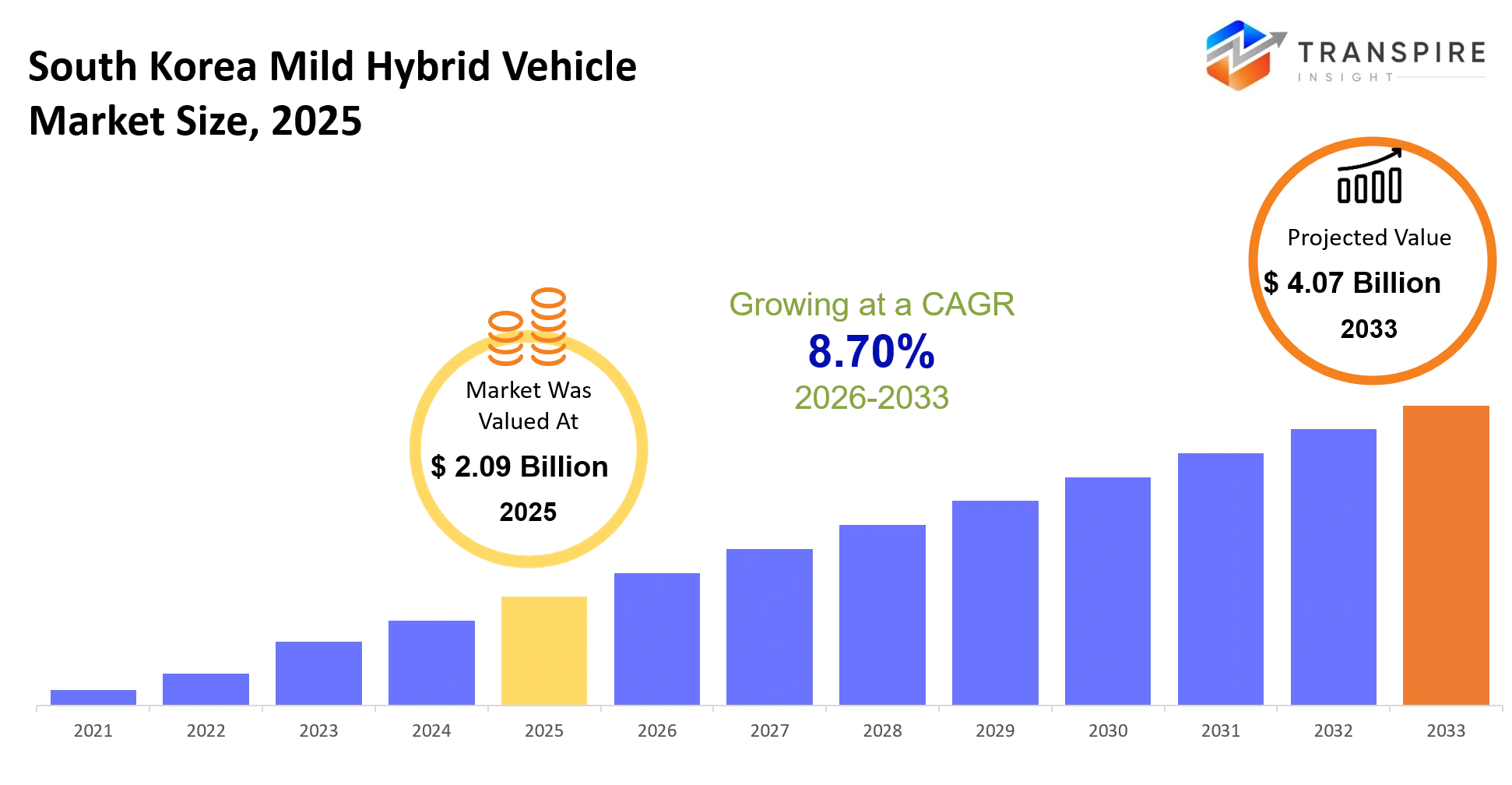
- South Korea Mild Hybrid Vehicle Market Size 2025: USD 2.09 Billion
- South Korea Mild Hybrid Vehicle Market Size 2033: USD 4.07 Billion
- South Korea Mild Hybrid Vehicle Market CAGR: 8.70%
- South Korea Mild Hybrid Vehicle Market Segments: By Vehicle Type (Passenger Cars, SUVs, Hatchbacks, Sedans, Luxury Vehicles, Light Commercial Vehicles, Crossovers, Others); By Voltage Architecture (12V, 24V, 48V, Dual Voltage Systems, Advanced Mild Hybrid Systems, Integrated Starter Generators, Belt-driven Systems, Others); By Fuel Type (Gasoline Hybrid, Diesel Hybrid, Flex Fuel Hybrid, Biofuel Hybrid, Turbo Hybrid, Performance Hybrid, Economy Hybrid, Others); By End User (Private Owners, Fleet Operators, Rental Companies, Corporate Users, Government Agencies, Ride-sharing Drivers, Commercial Operators, Others)
South Korea Mild Hybrid Vehicle Market Summary
The South Korea Mild Hybrid Vehicle Market was valued at USD 2.09 Billion in 2025. It is forecast to reach USD 4.07 Billion by 2033. That is a CAGR of 8.70% over the period.
The South Korea mild hybrid vehicle market focuses on facilitating vehicles that can help customers improve their fuel economy and reduce emission without significantly altering typical driving routines or depending solely on charging infrastructure. Mild hybrid powertrain, consist of a normal combustion engine and a small electric motor that is utilized during start stop system and provide power during acceleration, help recover energy on the fly and enable consumers to efficiently move in both urban and long distances areas. Within the last 5 years, mild hybrid cars, initially part of the luxury car portfolio, are now structurally distributed to common passenger vehicles.
As the market is seeing accelerating demand for less dependency on the complete electric solution that requires a solid charging infrastructure, the global chip shortage has amplified the focus on less complex electrified solutions. In the South Korea's milder fuel regulation context, mild hybrid solutions were developed in pace with new standards, growing the number of mild hybrid variants on offer and this is likely to result in larger revenue streams down the automobile value chain, which could provide an accelerated penetration as per the market players in this industry.
Key Market Insights
- The Seoul metropolitan region represented about 45% of the South Korea mild hybrid vehicle market size in 2025 owing to increasing vehicle ownership and premium car penetration.
- The Southern industrial areas emerged as one of the fastest growing South Korea mild hybrid vehicle markets and will witness a CAGR of 5.5% through 2032 owing to expanding automotive manufacturing and supplier ecosystem in the region.
- The Passenger Cars segment dominates market share with over 65% share in 2025 on the back of increased consumer demand for fuel efficient sedans and compact SUVs.
- Sport utility vehicles (SUVs) captured the second largest share and are expected to reach nearly 25% in 2025 post 2021 as 48V mild hybrid systems are integrated in these large body vehicles.
- Luxury mild hybrid vehicles will expand at the fastest growth rate during the forecast period as several premium players roll out electrified lineups including mild hybrid variants.
- Personal mobility applications held over 78% share in the South Korea mild hybrid vehicle market in 2025 owing to widespread personal usage of vehicles in the country and increasing need for convenient and fuel efficient vehicles.
- Fleet and corporate mobility will expand considerably through 2032 as corporate end-users look for lower running costs and optimized fleet operational costs.
- Individual consumers are anticipated to constitute a share of over 70% in 2025, whereas, the fastest growing customer segments are expected to be corporate fleet operators through the forecast years.
- South Korea's mild hybrid vehicle market is expected to transition from premium only hybrid vehicles to mild hybrid electric vehicles for masses.
- Technologies such as 48V battery systems, regenerative braking technology, and intelligent energy management software are expected to revolutionize the development of the future vehicles.
What are the Key Drivers, Restraints, and Opportunities in the South Korea Mild Hybrid Vehicle Market?
The South Korean Mild Hybrid Vehicle Market is predominantly driven by two factors: increased stringency in fuel economy and emission standards alongside increasing customer demand for electrified practical transport solutions. Auto manufacturers adopted an in-house solution of embedding a 48V mild-hybrid system into their current vehicle platform enabling them to achieve a 10-15 percent enhancement in fuel efficiency while mitigating charging infrastructure demands. This brought down the barrier to ownership and broadened avenues of revenue within both the premium and mass-market car segmentation.
Significant challenges exist in the form of underlying competition from BEVs. In the long run, BEVs will be favored by government incentive programs and government-induced carbon neutrality commitments restricting opportunities in this mild-hybrid segment to those which fit within wider policy objectives, this cannot be solved efficiently by automotive firms, the investment decisions for charging infrastructure and vehicle model designs span 5+ years in order to achieve compliance with government policies limiting revenue growth potential and vehicle adoption.
A significant future growth opportunity arises in the form of sophisticated intelligent hybrid vehicles integrating smart software-based AI-driven energy management systems with 48V architectures, such as that undertaken by Hyundai & Kia with the implementation of Software-Defined Vehicles to realize value beyond merely fuel efficiency by developing smart connected vehicles with optimal energy usage.
What Has the Impact of Artificial Intelligence Been on the South Korea Mild Hybrid Vehicle Market?
South Korean light-hybrid vehicle makers are leveraging artificial intelligence and digital technologies to improve powertrain efficiency, manufacturing capacity, and the overall intelligence of their vehicles. Companies are now implementing AI models to help balance power generation between their conventional gasoline engines and 48V battery systems. The models analyze real-world conditions – like driving behaviour, traffic jams, road gradient and even the amount of battery charge – in real time and automatically balance how the battery recharges and the electric motors assist the engine, which can achieve fuel efficiency gains of a few percentage points for regular driving.
“Automotive suppliers can help car manufacturers produce better, faster and cheaper intelligent vehicles, with AI helping them integrate more sophisticated energy management into powertrain development and predictive maintenance to prevent downtime for connected vehicles”, points out Siying Li, a senior analyst. Machine learning tools and processes are becoming common in the sector to enhance predictive maintenance in connected vehicles by continuously tracking battery performance, starter motor-generators, and brake systems. This makes it easier for automakers or repair services to detect impending system failures before they happen, boosting the amount of time a vehicle is operable and the accuracy of repair estimates.
AI-enabled visual inspection systems can shorten manufacturing lead times and facilitate more effective defect identification on production lines and help automate tasks currently performed by factory line workers or testers to rapidly integrate new hybrid car designs. However, AI in the vehicle development cycle is far from mainstream for every manufacturer. Costs of developing highly-integrated vehicle systems based on AI remains high, and there may still be insufficient real-time driving data available for machine learning models for less complex suppliers that still do not have sophisticated vehicle-level smart-manufacturing capabilities.
Key Market Trends
- 48V mild-hybrid technology, initially seen in luxury sedans, has made its way into smaller SUVs and volume passenger car segments by automakers since 2021.
- The price spike in fuels, seen in 2022, spurred buyers’ preference for hybrid SUVs and automakers revved up the introduction of electric models.
- In the period from 2023 to 2025, Hyundai and Kia poured significant funds into software-defined vehicle technology which allows for the use of advanced energy-saving systems in its hybrids.
- The COVID-19 pandemic highlighted the weaknesses in imported batteries and semiconductors, prompting local players to build relationships with domestic battery suppliers.
- European luxury vehicle manufacturers rolled out a wide range of mild-hybrid vehicles as they moved toward making vehicle electrification standard rather than a premium option.
- Over the last five years, the effectiveness of regenerative braking systems has been refined to maximize energy recuperation.
- In terms of market demand, today’s buyers tend to look at total cost of ownership rather than mere purchase price of vehicles, thus shifting consumer interests in car makers’ offerings.
- It is less about solely engine prowess and much more about integrated systems such as connected-car technology, electrified powertrain, and software for vehicle intelligence.
- Makers are actively employing vehicle weight reduction technology and structural optimisation with which they aim to save even more energy and prolong vehicle efficiency gains achieved by their mild-hybrid solutions.
South Korea Mild Hybrid Vehicle Market Segmentation
By Vehicle Type:
Passenger Cars continue to lead the pack with their compact size, good mileage, and practicality in daily urban commutes. SUVs and Crossovers keep pulling in customers seeking additional space inside as well as commanding road presence. The steady popularity of sedans and Hatchbacks stems from a judicious blend of price and economy of use.
Luxury Vehicles concentrate on comfort, refined ride, and high-quality driving dynamics complemented by incorporating a mild-hybrid system for higher fuel efficiency. Light Commercial Vehicles cater to business transports as well as goods delivery and distribution systems that require increased efficiency and operational cost reduction.Other vehicle segments fulfill more specific use cases, and together they should contribute to increased market expansion.
By Voltage Architecture:
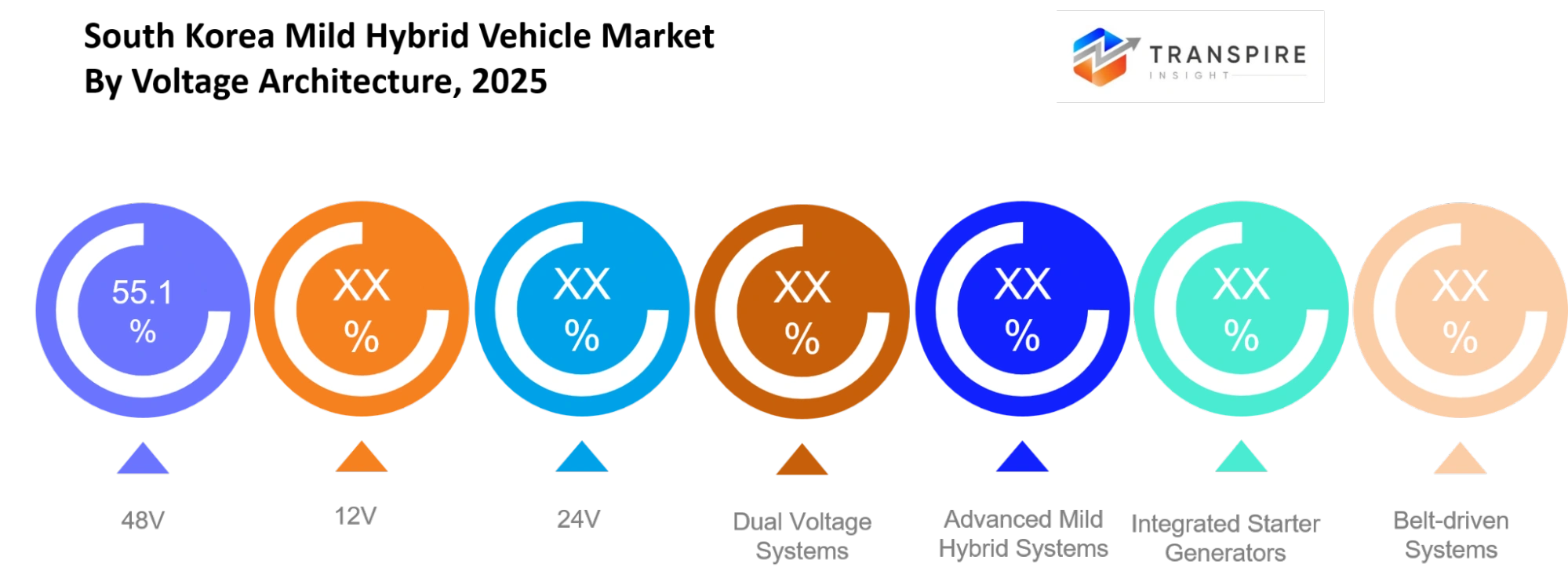
A 12V voltage architecture for entry level mild hybrid due to its ease of integration, and lower cost. A 24V for better energy recuperation and energy support in the power system of certain models. A 48V architecture that has been seeing greater adoption as efficiency benefits, and more powerful acceleration performance create an ever more compelling value proposition across all models.
Dual Voltage Systems to combine the advantages of multiple voltage architectures. Intelligent Mild Hybrid Systems and sophisticated battery control, and energy recuperation. Belt driven systems or integrated starter generators offering enhanced performance and smoother start-stop operation. The list goes on with innovations constantly being introduced in a changing, increasingly electric landscape for light commercial vehicles.
By Fuel Type:
A large number of Gasoline Hybrid vehicles because it is easy for gasoline engines to integrate with mild-hybrid systems and help reduce emissions. Diesel Hybrid vehicles are useful in specific use cases because higher torques can be used for vehicles needing long drive ranges. In the Flex Fuel and Biofuel Hybrid category you'll see new alternatives being brought forth, following people's preferences on what fuels to use. For example, many manufacturers are bringing more hybrid options into fuel-efficient compact cars under Economy Hybrid cars.
Turbo Hybrid helps people to enjoy both performance and fuel saving at the same time while Performance Hybrid is meant for customers interested in better acceleration and a smoother drive. Various other Fuel category hybrids are still growing and developing while manufacturers are looking for the best possible powering technologies of the near future.
By End User:
Private Owners are the largest market for purchases since fuel efficiency and reduced running costs contribute to customer decision making. Fleet Operators also want to minimize fuel expenses on large vehicle fleets. Rental companies are rapidly embracing mild hybrid vehicle designs to help with overall utilization rates and fuel costs as more efficient choices for vehicle rentals.
Corporations are investing in fleets that emphasize fuel efficiency to help with business travel and employee mobility. Government Departments have sustainability incentive programs that promote such vehicle use, while Ride-sharing Drivers and Commercial Operators simply want reliable vehicles that do not cost a fortune to run. End-use customers Other end-use consumers are helping grow market diversity due to growing accessibility of the technology.
What are the Key Use Cases Driving the South Korea Mild Hybrid Vehicle Market?
The most obvious use case of mild-hybrid technology in South Korea is as a mode for everyday passenger travel particularly in urban and sub-urban settings where economy and emissions are the primary concern. Users opt for mild hybrid as such a system uses electric power along with conventional ICE power while operating through recuperation in such a way as not to change the driving behavior while completely eliminating the need for a recharge infrastructure.
Other areas such as Corporate transport and Fleet vehicles is a rapidly growing use segment, which includes taxi and rent-a-car firms and business fleets looking for reduced running costs and better Corporate image on the green front. Small S.U.V and Cross overs with mild-hybrid technology are now being made available and marketed towards the segment of society seeking practicality with an improved economy.
New and emerging use cases being introduced for the mild-hybrid includes the luxury performance vehicle sector, also in hybrid integrated infotainment features and other advanced vehicular features being tested and launched.
|
Report Metrics |
Details |
|
Market size value in 2025 |
USD 2.09 Billion |
|
Market size value in 2026 |
USD 2.27 Billion |
|
Revenue forecast in 2033 |
USD 4.07 Billion |
|
Growth rate |
CAGR of 8.70% from 2026 to 2033 |
|
Base year |
2025 |
|
Historical data |
2021 - 2024 |
|
Forecast period |
2026 - 2033 |
|
Report coverage |
Revenue forecast, competitive landscape, growth factors, and trends |
|
Country scope |
South Korea |
|
Key company profiled |
Hyundai Motor, Kia, Toyota, Honda, Suzuki, Nissan, BMW, Mercedes-Benz, Audi, Volvo, Stellantis, Renault, Geely, Ford, Mazda |
|
Customization scope |
Free report customization (country, regional & segment scope). Avail customized purchase options to meet your exact research needs. |
|
Report Segmentation |
By Vehicle Type (Passenger Cars, SUVs, Hatchbacks, Sedans, Luxury Vehicles, Light Commercial Vehicles, Crossovers, Others); By Voltage Architecture (12V, 24V, 48V, Dual Voltage Systems, Advanced Mild Hybrid Systems, Integrated Starter Generators, Belt-driven Systems, Others); By Fuel Type (Gasoline Hybrid, Diesel Hybrid, Flex Fuel Hybrid, Biofuel Hybrid, Turbo Hybrid, Performance Hybrid, Economy Hybrid, Others); By End User (Private Owners, Fleet Operators, Rental Companies, Corporate Users, Government Agencies, Ride-sharing Drivers, Commercial Operators, Others) |
Which Regions are Driving the South Korea Mild Hybrid Vehicle Market Growth?
The Vehicle Market is a dynamic one as the high vehicle ownership, consumer purchasing power, and the rapid adoption of cutting-edge automotive technology has aided in increasing vehicle ownership. Driven by increasing environmental awareness & regulations for decreasing emissions & the higher vehicle ownership in the Korean Market have led to increased adoption of Mild Hybrid Vehicle & Passenger car & premium vehicle segments. The automotive supply chain in Korea has well-established research facilities, vehicle testing centres, automotive dealers & service outlets for increasing its efficiency and facilitating faster product launches.
The positive consumer sentiments and ease of financing would allow it to retain leadership in regional revenue growth. The southeastern region is growing in steady terms through an efficient industrial base & long term investments; it houses cities like Busan and Ulsan with large Automotive industries which include plants and suppliers in the integrated automotive ecosystem of Korea. The growth here can be linked to increasing automotive production, unlike the Seoul Capital Region whose growth can be related more to consumerism & automotive sales.
These regions are a steady contributor due to long term production capacities & stable logistics for the vehicle in the region. The Central & Southwest region is expected to be growing fastest due to continuous infrastructural development in roads and infrastructure and mobility demand will increase. Growth due to expansion in cities and increase in the level of comfort due to rise in the supply of advanced products and mild hybrid vehicles will offer manufacturers, suppliers & other stakeholders the prospect of new customers during the 2026-33 period.
Who are the Key Players in the South Korea Mild Hybrid Vehicle Market and How Do They Compete?
The mild hybrid car industry in South Korea is somewhat concentrated in that domestic automakers continue to assert firmholds, whilst overseas firms vie for consumer loyalty with technology and value-oriented high-quality models. Key competition areas include fuel economy, smart powertrain configurations, automotive performance, and prices. Key automakers have already strengthened brand value through various hybrids that enable them to maintain their respective shareholders, whereas international marques are distinguishing themselves with technical perfection and luxury-oriented amenities. Battery system innovations, software developments, and connected vehicle systems are an upcoming catalyst influencing competition amongst top players.
Hyundai Motors, a South Korean auto maker, emphasizes technology development by introducing and deploying innovative 48V systems and sophisticated fuel management software to its vast product lineup across varied segments. Through an extensive lineup of models coupled with its extensive domestic production and cost efficiencies Hyundai is positioned to promptly debut new vehicles at affordable prices. Hyundai’s competitor, Kia Corporation, also follows a similar development philosophy, while highlighting sport utility vehicles and sleek design principles to win over younger purchasers and broader demographic segments.
German automakers BMW and Mercedes-Benz differentiate themselves through premium mild-hybrid selections that successfully pair both performance and economy. BMW and Mercedes-Benz are continuing their investments in connected services, digitally integrated cockpits, and sophisticated automated driving systems, thereby gaining significant differentiating qualities on the consumer’s demand list, which goes way beyond the issue of fuel costs and consumption. Through their ongoing efforts in product development and the continued growth in the electrification sector, the brands will reinforce their respective strong stances.
Company List
- Hyundai Motor
- Kia
- Toyota
- Honda
- Suzuki
- Nissan
- BMW
- Mercedes-Benz
- Audi
- Volvo
- Stellantis
- Renault
- Geely
- Ford
- Mazda
Recent Development News
In April 2025, Hyundai Motor Group unveiled its next-generation hybrid powertrain system. The company introduced a new dual-motor transmission and expanded hybrid technology to multiple vehicle classes, strengthening fuel efficiency and accelerating electrification across the South Korean automotive market. Sourcehttps://www.hyundai.com/
In April 2026, Kia announced a long-term investment strategy to expand global hybrid vehicle sales to 1.1 million units annually by 2030 and double its hybrid lineup. The investment commitment highlights the growing importance of hybrid technologies within Kia's product portfolio and supports further development of electrified vehicles originating from South Korea. Source https://www.caranddriver.com/
What Strategic Insights Define the Future of the South Korea Mild Hybrid Vehicle Market?
The South Korea Mild Hybrid Vehicle Market will enter a more software-centric and efficiency-focused era during the coming five to seven years. The future growth of the market is heavily dependent on the manufacturers’ ability to systematically implement and integratesmart energy management and advanced 48V technologies to lightweight vehicles as a norm across vehicle models.
Underlying motive: It is a practical answer to increasing regulatory pressure, stringent emissions limits and an increasing appetite for electrification without compromising consumers’ budgets or charging needs. As more BEV-related options are emerging, it is possible to find substitution risks over the longer term. When BEVs start becoming more cost-competitive and the number of chargers are increasing, it is feasible for hybrid systems to reach constraints at higher segments where electrification becomes more of an economic alternative to the mild-hybrid option.
In addition, opportunities exist in using smart technologies such as AI with the future-integrated hybrid powertrain technology in order to optimise the driving patterns of future vehicles and to achieve further efficiencies, to take leverage in the early investment in software skills and to build the foundation for stronger vehicle intelligence by creating strategic partnerships in addition to already installed hybrid vehicle technology.
South Korea Mild Hybrid Vehicle Market Report Segmentation
By Vehicle Type
- Passenger Cars
- SUVs
- Hatchbacks
- Sedans
- Luxury Vehicles
- Light Commercial Vehicles
- Crossovers
By Voltage Architecture
- 12V
- 24V
- 48V
- Dual Voltage Systems
- Advanced Mild Hybrid Systems
- Integrated Starter Generators
- Belt-driven Systems
By Fuel Type
- Gasoline Hybrid
- Diesel Hybrid
- Flex Fuel Hybrid
- Biofuel Hybrid
- Turbo Hybrid
- Performance Hybrid
- Economy Hybrid
By End User
- Private Owners
- Fleet Operators
- Rental Companies
- Corporate Users
- Government Agencies
- Ride-sharing Drivers
- Commercial Operators
Frequently Asked Questions
Find quick answers to common questions.
The South Korea Mild Hybrid Vehicle Market size is USD 4.07 Billion in 2033.
Key segments for the South Korea Mild Hybrid Vehicle Market are By Vehicle Type (Passenger Cars, SUVs, Hatchbacks, Sedans, Luxury Vehicles, Light Commercial Vehicles, Crossovers, Others); By Voltage Architecture (12V, 24V, 48V, Dual Voltage Systems, Advanced Mild Hybrid Systems, Integrated Starter Generators, Belt-driven Systems, Others); By Fuel Type (Gasoline Hybrid, Diesel Hybrid, Flex Fuel Hybrid, Biofuel Hybrid, Turbo Hybrid, Performance Hybrid, Economy Hybrid, Others); By End User (Private Owners, Fleet Operators, Rental Companies, Corporate Users, Government Agencies, Ride-sharing Drivers, Commercial Operators, Others).
Major South Korea Mild Hybrid Vehicle Market players are Hyundai Motor, Kia, Toyota, Honda, Suzuki, Nissan, BMW, Mercedes-Benz, Audi, Volvo, Stellantis, Renault, Geely, Ford, Mazda.
The South Korea Mild Hybrid Vehicle Market size is USD 2.09 Billion in 2025.
The South Korea Mild Hybrid Vehicle Market CAGR is 8.70% from 2026 to 2033.
- Hyundai Motor
- Kia
- Toyota
- Honda
- Suzuki
- Nissan
- BMW
- Mercedes-Benz
- Audi
- Volvo
- Stellantis
- Renault
- Geely
- Ford
- Mazda
About the Authors

Mayur Shinde
I am Mayur Shinde, a Senior Research Analyst at Transpire Insight, specializing in the Automotive & Transportation and Information & Communication Technology (ICT) Industry. My work focuses on analyzing emerging market trends, technological advancements, competitive landscapes, and industry developments to deliver accurate, data-driven insights. I am passionate about transforming complex market information into clear, actionable content that helps businesses, professionals, and decision-makers stay informed and make confident strategic decisions.

Chakradhar Khansole
Chakradhar serves as the Research Director at Transpire Insight, bringing over 8 years of experience in technology, innovation, and strategic market intelligence. He specializes in transforming complex market data into actionable business insights that enable organizations to make informed, growth-oriented decisions. Recognized for his strategic vision and analytical expertise, Chakradhar leads high-impact research initiatives, delivering comprehensive market assessments, competitive intelligence, and forward-looking industry analysis.
Recently Published Reports
-
Apr 2026
ATV & UTV Market
ATV & UTV Market Size, Share & Analysis Report By Type (ATV, and UTV), By Variants (Less Than 400 CC, 400 CC To 800 CC, and More Than 800 CC), and Geography (North America, Europe, Asia-Pacific, Middle East and Africa, South and Central America), 2021 - 2031
-
Apr 2026
Automotive Central Gateway Module Market
Automotive Central Gateway Module Market Size, Share & Analysis Report By Type (Ethernet Central Gateway Module, CAN Central Gateway Module, LIN Central Gateway Module, and FlexRay), By Application (Powertrain Control, Body Control, Infotainment System, Advanced Driver Assistance Systems (ADAS), and Others), By End User (Passenger Vehicles, and Commercial Vehicles), and Geography (North America, Europe, Asia-Pacific, Middle East and Africa, South and Central America), 2021 - 2031
-
Apr 2026
Automotive Engine Oil Filter Market
Automotive Engine Oil Filter Market Size, Share & Analysis Report By Filter Type (Fuel Filter, Engine Oil Filter, Hydraulic Oil Filter, and Others), By Filter Media (Cellulose, Synthetic, and Micro), By Sales Channel (OEMs, and Aftermarket), By Vehicle Type (Passenger Cars, Light Commercial Vehicles, Heavy Duty Trucks, Buses and Coaches, and Off-road Vehicles), and Geography (North America, Europe, Asia-Pacific, Middle East and Africa, South and Central America), 2021 - 2031
-
Apr 2026
Automotive Parts Aluminium Die Casting Market
Automotive Parts Aluminium Die Casting Market Size, Share & Analysis Report By Production Process (Pressure Die Casting, Vacuum Die Casting, Squeeze Die Casting, Gravity Die Casting), By Application (Body Parts, Engine Parts, Transmission Parts, Battery And Related Components, Other Application Types), and Geography (North America, Europe, Asia-Pacific, Middle East and Africa, South and Central America), 2021 - 2031
Our Clients



