
Europe High Voltage Battery Market Size & Forecast:
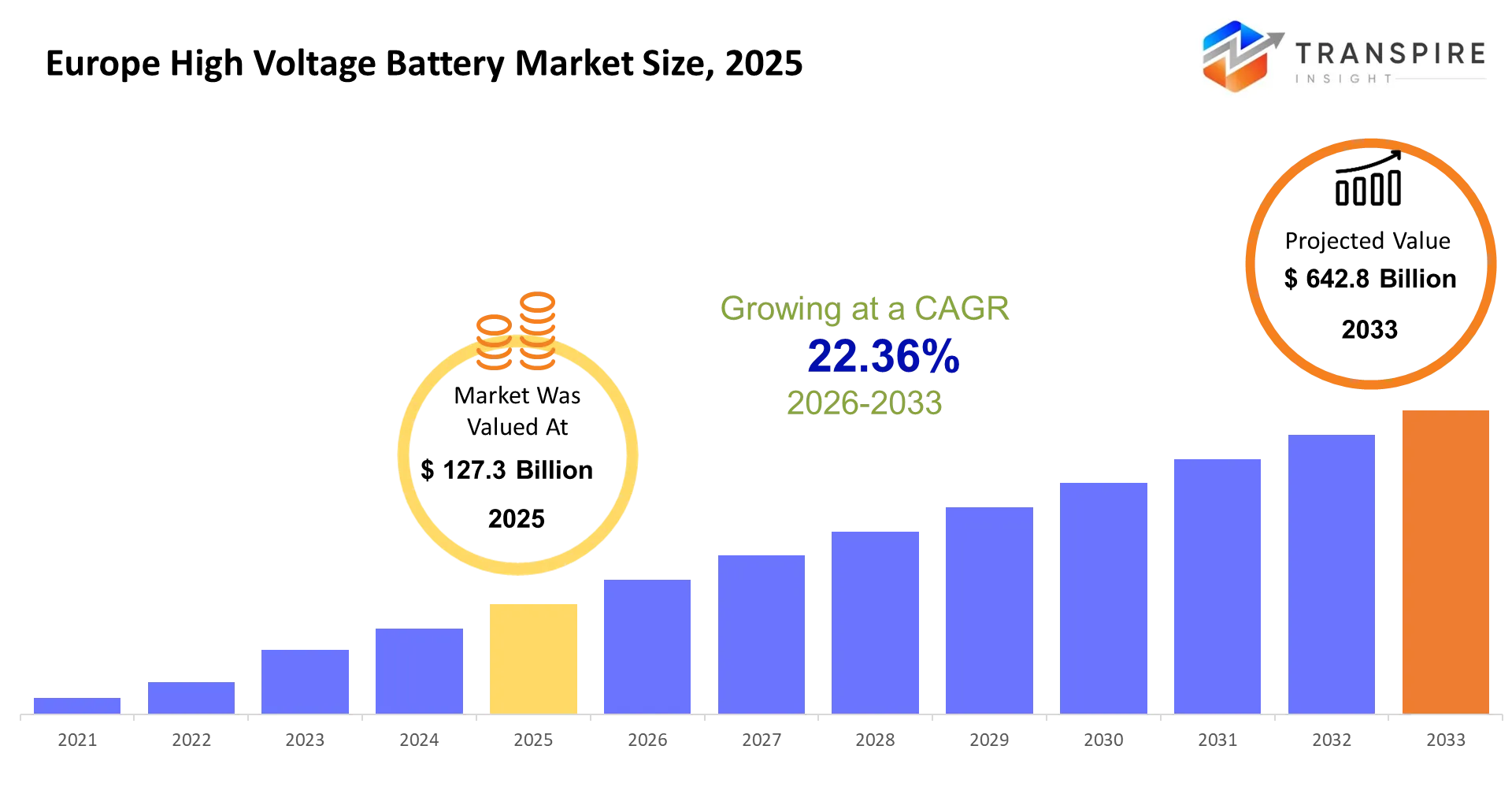
- Europe High Voltage Battery Market Size 2025: USD 127.3 Billion
- Europe High Voltage Battery Market Size 2033: USD 642.8 Billion
- Europe High Voltage Battery Market CAGR: 22.36%
- Europe High Voltage Battery Market Segments: By Type (Lithium-ion Batteries, Solid-state Batteries, Nickel-based Batteries, Lead-acid Batteries, Others); By Application (Electric Vehicles, Energy Storage Systems, Industrial Equipment, Others); By End-User (Automotive OEMs, Energy Companies, Industrial Users, Others); By Component (Cells, Modules, Battery Packs, BMS, Others)
To learn more about this report,  Download Free Sample Report
Europe High Voltage Battery Market Summary
The Europe High Voltage Battery Market was valued at USD 127.3 Billion in 2025. It is forecast to reach USD 642.8 Billion by 2033. That is a CAGR of 22.36% over the period.
High voltage batteries serve as essential components for Europe's electrification drive because they provide power to electric vehicles and maintain stability in power grids that rely on renewable energy and they enable industrial facilities to operate which requires high energy consumption. The systems provide solutions to real-world problems which automotive manufacturing and logistics fleets and utilities and industrial automation environments face regarding their fuel dependence and emission regulations and energy efficiency requirements.
During the previous five years the market has transitioned from its focus on automotive battery deployment to adopt an energy infrastructure model which integrates both grid-scale storage and industrial electrification systems. The European Union established a more stringent carbon emission system which requires better compliance from companies while implementing the internal combustion vehicle sales ban that starts in 2035 which created urgent demand for automakers to increase their battery purchasing and domestic manufacturing capabilities. The Russia-Ukraine conflict caused supply chain interruptions which revealed Europe's reliance on energy and battery material imports which led to investments in domestic gigafactories and recycling plants. The combination of policy requirements and energy security issues and the growth of local manufacturing operations drives higher adoption rates which generate sustainable revenue streams for both the transportation and power industries.
Key Market Insights
The Europe High Voltage Battery Market in 2025 will reach 45% market share because Western Europe will grow its market through Germany's gigafactory development and its strong electric vehicle production network.
* The fastest expanding area until 2030 in Northern Europe experiences this growth because Norway and Sweden are advancing their complete electric vehicle adoption and building clean energy power networks.
* The Europe High Voltage Battery Market uses lithium-ion batteries as its primary technology because more than 90% of electric vehicles depend on this battery type and the market has established its capacity for large-scale production.
* The solid-state battery systems market represents the most rapidly developing segment which will grow after 2027 when safety measures and energy density enhancements make products ready for commercial distribution.
* The Europe High Voltage Battery Market attributes more than 70% of its demand to electric vehicles which maintain automotive market dominance while other segments show growth.
* Energy storage systems represent the most rapidly expanding application area because wind and solar power face operational challenges in Germany and Spain and the Nordic region.
* The automotive original equipment manufacturers (OEMs) control about 60% of the market because Volkswagen and BMW and Stellantis implement their electrification initiatives throughout Europe.
* Energy firms are increasing their purchasing activities because grid modernization projects and extended storage capacity building efforts are backing their operations.
* The Europe High Voltage Battery Market gets shaped by key companies such as CATL LG Energy Solution Panasonic Northvolt Samsung SDI and Tesla.
* Strategic competition grows through companies expanding their gigafactory networks while they develop new battery technologies and build long-lasting supply chain relationships with original equipment manufacturers.
What are the Key Drivers, Restraints, and Opportunities in the Europe High Voltage Battery Market?
Driver:
The European Union's strict carbon emission regulations combined with the 2035 internal combustion engine ban have forced automotive industry operations to switch from traditional vehicles to electric power systems and vehicle-to-grid technology. Major automotive manufacturers including Volkswagen and Stellantis have increased their electric vehicle production plans because of this policy framework, which leads to greater demand for high voltage battery systems used in passenger and commercial vehicle fleets. The company experiences revenue growth, which depends on the schedule of regulatory compliance requirements because original equipment manufacturers need to increase their material purchases before new fleet-average emission regulations begin.
Restraint:
The supply chain for essential battery materials such as lithium, nickel, and graphite faces permanent limitations because of its high concentration in particular materials. The European Union requires manufacturers to depend on imported materials from China and Australia and South America, which exposes them to both price fluctuations and geopolitical risks. The dependency which exists forces manufacturers to spend more money on materials while their ability to manufacture goods enters a state of delay, especially those suppliers who operate in the mid-sized range and do not have permanent material supply contracts. The government provides strong policy support which leads to restricted profit margins and increased time needed to establish local gigafactory operations.
Opportunity:
The development of large-scale energy storage systems which connect with renewable energy power plants creates a significant business opportunity for companies operating in Germany and Spain and Nordic countries. Utility companies are increasing their spending on grid balancing projects because the growing use of offshore wind and solar energy creates new challenges with intermittent power supply. Germany's upcoming multi-gigawatt battery storage corridors demonstrate how high voltage systems can support national grid stability while generating long-lasting power needs that extend beyond vehicle usage.
What Has the Impact of Artificial Intelligence Been on the Europe High Voltage Battery Market?
Artificial intelligence and advanced digital systems are creating new pathways for better scrubber operations and more efficient electric propulsion systems through enhanced control systems and their capacity to analyze operational performance. AI technology now enables automated systems to monitor exhaust gas cleaning systems in real time which control flow rates and water consumption and energy usage according to the ship's load and operational situations. Fleet operators use integrated dashboards to track compliance with IMO 2020 sulphur limits and regional European port regulations, which reduces manual reporting workload and enhances their ability to prepare for audits.
Machine learning models are implemented for predictive maintenance in high-voltage battery systems which power hybrid and electric vessels, using temperature and voltage and cycling pattern sensor data to predict battery system degradation. Shipping companies and industrial operators report improved uptime of around 10–15 percent in early deployments because optimized charging cycles and fewer unplanned failures. AI-driven energy management systems enhance fuel efficiency by automatically adjusting the use of batteries and auxiliary engines according to the requirements of short-sea shipping operations.
The main obstacle to adoption exists because real-world maritime data quality continues to fluctuate between different locations. The combination of extreme environmental conditions and irregular satellite communication and diverse sensor technology standards decreases model performance while hindering the complete implementation of systems throughout maritime fleets.
Key Market Trends
- Automakers accelerated their electric vehicle platform development after the European Union implemented emission regulations in 2021.
- They stopped their hybrid vehicle development plans to focus on creating complete battery electric vehicle systems.
- The period between 2023 and 2025 showed that lithium-ion technology maintained its market dominance because solid-state technology only achieved prototype development.
- The German and Hungarian Gigafactory expansion projects increased local battery cell production capacity, which decreased Europe's need to import battery cells from Asian countries.
- Energy utilities expanded grid storage procurement after 2023 renewable volatility spikes exposed balancing challenges across national electricity networks.
- European cities experienced a significant increase in electric bus usage after 2022 when zero-emission zones replaced diesel buses in public transportation systems.
- The development of battery management systems progressed from basic monitoring systems in 2020 to AI-based safety assessment solutions by 2025.
- The industrial electrification sector experienced rapid growth because mining and manufacturing companies switched from diesel machinery to high-voltage battery systems after 2021.
- The number of OEM-battery joint ventures increased after 2022 because supply chains moved from short-term transactions to permanent integrated business relationships.
- The EU battery regulation of 2024 required suppliers to meet stricter sustainability standards, which led to the growth of recycling and second-life battery initiatives.
Europe High Voltage Battery Market Segmentation
By Type:
Lithium-ion batteries dominate the type segment because they possess established supply chains and high energy density and car makers use them in their vehicles. European gigafactories produce electric vehicles at high levels which strengthens their market position while their larger production capacity creates cost savings that make them more competitive than other battery technologies.
Solid-state batteries and nickel-based systems are being recognized as future technologies and temporary solutions because they provide better safety and they meet higher performance standards which premium vehicles and specialized industrial systems require. Lead-acid batteries have become less useful for high voltage applications because they show lower efficiency while their weight restrictions make them suitable only for traditional systems and affordable backup power solutions.
Lithium-ion technology will remain the primary power source until the market adopts solid-state batteries which will transform the premium electric vehicle market and the high-performance segment during the forecast period. The material innovators and OEMs will establish their main objectives as safety and charging speed and lifecycle performance enhancements whereas investors will concentrate on developing chemistry solutions for large-scale production.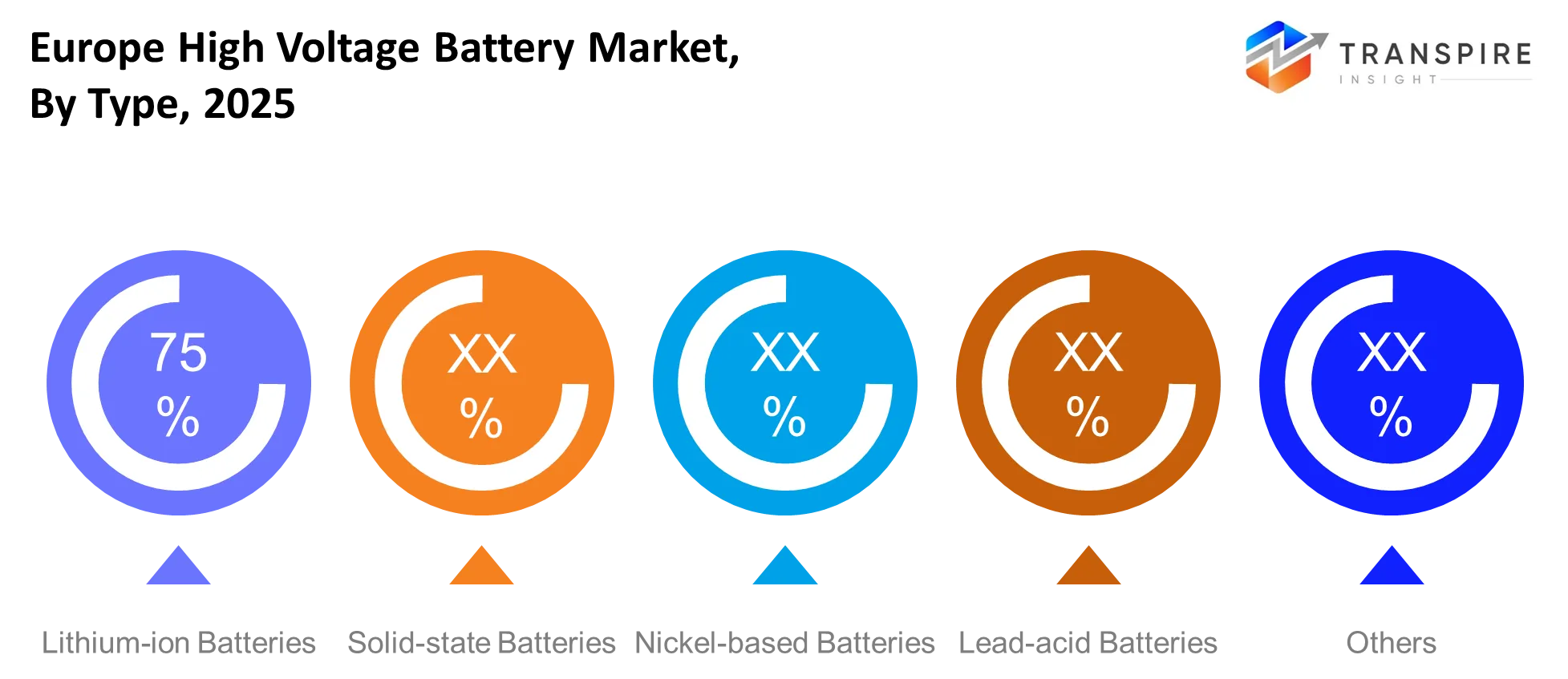
To learn more about this report, Download Free Sample Report
By Application:
The primary use of electric vehicles exists because EU emissions regulations require vehicle manufacturers to switch their fleets to electric power while they implement their plans to stop producing internal combustion engines. The majority of demand comes from passenger electric vehicles and light commercial vehicles because charging stations are being installed throughout key European transportation routes.
The secondary applications of energy storage systems and industrial equipment are becoming more important. The expansion of grid stabilization projects occurs together with increased renewable energy usage and industrial enterprises implement high voltage systems in their manufacturing and mining operations to boost productivity and decrease work interruptions.
Renewable grid energy storage systems and smart infrastructure systems will drive future development needs. Market participants are expected to diversify beyond automotive exposure, with utilities and industrial operators becoming key buyers as energy transition policies intensify across Europe.
By End-User:
The automotive OEMs lead the market share among end-users because European manufacturers and battery producers have formed large-scale electrification partnerships. The Europe high voltage battery market maintains its market leadership because companies use backward integration and lengthy procurement agreements to their benefit.
Energy companies and industrial users are expanding their influence as electrification spreads beyond transportation. Utilities invest heavily in grid-scale storage assets, while industrial operators adopt high voltage systems to meet decarbonization targets and improve operational efficiency across energy-intensive processes.
The period of time will show a significant increase in end-user demand which will result in decreased dependence on automotive-related consumption. The procurement models in the industry will develop through the collaborative efforts between utilities companies and industrial organizations and battery production companies while suppliers need to use risk diversification methods to achieve their long-term business objectives.
By Component:
The component segment identifies battery cells as its most important element because battery cells determine both energy density and performance and cost structure. The European gigafactories produce high volumes of products while leading manufacturers achieve production excellence through their complete control of supply chains.
The market for battery packs and battery management systems is expanding because system performance and safety features have emerged as the most important competitive factors. Electric vehicles and grid applications now need modular designs together with advanced BMS software to maintain thermal stability and achieve maximum energy efficiency.
The development process will focus on creating advanced battery systems which utilize system-wide battery management systems together with modular battery pack designs. The suppliers who develop software and hardware products together with recycling solutions will build a competitive edge because their products will help customers achieve better lifecycle efficiency.
What are the Key Use Cases Driving the Europe High Voltage Battery Market?
European markets see their primary adoption of high voltage battery technology through electric passenger vehicles which serve as their main use case. The automotive industry continues to experience demand because of two factors which include stringent CO2 emission regulations and the growing number of charging stations and the active electrification efforts of car manufacturers.
Electric buses and delivery vans which operate in urban areas show increasing demand from public transportation systems and commercial vehicle fleets. Industrial equipment manufacturers are developing high voltage systems for their heavy-duty equipment to achieve both decarbonisation and efficiency goals.
The industry develops new applications for grid-scale energy storage systems which enable renewable energy integration and vehicle-to-grid technology that supports electricity network stability. The development of electric aviation systems and the electrification of maritime operations for ferries and short-sea shipping show potential for future expansion.
|
Report Metrics |
Details |
|
Market size value in 2025 |
USD 127.3 Billion |
|
Market size value in 2026 |
USD 156.5 Billion |
|
Revenue forecast in 2033 |
USD 642.8 Billion |
|
Growth rate |
CAGR of 22.36% from 2026 to 2033 |
|
Base year |
2025 |
|
Historical data |
2021 - 2024 |
|
Forecast period |
2026 - 2033 |
|
Report coverage |
Revenue forecast, competitive landscape, growth factors, and trends |
|
Regional scope |
Europe (Germany, United Kingdom, France, Italy, Spain, Rest of Europe) |
|
Key company profiled |
LG Energy Solution, Panasonic, CATL, Samsung SDI, BYD, Northvolt, Tesla, SK On, AESC, Envision, Toshiba, Hitachi, GS Yuasa, Saft, VARTA |
|
Customization scope |
Free report customization (country, regional & segment scope). Avail customized purchase options to meet your exact research needs. |
|
Report Segmentation |
By Type (Lithium-ion Batteries, Solid-state Batteries, Nickel-based Batteries, Lead-acid Batteries, Others); By Application (Electric Vehicles, Energy Storage Systems, Industrial Equipment, Others); By End-User (Automotive OEMs, Energy Companies, Industrial Users, Others); By Component (Cells, Modules, Battery Packs, BMS, Others) |
Which Regions are Driving the Europe High Voltage Battery Market Growth?
The High Voltage Battery Market in Europe dominates because of its strict regulatory requirements and its comprehensive electrification policies which are part of the EU Green Deal. The automotive industry in Germany, France, and Scandinavia increases demand for electric vehicles because manufacturers are converting their production facilities to high-voltage systems. The clustering of original equipment manufacturers in Germany creates a strong supply network which includes battery cell production companies and recycling businesses and battery software development firms. Europe achieves its industrial supremacy through advanced grid systems and international industrial regulations which enable faster production growth of gigafactories.
North America represents a stable but structurally different growth region, where demand is shaped more by consumer adoption cycles and federal incentives rather than unified regulatory enforcement. The United States drives most of the activity through EV tax credits and domestic manufacturing incentives under the Inflation Reduction Act, which encourages localized battery sourcing. The growth pattern in this region differs from European markets because supply chains operate throughout the country and original equipment manufacturers (OEMs) develop electric vehicle (EV) markets while maintaining their gasoline-powered vehicle business. This creates steadier but less synchronized demand, making North America a consistent revenue contributor rather than a regulatory-led accelerator.
Asia Pacific experiences its fastest growth because China develops its capacity while India and Southeast Asia establish their electric vehicle (EV) markets. Recent policy shifts toward urban air quality targets and large-scale public EV fleet procurement have significantly increased demand for high-voltage battery systems. The construction of gigafactories and raw material processing hubs has increased production capacity while decreasing bottlenecks to enable more cost-effective production.For investors and market entrants, this momentum signals a shift toward volume-driven opportunities, where scale, supply chain control, and speed to market will determine success between 2026 and 2033.
Who are the Key Players in the Europe High Voltage Battery Market and How Do They Compete?
The Europe High Voltage Battery Market exists as a moderately consolidated market which combines emerging European companies with established Asian battery manufacturers. The competition between companies is growing stronger as OEMs demand local supply chains according to EU industrial policy while existing companies use their operational size and chemical expertise to maintain market share. Companies now compete through a combination of manufacturing localization and energy density innovations and regulatory compliance which includes carbon footprint transparency and recycling requirements.
CATL establishes its market position through aggressive localization efforts and large-scale production capabilities which use gigafactory builds in Hungary as an essential component for its European operations that support long-term contracts with BMW and Stellantis. The company achieves a competitive edge through its ability to produce LFP and NMC products at high volumes which drives down the production costs that competitors must pay for each kilowatt-hour. LG Energy Solution uses high-nickel NCM battery technology to set itself apart from competitors while maintaining supply contracts with European car manufacturers to establish its presence in premium electric vehicle markets which require extended range capabilities.
Northvolt establishes its competitive advantage through a European-first production process that incorporates complete recycling systems which meet EU environmental sustainability standards. Volkswagen PowerCo achieves vertical integration through its standardization of cell formats which unifies all company brands while minimizing reliance on outside suppliers and establishing internal production needs. BYD expands its market reach through complete control over battery manufacturing processes and vehicle development which enables it to manage both production expenses and innovations in charging technology.
Company List
- LG Energy Solution
- Panasonic
- CATL
- Samsung SDI
- BYD
- Northvolt
- Tesla
- SK On
- AESC
- Envision
- Toshiba
- Hitachi
- GS Yuasa
- Saft
- VARTA
Recent Development News
“In March 2026, BYD introduced its second-generation Blade battery alongside its 1,500 kW Flash Charging system rollout in Europe-linked EV platforms. The upgrade significantly improves energy density and enables ultra-fast charging capability, strengthening high-voltage battery performance standards across Europe’s EV ecosystem and accelerating competition in next-generation pack architectures.”https://en.wikipedia.org
“In May 2026, CATL confirmed accelerated production plans for its €7.3 billion Debrecen, Hungary gigafactory, targeting earlier-than-planned output to supply major European automakers including BMW, Stellantis, and Volkswagen. The expansion significantly increases localized high-voltage battery cell supply within the EU, reducing dependency on imports.”https://www.reuters.com
What Strategic Insights Define the Future of the Europe High Voltage Battery Market?
The European High Voltage Battery Market is undergoing a structural transformation which establishes a regional market system that follows local regulations while requiring that energy security and decarbonization requirements and electric vehicle growth together create demand for high-capacity fast-charging battery technologies during the next five to seven years. The market will develop through two main drivers which include requirements for grid-connected storage systems and growing regulatory demands from the EU Battery Regulation which drive the development of circular supply chain systems. The market faces a hidden danger which comes from excessive reliance on a small group of essential minerals that are processed mainly in Asia because this situation may result in unexpected price increases and supply chain interruptions despite high market demand. At the same time, sodium-ion and second-life EV battery applications for stationary storage are emerging as underpriced opportunities, particularly in grid stabilization markets. The market participants need to develop flexible chemistry portfolios while they should make early investments into recycling and refurbishment systems because this strategy will help them achieve long-lasting profit protection and mass compliance-driven market superiority.
Europe High Voltage Battery Market Report Segmentation
By Type
- Lithium-ion Batteries
- Solid-state Batteries
- Nickel-based Batteries
- Lead-acid Batteries
- Others
By Application
- Electric Vehicles
- Energy Storage Systems
- Industrial Equipment
- Others
By End-User
- Automotive OEMs
- Energy Companies
- Industrial Users
- Others
By Component
- Cells
- Modules
- Battery Packs
- BMS
- Others
Frequently Asked Questions
Find quick answers to common questions.
The Estimated Europe High Voltage Battery Market size is USD 642.8 Billion in 2033.
Key Segments for the Europe High Voltage Battery Market are By Type (Lithium-ion Batteries, Solid-state Batteries, Nickel-based Batteries, Lead-acid Batteries, Others); By Application (Electric Vehicles, Energy Storage Systems, Industrial Equipment, Others); By End-User (Automotive OEMs, Energy Companies, Industrial Users, Others); By Component (Cells, Modules, Battery Packs, BMS, Others).
Major Europe High Voltage Battery Market Players are LG Energy Solution, Panasonic, CATL, Samsung SDI, BYD, Northvolt, Tesla, SK On, AESC, Envision, Toshiba, Hitachi, GS Yuasa, Saft, VARTA.
The Current Europe High Voltage Battery Market size is USD 127.3 Billion in 2025.
The Europe High Voltage Battery Market CAGR is 22.36% from 2026 to 2033.
- LG Energy Solution
- Panasonic
- CATL
- Samsung SDI
- BYD
- Northvolt
- Tesla
- SK On
- AESC
- Envision
- Toshiba
- Hitachi
- GS Yuasa
- Saft
- VARTA
Recently Published Reports
-
Apr 2026
Active Power Filter Market
Active Power Filter Market Size, Share & Analysis Report By Type (Shunt Active Power Filters, Series Active Power Filter, Hybrid Active Power Filter), By Application (Harmonics Mitigation, Reactive Power Compensation, Voltage Regulation, Power Factor Correction), By Phase (Single Phase, Three Phase), By End-User Industry (Manufacturing, Healthcare, Commercial, Automotive, Oil and Gas, Others), and Geography (North America, Europe, Asia-Pacific, Middle East and Africa, South and Central America), 2021 - 2031
-
Apr 2026
Electrical Transformer Market
Electrical Transformer Market Size, Share & Analysis Report By Core (Closed, Shell, and Berry), By Insulation (Gas, Oil, Solid, Air, and Other), By Phase (Single, and Three), By Rating (100 MVA to 500 MVA, 501 MVA to 800 MVA, and 801 MVA to 1200 MVA), and Geography (North America, Europe, Asia-Pacific, Middle East and Africa, South and Central America), 2021 – 2031
-
Apr 2026
Hydraulic Piston Pumps Market
Hydraulic Piston Pumps Market Size, Share & Analysis Report By Type (Axial Piston Pumps, Radial Piston Pumps), By Operating Pressure (Low Pressure, Medium Pressure, High Pressure), By Application (Construction, Mining, Agriculture, Automotive, Oil & Gas, Industrial Machinery, Others), By End-User (OEMs, Aftermarket), and Geography (North America, Europe, Asia-Pacific, Middle East and Africa, South and Central America), 2021 – 2031
-
Apr 2026
Laboratory Gas Generators Market
Laboratory Gas Generators Market Size, Share & Analysis Report By Product (Nitrogen Gas Generator, Hydrogen Gas Generator, Zero Air Gas Generator, Purge Gas Generator, TOC Gas Generators, Others), By Application (Gas Chromatography, Liquid Chromatography-mass Spectrometry (LC-MS), Gas Analyzers, Others), By End-user (Life Science, Chemical & Petrochemical, Food & Beverage, Others), and Geography (North America, Europe, Asia-Pacific, Middle East and Africa, South and Central America), 2021 – 2031