
Middle East and Africa Automotive AI Agents Market Size & Forecast:
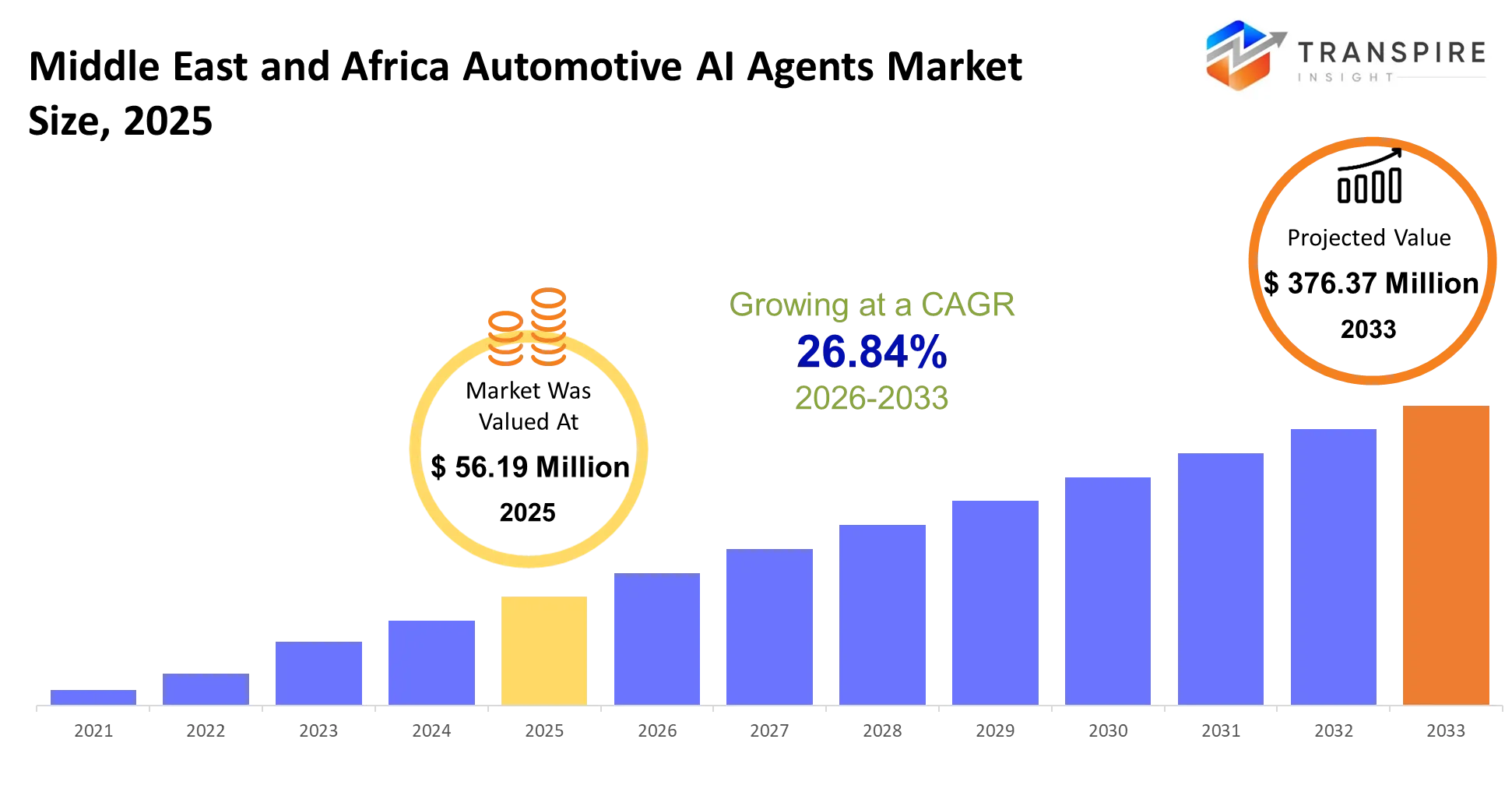
- Middle East and Africa Automotive AI Agents Market Size 2025: USD 56.19 Million
- Middle East and Africa Automotive AI Agents Market Size 2033: USD 376.37 Million
- Middle East and Africa Automotive AI Agents Market CAGR: 26.84%
- Middle East and Africa Automotive AI Agents Market Segments: By Type (Software Agents, Voice AI Agents, Predictive AI Agents, Autonomous Agents, Others); By Application (Autonomous Driving, Driver Assistance, Infotainment, Fleet Management, Predictive Maintenance, Navigation Systems, Others); By End-User (Automotive OEMs, Fleet Operators, Mobility Providers, Tech Companies, Automotive Suppliers, Others); By Deployment (Cloud, Edge, Hybrid, Others)
To learn more about this report,  Download Free Sample Report
Middle East and Africa Automotive AI Agents Market Summary
The Middle East and Africa Automotive AI Agents Market was valued atUSD 56.19 Million in 2025. It is forecast to reach USD 376.37 Million by 2033. That is a CAGR of 26.84% over the period.
The Middle East and Africa Automotive AI Agents Market is basically about rolling out intelligent software systems that can automate vehicle choices, improve how fleet vehicles move around, and handle live operational information across mobility logistics and smart transport networks. In real life, it tends to cut down the usual manual fleet coordination by using AI based routing, predictive servicing, and autonomous dispatch in both city commuting and long distance haulage workflows.
Over the last 3-5 years, things changed in a pretty structural way, moving from hardware led vehicle setups toward software-defined, cloud linked mobility platforms. That shift really picked up speed after Gulf governments brought in national autonomous mobility roadmaps, which, in turn, accelerated AI uptake inside public transport and ride hailing fleets. One of the biggest reasons was the post pandemic logistics disruption, it made clear where manual fleet management was shaky, and it pushed organizations to lean on AI optimization to steady delivery networks and also to limit downtime.
So nowadays, adoption seems to follow a kind of cause-and-effect loop where regulatory support, plus pressure on operating costs, directly shows up as quicker deployment of these AI agents. Fleet managers and OEMs are putting more money into scalable AI ecosystems , mostly because those ecosystems raise utilization efficiency, lower fuel consumption, and allow continuous performance observation across different and often fragmented regional transport infrastructures.
Key Market Insights
- Middle East dominates the Middle East and Africa Automotive AI Agents Market, at nearly 45 percent share in 2025, powered by sovereign funded autonomous mobility programs and a bit of the “we just build it” momentum.
- Africa stays the fastest growing region through 2033, backed by logistics digitization, and this expanding ride hailing fleet AI integration that seems to pop up everywhere.
- Software agents take the lead in product segmentation with over 40 percent share, because they deploy quickly into infotainment and fleet orchestration systems.
- Predictive AI agents end up as the fastest growing segment too, with adoption picking up in commercial fleets, mainly to cut down downtime and tune fuel optimization.
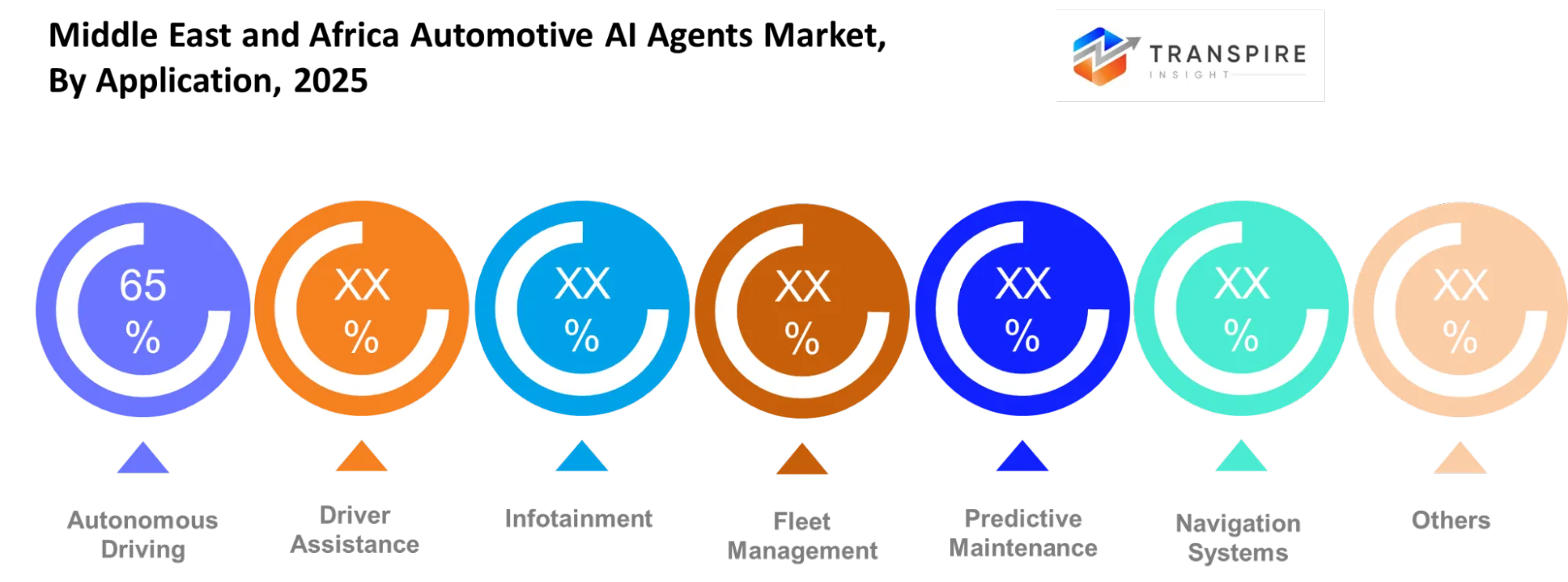
- Driver assistance applications keep the dominant share around 38 percent, supported by the regulatory push for advanced safety systems in urban mobility.
- Fleet management applications are showing the fastest growth, as logistics operators start using AI based routing and compliance automation tools more and more.
- Automotive OEMs dominate end user adoption, since their integrated AI platforms are embedded into next generation connected vehicles.
- Fleet operators are the fastest growing end user segment, mostly because e commerce delivery is scaling, and cross border transport demand keeps rising.
- Huawei is sort of integrating cloud–edge mobility platforms via telecom partnerships, while Bosch and Continental look more like they are doubling down on sensor fusion and ADAS integration.
- Honestly the competitive edge is getting less about a single feature, and more about ecosystem control, plus regional partnerships with governments, and moving fast with scalable software-defined vehicle architectures over those emerging mobility corridors.
What are the Key Drivers, Restraints, and Opportunities in the Middle East and Africa Automotive AI Agents Market?
Driver:
The strongest growth driver comes from state led smart mobility programs across Gulf countries, that kinda integrate autonomous transport into national infrastructure planning. Government backed pilots for robotaxis and connected fleet systems in the UAE and Saudi Arabia have reduced regulatory friction, and in turn created steady demand pipelines for AI enabled mobility platforms. This policy acceleration, sort of directly turns into revenue growth for technology vendors, since procurement moves from experimental pilots to contracted deployments inside urban transport networks.
Restraint:
The most persistent barrier is fragmented data infrastructure across parts of Africa, and also in some Middle Eastern transport systems where connectivity is inconsistent and sensor penetration stays limited. Because of that, AI model reliability drops, not just a little. This structural gap cannot be fixed overnight, it depends on long term investment in telecom networks, vehicle digitization, and standardized data protocols. So fleet operators end up delaying wide scale adoption and they limit AI usage to partial optimization functions, which in practice constrains revenue realization from advanced autonomous systems.
Opportunity:
A big emerging opportunity sits in cross border smart logistics corridors being developed between North Africa, and European trade routes—especially through Morocco and Egypt. These corridors are increasingly blending digital customs systems, EV compatible freight networks, and AI based fleet coordination platforms. If providers push early deployment of autonomous freight optimization and predictive routing in these areas, they can secure long term contracts, and help shape regional standards before full market maturity from 2026 up to 2033.
What Has the Impact of Artificial Intelligence Been on the Middle East and Africa Automotive AI Agents Market?
Artificial intelligence is getting woven into fleet operations and mobility systems all over the Middle East and Africa, where many operators use automated monitoring tools, to kind of keep an eye on vehicle health, compliance status, and dispatch work in one place. Logistics companies roll out AI-driven control systems to improve routing, observe driver conduct and automate the regulatory paperwork for cross border freight. In the city mobility arena, autonomous dispatch engines tweak vehicle allocation in real time, based on shifting demand plus road congestion, and it helps fleet utilization go up without the need for constant manual involvement.
Now machine learning models also help with predictive maintenance by pulling patterns from sensor feeds on engines, braking setups, and battery modules, to anticipate failures before they actually happen. Fleet teams then use those forecasts to cut down unplanned downtime and stretch asset life. At the same time, emissions monitoring systems estimate fuel burn plus regulatory exposure, as it’s happening, in real time. Some commercial transport operators claim directional gains, like 10 to 18 percent better fuel efficiency, and as much as a 25 percent reduction in maintenance downtime, after adopting AI-assisted optimization and scheduling systems.
Still though, there’s a big snag: adoption is held back by inconsistent data quality and a fragmented connectivity setup, especially along cross-border African transport corridors. When real-time telemetry coverage is thin, model performance drops in far-off areas, so operators end up leaning on partial datasets that weaken predictive reliability. That, unfortunately, slows the broader rollout of full scale autonomous fleet intelligence systems.
Key Market Trends
- Governments across Gulf countries, in kinda a stepped way, moved from exploratory pilots during 2023 toward more structured autonomous mobility corridors by 2026, and that kept speeding up commercial AI rollouts.
- In parallel OEMs went away from hardware-first thinking, more and more , toward software defined vehicle setups sometime between 2024 and 2026, which basically lets them push constant AI enhancements without waiting for a full rework.
- Fleet operators also leaned in. They started with cost-saving routing instruments back in 2022, then by 2026 they were using predictive multi-agent optimization systems for logistics tasks, not just single layer planning.
- Voice AI changed too. It moved beyond single-language infotainment helpers into multilingual in vehicle agents, covering Arabic, English, and French across different regional markets, so the experience feels less rigid and more… adaptable.
- Edge computing adoption jumped especially after 2024, because the autonomous pilots needed real time decisions, even inside dense city transport settings where latency can become a big issue.
- Regulators in the UAE and Saudi Arabia also adjusted. They shifted from tight testing rules, to controlled commercial approvals that enabled robotaxi trials by 2025.
- Predictive maintenance followed a similar upgrade path. Instead of reactive diagnostics in 2022, commercial fleets by 2026 were embedding AI driven failure prevention models that try to stop breakdowns before they happen.
- Meanwhile technology vendors got more competitive after 2025, but not by selling lone products only. They formed ecosystem partnerships, kind of like coalitions, around mobility platforms.
- And on the African side, logistics companies grew their AI usage too, from route optimization toward cross-border fleet coordination systems that run alongside digital trade corridors, which makes the whole movement chain more synchronized.
Middle East and Africa Automotive AI Agents Market Segmentation
By Type
Software agents have the biggest slice, mostly because they were integrated early in infotainment, navigation , and fleet management setups across connected cars. Automotive OEMs and mobility providers seem to like software-first architectures a lot because they lessen hardware dependency and make it easier to push faster over the air updates. Voice AI agents keep growing too, especially as multilingual support becomes a kind of differentiator across Gulf and African cities . Meanwhile predictive AI agents are getting more traction in logistics heavy fleets where cost optimization is basically the daily goal. Autonomous agents are still more limited, yet they pull pilot investments in controlled smart city zones, sort of like test beds.
Software agents can keep expanding through cloud native platforms that support continuous feature rollouts and smoother ecosystem integration with mapping and telematics providers. Voice AI adoption is rising because regional language localization improves in vehicle user experience and also tends to meet regulatory acceptance faster in public mobility services. Predictive and autonomous agents also benefit from ongoing advances in edge computing and sensor fusion, particularly where there are high density urban corridors. Product developers should really prioritize modular architectures so they can do hybrid deployment across connected and semi autonomous vehicle systems without too much friction.
By Application
Driver assistance and infotainment applications lead the pack, mainly due to broad uptake of advanced safety systems and connected cockpit solutions inside new vehicle fleets. Fleet management holds a strong ground as well, largely because logistics operators and ride hailing platforms are trying to optimize costs and utilization. Autonomous driving applications are still mostly found in pilot programs, while predictive maintenance keeps getting a steadier adoption rate in commercial fleets that face higher operational downtime risks.
Fleet management is growing faster than most other applications, mostly because e-commerce demand keeps climbing and also because cross-border transport activity in Africa and along Gulf trade routes becomes more intense. At the same time, infotainment systems are getting serious momentum, driven by consumer preference for more individualized in-car digital services, you know that kind of thing. Predictive maintenance keeps expanding too, since AI-based diagnostics are cutting down the chances of breakdowns, especially for long-haul freight and public transport networks. Autonomous driving applications still feel policy-sensitive, but they still pull in substantial strategic investment from technology companies and state-backed mobility programs, even when rules are not always clear.
To learn more about this report, Download Free Sample Report
By End-User
Automotive OEMs dominate adoption, largely because they can directly embed AI systems into the vehicle platforms, and also because they are more aligned with new safety and connectivity standards that are emerging. Fleet operators are the next largest group, because everyday operational efficiency pressures push them to deploy AI quickly across logistics and mobility services. Mobility providers along with technology firms act like innovation accelerators, while suppliers help with implementation through hardware-software co-development arrangements, somewhat tightly connected.
Fleet operators show the quickest growth, especially as ride-hailing and logistics ecosystems scale across dense urban areas and across trade corridors. OEMs keep strategic control through platform-based vehicle architectures that essentially bind customers to software ecosystems. Tech companies expand their influence by offering cloud-based AI stacks and forming autonomous driving collaborations with regional governments. Suppliers, meanwhile, increase their value through embedded sensor systems and domain-specific computing modules that are tuned for severe environmental conditions, like heat dust and constant vibration.
By Deployment
Cloud deployment is taking over because centralized data processing really matters for fleet analytics, mapping, and ai model training. Edge deployment keeps growing fast too, especially in autonomous, and driver-assistance setups where low latency decision making is needed,like right now. Hybrid models are starting to show up more often in advanced fleet and mobility projects, where you want on-the-spot processing while centralized learning and optimization are still happening in the background.
Edge deployment speeds things up because autonomous pilots and connected vehicle systems must respond immediately in city streets, and on highways too, in practice. Cloud systems stay important for big scale fleet coordination , plus predictive analytics across widely spread operations. Hybrid architecture is gaining weight as operators juggle regulatory constraints, data sovereignty worries , and raw performance targets. Technology providers are also building more flexible deployment stacks that handle regional infrastructure differences and phased autonomy rollouts in the same general approach.
What are the Key Use Cases Driving the Middle East and Africa Automotive AI Agents Market?
Autonomous fleet operations for ride-hailing and city mobility kind of become the main core use case, specially in Gulf smart city programs where governments are deploying robotaxi pilots quite actively and then rolling out AI dispatch systems that do the work. The demand stays strong, because they lessen labor dependency, but also because they improve route efficiency as well as safety in those tightly regulated urban corridors, where everything is watched.
Fleet optimization for logistics and commercial transport is moving fast too, mainly across e-commerce delivery operators and long-haul trucking companies. AI agents are getting used more often for predictive routing, fuel optimization, and real-time load balancing. This is particularly noticeable in South Africa and Kenya, since cost pressures are high, and you really feel it. Also, connected in-vehicle assistants are gaining momentum in premium OEM segments, where infotainment is paired with driver monitoring systems, in a kind of integrated setup.
Newer use cases show up as cross-border autonomous freight corridors in North Africa and AI-based vehicle diagnostics aimed at predictive maintenance, especially within mixed commercial fleets. These efforts are being tested alongside early-stage smart port integration projects, where AI agents coordinate vehicle flow with logistics infrastructure, and manage the signaling too. So overall, it looks like broader ecosystem convergence is in motion during the forecast period, even if it’s not fully uniform yet.
|
Report Metrics |
Details |
|
Market size value in 2025 |
USD 56.19 Million |
|
Market size value in 2026 |
USD 71.27 Million |
|
Revenue forecast in 2033 |
USD 376.37 Million |
|
Growth rate |
CAGR of 26.84% from 2026 to 2033 |
|
Base year |
2025 |
|
Historical data |
2021 - 2024 |
|
Forecast period |
2026 - 2033 |
|
Report coverage |
Revenue forecast, competitive landscape, growth factors, and trends |
|
Regional scope |
Middle East and Africa (Saudi Arabia, United Arab Emirates, South Africa, Rest of Middle East and Africa) |
|
Key company profiled |
Tesla, NVIDIA, Intel, Qualcomm, Bosch, Continental, Denso, Aptiv, Valeo, Microsoft, Google, Amazon, Baidu, Huawei, Mobileye |
|
Customization scope |
Free report customization (country, regional & segment scope). Avail customized purchase options to meet your exact research needs. |
|
Report Segmentation |
By Type (Software Agents, Voice AI Agents, Predictive AI Agents, Autonomous Agents, Others); By Application (Autonomous Driving, Driver Assistance, Infotainment, Fleet Management, Predictive Maintenance, Navigation Systems, Others); By End-User (Automotive OEMs, Fleet Operators, Mobility Providers, Tech Companies, Automotive Suppliers, Others); By Deployment (Cloud, Edge, Hybrid, Others) |
Which Regions are Driving the Middle East and Africa Automotive AI Agents Market Growth?
The Middle East, especially the Gulf Cooperation Council states, kind of leads the automotive AI agents market because there is aggressive sovereign funding towards smart mobility and autonomous transport backbone. In the UAE and Saudi Arabia , governments are not just talking—they are actively weaving AI into national mobility roadmaps , and they back big pilot rollouts for autonomous taxis plus “intelligent fleet” setups. With solid digital infrastructure , high levels of vehicle digitization and a more centralized regulatory hand, approval cycles for AI enabled automotive systems tend to move faster. All this ends up forming a closely linked ecosystem where public money, tech suppliers, and mobility operators sort of push each other ahead in expansion.
Africa, though, is more scattered, but still it stays structurally steady as a contributor. The momentum comes from gradual city growth and pragmatic vehicle fleet upgrades in places like South Africa and Kenya. Rather than the Gulf’s top-down rollout logic, African demand grows through private sector uptake in logistics , ride-hailing, and commercial transport fleets. Regulation doesn’t always shift as quickly, but somehow that slower pace creates a kind of baseline certainty for fleet operators long-term, those who focus on cost efficiency and step-by-step AI integration rather than going all the way to full autonomy. So in practice, Africa works as a reliable demand pool for scalable driver-assist tools and fleet optimization solutions.
North Africa is showing up as the quickest growth subregion. That’s because new smart transport corridors are being built and foreign investment keeps increasing in automotive assembly and broader mobility infrastructure, mainly in Morocco and Egypt. New industrial policies that encourage EV production, along with connected vehicle ecosystems, have also sped up AI adoption within transport planning and logistics networks.With improved port connectivity and a better trade alignment toward Europe it kind of amplifies tech inflows and those fleet modernization cycles more and more. For investors, and for newcomers in the market, this area looks like a signal of high upside potential especially for companies that can localize AI systems and sync up with export- focused automotive value chains across 2026 through 2033, more or less.
Who are the Key Players in the Middle East and Africa Automotive AI Agents Market and How Do They Compete?
The Middle East and Africa automotive AI agents market stays pretty fragmented, like not really coalescing. It is influenced by global OEM platform decisions and state driven smart mobility programs across the Gulf , plus a few carefully chosen urban pilots in parts of Africa. The real competition seems to revolve around who gets the AI compute in the first place, who owns the autonomous driving software stacks, and how smoothly everything plugs into government mobility programs. Meanwhile, older players tend to lean on ecosystem control, and newer players often push pilot deployments—robotaxis, in vehicle assistants and similar stuff—so they can grab data early and also improve their odds with regulatory access.
NVIDIA is driving a technology led race using an integrated AI compute platform approach that strings together GPUs, simulation tooling, and autonomous driving software. This shows up in regional research hubs a lot. The advantage is basically end to end stack control, which speeds up fleet training and makes iteration quicker. Qualcomm competes from the angle of scalable and cost efficient automotive chipsets, plus digital cockpit systems , and it tends to embed Snapdragon platforms into OEM partnerships. Those partnerships are often tied to Gulf smart mobility rollouts and connected vehicle deployments, so the momentum feels tied to infrastructure timing too.
Mobileye focuses more on vision based driver assistance, relying on high precision mapping and safety validation, to satisfy regulatory expectations as autonomy grows in emerging markets. Huawei builds a vertically integrated ecosystem that links in vehicle software with cloud AI services, and it leans on telecom partnerships across the Middle East. Those connections help enable connected vehicle pilots and the integration of smart mobility infrastructure, even when requirements move quickly.
Company List
- Tesla
- NVIDIA
- Intel
- Qualcomm
- Bosch
- Continental
- Denso
- Aptiv
- Valeo
- Microsoft
- Amazon
- Baidu
- Huawei
- Mobileye
Recent Development News
“In September 2025, Nvidia and Abu Dhabi’s Technology Innovation Institute (TII) launched a joint AI and robotics research lab. The collaboration established the first Nvidia AI Technology Center in the Middle East, advancing autonomous systems and robotics R&D that directly supports AI-driven mobility and automotive intelligence development in the region.https://www.reuters.com
“In January 2026, Nvidia and multiple automotive suppliers expanded partnerships to accelerate autonomous driving development, including ecosystem-level collaboration supporting deployment-ready AI driving systems. The initiative strengthens the automotive AI agent stack through hardware-software integration used by global OEMs with deployment relevance in emerging markets including the Middle East and Africa.https://auto.economictimes.indiatimes.com
What Strategic Insights Define the Future of the Middle East and Africa Automotive AI Agents Market?
Over the next 5–7 years, the Middle East and Africa Automotive AI Agents Market is expected to move from rough pilot deployments into infrastructure-led scaling, mainly because of sovereign-backed smart mobility programs in the Gulf, plus a few more selective urban modernization efforts in Africa. The main thing pushing this change is the convergence of AI compute localization and state-funded autonomous mobility corridors , which in turn lowers the dependence on old OEM roadmap plans. There’s also a quieter risk, the regulatory kind of asymmetry across the region, where fast adoption in Gulf countries may run into slower policy harmonization across broader African markets , and then you end up with fragmented deployment economics.
At the same time, there’s a new chance in climate-adaptive automotive AI agents, specifically tuned for extreme heat, dust, and mixed urban road conditions, plus Arabic-first in-vehicle interfaces. Companies in this space should focus on partnerships with sovereign wealth funds and deploy localized pilot fleets, so they can lock in early data advantage and improve regulatory alignment early on.
Middle East and Africa Automotive AI Agents Market Report Segmentation
By Type
- Software Agents
- Voice AI Agents
- Predictive AI Agents
- Autonomous Agents
- Others
By Application
- Autonomous Driving
- Driver Assistance
- Infotainment
- Fleet Management
- Predictive Maintenance
- Navigation Systems
- Others
By End-User
- Automotive OEMs
- Fleet Operators
- Mobility Providers
- Tech Companies
- Automotive Suppliers
- Others
By Deployment
- Cloud
- Edge
- Hybrid
- Others
Frequently Asked Questions
Find quick answers to common questions.
The estimated Middle East and Africa Automotive AI Agents Market size is USD 376.37 Million in 2033.
Key segments for the Middle East and Africa Automotive AI Agents Market are By Type (Software Agents, Voice AI Agents, Predictive AI Agents, Autonomous Agents, Others); By Application (Autonomous Driving, Driver Assistance, Infotainment, Fleet Management, Predictive Maintenance, Navigation Systems, Others); By End-User (Automotive OEMs, Fleet Operators, Mobility Providers, Tech Companies, Automotive Suppliers, Others); By Deployment (Cloud, Edge, Hybrid, Others).
Major Middle East and Africa Automotive AI Agents Market players are Tesla, NVIDIA, Intel, Qualcomm, Bosch, Continental, Denso, Aptiv, Valeo, Microsoft, Google, Amazon, Baidu, Huawei, Mobileye.
The Middle East and Africa Automotive AI Agents Market size is USD 56.19 Million in 2025.
The Middle East and Africa Automotive AI Agents Market CAGR is 26.84% from 2026 to 2033.
- Tesla
- NVIDIA
- Intel
- Qualcomm
- Bosch
- Continental
- Denso
- Aptiv
- Valeo
- Microsoft
- Amazon
- Baidu
- Huawei
- Mobileye
Recently Published Reports
-
Apr 2026
3D Optical Profiler Market
3D Optical Profiler Market Size, Share & Analysis Report By Type (Desktop 3D Optical Profiler, and Portable 3D Optical Profiler), By Technology (Confocal Technology, and White Light Interference), By End-Use Industry (Manufacturing, Research Institutions, Automotive, Aerospace and Defense, Medical Devices, and Other), and Geography (North America, Europe, Asia-Pacific, Middle East and Africa, South and Central America), 2021 - 2031
-
Apr 2026
Depth Sensor Market
Depth Sensor Market Size, Share & Analysis Report By Type (Infrared Depth Sensors, Time-of-Flight (ToF) Sensors, Stereo Vision Sensors, Structured Light Sensors, Ultrasonic Depth Sensors), By Application (Automotive, Robotics, Gaming, Consumer Electronics, Industrial Automation, Healthcare, Security & Surveillance, Others), By End Users (Automotive Manufacturers, Consumer Electronics Companies, Healthcare Providers, Industrial Companies, Security Agencies, Gaming Companies, Robotics Companies, Others), and Geography (North America, Europe, Asia-Pacific, Middle East and Africa, South and Central America), 2021 – 2031
-
Apr 2026
Digital Manufacturing Market
Digital Manufacturing Market Size, Share & Analysis Report By Component (Hardware, Software, and Services), By Technology (Robotics, 3D Printing, Internet of Things (IoT), and Others), By Application (Automotive and Transportation, Aerospace and Defense, Consumer Electronics, Industrial Machinery, and Others), By Process Type (Computer-Based Designing, Computer-Based Simulation, Computer 3D Visualization, Analytics, and Others), and Geography (North America, Europe, Asia-Pacific, Middle East and Africa, South and Central America), 2021 – 2031
-
Apr 2026
Digital Visa Services Market
Digital Visa Services Market Size, Share & Analysis Report By Type (Individual Travelers, Group Travelers), By Application (Tourism, Business Travel, Others), and Geography (North America, Europe, Asia-Pacific, Middle East and Africa, South and Central America), 2021 – 2031