

South Korea Malt Extracts & Ingredients Market Size & Forecast:
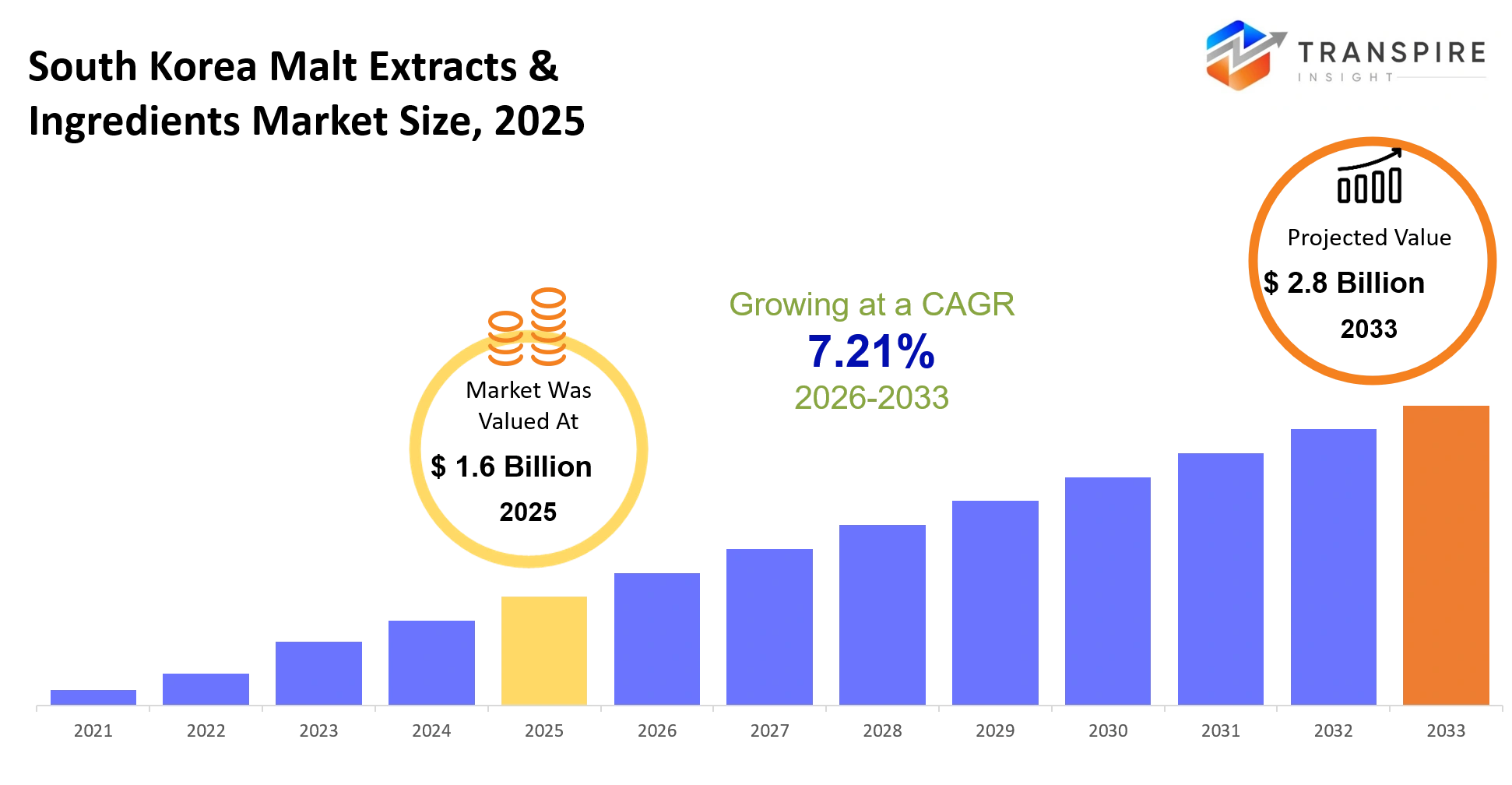
- South Korea Malt Extracts & Ingredients Market Size 2025: USD 1.6 Billion
- South Korea Malt Extracts & Ingredients Market Size 2033: USD 2.8 Billion
- South Korea Malt Extracts & Ingredients Market CAGR: 7.21%
- South Korea Malt Extracts & Ingredients Market Segments: By Product Type (Dry Malt Extract, Liquid Malt Extract, Specialty Malt, Roasted Malt, Base Malt, Organic Malt, Brewing Ingredients, Others); By Application (Beer Production, Distilling, Bakery, Confectionery, Functional Foods, Beverages, Animal Feed, Others); By Source (Barley, Wheat, Rye, Oats, Sorghum, Mixed Grains, Organic Grains, Others); By End User (Breweries, Food Manufacturers, Distilleries, Bakeries, Nutraceutical Firms, Feed Producers, Retail Brands, Others)
South Korea Malt Extracts & Ingredients Market Summary
The South Korea Malt Extracts & Ingredients Market was valued at USD 1.6 Billion in 2025. It is forecast to reach USD 2.8 Billion by 2033. That is a CAGR of 7.21% over the period.
The South Korea Malt Extracts & Ingredients Market plays a practical role far beyond just brewing. Malt extracts and specialty malt ingredients give flavor, color, texture and even some natural sweetness, which food manufacturers use as a way to set apart bakery products, drinks, confectionery, and nutritional foods. In day to day production, they assist producers in building more premium formulations while also lowering reliance on artificial additives, so it becomes pretty important in a market where ingredient transparency is, well, shaping buying choices more and more. Over the past few years, there has been a real structural shift toward clean-label and functional food uses, which basically stretches malt usage beyond the old idea of alcoholic beverages only. At the same time, supply chain problems after the Russia-Ukraine conflict changed global barley routes, and in that process highlighted raw material weak spots. Because of that, South Korean manufacturers started diversifying their sourcing, and putting money into higher value malt formulations. That effort supports revenue growth through premiumization, product innovation , and broader adoption across a wider set of food and beverage categories.
Key Market Insights
- Seoul metropolitan region, pretty much runs the South Korea Malt Extracts & Ingredients Market in 2025 with more than 45% share, mostly because the food processing capacity is kinda concentrated in that area.
- The southern industrial clusters are showing up as the fastest growing region through 2032, and honestly it seems to happen as beverage makers expand their specialty ingredient sourcing , plus they build wider production networks.
- For products, malt extracts still stay in front, about 55% market share in 2025, mostly tied to how extensively they get used in beverages and also bakery formulations, you know.
- Specialty malt ingredients sit as the second largest segment, since more food manufacturers are adopting premium flavor and color enhancement solutions, step by step.
- When it comes to growth, organic and functional malt ingredients are expected to be the quickest moving segment through 2032, supported by clean label food innovation , and health driven formulations that keep gaining attention.
- On the application side, beverage use leads with roughly 48% share, because craft beer, malt drinks, and premium beverages keep diversifying their product lineups.
- Nutritional foods and dietary supplements look like the fastest-growing application slice, as protein enriched ingredients and naturally sourced options are picking up momentum commercially.
- For end users, food manufacturers remain the main group with over 50% market share, while nutraceutical companies are the ones expanding the quickest, which is kinda notable.
- Key players—Malteurop, Viking Malt, Muntons, Briess Malt & Ingredients, Simpsons Malt, and Boortmalt—are pushing product innovation, doing strategic partnerships, and leaning into regional expansion.
- Since 2022, competition feels higher too, producers are investing in specialty malts, traceable sourcing, and advanced processing technologies, trying to lock in long-term market share before others do.
What are the Key Drivers, Restraints, and Opportunities in the South Korea Malt Extracts & Ingredients Market?
The main force, pushing the South Korea Malt Extracts & Ingredients Market, is basically the move toward premium-ish and clean label food formulations. Food and drink manufacturers are leaning more and more on malt based ingredients because they bring that natural sweetness, real flavor, and color, without needing so much artificial additives. After 2020 this trend picked up quite a bit, since big Korean food companies expanded their premium bakery, ready to drink beverage, and nutritional product lines. What follows is that specialty malt ingredients often get sold at higher average prices and they show up across more food categories, so suppliers can keep driving revenue growth in a more steady way.
At the same time, raw material dependence is still the biggest structural obstacle. In South Korea, most malting barley is imported, so manufacturers get stuck with real exposure to bad weather events , trade limitations, and commodity price swings. And fixing this is not fast, because barley farming inside the country is still relatively limited , plus building new supply channels takes years of investment. When input costs keep moving, margins get squeezed, procurement decisions get delayed, and revenue growth gets held back, across nearly the whole value chain.
Functional nutrition feels like it has the clearest long- term opportunity. Malt extracts, loaded with natural nutrients and bioactive compounds are starting to show up more often in sports nutrition, fortified beverages, and also in older adult nutrition products. There’s also the whole idea of investing in personalized nourishment and functional foods, which gives ingredient suppliers room to craft more differentiated formulations…especially when South Korea’s aging population keeps pushing demand for nutrient-dense food products.
What Has the Impact of Artificial Intelligence Been on the South Korea Malt Extracts & Ingredients Market?
Artificial intelligence, plus more advanced digital technologies, are slowly changing the South Korea Malt Extracts & Ingredients Market, in a way that feels almost invisible at first, by boosting manufacturing efficiency and ingredient consistency. Malt producers are increasingly rolling out AI-enabled sensors and industrial analytics systems, to watch temperature, moisture levels, germination progress, and roasting parameters during the entire malting cycle. At the same time, automated control setups fine tune operating conditions in real time, so batch differences drop, and product quality tends to come out more steady.
There’s also machine learning helping with predictive maintenance, especially around milling and processing gear. By reading vibration signatures, tracking energy consumption, and comparing equipment performance signals, makers can spot likely problems before they actually cause production stops. This supports stronger uptime, lowers maintenance spending, and helps in tuning energy use which matters a lot since electricity and utility costs are still high.
On top of that, digital twins and sharper analytics let manufacturers estimate production yields more accurately and steer raw material utilization in a more prudent direction. Still, AI take-up has a noticeable snag. Integration expenses are high, and historical production records, are often limited. Because of that, smaller and medium-sized processors struggle to deploy advanced AI systems across their full operations, so the broader industry digital shift moves a bit slower.
Key Market Trends
- Since 2021, food manufacturers started moving away from commodity malt products toward more specialty ingredients that kind of bring unique flavor color plus nutritional properties, it’s like a shift that really stuck.
- After 2020, clean label product launches rose in a steady way, so naturally derived malt extracts got used much more often across bakery and beverage cases.
- In 2022, supply chain disruptions messed with how barley was sourced , and that pushed manufacturers to diversify procurement across several exporting countries, not just one or two.
- More beverage producers are leaning on specialty malts to set apart premium drinks, so they’re drifting away from the standardized formulations that were common before 2020.
- Functional nutrition applications really took off after 2021, since older demographics encouraged investment in nutrient rich and fortified food products, kind of a direct response.
- Manufacturers also invest more and more in traceability technologies, to back ingredient quality, sustainability credentials, and supply chain transparency , all at once.
- Since 2023 product innovation cycles feel shorter now, because suppliers bring in organic, enzyme active, and tailored malt ingredient portfolios, almost like updates rather than long waits.
- Competition has gotten sharper too, as global companies broaden regional partnerships and local distribution networks to strengthen their footprint in South Korea.
- And digital manufacturing technologies are gradually replacing manual quality monitoring , which improves consistency and cuts production losses across processing facilities.
South Korea Malt Extracts & Ingredients Market Segmentation
By Product Type:
Dry Malt Extract gets made in powdered form and people really like it because it has a longer shelf life, plus its easier storage. Liquid Malt Extract tends to be picked when there is need for quick mixing , and it can bring a richer flavor. Specialty Malt contributes a sort of distinct taste , aroma and color to food and beverage products, kind of like a finishing note.
Roasted Malt is processed at higher temperatures so the flavors become deeper , and the shades turn darker. Base Malt works as the main ingredient in many malt based formulations because it has strong enzyme activity. Organic Malt comes from organically grown grains, and it pulls in manufacturers who want natural ingredient options, rather than the usual route.
Brewing Ingredients and Others covers enzymes, flavor enhancers, plus supporting materials used across food and beverage processing. Product diversity lets manufacturers make customized formulations that match changing consumer preferences and the industrial needs of the moment.
By Application:
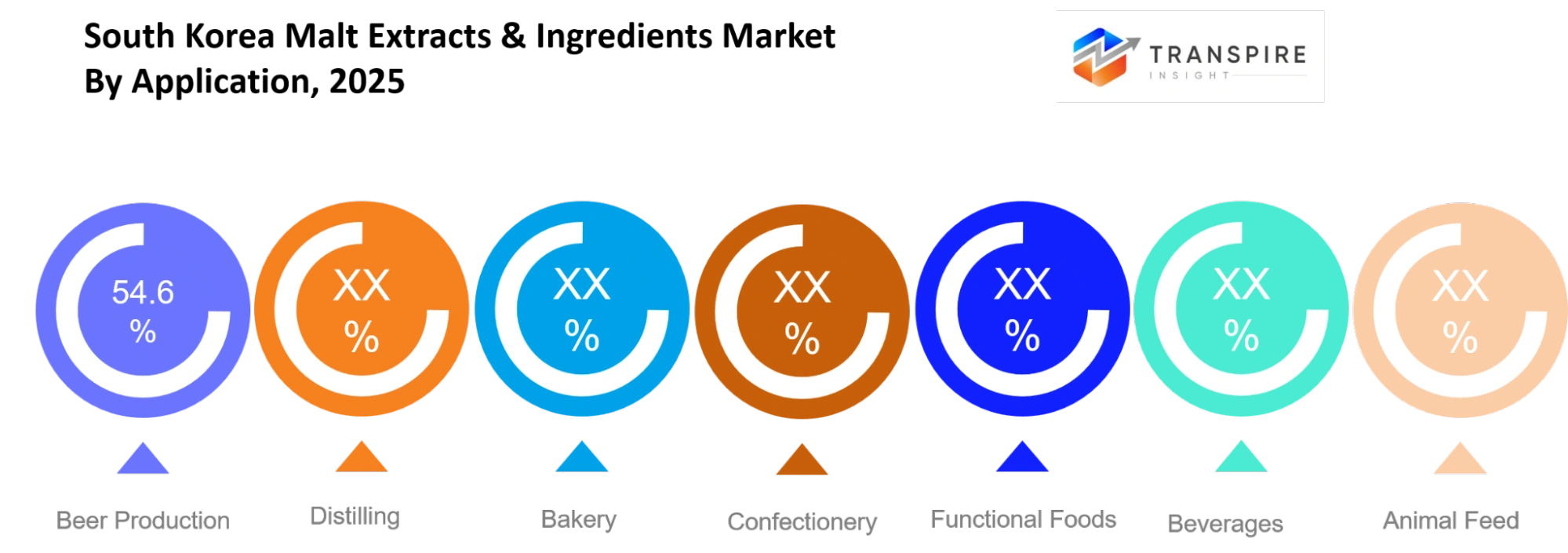
Beer Production still stays one of the major application areas, because malt ingredients supply fermentable sugars, flavor, and the needed color, for brewing. Distilling also leans on malt for alcohol creation and for holding product consistency steady. In bakery use, malt extracts help with texture building, crust color, and the general sweetness profile in baked goods.
In confectionery, manufacturers add malt components into chocolates, candies, and sweet snacks, to sharpen taste and shape distinctive flavors that feel more “crafted” than usual. Functional Foods and Beverages are using malt more and more, mainly due to nutritional value plus a natural ingredient positioning story.
Animal Feed and other categories cover cases where malt by-products offer nutritional benefits and also improve overall feed quality. Overall, expanding use across different industries continues to open wider commercial chances for ingredient suppliers.
By Source:
Barley is sort of leading the way because of very high enzyme activity and a well-balanced flavor profile, it is used a lot. Wheat meanwhile is widely used to create lighter textures and more mild tastes in food and beverage products. Rye brings a more distinctive flavor character, so it gets picked for specialty formulations too, even when people want something a bit unusual.
Oats give nutritional benefits and help support the development of health oriented products. Sorghum is picking up momentum as a gluten-free alternative, it serves consumers who have dietary restrictions, and that matters. Mixed Grains combine various cereals, to build customized flavors plus functional characteristics.
Organic Grains and Others are more niche but still expanding categories that match natural ingredient trends. Using diverse grain sources helps manufacturers reduce supply risks and also introduce innovative malt-based products across different end-use industries, which is helpful overall.
By End User:
Breweries fall among the biggest users , since malt extracts and other ingredients stay essential to keep brewing operations running well and to protect product quality. Food Manufacturers rely on malt across bakery goods, confectionery items, snack categories and even some beverages, because it helps lift flavor and texture, but also supports ongoing product innovation, not just the basics.
Distilleries as well as Bakeries keep increasing their malt usage , especially when premium products get more common with consumers. Nutraceutical Firms are doing the same thing , driven by the growing pull toward natural and nutrient-dense inputs, which can back health oriented product design.
Feed Producers , Retail Brands , and a few others also turn to malt ingredients to broaden what they sell and to react to shifting customer tastes. This wide mix of end users keeps steady business possibilities alive and it nudges continuous product development across the whole value chain.
What are the Key Use Cases Driving the South Korea Malt Extracts & Ingredients Market?
Beer production still feels like the main reason the South Korea Malt Extracts & Ingredients Market is moving. Breweries basically lean on malt extracts, and even those specialty malts, so they can keep flavor, color, and fermentable sugars pretty stable. Lately , with more premium beer launches and the whole craft brewing trend, demand looks even stronger. Manufacturers are trying to stand out, so they push for better quality formulations, and that obviously helps.
And then, beyond brewing, bakery and functional food use cases are growing. Food companies use malt ingredients for texture, a sort of natural sweetness, and better shelf life, especially in breads, cereals, and also snack items. At the same time nutraceutical firms are dropping malt-based ingredients into fortified drinks, plus nutrition products… all aimed at consumers who are more health minded.
Something newer is also appearing, like plant-based foods and clean-label confectionery. Companies are exploring malt ingredients as natural taste enhancers, and sometimes as sugar alternatives too, which could help keep those ingredient lists simpler. Right now this is still kind of in an early stage , but it’s expected to pick up speed as product invention accelerates during the forecast period.
|
Report Metrics |
Details |
|
Market size value in 2025 |
USD 1.6 Billion |
|
Market size value in 2026 |
USD 1.72 Billion |
|
Revenue forecast in 2033 |
USD 2.8 Billion |
|
Growth rate |
CAGR of 7.21% from 2026 to 2033 |
|
Base year |
2025 |
|
Historical data |
2021 - 2024 |
|
Forecast period |
2026 - 2033 |
|
Report coverage |
Revenue forecast, competitive landscape, growth factors, and trends |
|
Country scope |
South Korea |
|
Key company profiled |
Muntons, Briess, Simpsons Malt, Viking Malt, GrainCorp, Boortmalt, Malteurop, Cargill, ADM, Soufflet, Axereal, CJ CheilJedang, Lotte Foods, Daesang, Ottogi |
|
Customization scope |
Free report customization (country, regional & segment scope). Avail customized purchase options to meet your exact research needs. |
|
Report Segmentation |
By Product Type (Dry Malt Extract, Liquid Malt Extract, Specialty Malt, Roasted Malt, Base Malt, Organic Malt, Brewing Ingredients, Others); By Application (Beer Production, Distilling, Bakery, Confectionery, Functional Foods, Beverages, Animal Feed, Others); By Source (Barley, Wheat, Rye, Oats, Sorghum, Mixed Grains, Organic Grains, Others); By End User (Breweries, Food Manufacturers, Distilleries, Bakeries, Nutraceutical Firms, Feed Producers, Retail Brands, Others) |
Which Regions are Driving the South Korea Malt Extracts & Ingredients Market Growth?
The Seoul Metropolitan Area still seems to be the dominant part in the South Korea Malt Extracts & Ingredients Market because it manages to bring together a huge consumer base , and at the same time the country’s most capable food and beverage manufacturing network. Most notable bakery brands, beverage firms, and nutrition product manufacturers run their production lines through Seoul, Incheon, and Gyeonggi Province. On top of that, advanced logistics systems , plus a pretty solid import setup, makes it easier for companies to lock in barley and specialized malt supplies without too much friction. So, this all-in-one environment kind of keeps product development moving and also lets the region keep its stronger position in market revenue.
Then there’s the southeastern region, with Busan and Ulsan inside it , which works as the second most important market. It feels different from the capital area mainly due to its export driven industrial structure. The demand is mostly pulled by beverage processing, food manufacturing, and ingredient distribution businesses that like being near large ports and industrial clusters. With economic steadiness , and consistent spending on processing facilities, the region offers a dependable stage for longer term business growth. Businesses here often lean on supply chain efficiency and local collaboration , rather than aiming to outplay others just by bigger scale.
The central and southwestern regions are expected to see the fastest growth through 2033, as food manufacturers kinda diversify where they produce and put money into premium product categories. The expansion of functional foods , health supplements, and specialty beverages has opened up real chances for malt ingredient suppliers. On top of that, regional governments have encouraged food processing investments via industrial development programs and infrastructure upgrades. This momentum will likely generate interesting opportunities for new entrants and investors looking for exposure to emerging consumer trends plus an expanding manufacturing capacity.
Who are the Key Players in the South Korea Malt Extracts & Ingredients Market and How Do They Compete?
In the South Korea Malt Extracts & Ingredients Market, competition feels kinda moderately consolidated, not totally, global malt producers are in the mix with regional ingredient suppliers, plus a few specialized processors also. What really tips the scale is product quality and specialty formulations, supply reliability and technical support.Those things shape competitive positioning more strongly than price by itself. A lot of established companies keep defending market share via innovation. Meanwhile smaller participants kind of lean into niche products, plus customized ingredient solutions for food manufacturers, so it’s not all one-size-fits-all.
Muntons competes by leaning on product diversification and customized malt formulations for bakery, beverage, and nutrition uses. It differentiates with clean-label ingredients and flexible production capabilities, which makes it easier to respond quickly when customer requirements shift, or just change, sometimes midstream. Malteurop tends to stress supply chain strength and big, large-scale malting operations. This helps keep quality steady and also supports secure raw material sourcing across international markets.
Viking Malt emphasizes specialty and organic malt products that fit premium food and beverage categories. Briess Malt & Ingredients pushes ahead through innovation in flavor profiles and application specific ingredients, so customers can build differentiated products with distinct taste and texture characteristics. Together, these approaches help companies stay tight with customers and also capture opportunities in higher value segments of the market.
Company List
- Muntons
- Briess
- Simpsons Malt
- Viking Malt
- GrainCorp
- Boortmalt
- Malteurop
- Cargill
- ADM
- Soufflet
- Axereal
- CJ CheilJedang
- Lotte Foods
- Daesang
- Ottogi
Recent Development News
In April 2026, Malteurop highlighted the commercial rollout of Malta Mexico 2-Row Base Malt produced at its Meoqui malting facility. The product expansion strengthens Malteurop's specialty malt portfolio available to international food and beverage manufacturers, including customers across Asia. Sourcehttps://www.malteuropmaltingco.com/
In September 2025, Boortmalt showcased new malt solutions and customer-focused innovations at Drinktec 2025. The initiative reinforced the company's commitment to expanding technical support and specialty malt offerings for brewing, distilling, and food industry customers across international markets. Sourcehttps://www.boortmalt.com/
What Strategic Insights Define the Future of the South Korea Malt Extracts & Ingredients Market?
The South Korea Malt Extracts & Ingredients Market is, kinda, moving toward a value-driven model where specialty ingredients, functional nutrition, and clean-label formulations will take a bigger chunk of revenue than conventional malt products. This shift seems to be propelled by shifting food consumption patterns, premium product placement, and the ongoing need for natural ingredients that bring both taste and nutritional upside. Firms that put more effort into application-specific malt solutions will likely stay stronger, because the competitive focus is going from pure volume toward product differentiation.
There’s also a less obvious risk, maybe hidden in plain sight, which is raw material concentration. If manufacturers lean heavily on imported barley, they’re exposed to climate-related crop disruptions and trade uncertainties, and that could lead to supply swings even when the end-market demand is still solid. In turn, that kind of uncertainty can reduce pricing flexibility and quietly squeeze profit margins over time.
At the same time, an emerging opportunity shows up in personalized nutrition and healthy aging products. Since South Korea is expanding investments in functional foods and precision nutrition, market players should form collaborations with nutraceutical companies and build tailored formulations, mapped to specific health and wellness goals.
South Korea Malt Extracts & Ingredients Market Report Segmentation
By Product Type
- Dry Malt Extract
- Liquid Malt Extract
- Specialty Malt
- Roasted Malt
- Base Malt
- Organic Malt
- Brewing Ingredients
By Application
- Beer Production
- Distilling
- Bakery
- Confectionery
- Functional Foods
- Beverages
- Animal Feed
By Source
- Barley
- Wheat
- Rye
- Oats
- Sorghum
- Mixed Grains
- Organic Grains
By End User
- Breweries
- Food Manufacturers
- Distilleries
- Bakeries
- Nutraceutical Firms
- Feed Producers
- Retail Brands
Frequently Asked Questions
Find quick answers to common questions.
The South Korea Malt Extracts & Ingredients Market size is USD 2.8 Billion in 2033.
Key segments for the South Korea Malt Extracts & Ingredients Market are By Product Type (Dry Malt Extract, Liquid Malt Extract, Specialty Malt, Roasted Malt, Base Malt, Organic Malt, Brewing Ingredients, Others); By Application (Beer Production, Distilling, Bakery, Confectionery, Functional Foods, Beverages, Animal Feed, Others); By Source (Barley, Wheat, Rye, Oats, Sorghum, Mixed Grains, Organic Grains, Others); By End User (Breweries, Food Manufacturers, Distilleries, Bakeries, Nutraceutical Firms, Feed Producers, Retail Brands, Others).
Major South Korea Malt Extracts & Ingredients Market players are Muntons, Briess, Simpsons Malt, Viking Malt, GrainCorp, Boortmalt, Malteurop, Cargill, ADM, Soufflet, Axereal, CJ CheilJedang, Lotte Foods, Daesang, Ottogi.
The South Korea Malt Extracts & Ingredients Market size is USD 1.6 Billion in 2025.
The South Korea Malt Extracts & Ingredients Market CAGR is 7.21% from 2026 to 2033.
- Muntons
- Briess
- Simpsons Malt
- Viking Malt
- GrainCorp
- Boortmalt
- Malteurop
- Cargill
- ADM
- Soufflet
- Axereal
- CJ CheilJedang
- Lotte Foods
- Daesang
- Ottogi
About the Authors

Chetan Dhatrak
I’m Chetan Dhatrak, a Senior Research Analyst at Transpire Insight, specializing in the Consumer Goods, Foods and Beverages industry. I focus on analyzing market trends, consumer behavior, competitive landscapes, and industry developments to deliver accurate, data-driven insights. My research at Transpire Insight is built on credible sources and in-depth analysis, helping businesses and readers better understand market dynamics, emerging opportunities, and evolving consumer preferences. I’m committed to creating reliable, well-researched content that supports informed decision-making and reflects the latest developments in the consumer goods and food & beverage sectors.

Chakradhar Khansole
Chakradhar serves as the Research Director at Transpire Insight, bringing over 8 years of experience in technology, innovation, and strategic market intelligence. He specializes in transforming complex market data into actionable business insights that enable organizations to make informed, growth-oriented decisions. Recognized for his strategic vision and analytical expertise, Chakradhar leads high-impact research initiatives, delivering comprehensive market assessments, competitive intelligence, and forward-looking industry analysis.
Recently Published Reports
-
Apr 2026
Baby Infant Formula Market
Baby Infant Formula Market Size, Share & Analysis Report By ype (Infant Milk, Follow On Milk, Specialty Baby Milk, Growing-Up Milk), By Ingredient (Carbohydrate, Fat, Protein, Minerals, Vitamins, and Others), By Product Form (Powder, Liquid, and Ready-to-feed), By Distribution Channels (Supermarket/Hypermarket, Specialty Store, Pharmacies, Online Retail, and Others), and Geography (North America, Europe, Asia-Pacific, Middle East and Africa, South and Central America), 2021 - 2031
-
Apr 2026
Edible Insects for Animal Feed Market
Edible Insects for Animal Feed Market Size, Share & Analysis Report By Type (Insect Powder, Insect Meal, Insect Bar, Insect Paste, Insect Oil, and Others), By Insect Type (Beetles, Cricket, Caterpillar, Hymenoptera, Orthoptera, Tree Bugs, and Others), By Application (Livestock, Pet Food, and Aquaculture), By Livestock Type (Poultry, Swine, and Others), and Geography (North America, Europe, Asia-Pacific, Middle East and Africa, South and Central America), 2021 - 2031
-
Apr 2026
Food Industry Disinfection and Bacterial Control Market
Food Industry Disinfection and Bacterial Control Market Size, Share & Analysis Report By Type (Chemical Disinfectants, Physical Disinfectants, and Biocides and Antimicrobials), By Application (Food Processing Equipment Surface Disinfection, Food Preparation Areas Surface Disinfection, Storage Areas Surface Disinfection, Anti-microbial Coatings Food Preservation, and Preservative Solutions Food Preservation), By End User (Meat and Poultry Processing, Dairy Processing, Seafood Processing, Bakery and Confectionery, Restaurants and Commercial Kitchens, and Food Service Providers), By Sales Channel (Online, Offline), and Geography (North America, Europe, Asia-Pacific, Middle East and Africa, South and Central America), 2021 - 2031
-
May 2026
Freeze Dried Food Market
Freeze Dried Food Market Size, Share & Analysis Report By Product Type (Fruits, Vegetables, Freeze-Dried Dairy Products, Freeze-Dried Meat and Seafood, Freeze-Dried Pet Food, and Prepared Meal), By Nature (Organic, and Conventional), By Form (Powdered, Granules, and Diced), By End Use (Breakfast Cereals, Dairy Products, Bakery & Confectionery, Nutritional Bars & Supplements, Powdered Beverages, Snacks, and Retail (Household)), and Geography (North America, Europe, Asia-Pacific, Middle East and Africa, South and Central America), 2021 - 2031