

France Malted Milk Market Size & Forecast:
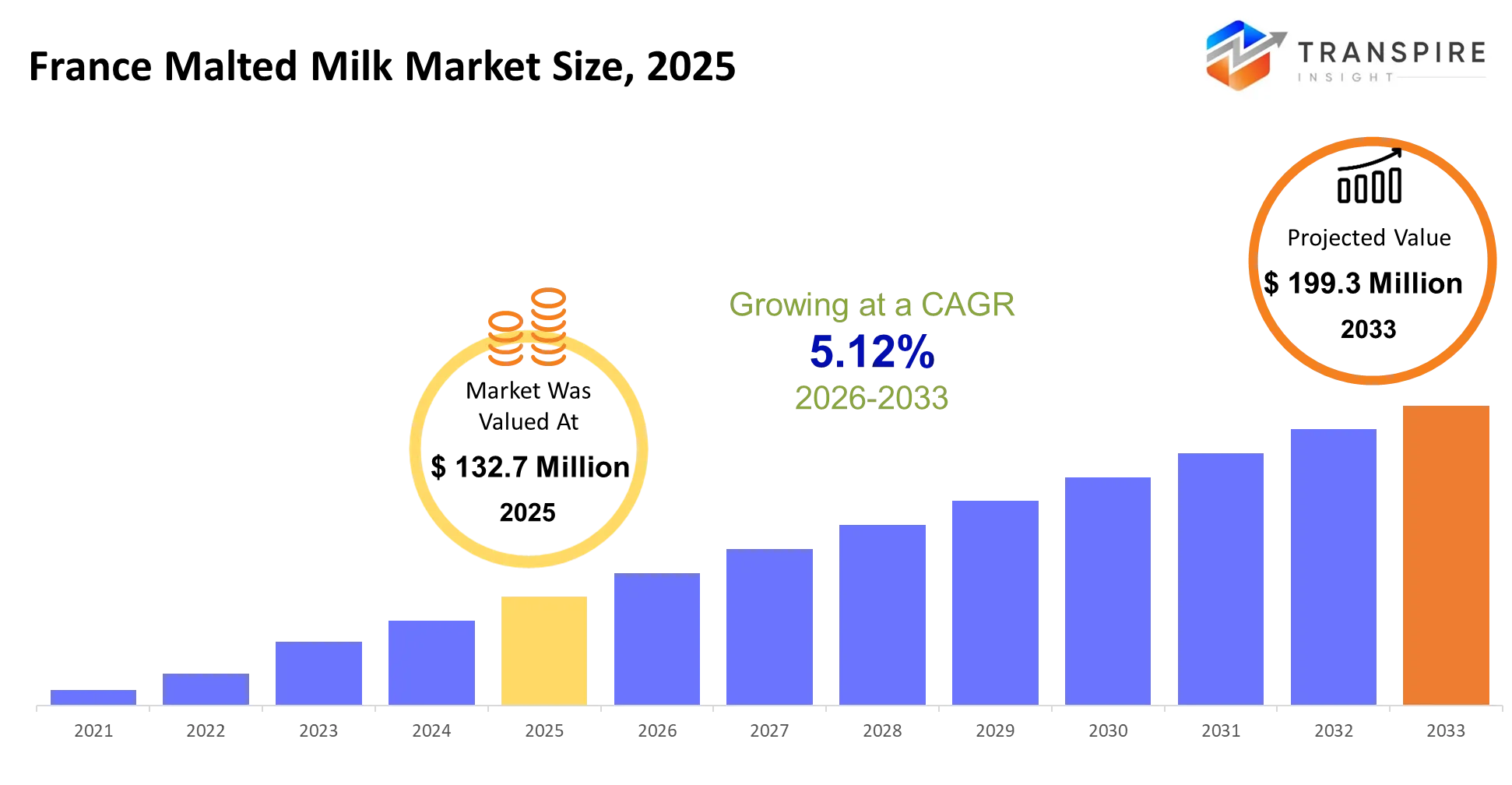
- France Malted Milk Market Size 2025: USD 132.7 Million
- France Malted Milk Market Size 2033: USD 199.3 Million
- France Malted Milk Market CAGR: 5.12%
- France Malted Milk Market Segments: By Type (Plain, Flavored, Others); By Application (Beverages, Bakery, Confectionery, Others); By End-User (Consumers, Food Industry, Cafes, Others); By Distribution (Retail, Online, Supermarkets, Others)
To learn more about this report,  Download Free Sample Report
France Malted Milk Market Summary
The France Malted Milk Market was valued at USD 132.7 Million in 2025. It is forecast to reach USD 199.3 Million by 2033. That is a CAGR of 5.12% over the period.
In France, the malted milk market plays a kind of practical role in the country’s food and beverage ecosystem, because it keeps feeding nutrient-rich ingredients into breakfast drinks, bakery bases, sports nutrition items, infant foods, and those convenience beverages that people grab quickly. Malted milk helps with mouthfeel, flavor stability, and energy density, so it ends up being pretty useful for manufacturers aiming at functional nutrition and that more premium kind of dairy consumption. Over the last five years, though, the market kind of moved away from the older pattern of just drinking flavored milk and more toward protein-enriched and low-sugar options, matching how French dietary preferences keep evolving.
This shift really took off after the COVID-19 period, since retail buying patterns got disrupted and a lot of consumers started leaning into shelf-stable nutritional products and immunity-leaning drinks. Then, food processors responded by tweaking recipes, using fortified malt extracts and cleaner ingredient profiles. And as a consequence, brands expanded their higher-end lines and put more effort into localized sourcing, so they could cut back on import dependency. These adjustments helped manufacturers keep stronger pricing power , improve retail coverage, and open up new revenue streams across health-focused dairy and convenience food categories.
Key Market Insights
- Northern France made up about 34% of France Malted Milk Market revenue in 2025, mostly because the dairy processing infrastructure there is pretty concentrated plus the retail distribution networks are already in place.
- Western France is expected to become the fastest-growing regional cluster by 2033 , mainly driven by more organic dairy production capacity coming online.
- Conventional malted milk products still led the pack at roughly 58% market share in 2025 , backed by long standing household consumption and pricing that stays competitive enough for most shoppers.
- At the same time, organic and clean-label malted milk formulations are basically the quickest moving segment , since premium grocery retailers are pushing deeper into health oriented dairy portfolios.
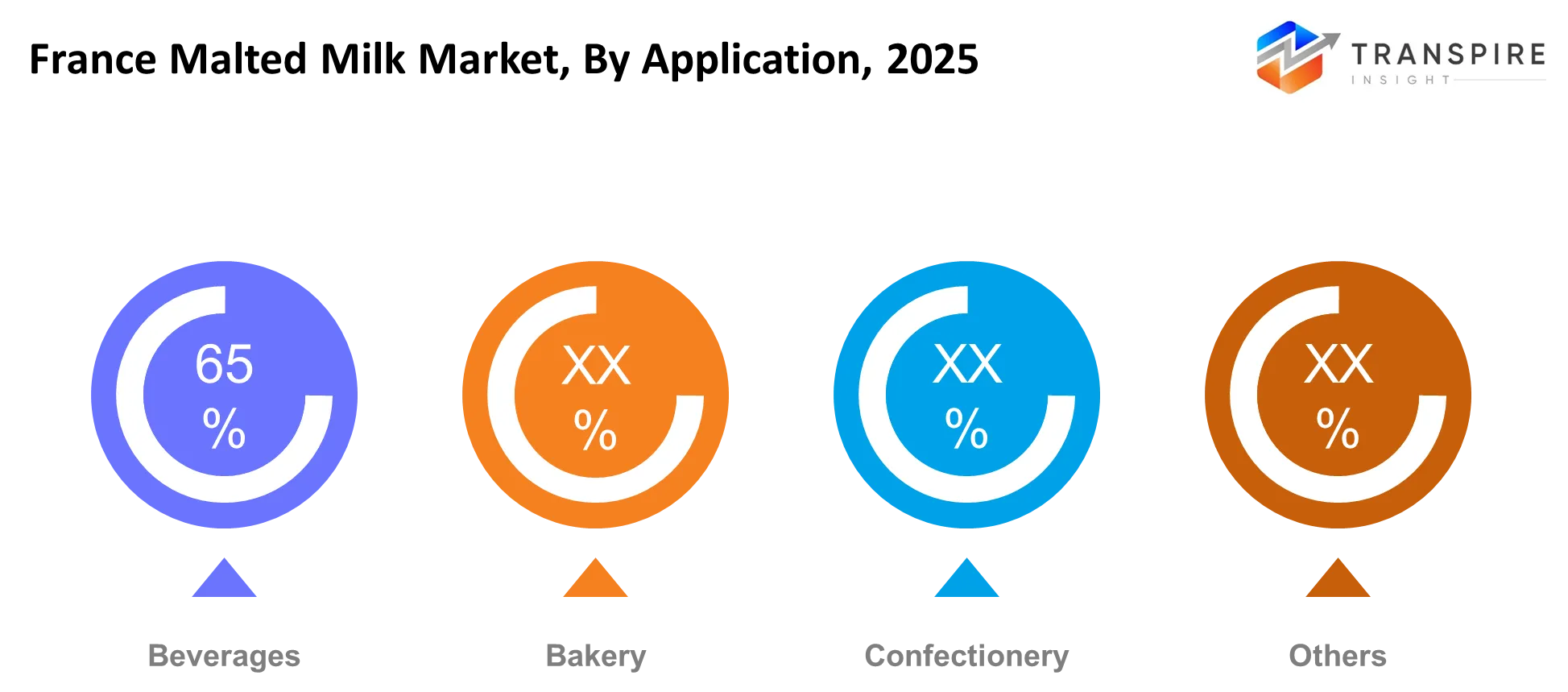
- When it comes to where it’s used, beverage applications held more than 46% share of market demand in 2025, largely due to ongoing demand for flavored dairy drinks.
- Nutritional supplements and sports recovery beverages were the strongest expanders after 2022 too, because active lifestyle consumption patterns got more intense during that period.
- For end users , household retail consumers stayed on top , contributing close to half of the total industry size through supermarkets and hypermarkets.
- Foodservice and café chains also started speeding up procurement of flavored malt ingredients after 2023, especially for premium milkshakes, bakery beverages and dessert style applications.
- Meanwhile manufacturers seem to be carving out competitive advantage via sugar-reduction technologies, functional ingredient partnerships, localized sourcing approaches, and digital retail expansion across France.
What are the Key Drivers, Restraints, and Opportunities in the France Malted Milk Market?
The main driver pushing the France malted milk market forward is the pretty fast reformulation of dairy and drink products, toward high protein , fortified, but also lower sugar nutrition formats. In France, food regulators and big retail chains keep adding more pressure on manufacturers, to raise the nutritional labeling standard, since the Nutri-Score framework got more commercial weight. Because of that, beverage and dairy producers have had to rework the classic malt based drinks, adding functional components like whey protein, vitamins, and mineral blends. The upshot is that we’re seeing new higher value product launches, better supermarket shelf visibility, and improved margins especially within the premium malted milk categories.
Still, the biggest holdback is volatility in raw material pricing, mainly barley malt, milk solids, and energy hungry dairy processing inputs. This is kind of structural since French dairy production remains under cost pressure due to energy inflation, agricultural compliance requirements, and climate related disruptions that mess with grain harvest timing. Manufacturers can’t always pass these costs to consumers completely, without hurting volume sales, and that situation ends up limiting market spread in the more price sensitive retail areas.
Meanwhile, one major opportunity is coming into view around functional nutrition, and also healthy aging needs. France’s senior population keeps growing, so demand rises for easy to digest, nutrient dense beverages enriched with protein and micronutrients. Many companies are now investing more in ready to drink malted dairy beverages made for elder nourishment, clinical recovery support, and active aging routines. This space tends to bring higher margins, and it also opens doors for pharma-food partnerships, in specialized nutrition channels.
What Has the Impact of Artificial Intelligence Been on the France Malted Milk Market?
Artificial intelligence and advanced digital technologies are kind of reshaping operations across the France malted milk market, mostly by pushing production efficiency higher, keeping quality more consistent, and improving supply chain forecasting, too. Dairy processors and ingredient manufacturers are more and more using AI-driven analytics for optimizing blending ratios, tracking fermentation stability, and trimming ingredient waste during these big production cycles. Machine learning systems, if you look closely, study past demand behavior, retail consumption signals, and seasonal buying habits, so inventory planning gets better and the risk of overproduction gets lower.
At the same time, manufacturers are rolling out predictive maintenance tools across dairy processing equipment and malt extraction facilities. These AI models watch temperature swings, machinery vibration, and moisture levels to spot odd operational patterns before an actual breakdown happens. In practice, this has boosted plant uptime and also lowered unplanned maintenance costs, especially in energy-heavy processing sites. And some teams are testing advanced digital twins, to imitate production scenarios and fine tune energy use during drying , and pasteurization stages, which can be tricky.
Operationally, these tools help producers improve batch uniformity, cut down production delays, and better meet strict French food safety requirements. Still, AI adoption is not fully smooth because integration can be expensive, and the data landscape is often fragmented among mid-sized dairy processors. Many smaller manufacturers don’t have standardized digital infrastructure, so deploying real-time analytics becomes slower and sometimes less reliable in day to day production settings, even when the intent is there.
Key Market Trends
- Since 2021, French dairy brands have started to move a bit away from sugar-heavy flavored drinks toward protein-enriched malt beverages aimed at folks with an active lifestyle, you know how it is.
- Retailers then gave more shelf space to organic malted milk products , mainly after private-label wellness drinks got better traction in supermarkets during 2023.
- Manufacturers also tried to lower their dependence on imported malt ingredients by leaning more into procurement partnerships with domestic barley producers across western France.
- At the same time, foodservice chains rolled out premium malt-based café beverages and dessert drinks , because “experiential” dairy consumption picked up among urban consumers.
- Companies like Nestlé and Danone pushed clean-label reformulations too, using lower-sugar dairy processing technologies after 2022, and it kind of snowballed from there.
- Meanwhile, digital retail channels boosted product visibility as French consumers shifted more grocery shopping toward e-commerce platforms, sometimes even replacing the usual trip.
- Sports nutrition companies went further and integrated malted milk ingredients into recovery beverages and meal replacement products, targeting younger fitness-focused demographics.
- Dairy processors, for their part, invested in AI-enabled production monitoring systems, to keep batch consistency steadier and reduce energy consumption at manufacturing facilities.
- Premium ready-to-drink nutritional beverages gained momentum in elderly nutrition and clinical recovery contexts, helped by pharmacy distribution partnerships.
- In general competitive behavior shifted toward functional ingredient collaborations and specialized nutrition portfolios rather than conventional mass-market flavored milk offerings, it’s a clear direction change.
France Malted Milk Market Segmentation
By Type
Plain malted milk kind of keeps the lead market position, mainly because the usual dairy consumption patterns in France keep things steady , so households stay buying simple nutritional beverage products. Both food manufacturers and consumers tend to like plain formulations since they’re kind of handy for a lot of uses, like breakfast drinks , plus bakery applications, or even for nutritional supplement mixing. Production is also a bit easier— less operational fuss, and it matches well with fortified ingredient add-ons, so overall commercial results stay pretty stable inside this segment. It’s also used a lot in institutional nutrition settings and in family-oriented dairy routines, which kinda locks in longer term volume stability.
Flavored malted milk is still picking up momentum, especially with younger consumers who prefer indulged and ready to drink nutrition beverages, but with better, more “rewarding” taste. Chocolate, vanilla, caramel and coffee-based styles bring stronger shelf presence and also allow premium pricing, think supermarkets and café chains. At the same time product developers are pushing reduced-sugar, and protein-fortified flavored formulations to fit what urban consumers are asking for right now. There are also other niche variants, like organic, lactose-free, and plant-integrated malt beverages, and those are expected to open selective growth chances for premium dairy processors, along with functional nutrition brands, throughout the forecast window.
By Application
Beverages are seen as the leading application segment, mainly because malted milk stays widely used in flavored dairy drinks, breakfast cups and also in sports recovery mixtures across France. There’s strong retail presence, and the appetite for easy-to-use nutritional items keeps climbing, so repeat buying goes on in both household and commercial places. On top of that, ready-to-drink beverage launches and café based premium dairy options have boosted revenue inside this segment too. Functional beverage producers are now more and more mixing in fortified components, plus low-sugar versions, to get clearer differentiation and a more premium stance.
Bakery applications keep a meaningful market share, because malted milk brings better texture, richer flavor nuance and also improved moisture holding in cakes, biscuits and dessert items. Food processors keep leaning on malt-based dairy ingredients, to support dependable product quality and longer shelf life stability in packaged baked goods. Confectionery applications are moving forward steadily, since chocolate makers and dessert brands are folding malted milk into more upscale snack recipes, kind of aiming at younger consumers. Other industrial food uses, like clinical nutrition products and meal replacement formulations , are expected to back longer term innovation, giving ingredient suppliers and specialized food manufacturers more room to develop new offerings.
To learn more about this report, Download Free Sample Report
By End-User
Consumers kind of dominate the end-user segment, mainly because household buying counts for most of the malted milk consumption you see across supermarkets, retail shops, and those digital grocery platforms in France. You can also tell that breakfast routines , especially the nutritional ones, plus the push for easy drinking dairy beverages keeps creating repeat purchase behaviors , mostly among families and people in bigger cities. On top of that, the premium flavored stuff, plus fortified nutritional products, ends up lifting the typical spending levels inside the consumer group. There’s also a rising curiosity around protein-heavy beverages and reduced-sugar options, and that should keep strengthening retail oriented demand during the forecast window.
Meanwhile the food industry still holds a big market share, because dairy processors, bakery manufacturers, and confectionery brands depend on malted milk as a functional ingredient for large scale production. The industrial side stays consistent , so procurement stays stable with long term supply links between ingredient suppliers. Cafés are growing steadily too, since premium milkshakes, dessert drinks and flavored dairy beverages are getting more attention in urban hospitality settings. Other end users, like healthcare nutrition providers and institutional catering operators are also likely to bring new demand for fortified and clinically focused malt based drink ideas.
By Distribution
Retail channels hold the dominant market position, more or less, because supermarkets, convenience stores, and grocery retailers stay the main places where malted milk products get purchased in France. People still like going to physical retail locations for comparing packs, getting promotional pricing access, and having the product right away across the dairy beverage lineup. Since the retail distribution routes are already pretty established, manufacturers get better visibility and wider brand penetration nationwide. Ongoing spending on premium shelf positioning and in-store nutritional messaging also keeps the commercial results steady inside these traditional channels.
Online distribution is growing fast though, helped by digital grocery platforms and direct-to-consumer nutrition brands that make premium, specialized malted milk products easier to reach. Subscription style delivery models and more specific digital promotions are helping keep customers, especially within health-focused beverage groups. Supermarkets are also pushing harder on private-label malt beverage ranges while expanding premium nutritional dairy sections to catch higher-value consumer spending. Meanwhile, other routes like pharmacies, specialty nutrition shops and even café-linked retail setups should open selective chances for fortified and functional malt-based beverage products during the forecast period.
What are the Key Use Cases Driving the France Malted Milk Market?
In France the dominant use case in the malted milk market is still mostly those flavored nutritional drinks, moved through supermarkets, cafés, and regular household retail. Malted milk brings this mix of texture enhancement, higher energy density, and solid flavor stability , so it tends to work really well for ready-to-drink dairy beverages and breakfast nutrition items. This part creates the biggest demand because it fits with France’s already established dairy consumption culture and also the premium beverage positioning.
Alongside that, other applications are kind of pushing outward into bakery, confectionery, and sports nutrition industries. For example, bakery makers are using malted milk ingredients to add more flavor depth and a softer mouthfeel in biscuits, cakes , and dessert fillings. At the same time sports nutrition brands are adding malted milk into protein recovery beverages and meal replacement formulations aimed at active consumers.
Some newer use cases are showing up too, like senior nutrition products and clinical dietary beverages, where the point is recovery support and muscle maintenance. There are also pharmaceutical-food collaborations, plus specialized nutrition startups, testing fortified malt based formulations for older customers , which could open more durable opportunities in preventive healthcare nutrition.
|
Report Metrics |
Details |
|
Market size value in 2025 |
USD 132.7 Million |
|
Market size value in 2026 |
USD 140.5 Million |
|
Revenue forecast in 2033 |
USD 199.3 Million |
|
Growth rate |
CAGR of5.12% from 2026 to 2033 |
|
Base year |
2025 |
|
Historical data |
2021 - 2024 |
|
Forecast period |
2026 - 2033 |
|
Report coverage |
Revenue forecast, competitive landscape, growth factors, and trends |
|
Regional scope |
France |
|
Key company profiled |
Nestle, GlaxoSmithKline, Mondelez, Danone, Abbott, Kraft Heinz, Unilever, Amul, Britannia, Marico, Cadbury, Hershey, FrieslandCampina, Arla, Lactalis |
|
Customization scope |
Free report customization (country, regional & segment scope). Avail customized purchase options to meet your exact research needs. |
|
Report Segmentation |
By Type (Plain, Flavored, Others); By Application (Beverages, Bakery, Confectionery, Others); By End-User (Consumers, Food Industry, Cafes, Others); By Distribution (Retail, Online, Supermarkets, Others) |
Which Regions are Driving the France Malted Milk Market Growth?
The northern region of France keeps on leading the France malted milk market, kind of because it stacks together big dairy infrastructure, more advanced food processing capacity, and pretty solid retail distribution channels. Areas like Hauts-de-France and Normandy host multiple major dairy manufacturing plants, run by companies including Danone, and Lactalis—so the whole region gets a real production scale advantage. On top of that, the northern side also leans on dense logistics connectivity to Belgium and Germany plus those export routes via key transport corridors. That helps with steadier ingredient sourcing, and also with getting finished products out without too much friction. And, long standing agricultural policies that support domestic barley cultivation together with dairy modernization really keep the ecosystem strong, which is why northern France can stay ahead.
Western France is basically the second most influential regional market, but the growth story here is not the same as that of more industrial clustering in the north. Brittany and Pays de la Loire tend to depend more on cooperative dairy structures, premium organic farming, and stable domestic consumption, instead of focusing as much on export oriented processing scale. The region has built a durable revenue engine with specialty dairy products, clean-label nutrition beverages, and malt ingredients sourced locally, which makes it attractive to premium retail customers. Also, continuous investment in sustainable farming and food traceability systems has helped western France stay commercially dependable even when raw material volatility shows up, or when energy costs start rising, pretty quickly.
Southern France is showing up as the fastest-growing regional market, because shifts in consumer routines are changing what people want in terms of beverages and nutrition. Urban hubs such as Lyon, Marseille, and Toulouse have seen faster adoption, but the sentence kind of stops here.
Who are the Key Players in the France Malted Milk Market and How Do They Compete?
Competition in the France malted milk market is still kinda moderately consolidated, with multinational dairy and nutrition companies grabbing a lot of the premium retail and even that functional beverage space. The older manufacturers don’t really fight only on price , they tend to compete with formulation know-how, nutritional framing, supply chain staying power, and getting better shelf presence. Bigger incumbents keep defending their share with fortified product launches and improvements that feel “new enough”, while smaller niche brands go after organic, low-sugar and plant-based nutrition audiences. Overall, the arena seems to reward firms that can blend nutritional science with localized sourcing plus quick commercialization, it’s not just one thing.
Nestlé stands out via a set of diversified nutritional beverage brands and solid research strength in fortified dairy products. The company keeps putting money into digitized manufacturing, and also regenerative agricultural sourcing programs in France, mainly to boost supply chain resilience and reinforce premium brand positioning. Danone competes through specialized nutrition offerings and medical-grade dairy beverages, backed by its established domestic production footprint and functional health branding. Its newer investments in medical nutrition production capacity reinforce its standing in high-margin clinical and elderly nutrition categories.
Mondelez International uses flavor innovation along with snack-linked expansion tactics to grow malt-based confectionery and beverage usage. Abbott Laboratories leans into clinical nutrition formulations, where malted dairy ingredients support recovery and therapeutic nutrition use cases. Lactalis keeps a competitive edge through vertically integrated dairy sourcing and regional production scale, which makes it easier to adapt quickly to changing French customer demand , however the “co” part at the end got cut off in the source text so I’m not sure how you want that finished.
Company List
- Nestlé
- GlaxoSmithKline
- Mondelez
- Danone
- Abbott
- Kraft Heinz
- Unilever
- Amul
- Britannia
- Marico
- Cadbury
- Hershey
- FrieslandCampina
- Arla
- Lactalis
Recent Development News
“In March 2026, Danone announced acquisition of Huel. The acquisition strengthens Danone’s position in functional nutrition and expands its ready-to-drink and complete meal portfolio across Europe. Source:http://www.danone.com
“In April 2026, Nestlé announced organizational restructuring and expanded digital transformation initiatives in France. The move aims to improve competitiveness, streamline R&D operations, and support future investment in nutrition-focused product categories. Source:http://www.nestle.fr/media
What Strategic Insights Define the Future of the France Malted Milk Market?
France’s malted milk market is drifting, slowly but surely, toward specialized nutrition, premium functional drinks,and more medically oriented dairy uses over the next five to seven years. You can see it happening because of demographic aging, tighter nutritional labeling rules,and the fact that protein enriched dairy mixes are getting commercialized at speed. Still there’s a sneaky risk underneath all that: a bigger reliance on dairy and barley supply chains that can swing around a lot. It’s especially true when climate variability kicks in, and when agricultural compliance costs start squeezing domestic ingredient production. So margin compression could get worse, if makers can’t lock in long-term sourcing stability or they simply can’t pass higher costs through in those premium pricing setups.
\At the same time, there’s an opportunity that feels more “next step” than just improvement. Think personalized nutrition, plus clinically targeted malt based beverages for elderly care, recovery nutrition,and people chasing an active lifestyle. Firms that plug in AI enabled formulation systems and also keep sourcing localized ingredients will probably move faster on development cycles, and also look stronger to retailers. Market players should really focus on strategic partnerships with healthcare nutrition providers and start investing early in high protein, low sugar ready to drink formats, so they can secure longer term competitive differentiation.
France Malted Milk Market Report Segmentation
By Type
- Plain
- Flavored
- Others
By Application
- Beverages
- Bakery
- Confectionery
- Others
By End-User
- Consumers
- Food Industry
- Cafes
- Others
By Distribution
- Retail
- Online
- Supermarkets
- Others
Frequently Asked Questions
Find quick answers to common questions.
The approximate France Malted Milk Market size for the market will be USD 199.3 Million in 2033.
Key segments for the France Malted Milk Market are By Type (Plain, Flavored, Others); By Application (Beverages, Bakery, Confectionery, Others); By End-User (Consumers, Food Industry, Cafes, Others); By Distribution (Retail, Online, Supermarkets, Others).
Major France Malted Milk Market players are Nestle, GlaxoSmithKline, Mondelez, Danone, Abbott, Kraft Heinz, Unilever, Amul, Britannia, Marico, Cadbury, Hershey, FrieslandCampina, Arla, Lactalis.
The France Malted Milk Market size is USD 132.7 Million in 2025.
The France Malted Milk Market CAGR is 5.12% from 2026 to 2033.
- Nestlé
- GlaxoSmithKline
- Mondelez
- Danone
- Abbott
- Kraft Heinz
- Unilever
- Amul
- Britannia
- Marico
- Cadbury
- Hershey
- FrieslandCampina
- Arla
- Lactalis
Recently Published Reports
-
Apr 2026
Baby Infant Formula Market
Baby Infant Formula Market Size, Share & Analysis Report By ype (Infant Milk, Follow On Milk, Specialty Baby Milk, Growing-Up Milk), By Ingredient (Carbohydrate, Fat, Protein, Minerals, Vitamins, and Others), By Product Form (Powder, Liquid, and Ready-to-feed), By Distribution Channels (Supermarket/Hypermarket, Specialty Store, Pharmacies, Online Retail, and Others), and Geography (North America, Europe, Asia-Pacific, Middle East and Africa, South and Central America), 2021 - 2031
-
Apr 2026
Edible Insects for Animal Feed Market
Edible Insects for Animal Feed Market Size, Share & Analysis Report By Type (Insect Powder, Insect Meal, Insect Bar, Insect Paste, Insect Oil, and Others), By Insect Type (Beetles, Cricket, Caterpillar, Hymenoptera, Orthoptera, Tree Bugs, and Others), By Application (Livestock, Pet Food, and Aquaculture), By Livestock Type (Poultry, Swine, and Others), and Geography (North America, Europe, Asia-Pacific, Middle East and Africa, South and Central America), 2021 - 2031
-
Apr 2026
Food Industry Disinfection and Bacterial Control Market
Food Industry Disinfection and Bacterial Control Market Size, Share & Analysis Report By Type (Chemical Disinfectants, Physical Disinfectants, and Biocides and Antimicrobials), By Application (Food Processing Equipment Surface Disinfection, Food Preparation Areas Surface Disinfection, Storage Areas Surface Disinfection, Anti-microbial Coatings Food Preservation, and Preservative Solutions Food Preservation), By End User (Meat and Poultry Processing, Dairy Processing, Seafood Processing, Bakery and Confectionery, Restaurants and Commercial Kitchens, and Food Service Providers), By Sales Channel (Online, Offline), and Geography (North America, Europe, Asia-Pacific, Middle East and Africa, South and Central America), 2021 - 2031
-
Apr 2026
Freeze Dried Food Market
Freeze Dried Food Market Size, Share & Analysis Report By Product Type (Fruits, Vegetables, Freeze-Dried Dairy Products, Freeze-Dried Meat and Seafood, Freeze-Dried Pet Food, and Prepared Meal), By Nature (Organic, and Conventional), By Form (Powdered, Granules, and Diced), By End Use (Breakfast Cereals, Dairy Products, Bakery & Confectionery, Nutritional Bars & Supplements, Powdered Beverages, Snacks, and Retail (Household)), and Geography (North America, Europe, Asia-Pacific, Middle East and Africa, South and Central America), 2021 - 2031